Computational Study for Workforce Scheduling and Routing Problems
J. Arturo Castillo-Salazar, Dario Landa-Silva and Rong Qu
Automated Scheduling, Optimisation and Planning (ASAP) Research Group
School of Computer Science, Jubilee Campus, The University of Nottingham, Wollaton Road, NG8 1BB, Nottingham, UK (psxjaca, dario.landasilva, rong.qu)@nottingham.ac.uk
Keywords: Workforce Scheduling and Routing, Mathematical Programming, Benchmark Datasets and Results
Abstract: We present a computational study on 112 instances of the Workforce Scheduling and Routing Problem (WSRP). This problem has applications in many service provider industries where employees visit customers to perform activities. Given their similarity, we adapt a mathematical programming model from the literature on vehicle routing problem with time windows (VRPTW) to conduct this computational study on the WSRP. We generate a set of WSRP instances from a well-known VRPTW data set. This work has three objectives. First, to investigate feasibility and optimality on a range of medium size WSRP instances with different dis-tribution of visiting locations and including teaming and connected activities constraints. Second, to compare the generated WSRP instances to their counterpart VRPTW instances with respect to their difficulty. Third, to determine the computation time required by a mathematical programming solver to find feasible solutions for the generated WSRP instances. It is observed that although the solver can achieve feasible solutions for some instances, the current solver capabilities are still limited. Another observation is the WSRP instances present an increased degree of difficulty because of the additional constraints. The key contribution of this paper is to present some test instances and corresponding benchmark study for the WSRP.
1
INTRODUCTION
A lot of research has been dedicated to the Vehicle Routing Problem with Time Windows (VRPTW). Research literature on workforce scheduling is also abundant. For these problems, benchmark instances and results have been published, which can be used to assess the performance of new proposed solu-tion methods. This is not the case for the com-bined problem of Workforce Scheduling and Rou-ting. To the best of our knowledge, there are no benchmark datasets that have been studied to the same extent as VRPTW and workforce scheduling inde-pendently. Our long term goal is to develop po-werful algorithms to tackle WSRP. This study re-presents our first step towards achieving that goal. Here, we take some well-known VRPTW instances (Solomon, 1987) and include additional data to trans-form them into WSRP instances. We then conduct computational experiments to assess the difficulty of these generated WSRP instances compared against the original VRPTW ones. We use a modern ma-thematical programming solver in our experiments al-lowing us to obtain an updated perspective of the ca-pability of such solution method to tackle the WSRP and establishing a base-line to compare future work.
We use the term Workforce Scheduling and Rou-ting Problem (WSRP) in reference to problems where employees travel across different locations to perform their work. WSRPs combine characteristics of the general employee scheduling problem (Glover and McMillan, 1986) and vehicle routing problem with time windows (VRPTW) (Solomon, 1987) to des-cribe the work of mobile employees in an organisa-tion. Some service provider-industries require em-ployees to visit customers at their premises to per-form specific activities. Examples of such service industries include healthcare, security, communica-tions, domestic cleaning, etc. Customers are located at different addresses and require service within a time window or other timing requirement. In most cases, travelling time is considered part of emplo-yees’ working time. As a result, reductions in travel time could mean more time to perform additional cus-tomers visits. Scheduling employees to meet these time windows on visits whilst reducing travel time is a difficult process for medium to large size scenarios. WSRP’s size is often given by the number of emplo-yees and the number of activities.
not fixed (minimising the number of vehicles is often the goal) and vehicles types are often the same. Ne-vertheless, research on scenarios with heterogeneous fleet of vehicles (Dondo and Cerd´a, 2007) and where the number of vehicles is limited (Chuin Lau et al., 2003) has also been reported. In WSRP scenarios, the number of employees is usually known in advance. An objective is often to balance the workload instead of reducing the number of workers. Workforce is he-terogeneous since every employee is different consi-dering their individual skills, training, attitudes, etc.
Castillo-Salazar et al. (2012) describe WSRP’s main characteristics. Time window refers to the pe-riod by which the service should start. Start and end locationindicate if employees start/end their work at home, central building, etc.Service timerefers to ac-tivities’ duration at customer premises. Skillsreflect the potential diversity of abilities in the workforce.
Transportation modespecifies if it is possible to use more than one medium of transportation between the visiting locations, i.e. walking, car, public transport,
etc. Connected activitieshandle all time dependant
relations between two or more activities, for example synchronisation and precedence. Teamingconsiders activities needing a team of employees. Clustering, refers to forming groups of visits based on geographi-cal location usually to reduce the size of the problem.
Given the similarity between WSRP and VRPTW, researchers have successfully utilized VRPTW mod-els and solution techniques to obtain feasible solu-tions for WSRP-like scenarios. For example, home healthcare (Cheng and Rich, 1998; An et al., 2012; Nickel et al., 2012), patrolling of security officers (Misir et al., 2011; Chuin Lau and Gunawan, 2012), engineers/technicians on field (G¨unther and Nis-sen, 2012). These previous works cover: time win-dows, start/end location, skills, service time and trans-portation mode. Other characteristics such as con-nected activities, teaming and clustering have been researched to a lesser extent in the WSRP literature. There are some exceptions, for example, connected activities have been considered by Rasmussen et al. (2012), while teaming has been considered in Li et al. (2005) and Dohn et al. (2009).
Connected activities and Teaming are important features of WSRP because they allow the modelling of scenarios with linked activities. Depending on the service sector, this could be for example, conducting a 2nd visit within a day to administer an additional medication dose to the patient, or bringing two spe-cialist technicians at the same time to install and cal-ibrate equipment, etc. These constraints already exist in the VRPTW literature (Toth and Vigo, 1987; Tail-lard et al., 1996; Bredstr¨om and R¨onnqvist, 2008).
Bredstr¨om and R¨onnqvist (2008) apply their ma-thematical model of VRPTW with temporal pre-cedence and synchronisation constraints to tackle home healthcare and forest operations, which are ex-amples of WSRP scenarios. In their experiments, the majority of instances have 20 visits only and all visits are uniformly distributed in a square area, hence with no apparent clusters of visits. As part of our study we adapt 112 VRPTW instances, 56 of them contain 25 visits and the remaining 56 contain 50 visits. Ad-ditionally, clusters of visits are present in half of the instances. This brings us closer to having problem instances reflecting real-world WSRP scenarios.
Our study has three objectives. The first objective is to use Bredstr¨om and R¨onnqvist (2008) VRPTW model to tackle medium size WSRP instances (in-cluding 20 or more visits). The second objective is to assess the difficulty of the adapted problem instances as a result of adding connected activities and team-ing constraints. We aim to test by experimentation whether WSRP is a more difficult problem to solve than traditional VRPTW for a mathematical program-ming solver. The third objective is to establish the computational time that a mathematical solver needs to find feasible solutions, if such solutions exist, for our adapted data set. Regarding the third objec-tive, most research papers report computation time within minutes when solving small instances. Using a solver to obtain optimal solutions in medium to large instances has been reported to take up to 64 hours (Li et al., 2005). Commonly, real-world WSRP scenarios have a planning time horizon of one day, and the prob-lem can be solved at the beginning of the working day or at the end of the previous one. In such scenarios, waiting many hours to obtain a solution is not prac-tical. Therefore, our experiments consider three dif-ferent computation time settings for the mathematical solver: 15 min, 60 min and 240 min.
The remaining of the paper has 4 sections. Section 2 explains Bredstr¨om and R¨onnqvist (2008) model, and the adaptations performed for tackling WSRP. Section 3 describes the data set used and how it is generated from the original widely known Solomon (1987) instances. Section 4 describes our experiments and results, divided in 3 sub-sections, each of them focusing in one of the three objectives stated above. Finally, section 5 provides our conclusions.
2
INTEGER LINEAR MODEL
situations in which more than one employee need to arrive at a location at the same time or when activi-ties depend on the finishing/starting time of other ac-tivities. There are other models in the literature that contain these constraints, for example the one by Ko-rsah et al. (2010). But the KoKo-rsah et al. model uses more variables to capture the waiting time of vehi-cles. Another model including synchronisation and precedence constraints is the one by Rasmussen et al. (2012) , which also uses more variables to record if an activity is performed or not by an employee. We aim to schedule all activities, otherwise we consider the scenario as infeasible. Such infeasible scenarios occur due to limited number of workers, and the avail-ability or lack of skills. The extra variables in the models by Korsah et al. and Rasmussen et al. re-quire much more memory when tackled by the solver. Since the features modelled with those extra variables are not required in our study we opt for the Bredstr¨om and R¨onnqvist model.
In the WSRP the number of employees is limited. The setN is all clients locations. Then, o,d repre-sent the same location (start and end) but two differ-ent nodes are required for modelling purposes. A is a set containing all clients locationsN plus o,d. K
is the set of all employees. Time windows are given with the valuesaifor the earliest start time andbifor
the latest start time of visiti. All visits have a set du-ration given byDi. Travel time between visitsiand j
is a predefined valueTi j. Variablestikcontain the time
when visitistarts, performed by employeek, all times are given in minutes after the start of the time horizon. Finally, each employee has a time window represent-ing their workrepresent-ing time. Termsaki andbki represent the start and the end of the working time for employeek
respectively. The termEi jincludes the travelling time
from visitito visit jplus the duration of visit at node
i(Ei j=Ti j+Di).
The objective function (1) has two elements: the cost for assigning a preferred visit to an employeecik
and the travel time of all employees when performing their visits. In the original model by Bredstr¨om and R¨onnqvist there is a third element to balance distance and time. Such element is not used here because dis-tance and travel time between visits or locations are equal in the Solomon instances. We set the weights in the objective function (1) to the same valueαp=αT.
All visits need to be performed (2). All employees must start and return to the initial location after the last visito,d(3). Constraint (4) preserves employees’ flow conservation. Every visit time window must be satisfied (5, 6 and 7). All visits need to be performed during the employees starting and ending times (8). When two or more visits require starting at the same
time, a synchronisation constraint (9) is necessary for every pair of visits. Other type of temporal dependen-cies are covered by constraint (10). The binary deci-sion variables xi jk are set to 1 if employee ktravels
fromitojand are set to 0 otherwise (11). Apart from the objective function, another change made to the model is in the scheduling variablestik. In the
orig-inal model the scheduling variables are positive real numbers. Here, the scheduling variables are enforced to be positive integers (12). Such change makes the problem harder to solve but provides an exact time for the activities without introducing rounding errors for seconds and milliseconds. In our data sets, all em-ployees have the same starting and ending time which matches the time horizon of every instance.
min αp
∑
k∈K(i,∑
j)∈Acikxi jk+αT
∑
k∈K(i,∑
j)∈ATi jxi jk (1)
s.t.
∑
k∈Kj:(i
∑
,j)∈Axi jk=1 ∀i∈N, (2)
∑
j:(o,j)∈A
xo jk=
∑
j:(j,d)∈A
xjdk=1 ∀k∈K, (3)
∑
j:(i,j)∈A
xi jk−
∑
j:(j,i)∈A
xjik=0 ∀i∈N, ∀k∈K, (4)
tik+Ei jxi jk≤tjk+bi−bixi jk∀k∈K,∀i,j∈A, (5)
ai
∑
j:(i,j)∈A
xi jk≤tik ∀k∈K, ∀i∈N, (6)
tik≤bi
∑
j:(i,j)∈Axi jk ∀k∈K, ∀i∈N, (7)
aki ≤tik≤bki ∀k∈K, ∀i∈o,d, (8)
∑
k∈K
tik=
∑
k∈K
tjk ∀i,j∈Psync, (9)
∑
k∈K
tik+pi j≤
∑
k∈K
tjk ∀i,j∈Pprec, (10)
xi jk∈ {0,1} ∀k∈K, ∀i,j∈A, (11) tik∈Z+ ∀k∈K, ∀i∈N. (12)
3
WSRP PROBLEM INSTANCES
3.1
Description of Solomon’s Instances
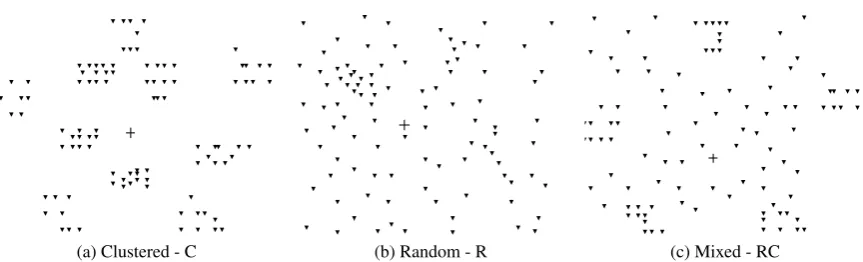
(a) Clustered - C (b) Random - R (c) Mixed - RC
Figure 1: Three different types of location arrangement of visits in the Solomon’s data set (Solomon, 1987). Original instances with 100 visits each. The depot is identified with a black cross.
(R) and mixed (RC). Figure 1 shows the layout of the instances according to their location of visits. In sub-figure 1a (C group) ten clusters can be appreci-ated. A random layout of visit locations is present in sub-figure 1b (R group). Finally, a mixed scenario is shown in sub-figure 1c with five clusters and some random visits (RC group). All instances in each type of visit-location group (C, R and RC) have the same distribution of visits. In total, there are 17 clustered, 23 random and 16 mixed instances. All clustered instances (C) have a visit duration of 90 min while random and mixed instances (R and RC) have a visit duration of 10 min.
3.2
Generating WSRP Instances
We took a data set with 56 instances having 100 vis-its each. For this study we use versions of each in-stance with 25 and 50 visits since preliminary exper-iments with all 100 visits resulted in the solver run-ning out of memory. We took the first 25 and 50 visits in the order in which they appear in the original 100 visit file since as suggested by Solomon, doing this provides a good distribution of visits. In total, 112 instances were generated, 56 instances with 25 vis-its and 56 instances with 50 visvis-its. Moreover, the 112 instances were adapted to include enough information to be representative of WSRP scenarios. First, in the VRPTW there is no limit in the number of vehicles to complete all visits. In contrast, in WSRP the num-ber of employees is known in advance, perhaps with the exception of casual employees who are called “on demand” if needed. Even though, casual employees can be added for a day or two when necessary, it is often preferred no to use them, and try to complete all visits with the staff available. As a result, we de-fined a set of workers for every instance by setting the ratio of employees to visits to 1/5. This value was decided following our conversations with a home care provider, and it also matches the assumption by Bred-str¨om and R¨onnqvist (2008). The home care provider
told us that their average visit duration is currently 50 min. At present, the provider gives a maximum of 30 min for the carer to move from one location to another and carers must start and end their working day at the provider’s main site. Current shift length is 8 hours with a break of 1 hour, or two breaks of 30 min each. Taking this into account, we determine the mean visits per employee per dayxby solving the simple equation 50x+30(x+1) +60=480, where
x+1 is the number of trips in a route including the last trip returning to the provider’s main site. It is as-sumed that the breaks are taken near a visit. The result isx=4.875 rounded to 5. In other words, instances with 25 activities have a workforce of 5 employees and instances with 50 visits have a workforce of 10 employees. In some instances we further reduced the workforce by one employee emulating an absent em-ployee. The capacity of each vehicle in VRPTW can refer to the number of hours every employee is al-lowed to work under his/her contractual agreement. In this study, we it is assumed that employees are available to work throughout the time horizon.
Teaming is included in the adapted instances by making a percentage of visits to require more than one employee to be performed. As suggested by Bred-str¨om and R¨onnqvist (2008, p. 11), we set 10% of the visits in each instance to requiring two employees for the whole duration of the visit. Employees’ pref-erences are not included in the original Solomon data set but required to compute the objective function (1). For this, we randomly assigned a preference (high, medium, low and not-preferred) value for each em-ployee in regards to each visit.
of time both activities are being performed simulta-neosly. Minimum difference restricts the start of the second activity after a minimum time has passed from the staring of the first one. Maximum time difference limits the start of the second activity from immedi-ately up to a defined value. Finally, min-max differ-ence is a combination of the previous two, with a spe-cific time window (minimum and maximum starting time) for the second activity in relation to the com-mencing of the first one. The procedure to add con-nected activities constraints is as follows. Every visit has a 25% probability of having a connected activity constraint with the activity that immediately follows in the original Solomon’s instance. Rasmussen et al. (2012) used three different percentages 10%, 20% and 30%. The visits order remain the same. If there is a connected activity constraint, then we must choose between one of the 5 different types. In real scenar-ios the two first types (synchronisation and overlap-ping) occur more often than the last three. Hence, we assigned the following probabilities to each type: 35% to each synchronisation and overlapping; 10% to each of maximum, minimum and min-max differ-ence. When using the previously described procedure to create connected activities constraints, sometimes the added constraints make the instance infeasible, e.g. an overlapping constraint for two activities that given their duration and time windows can definitely not overlap. In such cases the constraint is discarded and another one tried.
Changing the Solomon dataset with the adap-tations described above, could make the problem instances to become easier to solve than the origi-nal ones. The experiments in subsection 4.3 aim to test this possibility by solving the WSRP model with and without the teaming and connected activities con-straints. In the following, we refer to the 112 gener-ated problem instances as WSRP instances.
3.3
Other Instances in the Literature
There are other problem instances used in published papers relating to problems that can be seen as WSRP. Examples include the Akjiratikarl et al. (2007) data set which is based on a council in Wales scheduling care workers across the region The home health care data set by Bertels and Fahle (2006) is a generated one and it consists of 120 test scenarios containing between 20 and 50 nurses and up to 200 jobs. Such data set does not include any jobs requiring more than one worker (nurse) and there is no presence of con-nected activities. The manpower allocation problem (Li et al., 2005) contains job-teaming constraints but the number of instances (25) is limited for our study and the number of jobs in each instance is on average
300, which the solver cannot handle. Moreover, there is no set number of workers available since the objec-tive is to find a minimum workforce size. There is also the data set by Cheng and Rich (1998) which is con-sidered too small, with 4 nurses and 10 jobs. Finally, the most complete data set which includes both team-ing and connected activities constraints is the one by Rasmussen et al. (2012) . In that data set, the majority of instances are understaffed which leaves some activ-ities not performed. The IP Model used here does not consider such possibiliy so it would result in having infeasible instances.
4
EXPERIMENTS AND RESULTS
4.1
Description of Experiments
Three sets of experimental results are described in the following subsections. The first set relates to the ob-jective of tackling WSRP with the IP model by report-ing on gap achieved. The second set addresses the second objective of studying whether or not the ad-ditional connected activities and teaming constraints makes the WSRP easier or more difficult to solve. Finally, the third set is associated to the first set to analyse how much time is necessary to find a feasible solution for the adapted instances. Additionally, the third set of experiments also provides an insight into the type of method used by the solver when finding feasible solutions, either through branching-cutting or with heuristics. All the experiments are performed using Gurobi version 5.5 and CPLEX 12.5. The re-sults produced by the two solvers do not differ much. Nevertheless, using our computational setting, Gurobi finds better results for more instances. Therefore, we report the Gurobi results only. No parameter tuning was performed on either of the solvers apart from set-ting a time limit. Our goal does not include to com-pare both solvers. A x64-based computer with a pro-cessor Intel Core 2 Duo (3.16 GHz) and 4 gigabytes of RAM was used in the experiments.
4.2
Feasibility and Optimality
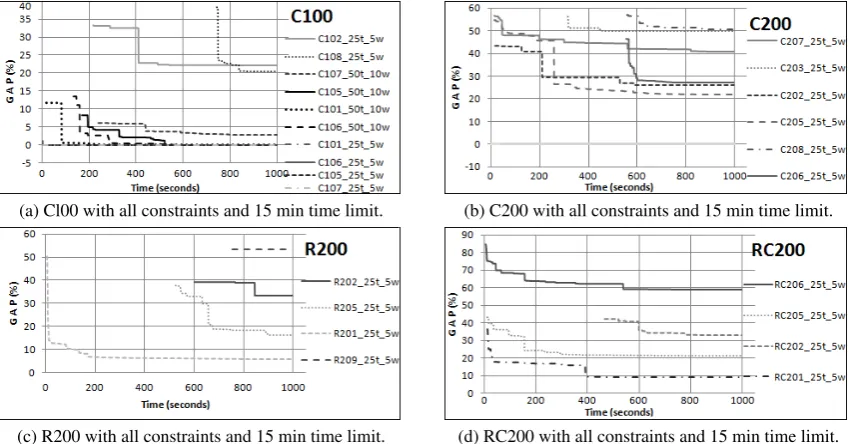
(a) Cl00 with all constraints and 15 min time limit. (b) C200 with all constraints and 15 min time limit.
[image:6.595.75.502.104.326.2](c) R200 with all constraints and 15 min time limit. (d) RC200 with all constraints and 15 min time limit.
Figure 2: Results of experiments with time limit of 15 min showing gap reduction for feasible instances found (26 in total).
are achieved provides an insight into the clustering component of the visits since around a third of the instances have clustered visits e.g. C100 and C200.
In this first set of experiments, at least one feasible solution is achieved for 26 out of the 112 instances. From those 26 instances, the optimal solution (gap 0.0%) is found for 7 of them. Figure 2 shows the gap reduction achieved within 15 minutes for the 26 instances. The figure shows one graph for each of the 4 groups (C100, C200, R200, RC200) with feasible solutions found. For the remaining 86 instances, in-feasibility was reported by the solver for 7 instances. In the remaining 79 instances, Gurobi times out after 15 minutes with no additional information. No fea-sible solution is achieved within 15 minutes for any instance within the R100 and RC100 groups. Even-thoug all instances involve the same number of activ-ities, groups R100 and RC100 seem harder to solve because they have a shorter planning horizon (230 and 240 minutes) when compared to the other four groups where the planning horizon is 900 minutes or more. The duration of the planning horizon also dictates em-ployees’ available working time, resulting in less ca-pacity of working hours in such scenarios. Addition-ally, the random distribution of visits in these two (R) groups (see Figure 1) does not exploit the cluster fea-ture that other scenarios present. Once an employee enters a cluster region it is very likely that he/she re-mains there for other visits rather than travelling to a different cluster location, saving time overall. Gurobi finds only 4 feasible solutions for instances in group R200 with randomly spread visits. All the 7 optimal
Table 1: Instances where Gurobi finds optimal solutions, showing two times: first feasible solution and optimal.
Instance Feasible Optimal Instance Feasible Optimal C101 25 5 0.62 0.62 C105 25 5 2.0 3.86 C105 50 10 168.0 522.08 C106 25 5 0.67 0.67 C107 25 5 2.0 2.78 C201 25 5 1.0 1.63 C201 50 10 43.0 44.99
Table 2: Infeasible instances and time required to prove in-feasibility
Instance Time Instance Time
R101 25 5 1.53 R101 50 10 20.05 R102 50 10 82.75 R103 50 10 104.99 R104 50 10 296.3 R105 25 5 4.78 RC102 50 10 188.63
solutions that were found (see Table 1) are in the clus-tered groups (C) and the majority in group C100. This group has the second largest planning horizon of all instances (1236 minutes) giving more working time overall. All infeasible instances are shown in Table 2, almost all of them corresponding to group R100.
4.3
Effect of Teaming and Connected
Activities Constraints
[image:6.595.334.499.447.498.2]Table 3: Number of feasible solutions found in every group. Values in parentheses indicate the number of instances per group.
Teaming and Connected Activities (TC) Time Limit C100(18) C200(16) R100(24) R200(22) RC100(16) RC200(16) Total(112)
1 with TC constraints 15 min 10 8 0 4 0 4 26
2 without TC constraints 15 min 13 13 3 12 8 10 59
corresponding rate of improvement (gap reduction). Our aim is to find out if more feasible solutions are found compared to the results from the previous ex-periments (subsection 4.2). If that is the case, it could suggest that teaming and connected activities make the problem harder to solve. Constraints for teaming and connected activities are considered together be-cause a teaming constraint is modelled as a connected activity constraint of the synchronisation type. If a visitxrequires a team ofmworkers, thenm−1 virtual visits are created with the same requirements as the original visitx. Afterwards, a synchronisation con-straint is created between each possible pair of vis-its. Such procedure guarantees that all employees re-quired to perform visitxarrive at the same time, ef-fectively forming a team.
Table 3 shows the number of instances in each group for which at least one feasible solution was achieved within 15 minutes computation time. The first row summarises the results from the first set of experiments in the previous subsection. The second row summarises the results when teaming and con-nected activities constraints are relaxed. After com-paring both rows it is clear that removing these con-straints allows the solver to find feasible solutions for more instances. If we compare only the instances where a known feasible solution is known (from pre-vious subsection 4.2), results in Table 4 show that significantly better gaps are achieved (approximately 10% overall) when the teaming and connected activ-ities constraints are relaxed. Table 4 shows that the version of the problem instance without these con-straints achieves a better gap than its complete coun-terpart. As it can be noticed, for the majority of instances the result is=or >, with the exception of one instance (C106 50 10) but the difference is very small (0.04%). Additionally, for 59 of the instances a feasible solution is achieved when both teaming and connected activities constraints are relaxed This is in contrast to the only 26 instances for which a feasible solution was found when both types of constrains are present.
In all groups of instances, removing the teaming and connected activities constraints produces an im-provement in the number of instances achieving feasi-bility. Groups R100 and RC100 for which no feasible solution was found before, now have 3 and 8 instances with feasible solutions respectively. But overall, these groups still remain as the two groups with the least
Table 4: Feasible solutions with final gap achieved after 15 min computation time. The second (w/TC) and third (wo/TC) columns show gap results with and without the teaming and connected activities constraints respectively.
Instance w/TC wo/TC Instance w/TC wo/TC C101 25 5 0 = 0 C101 50 10 0.07> 0 C102 25 5 22.1 > 12.4 C105 25 5 0 = 0 C105 50 10 0.04 > 0 C106 25 5 0 = 0 C106 50 10 0.03 < 0.34 C107 25 5 0 = 0 C107 50 10 2.9 > 0 C108 25 5 20.4> 4.55 C201 25 5 0 = 0 C201 50 10 0 = 0 C202 25 5 26.1 > 1.63 C203 25 5 49.7> 25.4 C205 25 5 21.8 > 1.82 C206 25 5 27.2> 1.56 C207 25 5 40.6 > 11.9 C208 25 5 50.5> 16.5 R201 25 5 5.77 > 4.56 R202 25 5 33.3> 16.3 R205 25 5 16.3 > 6.52 R209 25 5 53.2> 14 RC201 25 5 9.29 > 0.84 RC202 25 5 32.9> 31.5 RC205 25 5 21.2 > 19.6 RC206 25 5 58.8> 44.9
Mean w/TC: 18.93 Mean wo/TC: 8.24
number of feasible solutions reported. Such result confirm that even when the teaming and connected activities constraints are relaxed, a group of clustered visits is easier to solve than a random distribution of visiting locations. In general, our results for this sec-ond set of experiments suggest that the adaptations made to the Solomon instances to generate WSRP problem instances, make the problem harder for a cur-rent solver to tackle. Figure 3 shows the gap reduction for the instances achieving feasibility within 15 min-utes (900 seconds) without teaming and connected ac-tivities constraints, grouped by location and planning horizon. In the next set of experiments, we extend the computation time given to the solver in order to in-vestigate the rate of improvement in the gaps and find more feasible solutions.
4.4
Extending Computational Time
(a) Cl00 without TC constraints. (b) C200 without TC constraints.
(c) Rl00 without TC constraints. (d) R200 without TC constraints.
[image:8.595.85.507.95.454.2](e) RCl00 without TC constraints. (f) RC200 without TC constraints.
[image:8.595.309.519.473.556.2]Figure 3: Gap reduction of feasible solutions for instances without Teaming and Connected activities (TC) constraints.
Table 5: Instances for which feasible solutions were found within the time limit of 60 minutes. The time in seconds at which Gurobi found the first feasible solution is shown, together with the initial gap and final gap values.
Instance 1st feasible Initial Final
R201 50 10 2594 18.6% 12.3% R210 25 5 2099 42.6% 31.7% RC106 25 5 1915 40.9% 39.1%
Increasing the computational time to 60 minutes for the 79 instances produced feasible solutions for 3 of those instances, none of them achieving optimal-ity. The remaining 76 instances again timed out with no further information. Details of these additional re-sults is shown in Table 5. It should be noted that the computation time for finding the first feasible solu-tion for the 3 instances is more than 30 minutes (1800 seconds). The difference between the initial gap and the final gap values is less than 11%. Figure 4 shows the gap reduction achieved over the given computa-tion time.
We then increased the computation time from 60
Figure 4: Gap reduction of instances for which feasible so-lutions are achieved within the time limit of 60 minutes.
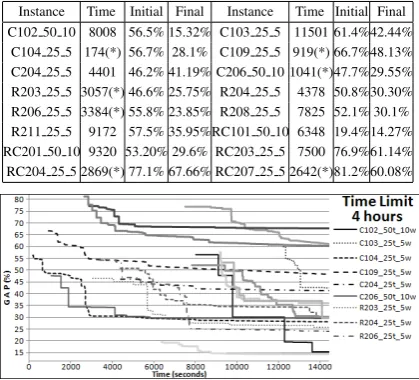
[image:8.595.105.256.518.561.2]Table 6: Feasible solutions and initial/final gap achieved after 240 min computation time (first solution time shown in seconds). For all these instances no feasible solution was found in the previous experiments with 15 and 60 minutes.
Instance Time Initial Final Instance Time Initial Final C102 50 10 8008 56.5% 15.32% C103 25 5 11501 61.4%42.44%
C104 25 5 174(*) 56.7% 28.1% C109 25 5 919(*) 66.7%48.13% C204 25 5 4401 46.2% 41.19% C206 50 10 1041(*)47.7%29.55% R203 25 5 3057(*) 46.6% 25.75% R204 25 5 4378 50.8%30.30% R206 25 5 3384(*) 55.8% 23.85% R208 25 5 7825 52.1% 30.1% R211 25 5 9172 57.5% 35.95%RC101 50 10 6348 19.4%14.27% RC201 50 10 9320 53.20% 29.6% RC203 25 5 7500 76.9%61.14% RC204 25 5 2869(*) 77.1% 67.66% RC207 25 5 2642(*)81.2%60.08%
Figure 5: Gap reduction of instances for which feasible so-lutions are achieved within the time limit of 240 minutes.
into the branching tree might depend on the computa-tion time available. Figure 5 complements Table 6 as a visual representation of the gap reduction over the 240 minutes for the instances that achieve feasible so-lutions. A reduction of 15% in gap when compared to the initial solution is achieved for all instances except RC101 50 10. As noted before, for some instances a first feasible solution is found before 60 minutes, rows marked with (*) in Table 6, which shows that analysing the first hour of computation results in a four-hour experiment is not equivalent to restricting the computation time to only one hour with Gurobi.
4.5
Methods Used by Gurobi
Gurobi provides information regarding the current gap achieved while performing the optimisation. In our experiments, we set up the solver to report the gap reduction every 15 seconds. When a gap reduction is achieved, the method used is reported by the solver. The objective in this set of experiments is to identify which method is used by Gurobi when finding bet-ter solutions for each instance. For every new feasi-ble solution Gurobi reports whether the solution was found by branching or by heuristics (Inc., 2013). If most of the time new feasible solutions are found this is achieved by heuristics, it would justify developing our own. In all previous experiments, without exemp-tion, Gurobi found more gap improvements when us-ing heuristics. It is expected that MIP heuristics find more feasible solutions than the branching process for the VRPTW. The adaptations to the data set and mod-ification of the VRPTW model to tackle WSRP have
Table 7: Summary of methods used by Gurobi during the optimisation process. Columns H/B report the number of gap reductions within a group of instances that are achieved with Heuristics (H) or Branching (B). Within every group the number of instances with feasible solutions is reported.
Time(#) C100 H/B C200 H/B R100 H/B 15m(112) 10 26/16 8 27/11 0 0/0 *15m(112) 13 50/12 13 71/19 3 10/5 60m(79) 0 -/- 0 -/- 0 -/-240m(112) 14 95/23 10 83/23 0 0/0
Time(#) R200 H/B RC100 H/B RC200 H/B 15m(112) 4 25/10 0 0/0 4 57/14 *15m(112) 12 75/21 8 48/25 10 99/20 60m(79) 2 8/1 1 3/2 0 -/-240m(112) 11 196/27 2 11/1 8 126/15
similar results. In fact, the number of times a heuris-tic within Gurobi finds a better solution is in general larger for instances that include the additional con-straints in the WSRP instances.
Table 7 summarises the number of times a gap reduction was achieved for every group of instances in all experiments. The table has four rows but split in two parts vertically, each part has three groups of instances. Note that the second row in each part, marked with (*), refers to all instances without the teaming and connected activities constraints. The third row in each part shows the 79 instances that timed out after 15 minutes in the first set of experi-ments but then executed for up to 60 minutes. The number in parentheses after the time limit is the num-ber of instances used in that set of experiments. In all groups there are more gap reductions achieved by heuristics than by branching (H/B values).
5
CONCLUSION
In this study we applied a vehicle routing problem with time windows (VRPTW) model that incorpo-rates temporal precedence and synchronisation con-straints to tackle the workforce scheduling and rou-ting problem (WSRP). We extended 112 well-known VRPTW instances to generate a set of 112 difficult WSRP instances. Using a current powerful opti-misation solver, only some of the generated WSRP instances were tackled with some success. For 60 instances, the solver could not even find a feasible lution (see Table 8). This suggests that alternative so-lution methods should be considered besides existing mathematical programming solvers.
[image:9.595.309.522.144.247.2]Table 8: Results summary for all experiments. Gurobi did not find a feasible solution for 60 instances.
Set FeasibleInfeasibleNot Set FeasibleInfeasible Not
found found
C100 14 0 4 C200 10 0 6 R100 0 6 18 R200 11 0 11 RC100 2 1 13 RC200 8 0 8
Totals Feasible45 Infeasible7 Not found60
generated WSRP instances are more difficult to solve due to the additional teaming and connected activities constraints (similar results are reported by Rasmussen et al. (2012) ). Additionally, we found that WSRP instances with clustered visiting locations tend to be easier to solve according to the gap reduction rate re-ported by the solver in our experiments.
Finally, we established that the computational time for a mathematical solver to find good feasible solutions for the generated WSRP problem instances needs to be more than 1 hour. Considering only the 45 instances for which feasible solutions were found, for 29 of them feasible solutions were found within an hour. For the reminder 16, feasible solutions were found within 1 to 4 hours. Nevertheless, for 90% of the instances, feasible solutions were found within 2 hours and 5 minutes. Adding two more hours of computational time achieved only 10% more feasi-ble solutions. We consider this not to be practical, hence suggest a maximum computation time of 2 hours when solving WSRP instances with planning time horizon of one day.
REFERENCES
Akjiratikarl, C., Yenradee, P., and Drake, P. R. (2007). Pso-based algorithm for home care worker schedul-ing in the uk. Computers & Industrial Engineering, 53(4):559–583.
An, Y.-J., Kim, Y.-D., Jeong, B., and Kim, S.-D. (2012). Scheduling healthcare services in a home healthcare system.Journal of the Operational Research Society, 63:1589–1599.
Bertels, S. and Fahle, T. (2006). A hybrid setup for a hybrid scenario: combining heuristics for the home health care problem. Computers & Operations Research, 33(10):2866–2890.
Bredstr¨om, D. and R¨onnqvist, M. (2008). Combined vehicle routing and scheduling with temporal pre-cedence and synchronization constraints. European Journal of Operational Research, 191(1):19–31. Castillo-Salazar, J. A., Landa-Silva, D., and Qu, R. (2012).
A survey on workforce scheduling and routing prob-lems. In Proceedings of the 9th International Con-ference on the Practice and Theory of Automated Timetabling, pages 283–302.
Cheng, E. and Rich, J. L. (1998). A home health care rou-ting and scheduling problem. Technical Report TR98-04, Rice University, Texas.
Chuin Lau, H. and Gunawan, A. (2012). The patrol
schedul-ing problem. InProceedings of the 9th International Conference on the Practice and Theory of Automated Timetabling, pages 175–192.
Chuin Lau, H., Sim, M., and Meng Teo, K. (2003). Vehicle routing problem with time windows and a limited number of vehicles.European Journal of Operational Research, 148:559–569.
Dohn, A., Kolind, E., and Clausen, J. (2009). The man-power allocation problem with time windows and job-teaming constraints: A branch-and-price approach.
Computers & Operations Research, 36(4):1145– 1157.
Dondo, R. and Cerd´a, J. (2007). A cluster-based opti-mization approach for the multi-depot heterogeneous fleet vehicle routing problem with time windows. Eu-ropean Journal of Operational Research, 176:1478– 1507.
Glover, F. and McMillan, C. (1986). The general employee scheduling problem. an integration of ms and ai. Com-puters & Operations Research, 13(5):563–573. G¨unther, M. and Nissen, V. (2012). Application of
parti-cle swarm optimization to the british telecom work-force scheduling problem. InProceedings of the 9th International Conference on the Practice and Theory of Automated Timetabling, pages 242–256.
Inc., G. O. (2013). Gurobi Optimizer, Reference Manual version 5.5. Gurobi Optimization Inc.
Korsah, G. A., Stentz, A., Dias, M. B., and Aslam, I. (2010). Optimal vehicle routing and scheduling with precedence constraints and location choice. InIEEE International Conference on Robotics and Automation Workshop on Intelligent Autonomous Systems. Li, Y., Lim, A., and Rodrigues, B. (2005). Manpower
allocation with time windows and job-teaming con-straints.Naval Research Logistics, 52(4):302–311. Misir, M., Smet, P., Verbeeck, K., and Vanden Bergue, G.
(2011). Security personnel routing and rostering: a hyper-heuristic approach. InProceedings of the 3rd International Conference on Applied Operational Re-search, pages 193–206.
Nickel, S., Schr¨oder, M., and Steeg, J. (2012). Mid–term abd short–term planning support for home health care services. European Journal of Operational Research, 219:574–587.
Rasmussen, M. S., Justesen, T., Dohn, A., and Larsen, J. (2012). The home care crew scheduling problem: Preference-based visit clustering and temporal depen-dencies. European Journal of Operational Research, 219(3):598–610.
Solomon, M. M. (1987). Algorithms for the vehicle rou-ting and scheduling problems with time windows con-straints.Operations Research, 35(2):254–265. Taillard, E. D., Laporte, G., and Gendreau, M. (1996).
Vehicle routeing with multiple use of vehicles. Jour-nal of the OperatioJour-nal Research Society, 47:1065– 1070.