Impact of the Use of Sterically Congested
Cyclometalated Ligands on the Optoelectronic
Properties and Device Performances In
Light-Emitting Electrochemical Cells of Cationic
Iridium(III) Complexes
Claus Hierlinger,a,b Elzbieta Trzop,c Loïc Toupet,c Jorge Ávila,d Henk J. Bolink,d Véronique Guerchais*a Eli Zysman-Colman*b
a
Univ Rennes, CNRS, ISCR (Institut des Sciences Chimiques de Rennes) – UMR 6226, F-35000 Rennes, France. E-mail: [email protected]
b Organic Semiconductor Centre, EaStCHEM School of Chemistry, University of St
Andrews, St Andrews, Fife, KY16 9ST, UK. E-mail: [email protected]; Web: http://www.zysman-colman.com
c Univ Rennes, CNRS, IPR (Institut de Physique de Rennes) - UMR 6251, F-35000 Rennes, France
c
Instituto de Ciencia Molecular, Universidad de Valencia, C/J. Beltran 2, 46980 Paterna, Spain
Abstract
= 4,4ʹ-di-tert-butyl-2,2ʹ-bipyridine and C^N = a cyclometalating ligand decorated at the 4-position of the pyridine ring and/or the 3-4-position of the phenyl ring with a range of sterically bulky substituents) are reported. This family of complexes is compared to the unsubstituted analogue complex R1 bearing 2-phenylpyridinato as cyclometalating ligand. The impact of the use the sterics on the C^N ligands on both the solid state photophysics and light-emitting electrochemical cell (LEEC) device performance is investigated. X-ray diffraction analysis of complexes 1a, R2, 2a, and 1b show an increasing internuclear distance in the solid state, within these four complexes. Emission studies in solution and neat film show that the chosen substituents essentially do not impact the emission energy. The photoluminescence quantum yields (ΦPL) are in the same range (ΦPL ~ 25 – 31%), except for 1b, which shows a lower ΦPL of 12%. All complexes exhibit similar monoexponential emission lifetimes in the submicrosecond regime. LEECs based on R1, 1a, 1b and R2 were fabricated, showing yellow luminescence and moderate efficiencies and lifetimes. The arguably best performing LEEC device, showing the highest luminance (737 cd m-2), current efficiency (7.4 cd A-1) and EQE (2.6%), employed emitter 1a.
Introduction
and widely studied class of emitters for LEECs is the heteroleptic cationic Ir(III) complex of the form [Ir(C^N)2(N^N)]PF6 (C^N is a cyclometalating ligand, N^N is a diimine ancillary ligand).
Unlike in OLEDs where the emissive compound is present in only small concentrations as a dopant within a higher bandgap host, in LEECs the emissive layer is frequently composed either of a homogenous layer of emitter molecules or the emitter is the major component within the layer. As a consequence, one issue that can limit device performance is excited state self-quenching during device operation.5 A strategy to circumvent this issue is to decorate the complexes with bulky, hydrophobic substituents that serve to increase the intermolecular distance while simultaneously hindering the disadvantageous attack of small molecules.6 Chart
N N Ir PF6 N N N N N N Ir PF6 F F F F R6 R7 N N N N Ir PF6 R5 N N N N N N Ir PF6 R8 N N Ir N N PF6 R3 N N N N Ir PF6 R R R1, R = H R2, R = mes
R9 PF6 N N Ir N N R4 N N Ir PF6 N N OMe OMe
Chart 1. Representative literature examples of iridium complexes bearing bulky substituents.
a disruption of the conjugation between these two aryl groups, minimizing the impact on the emission energy. Such an approach has been applied to cationic iridium complexes by us, where we have observed an enhancement of solution- and solid-state FPL compared to the non-decorated analog complex.8
A comparison of R1 and R2 of the form [Ir(C^N)2(dtBubpy)]PF6 (where C^N is ppy or mesppy for R1 and R2, respectively and dtBubpy is 4,4ʹ-di-tert-butyl-2,2ʹ-bipyridine) reveals the impact of the mesityl group on the photophysical properties in cationic complexes.8a In CH2Cl2, the same emission maximum (lPL = 577 nm) is observed for both complexes while the
FPL is moderately enhanced for the mesitylated complex (FPL = 35 and 40% for R1 and R2, respectively). The LEECs fabricated with R1,8a showed a lifetime of t1/2 = >1300 h and an EQE of 2.5%. Surprisingly and in contrast to the above-mentioned impact of the mesityl group, for LEECs based on R2 there was a reduction in the device lifetime (t1/2 = 0.6 h) and EQE (1.4%) upon incorporation of the mesityl groups on the C^N ligands. However, with R2 faster response times could be achieved in devices compared to those based on R1, as the mesityl groups induce a more efficient electronic communication and recombination within the device, which results in faster turn-on times. The related complex [Ir(dPhPy)2(bpy)]PF6, R3 (where dPhPy is 2,4-diphenylpyridine and bpy is 2,2ʹ-bipyridine) bears a phenyl group on the 4-position of the pyridine of the C^N ligand in lieu of a mesityl group and contains a bpy N^N ligand in lieu of the dtBubpy ligand.9 In CH2Cl2, complex R3 exhibits yellow phosphorescence (lem = 598 nm) with a FPL of 21% . A single-layer LEEC based on R3 containing a lithium salt additive showed improved device performance compared to the unsubstituted analogue. The device with R3
ascribed the improved LEEC performance to the bulky, hydrophobic nature of the phenyl substituent, which they asserted impeded self-quenching pathways of the Ir(III) complex. Another analogous complex is [Ir(Phppy)2(bpy)]PF6, R4 (where Phppy is 2-([1,1'-biphenyl]-3-yl)pyridine), bearing a phenyl group trans to the Ir-CC^N bond. Complex R4 exhibits a yellow-orange emission with a FPL of 13% in CH2Cl2. LEECs based on R4 are likewise highly stable with t1/2 = 2800 h and also are very bright with a maximum luminance of 1024 cd m-2.10
The use of the sterically congested the dtBubpy in R611 coupled with dFppy ligands contributed to a record maximum external quantum efficiency in the LEEC of 15%,11a significantly higher than that reported for the LEECs with R1, with EQE values ranging from 0.6 - 5.0%.8a, 12 LEECs fabricated with R512b incorporating a bulky ancillary ligand (5,5ʹ -diphenyl-2,2ʹ-bipyridine, dpbpy) showed long device lifetimes of 110 h (LEEC operating at 4 V), particularly compared to [Ir(ppy)2(dtBubpy)]PF6, R1 (1.3 h). Using R7,5 which contained the 4,5-diaza-9,9ʹ-spirobifluorene ancillary ligand, resulted in LEECs with a maximum external quantum efficiencies of 7.1% at a device lifetimes of 12 h and luminance value of 52 cd m-2.
(183 cd m-2 and 8.2 cd A-1, respectively).15 In the majority of cases, decorating the complex with bulky, hydrophobic substituents greatly improves the stability of LEECs.
PF6 N N Ir N N N N Ir N N PF6 1a N N Ir N N PF6 2a OMe N N Ir OMe N N PF6 3a N N Ir N N PF6 PF6 1b N N Ir N N t-Bu t-Bu
N N N N
OMe
N N
LR1 L1a L1b LR2 L2a L3a
R1
R2
Figure 1. Proligands and Ir(III) complexes under investigation in this study.
Results and Discussion
Synthesis of the C^N ligands
4-substituted 2-phenylpyridine derivatives L1a, LR1, L2a and L3a [with R1 = tert-butyl (tBu), mesityl (mes), manisyl (man) – 4-methoxy-2,6-dimethylphenyl, and 3,5-di-tert-butylphenyl (dtBuphen), respectively, and R2 = H], andthe substituted arylpyridine L1b (where R1 = R2 = tert-butyl). The ligand LR1 is the unsubstituted ppyH (Figure 1).
Compounds L1a and L1b are accessible as colourless oils from 4-tert-butylpyridine via a Minisci reaction16 in moderate yields (45 and 46%, respectively), while LR1 was commercially available. For LR2, L2a and L3a, a two-step Suzuki-Miyaura cross-coupling strategy was adapted from 2-chloro-4-iodopyridine (Scheme 1).8cThe mono-arylated 2-chloro-4-substituted compounds ClR2, Cl2a and Cl3a were isolated in excellent yields (94-96%) after purification by column chromatography. Key to the high yields is the use of excess R1B(OH)2, which led to easier purification of the intermediate 4-aryl-2-chloropyridines. A second Suzuki-Miyaura reaction with PhB(OH)2 afforded LR1, L2a and L3a in excellent yields (86-90%) (Scheme 1).
R1= mes,
R1= man,
R1= dtBuphen,
N Cl
N I
Cl N
R1 R1
a b
R1B(OH)2 PhB(OH)2
ClR2, 94%
Cl2a, 94%
Cl3a, 96%
R1= mes,
R1= man,
R1= dtBuphen,
LR2, 90%
L2a, 89%
L3a, 85%
OMe
mes = man = dtBuphen =
Scheme 1. Synthesis scheme for compounds LR1, L2a and L3a (with R1 = mes, man and dtBphen, respectively). a R1B(OH)2, K2CO3, Pd(PPh3)4, dioxane/H2O (4/1), 95 °C, 3 d; b PhB(OH)2, K2CO3, Pd(PPh3)4, dioxane/H2O (4/1), 95 °C, 18 h.
The target complexes were synthesised via a two-step literature procedure (Scheme 2). The C^N ligands were each first reacted with IrCl3.6H2O to afford the corresponding [Ir(C^N)2Cl]2 dimers in excellent yields (79-89%).17 These intermediate dimers were then reacted with dtBubpy in the presence of AgPF6 to afford the desired heteroleptic complexes as yellow solids in generally excellent yields (79-92%) as their hexafluorophosphate salts.18 Through the systematic increase of steric bulk of the cyclometalated ligands, the corresponding [Ir(C^N)2Cl]2 dimers as well as the cationic complexes show increased solubility in organic solvents such as CH2Cl2, CHCl3 and MeCN compared to [Ir(ppy)2Cl]2 and the reference complex R1. Recrystallization from pentane/diethyl ether gave pure R1, whereas for the other complexes (1a, 1b, R2, 2a and 3a) column chromatography on silica (eluent: 5% MeOH in CH2Cl2) was required. Following chromatographic purification, a second anion exchange reaction with NH4PF6 was conducted to ensure that the sole counterion was PF6-.
N
R1
R2
a b
89%, R1 = H, R2 = H
82%, R1 = tBu, R2 = H
85%, R1 = tBu, R2 = tBu
79%,R1= mes, R2= H
75%, R1 = man, R2= H
89%, R1 = dtBuphen, R2 = H PF6 N N Ir N N R1 R2 R2 R1 N Cl Cl N Ir Ir N N R2
R2 R2
R2
R1 R1
R1 R1 R1, 1a, 1b, R2, 2a,
3a,
X-ray structural studies
Single crystals of sufficient quality of 1a, 1b, R2 and 2a were grown from CH2Cl2/Et2O. The determined space groups are P1 (for 1a) and P21 (for 1b, R2 and 2a). The crystal structure of R2 has been previously reported; however, in the previous report the crystallization conditions were different.8a The crystal structure of 1a, 1b, R2 and 2a are presented in Figure
2.
Figure 2. Representation of the crystal structure of 1a, 1b, R2 and 2a. The hydrogen atoms, solvent molecules, minor disorder, as well as the counter ion PF6- are omitted for clarity.
found in R3 for which an average torsion angle of 26° between the phenyl and the pyridine rings of the C^N ligands is observed.20 The steric hindrance provided by the substituents on the C^N ligands modulates the nuclear distance in the solid state. The shortest inter-iridium distance between adjacent complexes is approximately 7.24 Å in 1a and increases significantly in R2 and 2a (~10.55 and 10.97 Å, respectively). A similar Ir…Ir distance is observed when both R1 and R2 are tert-butyl groups in 1b (~10.86 Å). In R1 the distance 7.897 Å is notably higher with respect to 1a. The inter-iridium distance for R3 is with 8.87 Å,20 which is significantly shorter compare to the distance in R2 and 2a.
Cyclic Voltammetry
The electrochemical behaviour of each of the complexes was investigated by cyclic voltammetry (CV) in deaerated MeCN solution at 298 K with n-Bu4NPF6 as the supporting electrolyte at a scan rate of 100 mV s-1 and using ferrocene/ferrocenuim (Fc/Fc+) as the internal reference. All potentials are referenced with respect to SCE (Fc/Fc+ = 0.38 V in MeCN).21 The cyclic voltammograms are shown in Figure 3 and the electrochemistry data are given in Table
Figure 3. Cyclic voltammograms of 1a–5a measured in a deaerated MeCN with 0.1 M nBu4NPF6 at a scan rate of 100 mV s-1 in the positive scan direction and Fc/Fc+ as the internal standard, and are referenced with respect to SCE (Fc/Fc+ = 0.38 V in MeCN).21
Table 1.Electrochemical data and orbital energies for the investigated complexesa
𝑬𝟏/𝟐𝒐𝒙 / V 𝜟𝑬
𝒑 / mV 𝑬𝟏/𝟐𝒓𝒆𝒅 / V 𝜟𝑬𝒑 / mV 𝑬𝑯𝑶𝑴𝑶b / eV 𝑬𝑳𝑼𝑴𝑶b / eV 𝜟𝑬𝒓𝒆𝒅𝒐𝒙 / V
R1 1.13 90 -1.61 70 -5.93 -3.20 2.74
1a 1.13 180 -1.54 100 -5.93 -3.26 2.67
1b 1.15 70 -1.52 90 -5.95 -3.29 2.67
R2 1.35 90 -1.37 80 -6.16 -3.43 2.72
2a 1.29 90 -1.43 70 -6.10 -3.38 2.72
[image:13.595.72.569.531.784.2]a Measurements were carried out in degassed MeCN at a scan rate of 100 mV s-1 with Fc/Fc+ used as the internal reference and referenced with respect to SCE (Fc/Fc+ = 0.38 V in MeCN).21 b EHOMO/LUMO = -[Eox/red vs. Fc/Fc+ + 4.8] eV.22
oxidation potentials, this effect is counteracted by the increased conjugation present in 3a. Surprisingly, despite the electron-donating nature of the tert-butyl groups, the reduction potential is not further cathodically shifted, but instead is -1.54 V for 1a and -1.52 V for 1b.
UV-Vis absorption spectroscopy
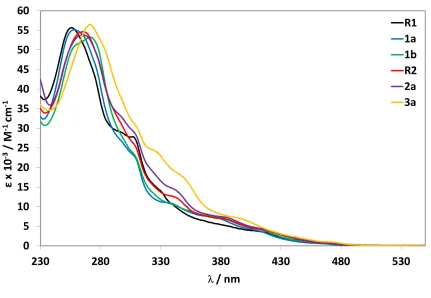
[image:15.595.86.517.305.603.2]The absorption spectra for all complexes recorded in aerated MeCN at 298 K are shown in Figure 4 and the data summarized in Table 2.
Figure 4. UV-Vis absorption spectra recorded at 298 K in aerated acetonitrile.
Table 2. UV-vis absorption data of the investigated Ir(III) complexes
R1 255 (56 853), 286 (34 421), 309 (28 841), 329 (16 244), 408 (3 757), 466 (663)
1a 258 (55 115), 309 (22 533), 323 (12 442), 340 (10 817), 374 (7 397), 410 (3 976), 448 (941)
1b 272 (53 237), 310 (22 321), 329 (12 109), 377 (7477), 397 (5 357), 410 (4 408), 429 (2 455), 470 (837)
R2 267 (54 540), 310 (24 832), 331 (13 504), 344 (12 153), 385 (6 752), 419 (3 826), 471 (675)
2a 265 (53 788), 296 (33 350), 310 (28 049), 343 (14 195), 385 (7 269), 419 (4 019), 467 (855)
3a 272 (56 407), 311 (29 765), 327 (23 945), 350 (17 179), 402 (6 388), 439 (2 460), 472 (993)
a recorded in aerated MeCN at 298 K.
The acquired absorption data for R1,231b24and R28d match those previously reported. For all complexes, the electronic absorption spectra show intense (e on the order of 5.5 × 10⁴ M-1 cm-1) high-energy absorption bands between 255 - 272 nm that are assigned to 1π–π* ligand-centred (1LC) transitions on both the C^N and N^N ligands. With respect to R1, complex
Photophysical Properties
Solution-state Photophysical Behavior
The photoluminescence (PL) spectra in degassed MeCN are shown in Figure 5a and the data are summarized in Table 3.
Figure 5. Emission spectra. a) recorded at 298 K in deaerated MeCN, with λexc = 400 nm, b)
dropcast thin films at 298 K, with λexc = 400 nm.
Table 3. Photophysical data of 1a-5a.
MeCN Neat film
lPLa
/ nm
τPLa
/ ns
ΦPLa,b
/ %
kr c × 10-5
/ s-1
knrd × 10-5
/ s-1
lPLe
/ nm
τPLe,f
/ ns
ΦPLg
/ %
R1 592 581 31 3.61 13.60 578
5 (11.7%) 29 (30.6%)
180 (57.7%) 23
1a 597 497 26 3.42 16.70 579
9 (13.7%) 40 (33.2%) 200 (53.1%)
Upon excitation at 400 nm, all complexes show moderately intense yellow emission over a narrow range between 588 to 611 nm and show a broad and unstructured profile, indicative of an emission with mixed CT character. An increasing red-shifting of the emission spectra is observed upon addition of tert-butyl groups (5 nm, 140 cm-1 for R1 to 1a and 19 nm, 530 cm-1 for 1a to 1b). This trend is also observed for the LC band in the absorption spectra and correlates as well with a slightly smaller DEredox gaps. The effect of the addition of electron-donating groups on the phenyl rings of the C^N ligands has been shown to induce a red-shift of the emission.23a A red-shift of 6 nm (169 cm-1) in the emission spectrum is also observed for 3a
compared to R1, which is due to stabilization of the triplet state as a result of the increased conjugation within the C^N ligands. Given the orthogonal conformation of the aryl groups in
R2 and 2a there is expectedly no significant change in the emission energy, consistent with
1b 611 250 12 3.20 36.80 565
8 (7.7%) 43 (23.4%) 225 (68.9%)
27
R2 592 643 28 2.95 12.60 565
10 (16.4%) 42 (37.5%) 171 (46.1%)
15
2a 588 623 29 3.05 13.00 564
10 (14.4%) 42 (35.5%) 179 (50.1%) 16
3a 598 501 25 3.39 16.57 570
8 (13.8%) 36 (34.3%) 183 (51.9%)
40
a recorded at 298 K in deaerated MeCN, with lexc = 400 nm; b [Ru(bpy)3]Cl2.6H2O was used as reference (ΦPL = 0.04 in 10-5 M aerated H2O);26c kr = τPL / ΦPL. d knr = 1/(τPL - kr) = [(1 -
previous studies.8b, 8d This design approach permits a modulation of the bulkiness of the resulting complexes without substantially affecting the emission energy.
The photoluminescence quantum yield (FPL) values of all complexes are approximately in the same range (ΦPL ~ 25 – 31%), except for notably red-shifted 1b, which shows a lower
ΦPL of 12%. This finding is a logical consequence of the energy gap law, which states that the non-radiative decay rate increases with decreasing emission energy.27 These values are comparable to those obtained for related cationic iridium complexes emitting in the same energy region.3d, 5, 8a, 23a, 24, 28 The emission decays are monoexponential and the lifetimes (tPL) are all in the submicrosecond regime. The addition of increasing numbers of tert-butyl groups on the C^N ligands result in a decrease in the tPL values, a consequence of an increase in the non-radiative decay rate, knr. Over the series of substituted complexes, the radiative decay rate, kr, remains similar, though lower than the reference complex R1.
Emission Studies in Neat Films
while those of 1a, 1b and 3a are enhanced, a function of reduced non-radiative decay in the neat film.
LEEC Devices
Figure 6. Luminance versus time(DR1 and D1a in (a) and D1b and DR2 in (b)) operated with a pulsed current of 100 A m-2 (1KHz, 50% duty cycle and block wave). (c) Electroluminescence spectrum. (d) LEEC architecture.
The yellow electroluminescence of the devices consists on one peak centred at 582 nm for DR1 and 577-578nm for D1a, D1b and DR2 (see Figure 6c). The electroluminescence spectra are narrower than the thin film photoluminescence spectra. The solubility of the D2a
evaporation by spin-coating, which was confirmed by optical microscopy (see Figure S25 in the Supporting Information).
imperfections were not identified for the films of the other complexes it is likely due to the similarity in the chemical structure that also here some film-forming issues are occurring, albeit at a smaller scale and dimension. This would also lead to pathways where the degradation is accelerated. Higher photoluminescence quantum yield values were published for similar complexes.8a The described imperfections in the film formation can explain the lower observed photoluminescence quantum yield. However, the obtained EQEs (1.2% – 2.6%) are in line with the typical values for efficient yellow LEECs. Indeed, only a few examples with high EQE (>6%) have been published for yellow/orange LEECs.3a, 3d, 31 Furthermore, the EQE’s appear in line with the PLQY of the films, again highlighting the main issue is the film formation.
Table 4. Device performance of the LEEC: ITO/PEDOT:PSS/Complex:[Bmim][PF6]/Al operated with a pulsed current of 100 A m-2 (1KHz, 50% duty cycle and block wave).
Device Lummax
/ cd m-2
ton / s t1/2
/ h
Efficacy
/ cd A-1
PE
/ lm W-1
EQE
/ %
lEL
/ nm
CIE (x, y)
DR1 432 2400 62 4.3 2.3 1.8 582 0.50, 0.52
D1a 737 25 14 7.4 3.7 2.6 577 0.49, 0.50
D1b 353 <5 1.3 3.4 1.4 1.2 578 0.51, 0.51
DR2 557 54 0.3 5.6 2.1 2 578 0.47, 0.51
aMaximum luminance. bTime to reach maximum luminance. cTime to reach one-half of the maximum luminance. dMaximum efficacy. eMaximum power efficiency. fMaximum external quantum efficiency. gWavelength emission in electroluminescence. hCIE coordinates obtained from the electroluminescence spectrum at maximum luminance.
In conclusion, we successfully synthesized and characterized a series of cationic Ir(III) complexes of the form [Ir(C^N)2(dtBubpy)]PF6 incorporating bulky substituents on the C^N ligand in order to develop new emissive materials for light-emitting electrochemical cells. The syntheses are straightforward allowing the introduction of tert-butyl, mesityl, manisyl, and 3,5-di-tert-butylphenyl groups into the C^N ligand. This systematic study revealed that the solubility of the complexes in standard organic solvents increased. At high concentrations (>15 mg mL-1) complexes 2a and 3a did not, however, show good solubility in MeCN and DCM. All complexes have been structurally characterised and the single crystal structure determinations of complexes 1a, 1b, R2 and 3a confirm that by increasing the sterical congestion of the substituent the inter-nuclear distance between adjacent complexes increased in the solid state. All complexes show bright yellow luminescence in MeCN, with moderate photoluminescence quantum yields. The yellow phosphorescence of the parent complex R1 is retained, due to a twisted conformation of the bulky aromatic substituents (in R2, 2a and 3a) as they do not extend the π-conjugated system of the C^N ligand. Neat film photoluminescence quantum yields of up to 40% could be obtained. Complexes R1, 1a, 1b and R2 were successfully employed in LEECs, showing yellow luminescence with moderate external quantum efficiencies.
Experimental Section
Synthesis
The compounds ClR2 and LR2 where synthesised according previously reported procedures.8b
General procedure I (for L1a and L1b)
(3.0 equiv.). The solution was stirred vigorously for 6 h. The reaction was quenched with water (10 mL), extracted with CH2Cl2 (50 mL) and washed with conc. aqueous NaHCO3 (10 mL). After layer separation, the brown yellow organic phase was dried over MgSO4 and the solvent was evaporated under vacuum leaving brown oil which was purified on silica (10% of EtOAc in petroleum ether). The desired fractions were combined and reduced until dryness yielding the desired compound as oil.
4-(tert-butyl)-2-phenylpyridine (L1a)
Compound L1a was prepared following the general procedure I and was obtained as yellow-brown oil (0.351 g, 1.661 mmol). Yield: 45%, Rƒ: 0.32 (10% of EtOAc in petroleum ether on
silica). 1H NMR (400 MHz, CDCl3) δ 8.62 (d, 1H), 8.02 – 7.93 (m, 2H), 7.74 – 7.69 (m, 1H), 7.48 (q, J = 7.4 Hz, 2H), 7.41 (q, J = 7.4 Hz, 1H), 7.25 – 7.22 (m, 1H), 1.36 (s, 9H). 13C NMR
(101 MHz, CDCl3) δ 161.4, 156.3, 148.9, 140.2, 129.7, 129.4, 125.9, 118.5, 116.8, 33.7, 31.2.
HR-MS (FTMS+): [M-H]+ Calculated: (C15H17NH): 212.1434 Found: 212.1428. The
characterisation matches that previously reported.16
4-(tert-butyl)-2-(4-(tert-butyl)phenyl)pyridine (L1b)
Compound L1b was prepared following the general procedure I and was obtained as yellow-brown oil (1.000 g, 3.739 mmol). Yield: 46%, Rƒ: 0.36 (10% EtOAc in petroleum ether on
silica). 1H NMR (400 MHz, CDCl3) δ 8.55 (d, 1H), 7.89 (d, J = 8.3 Hz, 2H), 7.68 (s, 1H), 7.49 (d, J = 8.3 Hz, 2H), 7.22 – 7.20 (m, 1H), 1.52 (s, 18H). The matches that previously reported.32
General procedure II (for Cl2a and Cl3a)
cooled to room temperature. Toluene (80 mL) was added. After layer separation the organic phase was washed with water (10 mL) and dried over MgSO4. The solvent was evaporated leaving a residue which was purified by column chromatography (15% EtOAc in petroleum ether on silica). The desired fractions were combined, and the solvent evaporated leaving the title compound as solid.
2-chloro-4-(4-methoxy-2,6-dimethylphenyl)pyridine (Cl3a)
Compound Cl3a was prepared following the general procedure II and was obtained as a colourless sticky oil (0.995 g, 4.016 mmol). Yield: 94%. Rf: 0.32 (10% EtOAc in petroleum
ether on silica). 1H NMR (400 MHz, Chloroform-d) δ = 8.44 (d, J=5.0, 1H), 7.15 (m, 1H), 7.04 (d, J=5.0, 1H), 6.95 (s, 2H), 2.33 (s, 3H), 2.00 (s, 6H).13C NMR (101 MHz, CDCl3) δ = 159.2, 152.7, 151.8, 149.7, 136.6, 130.4, 125.5, 124.0, 113.1, 77.4, 77.2, 77.0, 76.7, 55.2, 20.9. HR-MS (FTMS+): [M-H]+ Calculated: (C14H15ClNOH): 248.0837 Found: 248.0837. CHN:
Calcd. for C14H14ClNO: C, 67.88; H, 5.70; N, 5.65. Found: C, 67.76; H, 5.59; N, 5.57.
2-chloro-4-(3,5-di-tert-butylphenyl)pyridine (Cl3a)
Before following the general procedure II for Cl3a, (3,5-di-tert-butylphenyl)boronic acid was prepared, adapted from a previously reported procedure.33
Cl3a was obtained as a red solid (1.613 g, 5.346 mmol). Yield: 96%. Rf: 0.40 (10 vol.%
EtOAc in petroleum ether on silica). Mp: 68 °C. 1H NMR (400 MHz, Chloroform-d) δ = 8.42
General procedure III (for L2a and L3a)
A mixture of the corresponding 2-chloro-4-arylpyridine (1.00 equiv.), phenylboronic acid (1.50 equiv.), palladium (II) acetate (0.06 equiv.), PPh3 (0.26 equiv.), 2 M aqueous Na2CO3 (4.00 equiv.) and 1,2-dimethoxyethane (25 mL) was degassed for 15 min. The reaction mixture was heated to reflux for 24 h under Ar atmosphere, and then cooled to room temperature. CH2Cl2 (50 mL) was added. After layer separation the organic layer was washed with brine and dried over MgSO4. The solvent was evaporated leaving a residue, which was purified by column chromatography (10% petroleum ether in CH2Cl2). The desired fractions were combined, and the solvent evaporated leaving the desired compound as a solid.
4-(4-methoxy-2,6-dimethylphenyl)-2-phenylpyridine (L2a)
Compound L2a was prepared according to the general procedure III and was obtained as a colourless solid (0.420 g, 1.451 mmol). Yield: 89%. Rf: 0.25 (10 vol.% EtOAc in petroleum
ether on silica). Mp.: 57-58 °C. 1H NMR (400 MHz, Chloroform-d) δ = 8.70 (dd, J=4.9, 1H), 8.00 (m, 2H), 7.55 (s, 1H), 7.46 (m, 3H), 7.06 (dd, J=4.9, 1H), 6.72 (s, 2H), 3.93 (s, 3H), 2.21 (s, 6H). 13C NMR (101 MHz, CDCl3) δ = 158.9, 157.6, 150.2, 149.8, 139.3, 136.8, 131.9, 129.0, 128.7, 126.9, 123.6, 121.9, 113.0, 77.4, 77.0, 76.7, 55.2, 21.0. HR-MS (FTMS+): [M-H]+ Calculated: (C20H19NOH): 290.1539 Found: 290.1538. CHN: Calcd. for C20H19NO: C, 83.01; H, 6.62; N, 4.84. Found: C, 82.89; H, 6.56; N, 4.73.
4-(3,5-di-tert-butylphenyl)-2-phenylpyridine (L3a)
Compound L3a was prepared following the general procedure III and was obtained as a colourless solid (0.751 g, 2.186 mmol). Yield: 85%. Rf: 0.22 (5 vol.% EtOAc in petroleum
= 150.0, 129.0, 128.9, 127.2, 123.3, 121.6, 120.9, 119.3, 31.6. HR-MS (FTMS+): [M-H]+ Calculated: (C25H29NH): 344.2371 Found: 344.2373. CHN: Calcd. for C25H29N: C, 87.41; H, 8.51; N, 4.08. Found: C, 87.31; H, 8.43; N, 4.14.
General procedure IV (for the Synthesis of target Complexes)
The iridium chloride (2.0 equiv.) and the corresponding C^N ligand (5.0 equiv.) were suspended in a mixture of 2-ethoxyethanol/water (75/25). The mixture was refluxed under stirring. After 24 h the mixture was allowed to cool to r.t. and distilled water was added. A precipitate was observed. The solid was washed with Et2O, H2O and dried under vacuum to give the intermediate [Ir(C^N)2Cl]2. A suspension of this dimer (1.0 equiv.), the ancillary ligand 4,4’-di-tert-butyl-2,2’-bipyridine (2.2 equiv.) and AgPF6 (2.5 equiv.) in 1,2-dichloroethane was kept at reflux for 2 h and stirred at r.t. for another 16 h. The solvent was then evaporated leaving a brown yellow residue, which was then placed in dichloromethane. A beige precipitate was observed. After filtration, the filtrate was reduced till dryness under reduced pressure, leaving a yellow-brown solid, which was purified on silica with dichloromethane and increasing percentages of methanol (0% - 8%). The desired fractions were collected and reduced to dryness, giving a yellow solid, which was suspended under stirring in a hexane/Et2O mixture (1/1) for 4 h. The yellow precipitate was filtered off and dissolved in methanol. An aqueous NH4PF6 solution was added dropwise resulting in a precipitate. The suspension was stirred vigorously for 2 h and subsequently filtered. The solid was dissolved in CH2Cl2 and washed with water. The layers were separated, and the organic layer was reduced to dryness, leaving a yellow solid, which was recrystallised through vapor diffusion using CH2Cl2 as the solvent and Et2O as the anti-solvent. After filtration, the target complexes were obtained as solids.
Yellow solid. Yield: 89%.Mp.: 285 - 290 °C. Lit.: 284 - 288 °C.8a 1H NMR (400 MHz, Chloroform-d) δ = 8.38 (m, 2H), 7.88 (d, J=8.1, 2H), 7.82 (d, J=5.8, 2H), 7.74 (t, J=7.9, 2H), 7.66 (d, J=7.6, 2H), 7.61 (d, J=5.8, 2H), 7.37 (dd, J=5.9, 1.8, 2H), 7.08 (s, 1H), 7.01 (t, J=7.4, 2H), 6.89 (t, J=7.4, 2H), 6.29 (d, J=7.4, 2H), 1.43 (s, 18H). 13C NMR (126 MHz, CDCl3) δ = 167.5, 163.8, 155.7, 150.8, 149.6, 149.1, 143.6, 137.9, 131.7, 130.6, 125.2, 124.5, 123.5, 122.3, 121.7, 119.3, 35.7, 30.2. HR NSI+ MS: [M-PF6]+ Calculated: (C40H40IrN4): 767.2853 Found:
767.2836. CHN: Calcd. for C40H40F6IrN4P x 1/4 CH2Cl2: C, 51.69; H, 4.37, N, 5.99. Found: C, 52.04; H, 4.26; N, 5.83. The characterisation matches that previously reported.12a
[Ir(4-tert-butyl-2-phenylpyridinato)2(4,4’-di-tert-butyl-2,2’-bipyridine)][PF6] (1a)
Yellow solid. Yield: 82%. Mp: 340 °C (decomp.).1H NMR (400 MHz, Chloroform-d) δ = 8.39 (d, J=1.9, 2H), 7.84 (m, 4H), 7.67 (m, 2H), 7.39 (m, 4H), 7.09 (m, 2H), 7.00 (m, 2H), 6.90 (m, 2H), 6.27 (m, 2H), 1.43 (s, 18H), 1.36 (s, 18H). 13C NMR (101 MHz, Chloroform-d)δ = 167.0, 163.8, 162.3, 155.8, 151.0, 149.81, 148.3, 144.0, 131.8, 130.4, 125.1, 124.2, 122.1, 121.7, 121.2, 116.1, 77.2, 35.7, 35.2, 30.5, 30.4, 30.3. NSI+ HRMS MS: [M-PF6]+
Calculated: (C48H56IrN4): 879.4105 Found: 879.4093. CHN: Calcd. for C48H56F6IrN4P: C, 56.18; H, 5.50, N, 5.46. Found: C, 56.09; H, 5.36; N, 5.44
[Ir(4-tert-butyl-2-(4-(tert-butyl)phenyl)pyridinato)2(4,4’-di-tert
-butyl-2,2’-bipyridine)][PF6] (1b)
Yellow solid. Yield: 85%. Mp: 345 °C (decomp.).1H NMR (400 MHz, Chloroform-d) δ = 8.35 (s, 2H), 7.79 (s, 4H), 7.54 (s, 2H), 7.49 (d, 2H), 7.38 (s, 2H), 7.10 (d, 2H), 7.01 (d, 2H), 6.22 (s, 2H), 1.60 (s, 18H), 1.51 (s, 18H), 1.23 (s, 18H). 13C NMR (101 MHz, Chloroform-d)
CH2Cl2: C, 53.72; H, 5.32, N, 5.14. Found: C, 53.44; H, 5.26; N, 5.14. The characterisation matches that reported.24
[Ir(4-mesityl-2-phenylpyridinato)2(4,4’-di-tert-butyl-2,2’-bipyridine)][PF6] (R2)
Yellow solid. Yield: 79%. Mp.: 263 - 267 °C. Lit.: 264 - 268 °C.8a 1H NMR (400 MHz, Chloroform-d)δ = 8.56 (s, 2H), 7.96 (d, 2H), 7.70 (m, 4H), 7.63 (d, 2H), 7.45 (m, 2H), 6.96 (m, 11H), 6.41 (d, 2H), 2.36 (s, 6H), 2.14 (s, 6H), 1.96 (s, 6H), 1.47 (s, 18H). 13C NMR (126 MHz, CDCl3) δ = 167.65, 164.15, 155.98, 151.81, 151.04, 149.74, 149.05, 143.80, 138.24, 135.08, 134.91, 131.69, 130.70, 128.58, 128.53, 125.17, 124.84, 124.57, 122.39, 122.23, 120.49, 35.80, 30.26, 29.72, 21.08, 20.53, 20.44. NSI+ HRMS MS: [M-PF6]+ Calculated:
(C58H60IrN4): 1003.4418 Found: 1003.4411. CHN: Calcd. for C58H60F6IrN4P: C, 60.56; H, 5.26, N, 4.87. Found: C, 60.49; H, 5.13; N, 5.04. The characterisation matches that previously reported.8a, 8d
[Ir(4-(4-methoxy-2,6-dimethylphenyl)-2-phenylpyridinato)2(4,4’-di-tert
-butyl-2,2’-bipyridine)][PF6] (2a)
Yellow solid. Yield: 75%. Mp.: 330 °C (decomp.). 1H NMR (400 MHz, Chloroform-d) δ
= 8.60 (d, J=5.3, 2H), 8.53 (m, 2H), 8.40 (m, 2H), 7.94 (m, 2H), 7.68 (s, 2H), 7.64 (s, 2H), 7.61 (d, 2H), 7.42 (d,2H), 7.31 (d, 2H), 7.01 (s, 2H), 6.93 (s, 2H), 6.91 (s, 2H), 6.69 (d, 4H), 6.38 (d, 2H), 3.82 (s, 6H), 2.14 (s, 6H), 1.96 (s, 6H), 1.45 (s, 18H). 13C NMR (101 MHz, Chloroform-d) δ = 167.5, 159.3, 155.9, 151.6, 149.7, 149.0, 131.7, 130.6, 130.5, 125.2, 124.5, 122.3, 122.0, 120.8, 113.1, 77.2, 55.2, 35.7, 30.2, 20.8. NSI+ HRMS MS: [M-PF6]+ Calculated:
[Ir(4-(3,5-di-tert-butylphenyl)-2-phenylpyridinato)2(4,4’-di-tert
-butyl-2,2’-pipyridine)][PF6] (3a)
Yellow solid. Yield: 89%. Mp: 365 °C (decomp.). 1H NMR (300 MHz, Chloroform-d) δ = 8.48 (d, J=1.6, 2H), 8.09 (d, J=1.7, 2H), 7.92 (d, J=5.9, 2H), 7.80 (d, J=6.9, 2H), 7.64 (d, J=6.1, 2H), 7.55 (m, 6H), 7.43 (dd, J=5.9, 1.8, 2H), 7.35 (d, J=2.0, 2H), 7.08 (m, 2H), 6.97 (t, J=6.8, 2H), 6.47 (d, J=6.7, 2H), 1.47 (s, 18H), 1.41 (s, 36H). 13C NMR (126 MHz, Chloroform-d) δ = 167.4, 155.8, 151.9, 151.1, 149.7, 148.9, 136.2, 131.9, 130.5, 125.2, 124.4, 124.2, 122.2, 121.8, 121.4, 117.0, 35.7, 35.1, 31.4, 30.2, 29.7. NSI+ HRMS MS: [M-PF6]+ Calculated:
(C68H80IrN4): 1143.5954 Found: 1143.5983. CHN: Calcd. for C68H80F6IrN4P: C, 63.28; H, 6.25, N, 4.34. Found: C, 63.23; H, 6.15, N, 4.40
Acknowledgments
We thank Umicore AG for the gift of materials. We thank the EPSRC UK National Mass Spectrometry Facility at Swansea University for analytical services. C.H. acknowledges the Région Bretagne, France for funding. E.Z.-C. acknowledges the University of St Andrews and EPSRC (EP/M02105X/1) for financial support.
Supporting information. NMR spectra for ligands and complexes; Supplementary
crystallographic data (CCDC: 1034962, 1038996, 1039805 and 1045877); Supplementary LEEC fabrication data.
References
(2). (a) H. Xu, R. Chen, Q. Sun, W. Lai, Q. Su, W. Huang and X. Liu, Chem. Soc. Rev., 2014,
43, 3259-3302; (b) E. Longhi and L. De Cola, in Iridium(III) in Optoelectronic and Photonics Applications, ed. E. Zysman-Colman, John Wiley & Sons, Ltd, 2017, pp. 205-274; (c) J.-H. Jou, S. Kumar, A. Agrawal, T.-H. Li and S. Sahoo, J. Mater. Chem. C, 2015, 3, 2974-3002; (d) D. Ma, T. Tsuboi, Y. Qiu and L. Duan, Adv Mater, 2017, 29, 1603253.
(3). (a) A. F. Henwood and E. Zysman-Colman, in Iridium(III) in Optoelectronic and Photonics Applications, John Wiley & Sons, Ltd, 2017, pp. 275-357; (b) S. B. Meier, D. Tordera, A. Pertegás, C. Roldán-Carmona, E. Ortí and H. J. Bolink, Mater. Today, 2014, 17, 217-223; (c) C. E. Housecroft and E. C. Constable, Coord. Chem. Rev., 2017, 350, 155-177; (d) A. F. Henwood and E. Zysman-Colman, Top. Curr. Chem., 2016, 374, 36.
(4). For recent reviews on LEECs see: R. D. Costa, E. Ortí, H. J. Bolink, F. Monti, G. Accorsi and N. Armaroli, Angew. Chem. Int. Ed., 2012, 51, 8178-8211.
(5). H. C. Su, F. C. Fang, T. Y. Hwu, H. H. Hsieh, H. F. Chen, G. H. Lee, S. M. Peng, K. T. Wong and C. C. Wu, Adv. Funct. Mater., 2007, 17, 1019-1027.
(6). G. G. Malliaras, J. D. Slinker, J. A. DeFranco, M. J. Jaquith, W. R. Silveira, Y.-W. Zhong, J. M. Moran-Mirabal, H. G. Craighead, H. D. Abruna and J. A. Marohn, Nat Mater, 2008, 7, 168-168.
(7). V. N. Kozhevnikov, Y. Zheng, M. Clough, H. A. Al-Attar, G. C. Griffiths, K. Abdullah, S. Raisys, V. Jankus, M. R. Bryce and A. P. Monkman, Chem. Mater., 2013, 25, 2352-2358. (8). (a) D. R. Martir, C. Momblona, A. Pertegás, D. B. Cordes, A. M. Z. Slawin, H. J. Bolink and E. Zysman-Colman, ACS Applied Materials & Interfaces, 2016, 8, 33907-33915; (b) D. Rota Martir, A. K. Bansal, V. Di Mascio, D. B. Cordes, A. F. Henwood, A. M. Z. Slawin, P. C. J. Kamer, L. Martinez-Sarti, A. Pertegas, H. J. Bolink, I. D. W. Samuel and E. Zysman-Colman, Inorganic Chemistry Frontiers, 2016, 3, 218-235; (c) A. F. Henwood, A. K. Bansal, D. B. Cordes, A. M. Z. Slawin, I. D. W. Samuel and E. Zysman-Colman, J. Mater. Chem. C, 2016,
4, 3726-3737; (d) D. Rota Martir, G. J. Hedley, D. B. Cordes, A. M. Z. Slawin, D. Escudero, D. Jacquemin, T. Kosikova, D. Philp, D. M. Dawson, S. E. Ashbrook, I. D. W. Samuel and E. Zysman-Colman, Dalton Trans., 2016, 45, 17195-17205.
(9). K. J. Suhr, L. D. Bastatas, Y. Shen, L. A. Mitchell, B. J. Holliday and J. D. Slinker, ACS Appl Mater Interfaces, 2016, 8, 8888-8892.
(10). A. M. Bünzli, E. C. Constable, C. E. Housecroft, A. Prescimone, J. A. Zampese, G. Longo, L. Gil-Escrig, A. Pertegás, E. Ortí and H. J. Bolink, Chem. Sci., 2015, 6, 2843-2852. (11). (a) H. J. Bolink, E. Coronado, R. n. D. Costa, N. Lardiés and E. Ortì, Inorg. Chem., 2008,
47, 9149-9151; (b) A. B. Tamayo, S. Garon, T. Sajoto, P. I. Djurovich, I. M. Tsyba, R. Bau and M. E. Thompson, Inorg. Chem., 2005, 44, 8723-8732.
(12). (a) J. D. Slinker, A. A. Gorodetsky, M. S. Lowry, J. Wang, S. T. Parker, R. Rohl, S. Bernhard and G. G. Malliaras, J. Am. Chem. Soc., 2004, 126, 2763; (b) L. Sun, A. Galan, S. Ladouceur, J. D. Slinker and E. Zysman-Colman, J. Mater. Chem., 2011, 21, 18083-18088. (13). R. D. Costa, E. Ortı´, H. J. Bolink, S. Graber, C. E. Housecroft and E. C. Constable, J. Am. Chem. Soc., 2010, 132, 5987-5989.
(14). H. J. Bolink, E. Coronado, R. D. Costa, E. Ortì, M. Sessolo, S. Graber, K. Doyle, M. Neuburger, C. E. Housecroft and E. C. Constable, Adv. Mater., 2008, 20, 3910-3913.
(16). I. B. Seiple, S. Su, R. A. Rodriguez, R. Gianatassio, Y. Fujiwara, A. L. Sobel and P. S. Baran, J. Am. Chem. Soc., 2010, 132, 13194-13196.
(17). M. Nonoyama, Bull. Chem. Soc. Jpn., 1974, 47, 767-768.
(18). M. Lepeltier, T. K.-M. Lee, K. K.-W. Lo, L. Toupet, H. Le Bozec and V. Guerchais, Eur. J. Inorg. Chem., 2005, 2005, 110-117.
(19). For recent reviews see: L. Flamigni, A. Barbieri, C. Sabatini, B. Ventura and F. Barigelletti, Top. Curr. Chem., 2007, 281, 143-203.
(20). K. J. Suhr, L. D. Bastatas, Y. Shen, L. A. Mitchell, G. A. Frazier, D. W. Taylor, J. D. Slinker and B. J. Holliday, Dalton Trans, 2016, 45, 17807-17823.
(21). V. V. Pavlishchuk and A. W. Addison, Inorg. Chim. Acta, 2000, 298, 97-102.
(22). C. M. Cardona, W. Li, A. E. Kaifer, D. Stockdale and G. C. Bazan, Adv. Mater., 2011,
23, 2367-2371.
(23). (a) K. Hasan, A. K. Bansal, I. D. W. Samuel, C. Roldán-Carmona, H. J. Bolink and E. Zysman-Colman, Scientific Reports, 2015, 5, 12325; (b) For examples see: S. Ladouceur, D. Fortin and E. Zysman-Colman, Inorg. Chem., 2011, 50, 11514-11526.
(24). M. S. Lowry, W. R. Hudson, R. A. Pascal Jr. and S. Bernhard, J. Am. Chem. Soc., 2004,
126, 14129-14135.
(25). S. Ladouceur, D. Fortin and E. Zysman-Colman, Inorg. Chem., 2010, 49, 5625-5641. (26). H. Ishida, S. Tobita, Y. Hasegawa, R. Katoh and K. Nozaki, Coord. Chem. Rev., 2010,
254, 2449-2458.
(27). (a) J. V. Caspar and T. J. Meyer, J. Phys. Chem., 1983, 87, 952-957; (b) M. Bixon, J. Jortner, J. Cortes, H. Heitele and M. E. Michel-Beyerle, J. Phys. Chem., 1994, 98, 7289-7299. (28). R. D. Costa, E. Ortì, H. J. Bolink, S. Graber, S. Schaffner, M. Neuburger, C. E. Housecroft and E. C. Constable, Adv. Funct. Mater., 2009, 19, 3456-3463.
(29). D. Tordera, S. Meier, M. Lenes, R. D. Costa, E. Ortí, W. Sarfert and H. J. Bolink, Adv. Mater., 2012, 24, 897-900.
(30). M. Lenes, G. Garcia-Belmonte, D. Tordera, A. Pertegás, J. Bisquert and H. J. Bolink, Adv. Funct. Mater., 2011, 21, 1581-1586.
(31). For representative of white-emitting LEECs see: L. He, J. Qiao, L. Duan, G. Dong, D. Zhang, L. Wang and Y. Qiu, Adv. Funct. Mater., WILEY-VCH Verlag, 2009, 19, 2950-2960. (32). A. Deb, S. Manna, A. Maji, U. Dutta and D. Maiti, Eur. J. Org. Chem., 2013, 2013, 5251-5256.
(33). A. L. Kanibolotsky, R. Berridge, P. J. Skabara, I. F. Perepichka, D. D. C. Bradley and M. Koeberg, J. Am. Chem. Soc., 2004, 126, 13695-13702.