1
Identifying robust response options to manage environmental change using an Ecosystem
Approach: a stress-testing case study for the UK
Iain Brown
1* Pam Berry
2Mark Everard
3Les Firbank
4Paula Harrison
2Lian Lundy
5Chris Quine
6John
Rowan
7Rebecca Wade
8Kevin Watts
91*
The James Hutton Institute, Craigiebucker, Aberdeen AB15 8QH. UK Email: [email protected] Tel: 44-1224-395260
2
Environmental Change Institute, Oxford University Centre for the Environment, S Parks Rd, Oxford OX1 3QY. UK 3
Faculty of Environment and Technology, University of the West of England, Coldharbour Lane, Frenchay Campus, Bristol BS16 1QY. UK
4
School of Biology, University of Leeds, Leeds LS2 9JT. UK 5
Urban Pollution Research Centre, School of Science and Technology, Middlesex University, London NW4 4BT. UK
6
Centre for Ecosystems, Society and Biosecurity, Forest Research, Bush Estate, Roslin EH25 9SY. UK 7
Dept. of Geography, School of the Environment, University of Dundee, Nethergate, Dundee DD1 4HN. UK 8
Urban Water Technology Centre, School of Science Engineering and Technology, Abertay University, Dundee DD1 1HG. UK
9
2 Abstract
A diverse range of response options was evaluated in terms of their utility for sustaining ecosystem services in the UK. Robustness of response options was investigated by applying a ‘stress-testing’ method which evaluated expected performance against combined scenarios of socioeconomic and climate change. Based upon stakeholder feedback, a reference scenario representing current trends in climate and socioeconomic drivers (‘business-as-usual’) was used as a dynamic baseline against which to compare results of other scenarios. The robustness of response options was evaluated by their utility in different environmental and social contexts as represented by the scenarios, and linked to their adaptability to adjust to changing conditions. Key findings demonstrate that adaptability becomes increasingly valuable as the magnitude and rate of future change diverges from current trends. Stress-testing also revealed that individual responses in isolation are unlikely to be robust meaning there are advantages from integrating cohesive combinations (bundles) of response options to maximise their individual strengths and compensate for weaknesses. This identifies a role for both top-down and bottom-up responses, including regulation, spatial targeting, incentives and partnership initiatives, and their use in combination through integrated assessment and planning consistent with the adoption of an Ecosystem Approach. Stress-testing approaches can have an important role in future-proofing policy appraisals but important knowledge gaps remain, especially for cultural and supporting ecosystem services. Finally, barriers and enablers to the implementation of more integrated long-term adaptive responses were identified drawing on the ‘4 Is’ (Institutions, Information, Incentives, Identity) conceptual framework. This highlighted the crucial but usually understated role of identity in promoting ownership and uptake of responses.
3
1.
Introduction
The increasing rate and magnitude of environmental change is leading to calls to do more to sustain the biosphere’s ability to deliver the goods and services that we need from the natural environment, including food, water and regulation of climate, both now and in the future. The challenge for sustainability is to balance the contemporary demands for these ecosystem services (ES) among each other, whilst retaining the potential to carry on delivering these ES in the future by maintaining the so-called ‘natural capital’ of soils, habitats, landscape features, water and biodiversity (Carpenter et al., 2009). Ultimately, these ES provide many benefits for human well-being including livelihoods, security, health and local identity. The sustainability challenge is not trivial, given the need to minimise undesirable trade-offs that often currently occur between different categories of ES. For example, increasing food production has often been at the expense of other ES that act to maintain and regulate environmental quality which has tended to result in increased greenhouse gas emissions, soil degradation, water pollution and biodiversity loss (MA, 2005). The challenge is compounded because decisions intended to support the ongoing delivery of ES need to be able to adapt to changing external conditions (Fazey et al., 2010) and because environmental change is complex, sensitive to place and often unpredictable (Connick and Innes, 2003).
Although a diverse array of response options are available to manage environmental change through interventions and other influences, long-term policies often have difficulty gaining traction within current decision-making frameworks (Plummer and Armitage, 2007). Complexity and irreducible uncertainty defy a conventional ‘predict-then-act’ decision-making paradigm which would aim to forecast the interaction of future drivers and response options in order to develop an optimum strategy for ES outcomes (Holling, 2001; Wise et al., 2014). This has led to increased interest in developing robust decision-making approaches which instead prioritise response options that can deliver on their objectives across a wide range of potential future conditions rather than assume a single predictive outcome (Lempert and Collins, 2007). This may include responses that are flexible with alternative implementations or adaptable because they can be adjusted to spatio-temporal change (Pelling, 2011). Changing interactions between macro-scale drivers are likely to have major implications for both supply and demand for ES (Carpenter et al., 2006). These dynamic interactions are typically too complex to be forecast with precision, but can be characterised and analysed through the use of scenario-based techniques to investigate changes in risks and opportunities. Scenarios are systems-based tools that facilitate conceptualisation and description of alternative future events and pathways of change in terms of decision points (van Notten et al., 2003). The development of multiple scenarios can, therefore, be used to identify a range of credible trajectories of change based upon coherent cross-scale interactions of macro-scale drivers, including the effects of globalisation, climate change, demographics, urbanisation patterns, and new technologies (Wilkinson and Eidinow, 2008; Brown and Castellazzi, 2014). The ability of a policy response to deliver robust outcomes across multiple plausible futures is therefore a sign of its efficacy and resilience (i.e. its capability of withstanding stress due to changing circumstances). Within an appropriate framework, scenario-based analysis can therefore provide a methodology to select appropriate response options by instilling a better awareness of future change and providing an improved indication of decision robustness in options appraisal (Polasky et al., 2011). This can be further facilitated by incorporation of scenarios within a reflexive process characterised by learning and critical evaluation (Berkhout et al., 2002).
4
This paper describes a stress-testing method to test the efficacy and robustness of different response options for environmental management based on their expected performance under combined socioeconomic and climate scenarios. The method can be seen as an extension of conventional scenario ‘wind-tunnelling’ techniques (cf. Chermack and van der Merwe, 2003). Scenario-based stress-testing tools have received considerable emphasis in the financial sector as a means to regulate risk-determined capital required by financial institutions to maintain security against unexpected events (Quagliariello, 2009). In the present study, notions of stress-testing were extended beyond a financial balance sheet to include application to natural capital and an ES framework. For ease of reference to previous work, conventional grouping of ES into four categories (regulating, provisioning, cultural, supporting) has been adopted (MA, 2005), retaining the distinctive underpinning role of ecological and environmental processes as ‘supporting’ ES that are important for long-term sustainable decision-making, whilst recognising they may be excluded from economic valuation to avoid notional double-counting (Fisher et al., 2008).
2.
Methods
Assessment of response options to evaluate future outcomes needs to consider three interacting components (cf. Berkhout et al., 2014):
(i) the response options that are preferred and their efficacy, individually and in combination (i.e. as bundles); (ii) changing combinations of macro-scale socioeconomic drivers which are represented as socioeconomic
scenarios; and
(iii) the rate and magnitude of climate change (low to high) which can be represented by climate change scenarios.
The first of these represents an aspect within a decision-maker’s control, whilst the other two are effectively uncontrollable at the individual level. Extrapolation of results into the future requires prognostication of available evidence derived from current trends, but is further conditioned by the other changes implicit within a particular scenario as an extension of ‘what-if’ counterfactual thinking (Roese, 1997). This may be guided by cautious interpretation of other available evidence that may have incorporated a scenario-based approach (e.g. modelling; controlled experiments).
A key issue for assessment is the definition of a baseline that provides a reference point from which future changes can be evaluated. Discussions with stakeholders (see Section 2.1) identified a preference to include a type of ‘business-as-usual’ reference ‘scenario’ that projected forward the current trends in socioeconomic and climate drivers together with the current suite of response options. This highlights the importance of the earliest possible dialogue with stakeholders to formulate expected outcomes as a precursor to consideration of other ‘counterfactual’ aspects of change (including different priorities or changes in external drivers). The performance of the reference scenario then provides a dynamic baseline against which the outcomes associated with other scenarios can be evaluated in relative terms rather than requiring measures of absolute change. This removes the need for detailed quantification studies that are typically hindered by data limitations currently pertaining for many aspects of ES. As collecting requisite data would consume considerable time and financial resources, the approach adopted here facilitates evaluation framed within the context of the bounded rationality that exists for real-world decision-making.
2.1 Application to the UK
5
members) and Expert (20 members) Groups set up as part of the assessment1. This included stakeholders responsible for developing and appraising response options from all the devolved administrations of the UK covering national and local government, environmental agencies, business representatives, academics and non-governmental organisations (NGOs). These groups met with the project team three times during the course of the assessment to provide valuable feedback on methodology and results.
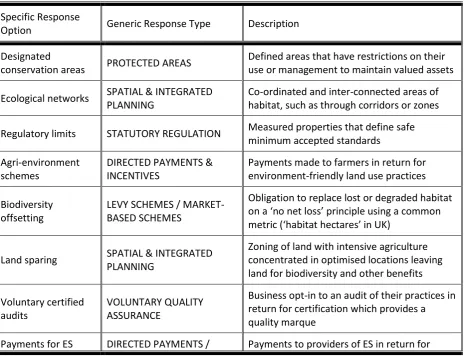
In addition, a set of more detailed interviews (13 in total) was arranged to identify strategic policy issues that entailed meeting long-term objectives and which may therefore require innovative responses. Interviews were used, along with document analysis, to identify a long-list of alternative response options structured by their type, current status, relevant governance arrangements, the time horizons associated with policy objectives, and the key scales associated with their implementation. This list was circulated around the stakeholder group who provided written feedback on a set of criteria for creating a representative short-list of policies and practices to be stress-tested. Criteria were based upon coverage of the different categories of a generic typology (Table 1; Brown and Everard, submitted), taking into account the stage of implementation (established or early stages), the spatial scale (including top-down and bottom-up options), the key actors involved, and the flexibility of the response option. Forty-eight response options were short-listed, although only 17 (Table 2), which cover nearly all categories of the generic typology, are discussed here due to space limitations.
A scoring system was developed to evaluate the performance of the short-listed response options under different scenarios, based on an ES framework which was consistent with the overall aims of the UK NEAFO programme. The rationale for scoring was based upon consistency with previous work that had synthesised UK evidence on recent trends in ES and therefore established an initial evaluation baseline (UK NEA, 2011). This scoring system was tested in a workshop involving a subset of stakeholders from the NEAFO groups, and refined based upon workshop participants’ feedback. The feedback highlighted the need for a workable method to be not overly complex and to recognise the limits of bounded rationality. The final approved scoring system had three criteria:
(i) Priority of the response option within each scenario as influenced by assumed policy paradigms and societal attitudes (NEAFO, 2014), scored as low, medium or high. Hence, those response options which are presumed to have lesser relevance in a scenario were scored on the basis that they were less likely to result in a negative/positive change for ES because they would not have support for implementation. (ii) Effect of the response option on provisioning, regulating, cultural and supporting services scored on a
5-point scale from very negative to very positive (--, -, O, +, ++). Whilst recognising the many diverse individual ES and their regional variations, the priority for systematic comparison of different response options meant an expedient grouping into four categories used by convention (MA, 2005). Supporting services were included to ensure these vital services, that underpin all others, were not overlooked in the evaluation of response options.
(iii) Confidence level based upon the quality of existing evidence, scored as low, medium or high. In determining confidence level, reference was made to the aforementioned synthesis exercise on current trends in ES delivery (UK NEA, 2011), as well as other relevant literature.
The socioeconomic scenarios were derived from the UK NEA scenario framework (Haines-Young et al., 2011) and used the same future time horizon of 2060 as agreed with stakeholders. Five scenarios were utilised (Table 3) including a type of business-as-usual scenario (‘Go with the Flow’: GWF). This number of alternative scenarios has generally been concluded as an acceptable compromise between a comprehensive representation of the future and information overload for stakeholders (Amer et al., 2013). Broad similarities exist between the UK NEA scenarios and
1
6
[image:6.595.55.521.414.772.2]generic scenario archetypes synthesised from a range of previous scenario exercises, including from the IPCC, to characterise comparable ‘world views’ on changing global drivers (Raskin, 2008; Hunt et al., 2012; Table 3) . For the climate change scenarios, it was assumed that a continuation of the current climatic trends defines a reference Low scenario, whilst a High scenario defines changes towards the upper end of the range of future estimates which was provided by using the 90% probability level data from the UK Climate Projections 2009 (UKCP09; Murphy et al., 2009).
Table 1 Generic response option types (Brown and Everard, submitted)
Types of Response Option
Statutory Regulation
Levy Schemes
Protected Areas
Common, Civil or Constitution Law
Directed Payments and Incentives
Market-based Schemes
Voluntary Quality Assurance
Spatial & Integrated Planning
Science and Technology Investment
Education and Knowledge Exchange
Networks and partnerships
Good management practice
Table 2 Specific response options used for the stress-testing
Specific Response
Option Generic Response Type Description
Designated
conservation areas PROTECTED AREAS
Defined areas that have restrictions on their use or management to maintain valued assets Ecological networks SPATIAL & INTEGRATED
PLANNING
Co-ordinated and inter-connected areas of habitat, such as through corridors or zones Regulatory limits STATUTORY REGULATION Measured properties that define safe
minimum accepted standards Agri-environment
schemes
DIRECTED PAYMENTS & INCENTIVES
Payments made to farmers in return for environment-friendly land use practices Biodiversity
offsetting
LEVY SCHEMES / MARKET-BASED SCHEMES
Obligation to replace lost or degraded habitat on a ‘no net loss’ principle using a common metric (‘habitat hectares’ in UK)
Land sparing SPATIAL & INTEGRATED PLANNING
Zoning of land with intensive agriculture concentrated in optimised locations leaving land for biodiversity and other benefits Voluntary certified
audits
VOLUNTARY QUALITY ASSURANCE
Business opt-in to an audit of their practices in return for certification which provides a quality marque
7
(output-based) MARKET-BASED SCHEMES ongoing delivery of services to a nominal standard
Urban ES SPATIAL & INTEGRATED PLANNING
Schemes to recognise provision of ES in urban areas and formalise their role in urban planning documents
Precision farming SCIENCE & TECHNOLOGY
Use of high-resolution data on soil and agronomic properties to direct farm management (eg. fertiliser application) Managed coastal
realignment
SPATIAL & INTEGRATED PLANNING
Planned movement of coastal defences inland to allow for sea-level rise
Quotas STATUTORY REGULATION Allocation of specific quantities of a resource or service to each user
Advisory services EDUCATION AND
KNOWLEDGE EXCHANGE
Extension services that provide customised advice to managers or the public to improve awareness and uptake
Green and blue infrastructure
SPATIAL & INTEGRATED PLANNING
Combined networks based upon greenspace and water bodies to maximise connectivity in planning frameworks
Natural flood management
GOOD MANAGEMENT PRACTICE
Schemes that aim to maximise the flow regulation role of the natural environment without requiring hard engineering Water demand
management STATUTORY REGULATION
Planned compulsory use of water efficiency measures and metering to reduce water use Community
partnerships
NETWORKS & PARTNERSHIPS
8
Table 3. Summary storylines for the five UK NEA (UK NEA, 2011) scenarios used in the analysis.
2.2 Evaluating response options
A sequence of logical steps was used to progressively analyse response options at national scale against different dimensions of change:
(i) Response options were evaluated assuming a continuation of current socioeconomic and climate trends (i.e. GWF / Low Climate Change). This provides a Reference scenario.
(ii) Response options were evaluated assuming current socioeconomic trends and a higher magnitude of climate change (GWF / High Climate Change).
(iii) Response options were evaluated against the changing socioeconomic drivers implied by the other scenarios (Nature@Work (N@W), Local Stewardship (LS), World Markets (WM), National Security (NS)) based upon the Low Climate Change scenario.
(iv) Response options were evaluated against the changing socioeconomic drivers implied by the other scenarios (N@W, LS, WM, NS) in combination with the High Climate Change scenario.
The steps in the method therefore increase the level of external change compared to the Reference scenario. Evaluation was undertaken by a team of scientific experts specialising in different areas of UK sectoral policy (agriculture, forestry, water, biodiversity, urban, coasts and marine), with at least two team members having expertise in each sector. First, each response option was scored independently by a sectoral expert. Second, the individual scoring was compared with at least one other expert per sector, and the reasoning and justification for the scores discussed and a consensus reached. Finally, the scoring was compared across sectors in a 2-day meeting
Go with the Flow: (GWF): This represents a forward projection of current policy frameworks and decision-making paradigms. Environmental improvement is considered important but society and industry are reluctant to adopt new approaches that would mean radical change. Many decisions are made in a reactive or incremental mode with some regions increasingly dependent on others to meet their needs.
Nature@Work (N@W) : Maintaining and enhancing the output of ES in response to climate change and other drivers is a key priority. Emphasis is placed on the wider benefits from multifunctional landscapes and the sea rather than just conservation of habitats and species. Hence nature is valued increasingly based upon what it provides and a careful evaluation of the trade-offs is involved. Similar to IPCC SRES B1 or ‘Global Sustainability’ (cf. Hunt et al., 2012).
World Markets: (WM): The dominant drivers are the complete liberalisation of trade (e.g. removal of agricultural subsidies) and the push for economic growth creating a consumption-led society. Technological development is high based mainly on private funding, with increased commoditisation of ES. Competition for land is often high with the environment as a lesser priority unless it can deliver economic growth. Similar to IPCC SRES A1 or Global Markets’ (cf. Hunt et al., 2012).
National Security: (NS): Self-sufficiency is a primary concern with food and energy security the main priorities. Protectionism and trade barriers are imposed. Technological development is state funded and many
industries (including agriculture) are subsidised. Efficiency concerns mean that resource use is constrained with society less profligate because of economic necessity. Similar to IPCC SRES A2 or ‘Continental Barriers’ (cf. Hunt et al., 2012).
9
where the scoring for each sector was discussed to ensure that the method had been applied consistently across policy areas. Inevitably there are degrees of subjectivity in this assessment, as introduced by the generalisation process, but its systematic and deliberative nature offers an important resource to policy makers who are required to develop long-term strategies and solutions now, irrespective of a lack of definitive knowledge on ES or future conditions.
The evaluation was peer-reviewed by members of the Expert group and presented to the Stakeholder Group for final validation. This resulted in further minor refinement of some of the scoring and levels of confidence for the evidence base with confidence reduced to a lower level when scoring was contested, evidence limited, or results difficult to generalise due to context-dependence factors.
4 Results
4.1 Reference Scenario (‘Go with the Flow’ and Low Climate Change)
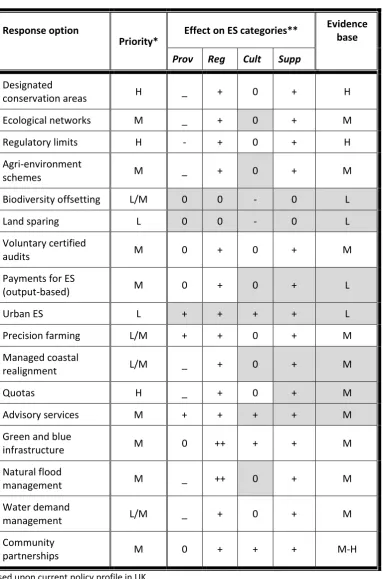
As shown in Table 4a, many of the response options were identified as involving trade-offs between different ES categories. Trade-offs are particularly apparent for those response options that enhance regulating or supporting ES at the expense of constraining provisioning ES by imposing restrictions on activities associated with food or fibre production or on water use (e.g. regulatory limits; designated areas; ecological networks; quotas). Another sub-group of response options, that feature targeted small-scale interventions (e.g. directed payments; precision farming), were identified as enhancing or maintaining regulating/supporting ES without necessitating a negative effect on provisioning ES. However, net benefits from such small-scale interventions may only occur within the target areas and there is as yet only limited evidence of such ‘win-win’ situations that maximise benefits across all ES categories being achieved in practice (e.g. Engel et al., 2008); therefore, some uncertainty remains as to whether large-scale benefits would be universally achieved. Spatial targeting through integrated management interventions (e.g. natural flood management; green/blue infrastructure) were also identified as being particularly beneficial for enhancement of regulating ES but with likely reductions in provisioning ES, although there is some evidence that trade-offs could be minimised with integrated landscape-scale planning to better coordinate modified land use practices (e.g. Hodder et al., 2014; Reed et al., 2014).
For other responses, including offsetting or land sparing, the net large-scale effect was assumed to be neutral, based upon their design principles of ‘no net loss’, at least amongst services that are more easily defined such as regulating and provisioning ES. However, a possibility of indirect negative effects from these response options on cultural ES was identified (Table 4a) because the less tangible and localised benefits derived from cultural ES are not usually explicitly incorporated into such schemes, particularly if they are administered over larger scales. Furthermore, an assumption of ‘no net loss’ being maintained over the longer term can only be supported with limited confidence, even with a forward projection of current trends, as ecosystem dynamics imply some change is inevitable; mechanisms to adjust for change are yet to be factored into design of ‘no net loss’ initiatives (e.g. offsetting:. McKenney and Keisicker, 2010). The development of more novel response options, such as enhancement of urban ES through integration with built infrastructure (e.g. sustainable drainage systems; green roofs) was suggested to potentially benefit all types of services, often because they are typically starting from a low or declining base (UK NEA, 2011). However, although the evidence base for urban ES is expanding it remains rather asymmetric with much less knowledge on ES with a non-economic value (Gómez-Baggethun and Barton, 2013), meaning there is lower confidence as to whether the full potential for restoration of urban ES can be realised (Lundy and Wade, 2011). By contrast, well-established responses, such as designated conservation areas or statutory regulation, are supported by a rich evidence base suggesting higher levels of confidence that, based on current trends, they can maintain biodiversity and associated regulatory and supporting ES if fully implemented, monitored and enforced (e.g. Coetzee
10
restrictive to facilitate natural adaptation through species dispersal and ecosystem genetic diversity, even with current climate trends, imply that further development of ecological networks in the wider landscape will be also required (Lawton et al., 2010).
Across the majority of the response options investigated here, the outcomes for cultural ES were identified as of higher uncertainty, primarily because they are usually considered a side-effect of the main scheme objectives and they have a high degree of local context-dependency (Chan et al., 2012). Community partnerships and advisory services are identified as notable exceptions because they may be developed opportunistically to recognise the importance of cultural ES at the local scale as crucial influences in motivating pro-environmental actions (Pleininger
et al., 2013). At key locations, designated status (e.g. UNESCO ‘World Heritage Site’) may also enable more explicit
11
Table 4: Evaluation of selected response options based upon the ‘Go with the Flow’ scenario with (a) Low Climate Change (b) High Climate Change.
(a)
Response option
Priority* Effect on ES categories**
Evidence base
Prov Reg Cult Supp
Designated
conservation areas H _ + 0 + H
Ecological networks M _ + 0 + M
Regulatory limits H - + 0 + H
Agri-environment
schemes M _ + 0 + M
Biodiversity offsetting L/M 0 0 - 0 L
Land sparing L 0 0 - 0 L
Voluntary certified
audits M 0 + 0 + M
Payments for ES
(output-based) M 0 + 0 + L
Urban ES L + + + + L
Precision farming L/M + + 0 + M
Managed coastal
realignment L/M _ + 0 + M
Quotas H _ + 0 + M
Advisory services M + + + + M
Green and blue
infrastructure M 0 ++ + + M
Natural flood
management M _ ++ 0 + M
Water demand
management L/M _ + 0 + M
Community
partnerships M 0 + + + M-H
*Based upon current policy profile in UK
** ES categories: Prov Provisional; Reg Regulating; Cult Cultural; Supp Supporting
KEY L: Low: M: Medium H: High; -- Very Negative; - Negative; 0 Limited net change; + Positive; ++ Very Positive; -/+ Variable
12 (b)
Response option
Priority* Effect on ES categories**
Evidence base
Prov Reg Cult Supp
Designated areas H _ + 0 0 M
Ecological networks M _ ++ 0 + M
Regulatory limits H - + 0 0 M
Agri-environment
schemes M _ + 0 + M
Biodiversity offsetting L/M 0 0 - 0 L
Land sparing L + - - - L
Voluntary certified
audits M 0 + 0 + M
Payments for ES
(output-based) M 0 + 0 + L
Urban ES L - + -/+ 0 L
Precision farming L/M ++ + 0 + M
Managed coastal
realignment L/M _ ++ 0 + M
Quotas H - + - + L
Advisory services M + + + 0 M
Green/blue
infrastructure M 0 ++ + + M
Natural flood
management M _ ++ -/+ + M
Water demand
management L/M _ + -/+ + M
Community
partnerships M 0 + + + M-H
*Based upon current policy profile in UK
** ES categories: Prov Provisional; Reg Regulating; Cult Cultural; Supp Supporting
KEY L: Low: M: Medium H: High; -- Very Negative; - Negative; 0 Limited net change; + Positive; ++ Very Positive; -/+ Variable
13 4.2 ‘Go with the Flow’ and High Climate Change
Performance of response options for the High Climate Change scenario combined with current (GWF) socioeconomic trends is shown in Table 4b. Here there is inevitably more uncertainty regarding ES outcomes because evidence based upon recent trends requires extrapolation to a faster rate of climate change. Nevertheless, it can reasonably be inferred that challenges noted for the Low climate scenario are likely to be exacerbated under the High climate scenario, particularly if the response has attributes that imply it may be slow to adapt to change (Brown and Everard, submitted). Hence, adaptability to maintain or enhance ES may be particularly enabled by responses that allow both spatial differentiation and temporal adjustments, most notably for schemes that can be adjusted locally to address heterogeneous impacts of climate change that vary with local circumstances. These variable but rapidly changing conditions are more likely to challenge approaches based upon homogeneity and universally-defined standards (e.g. regulatory limits) or a rigid and fragmentary designation of protected areas which constrain ecological adjustment to occur at specific locations rather than across the wider landscape (Hannah, 2008; Gaston et al., 2008). They would also be likely to mean greater uncertainty of ES outcomes for current implementation of ‘no net loss’ schemes, such as offsetting or land sparing, as they presently do not incorporate adaptive management. Hence response options such as ecological networks, managed coastal realignment, green/blue infrastructure and natural flood management, were identified as beneficial for ES in a High climate scenario because of in-built flexibility to adjust to local circumstances and to temporal change (e.g. Esteves et al., 2013; Hansen and Pauleit, 2014; Iacob et al., 2014). Such adaptive management would have increased opportunity to enhance overall system resilience (including ecosystem integrity, functioning, and supporting ES) in this scenario although realisation of this would also be likely to require larger-scale and more integrated planning than occurs at present in the UK (e.g. Hodder et al., 2014).
4.3 Other socioeconomic scenarios and Low Climate Change
Further evaluation is provided through prospective changes in drivers from the other socioeconomic scenarios combined with a Low Climate Change scenario (Figure 1). The more robust response options across the range of scenarios were those identified as providing most scope for net ES gains, namely: ecological networks, voluntary certification, Payments for ES (PES), urban ES, advisory services and community partnerships; each of these has some flexibility to adjust to a range of different socioeconomic conditions. Trade-offs between ES categories compared to the Reference scenario would be strongly influenced by the scenario ‘world view’. Hence, the more robust response options were identified to benefit ES categories other than provisioning in the N@W and LS scenarios (notably regulating/supporting ES in N@W and cultural ES in LS). By contrast, provisioning ES are more enhanced in the WM and NS scenarios, although several response options were evaluated as having limited relevance and efficacy in the WM scenario. In the NS scenario, co-benefits for regulating ES would be likely to accrue from those that concurrently enhance productivity of provisioning ES (e.g. water flow regulation, pollination).
Two socioeconomic scenarios, N@W and LS, emerged as more receptive to the broad suite of response options, resulting in the most positive and balanced outcomes across the range of ES categories. In the WM and NS scenarios, some response options were of low relevance or implied to have negative effects on ES unless they had realisable economic value or a strong link with food and energy security respectively (both these priorities tend to emphasise increased provisioning ES). Cultural ES were identified to be particularly vulnerable to changes in the WM and NS scenarios because immaterial benefits were considered likely to be lost when more material priorities dominate decision agendas. The restricted (market-based) group of response options assumed to be most favoured in a WM scenario has a rather limited evidence base for efficacy which, together with exposure to market volatility effects, implies a high risk strategy for sustaining many ES.
14
Scenario: Nature@Work
Effect on ES categories**
Response (with
priority*) Very Negative Negative
Limited net
change Positive Very Positive
Designated
conservation areas (M)
Ecological networks (H)
Regulatory limits (H)
Agri-environment schemes (H)
Biodiversity offsetting (M)
Land sparing (M)
Voluntary certified audits (M)
Payments for ES (H)
Urban ES (H)
Precision Farming (M)
Managed coastal realignment (M)
Quotas (M)
Advisory services (M)
Green/blue infrastructure (H)
Natural flood management (H)
Water demand management (H)
Community partnerships (M)
*Assumed priority of response option in scenario (H: High M: Medium L: Low)
15
Scenario: World Markets
Effect on ES categories**
Response (with
priority*) Very Negative Negative
Limited net
change Positive Very Positive
Designated
conservation areas (L)
Ecological networks (L)
Regulatory limits (L)
Agri-environment schemes (L)
Biodiversity offsetting (H)
Land sparing (H)
Voluntary certified audits (L)
Payments for ES (H)
Urban ES (M)
Precision farming (H)
Managed coastal realignment (L)
Quotas (L)
Advisory services (L)
Green/blue infrastructure (L)
Natural flood management (L)
Water demand management (L)
Community partnerships (L)
*Assumed priority of response option in scenario (H: High M: Medium L: Low)
16
Scenario: National Security
Effect on ES categories**
Response (with
priority*) Very Negative Negative
Limited net
change Positive Very Positive
Designated
conservation areas (M)
Ecological networks (M)
Regulatory limits (M)
Agri-environment schemes (L)
Biodiversity offsetting (M)
Land sparing (M)
Voluntary certified audits (L)
Payments for ES (M)
Urban ES (M)
Precision farming (M)
Managed coastal realignment (M)
Quotas (M)
Advisory services (M)
Green/blue infrastructure (M)
Natural flood management (M)
Water demand management (M)
Community partnerships (M)
*Assumed priority of response option in scenario (H: High M: Medium L: Low)
17
Scenario: Local Stewardship
Effect on ES categories**
Response (with
priority*) Very Negative Negative
Limited net
change Positive Very Positive
Designated
conservation areas (M)
Ecological networks (M)
Regulatory limits (L)
Agri-environment schemes (M
Biodiversity offsetting (L)
Land sparing (L)
Voluntary certified audits (H)
Payments for ES (L)
Urban ES (M)
Precision farming (L)
Managed coastal realignment (M)
Quotas (L)
Advisory services (H)
Green/Blue infrastructure (L)
Natural flood management (H)
Water demand management (H)
Community partnerships (H)
*Assumed priority of response option in scenario (H: High M: Medium L: Low)
18 4.4 Other socioeconomic scenarios and High Climate Change
Outcomes for the different socioeconomic scenarios combined with High Climate Change are dominated by major uncertainties due to the amplified complexity and rate of change of interactions between socioeconomic and climate drivers. In this case, the level of stress for ES may be considered extreme and the possibility of threshold effects much more likely (hence indicative ‘results’ become rather speculative and are not shown here). However, advantages of adaptability and ecosystem resilience highlighted through previous results become particularly relevant: hence, those response options that are flexible and can incorporate adaptive management to adjust to the rapid rate of change are likely to be the more useful for sustaining ES. This scenario also serves to identify limits to adaptation, particularly for current versions of response options.
5 Discussion
5.1 Methodological learning
Previous studies have highlighted a frequent mismatch between the development of scenario exercises and the practicalities of decision-making (e.g. Volkery et al., 2008; Berkhout et al., 2014). The method presented here differs from a conventional assessment by placing the focus on the performance of the response options (i.e. beginning with ‘R’ in a DPSIR framework2). The response options were tested against possible future change using scenarios to screen (i.e. ‘stress-test’) for the better performing options, and those that may be considered robust across a range of alternative futures. In terms of its scope, this stress-testing method is more consistent with approaches described as ‘policy-first’ rather than ‘science-first’ (Dessai and Hulme, 2007): a science-first method would first define future changes and resultant impacts before subsequently assessing responses to these impacts (i.e. beginning with the ‘D’ in a DPSIR framework). Scoping of potential response options as a procedural first step is considered more consistent with practical decision-making and the importance of maintaining stakeholder relevance, including that some prospective response options are pre-determined due to legacy issues, and that bounded rationality will have an influence on stakeholder engagement.
There are many generalisations and caveats involved with scenario analysis, suggesting that it is more appropriate to consider it as a heuristic and deliberative tool to guide options appraisal rather than to provide definitive or ‘optimal’ results. Evaluation in a participatory setting, such as in workshops, can enable greater discussion of reasoning, informed by a wider spectrum of knowledge, and therefore added value is achieved through a constructive learning process (Chermack and van der Marwe, 2003), rather than simply assuming outputs as a specific result or single decision point. In particular, pre-existing preferences and even decision criteria may change during the scenario analysis process as knowledge is shared (Harries, 2003). It has long been recognised that policy analysis in an uncertain world is often better supported by exploratory approaches rather than designing consolidative models that aim to provide ‘definitive’ answers (Bankes, 1993). This is consistent with the evolution of integrated assessment frameworks such as DPSIR from an original expert-driven, evidence-focused mode of application towards their use as a heuristic ‘interpretivist’ device to facilitate engagement and communication with different stakeholders (Atkins et al., 2011). Similar findings have been advanced for the use of economic valuation of ES in appraisals (e.g. Chee, 2004). This heuristic and pluralistic mode of assessment is consistent with principles 11 (taking account of multiple forms of knowledge) and 12 (participation in decision-making) of the Ecosystem Approach (CBD, 2004).
2
19
Scenarios should be relevant, plausible, different, challenging and internally consistent (van der Heijden, 1996) but this can mean stakeholder engagement is time- and resource-intensive due to the complex issues involved. In the present study, the benefits from an iterative scenario analysis process were particularly apparent with the inclusion of the Reference scenario in the stress-testing method. This was found to enhance stakeholder dialogue as it was considered a ‘realistic’ intermediary for making the other scenarios appear less ‘abstract’. The enduring notion of policy development as an incremental business-as-usual process of ‘muddling through’ (Lindblom, 1959, 1979) became adopted as a pragmatic structure on which to develop a forward outlook and counterfactual statements. Each alternative scenario was considered to be a plausible description of the future with no likelihoods assigned. From a rational perspective, the notion of such a Reference scenario may be suggested as becoming increasingly less plausible in the future, as current trends are unlikely to continue due to the scale and interaction of expected global changes. However, based upon the three key criteria identified by Cash et al. (2003) for successful science-policy interaction, the lesser scientific credibility of a Reference scenario needs to be balanced against its perceived increased legitimacy and salience for stakeholders. The use of a Reference scenario has the advantage of anchoring dialogue within the familiarity of the current decision-making context, and then identifying additional decision requirements beyond current norms. This can highlight potential limitations and missed opportunities from stakeholders’ existing mental models remaining fixed around business-as-usual, as an integral step to considering a broader range of alternative futures (Chermack, 2004; van Drunen et al., 2011). Such an approach recognises that proceeding prematurely to more challenging alternative futures can risk disengaging stakeholders because the scenarios appear too psychologically ‘distant’ or ‘abstract’ from the current situation (cf. Liberman and Trope, 2008). A dynamic reference baseline may also help to overcome limitations of static baselines due to inherent systems variability or shifting stability (Plummer and Armitage, 2007). Incremental decision-making is acknowledged to have important deficiencies, such as perpetuating current inadequate governance and institutional arrangements (Kates
et al., 2012), but our experience has been that recognising associated fixed perceptions is a crucial step in engaging
stakeholders in deliberation of more transformative solutions for change management. In the presence of bounded rationality, interpretation of novel future situations proceeds through reasoning by similarity and simulation rather than formal logic (Berkhout et al., 2014), and our findings emphasise the importance of reasoning by similarity in the first instances. Nevertheless, there is also a suggestion that the influence of incremental approaches may be more strongly instilled for policy-level stakeholders than at other levels of decision-making (e.g. local bottom-up initiatives), as recognised elsewhere (Marshall et al., 2012).
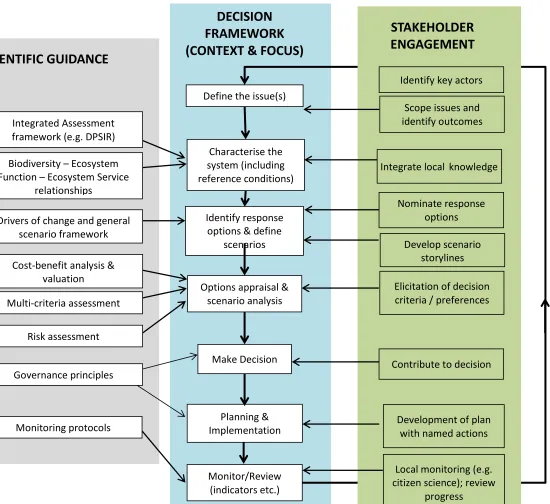
The coarse collation of ES into four categories has amalgamated a wide diversity of ES and within these categories the influence of specific response options may have a varying effect. A further stage of iterative analysis could therefore assess individual priority ES to further investigate trade-offs and synergies, although care must be taken not to pre-select these ‘priorities’ as initial assumptions may overlook other equally important but less obvious ES. Stakeholder deliberation can refine initial analysis by including further variants of response options, which may also help distinguish the relative importance of different drivers of change for a generic response option type. An iterative approach to scenario analysis that uses a policy-first screening process with stakeholder engagement to develop a focus on key ES would be consistent with a tiered sequence of options appraisal incorpoarting adaptive management. Scenario analysis would therefore be used alongside other tools including multi-criteria assessment, cost benefit analysis, life cycle assessment, risk assessment, environmental assessment and sustainability appraisal (Smith and Kerrison, 2013). Following this rationale, Figure 2 offers a proposed schematic framework for structuring decision appraisals using systemic scenario-based analysis of response options, integrating science and stakeholder perspectives. This may provide a general structure to guide further use of and learning from participatory scenario exercises in combination with integrated assessment and option appraisal tools (cf. Adelle et al., 2012; Pope et al., 2013).
20
Response options have different capabilities to manage change through adjustment to three key factors: different geographic contexts; heterogeneity of risk/opportunity; and future uncertainty. Robust ‘no-regret’ options can be characterised as those that deliver ES improvements or safeguards not just based upon current trends but also in alternative futures (Hallegatte, 2009). In the present study, although some candidate response options could be identified as relatively robust, none were identified as being a guaranteed success in all futures, and most result in trade-offs between ES categories. Although some trade-offs are explicit components of the response, many also represent implicit untested assumptions. Previous work has shown that resolving trade-offs between regulating ES and provisioning ES are a key issue for decision-makers in choosing between intervention or non-intervention strategies (Newton et al., 2012). However, expected impacts on supporting ES are often ‘taken for granted’, based particularly on their association with regulating ES, despite a lack of corroborating evidence for cause-effect relations and the longer time periods involved (Rodríguez et al., 2006).
Market-based schemes can leverage new investment in ES and can provide efficiency-based gains, but may be too exposed to market volatility to form a reliable basis by themselves for managing change. These schemes were therefore identified as risky, particularly for those who bear this risk, and they may also result in unwanted trade-offs between marketed and non-marketed services, especially across scales. For example, large-scale efficiencies generated by markets for some ES (e.g. carbon storage) may develop at the expense of locally important services, including those that are less tangible and difficult to convert into market-based metrics (e.g. cultural ES and supporting ES). At present, over-emphasis on carbon storage in some initiatives compared to other ES benefits has been characterised as producing ‘carbon blinkers’ (Wynne-Jones, 2013). This has important implications for the design of market-based schemes such as offsetting and PES. Using one ES (e.g. carbon: Bonn et al., 2014) as a mechanism to ‘piggy-back’ others through the same service provider-beneficiary agreement may not be in accord with social preferences (Martín-López et al., 2012) or may potentially degrade other ES that operate at different spatial and temporal scales. Market-based schemes based upon notional exchangeable units may also be in conflict with traditional conservation objectives and legislation, particularly those that seek to protect biodiversity based upon the location of rare and endangered species (Reid, 2013a; Quine et al., 2013).
Statutory instruments, such as regulation, can maintain minimum standards if fully implemented and enforced, but environmental change poses important challenges for these types of response options in terms of how much change to accept and how much to regulate against (Holling and Meffe, 1996). Acceptable levels of risk and notional ecosystem ‘health’ based upon past or present environments may not necessarily be the best guide for adaptation to the different conditions of the future (Dufour andPiegay, 2009; Wise et al., 2014). These challenges are likely to be severely exacerbated if the future is characterised by more rapid rates of change (climate or socioeconomic). For example, the setting of minimum river flows (i.e. ‘environmental flows’) and regulation of water abstraction will require adjustment for both socioeconomic drivers (e.g. increased agricultural demand) and climate change (e.g. hotter, drier summers) which may require adaptive revision of safety margins (e.g. ‘headroom’ concept) to maintain minimum standards for water-related ES (Pahl-Wostl et al., 2012). Whilst statutory regulation can be legally enforced, the legal process to define standards can be slow and subject to challenge, as well as raising issues of cost-effectiveness in a heterogeneous landscape. By contrast, more localised bottom-up initiatives can engage and catalyse local action to manage change based upon their local context, but their heterogeneity may be a disadvantage if it leads to missed synergies or inefficiencies that could be avoided through larger-scale coordination.
21
resilience with a minimum of externalities, but their heterogeneity and dependence on informed (often voluntary) leadership (Davies, 2002) also suggest a role for top-down guidance to maintain minimum standards. Secondly, market-based responses, despite the additional flexibility and investment they can provide, need to be managed by appropriate regulation to control changes in risk and ensure safe margins for all categories of ES. This would also help to guarantee that any investment covers the risks associated with future sustainability of ES provision as well as present-day efficiencies (Burkhard et al., 2012). Review of different PES schemes has indicated the more successful of these tend not to be pure provider-beneficiary (Coeasean) schemes, but those with intermediary involvement (e.g. government agencies), longer-term contracts, co-benefits, voluntary entry, and design of PES as output-based schemes (Sattler et al., 2013). Quality standards may be further supported through voluntary quality assurance schemes linked to environmental sustainability, such as branding and marques. Alternatively, hybrid response option design may be exemplified by the underpinning of voluntary initiatives by legal mechanisms, as exemplified by voluntary incentive-based land transfers to alternative uses being supported by legally-binding ‘conservation covenants’ (Reid, 2013b).
The development of complementary response options may be particularly useful in advancing cross-sectoral initiatives that use the shared vision of an Ecosystem Approach to co-ordinate change management. Linked initiatives such as green and blue infrastructure, agri-environment schemes that enhance ecological networks, integrated spatial planning and local/regional partnerships, may be particularly useful in this context, whilst also bridging rural and urban areas in balancing long-term supply and demand of ES.
5.3 Designing complementary responses
Adoption of a systems-based structure consistent with the Ecosystem Approach can further help in identifying complementary response options that enhance dynamic resilience and adaptability of ES (Plummer and Armitage, 2007; Biggs et al., 2012; Brown and Everard, submitted). Hence, resilience may be strongly associated with schemes that maintain basic ecosystem functioning (i.e. supporting ES) as they are likely to be beneficial in all circumstances of change. Adaptability is also linked to sustainable adjustments in patterns of demand for ES which may be more effectively implemented through service-based schemes (e.g. PES) that explicate ES values and provide a clearer role for human beneficiaries in decision making. However, resilience concepts have not yet been incorporated into economic valuation procedures to capture monetary (and non-monetary) benefits of longer-term stability for ES delivery (Fisher et al., 2008), representing an important research and policy development gap.
22
economic self-interest, reinforcing the importance of being aware of shared and social benefits, as particularly provided by cultural and provisioning ES (Kenter et al., 2014).
Fiske (2004) asserted that belonging (i.e. identity) is the primary core motive which the other motives act to support. This assertion would be consistent with the poor uptake of incentive schemes that are not in sympathy with local identities, as exemplified by limited success from agri-environment schemes if they act against the primary cultural identity of farmers as food producers (Burton et al., 2008). Similarly, although investment in science and technology can potentially enhance other responses regardless of the exact pathway of change, the provision of scientific or technical information by itself is also unlikely to lead to successful uptake of adaptive responses unless accompanied by enabling networks or institutions that engage and build capacity to use that information (Farrell et al., 2001; Sarewitz and Pielke, 2007). For example, social factors such as experiential learning have been identified as key factors in the outcomes from agri-environment schemes (McCracken et al., 2015). Responses that combine scientific with other forms of knowledge, and that use effective knowledge exchange mechanisms to link with good management practices are therefore complementary initiatives. Hence, the use of social norms, habit formation and networking based upon local identity (Ostrom, 2000) represent under-utilised policy tools to encourage sustainable delivery of ES. This further emphasises the added value of place-based schemes and the use of spatial targeting to identify the right mix of response options that can function across sectors and link multiple scales (Berkes, 2002).
Evaluation and complementarity of response options is therefore currently particularly constrained by a relative lack of knowledge on cultural ES and supporting ES, which challenges the aspiration of integrated assessment to identify a sustainable balance of services. Knowledge of cultural ES is particularly important for understanding the role of local identity and community engagement as a key factor in managing change. Similarly, knowledge of supporting ES is crucial for enhancing ecosystem resilience and buffering against abrupt change, including concomitant risks to the final services, i.e. those that are more directly associated with human wellbeing (sensu UK NEA, 2011). Moves towards an increased use of adaptive management to manage change will be highly dependent on incorporation of this knowledge and improved monitoring procedures to better collectively interpret system dynamics and the effectiveness of response options in different socio-ecological contexts.
5 Conclusions
23
circumstances, recognizing the added value of cultural ES and supporting ES respectively. However, acknowledgement of the key role of local identity and social capital in stimulating collective action to adapt to change across the full range of ES has to-date often been understated in policy initiatives.
Acknowledgments: Funding for the research was provided by Defra, the Welsh Government, ESRC and NERC through the UK National Ecosystem Assessment Follow-on project, and by the Scottish Government through its Strategic Research Programme on Environmental Change. We thank the stakeholders involved in the UK NEA workshops and interviews for their guidance on evaluating response options and for improvements in the methodology.
References
Adelle, C., Jordan, A., Turnpenny, J., 2012. Proceeding in parallel or drifting apart? A systematic review of policy appraisal research and practice, Environment and Planning C 30, 400-414.
Amer, M., Daim T.U., Jetter, A. , 2013. A review of scenario planning. Futures 46, 23–40.
Atkins, J.P., Gregory, A., Burdon, D., Elliott, M., 2011. Managing the marine environment: is the DPSIR framework holistic enough? Systems Research and Behavioral Science 28, 497–508.
Bankes S., 1993. Exploratory modelling for policy analysis. Operational Research 41, 435–449
Berkes, F., 2002. Cross-scale institutional linkages: perspectives from the bottom up. In Ostrom, E., Dietz, T., Dolšak, N., Stern, P.C., Stonich, S. and Weber E.U. (eds.). The drama of the commons. National Academy Press, Washington, D.C., USA. pp 293-319.
Berkhout, F., Hertin, J., Jordan, A., 2002. Socio-economic futures in climate change impact assessment: using scenarios as ‘learning machines’. Global Environmental Change: Human & Policy Dimensions 12, 83–95.
Berkhout, F., van der Hurk, B., Bessenbinder, J., de Boer J., Bregman, B, van Drunen, M., 2014. Framing climate uncertainty: socio-economic and climate scenarios in vulnerability and adaptation assessments. Regional
Environmental Change 14, 879–893.
Biggs, R., Schlüter, M., Biggs, D., Bohensky, E.L., Burnsilver, S., Cundill, G., Dakos, V., Daw, T.M., Evans, L.S., Kotschy, K., Leitch, A.M., Meek, C., Quinlan, A., Raudsepp-Hearne, C., Robards, M.D., Schoon, M.L., Schultz, L., West, P.C., 2012. Toward principles for enhancing the resilience of ecosystem services. Annual Review of Environment and
Resources 37, 421-448.
Bonn, A., Reed, M., Bain, C., Evans, C., Joosten, H., Bain, C., Farmer, J., Emmer, I., Couwenberg, J., Moxey, A., Artz, R., Tanneberger, F., von Unger, M., Smyth, M-A, Birnie, D., 2014. Investing in nature: developing ecosystem markets for peatland restoration. Ecosystem Services 9, 54-65.
Brown, I., Castellazzi, M., 2014. Scenarios analysis for regional decision making on sustainable multifunctional landscapes. Regional Environmental Change 14, 1357-1371
Brown, I., Everard M., submitted. A working typology of response options to manage environmental change and their scope for complementarity using an Ecosystem Approach. Environmental Science & Policy
Burkhard, B., de Groot, R., Costanza, R., Seppelt, R., Jørgensen, S.E., Potschin. M., 2012. Solutions for sustaining natural capital and ecosystem services. Ecological Indicators 21, 1-6.
24
Carpenter, S. R., Bennett, E.M., Peterson, G.D., 2006. Scenarios for ecosystem services: an overview. Ecology and
Society 11: 29. [online]http://www.ecologyandsociety.org/vol11/iss1/art29/
Carpenter, S.R., Mooney, H.A., Agard, J., Capistrano, D., Defries, R.S., Díaz, S., Dietz, T., Duraiappah, A.K., Oteng-Yeboah, A., Pereira, H.M., Perrings, C., Reid, W.V., Sarukhan, J., Scholes, R.J., Whyte, A., 2009. Science for managing ecosystem services: Beyond the Millennium Ecosystem Assessment. Proceedings of the National Academy of
Sciences USA 106, 1305–1312.
Cash, D.W., Clark, W.C., Alcock, F., Dickson, N.M., Eckley, N., Guston, D.H., Jaeger, J., Mitchell, R.B., 2003. Knowledge systems for sustainable development. Proceedings of the National Academy of Sciences USA 100, 8086–8091
CBD, 2004. Principles of the Ecosystem Approach. 7th Conference of Parties to the UN Convention on Biological
Diversity. http://www.cbd.int/ecosystem/principles.shtml [Accessed 13th October, 2014].
Chan, K.M.A., Satterfield, T., Goldstein, J., 2012. Rethinking ecosystem services to better address and navigate cultural values. Ecological Economics 74, 8–18.
Chee, Y.E., 2004. An ecological perspective on the valuation of ecosystem services. Biological Conservation 120, 549-565.
Chermack, T., 2004. Improving decision-making with scenario planning. Futures 36, 295–309.
Chermack, T. J., van der Merwe, L., 2003. The role of constructivist learning in scenario planning. Futures, 35, 445-460.
Coetzee, B.W.T., Gaston, K.J., Chown, S.L., 2014. Local Scale Comparisons of Biodiversity as a Test for Global Protected Area Ecological Performance: A Meta-Analysis. PLoS ONE 9, e105824. doi:10.1371/journal.pone.0105824. Connick, S., Innes J.E., 2003. Outcomes of collaborative water policy making: applying complexity thinking to
evaluation. Journal of Environmental Planning and Management 46, 177–197.
Cortina, J., Maestre, F.T., Vallejo, R., Baeza, M.J., Valdecantos, A., Pérez-Devesa, M., 2006. Ecosystem structure, function, and restoration success: Are they related? Journal for Nature Conservation 14, 152–160.
Davies, A., 2002. Power, politics and networks: shaping partnerships for sustainable communities. Area 34, 190-203. Dessai, S., Hulme, M., 2007. Assessing the robustness of adaptation decisions to climate change uncertainties: A case study on water resources management in the East of England. Global Environmental Change 17, 59-72.
Dufour S., Piegay H.,2009. From the myth of a lost paradise to targeted river restoration: forget natural references and focus on human benefits. River Research and Applications 25, 568–581.
Engel, S., Pagiola, S., Wunder, S., 2008. Designing payments for environmental services in theory and practice: an overview of the issues. Ecological Economics 65, 663-674.
Esteves, L.S., 2013. Is managed realignment a sustainable long-term coastal management approach? Journal of
Coastal Research 65, 933-938.
Farrell, A., Van Deveer, S.D., Jager, J., 2001. Environmental assessments: four under-appreciated elements of design.
Global Environmental Change 11, 311-333.
Fazey, I., Gamarra, J.G.P., Fischer, J., Reed, M.S., Stringer, L.C., Christie, M., 2010.Adaptation strategies for reducing vulnerability to future environmental change. Frontiers in Ecology and the Environment 8, 414–422.
Fehr, E., Rockenbach, B., 2003. Detrimental effects of sanctions on human altruism. Nature 42, 137–140.
25
Ecosystem services and economic theory: integration for policy-relevant research. Ecological Applications18, 2050-2067.
Fiske, S.T. ,2004. Social beings: A core motives approach to social psychology. New York: Wiley.
Gaston K.J., Jackson, S.F., Nagy, A., Cantú-Salazar, L., Johnson, M., 2008. Protected areas in Europe: principle and practice. Annals New York Academy of Sciences 1134, 97-119.
Gigerenzer, G., Selten, R.,(2002. Bounded Rationality: The Adaptive Toolbox. MIT Press.
Gómez-Baggethun, E. Barton, D. N., 2013. Classifying and valuing ecosystem services for urban planning. Ecological
Economics 86, 235-245.
Haines-Young, R., Paterson, J., Potschin, M., Wilson, A., Kass, G., 2011. The UK NEA scenarios: Development of storylines and analysis of outcomes (Chapter 25). UK National Ecosystem Assessment: Technical Report. UNEP-WCMC, Cambridge, pp. 1195-1264.
Hallegatte, S., 2009. Strategies to adapt to an uncertain climate change. Global Environmental Change 19, 240-247. Hannah, L., 2008. Protected areas and climate change. Annals New York Academy of Sciences 1134, 201-12.
Hansen, R., Pauleit, S., 2014. From multifunctionality to multiple ecosystem services? A conceptual framework for multifunctionality in green infrastructure planning for urban areas. Ambio43, 516-529.
Harries, C., 2003. Correspondence to what? Coherence to what? What is good scenario-based decision making?
Technological Forecasting and Social Change70, 797-817.
Hodder, K., Newton, A.C., Cantarello, E., Perrella, L., 2014. Does landscape-scale conservation management enhance the provision of ecosystem services? International Journal of Biodiversity Science, Ecosystem Services and
Management, 10, 71-83.
Holling, C.S., 2001. Understanding the complexity of economic, ecological, and social systems. Ecosystems 4, 390– 405.
Holling, C.S., Meffe, G.K., 1996. Command and control and the pathology of natural resource management.
Conservation Biology 10, 328-337.
Hunt, D.V.L., Lombardi, D.R, Atkinson S., 2012. Scenario archetypes: converging rather than diverging themes. Sustainability, 4, 740-772.
Kates, R.W., Travis, W.R., Wilbanks, T.J., 2012. Transformational adaptation when incremental adaptations to climate change are insufficient. Proceedings of the National Academy of Sciences USA 109, 19, 7156-7161.
Kenter, J.O., O'Brien, L., Hockley, N., Ravenscroft, N., Fazey, I., Irvine, K.N., Reed, M.S., Christie, M., Brady, E., Bryce, R., Church, A., Cooper, N., Davies, A., Evely, A., Everard, M., Fish, R., Fisher, J.A., Jobstvogt, N., Molloy, C., Orchard-Webb, J., Ranger, S., Ryan, M., Watson, V., Williams, S., 2015. What are shared and social values of ecosystems? Ecological Economics 111,86-99.
Lawton, J.W., Brotherton, P.N.M., Brown, V.K., Elphick, C., Fitter, A.H., Forshaw, J., Haddow., R.W., Hilborne, S., Leafe, R.N., Mace, G.M., Southgate, M.P., Sutherland, W.A., Tew, T.E., Varley, J., Wynne, G.R., 2010. Making space for nature: a review of England’s wildlife sites and ecological network. Report to Defra, London. http://archive.defra.gov.uk/environment/biodiversity/documents/201009space-for-nature.pdf Accessed 11th October 2014).
Lempert, R.J., Collins, M.T., 2007. Managing the risk of uncertain threshold responses: Comparison of robust, optimum, and precautionary approaches. Risk Analysis 27, 1009-1026.