PAPER • OPEN ACCESS
From composite material technologies to
composite products: a cross-sectorial reflection on
technology transitions and production capability
To cite this article: Anna P Chatzimichali and Kevin D Potter 2015 Transl. Mater. Res. 2 026001
View the article online for updates and enhancements.
Related content
Managing the technological and market uncertainty of composites innovation: a case study of composites manufacturers in Western Canada and interventions by a translational research centre
Janna Fabris, David Roughley, Anoush Poursartip et al.
-The changingpattern of innovation
P Jervis
-The magic cube: towards a theoretical framework to explain the disruptive potential of additive manufacturing
Johannes Gartner and Matthias Fink
-Recent citations
Real-time damage monitoring in trailing edge bondlines of wind turbine blades with triboluminescent sensors
Md Abu Shohag et al
-Kevin Potter
-Managing the technological and market uncertainty of composites innovation: a case study of composites manufacturers in Western Canada and interventions by a translational research centre
Janna Fabris et al
Transl. Mater. Res. 2 (2015) 026001
1. A brief introduction to composites: an industry of industries
Composite materials can offer significant benefits to a very diverse range of modern products. They contribute to the development of durable, lightweight and high-performance products, help to deliver a low-carbon economy and offer the potential to revolutionize high value industrial sectors. They present the opportunity to yield significant benefits in a variety of sectors (aerospace, automotive, wind energy, marine and construction). However, despite the fact that composite materials have been known for decades, the composites industry is still considered an industry in its infancy.
Unusual geometries, non-uniform weight distributions, directional strength and stiffness are the main advan-tages that composites can offer in existing or new products. Products made from composite range from aircraft components, boats, bike frames, bridges, wind turbine blades, and more recently car chassis. Examples of the use of composites can be found in the Boeing 787 Dreamliner and the Airbus A350 (Marsh 2007, Lu 2010). The largest
From composite material technologies to composite products: a
cross-sectorial reflection on technology transitions and production
capability
Anna P Chatzimichali and Kevin D Potter
Department of Aerospace Engineering, Advanced Composites Centre for Innovation and Science, University of Bristol Queen’s Building, University Walk, Bristol, BS8 1TR, UK
E-mail: [email protected] and [email protected]
Keywords: material technology transitions, composites manufacturing strategy, production capability, industrialization
Abstract
Materials, since the dawn of time, have played a crucial role in the development of civilization. Pre-history ages are fundamentally characterized by the material humans mastered, while the transitions to new materials have always marked a different socio-technical order. In this work we are going to investigate a relatively new material class, composites, in order to explain the issues the industry is currently facing. We are going to discuss material in the context of developing products that take full advantage of the benefits that composites can offer.
The main idea behind this work is to understand how composite material technologies create growth and how the properties of those materials influence production capability and manufacturability. This work is the result of the EPSRC Centre for Innovative Manufacturing in Composites Platform research in the UK. It started with the bold intention to go beyond
conventional research in composite material and explore the mechanisms of industrial change and growth through material. An examination of cases from a diverse range of sectors, acted as a platform to initiate a conversation on the issues practitioners are facing when adapting their products, or processes, to composite technologies, or when moving from a craftsman approach to state-of-the-art material and process technologies. This paper presents insights from a sector/market agnostic point of view to probe the socio-technical considerations related to the diffusion of manufacturing innovation concerning composites and their production capabilities.
The paper makes three main contributions. First, it presents a discussion on the capability issues regarding composites. Second, it presents empirical evidence on industrializing in composite material technologies. Finally, building on empirical evidence and previous literature, it describes the feedback loops during the composite product development process. The paper concludes with a reflection on current theories of innovation management on composite material technologies. A P Chatzimichali and K D Potter
Printed in the UK 026001
tmr
© 2015 IOP Publishing Ltd 2015
2
transl. mater. res.
tmr 2053-1613 10.1088/2053-1613/2/2/026001 PaPer
1
page 11
translational materials research
24
July
2015
© 2015 IOP Publishing Ltd
Content from this work may be used under the terms of the Creative Commons Attribution 3.0 licence.
Any further distribution of this work must maintain attribution to the author(s) and the title of the work, journal citation and DOI. OPEN ACCESS
received
20 February 2015
revised
2 July 2015
accePted for Publication
2 July 2015
Published
24 July 2015
percentage of those aircraft structures is composite, reducing structural weight and consequently fuel consump-tion compared with existing aircrafts in the same class. These benefits explain the interest in this relatively new class of material technologies.
Despite such examples and other sector-specific cases, it is widely understood that the composites industry can only demonstrate individual cases of success, and that these successes have proven to be inadequate for the development of a coherent industry built on deep expertise and volume production. So the question is—is a ‘better material’ a guarantee for industrial success?
In this paper we attempt to answer this question. Section 2 sketches a current picture of the composites material industry, including a brief historical analysis. In section 3 we discuss the issues related to craftsmanship, indus-trialization and academic research related to composites. In section 4 empirical evidence from the investigation of eight industrial Cases regarding the enabling and the blocking factors in the development of the industry are presented. Section 5 demonstrates a framework for production capability development for composite products. Discussion on material strategy theories follows in section 6. Section 7 concludes this paper and discusses implica-tions of the current study.
2. The industrial practice of composite technologies
2.1. Paint it black: black metal components and black craftsmanship
Industrial practice has traditionally treated composites as a substitute material, usually overlooking the systemic architecture of the component and thus compromising the benefits composites can offer. Part of the reasons behind this is that engineering design has been very closely interwoven with the metallic tradition, and composites require a very different design mind-set. Most engineering designers are still trained in metallic design and thus carry this tradition across even when dealing with composites. As a result very often those components do not take full advantages of the novel possibilities inherent in composites. Historically, composites have evolved around this oxymoron known widely as black aluminium (Tsai 1993), carbon fibre components designed using the ‘old’ knowledge and norms of metallic structures. These components are designed as metals but manufactured in composite material resulting also in serious manufacturability issues. For example, processes like milling, drilling or grinding, widely used in metals, deliver a particular set of localized geometrical features such as corner radii, minimum gauges, surface finishes and geometrical tolerances which cannot be carried directly across into composites manufacturing processes.
Metals and composites might require very diverse industrial philosophies and distinct skill-sets, however, the limited availability of composite design and manufacturing knowledge is not the root of all the problems. Practice has demonstrated that even when new knowledge is available, adoption by industrial partners is not as evident as we might expect. Practices and rules developed very early in the history of composites, when the materials were new and untried, are still widely used across the breadth of composites applications despite the availability of new knowledge (Potter 2009). This old mindset around composites is evident when we consider current production capability issues.
2.2. On low production capability
The origins of composite manufacturing methods go back to a technique known in practice as ‘bucket and brush’. This is the manual process of dipping a brush in resin and covering layers of fibres with it. A more recent technique known as lamination utilizing pre-impregnated (prepreg) fibres has standardized the quality of the raw material (Paton 2007), nonetheless it still relies heavily on manual labour to apply that material to the mould tools. Product quality is thus dependent on human craftsmanship skills, creating a ‘black art’ character (Bloom et al 2013) in composite manufacturing. This craft requires highly skilled manual techniques and frequently involves the use of a self-made toolset (known as dibbers) created by the workers themselves (Jones et al 2015). This skillset is usually self-taught and can only be acquired in practice by apprenticeship next to a master laminator with many years of expertise. Very little formal training for laminators exists, and the application of theoretical knowledge to support a deeper understanding of this tacit process is in its infancy (Elkington et al 2013).
numbers of complex components can be manufactured with sometimes unreliable quality and relatively low efficiency levels.
This inability to capture the expert skills and develop automated technologies seems to result in limiting the composite production capability. A particular case is the new Boeing 787 Dreamliner where composite produc-tion capability and material lay-down rate fell short. The forecasted materials deposiproduc-tion producproduc-tion capability target of 200–500 lbs h−1 proved to be unrealistic and the actual production rate only reached 30 lb h−1 by the time a report became available (Airbus SAS 2008). The corporate world has put significant effort into increasing compos-ite production rates. Nevertheless, reports of these efforts are never available, mainly due to the reluctance to share evidence related with their organizational performance. On the other hand, official national and international statistical records regarding composite material are not available either. Since composites pertain to a variety of sectors and, no single Standard Industrial Classification (SIC) code exists, making it particularly difficult to map composite activity and formulate reliable figures. However, data related to composite patents can provide a good indication and historical reference regarding the growth of the sector.
2.3. Composites and the 1970s promise
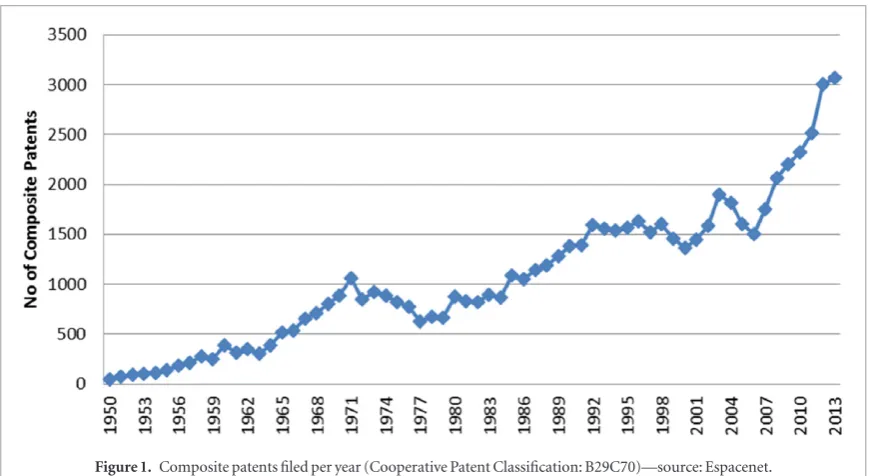
Patent records can provide evidence to sketch some reliable patterns related to the trajectory of the composites industry. Figure 1 demonstrates a growing trend in composite patents through the years. Data refer to international patent filings. But how many of those patents actually relate to the shaping of composite products (i.e. directly to forming composites on the tool) and not with technologies that are peripheral to their development? Figure 2 shows a very different pattern. Industrial patents related to composite shaping rose around the 1970s when composites were believed to be part of the future (Schatzberg 1998). After a twenty-year gap the industry appears to return to a similar record only very recently. This momentum echoed up to the early 1980s when strong expectations in composite technologies were still formed (Harris 1991, Carlson 1993). We can only make speculations regarding the reasons behind those trends. Another approach would be to rely on basic theory about industrialization in order to understand how such a pattern might have developed. In the next section we explore those concerns.
3. Manufacturing skills, craftsmanship and industrialization
The current diversity and broad spectrum of activities in composites results in different levels of sophistication in manufacturing skills, fabrication techniques or production approaches. However, the main difficulty in the sector arises from the fact that designing and manufacturing composite products that utilize the qualities of the material, requires a very deep understanding of the behaviour of the material, not only during the material use, but also during manufacturing. This essentially means that the industry first needs to build up enough expertise on these matters before it is able to formulate product specifications that utilize the inherent material qualities.
[image:4.595.119.554.54.292.2]Consider for instance the case of the two crashed de Havilland Comet airplanes in the 1950s (e.g. Withey 1997, Schijve 1994) . These accidents unveiled a major flaw in knowledge related to the fatigue behaviour of aluminium under the load conditions of pressurized fuselages therefore causing the engineers to overlook the potential fatigue related problems in their design. Consequently, metal fatigue became a major engineering issue on the agenda of the airplane designer (Vlot 2001). Similar stories can be found in incomplete manufacturing knowledge in early
stages of the adoption cycle of new materials. The development of theoretical understanding of the material in terms of how to engineer it (calculate loads, strength, etc), its behaviour in production and its performance in practical applications are essential for the advanced industrialization of the sector.
3.1. Division of labour and material transitions
Historically, knowledge developed in composite technologies was largely based on old rules and routines prevalent in traditional industries. As a result, when composites became broadly available as a new class of material the growth of the sector was restricted. To understand the main mechanisms leading to industrialization of the composite sector we need to go back to the basic principles of industrialization. Those considerations could allow a clearer view of the enabling factors that can catalyse industrial growth of a material technology.
The division of labour and the disconnection of design, engineering and production from physical crafts-manship skills lie at the heart of the industrial revolution. Essentially, design and manufacturing are found in one and the same ‘hand’ during early stages of applying new materials. One could say that in order to industrialize, first an integrated body of knowledge covering design, engineering, manufacturing, and use, needs to be in place. The industrial engineering literature is full of methodologies and approaches on dividing tasks in workstations and balancing production lines after such a body of knowledge is established. This is also happening in activities beyond the production floor, where outsourcing nowadays is a very common strategy. However, this approach that seemed to work well in the post industrial revolution area is currently falling short due to rapid technological developments. For example, when the actual tasks of detailed design and manufacturing in automotive are carried out by outside suppliers, the outsourcing company is missing substantial opportunities to gain knowledge and as a consequence the company’s knowledge base tends to decline (Takeishi 2002). Something similar happened recently to Boeing’s 787 Dreamliner where due to outsourcing design and manufacturing of parts, an integrated body of knowledge regarding the design itself was largely missing (Tang and Zimmerman 2009). As tasks are divided (i.e. division of labour) or outsourced, the integrated knowledge that used to belong to a single master craftsman or team is spread now across the whole supply chain. Thus it becomes a challenge to manage knowledge especially when substantive amounts of new knowledge are simultaneously developed. However, it is even more of a challenge when an integrated body of knowledge covering design, engineering, manufacturing, and use is only weakly developed.
[image:5.595.118.553.56.274.2]Additional issues arise when new technologies enter the field and a lack of integrated and embodied knowledge appears to be a burden in adapting to a new reality. It is already known that supplying an immature industrial envi-ronment with the latest machines and methods is a seriously inappropriate model for industrialization, particu-larly due to the lack of specialists who can improve raw material and products (Stigler 1951). Meaning, that without having the deep knowledge that underpins the new machines, users of these machines will be ‘condemned’ to consider this technology as a black box and thus preventing them to ‘play’ with the underlying principles in order to innovate and aim at a sustainable growth. Therefore, the solution does not rest in mechanization or automation as such, but in progressive development and establishment of the capability to build the practical skills and the integrated knowledge around the new technology.
3.2. Composite material research
On the other side of industrial practice stands pure academic composite research. Here there is a relatively narrow focus around issues related to the chemical or physical properties of composite material. There is also an important body of research driven by design considerations (i.e. strength prediction, damage characterization), however, the great bulk of that work has been related to the design of simple structural forms to achieve specific property suites (including effects such as bend/twist coupling, maximizing buckling resistance, minimizing the effects of impacts and minimizing mass properties). Much less work has been done to formalize design approaches for the components of more complex geometry that make up the great bulk of commercially manufactured parts. In parallel to that research, there has been a significant level of research activity relating to aspects of composites processing and manufacture in areas such as cure simulation, geometrical distortion, process modelling, woven cloth drape and consolidation, defect initiation and propagation and so on.
A systemic approach to innovation and technology development in composites was recognized very early as a need for the sector (Brown et al 1985, Carlson 1993), nonetheless research at the organizational and operations level for composites manufacturing has been very limited (Oliver and Stricklans 1990, The Lean Aircraft Initiative 1997). Despite the significant research output in the science of composites, there is no known effort to understand concerns related to composites productivity at a systemic level.
4. Empirical evidence and issues in the composites industry
This lack of theoretical underpinning drove the collection of industrial cases regarding the growth of the composites industry. Rather than testing a hypothesis, a series of expert interviews generated contextually rich data, looking at a broader range of interconnected themes in the context of composite product innovation and industrial growth. Early findings were reported in Chatzimichali and Potter (2015). Here we discuss the emerging themes related to growth issues and developed through the investigation of eight industrial Cases in different composite sectors.
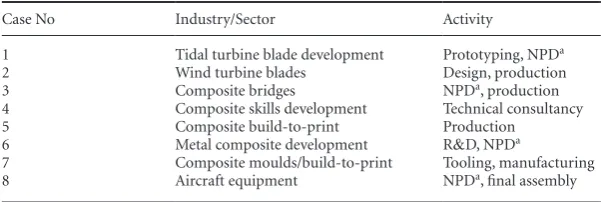
Table 1 presents the sectors of those Cases and their main activity. All interviews were audio recorded (total hours of interviews 17 : 07) and were fully transcribed by the researcher (total number of words: 101 241). The participants had an average amount of experience in the composite industry of 30.5 years.
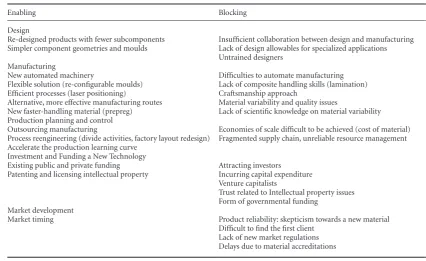
The qualitative data were analysed from two perspectives, the factors that enable and the factors that block the industrial growth of composite technologies. The following table is an aggregated report of those factors as derived from the analysis of all expert interviews.
There are five general categories emerging that relate to industrial growth in composites: design, manufactur-ing, production planning and control, investment and funding a new technology, and market development. Each category presents themes related with enabling and blocking factors for the development of the sector (table 2).
Having a critical view of those themes reveals an interesting pattern. The majority of issues under design and manufacturing are very closely related to the nature of composites. On the other hand, in investment and fund-ing, market development and production planning and control more general issues arise that can also be found in many other new products, technologies or markets. For example, lack of trained designers, material variability and faster-handling material are closely interwoven with the nature of the industry, while outsourcing, difficulty to find the first client or IP issues can be identified in many sectors.
The next step would be to get a deeper understanding of elements related to design and manufacturing of composite products. This will be a credible approach that could enable us to highlight where the real issues lie for composites.
5. Building composite production capabilities
[image:6.595.185.486.69.170.2]Successful product development in composites requires an integrated view of many strands of activity, usually under tight time and financial constraints and often with some uncertainties with regard to the
Table 1. Cases studied.
Case No Industry/Sector Activity
1 Tidal turbine blade development Prototyping, NPDa
2 Wind turbine blades Design, production 3 Composite bridges NPDa, production
4 Composite skills development Technical consultancy 5 Composite build-to-print Production
6 Metal composite development R&D, NPDa
design requirements and materials response. Despite the importance of those factors, there is little academic research that is concentrated on the development process of composite products or any schematic map of the interactions between processes that take place. In order to understand how production capabilities are built, it is important that composite product development be considered as a system that addresses the total requirements of application that the product is intended and their impact in every part of the development cycle.
5.1. A framework of feedback loops in composite product development
Composite component design, compared to other material technologies, is not a well-defined problem that can be divided into smaller bits that are solved separately and then combined into a total solution. This feedback approach in composite product development means that during the component design the part geometry, the decision of the material and the manufacturing routes evolve simultaneously. The reason is that one cannot perform the selection of component material, design, and choice of processes independently; any change in one will inevitably affect the other (Bader 2002).
Here we concentrate on this need for a combinatorial product development map that highlights the integrative nature of composite products. Going back to product development in composite design and manufacturing, the individual building elements of design and process development are represented as feedback loops. Those building elements, initially presented in Potter (1997) are represented here in such a way that allows a consistent view of the evolution of a composite component from concept to reality.
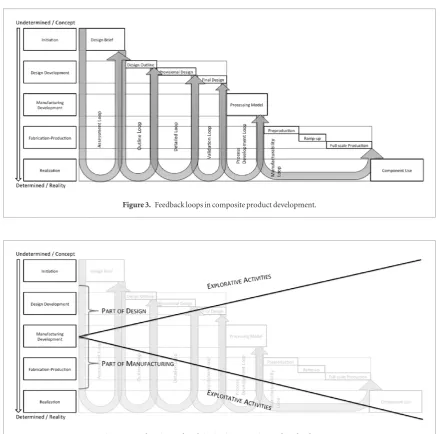
Figure 3 represents how the main elements in composite product development interact with each other. The main product development process starts with the Initiation and formulation of a design brief. To develop this design brief an assessment loop takes place and involves considerations regarding all future process, design devel-opment, manufacturing develdevel-opment, fabrication/production but most importantly the final stage which is the realization of the product and includes the assessment of the product’s functional requirements and costs. The next stage is the design development that involves three feedback loops outline, detailed, and validation where decisions about manufacturability, joints and loads, prototyping or scaling happen and we move from the design outline to a provisional design and the final design. Manufacturing development follows when a process devel-opment loop with decisions regarding manufacturability, tools and thermal analysis lead to a processing model. Fabrication/production is the next step where the last manufacturability considerations are addressed while mov-ing from preproduction to ramp-up and full-scale production. Finally in realization, the product is a reality and the developed component is in use.
[image:7.595.119.546.66.327.2]The feedback loops demonstrate the difficulty to take decisions in each stage while envisioning a future or a reality that is not yet determined. Also while in the Initiation stage the feedback loops concerns all four next stages, in fabrication/production there is only one stage the feedback loop is touching upon. This explains what Potter (1997) observed, that the majority of defects in manufactured parts could be traced back to design decisions (where more future stages should be considered), rather than processing variability or errors.
Table 2. Enabling and blocking factors in the growth of composite material technologies.
Enabling Blocking
Design
Re-designed products with fewer subcomponents Insufficient collaboration between design and manufacturing Simpler component geometries and moulds Lack of design allowables for specialized applications
Untrained designers Manufacturing
New automated machinery Difficulties to automate manufacturing Flexible solution (re-configurable moulds) Lack of composite handling skills (lamination) Efficient processes (laser positioning) Craftsmanship approach
Alternative, more effective manufacturing routes Material variability and quality issues
New faster-handling material (prepreg) Lack of scientific knowledge on material variability Production planning and control
Outsourcing manufacturing Economies of scale difficult to be achieved (cost of material) Process reengineering (divide activities, factory layout redesign) Fragmented supply chain, unreliable resource management Accelerate the production learning curve
Investment and Funding a New Technology
Existing public and private funding Attracting investors Patenting and licensing intellectual property Incurring capital expenditure
Venture capitalists
Trust related to Intellectual property issues Form of governmental funding
Market development
Market timing Product reliability: skepticism towards a new material Difficult to find the first client
5.2. Exploration versus exploitation in composites
Within the context of innovation, it has long been known that ‘an organization that is designed to do something well for the millionth time is not good at doing something for the first time’ (Galbraith 1982, p 6). According to Galbraith (1982), this creates a dual perspective when the process of creating new products uses a fundamentally opposing logic to the process of manufacturing. This is the fundamentally opposing reasoning of exploration and exploitation. Exploration happens in the initial stages when experimenting and developing new products and components. On the other hand, improving quality and production reliability through refinements, production efficiency or incremental innovation of existing output is the exploitative aspect of product development (Levinthal and March 1993). When developing new products organizations ought to focus on both those logics, therefore different departments or organizational arrangements in a supply chain cover those aspects. But what does this reveal for composite product development and production?
[image:8.595.116.557.48.482.2]We should reconsider under this light the previous discussion on industrialization and division of labour in section 3. When an established organization has already delegated product design to one actor and manufactur-ing to another actor, what would happen when a new material that requires different design and manufacturmanufactur-ing approach becomes available? This transition is not easy, because it is not a simple material substitution. It requires a bottom up reengineering of the organizational structure or even of the whole supply chain. New knowledge should be generated and redistributed. Failure to redistribute this knowledge is reflected as a symptom on production capability.
Figure 4 represents exactly this concept. Manufacturing development a crucial activity in composites stands exactly in-between traditional design and manufacturing processes, making it a grey zone. Instead of recognizing it as an activity on its own, many organizations tend to fit it within their previous structure because this seems to be more in line with the pre-existing and well-founded concepts on product development.
Figure 3. Feedback loops in composite product development.
A possible way forward would be to understand how material strategy and material technology development can create production capability. In the next section we discuss some of the most established theories and their limitations.
6. Discussion on material technology strategy
6.1. The socio-technical forces that shape a new technology
Technology strategy is crucial for the success of any product or technology, however to understand composite product development we also need to understand the environment in which they evolve as technologies. A critical look at the history of material developments in the aerospace sector makes clear that this new technology requires much more than technological expertise. Schatzberg (1998) discusses the resistance to composite innovation and questions the laws of natural selection for new material technologies. No objective processes ensure that the best technology will prevail. Instead, progress comes part from reasoned argument and empirical evidence, and part from the symbolic meanings shaping technical culture. In these terms, the first step to gain industrial momentum in composite material technologies is by becoming convinced that they are an indispensable part of a sustainable future. A new material technology requires the shaping of a new social order when stakeholders tacitly cooperate to formulate different technological reality.
There are two distinctive stands of literature arguing on this point: technical determinism and social con-structivism. Technical determinism supports the vision that technologies develop as a reflex of scientific discovery and therefore are unable to be affected by human influence. According to this point of view and paraphrasing the Victor Hugo quote ‘nothing is stronger than a technology whose time has come’. Technical determinism is evident in many companies with great technical abilities that often are very dismissive of their understanding of their own (design and product development processes) processes (O’Donovan et al 2005). Social constructivism on the other hand, simply argues that technologies are shaped through individuals and collective groups through actions, strategies and interpretations.
Taking both theories to the extreme can provide a platform to understand why the answer in making sense of the growth of a material technology might rest in the middle. Social constructivism has been characterized as naïve empiricism, when focusing purely on markets and networks. Similarly, promising technologies are not born in a social vacuum. But is it possible to delay or speed up the development of a technology ‘when its time has come’ and how do we know when is this? Of course one cannot ignore the disruptive nature of some technologies that changed the course of sectors and markets almost overnight (e.g. fibreglass in the small boat hulls market). However, even if one studies disruptive innovations and technologies it is clear that those technologies are only disruptive in specific contexts (Christensen 1997, Christensen and Raynor 2003). This means that a material tech-nology like composites cannot be approached in a very broad context, but in order to be studied should be pinned down to specific products and markets.
6.2. Dynamic capabilities and technology diffusion
Another level of analysis on the socio-technical forces driving new technologies deals with the emergence of antagonistic patterns between competing technologies (Rip and Talma 1998) and more recent studies from sociology and institutional theory (Geels 2004). Considering that innovations are separate from the current socio-technical regime (Geels and Schot 2007), technological skills arise after the transition and grow due to the industrial momentum around a technology. Consequently, a seeming lack of momentum in the composites socio-technical environment might be the underlying reason of low production capability. Even if resources or the right skills magically appear, there is an increased possibility of not getting properly utilized. An immature industrial environment cannot absorb new technologies, when integrated and embodied knowledge is in short supply. According to Mitchell (1989), who examined probability and timing of entry into emerging technical sub-fields, industry-specific capabilities increased the likelihood a firm could exploit a new technology within the industry. However, dynamic capabilities and the ways they were defined in strategic management seem to have more to do with private wealth creation and keeping competitors off balance (Teece et al 1997), rather than growth and the development of a sophisticated technology that can potentially impact a variety of fields. It is therefore particular difficult to use such theoretical construct to analyse industrial change in the context of composites. Moreover, these studies go beyond the scope of the present work and touch upon the realms of research and technology policy.
composites it is particularly difficult to quantify the market or the part of the sectors that took the decision to adopt composites and also acquire empirical evidence to illustrate how such transition happen.
6.3. Dominant designs and material
Another body of work built on evolutionary economics and literature on history of technology and was initiated by Abernathy (1978), Abernathy and Utterback (1978), Utterback and Abernathy (1975), Anderson and Tushman (1990), Utterback and Suarez (1993). This strand of literature argues that technological innovation in a sector is driven forward by the role of a dominant design. Dominant designs emerge as an outcome of socio-political or institutional dynamics constrained by economic and technical conditions and directly link to organizational evolution and technology cycles. When a dominant design appears and gets broadly accepted in an industrial context, an organization shifts efforts from product innovation to process innovation. This essentially means that the R&D activities change their focus from product innovation and work towards decreasing production cost through process innovation. It also allows the development of production capability and the further growth of new technologies.
There is another limitation of this theory in relation to composite material. Theories around dominant design raise several conceptual issues in the material technology context. First, the classification of new technologies as process innovation or product innovation fails to describe the underlying dynamics in composites. The composites industry does not fall in the same category with cement, steel or glass and other chemicals, where innovation comes from fundamental changes in the production processes and the products have little or no customization capabil-ity (Hayes and Wheelwright 1979). Composite characteristics are customized according to the product; however they do not belong to the product innovation class either. The reason is that the material and the manufacturing processing are the ones that enable the product’s distinctive characteristic. In composites, product and material are created simultaneously and therefore product innovation cannot happen without process innovation. Therefore composite technologies seem to fall in the middle between the product and process innovation schemes, making the dominant design framework unable to describe the growth of this material technology at an industrial level. A similar pattern of product and process innovation occurring simultaneously has been identified in the nano-technology sector (Linton and Walsh 2008).
Another point related to the dominant design approach is the hierarchy of the design that a product or a tech-nology is divided into (system level, first-order subsystem, second order subsystem, component level), according to (Murmann and Frenken 2006). Each level in this hierarchy can follow its own technology cycle. However, the material of a product is not a part of this systemic hierarchy. The material is an attribute and a change in mate-rial can potentially redefine the whole systemic hierarchy in a product. Consequently, current theories around dominant design and technological change cannot adequately describe this type of material-based technology.
Finally another issue with the particular framework is that dominant designs can only be studied in retrospect, also it is a rather ambiguous phenomenon whose definition, unit of analysis, causal mechanisms and underlying conditions seem rather unclear (Ehrnberg 1995).
7. Conclusions
Technologies have their own dynamics, but one cannot ignore actor strategies or sector economics. Shaping the social dimension of the associated design and manufacturing network or the dynamics of pre-existing networks determines to a large extent the success of a technology. At least this was proven in the case of the semiconductor industry as demonstrated by the narrative of inventors (Berlin 2005) where influencing technology development proved to be a complicated multi-actor process and also supported by more recent literature (Le Masson et al 2013). In the semiconductor industry growth became possible first by getting collaboration together and later by solving the technical problems. Expectations structured activities and built agendas. The pure nature of the technology was not enough to fuel growth and also the patterns that eventually emerged could not be attributed to one particular actor. It was also apparent that a repertoire of stories (including Moore’s law) defined the possibilities and future strategies including the evaluation of actions of others as illustrated by Lente and Rip (1998).
The answer to how a new material technology can create growth rests on the common thread that connects those seemingly independent but linked stands of literature. One thing to keep in mind is that composites are not simply a material or a technology, but material systems. Therefore adequate theoretical frameworks are hard to come by. Thus, the difficulties organizations face in the composite product development, don’t have to do merely with the reconfiguration of the product, but also with the reconfiguration of organizational structures. When something as radical as the material changes, a substitution process would not get you far. It requires organizational change that must be considered at system level.
important to select researchers that understand production methods in different industries and have an aptitude in communicating findings to people from very diverse backgrounds. This will enable the discussion of real problems with industry, government ministries, union executive committees, labour unions and leaders in the investment community in order to gain their reaction, criticism and suggestions to continue this work forward. This requires access to both executive suites and factory production floors. Only when organizations open up to discuss their problems candidly, can research projects a successful feedback to practice.
Acknowledgments
This research was supported by the EPSRC Centre for Innovative Manufacturing in Composites.
References
Abernathy W J 1978 The Productivity Dilemma (Baltimore, MD: Johns Hopkins Press) AbernathyW J and Utterback J 1978 Patterns of industrial innovation Technol. Rev.50 41–7
Airbus SAS 2008 Boeing 787—lessons learnt; 2008 Available at www.slideshare.net/aergenium/b787-lessons-learnt-presentation Anderson P and Tushman M 1990 Technological discontinuities and dominant designs: a cyclical model of technological change Adm. Sci.
Q.35604–35
Bader M G 2002 Selection of composite materials and manufacturing routes for cost effective performance Composites A 33913–34
Berlin L 2005 The Man Behind the Microchip: Robert Noyce and the Invention of Silicon Valley (Oxford: Oxford University Press) Bloom L D, Elkington M, Ward C, Chatzimichali A and Potter K 2013 On prepreg properties and manufacturability 19th Int. Conf. on
Composite Materials, ICCM 19 (Montreal, Canada, 28 July–2 August)
Brown D S, Eckert C H and Kline C H 1985 Advanced polymer composites—five keys to success Mater. Des.6203–6
Carlson C W 1993 Polymer composites: adjusting to the commercial marketplace J. Miner. Met. Mater. Soc.4556–7
Christensen C and Raynor M 2003 The Innovator’s Solution: Creating and Sustaining Successful Growth (Boston, MA: Harvard Business School Press)
Christensen C M 1997 The Innovator’s Dilemma: When New Technologies Cause Great Firms to Fail (Boston, MA: Harvard Business School Press)
Chatzimichali A P and Potter K D 2015 Building material capabilities: a socio-technical analysis of composite product development and manufacturing strategy Int. J. Markets Business Syst. at press
Ehrnberg E 1995 On the definition and measurement of technological discontinuities Technovation15437–52
Elkington D M, Bloom C, Ward A P Chatzimichali and Potter K D 2013 Understanding the lamination process ICCM 19 (Montreal, Canada, 28 July–2 August)
Galbraith J R 1982 Designing the Innovating Organization Organ. Dyn.105–25
Geels F W and Schot J 2007 Typology of sociotechnical transition pathways Res. Policy36399–417
Geels F W 2004 From sectoral systems of innovation to socio-technical systems: insights about dynamics and change from sociology and institutional theory Res. Policy33897–920
Harris B 1991 A perspective view of composite materials development Mater. Des.12259–72
Hayes R H and Wheelwright S C 1979 Link manufacturing process and product life cycles Harvard Business Rev.57 133–40
Jones H, Chatzimichali A P, Potter K D and Ward C 2015 Exploring the discrete tools used by laminators in composite manufacturing: design and manufacture Int. Conf. of Engineering Design (Milan, July)
Lu K 2010 The future of metals Science328319–20
Le Masson P, Weil B, Hatchuel Aand Cogez P 2013 Why are they not locked in waiting games? Unlocking rules and the ecology of concepts in the semiconductor industry Technol. Anal. Strateg. Manag.24 617–30
Lente van H and Rip A 1998 Expectations in technological developments: an example of prospective structures to be filled in by agency
Getting New Technologies Together. Studies in Making Sociotechnical Order ed de C Disco and B van der Meulen (Berlin: Walter de Gruyter)
Levinthal D A and March J G 1993 The myopia of learning Strateg. Manag. J.1495–112
Linton J D and Walsh S 2008 A theory of innovation for process based innovations such as nanotechnology Technol. Forecast. Soc. Change 75583–94
Lukaszewicz D H J, Ward C and Potter K D 2012 The engineering aspects of automated prepreg layup: history, present and future Composites
B 43997–1009
Marsh G 2007 Airbus takes on Boeing with reinforced plastic A350 XWB Reinf. Plast.51 26–7
Mitchell W 1989 Whether and when? Probability and timing of incumbents’ entry into emerging industrial subfields Admin. Sci. Q. 34208–30
Murmann J P and Frenken K 2006 Toward a systematic framework for research on dominant designs, technological innovations, and industrial change Res. Policy35925–52
Newell G C, Buckingham R O and Khodabandehloo K 1996 The automated manufacture of prepreg broad goods components—a review of literature Composites A 27 211–17
O’Donovan B, Eckert C, Clarkson J and Browning T R 2005 Design planning and modelling Design Process Improvement: A Review of Current Practice ed J Clarkson and C Eckert (London: Springer) pp 60–87
Oliver M and Stricklans B 1990 Synchronised manufacture of composites knowledge study (SMACKS) Compos. Manuf. 1103–8
Paton R 2007 Forming Technologies For Thermoset Composites, Composites Forming Technologies 1st edn ed A C Long (Cambridge: Woodhead)
Potter K D 2009 Achieving low variability, rework and scrap rates in the production of advanced composite parts SEICO09, SAMPE Europe30th pp 265–70
Potter K D 1997 Introduction to Composite Products—Design, Development and Manufacture (London/Berlin: Chapman and Hall/Springer) Rogers E M 2003 Diffusion of Innovations 5th edn (New York: Free Press)
Schatzberg E 1998 Wings of Wood, Wings of Metal: Culture and Technical Choice in American Airplane Materials 1914–1945 (Princeton, NJ: Princeton University Press)
Schijve J 1994 Fatigue of aircraft materials and structuresFatigue16 21–32
Stigler G J 1951 The division of labor is limited by the extent of the market J. Political Economy59185–93
Takeishi A 2002 Knowledge partitioning in the interfirm division of labor: the case of automotive product development Organization Sci. 13321–38
Tang C S and Zimmerman J D 2009 Managing new product development and supply chain risks: the Boeing 787 case Supply Chain Forum 10 74–86
Teece D J, Pisano G and Shuen A 1997 Dynamic capabilities and strategic management Strateg. Manag. J.18509–33
The Lean Aircraft Initiative Report Series 1997 #RP97-04-152 1997 Lean Implementation Considerations in Factory Operations of Low Volume/High Complexity Production Systems. Prepared by: J T Shields, A Kilpatrick, M Pozsar, L G Ramirez-de-Arellano, V Reynal, M Quint, J Schoonmaker, Lean Aircraft Initiative, Center for Technology, Policy, and Industrial Development, Massachusetts Institute of Technology, 77 Massachusetts Avenue, Cambridge, MA 0213
Tsai S W 1993 Rules of composites design: a review. In metal matrix composites Proc. 9th Int. Conf. on Composite Materials ICCM9 (Madrid, Spain, 12–16 July) vol 1 (Cambridge: Woodhead)
Utterback J and Abernathy W 1975 A dynamic model of product and process innovation Omega3639–56
Utterback J and Suarez F 1993 Technology, competition and industry structure Res. Policy221–21
Vlot A 2001 Glare: History of the Development of a New Aircraft Material (Dordrecht: Kluwer) Withey P A 1997 Fatigue failure of the de Havilland Comet I Eng. Failure Anal.4147–54
Biographies
Anna Chatzimichali gained a 5-year MEng Diploma and PhD in Production
Engineering and Management from Democritus University of Thrace. She undertook research positions in Instituto Superior Technico, Maastricht University and TU Delft. In 2012 she joined University of Bristol as a Research Associate investigating the complex underlying dynamics of manufacturing strategy for composites. Currently she works in the field of intellectual property, helping firms to leverage their strategic advantage when entering markets with new products or services.
Kevin Potter gained his BSc in Materials Science from Imperial College of Science