An Integrated Perspective of TOE Framework
and Innovation Diffusion in Broadband Mobile
Applications Adoption by Enterprises
Chui-Yu Chiu1 *Shi Chen2 Chun-Liang Chen3
1
IE & M, National Taipei University of Technology, Taipei, Taiwan
2
Graduate Institute of Industrial and Business Management, National Taipei University of Technology, Taipei, Taiwan
3Graduate School of Creative Industry Design, National Taiwan University of Arts, New Taipei City, Taiwan This study aimed at exploring the critical factors for enterprises to adopt broadband mobile applications. The results are expected to guide enterprises to strengthen their competitiveness. Further, since the broadband mobile applications were integrated with many characteristics of information communication technologies, this study combined the Technology-Organization-Environment (TOE) framework and Diffusion of Innovation Theory in an effort to establish a comprehensive view and to increase the level of understanding. The Structural Equation Modeling and AMOS were applied for analysis; which discovered that the adoption of broadband mobile applications by enterprises is significantly affected by technological, organizational and environmental contexts. This paper also identified eleven critical factors from technological, organizational and environmental aspects, as well as two vital control variables. Based on the research outcome, this paper conducted an in-depth discussion and drew conclusions. Finally, the research implications were provided.
Keywords: Broadband mobile application,
technology-organization-environment framework (TOE framework),
diffusion of innovation theory, enterprise’s
adoption, critical factors
JEL:L96, O32
Global mobile broadband communication technology
has been evolving into the fourth generation
of wireless mobile tele-communications technology
standards. With broadband mobile network, the
development of innovative mobile applications will
then be massively accelerated. Lubbe and Louw
(2010) explained from the marketing perspective
that the superior advantage of mobile
communication and mobile commerce is that the
suppliers can now access to the customers via
mobile devices anytime anywhere. The rapid
evolution of broadband mobile applications has led
to a more advanced mobile commerce, which
attracts new customers and brings significant
revenue for mobile application service providers
(Nikou and Mezei, 2013). The characteristics of
mobile technology such as connectivity, agility,
interactivity and location positioning can bring Manuscript received January 2, 2017; revised March 5, 2017; accepted March
various advantages to enterprises, enhance the
efficiency and effectiveness of enterprises, and
improve enterprises’ competitive advantage (Porter
and Millar, 1985)
Barnes (2002) pointed out that the challenge for
information based industries such as
telecommunication, hardware and software,
contents, entertainment and financial industry
(Symonds, 1999) is the transformation from a
traditional fixed network infrastructure based
business model to a whole new mobile network
business model. The smartphone, as well as the
mobile application platforms (iOS and Android) will
also bring significant changes to the value network
of manufacturing and service industries (Suh and
Kim, 2015).
Broadband mobile network service is widely
implemented by telecommunication service
providers from all over the world, and the technical
characteristics of growing bandwidth have become a
core subject in mobile applications development.
Many of the past studies focus on the adoption of
mobile commerce and mobile applications from the
use of traditional 2G/3G/3.5G mobile network (High
Speed Downlink Packet Access, HSDPA, and
below), yet the researches on broadband mobile
applications and enterprise-focused topics remain
limited. Yang (2012) revealed that the high data
transmission rate of the 4G broadband mobile
network will drive more innovative forms of mobile
applications, which may also influence user
preferences and behavior (Kwak and Yoo, 2012), as
such, the enterprises’ adopting of broadband mobile
application may be triggered and affected by
different factors. In this case, this study is targeted at
enterprises to analyze by integrating the TOE
framework (i.e., Technology, Organization, and
Environment framework) (Depietro, Wiarda and
Fleischer, 1990; Tornatzky and Fleischer, 1990) and
diffusion of innovations theory (Rogers, 1962) in
order to further explore various key factors affecting
the adoption of broadband mobile applications.
Results of this study attempt to serve as a
reference for the continuous innovation and
development of mobile applications for enterprises.
The rest of this paper is structured as follows.
Literature review and the hypotheses were proposed
in the next section. The section three presents the
method and process of analysis as well as the
results. In the fourth section a discussion based on
the findings was mentioned. Then the conclusion in
final section with implications, limitations and
Barnes (2002) pointed out that the challenge for
information based industries such as
telecommunication, hardware and software,
contents, entertainment and financial industry
(Symonds, 1999) is the transformation from a
traditional fixed network infrastructure based
business model to a whole new mobile network
business model. The smartphone, as well as the
mobile application platforms (iOS and Android) will
also bring significant changes to the value network
of manufacturing and service industries (Suh and
Kim, 2015).
Broadband mobile network service is widely
implemented by telecommunication service
providers from all over the world, and the technical
characteristics of growing bandwidth have become a
core subject in mobile applications development.
Many of the past studies focus on the adoption of
mobile commerce and mobile applications from the
use of traditional 2G/3G/3.5G mobile network (High
Speed Downlink Packet Access, HSDPA, and
below), yet the researches on broadband mobile
applications and enterprise-focused topics remain
limited. Yang (2012) revealed that the high data
transmission rate of the 4G broadband mobile
network will drive more innovative forms of mobile
applications, which may also influence user
preferences and behavior (Kwak and Yoo, 2012), as
such, the enterprises’ adopting of broadband mobile
application may be triggered and affected by
different factors. In this case, this study is targeted at
enterprises to analyze by integrating the TOE
framework (i.e., Technology, Organization, and
Environment framework) (Depietro, Wiarda and
Fleischer, 1990; Tornatzky and Fleischer, 1990) and
diffusion of innovations theory (Rogers, 1962) in
order to further explore various key factors affecting
the adoption of broadband mobile applications. The
results of this study attempt to serve as a reference
for the continuous innovation and development of
mobile applications for enterprises.
The rest of this paper is structured as follows.
Literature review and the hypotheses were proposed
in the next section. The section three presents the
method and process of analysis as well as the
results. In the fourth section a discussion based on
the findings was mentioned. Then the conclusion in
final section with implications, limitations and
directions for future study were provided.
LITERATURE REVIEW
Broadband Mobile Communication Technology
The technical standards guideline published by
International Telecommunication Union (ITU)
100 Mbps peak in high-speed mobility state and 1
Gbps in low mobility state, it can be called the
fourth generation of wireless mobile
tele-communications technology (IMT-Advanced). The
Global mobile Suppliers Association (GSA)
estimates that by Q2 2016 the global Long-Term
Evolution (LTE) telecommunication subscriptions will
reach 1.4 billion. 166 operators have deployed
networks of LTE-Advanced or 4.5G/LTE-Advanced
Pro in 76 countries including the United States,
Europe, Australia and Japan (GSA, 2016).
Moreover, the Next Generation Mobile Networks
Alliance (NGMN) announced that the 5th generation
mobile networks (5G) will become operational by
2020 (NGMN 5G White Paper, 2015), which can
carry much more data in faster speed than ever, and
support more innovative applications such as the
Internet of Things (IoT).
Kwak and Yoo (2012) considered that 4G
broadband mobile network can not only solve 3G
system deficiencies, but also offers other services
3G doesn’t offer such as high quality voice
transmission, high-definition audio and video
broadcasting, and identified five key services
attributes of 4G: high-speed data transmission,
communication service, channels, on-demand video
and other additional services. Jung and Kwon (2015)
further found that 3G service users are more
concerned about the call quality and customer
service, whereas LTE service users are more
interested in data transmission quality and price.
Mobile Applications
Shih and Shim (2002) affirmed that mobile
commerce built upon the use of mobile applications
by enterprises or in a business environment can
stimulate transactions among businesses and
improve productivity. As such, mobile application is
deemed as one of the key driving forces for the
development of mobile commerce. Further, different
purposes of mobile applications can be developed
diversely. Nysveen, Pedersen and Thorbjørnsen
(2005) found from the earlier literature that it leads to
different methods to distinguish features of mobile
applications in view of different importance of
characteristics, such as by interaction (Device vs
Person) and by the process (Goal-oriented vs
Experience-oriented). Nikou and Mezei (2013) have
sorted out five categories of mobile services from
the past literature and those are communication,
entertainment, information, web 2.0, and transaction.
Unhelkar and Murugesan (2010) stated that
many enterprises adopt mobile technologies to
improve operational efficiency, increase
customer needs, in consequence, mobile
applications can provide new business opportunities
for companies. While mobile applications
incorporate a variety of information communication
characteristics, there are also studies about
individuals or businesses adopting mobile
technologies, and which provide references for this
study in exploring various possible factors affecting
the adoption of the broadband mobile applications in
enterprises. Some aforementioned studies are cloud
computing (Almudarra and Qureshi, 2015), mobile
innovation (Song, 2014), mobile payment services
(Slade et al., 2015) etc. However, today’s mobile
applications are far more capable than merely
providing voice communication and data
transmission back in 2G or 3G era. In addition,
mobile broadband network nowadays possesses
much more powerful features than the mobile
networks of the past, and this network advancement
has led to a radical change in the mobile
applications to become more integrated and
innovated, and thus change the customer habits and
business models, and become more conducive to
business. Moreover, a significant cognitive gap of
business managers generally occurs between the
varieties of mobile applications in the latest
broadband environment and limited speed of
network and bandwidth in old days, as a
consequence, it is necessary to conduct further
research.
TOE Framework
Technology-Organization-Environment Framework
(TOE framework) (DePietro et al., 1990; Tornatzky
and Fleischer, 1990) is an application level
framework for research from the organization-level
perspective (Piaralal, et al., 2015). TOE framework
proposes three main facets to explore the factors
that affect the organization's acceptance of
innovation technology. The technological context
includes the characteristics and the usefulness of
the innovative technology; the organization context
contains the internal issues within the company such
as management, employee, products and services;
and the environmental context involves the issues
exist in the business related field, such as the
competitors and business partners.
Zhu, Kraemer and Xu (2006a) indicated that the
TOE framework has proven to be fairly effective
from the past research. A lot of studies about
innovation technologies have been done by adopting
the TOE research method, including information
systems (DePietro et al., 1990), e-commerce (Rowe,
Truex and Huynh, 2012), web service (Lippert and
2008), and cloud computing (Lian, Yen and Wang
2014).
From the above literature, it can be well informed
that the TOE framework is widely used on the
adoption of different innovative technologies and
proven to be validated (Ramdani and Kawalek,
2007). Given that the theme of this study is in regard
to the application of innovative technology and from
the enterprises perspective, the TOE framework is
adopted as the main research model in this
research.
Diffusion of Innovations Theory
The concept of diffusion of innovation has long been
proposed by scholars. It was widely used in
agriculture, medicine, communication, marketing
and other fields (Greenhalgh et al., 2005). Rogers
(1962) on the other hand, summarized the studies in
the fields of anthropology, education, industry,
medicine etc., and proposed the diffusion theory of
innovation. Rogers elaborated that innovation is “any
idea, practice, or object that is perceived as new by
an individual or another unit of adoption”. Diffusion
means “the process by which an innovation is
communicated through certain channels over time
among the members of a social system”. In most
studies, innovators are individuals, organizations,
clusters, social networks, and even countries
(Meyer, 2004).
Rogers (1995) also pointed out that innovation
will go through five stages of the adoption process:
Knowledge, Persuasion, Decision, Implementation,
and Confirmation. In the persuasion stage, the
potential adopter will be more involved as compared
to the knowledge stage and begin to actively seek
out relevant information. Individuals or
decision-making units will generate a positive or negative
attitude towards an innovation; an innovative
perception will also develop, so the perceived
characteristics of innovation are particularly
important in the persuasion stage. Hence, five
perceptual characteristics of innovation i.e. relative
advantage, compatibility, complexity, trialability, and
observability were identified by Rogers and help to
assess the adoption rate. (Rogers, 1995; Bensley
and Brookins-Fisher, 2003)
As with the TOE framework, diffusion of
innovations theory has also been widely used in
recent years in the field of information technology
application research, such as web site adoption
(Beatty, Shim and Jones, 2001), ERP systems
implementation (Bradford and Florin, 2003), mobile
banking (Al-Jabri and Sohail, 2012) and
enterprises (SMEs) (Hussin and Noor 2005;
Limthongchai and Speece, 2003; Kendall et al.,
2001)
Integrating DOI and TOE
There have been numbers of literature in the past
exploring the use of innovative technologies that
combine the TOE framework with the diffusion of
innovation theory to better explain the diffusion of
innovation from the organizational perspective (Hsu,
Kraemer and Dunkle, 2006), and better focus on the
impact of both internal and external factors of
innovation technology adoption and diffusion (Zhu et
al., 2006a; Tornatzky and Fleischer, 1990), the
relevant factors are also validated effectively. As
reported by Piaralal et al. (2015), innovation
diffusion theory combined with TOE framework
provides a useful theoretical framework for small
and medium-sized logistics enterprises to adopt
green technology and explore the use of innovation
technology by the overall consideration of internal
and external factors. Wang, Wang and Yang (2010)
combined the important factors of both theories to
explore the key factors influencing the adoption of
Radio Frequency Identification (RFID) in the
manufacturing sector. Ramdani, Kawalek and
Lorenzo (2009) combined the TOE framework and
diffusion of innovation theory to explore the factors
of adoption of enterprise system. In addition,
Alshamaila, Papagiannidis and Li (2013) combined
both theories to identify the influence factors in the
adopting of the cloud computing by SMEs. Oliveira,
Thomas and Espadanal (2014) also explored the
key factors of cloud computing adoption in service
industry and manufacturing by using the TOE
framework in combination with innovation diffusion
theory.
As Thong (1999) suggested that due to the rapid
evolution of information technology and its
characteristic, whether a single theoretical model
can be applied to all the subjects is still arguable.
Oliveira and Martins (2011) also indicated that it
would be important to combine more than one
theoretical model in future studies in order to have a
better understanding of the adoption of complicated
innovation technologies. Hence, this study integrates
the innovation diffusion theory with the TOE
framework and proposes an integrated research
model.
Innovation Technology Adoption Stage
Organizational innovation usually has different
stages of processes (Grover and Goslar, 1993). As
noted earlier, Rogers (1995) pointed out that
innovation experiences five stages: knowledge,
confirmation. Grover and Goslar (1993) also divide
organizational innovation into three stages: initiation,
adoption and implementation. Furthermore, Zhu et
al. (2006a) identified three important stages of
initiation, adoption and routinization from the point of
view of the adoption of e-business. The “Initiation”
stage begins with the perception and assessment of
an innovation, to measure the performance
improvement and potential benefits of an
enterprise's value chain activities. In the “Adoption”
stage, decisions are made to formally allocate
resources needed to fully deploy the innovation.
Then, in the “Routinization” stage, the innovation
must be accepted by members of the enterprise;
which can be widely used and deployed
Considering that the characteristics of broadband
mobile applications which may involve the personal
mobile devices and user habits of all members of the
enterprise, as well as customers and suppliers;
therefore, it is very crucial in the adoption and
implementation stage rather than in the initiation
stage. As a result, this study divides the process of
adoption into three stages: Initiation, Adoption and
Implementation, in order to have a full spectrum of
facets and factors through the model structure
analysis. In addition, this study measured the three
enterprises’ adoption stages with nine gradual
questions in the questionnaire, e.g., “I wish the
company could adopt the broadband mobile
applications”, “My company has just adopted the
broadband mobile applications”, and “We would
recommend our clients or suppliers to adopt the
broadband mobile applications”.
Hypotheses and Research Model
Given the diversified characteristics of information
and communication technology that broadband
mobile applications possessed, which have been
widely discussed in varieties of literature; also the
determinant factors of technological, organizational
and environmental context were tested, this study
sourced from mentioned literature to explore the
possible factors that may affect the adoption of
broadband mobile applications accordingly. The
theoretical basis for each factor is provided as
follows.
-The Technology Context
Alshamaila et al. (2013) in the study on SMEs’
adoption of cloud computing combined the TOE
framework with diffusion of innovation theory, which
adopted the five perceptual characteristics from
Rogers’ innovation diffusion theory. Ramdani et al.
(2009) integrated the innovation diffusion theory as a
theoretical basis of technological factors for
Enterprise system. As such, this study integrated the
five perceptual characteristics of innovation in the
persuasion stage of innovation diffusion theory as
factors in the technological context, and also
referred the previous research of related innovation
technology topics. Zhu et al. (2006b) found that
compatibility is the most important factor influencing
the post-adoption in European enterprises’ adoption
of digital transformation. The research results of
Wang et al. (2010) showed that due to the ongoing
development of RFID, there is no common standard
developed yet, and there are still issues in system
integration with the company's existing internal
information system, so the complexity and
compatibility for the manufacturing industry adopting
RFID have respectively significant negative and
positive impacts. Low, Chen and Wu (2011)
identified that the relative advantages and
complexity on cloud computing are inversely related
to enterprises adoption. Sin Tan et al. (2009) found
that relative advantage, compatibility, complexity
and observability in the technology context are the
main factors influencing the SMEs’ adoption of ICT
in Malaysia. Alshamaila et al. (2013) in the study of
SMEs’ adoption of cloud computing found factors in
the technology context which have significant
impact, including relative advantage, compatibility,
and complexity, as well as the trialability which
contributes to reduce uncertainties in adoption. To
sum up, this study proposed the five factors of
innovative diffusion theory with the following
hypotheses:
-The Organization Context
Low et al. (2011) in the research of cloud computing
found that the support of high-level executives in the
organization is a significant factor influencing
enterprises' adoption. Lin (2014) in their research
about electronic supply chain management system
adoption stated that since the user is encouraged to
participate and to solve problems between trading
partners, and also the enterprises need to quickly
enhance the awareness and reduce the resistance,
the management support and absorptive capacity,
as well as the competitive pressures in the
environment context are significant factors in both
“Likelihood of SCM Adoption” and “Extent of
e-SCM adoption” stages. Hollenstein (2004) argued
that the knowledge capital generated through
learning and experience will bring the advantage in
applying new technology to enterprises, so
absorptive capacity is one of the most important
factors in adopting innovative technology. In
addition, Thong (1999) revealed that the information
intensity of company’s products and services has a
significant impact on the adoption of information
technology by small businesses. Al-Qirim (2008)
also indicated that the information intensity of
products and services is a significant factor
influencing the adoption of e-commerce websites by
small businesses. Moreover, Mirchandani and
Motwani (2001) found that one of the major
problems faced by enterprises was the lacking of
knowledge in information system by the employees,
so employees’ knowledge was also a significant
factor influencing the adoption of e-commerce by
small businesses. Considering the characteristics of
innovative technology, this study propose the
following hypotheses based on the four factors
discussed above:
-The Environment Context
There are results from the past studies shown that
competitive pressures are a significant factor
influencing the adoption of information technologies
by enterprises (e.g., Ghobakhloo, Arias-Aranda and
Benitez-Amado, 2011). Li (2008) found that both
competitive pressures and external support were
significant factors of the use of e-procurement in
manufacturing. Teo, Lin and Lai (2009) found that
trading partners will also significantly affect the
adoption of e-procurement. Similarly, Stockdale and
Standing (2006) found that key trading partner is an
important factor influencing the adoption of
e-commerce by SMEs. Besides, the government’s
attitude is also considered to be one of the important
technology. Dahnil et al. (2014) pointed out that
government attitudes, policies and initiatives are
important factors influencing the adoption of
innovative technology by SMEs. Lee et al. (2014)
considered government support as one of the
conditions to promote the adoption of cloud
computing among the enterprise. In this study, we
incorporated the above mentioned important factors
into the following hypotheses:
-Control Variables
Different types business of enterprises for the
application of an innovative technology will take a
different attitude; Hsu et al. (2006) found that for US
firms, the manufacturers compare the distribution
and financial industries tend to be more willing to
adopt e-business. However, Teo et al. (2009)
conducted a study in adopting e-procurement by 141
firms in Singapore and the industry type was used
as the control variable, the results showed no
significant difference. Moreover, this different
attitude may also occur in organizations of different
sizes, such as Ifinedo (2011) in the study of
internet/e-business technologies for Canadian SMEs
using company size and industry sector as control
variables. Siamagka et al. (2015) also used the size
as a control variable in the study of social media
adoption by B2B organizations. Thus, the industry
type (service/manufacturing) and company size are
incorporated as control variables with reference to
the above studies and were further examined in the
three stages of adoption.
Sample and Questionnaire
Given that the broadband mobile applications
possess the features of various applications, this
study referred to the previous literature and
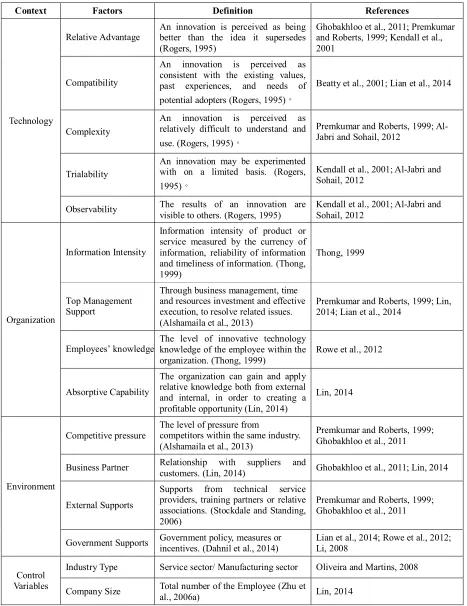
developed the questionnaire. The factors definition
and references are summarized in Table 1 (see
Appendix-I).
The responses were tapped by the Likert 5-point
scale. First of all, two Ph.D teachers reviewed and
provided feedbacks on items or questionnaire, then
the pre-questionnaires were given to 40 managers
and employees (22 high-level and 18 mid-level)
Economic Affairs. The respondents were asked to
read the instruction before filling the questionnaire. A
total number of 40 valid pre-questionnaires were
collected, and the test results of reliability and
validity were all found up to the standard. The
semantic amendments have been made into four
questions according to the feedbacks and
suggestions. In the formal stage, the main
databases were chosen from the project system of
industrial promotion organizations in cooperation
with economic department of government, such as
the National Association of Small and Medium
Enterprises and Corporate Synergy Development
Center, by following random sampling. The
respondents hold mid-level or above positions in
their organizations. 411 questionnaires were
distributed in both hard copy and via email, which
obtained a valid response rate of 73.72 percent and
has reached to the acceptable level (Rigdon, 2005).
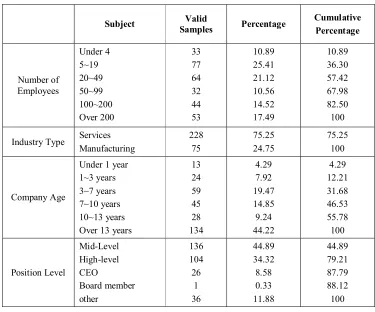
The statistical data are shown below in Table 2; and
the sample characteristics are shown in Table 3
-The Analysis of Measurement Model
In this study, the structural equation modeling (SEM)
was used to analyze the data. Based on Hair et al.
(1998), the two-stage analysis was proceeded. First,
all variables were tested in the measurement model,
the cronbach's α of technological, organizational and
environmental context and adoption were .89, .89,
.93 and .87 respectively, which showed that the
questionnaire had good reliability. Secondly, the
confirmatory factor analysis (CFA) was used to test
the convergent validity and discriminant validity of
each facet and to validate the appropriate model for
structural model analysis (Pijperset et al., 2001). The
model fit, factor loading and convergent validity of
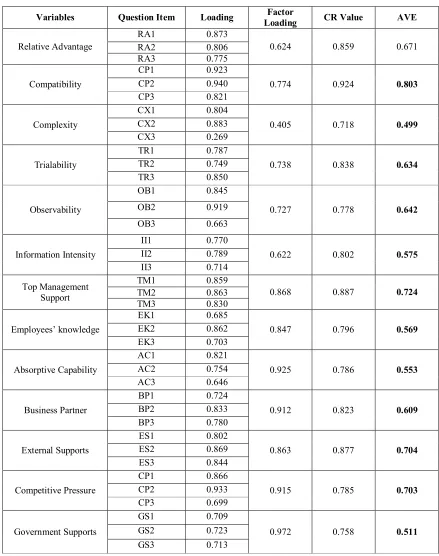
each facet were individually examined. According to
Bagozzi and Yi (1988), two factors’ loading showed
offending estimate (i.e., complexity did not reach .50
and government supports showed over .95) which
then been removed. Then the combined reliability
after the test was above .70, the average variance
extracted (AVE) ranged from .55 to .80, which were
in accordance with the standard proposed by
Bagozzi and Yi (1988) - the combined reliability
should be above .60, and the AVE should be above
.50. Further, the validities were in accordance with
the requirement value of .50 as proposed by Fornell
and Larcker (1981). Thus, the results indicated that
Distributed Return Invalid Valid Valid Percentage
Via Email 135 101 8 93 68.89%
Hard Copy 276 231 21 210 76.09%
Total 411 332 29 303 73.72%
the model has reached an acceptable level. Detailed
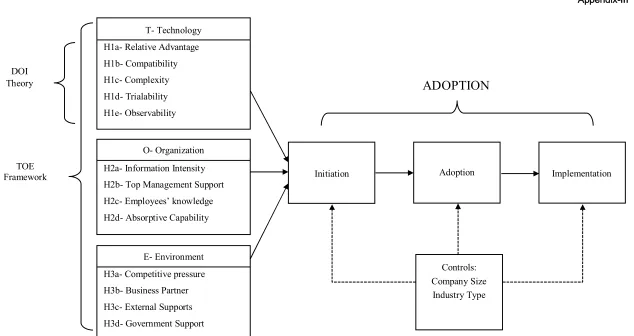
are given in Table 4 (see Appendix-II). In summary,
the proposed research architecture is shown below
in Figure 1 (see Appendix-III).
-The Analysis of Structural Model
First, in the goodness of fit test, the overall model fit
is shown in Table 5. The χ2/df ratio was 1.88 which
fitted the parsimonious fit value (less than 3) in
reference to Hair et al. (1998). Then Browne and
Cudeck (1993) pointed out that the GFI should be
greater than .80; and according to the study of Wu
and Wang (2006), that the goodness of fit index can
be in accordance with the recommendation
of Hadjistavropoulos, Frombach and Asmundson
Subject Valid
Samples Percentage
Cumulative Percentage Number of Employees Under 4 5~19 20~49 50~99 100~200 Over 200 33 77 64 32 44 53 10.89 25.41 21.12 10.56 14.52 17.49 10.89 36.30 57.42 67.98 82.50 100 Industry Type Services
Manufacturing 228 75 75.25 24.75 75.25 100 Company Age
Under 1 year 1~3 years 3~7 years 7~10 years 10~13 years Over 13 years
13 24 59 45 28 134 4.29 7.92 19.47 14.85 9.24 44.22 4.29 12.21 31.68 46.53 55.78 100 Position Level Mid-Level High-level CEO Board member other 136 104 26 1 36 44.89 34.32 8.58 0.33 11.88 44.89 79.21 87.79 88.12 100
Table 3: Sample Characteristics
Indicator of
Goodness-of-fit Standard Value Examination Result
RMR <0.08 (Jöreskog and Sörbom 1993) 0.066
RMSEA <0.08 (Hu and Bentler 1999) 0.054
TLI(NNFI) >0.9 (Bentler and Bonett 1980) 0.918
CFI >0.9 (Bentler and Bonett 1980) 0.924
NFI >0.8 (Hadjistavropoulos et al. 1999, Hair et al. 1998) 0.852
GFI >0.8 (Browne and Cudeck 1993) 0.825
AGFI >0.8 (Hadjistavropoulos et al. 1999) 0.800
χ2/d.f. <5 (Bentler and Bonett, 1980) 1.882
(1999) and Hair et al. (1998): AGFI> .80, NFI> .80.
In this study, GFI was .82, AGFI was .80 and the
NFI was .85 which reflected the good values.
Besides, the RMSEA was .05, which was in
accordance with the suggestion of Hu and Bentler
(1999) that the value of RMSEA should be less than
.08. It is concluded that the fit of the structural model
data in this study was in a good range.
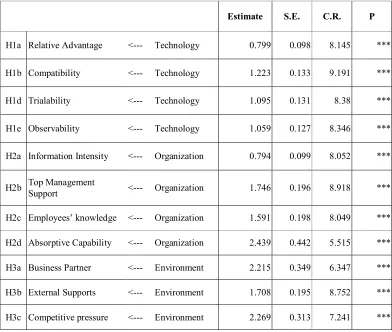
The results of the verification of factors are
shown in Table 6 (see Appendix-IV). A total number
of 11 factors showed significant results.
-Control Variable Test
First of all, in the variable “company size” analysis,
the ANOVA showed different results in various
stages. In the “adoption” and “implementation”
stages it showed insignificant results, only in the
“Initiation” stage, the f-value showed 10.54 and the p
value showed .001, which reached the significant
level. Yet the homogeneity assumption was rejected
after the homogeneity of variance test (Levene's
test: 8.78, p = .001), the results were further
compared by Brown and Forsythe (1974) and Welch
(1951) test and showed that value in the group of
company size with more than 200 employees is
significantly lower than in the groups which under
200 employees. It can be deduced that the size of
the company and the adoption of broadband mobile
application have an inverse correlation.
Next, in the analysis of “industry type”, the results
of independent sample t-test indicated that the
Figure 2: Results of Structural Modeling Analysis
Technology
Organization
Environment
Initiation Adoption Implementation
0.301***
0.316*** 0.471***
0.815*** 0.933***
Sum of Squares df Mean Square f Sig.
Between Groups 40.251 5 8.025 10.545 .000
Within Groups 226.736 297 .763
Total 266.987 302
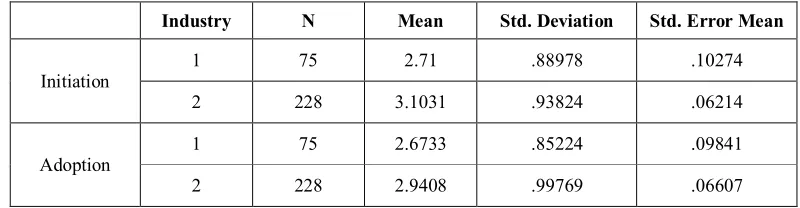
manufacturing and service industries showed
different results at various stages. In the final
“implementation” stage, there was no significant
difference. Yet, in the “initiation” and “adoption"
stages the results were significant, and the value of
service industries group was higher than the
manufacturing group after the comparison. The
results of the three-stage analysis are shown in
Tables 8 and 9 below.
DISCUSSION
The Technology Context
In terms of technology context, the relative
advantage and compatibility showed significant
results in line with the research results of
Premkumar and Roberts (1999) for enterprises
adopting innovative information technologies and
online data access, and Sin Tan et al. (2009) on the
adoption of information technology, indicated that
the broadband mobile applications possess a similar
information communication technology
characteristic. Zhu et al. (2006b) in the study of
digital transformation for European companies also
revealed that the e-business value chain activities,
which rely on communication tools, are now shifted
from paper/telephone/fax to digital form, and the
priority of digital assets and information flow within
the enterprise has gone up, thus the compatibility of
communication has become a key driving force.
Levene' test t-test for Equality of Means
f Sig. t df Sig.
(2-tailed)
Mean Difference
Std. Error Difference
Initiation .012 .914 -3.160 301 .002 -.38974 .12334
Adoption 1.928 .166 -2.084 301 .038 -.26746 .12832
Implementation 1.374 .242 -1.951 301 .052 -.21132 .10833
Table 8: Independent Sample t-test
Industry N Mean Std. Deviation Std. Error Mean
Initiation
1 75 2.71 .88978 .10274
2 228 3.1031 .93824 .06214
Adoption
1 75 2.6733 .85224 .09841
2 228 2.9408 .99769 .06607
Further, trialability has reached to a significant level,
as Ramdani et al. (2009) in the study of the adoption
of enterprise systems stated that getting a trial
version before the adoption is important to the
enterprise. The results of observability also showed
a significant result and matched the researches of
both Hussin and Noor (2005), and Limthongchai and
Speece (2003) in adoption of e-commerce. In
addition, this study also suggests that it’s easy to
observe the diversity and wide range of use of the
mobile broadband application around the people, the
observability of mobile broadband application has
become more important.
The Organization Context
The four factors within the organizational context all
showed significant results. First, the information
intensity showed significant result in line with the
study results of Al-Qirim (2008) on the adoption of
e-commerce communications and applications
technologies. Ghobakhloo et al. (2011) suggested
that companies will consider the technology relevant
to their products and services, enterprises with high
IT relevance are more likely to use e-commerce to
improve competitiveness. Next, the significant result
of top management support is consistent with
previous studies such as cloud computing (Oliveira
et al., 2014; Borgman et al., 2013), e-procurement
(Teo et al., 2009), Enterprise System (Ramdani and
Kawalek, 2007), e-commerce (Stockdale and
Standing, 2006), EDI (Premkumar and Roberts,
1999). This validates that the characteristics of
broadband mobile technology are similar to the IT
tools for data exchange used inside or between the
enterprises. Oliveira et al. (2014) claimed that top
management in the enterprise can show their
support for adoption of cloud computing by
supporting money and resources. Employees’
knowledge showed a significant result, which is
compatible with the study results of Mirchandani and
Motwani (2001), and Scupola (2009); the former
research indicated that employee’s knowledge was
one of the most important factors in company’s
website adopting. Scupola (2009) also reported that
employees’ knowledge in both Australian and
Danish companies is important factor for
e-commerce adoption, especially in the case that
Australian CEOs who have paid more attention to
the e-commerce recommendations from employees.
Absorptive capability reached to a significant result,
which is consistent with the results of research by
Lin (2014) in e-SCM (supply chain management),
and Hollenstein (2004) in information communication
technologies. As Park, Suh and Yang (2007)
includes multiple functional aspects (e.g.,
positivistic/anti-positivistic and constructive aspects),
hence, the status of absorptive capacity is easy to
perceive by employees and regarded as very
crucial. This study believes that multi-functional
features are also embodied in today's rapid
developed broadband mobile applications.
The Environment Context
Business partner in the environment context showed
a significant result. Li (2008) revealed in the
research that pressure from suppliers or trading
partners, like competitive pressures, drives
companies to adopt e-procurement to gain and
maintain competitive advantage. While competitive
pressure also revealed a significant result in this
context. Zhu et al. (2006a) found that in some low
ICT-intensity countries, the incentive to use
e-business is not necessarily due to perceived
competitive advantage, but to avoid lagging behind
the technological curve, therefore, the competitive
pressure is more apparent than in high ICT-intensity
country. Ifinedo (2011) also claimed in the research
of the Internet/e-business technologies in SMEs
from Canada that SMEs are more likely to adopt
innovative technologies in a high competitive region.
At last, external support also produced a significant
result. Ramdani and Kawalek (2007) in the research
on the adoption of enterprise system commented
that the external support can prove to be the most
challenging factor for vendors. Similarly, Attewell
(1992) also pointed out that external support can
help SMEs to cross knowledge barriers.
Controls
The test of first control variable “company size”
showed different results in the three stages of
adoption, and reached to the significant level only in
the initiation stage, wherein a reverse correlation
appeared. That is, the smaller the enterprise size,
the higher the willingness in adopting broadband
mobile applications. This study suggests that
although the large enterprises have a higher
financial capability and more skilled employees, the
traditional bureaucracy may be disadvantageous to
initiate an innovative technology. In comparison,
SMEs have higher flexibility and more willingness to
try the innovative technology with relatively lower
difficulty level. However, the company size was
insignificant in both adoption and implementation
stages, which explained that once the company has
started the innovative process, the company sizes
show no significant influences in the latter stage.
The test of the second control variable has
different results from the first control variable.
both initiation and adoption stages and failed in the
implementation stage. In addition, the result of the
analysis revealed that the service sector had a
higher adoption rate than the manufacturing sector.
This study suggests that unlike the big IT system
such as SCM or ERP, broadband mobile application
is not so sophisticated, and does not need to require
an information department or IT human resources in
order to operate, or even no longer need a desktop
or laptops to run the system, but through the more
convenient individual mobile devices that allow each
member of the enterprise to use it at any time and
location. Hence, the service industry relies more on
people’s direct contact and communicate, easy
access information and content delivery, has a
higher possibility and intention of adopting
broadband mobile applications in compare with
manufacturing sector. Thereafter due to the
approaching cognition, making the differences
between these two sectors gradually eliminate in the
implementation stage.
PRACTICAL IMPLICATIONS
This study discussed three aspects of the TOE
framework, namely technological, organizational and
environmental contexts having positive impact on
the broadband mobile applications adoption. There
are eleven factors explored, and the impact of the
two control variables i.e. company size and industry
type are also identified. All these results bring in
several critical insights for both enterprises and
broadband mobile applications providers. For the
enterprise, the management team should make sure
that the new application must be compatible with the
existing system, then gets involved with the change,
helps employees to absorb the information and
builds up the knowledge assimilating structure within
the enterprise. Continued supports from external
actors along with the willingness and ability of the
business supplier and buyer must also be taken into
account in order to ensure successful and effective
use. The results also showed that in attempts to
enhance customer communication, as well as to
reduce cost and increase profits, SMEs with higher
flexibility are more willing to adopt broadband mobile
applications; on the contrary, management level
from large enterprises must have the mindset to
change the attitude of acceptance in innovative
mobile broadband applications, in order to help
enterprises’ sustainable development. Similarly,
manufacturing companies must consider the
advantages of broadband mobile applications, and
invest more resources to keep up with rapidly
changing of mobile trends and to ensure long-term
application providers, aside from good functional
design, the trial version and platform optimization
should be included in the product development and
marketing stage, so as to be more attractive and
accepted by the enterprise and the market. In
addition, after-sales support and knowledge-sharing
with the customers will increase the willingness to
adopt the application, and ensure clients’ successful
operation afterwards.
Theoretical contributions
The continuous improvement of technical
characteristics leads to more powerful mobile
applications into the market, and remains a key
element for sustainable development of enterprises
and industries. Yet, there exists few studies focused
on the topic from enterprise perspective, this study
aims to propose a research framework and
commence the empirical research, in an effort to
establish a preliminary basis for related research
and discussion subsequently. Then, this paper
combined the TOE framework with diffusion of
innovation theory, hoping to have a broader view
and extensive insights in environmental and
organizational aspects apart from technology
diffusion perspective, and then to develop a
reference model for the follow-up research. Finally,
this study applied company size and industry type as
control variables; as a result, it may also be useful
for the follow-up study in exploring the possibility of
different variables.
LIMITATIONS AND FURTHER DIRECTIONS
Because of the limitation of research scale, it was
hard to incorporate all the variables presented in
past literature of innovation technology.
Nonetheless, this study has still tried to achieve
unbiased results through data collection,
comparisons, and selections from related papers as
many as possible. Also, to keep on further in-depth
researching into distinct enterprises via the field
interviews to acquire an intensive perspective in the
adoption of broadband mobile applications will be
instructive. Finally, this research adopted the point of
view of overall mobile applications in consideration
of the understanding of the participants and
enterprises, thus, for applications with specific
characteristics such as voice, data, video or other
interactive features, the researches can be
continued hereafter considering customer's point of
view and value in the future.
REFERENCES
Al-Jabri, I. M. & Sohail, M. S. (2012). Mobile banking adoption:
Application of diffusion of innovation theory. Journal of
Electronic Commerce Research, 13(4): 379-391.
Alliance, N. G. M. N. (2015). 5G white paper. Next generation
fromhttp://ngmn.org/uploads/media/NGMN_5G_White_Paper_
V1_0.pdf
Almudarra, F. & Qureshi, B. (2015). Issues in adopting agile
development principles for mobile cloud computing
applications. Procedia Computer Science, 52, 1133-1140.
Al-Qirim, N. (2008). The adoption of e-Commerce
communications and applications technologies in small
businesses in New Zealand. Electronic Commerce Research
and Applications, 6(4): 462-473.
Alshamaila, Y., Papagiannidis, S. & Li, F. (2013). Cloud
computing adoption by SMEs in the north east of England: A
multi-perspective framework. Journal of Enterprise
Information Management, 26(3): 250-275.
Attewell, P. (1992). Technology diffusion and organizational
learning: The case of business computing. Organization
Science, 3(1): 1-19.
Bagozzi, R. P., & Yi, Y. (1988). On the evaluation of structural
equation models. Journal of the Academy of Marketing
Science, 16(1): 74-94.
Barnes, S. J. (2002). The mobile commerce value chain: Analysis
and future developments. International Journal of Information
Management, 22(2): 91-108.
Beatty, R. C., Shim, J. P. & Jones, M. C. (2001). Factors
influencing corporate web site adoption: A time-based
assessment. Information & Management, 38(6): 337-354.
Bensley, R. J. & Brookins-Fisher, J. (2003). Community health
education methods: A practical guide. (2nd ed.). New York:
Jones & Bartlett Learning.
Bentler, P. M. & Bonett, D. G. (1980). Significance tests and
goodness of fit in the analysis of covariance
structures. Psychological bulletin, 88(3): 588-606.
Borgman, H. P., Bahli, B., Heier, H. & Schewski, F. (2013).
Cloudrise: Exploring cloud computing adoption and
governance with the TOE framework. In Proceedings of the
2013 46th Hawaii International Conference on System
Sciences (pp. 4425-4435), HI.
Bradford, M., & Florin, J. (2003). Examining the role of innovation
diffusion factors on the implementation success of enterprise
resource planning systems. International Journal of
Accounting Information Systems, 4(3): 205-225.
Brown, M. B. & Forsythe, A. B. (1974). Robust tests for the
equality of variances. Journal of the American Statistical
Association, 69(346): 364-367.
Browne, M. W. & Cudeck. R. (1993). Alternative Ways of
Assessing Model Fit, in Testing Structural Equation Models.
Kenneth A. Bollen and J. Scott Long, editors. Newbury Park,
CA: Sage.
Dahnil, M. I., Marzuki, K. M., Langgat, J. & Fabeil, N. F. (2014).
Factors influencing SMEs adoption of social media
marketing. Procedia-Social and Behavioral Sciences, 148,
119-126.
Depietro, R., Wiarda, E. & Fleischer, M. (1990). The context for
change: Organization, technology and environment. The
Processes of Technological Innovation, 199(0): 151-175.
Fornell, C. & Larcker, D. F. (1981). Structural equation models
with unobservable variables and measurement error: Algebra
and statistics. Journal of Marketing Research, 18(3): 382-388.
Ghobakhloo, M., Arias-Aranda, D. & Benitez-Amado, J. (2011).
Adoption of e-commerce applications in SMEs. Industrial
Management and Data Systems, 111(8): 1238-1269.
Greenhalgh, T., Robert, G., Macfarlane, F., Bate, P., Kyriakidou,
O. & Peacock, R. (2005). Storylines of research in diffusion of
innovation: A meta-narrative approach to systematic
review. Social Science and Medicine, 61(2): 417-430.
Grover, V. & Goslar, M. D. (1993). The initiation, adoption, and
implementation of telecommunications technologies in US
organizations. Journal of Management Information
Systems, 10(1): 141-164.
GSA (2016). LTE Broadcast – Lessons learned from trials and
early deployments, LTE Broadcast Alliance. Retrieved
December 23, 2016, from http://gsacom.com/
paper/lte-broadcast-white-paper/
GSA (2016). LTE- Advanced, LTE- Advanced Pro global status-
commitments, launches, devices ecosystem. Retrieved
December 23, 2016, from http://gsacom.
com/paper/lte-
advanced-lte-advanced-pro-global-status-commitments-launches-devices-ecosystem-2/
Hadjistavropoulos, H. D., Frombach, I. K. & Asmundson, G. J.
(1999). Exploratory and confirmatory factor analytic
investigations of the Illness Attitudes Scale in a nonclinical
sample. Behaviour Research and Therapy, 37(7): 671-684.
Hair, J. F., Anderson, R. E., Tatham, R. L. & Black, W. C. (1998).
Multivariate data analysis, (5th Ed.). NY: Prentice Hall
International.
Hollenstein, H. (2004). Determinants of the adoption of
Information and Communication Technologies (ICT): An
empirical analysis based on firm-level data for the Swiss
business sector. Structural Change and Economic Dynamics,
15(3): 315-342.
Hsu, P. F., Kraemer, K. L. & Dunkle, D. (2006). Determinants of
e-business use in US firms. International Journal of Electronic
Commerce, 10(4): 9-45.
Hu, L. T. & Bentler, P. M. (1999). Cutoff criteria for fit indexes in
new alternatives. Structural Equation Modeling: A
Multidisciplinary Journal, 6(1): 1-55.
Hussin, H. & Noor, R. M. (2005). Innovating business through
e-commerce: Exploring the willingness of Malaysian SMEs.
In Proceedings of the Second International Conference on
Innovation in IT.
Ifinedo, P. (2011). An empirical analysis of factors influencing
Internet/e-business technologies adoption by SMEs in
Canada. International Journal of Information Technology and
Decision Making, 10(4): 731-766.
ITU, I. (2008). 2134, Requirements related to technical
performance for IMT-Advanced radio interface
(s). International Telecommunications Union. Retrieved July
31, 2015, from http://www.itu.int/pub/R-REP-M.2134-2008/en
Jöreskog, K. G. & Sörbom, D. (1993). LISREL® 8: Structural
equation modeling with SIMPLISTM command language.
Chicago, IL: ScientiWc Software International.
Jung, W. & Kwon, Y. (2015). Differences between LTE and 3G
service customers: business and policy
implications. Telematics and Informatics, 32(4): 667-680.
Kendall, J. D., Tung, L. L., Chua, K. H., Ng, C. H. D. & Tan, S. M.
(2001). Receptivity of Singapore's SMEs to electronic
commerce adoption. The Journal of Strategic Information
Systems, 10(3): 223-242.
Kwak, S. Y. & Yoo, S. H. (2012). Ex-ante evaluation of the
consumers' preference for the 4th generation mobile
communications service. Technological Forecasting and
Social Change, 79(7): 1312-1318.
Li, Y. H. (2008). An empirical investigation on the determinants of
e-procurement adoption in Chinese manufacturing
enterprises. In 2008 International Conference on
Management Science and Engineering 15th Annual
Conference Proceedings (pp. 32-37). IEEE.
Lee, S. G., Hwang, S. W., Kang, J. Y. & Yoon, S. (2014). Factors
Influencing the Adoption of Enterprise Cloud
Computing. Journal of Internet Technology, 15(1): 65-75.
Lian, J. W., Yen, D. C. & Wang, Y. T. (2014). An exploratory
study to understand the critical factors affecting the decision
to adopt cloud computing in Taiwan hospital. International
Journal of Information Management, 34(1): 28-36.
Limthongchai, P. & Speece, M. (2003). The effect of perceived
characteristics of innovation on e-commerce adoption by
SMEs in Thailand. In Proceedings of the Seventh
International Conference on Global Business and Economic
Development, Bangkok, Thailand.
Lin, H. F. (2014). Understanding the determinants of electronic
supply chain management system adoption: Using the
technology–organization–environment
framework. Technological Forecasting and Social
Change, 86, 80-92.
Lippert, S. K. & Govindarajulu, C. (2015). Technological,
organizational, and environmental antecedents to web
services adoption. Communications of The IIMA, 6(1): 14.
Low, C., Chen, Y. & Wu, M. (2011). Understanding the
determinants of cloud computing adoption. Industrial
Management and Data Systems, 111(7): 1006-1023.
Lubbe, B. & Louw, L. (2010). The perceived value of mobile
devices to passengers across the airline travel activity
chain. Journal of Air Transport Management, 16(1): 12-15.
Meyer, G. (2004). Diffusion methodology: time to
innovate? Journal of Health Communication, 9(S1): 59-69.
Mirchandani, D. A. & Motwani, J. (2001). Understanding small
business electronic commerce adoption: An empirical
analysis. Journal of Computer Information Systems, 41(3):
70-73.
Nikou, S. & Mezei, J. (2013). Evaluation of mobile services and
substantial adoption factors with Analytic Hierarchy Process
(AHP). Telecommunications Policy, 37(10): 915-929.
Nysveen, H., Pedersen, P. E. & Thorbjørnsen, H. (2005).
Intentions to use mobile services: Antecedents and
cross-service comparisons. Journal of The Academy of Marketing
Science, 33(3): 330-346.
Oliveira, T. & Martins, M. F. (2008). A comparison of web site
adoption in small and large Portuguese firms. ICE-B:
Proceedings of the international conference on e-business,
Porto, Portugal.
Oliveira, T. & Martins, M. F. (2011). Literature review of
information technology adoption models at firm
level. Electronic Journal of Information Systems
Evaluation, 14(1): 110-121.
Oliveira, T., Thomas, M. & Espadanal, M. (2014). Assessing the
determinants of cloud computing adoption: An analysis of the
manufacturing and services sectors. Information and
Management, 51(5): 497-510.
Park, J. H., Suh, H. J. & Yang, H. D. (2007). Perceived absorptive
capacity of individual users in performance of Enterprise
Resource Planning (ERP) usage: The case for Korean
firms. Information and Management, 44(3): 300-312.
Piaralal, S. K., Nair, S. R., Yahya, N. & Karim, J. A. (2015). An
integrated model of the likelihood and extent of adoption of
green practices in small and medium sized logistics
firms. American Journal of Economics, 5(2): 251-258.
Pijpers, G. G., Bemelmans, T. M., Heemstra, F. J. & van Montfort,
technology. Information and Software Technology, 43(15):
959-971.
Porter, M. E. & Millar, V. E. (1985). How information gives you
competitive advantage. Harvard Business Review,
July-August, 149-152
Premkumar, G. & Roberts, M. (1999). Adoption of new
information technologies in rural small
businesses. Omega, 27(4): 467-484.
Racherla, P. & Hu, C. (2008). e-CRM system adoption by
hospitality organizations: A
technology-organization-environment (TOE) framework. Journal of Hospitality and
Leisure Marketing, 17(1-2): 30-58.
Ramdani, B. & Kawalek, P. (2007). SME adoption of enterprise
systems in the Northwest of England. In IFIP International
Working Conference on Organizational Dynamics of
Technology-Based Innovation (pp. 409-429). Manchester, UK
Ramdani, B., Kawalek, P. & Lorenzo, O. (2009). Predicting SMEs'
adoption of enterprise systems. Journal of Enterprise
Information Management, 22(1/2): 10-24.
Rigdon, E. E. (2005) Structural equation modeling: nontraditional
alternatives. In: Everitt Brian, Howell David, editors.
Encyclopedia of Statistics in Behavioral Science, Vol. 4. New
York: Wiley.
Rogers, E. M. (1962). Diffusion of innovations, (1st ed.). New
York: Free Press.
Rogers, E. M. (1995). Diffusion of Innovations, (4th ed.). New
York: Free Press.
Rowe, F., Truex, D. & Huynh, M. Q. (2012). An empirical study of
determinants of e-commerce adoption in SMEs in Vietnam:
An economy in transition. Journal of Global Information
Management, 20(3): 23-54.
Scupola, A. (2009). SMEs'e-commerce adoption: perspectives
from Denmark and Australia. Journal of Enterprise
Information Management, 22(1/2): 152-166.
Shih, G. & Shim, S. S. (2002). A service management framework
for m-commerce applications. Mobile Networks and
Applications, 7(3): 199-212.
Siamagka, N. T., Christodoulides, G., Michaelidou, N. & Valvi, A.
(2015). Determinants of social media adoption by B2B
organizations. Industrial Marketing Management, 51, 89-99.
Sin Tan, K., Choy Chong, S., Lin, B. & Cyril Eze, U. (2009).
Internet-based ICT adoption: evidence from Malaysian
SMEs. Industrial Management and Data Systems, 109(2):
224-244.
Slade, E. L., Dwivedi, Y. K., Piercy, N. C. & Williams, M. D.
(2015). Modeling consumers’ adoption intentions of remote
mobile payments in the United Kingdom: extending UTAUT
with innovativeness, risk, and trust. Psychology and
Marketing, 32(8): 860-873.
Song, J. (2014). Understanding the adoption of mobile innovation
in China. Computers in Human Behavior, 38, 339-348.
Stockdale, R. & Standing, C. (2006). A classification model to
support SME e-commerce adoption initiatives. Journal of
Small Business and Enterprise Development, 13(3): 381-394.
Suh, Y. & Kim, M. S. (2015). Dynamic change of manufacturing
and service industries network in mobile ecosystems: The
case of Korea. Telematics and Informatics, 32(4): 613-628.
Symonds, M. (1999). The net imperative. The
Economist, 351(8125): 1-44.
Teo, T. S., Lin, S. & Lai, K. H. (2009). Adopters and non-adopters
of e-procurement in Singapore: An empirical
study. Omega, 37(5): 972-987.
Thong, J. Y. (1999). An integrated model of information systems
adoption in small businesses. Journal of Management
Information Systems, 15(4): 187-214.
Tornatzky, L. & Fleischer, M. (1990). The process of technology
innovation, Lexington, MA. Lexington Books.
Trott, P. (2001). The role of market research in the development
of discontinuous new products. European Journal of
Innovation Management, 4, 117-125.
Unhelkar, B. & Murugesan, S. (2010). The enterprise mobile
applications development framework. IT Professional
Magazine, 12(3): 33.
Wang, Y. M., Wang, Y. S. & Yang, Y. F. (2010). Understanding
the determinants of RFID adoption in the manufacturing
industry. Technological forecasting and social change, 77(5):
803-815.
Welch, B. L. (1951). On the comparison of several mean values:
An alternative approach. Biometrika, 38(3/4): 330-336.
Wu, J. H., & Wang, Y. M. (2006). Measuring ERP success: The
ultimate users' view. International Journal of Operations and
Production Management, 26(8): 882-903.
Yang, S. C. (2012). Mobile applications and 4G wireless
networks: A framework for analysis. Campus-Wide
Information Systems, 29(5): 344-357.
Zhu, K., Kraemer, K. L. & Xu, S. (2006a). The process of
innovation assimilation by firms in different countries: a
technology diffusion perspective on e-business. Management
Science, 52(10): 1557-1576.
Zhu, K., Dong, S., Xu, S. X. & Kraemer, K. L. (2006b). Innovation
diffusion in global contexts: determinants of post-adoption
digital transformation of European companies. European