JOURNAL OF FOREST SCIENCE, 55, 2009 (8): 357–367
Floodplain forest soils are characterized by the rapid decomposition of organic residues, consid-erable differences in the accumulation of organic residues in the layer of surface humus during the year (Klimo 1985) and the relatively high content of organic matter (carbon) in the organomineral layer of surface horizons and often in “buried horizons” (Pelíšek 1976). It means that the accumulation and dynamics of changes in the organic matter are particularly dependent on the history of the origin of alluvial areas, on the species composition of floodplain forests and, last but not least, on meth-ods of management, particularly on the technology of floodplain forest regeneration. Pedunculate oak, ash and hornbeam are of use in the dynamics of the rate of decomposition processes (Klimo 1985).
Problems of the effect of various methods of re-generation on the soil environment are discussed, which is also the subject of this paper, particularly comparing the effect of the natural regeneration of floodplain forests with clear-felling regeneration. Methods of regeneration of floodplain forests in various European countries are different depend-ing on ecological conditions, historical experience and economic aspects. In the majority of countries, regeneration by means of clear-felling on small areas is used, particularly with reference to pedunculate oak regeneration. Of course, from the point of view of biodiversity, a tendency increases to use natural regeneration broadly used in Croatia or by means of coppice forest or coppice-with-standards (Klimo et al. 2008).
Different technologies of floodplain forest regeneration
from the aspect of soil changes
N. Pernar
1, E. Klimo
2, S. Matić
1, D. Bakšić
1, H. Lorencová
21
Faculty of Forestry, University of Zagreb, Zagreb, Croatia
2
Faculty of Forestry and Wood Technology, Mendel University of Agriculture and Forestry
in Brno, Brno, Czech Republic
ABSTRACT:Like in other types of forests the greatest changes in the soil of floodplain forest stands occur during their regeneration. These changes are manifested as changes in the content and dynamics of organic matter in the soil. Research wasconducted in oak and ash floodplain forests in the eastern part of Croatia and in southern Moravia in the Czech Republic. The results showed that the type and extent of these changes depended, in addition to environmental factors, also on the technology of forest regeneration. The natural regeneration of oak in floodplain forests of Spačva (eastern Croatia) protects soil from dramatic changes in soil by successive regeneration felling and that it retains the plant cover permanently. The weight of organic matter on the soil surface is increased after regeneration till the period when the effect of thinning becomes evident (about 70 years). In the surface mineral layer of soil the pH value increases after shelterwood felling. Stand regeneration with clear-cutting results in a rapid change in the conditions of surface humus accumulation and decomposition. The process of organic residue accumulation is interrupted in the clearings. In the preparation of soil/site by ploughing, the concentrations of nitrogen and carbon slightly decrease. The management impact depends on the method of site preparation for the establishment of a new stand. The selection of a method of the floodplain forest regeneration (particularly of oak) is markedly dependent on actual ecological conditions and on ecological and historical experience of the given region.
Matić (1996, 2003a,b), Oršanić and Drvodelić (2007) consider natural regeneration of oak to be a method which preserves the uninterrupted develop-ment of forest sites and biocoenoses being realized during 3 stages (preparatory felling, seed felling and final felling). In addition to this, Houšková et al. (2007) drew a conclusion: “Natural regeneration of pedunculate oak cannot be fully relied on in the Czech Republic due to the long-term absence of rich mast years and it is, therefore, necessary to continue the planning of artificial regeneration.”
Farm forestry (alternate forest and farm crops) as one of the methods of clear-felling regeneration shows potential negative impacts on the soil envi-ronment (Libus et al. 2007), particularly decreasing porosity and water retention capacity at a depth of 25 to 35 cm. Soil/site preparation by ploughing shows also negative impacts due to decreased ac-cumulation of carbon.
From the aspect of the ecosystem approach in the floodplain forest management, attention is also paid (in addition to maintaining the high production level of the ecosystem tree layer) to other components, such as preserving and increasing biodiversity at the level of communities and species, nature and water resources protection and the function of forests in the landscape and socioeconomic consequences.
Problems of these functions were also dealt with by the last ministerial conference held in Warsaw at the beginning of 2007. Resolution 2 Forests and Water emphasises the importance of floodplain forests for the reduction of effects of large floods, protection of biodiversity and water resources.
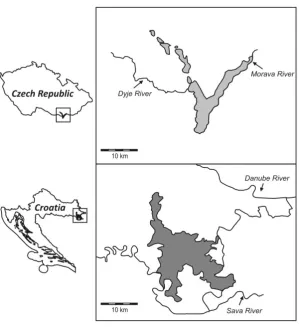
The aim of our paper is to compare two systems of floodplain forest regeneration, namely natural and clear-felling regeneration on the example of the Sáva river watershed (Croatia) and the Morava and Dyje rivers watershed (Czech Republic – southern Moravia).
Studied areas and methods
The complex of floodplain forests Spačva, eastern Croatia
[image:2.595.64.364.50.378.2]Regeneration of pedunculate oak forests in Croatia is traditionally based on the shelterwood system. The largest coherent forest complex of pedunculate oak in Croatia is Spačva (Klepac 2000), located in the easternmost part of Croatia. According to Klepac (2000), the present forests of pedunculate oak in Spačva differ profoundly from the past old oak for-ests. In contrast to very old oaks of gigantic dimen-sions, these stands are up to 140 years old. They are
the result of shelterwood cuts undertaken by expert foresters. The activities go back to 1769, when a legal regulation was passed for oak rotation of 200 years. Later, the rotation period was gradually shortened to reach the age of 120 (the regulation of 1985). At present (according to the 1994 regulation and later ones) the rotation period is 140 years, and tending and regeneration of pedunculate oak forests are con-ducted during the entire rotation (Matić 2003a,b). Regeneration is based on the shelterwood system, with the main goal always being natural regenera-tion, and alternatively, the introduction of acorns at the end of the regeneration period (Fig. 2).
This is a relatively large forest complex covering about 40,000 hectares. We selected stands of differ-ent ages: Plot 1 – 5 yr, Plot 2 – 15 yr, Plot 3 – 29 yr, Plot 4 – 70 yr, Plot 5 – 96 yr, Plot 6 – 135 yr and Plot 7 – 139 yr. In the flat region, the microrelief is of decisive importance for ecological stand conditions and floristic characteristics of the stand. It should be pointed out that the altitude in the research area varies between 79 and 84 m. Microdepressions and microelevations are almost indistinct and have hardly any effect on the floristic composition. This may be ascertained by the higher or lower presence of hornbeam. The plant communities occurring at such amplitudes in this area are the forest of pedun-culate oak with tall broom and remote sedge (Ge- nisto elatae-Quercetum roboris caricetosum remotae (Ht. 1938)), the forest of pedunculate oak with tall broom and Tatarian maple (Genisto elatae-Querce-tum roboris aceretosum tatarici Rauš (1971)), and the forest of pedunculate oak and common horn-beam (Carpino betuli-Quercetosum roboris (ANIć) 1959; RAuš (1969)). The sites in question contain the forest of pedunculate oak with tall broom and remote sedge, with some sporadic occurrences of hornbeam.
According to the data from the meteorological station situated in the forest of Spačva, the mean annual precipitation amount is 805 mm (462 mm in the vegetation period), and the mean annual air tem-perature is 10.1°C (16.4°C in the vegetation period). The soil in the study area is Gleysol.
The complex of floodplain forests in southern Moravia, Czech Republic
In southern Moravia, the area of floodplain for-ests was colonized by man for a variety of reasons. Among others, these areas represent a source of building timber, offer the possibility of water trans-port, and are suitable for agriculture and pasturage in particular. Forest stands were gradually cleared and converted to meadows and pastures as early as in the 14th century (Nožička 1957). Large areas
were deforested as a result of conversion of soft hardwoods of floodplain forest to hard hardwoods or as a consequence of damage to forest stands at high and long-lasting floods. All these effects lead to forest regeneration over large areas, sometimes even on clear-cut areas of more than tens of hectares (Vybíral 2004).
Although the coppice management system, which favours species of higher sprouting capacity, was ap-plied at the beginning of the 17th century (Nožička
1957), artificial regeneration began to be increasingly used. Thus, particularly in the second half of the 18th century, broadcast soil preparation and row
seeding gradually gained predominance. Agricul-tural crops were grown between the rows (alternate forest and farm crops). The initially unlimited area of unstocked forest land was specified at 5 ha by Forest Law No. 96/1977 Gaz.
[image:3.595.65.289.55.210.2]Without giving a detailed outline of the historical development of methods of floodplain forest regen-eration, we can note that the clear-felling method of forest regeneration was a dominant method in the past. The application of this method has survived up to this day in spiteof many attempts to use natural regeneration (Fig. 3). Mezera (1958) advocates this option when he mentions that “there is general awareness of the limited possibilities of using natural regeneration of trees in floodplain forests”. However, he points out that “by working intensively, it is pos-sible to use natural regeneration over small areas”, namely, gap felling or narrow clear felling. Farm forestry has largely been accepted for economic reasons although it has had both supporters and op-ponents since the beginning. At present, however, it is gradually being abandoned due to a lack of interest in this type of production by local people. Regen-eration with clear felling, which was prohibited by
the 1995 Forest Law, is allowed only in floodplain forests over areas of 2 ha at maximum. The present ecosystem approach to management advocates new ideas and tendencies. On the one hand, floodplain forests maintain high productivity although there arise problems concerning oak regeneration due to very sporadic years of seed production. On the other hand, attempts are being made to protect the natural development of soil environment and its humus layer in particular, conserve biodiversity and encourage rational water management endangered by potential global climate changes.
The area of floodplain forests in southern Moravia is located at the confluence of the Morava and Dyje rivers and covers about 15,000 ha. The underlying layers of the area consist of recent sandy or clay sediments of various thickness of 1–2 m in general and underlying Pleistocene water-bearing sands. The mineral composition of the soils corresponds to the geological composition of the catchment area the sediments come from. On relatively small areas, shallow and very deep soils of different physical and chemical properties alternate. This considerable variability of soils is conditioned by the dynamic processes of alluvium formation and by the diversity of the stand species composition.
The mean annual temperature of 9°C ranks the region among the warmest in the Czech Republic. A comparison of long-term precipitation values in-dicates a drop of approximately 70 mm per annum in the period after the end of flooding; according to the long-term average, there was precipitation of 524 mm per annum, which fell to 452 mm per annum in the period after 1973.
To assess impacts on the soil environment the fol-lowing localities were selected:
(1) Lednice locality – is characterized by Ulmeto-Fraxinetum-Carpineum (Vašíček 1985), aged
about 120 years, dominated by Quercus robur L. (74%) and Fraxinus angustifolia L. (24%). Other species: Tilia cordata Mill. (3%) and Ul-mus carpinofolia Gled. (1%). Cornus sanguinea L. is the dominant species of the undergrowth. To assess changes in soil properties affected by clear-felling regeneration, three experimental plots were established:
Plot 1 – undisturbed development of soil properties (basic comparative plot).
Plot 2 – clear-felling regeneration in 1999, whole-area site preparation by ploughing to a depth of 35 cm and stump removal.
Plot 3 – clear-felling regeneration in 2001, site prep-aration after felling – flush cutting of stumps. (2) In the second locality (Vranovice), sampling
was carried out in a mature stand of Slavonian oak with heavy undergrowth of nettle and in the plot after the soil was cleared and prepared by ploughing.
(3) Tvrdonice locality.
In this locality, we compared the soil (A horizon 0–8 cm) under a mature ash stand with a heavy cover of herbs (Plot 1) with Plot 2 – reforested with oak preceded by whole-area preparation of soil by ploughing, and with Plot 3 – reforested with oak similarly to Plot 2, where agricultural crops were grown between the rows (in the period of sampling, both stands were aged 8 years).
METHODS
The surface humus (L and F layers) was sampled on 0.25 m2 plots with 3 replications and at the same
place; samples of organomineral horizons A were taken. The weight of organic residues (L, and F lay-ers) was determined after desiccation (80°C).
Laboratory analyses focused on determining the concentrations of biogenic elements in the organic material as well as the pH value, organic C and total N in the soil. In the locations in Moravia, depending on the specific features of the treatments, physical parameters were also determined (humidity, poros-ity and aeration using Kopecký physical cylinders) and so were the dynamics of matter mass in the surface humus during the year and the content of carbon and some biogenic elements in the soil. The weight of organic residues (L and F layer) as well as the content of C, N and other elements was deter-mined as the mean of 3 samplings.
[image:4.595.64.291.57.209.2]Chemical analyses were carried out as follows: Actual soil reaction (pH/H2O) and exchangeable soil reaction (pH/KCl) were measured by potentiometry from the leachate of soil samples at the ratio of 1:2.5.
The content of total nutrients (Ca, Mg, P) was de-termined in the extract after mineralization by hot aqua regia using standard procedures (Ca and Mg by FAAS method – Zbíral (2003) and P by spec-trophotometry as phosphomolybdic blue – Zbíral (2002)).
The content of total nitrogen and carbon was determined using an elementary analyzer LECO TruSpecCN at the temperature of combustion 950/850°C.
To evaluate the results of the analysis of organic matter and organomineral soil horizons, statistical methods were used of the significance of differences determination of sampling means differences (t-test, confidence intervals).
RESULTS
Experimental area in southern Moravia
Locality 1 – basic area – Lednice
The mean annual value of surface humus on the basic comparative area – mull (L+F – without wood
residues) was 3.5 t/ha. During the year, marked changes occurred in the accumulation of surface humus due to rapid decomposition, which was par-ticularly fast in the plots dominated by ash.
In the basic area with an undisturbed layer of sur-face humus, marked changes occurred in nutrient reserves in combination with the nutrient flow of decomposition processes to mineral soil (Table 1).
This natural process, which depends on element cycling, largely contributes to the preservation of soil functions for the stability of floodplain forest ecosystems. In none of the comparative plots with the clear-felling regeneration method was it possible to determine the amount of surface humus. The sur-face humus was completely removed in the process of clear-felling regeneration and soil preparation.
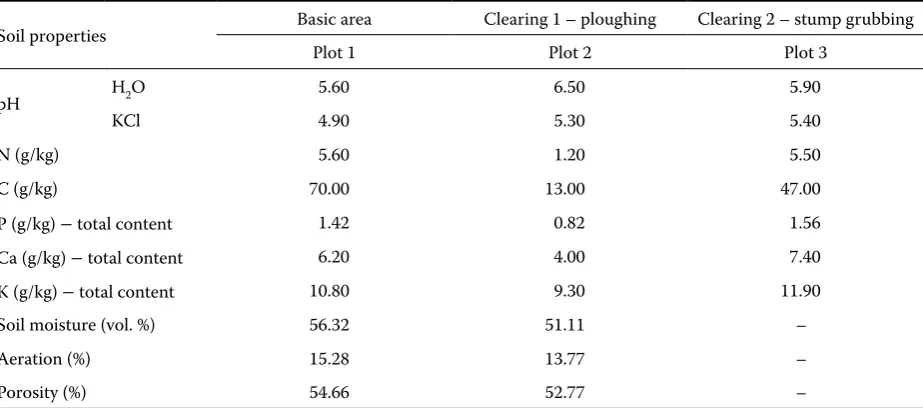
According to the results given in the table men-tioned above, in Plot 1 (under the forest), due to the effect of higher accumulation of organic mat-ter on the soil surface, it is possible to note slight acidification compared to the plots with clear-fell-ing regeneration. This difference is not, of course, significant from the aspect of ecology. In an older clearing (Plot 2), there is a markedly lower nitrogen concentration in comparison with the plot under the forest (Plot 1).
In a new clearing where ploughing was not carried out this difference was not distinct (Table 2). A simi-lar trend can also be noted in the content of carbon, i.e. a marked decline in the older clearing where the site preparation (ploughing) was applied. This “thin-ning” of soil chemistry after the soil preparation by ploughing is also evident in other elements.
These marked changes did not occur in Plot 3, where only stumps were cut off before reforestation. Table 1. Changes in nutrient reserves in L+F horizon
during the year (kg/ha) (Klimo 1985)
Element 1 December 1 April 1 July 1 October
N 143 59 56 36
P 9 4 5 2
K 24 10 9 7
Ca 99 62 38 17
[image:5.595.63.292.88.189.2]Mg 21 10 7 4
Table 2. Results of soil analysis from the A horizon
Soil properties Basic area Clearing 1 – ploughing Clearing 2 – stump grubbing
Plot 1 Plot 2 Plot 3
pH H2O 5.60 6.50 5.90
KCl 4.90 5.30 5.40
N (g/kg) 5.60 1.20 5.50
C (g/kg) 70.00 13.00 47.00
P (g/kg) – total content 1.42 0.82 1.56
Ca (g/kg) – total content 6.20 4.00 7.40
K (g/kg) – total content 10.80 9.30 11.90
Soil moisture (vol. %) 56.32 51.11 –
Aeration (%) 15.28 13.77 –
[image:5.595.69.531.551.755.2]Comparing the data on the chemistry of soils under the forest and those in clear-cut areas, we can see that in particular the clearing (Plot 2), where the soil was prepared to a depth of 35 cm, shows the greatest changes in nutrient concentrations. This was caused by mixing the upper part of the soil and bringing the soil with a lower nutrient content to the soil surface. There were fewer changes in the clearing without this type of soil preparation (Plot 3) and where only the stumps were cut off (Klimo, Hybler 2005).
There were no significant changes in physical prop-erties of the upper soil horizon, which is due to the soil preparation by ploughing (Plot 2). Nevertheless,
the central part of the soil profile may gradually be-come compact, particularly in heavy-textured soils. Thus, the soil permeability is changed and precipi-tation water or flood water can stagnate in the soil profile.
Locality 2 – Vranovice
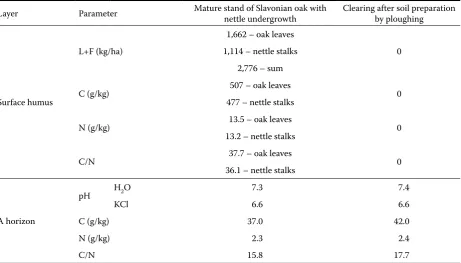
Another comparison was carried out at the Vranovice locality. These plots differ from the Led-nice locality particularly in the occurrence of heavy undergrowth of nettle in the stand of Slavonian oak. The humus layer was sampled at the beginning of summer, when only the stalks from the nettle
un-10,000 9,000 8,000 7,000 6,000 5,000 4,000 3,000 2,000 1,000 0
5 years L1
29 years L3 15 years
L2
70 years L4
96 years L5
135 years L6
[image:6.595.72.436.62.263.2]L F L + F
Fig. 4. Organic matter content (kg/ha) in the L and F subhorizons
Table 3. Properties of humus layers and the A horizon at the Vranovice locality
Layer Parameter Mature stand of Slavonian oak with nettle undergrowth Clearing after soil preparation by ploughing
Surface humus
L+F (kg/ha)
1,662 – oak leaves
0 1,114 – nettle stalks
2,776 – sum
C (g/kg) 507 – oak leaves 0
477 – nettle stalks
N (g/kg) 13.5 – oak leaves 0
13.2 – nettle stalks
C/N 37.7 – oak leaves 0
36.1 – nettle stalks
A horizon
pH H2O 7.3 7.4
KCl 6.6 6.6
C (g/kg) 37.0 42.0
N (g/kg) 2.3 2.4
[image:6.595.70.532.493.756.2]dergrowth remained. These stalks amounted to 40% of the surface humus total weight. The comparison of the values of selected properties of humus layers, particularly in the plot with oak and the clearing, shows the following:
– total removal of surface humus on the clearing, – minimum insignificant differences in pH values of
the A horizon,
– no differences in nitrogen content,
– insignificant differences in carbon content, – insignificant differences in the C/N ratio.
This shows that the rich nettle site retains its properties even when the clear-felling regeneration method is applied (Table 3).
Locality 3 – Tvrdonice
According to the results given in Table 4, we can confirm that the pH value increased slightly on clear-ings 2 and 3. A substantial change occurred in the nitrogen content since it decreased from the value of about 7 g/kgto about 3 g/kg in both clearings. This was caused by organic mater mineralization and particularly by mixing the upper horizon with the soil from the central part of the soil profile, which contains a lower nitrogen content (0.1–0.3%). In addition, we can state that there were no significant differences in the chemical properties of the
up-per A horizon between the plot where the soil was prepared by ploughing and the plot with ploughing and annual growing of agricultural crops. In the plot with alternate forest and farm crops, the macropores were heavily overgrown by moulds, which did not occur in the plot where agricultural crops were not grown annually.
Experimental area Spačva, Croatia The organic matter content in the L and F subhori-zons (Fig. 4) was the lowest in location 1 (a 5-year-old stand) and the highest in location 4 (a 70-year-old stand). It should be pointed out that location 5 re-veals deviations in the form of a lower matter con-tent compared to location 4 and location 6. This is attributed to the presence of the H subhorizon (silty organic matter), which was not sampled.
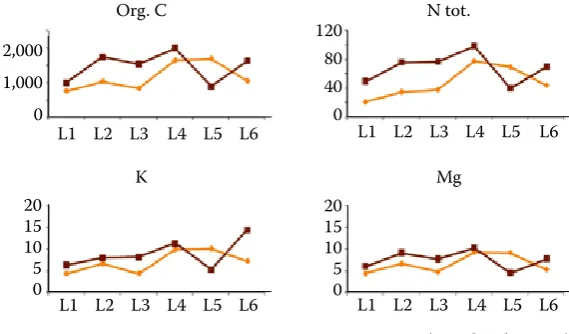
Organic matter from the L and F subhorizons was analyzed for the content of biogenic elements (Fig. 5) and showed that the content of biogenic elements rises up to the age of 70 years. In this case, the result for site 5 does not allow a more qualitative interpre-tation of the results.
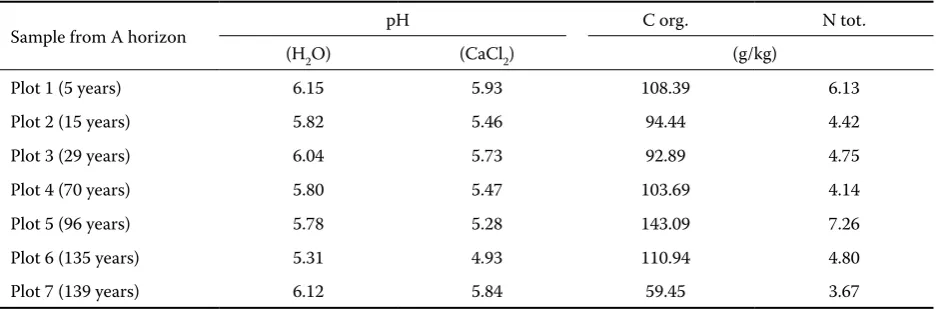
[image:7.595.68.531.72.159.2]In terms of the A horizon (Table 5) by locations in Spačva, it is evident that the lowest pH value is found in plot 6, while other plots do not differ significantly from one another. The significantly lowest values of Table 4. Comparison of chemistry in the upper A horizons in the comparative plots of the Tvrdonice locality
Plot pH N C P K
(H2O) (KCl) (g/kg)
1 – ash stand 6.1 5.4 0.69 9.4 1.3 10.8
2 – pedunculate oak stand, aged 8 years, ploughing, without farm forestry 6.8 6.1 0.30 3.4 1.3 12.6
3 – pedunculate oak stand, aged 8 years, ploughing, with farm forestry 6.6 5.9 0.32 4.3 1.3 12.9
Fig. 5. Content of biogenic elements in the L and F subhorizons (kg/ha) 2,000
1,000 0
120 80 40 0
L1 L2 L3 L4 L5 L6 L1 L2 L3 L4 L5 L6
L1 L2 L3 L4 L5 L6
L1 L2 L3 L4 L5 L6 L1 L2 L3 L4 L5 L6 L1 L2 L3 L4 L5 L6
20 15 10 5 0 20
15 10 5 0 20
15 10 5 0
Org. C N tot. Ca
K Mg P
L1, L2, L3, L4, L5, L6 (sampling location)
L F 120
[image:7.595.75.360.565.732.2]organic carbon and total nitrogen occur in plot 7*. The significantly highest values are found in plot 5, which is directly linked to the already mentioned deviation in the O horizon. Such high values for C and N are the consequence of an increased presence of humified organic matter (H), which was sampled together with the A horizon.
A higher content of organic carbon and particular-ly of total nitrogen in plot 1 is significant. This could be attributed to the luscious production of ground vegetation in the past 10–15 years, especially after the final cut. Such dead material humifies relatively rapidly, thus causing considerable accumulations of humus and nitrogen. As this developmental stage is marked by a dense canopy of young generation, humification is very intensive. More rapid miner-alization and a temporary fall in the production of organic matter and its level in the soil can only take place after the first cleaning treatments.
DISCUSSION
unless the pedunculate oak forest is regenerated us-ing expert management practices, undesirable changes may ensue both in the vegetation structure and in the soil (Matić 2003a,b; Elliott, Knoepp 2005; Strandberg et al. 2005). The biggest changes in the soil of a regular stand are linked with its regeneration (Snyder, Harter 1985; Fisher, Binkley 2000). Leaf litter decomposition is the basic chain in the cycling of matter and energy in a forest (Berg 2000; Cou-teaux et al. 1995). Forest management has a direct influence on carbon sequestration in the soil, which is also linked with greenhouse gas emission (Johnson 1992; Fisher, Binkley 2000; Johnson, Curtis 2001; Johnson et al. 2002; Jandl et al. 2007).
All this should be borne in mind when discussing silvicultural treatments in a pedunculate oak stand and their influence on the relations in the stand, and especially in the soil.
The type and intensity of the changes in the soil depend on silvicultural treatments applied during stand development, and particularly on treatments linked with stand regeneration at the end of the ro-tation (Huntington, Ryan 1990; Johnson et al. 1991a,b; Ryan et al. 1992). This research confirms past insights and indicates the complexity of the changes in the soil that take place during regenera-tion of an even-aged oak or ash-oak stand.
Clear-cutting combined with soil preparation is always followed by more rapid humification and mineralization of organic matter. In the initial stages of the development of a young stand, there is a con-tinuous positive trend in humification (Pernar et al. 2000). Despite the relatively small sample, the measurement results of organic matter parameters in differently aged stands in Spačva indicate such a trend. It should be stressed that this trend does not have a linear character. It is evidently linked with tending, cleaning and thinning treatments in the stand. In order to carry out consistent research on such a trend, very demanding long-term investiga-tion (monitoring) should be undertaken.
[image:8.595.64.535.73.228.2]Gradual (shelterwood) cuts allow a stand to regen-erate without undergoing too many stress impacts on the soil, which is very important for the continuous supply of nutrients to young plants (Cole 1995), but also for the preservation of the entire edaphon in the forest soil. In our research, this is indicated by the leaf litter organic matter and the content of biogenic elements in the soil A horizon. Research by Hendrickson et al. (1985, 1989) shows the decisive Table 5. Soil characteristics in the A horizon in the forest of Spačva
Sample from A horizon pH C org. N tot.
(H2O) (CaCl2) (g/kg)
Plot 1 (5 years) 6.15 5.93 108.39 6.13
Plot 2 (15 years) 5.82 5.46 94.44 4.42
Plot 3 (29 years) 6.04 5.73 92.89 4.75
Plot 4 (70 years) 5.80 5.47 103.69 4.14
Plot 5 (96 years) 5.78 5.28 143.09 7.26
Plot 6 (135 years) 5.31 4.93 110.94 4.80
Plot 7 (139 years) 6.12 5.84 59.45 3.67
importance of stand regeneration methods, as well as cutting methods, for changes in the soil.
Silvicultural treatments during the development of a stand and its regeneration depend on a variety of factors [site, previously applied methods in the stand (Gunapala et al. 1998), tradition, manage-ment objectives, etc.]. Shelterwood cutting has been traditionally and very successfully applied to pedun-culate oak stand management in Croatia. Problems occurring in some cases are attributed to changes in the water regime in the stand as a consequence of hydro-technical operations undertaken on large watercourses or in the environment of the stand.
The present practice in the floodplain forest re-generation in southern Moravia is closely related to historical experience. According to the Forest Act, it is carried out using the clear-felling method of regeneration.
Changes in the forest environment, induced by changes in the water regime caused by river ca-nalization and increased use of water for municipal purposes, as well as episodic climate changes, force us to pause and search for new methods of forest regeneration that would take into account these changes.
There were no significant differences in the se-lected chemical characteristics between clear-felling regeneration with alternate forest and farm crops and regeneration in which no farm forestry was ap-plied. It would be interesting to investigate different between-the-row agrotechnical treatments with dif-ferent agricultures under the same conditions.
Soil preparation by ploughing before reforestation does not change the physical properties of soil. The central part of the soil profile is likely to become compact, the soil may become dry during long-last-ing dry periods, and cracks may develop in the soil profile (Fisher, Binkley 2000).
The stand composition (species participation) also has a decisive impact on the quantity of organic matter in the soil (Prescott et al. 2000). This is confirmed by the results from the Lednice locality (participation of ash). The higher the number of plant species in the stand, the more complex the impact on the soil they exert (Pernar 1994), es-pecially in view of the temporal gradient, which is determined by specific features, such as individual vegetation zones (Hughes, Fahey 1994; Jobba’gy, Jackson 2000).
A relatively complex sample project should be made in order to conduct transversal research that would incorporate all treatments in the development of a stand linked to changes in the soil. A sample project of this kind could only be carried out in
a large and homogeneous forest complex such as Spačva, for example. Insights gained in this research will provide guidelines for the realization of the above-mentioned project.
CONCLUSION
– The natural regeneration of oak in floodplain forests of Spačva protects the soil from dramatic changes in soil in such a way that it retains the plant cover permanently.
– The weight of organic matter on the soil surface is increased after regeneration till the period when the effects of thinning become evident (about 70 years).
– In the surface mineral layer of soil, the pH value is increasing after shelterwood felling.
– This could be attributed to accelerated minerali-zation of organic matter and a higher proportion of ground vegetation in its production. Such material is richer in nitrogen, decomposes faster and releases more basic substances, while humus accumulated during the development of the stand mineralizes more rapidly due to more light, tem-perature and moisture changes. The comparison of soil conditions in mature stands and on a re-generated clear-felling area in southern Moravia can be summarized as follows:
The process of organic residue accumulation and the processes of their decomposition are inter-rupted in the clearings.
In the course of clear-felling regeneration, the pH values of the upper soil horizon are slightly increased.
In the preparation of soil/site by ploughing, the concentrations of nitrogen and carbon slightly decrease as a result of mixing the soil of the upper horizon with the central part of the soil profile.
– Higher values of the surface humus accumulation in the floodplain forest of Spačva as compared with Plot 1 in Lednice are conditioned by the spe-cies composition of stands (in Lednice, there is a higher proportion of ash with the rapid decompo-sition of litter).
– The selection of a method of the floodplain for-est regeneration (particularly of oak) is markedly dependent on actual ecological conditions and on ecological and historical experience of the given region.
Acknowledgements
This research has been realized through scientific cooperation between the Faculty of Forestry in Za-greb, Croatia, and the Faculty of Forestry and Wood Technology in Brno, Czech Republic, Project MSM 6215648902, and within the Eu-funded integrated project EFORWOOD, No. 518128-M-2, WP 2.2.
We would like to thank the company Hrvatske šume d.o.o. for their valuable help in field research conducted in the forest of Spačva.
References
BERG B., 2000. Litter decomposition and organic matter turnover in northern forest soils. Forest Ecology and Man-agement, 133: 13–22.
COLE D., 1995. Soil nutrient supply in natural and managed forests. Plant and Soil, 168–169: 43–53.
COuTEAuX M.-M., BOTTNER P., BERG B., 1995. Litter decomposition, climate and litter quality. Trends in Ecolo-gy & Evolution, 10: 63–66.
ELLIOTT K.J., KNOEPP J.K., 2005. The effects of three regeneration harvest methods on plant diversity and soil characteristics in the southern Appalachians. Forest Ecol-ogy and Management, 211: 296–317.
FISHER R.F., BINKLEY D., 2000. Ecology and Management of Forest Soils. 3rd Ed. New York, John Wiley & Sons, Inc.: 489.
GuNAPALA N., VENETTE R.C., FERRIS H., SCOW K.M., 1998. Effects of soil management history on the rate of or-ganic matter decomposition. Soil Biology & Biochemistry,
30: 1917–1927.
HENDRICKSON O.Q., CHATARPAuL L., ROBINSON J.B., 1985. Effects of two methods of timber harvesting on microbial processes in forest soils. Soil Science Society of America Journal, 49: 739–746.
HENDRICKSON O.Q., CHATARPAuL L., BuRGESS D., 1989. Nutrient cycling following whole tree and conven-tional harvest in northern mixed forest. Canadian Journal of Forest Research, 19: 725–735.
HOušKOVÁ K., PALÁTOVÁ E., MAuER O., 2007. Pos-sibilities and procedures for the natural regeneration of pedunculate oak (Quercus robur L.) in south Moravia. In: Proceedings from the International Conference Forest Management Systems and Regeneration of Floodplain Forest Sites. Brno, Mendel university of Agriculture and Forestry in Brno: 89–98.
HuGHES J.W., FAHEY T.J., 1994. Litterfall dynamics and ecosystem recovery during forest development. Forest Ecology and Management, 63: 181–198.
HuNTINGTON T.G., RYAN D.F., 1990. Whole-tree-harvest-ing effects on soil nitrogen and carbon. Forest Ecology and Management, 31: 193–204.
JANDL R., LINDNER M., VESTERDAL L., BAuWENS B., BARITZ R., HAGEDORN F., JOHNSON D.W., MINK-KINEN K., BYRNE K., 2007. How strongly can forest man-agement influence soil carbon sequestration? Geoderma,
137: 253–268.
JOBBA’GY E.G., JACKSON R.B., 2000. The vertical distribu-tion of soil organic carbon and its reladistribu-tion to climate and vegetation. Ecological Applications, 10: 423–436.
JOHNSON D.W., 1992. Effects of forest management on soil carbon storage. Water, Air, and Soil Pollution, 64: 83–120.
JOHNSON D.W., CuRTIS P.S., 2001. Effects of forest manage-ment on soil C and N storage: meta analysis. Forest Ecology and Management, 140: 227–238.
JOHNSON C.E., JOHNSON A.H., HuNTINGTON T.G., SICCAMA T.G., 1991a. Whole tree clear-cutting effects on soil horizons and organic matter pools. Soil Science Society of America Journal, 55: 497–502.
JOHNSON C.E., JOHNSON A.H., SICCAMA T.G., 1991b. Whole-tree clear-cutting effects on exchangeable cations and soil acidity. Soil Science Society of America Journal,
55: 505–507.
JOHNSON D., KNOEPP J., SWANK W., SHAN J., MORRIS L., VAN LEAR D., KAPELuCK P., 2002. Effects of forest management on soil carbon: results of some long-term re-sampling studies. Environmental Pollution, 116: 201–208. KLEPAC D., 2000. The biggest forest of pedunculate oak
in Croatia Spačva. HAZu Centre for Scientific Research Vinkovci: 117.
KLIMO E., 1985. Cycling of mineral nutrients. In: PENKA M., VYSKOT M., KLIMO E., VAšÍČEK F. (eds), Floodplain Forest Ecosystems. Prague, Academia: 425–459.
KLIMO E., HYBLER V., 2005. Revitalisation of floodplain forests in Southern Moravia from the point of view of their management. In: KuLHAVÝ J., SKOuPÝ A., KANTOR P., SIMON J. (eds), Sustainable Forest and Landscape Mana-gement. Brno, MuAF: 169–174.
KLIMO E., HAGER H., MATIČ S., ANIć I., KuLHAVÝ J. (eds), 2008. Floodplain Forests of the Temperate Zone of Europe. Kostelec nad Černými lesy, Lesnická práce: 623. LIBuS J., MAuER O., VAVŘÍČEK D., 2007. Impact of the
whole – area soil preparation by ploughing and agrofor-estry on some characteristics of floodplain ecotopes. In: Proceedings from the International Conference Forest Management Systems and Regeneration of Floodplain Forest Sites. Brno, Mendel university of Agriculture and Forestry in Brno: 121–132.
MATIć S., 1996. Silvicultural treatments in regeneration of pedunculate oak stands. In: KLEPAC D. (ed.), Pedunculate Oak in Croatia. Zagreb, HAZu Centre for Scientific Re-search Vinkovci, Croatian Forests Ltd.: 168–212.
of Pedunculate Oak in Croatia. Zagreb, HAZu Centre for Scientific Research Vinkovci: 143–166.
MATIć S., 2003b. Silvicultural practices in beech forests. In: MATIć S (ed.), Common Beach in Croatia. Zagreb, Academy of Forestry Science: 340–392.
MATIć S., ORšANIć M., BARIČEVIć D., 1999. Natural regeneration of pedunculate oak in floodplain forests of Croatia. Ekológia, Bratislava, 18: 111–119.
MEZERA A., 1958. Central-European Lowland Floodplains. Prague, ČSAZV, SZN.
NOŽIČKA J., 1957. View of the Development of our Forests. Prague, SZN: 460.
ORšANIć M., DRVODELIć D., 2007. Natural regeneration of pedunculate oak. In: HOZBA P. (ed.), Forest manage-ment systems and regeneration of floodplain forest sites. Reviewed Proceedings from the International Conference, Brno, Czech Republic, October 8.–9. 2007. Brno, Mendel university of Agriculture and Forestry: 99–106.
PELÍšEK J., 1976. Dynamics of nutrients in soils of flood-plain forests of southern Moravia. Lesnictví, 22: 57–74. (In Czech)
PERNAR N., 1994. Supplement to the research on the quan-tity and course of bioelements in organic horizon of birch (Betula pendula Roth) and beech (Fagus sylvatica L.) on Papuk mountain depending on species of trees and elements of relief. Agronomski glasnik (Zagreb), 1–2: 131–145. PERNAR N., SELETKOVIć Z., BAKšIć D., 2000. Pedological
and microclimatic properties of some experimental plots of pedunculate oak (Quercus robur L.) plantations in Croatia. Glasnik za šumske pokuse, 37: 251–262.
PRESCOTT C.E., ZABECK L.M., STALEY C.L., KABZEMS R., 2000. Decomposition of broadleaf and needle litter in forests of British Columbia: influences of litter type, for-est type, and litter mixtures. Canadian Journal of Forfor-est Research, 30: 1742–1750.
RYAN D.F., HuNTINGTON T.G., MARTIN C.W., 1992. Redistribution of soil nitrogen, carbon and organic matter by mechanical disturbance during whole-tree harvesting in northern hardwoods. Forest Ecology and Management,
49: 87–99.
SNYDER K.E., HARTER R.D., 1985. Changes in solum chem-istry following clearcutting of northern hardwood stands. Soil Science Society of America Journal, 49: 223–228. STRANDBERG B., KRISTIANSEN S.M., TYBIRK K., 2005.
Dynamic oak-scrub to forest succession: Effects of manage-ment on understorey vegetation, humus forms and soils. Forest Ecology and Management, 211: 318–328.
VAšÍČEK F., 1985. Natural conditions of floodplain forests. In: PENKA et al. (eds), Floodplain Forests Ecosystems 1. Prague, Academia: 13–29.
VYBÍRAL J., 2004. Function of the forester in the floodplain landscape. In: HRIB M., KORDIOVSKÝ E. (eds), Lužní les v Dyjsko-moravské nivě. Brno: 163–172.
ZBÍRAL J., 2002. Jednotné pracovní postupy. Analýza půd II. Brno, ÚKZÚZ: 197.
ZBÍRAL J., 2003. Analýza půd II. Jednotné pracovní postupy. Brno, ÚKZÚZ: 224.
Received for publication January 13, 2009 Accepted after corrections March 3, 2009
Corresponding author:
Prof. Ing. Emil Klimo, DrSc., Mendelova zemědělská a lesnická univerzita v Brně, Lesnická a dřevařská fakulta, Lesnická 37, 613 00 Brno, Česká republika
tel.: + 420 545 134 038, fax: + 420 545 211 422, e-mail: [email protected]
Rozdílné technologie obnovy lužního lesa z pohledu půdních změn
ABSTRAKT:Největší změny v půdě porostů lužního lesa, stejně jako v jiných typech lesů, probíhají v průběhu jejich obnovy. Tyto změny se projevují jako změny v obsahu a dynamice organické hmoty v půdě. Předmětem výzkumu byly dubo-jasanové lužní lesy ve východním Chorvatsku a na jižní Moravě v České republice. Výsledky ukázaly, že druh a velikost těchto změn je významně závislá nejen na faktorech prostředí, ale také na obnovních způsobech. Přirozená obnova dubu v lužním lese – Spačva (východní Chorvatsko) ochraňuje půdu před dramatickými změnami bylinné vrstvy. Hmotnost organické hmoty na půdním povrchu stoupá po obnově až do věku porostu kolem 70 let. V povrchovém minerálním půdním horizontu stoupá hodnota pH. Obnova lužního lesa holosečným způsobem vyvo-lává rychlé změny v zásobě povrchového humusu i v procesech dekompozice. Proces akumulace organické hmoty na půdním povrchu je přerušen. Příprava půdy orbou mírně snižuje koncentraci uhlíku a dusíku. Aplikace způsobu obnovy lužního lesa je značně závislá i na historických a současných přírodních podmínkách v dané oblasti.