Since a long time an increasing attention was given to the waste management chain and composting represents an effective way to recycle residues from agriculture, industry and other activities from an ecological as well from an economical point of view. Caused by the governmental funding biogas produc-tion has become more important in Germany in the two last decades. Both composting as well as biogas production result in substantial amounts of leftover material, namely compost and biogas residues. It is widely accepted that the reintegration of these ma-terials into soils is a potential solution of the waste management problem (Grigatti et al. 2011) and that compost improves physical and chemical soil proper-ties under field conditions (Pagliai et al. 1981) and gradually releases nutrients like N (Scherer et al. 1996) and P (Scherer 2004). Nevertheless negative effects, caused by N immobilization, mostly associated with yield decrease were also reported (Iglesias-Jimenez and Alvarez 1993). Besides, compost biogas residues are increasingly used as fertilizers because they con-tain plant nutrients like N, P, K and others, which favor yield formation of field crops (Bachmann et al. 2011, Lošák et al. 2012).
However, using compost and biogas residues di-rectly as potting medium or a substrate for plants may have negative effects on growth (Svensson et al. 2004), which may be overcome by the addition of natural or artificial additives (Benito et al. 2005, Mami and Peyvast 2010). Perlite, Styromull, Hygromull, and Lecaton were developed and used as soilless substrates for many years and they were described to contribute to increasing plant productivity in horticulture (Olympios 1992). Based on the char-acteristics of the raw materials and plant species, additives must be selected to gain optimal potting substrates. This paper was aimed to investigate the suitability of compost and biogas residues as target basic materials alone or in combination with ad-ditives for potting substrates. To get a first insight ryegrass as a plant with a higher salt tolerance was chosen as an experimental plant.
MATERIAL AND METHODS
Raw materials. Two basic raw materials were used: compost (Comp) from green wastes and
Compost and biogas residues as basic materials for potting
substrates
T.C.V. Do, H.W. Scherer
Institute of Crop Science and Resource Conservation, Department of Plant Nutrition,
University of Bonn, Bonn, Germany
ABSTRACT
Recent concerns over the environmental impact of peat harvesting have led to restrictions on the production of peat based potting substrates. Therefore the objective of our study was to evaluate the use of compost and biogas residues without and each with 20% additives (Perlite, Styromull, Hygromull, Lecaton, Peat, Cocofiber) as a substi-tute for peat. Ryegrass (Lolium perenne L.), chosen as an experimental plant, was cut four times. The results reveal that compost and biogas residues are suitable potting substrates. The incorporation of additives mixed into the ba-sic materials partly resulted in higher yield and nutrient uptake. However, the difference among additives was main-ly insignificant. Incorporation of Hygromull, especialmain-ly into biogas residues favored plant growth and increased the uptake of nutrients, which is attributed to the fact that Hygromull stores nutrients and delivers them even later in the growing season. Furthermore Hygromull reduces the salt concentration of the medium, resulting in favored plant growth of younger plants.
Keywords: organic residues; additives; nutrient uptake; yield; ryegrass
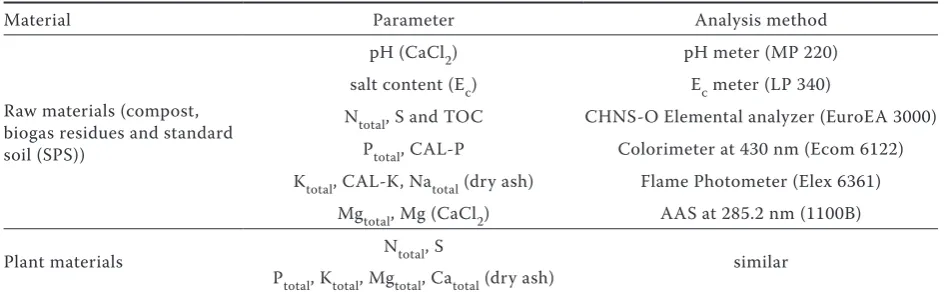
biogas residues (solid phase, pressed to reduce liquid content) from pig manure and maize as input materials for the biogas plant (BioR). The physiochemical characteristics of the raw materials including the standard potting substrate (SPS; peat based Einheitserde) are listed in Table 1. The salt content was lowest in SPS, followed by compost and biogas residues. The same order was found for plant available P, K and Mg and total S, while total N was highest in compost.
Additives. The additives included Perlite (Per), Styromull (Sty), Hygromull(Hy), Lecaton (Le), Peat (Peat), Cocofiber (Coco). These additives were decided to be added into the basic materials since they have a lot of advantages in improving substrate quality (Olympios 1992).
Perlite: expanded volcanic Al-silicate increases the aeration and water-holding capacity (WHC) of substrates.
Styromull: closed-pore polystyrene foam improves the substrate aeration.
Hygromull: open-pore hydrophilic PU foam im-proves WHC and substrate aeration, and is able to adsorb nutrients.
Lecaton: thermally expanded burnt clay granules improve the physical characteristics of substrates, are able to absorb cations, and may release Ca. Peat: a soil type formed from partially decomposed
mosses or sedges accumulating in bogs over hundreds or thousands of years, it has a high WHC and excellent structure for plant growth.
Cocofiber: is made from fibers of coconut hull, is rather stable and improves the aeration.
Experimental design. Ryegrass (Lolium perenne L., cv. Disco) was chosen as the experimental plant because of the relative high-salt tolerance and the ability of re-growing after cutting several times. Plants were cultivated from May to September 2010 in a greenhouse in 6 L pots and cut four times in 30 day intervals. Plants were watered with distilled water every day (60–70% of the maximum water holding capacity).
15 treatments with four replications were estab-lished: control (SPS), compost group including com-post 100% (Comp), 6 comcom-post treatments mixed separately with 20% of an additive (Comp Per, Comp Sty, Comp Hy, Comp Le, Comp Peat, Comp Coco) and biogas residues group including biogas residues 100% (BioR) and 6 biogas residues treatments mixed with 20% additives (BioR Per, BioR Sty, BioR Hy, BioR Le, BioR Peat, BioR Coco). After each harvest plant material was dried at 60°C in a thermal oven until constant weight, finely ground into powder and stored in plastic bottles for analysis.
[image:2.595.63.531.75.158.2]Substrate and plant analysis. Raw materials, standard substrate and plant materials were ana-lyzed according to the standard analysis methods of VDLUFA (Hoffmann 1991, 1995, 1997) (Table 2). Data were processed by using the SPSS 18.0 (Chicago, USA) software with multivariate analysis (ANOVA). Mean differences among treatments for dry matter, nutrient uptake of different cuts
Table 1. Physiochemical characteristics of raw materials for the pot experiment
Material DM (%) Ec
(mS/cm)(CaClpH 2)
CAL-P CAL-K Mg (CaCl2) Natotal Ntotal Stotal Ctotal C/N ratio (mg/kg)
Standard soil (SPS) 59.42 1.39 5.79 387 2545 950 3850 9810 40 481080 49.0 Compost 43.73 2.77 7.96 1417 7308 1045 1781 18768 9530 198625 10.6 Biogas residues 81.76 3.73 7.79 3003 12599 1571 1292 17070 20138 448238 26.3
Table 2. Analysis methods
Material Parameter Analysis method
Raw materials (compost, biogas residues and standard soil (SPS))
pH (CaCl2) pH meter (MP 220)
salt content (Ec) Ec meter (LP 340)
Ntotal, S and TOC CHNS-O Elemental analyzer (EuroEA 3000)
Ptotal, CAL-P Colorimeter at 430 nm (Ecom 6122)
Ktotal, CAL-K, Natotal (dry ash) Flame Photometer (Elex 6361)
Mgtotal, Mg (CaCl2) AAS at 285.2 nm (1100B)
Plant materials Ntotal, S similar
[image:2.595.62.535.614.760.2]or among different potting substrates for accu-mulated yield and nutrient uptake after 4 times of cutting were compared at significance level of P = 0.05 by the Tukey test.
RESULTS AND DISCUSSION
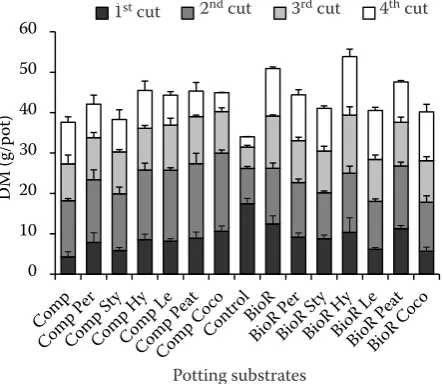
In the past many potting substrates were based on peat. However, peat is not a renewable resource and moreover, it is becoming difficult to obtain, because of new legislation for the conservation of non-renewable resources and environmental protection (Suo et al. 2011). Therefore it is widely recognized that compost from solid wastes and biogas residues are valuable sources for potting substrates. However, the high pH and electrical conductivity of both residues (Table 1) are assumed to restrict their use as potting substrates. To over-come these problems we incorporated Peat and Cocofiber with a share of 20% to each of the raw materials. In other treatments we added Perlite, Styromull, Hygromull and Lecaton because of their positive effect on the water-holding capacity or bulk density. In our investigations the influence of the different additives on plant growth (Figure 1) and uptake of different nutrients was not clear cut (Figure 2–6). However, it should be pointed out that especially with biogas residues the application of Hygromull resulted in a higher yield of ryegrass (Figure 1) and a higher total nutrient uptake, which was significant in the case of P (Figure 3) and Mg (Figure 5). The higher total nutrient uptake is
mainly caused by a higher uptake of the fourth cut. This is attributed to the fact that Hygromull is able to store nutrients and deliver them even later in the growing season. Furthermore based on the dilution effect the salt concentration of the medium is reduced, resulting in favored plant growth of younger plants.
The yield of grass planted in the control me-dium (SPS) decreased according to the time of cuttings and gained the highest value of 17.4 g/ pot in the 1st harvest and the lowest in the 4th
cut (2.6 g/pot) (Figure 1). These results differed from those with compost and biogas residues as raw materials both with or without additives. As compared to the control, dry matter (DM) yield of ryegrass grown in compost and biogas resi-dues treatments was lower in the 1st cut while in
the following three cuts the reverse hold true. However, the highest DM of the grass grown in the compost and biogas residue treatments was generally observed in the 2nd cut ranging from
13.9–19.4 and 11.4–15.5 g/pot, respectively. Reasons are the high salt and available nutrient content in the raw materials (Table 1), which are assumed to be limiting factors for plants growth in the first stage(Rivard et al. 1995), but soluble salts were strongly reduced later in the growing season (Papafotiou et al. 2004). DM yield of the 1st cut in between compost treatments was
com-paratively as high as in the 3rd and 4th cuts and
ranged between 4.3–11.6 g/pot, while for the biogas residues treatments the 1st cut was observed to have
the lowest DM yield of 5.7–12.5 g/pot, lower than
0 10 20 30 40 50 60
DM
(g
/p
ot
)
Potting substrates
[image:3.595.310.529.495.691.2]1st cut 2nd cut 3rd cut 4th cut
Figure 1. Dry matter (DM) yield of grass planted in different potting substrates. Error bars represent the standard deviation of 4 replicates. Accumulative means of different treatments followed by the same letters are not significantly different (P < 0.05) by the Tukey test
0 400 800 1200 1600 2000
N
u
pt
ake
(mg/
po
t)
Potting substrates
[image:3.595.67.289.498.690.2]1st cut 2nd cut 3rd cut 4th cut
Figure 2. N uptake of ryegrass grown in different potting substrates. Error bars represent the standard deviation of 4 replicates. Accumulative means of different treat-ments followed by the same letters are not significantly different (P < 0.05) by the Tukey test
1st cut 2nd cut 3rd cut 4th cut 1st cut 2nd cut 3rd cut 4th cut
the 3rd and 4th cuts ranging from 10.0–14.5 g/pot
(Figure 1). This is assumed to be caused by the higher nutrient delivery potential of biogas resi-dues in the later growing period (Rivard et al. 1995). On the other hand, the incorporation of additives into compost resulted in enhancement of DM yield formation of the 1st cut, while these
additives added to biogas residues slightly reduced grass yield formation of this cut (Figure 1).
Accumulated DM yield (total of 4 cuts) of ryegrass grown on compost and biogas residues without additives was remarkably higher than the control (Figure 1). Therefore both materials may be recom-mended for crop production (Svensson et al. 2004). However, the impact of the additives was not clear. The presence of some additives (Perlite, Hygromull,
[image:4.595.63.300.57.267.2]Lecaton, Peat, Cocofiber) favored yield formation, but the difference between the single additives was insignificant. The influence of Styromull on total DM yield was negligible. Based on these results the addition of 20% of an additive may be recommended. Benito et al. (2005) also reported that the incorpora-tion of an additive, for instance 10% or 25% volume of peat, to pruning waste compost significantly in-creased the germination index and yield of ryegrass as compared to pure compost. Moreover, in a study on some kinds of perennials such as Bolivian sunset (Gloxinia sylvatica), Brazilian plume (Justicia car-nea), and Golden globe (Lysimachia congestiflora) grown in compost-based media, it was concluded that compost from biosolids and yard trimmings mixed with 75% of vermiculite/perlite improved
Figure 3. P uptake of ryegrass grown in different potting
[image:4.595.301.527.61.258.2]substrates. For more details see Fig. 1 Figure 4. K uptake of ryegrass grown in different pot-ting substrates. For more details see Fig. 1
Figure 5. Mg uptake of ryegrass grown in different
pot-ting substrates. For more details see Fig. 1 Figure 6. S uptake of ryegrass grown in different potting substrates. For more details see Fig. 1
0 30 60 90 120 150 180
M
g
up
ta
ke
(mg/
po
t)
Potting substrates
1st cut 2nd cut 3rd cut 4th cut4th cut
1st cut 2nd cut 3rd cut
0 20 40 60 80 100 120 140
S
up
ta
ke
(mg/
po
t)
Potting substrates
1st cut 2nd cut 3rd cut 4th cut4th cut
1st cut 2nd cut 3rd cut
Potting substrates Potting substrates
0 100 200 300 400 500 600
P u
pt
ake
(mg/
po
t)
Potting substrates
1st cut 2nd cut
3rd cut 4th cut
0 500 1000 1500 2000 2500 3000 3500
K
u
pt
ake
(mg/
po
t)
Potting substrates
1st cut 2nd cut 3rd cut 4th cut
4th cut
4th cut
1st cut 2nd cut 1st cut 2nd cut
3rd cut
3rd cut
[image:4.595.307.531.533.735.2] [image:4.595.64.291.534.732.2]the physical properties of media and gained market-able values of plant size, visual color, and quality of flowers as compared to compost alone (Wilson et al. 2004). In contrast, the supplement of additives except Hygromull and Peat to biogas residues did not improve or even decrease the grass yield (Figure 1). Intensively, yield formation of ryegrass in pure biogas residues was remarkably higher than pure compost which was also shown by previous studies in experiments with leek (Båth and Rämert 1999), oat and barley (Svensson 2004) grown on biogas residues originated from organic household wastes. Additionally, Hygromull-mixed biogas residues were shown to positively support ryegrass growth, while yield formation was negatively influenced by the other additives.
Total N uptake (sum of 4 cuts) was lowest in the control and highest in the compost treatments, while the biogas residues treatments were ranging in between (Figure 2). With both raw materials the influence of the different additives was less pronounced. With biogas residues only Hygromull favored total N uptake, which is mainly the result of the higher N uptake of the 3rd and 4th cut. The
addition of Styromull and Cocofiber to compost resulted in a significantly lower total N uptake. We assume that Cocofiber promotes the immobiliza-tion of plant available nitrogen. The low total N uptake of ryegrass grown in the standard substrate (control) may be caused by the lower amount of total N applied with this substrate as compared to compost and biogas residues. Furthermore the high C:N ratio (49:1) of this material must be taken into consideration. Even though almost same amounts of N were applied with compost and biogas residues total N uptake of the compost treatments were almost double as high. This may be caused by the different C:N ratios, which is 11:1 for compost and 26:1 for biogas residues, resulting in a lower N delivery rate or even in N immobilization of the latter (Grigatti et al. 2011). In this context it should be mentioned that Gunnarson et al. (2010) estimated that only about 12% of the organic N in biogas residues was mineralized throughout a six-month experimental period. These authors as-sume that the organic N compounds are relatively recalcitrant. According to Rivard et al. (1995) and Arthurson (2009) a low amount of plant available N in biogas residues (C:Norg = 14:1; mineral N: total N = 0.5:1) is the result of the volatilization of considerable amounts of NH3 during the digestion of the highly degradable organic C residues. In contradiction Lošák et al. (2012) applying biogas residues with a C:N ratio of 4:1 to kohlrabi found
a higher availability of the organic N, which had positive effects on yield formation.
P uptake of ryegrass grown in the control medium was on the same level as of ryegrass grown in compost without and with additives, respectively (Figure 3). The addition of Hygromull slightly favored P uptake which is the result of a higher P uptake of the first cut. As compared to the control and the compost treatments P uptake of ryegrass grown in biogas residues was about double as high. Again P uptake was favored by the addition of Hygromull. Higher P uptake of ryegrass grown in biogas residues may be caused by the higher content of plant available P of this material. According to Güngör and Karthikeyan (2008) organic P compounds become partly miner-alized during the anaerobic digestion in the biogas plant. Therefore Bachmann et al. (2011) assume that P supplied with biogas residues is a more effective P source than P from compost.
While K uptake of the 1st cut of ryegrass grown
in the control medium was as high or even higher as compared to compost or biogas residues with or without additives, respectively, it steeply de-creased after the first cut and was lowest in all of the following cuts (Figure 4). This is the result of the comparatively low K content of the standard substrate, which was already exhausted after the first content, while compost and biogas residues were a longer lasting source of K (Soumaré et al. 2003). Yet, the content of the plant available K is higher in biogas residues as compared to compost K uptake of ryegrass grown in both media was in the same order of magnitude. Therefore we assume that the amount of plant available K applied with compost was sufficient for an optimal ryegrass growth and could not be increased by additional K. For this reason compost appears to be as good as biogas residues as a K supplier and our results confirm those of Wen et al. (1997) who state that K applied with wastes is equally available as K from mineral K fertilizers. The impact of the different additives was not clear cut. While with compost the additives, except Styromull, tended to result in a higher K uptake, with biogas residues the additives, except Hygromull, resulted in lower K uptake. These results were unexpected, because independently of the raw material, the amount of plant available K per pot was reduced by the additives in the same manner.
available Mg in biogas residues (Figure 5). With both raw materials the influence of the additives, except Hygromull added to biogas residues, was negligible. It should be pointed out, that this effect is not caused by an influence of Hygromull on the Mg delivery, but on the improvement of the water-holding capacity.
With compost total S uptake was not influenced by the additives and reached S uptake of ryegrass grown in the control medium (Figure 6). However, with biogas residues S uptake was reduced except by the addition of Hygromull. S immobilization was the highest after the addition of Peat and Cocofiber treatments. In general, reduction of S uptake in the biogas residues treatments is assumed to be the re-sult of a microbiological S immobilization. Materials with wide C:S ratios normally immobilize inorganic S, because the microbial biomass developing on the decomposing material needs more S than is provided by the substrate (Chowdhury et al. 2000).
REFERENCES
Arthurson V. (2009): Closing the global energy and nutrient cycles through application of biogas residue to agricultural land – Po-tential benefits and drawback. Energies, 2: 226–242.
Bachmann S., Wentzel S., Eichler-Löbermann B. (2011): Codigested dairy slurry as a phosphorus and nitrogen source for Zea mays L.
and Amaranthus cruentus L. Journal of Plant Nutrition and Soil
Science, 174: 908–915.
Båth B., Rämert B. (1999): Organic household wastes as a nitrogen source in leek production. Acta Agriculturae Scandinavica, Sec-tion B – Soil and Plant Science, 49: 201–208.
Benito M., Masaguer A., De Antonio R., Moliner A. (2005): Use of pruning waste compost as a component in soilless growing media. Bioresource Technology, 96: 597–603.
Chowhury M.A.H., Kouno K., Ando T., Nagaoka T. (2000): Microbial biomass, S mineralization and S uptake by African millet from soil amended with various composts. Soil Biology and Biochemistry,
32: 845–852.
Grigatti M., Di Girolamo G., Chincarini R., Ciavatta C., Barbanti L. (2011): Potential nitrogen mineralization, plant utilization effi-ciency and soil CO2 emissions following the addition of anaerobic digested slurries. Biomass and Bioenergy, 35: 4619–4629. Güngör K., Karthikeyan K.G. (2008): Phosphorus forms and
ex-tractability in dairy manure: A case study for Wisconsin on-farm anaerobic digesters. Bioresource Technology, 99: 425–436. Gunnarsson A., Bengtsson F., Caspersen S. (2010): Use efficiency
of nitrogen from biodigested plant material by ryegrass. Journal of Plant Nutrition and Soil Science, 173: 113–119.
Hoffmann G. (1991, 1995, 1997): Methods for Soil and Plant Analysis. Volume II. 4th Edition. VDLUFA-Verlag, Damstadt. (In German)
Iglesias-Jimenez E., Alvarez C.E. (1993): Apparent availability of nitrogen in composted municipal refuse. Biology and Fertility of Soils, 16: 313–318.
Lošák T., Musilová L., Zatloukalová A., Szostková M., Hlušek J., Fryč J., Vítěz T., Haitl M., Bennewitz E., Martensson A. (2012): Digestate is equal or a better alternative to mineral fertilization of kohlrabi. Acta Universitatis Agriculturae et Silviculturae Men-deleianae Brunensis, 60: 91–96.
Olympios C.M. (1992): Soilless media under protected cultivation rockwool, peat, perlite and other substrates. Acta Horticulturae,
323: 215–234.
Pagliai M., Guidi G., La Marca M., Giachetti M., Lucamante G. (1981): Effects of sewage sludges and composts on soil porosity and aggregation. Journal of Environmental Quality, 10: 556–561. Papafotiou M., Phsyhalou M., Kargas G., Chatzipavlidis I., Chrono-poulos J. (2004): Olive-mill wastes compost as growing medium component for the production of poinsettia. Scientia Horticul-turae, 102: 167–175.
Mami Y., Peyvast G. (2010): Substitution of municipal solid waste compost for peat in cucumber transplant production. Journal of Horticulture and Forestry, 2: 154–160.
Rivard C., Rodriguez J., Nagle N., Self J., Kay B., Soltanpour P., Nieves R. (1995): Anaerobic digestion of municipal solid waste. Applied Biochemistry and Biotechnology, 51–52: 125–135.
Scherer H.W. (2004): Influence of compost application on growth and phosphorus exploitation of ryegrass (Lolium perenne L.). Plant, Soil and Environment, 50: 518–524.
Scherer H.W., Werner W., Neumann A. (1996): N immobilization and N delivery from compost with different parent material and C/N ratio. Agribiological Research, 49: 120–129. (In German) Suo L.N., Sun X.Y., Li S.Y. (2011): Use of organic agricultural wastes
as growing media for the production of Anthurium andraeanum
‘Pink Lady’. Journal of Horticultural Science and Biotechnology,
86: 366–370.
Soumaré M., Tack F.M.G., Verloo M.G. (2003): Ryegrass response to mineral fertilization and organic amendment with municipal solid waste compost in two tropical agricultural soils of Mali. Journal of Plant Nutrition, 26: 1169–1188.
Svensson K., Odlare M., Pell M. (2004): The fertilizing effect of compost and biogas residues from source separated household waste. The Journal of Agricultural Science, 142: 461–467. Wen G., Winter J.P., Voroney R.P., Bates T.E. (1997): Potassium
availability with application of sewage sludge, and sludge and manure composts in field experiments. Nutrient Cycling in Agro-ecosystems, 47: 233–241.
Wilson S.B., Mecca L.K., Stoffella P.J. (2004): Evaluation of compost as a viable medium amendment for containerized perennial pro-duction. Acta Horticulturae, 659: 697–703.
Received on July 2, 2012
Corresponding author:
Prof. Dr. Heinrich W. Scherer, University of Bonn, Department of Plant Nutrition, Institute of Crop Science and Resource Conservation, Bonn, Germany