Abstract—Considering its need to trade-off multiple criteria exhibiting vagueness and imprecision, supplier selection is an important multi-criteria decision making problem. Vague and imprecise judgments inherent in numerous features of supplier selection call for using linguistic assessments rather than exact numerical values. In this paper, a novel fuzzy multi-criteria group decision making approach using the quality function deployment (QFD) concept, fusion of fuzzy information and 2-tuple linguistic representation model is developed for supplier selection. The proposed fuzzy decision making approach employs ordered weighted averaging (OWA) operator and the aggregation process is based on combining information by means of fuzzy sets on a basic linguistic term set (BLTS). Then, the collective performance values are transformed into linguistic 2-tuples to rectify the problem of loss of information encountered using other linguistic approaches. The computational procedure of the proposed framework is illustrated through a supplier selection problem reported in an earlier study.
Index Terms—Supplier selection, decision support systems, QFD, 2-tuple linguistic representation
I. INTRODUCTION
UPPLY chain management attempts to reduce supply chain risk and uncertainty, and thus improve customer service, optimize inventory levels, business processes and cycle times, and result in increased competitiveness, customer satisfaction and profitability [1]. Supplier selection is considered as one of the key issues faced by operations and purchasing managers to sharpen the company’s competitive advantage. As organizations become more dependent on their suppliers, the consequences of poor decisions on the selection of individual suppliers and the determination of order quantities to be placed with the selected suppliers become more severe [2].
Supplier selection is a popular area of research in purchasing with methodologies ranging from conceptual to empirical and modeling streams. Supplier selection decisions are complicated by the fact that various criteria must be considered in decision making process. Dickson [3]
Manuscript received July 17, 2012. This work was financially supported by Galatasaray University Research Fund under Grant 10.402.018.
M. Dursun is with Industrial Engineering Department, Galatasaray University, Ortakoy, Istanbul 34357, Turkey (fax: +90-212-259-5557; e-mail: [email protected]).
E. E. Karsak is with Industrial Engineering Department, Galatasaray University, Ortakoy, Istanbul 34357, Turkey (fax: +90-212-259-5557; e-mail: [email protected]).
conducted one of the earliest works on supplier selection and identified 23 supplier attributes that managers consider when choosing a supplier.
Most of the research on supplier selection focuses on the quantifiable aspects of the supplier selection decision such as cost, quality, and delivery reliability. However, as firms become involved in strategic partnerships with their suppliers, a new set of supplier selection criteria, which are difficult to quantify, needs to be considered. Fuzzy set theory is an effective tool to deal with uncertainty. In the literature, there are a number of studies that use different fuzzy decision making techniques to evaluate suppliers. Several authors have used fuzzy mathematical programming approaches ([4] - [6]). A number of studies have focused on the use of fuzzy multi-attribute decision making (MADM) techniques for supplier selection process ([7] - [9]). Several papers have proposed the use of 2-tuple fuzzy linguistic representation model ([10], [11]). Lately, few researchers have employed the quality function deployment (QFD) in supplier selection ([12] - [14]).
Although previously reported studies developed approaches for supplier selection process, further studies are necessary to integrate imprecise information into the analysis, regarding the importance of purchased product features, relationship between purchased product features and supplier assessment criteria, and dependencies between supplier assessment criteria. With its need to trade-off multiple criteria exhibiting vagueness and imprecision, supplier selection is a highly important group decision making problem.
In this paper, a fuzzy multi-criteria group decision making approach based on the concepts of QFD, fusion of fuzzy information, and 2-tuple linguistic representation model is proposed. This method identifies how well each supplier characteristic accomplishes meeting the requirements established for the product being purchased by constructing a house of quality, which enables the relationships among the purchased product features and supplier assessment criteria to be considered. Moreover, the method enables the managers to deal with heterogeneous information, and thus, allows for the use of different semantic types by the decision-makers. The proposed decision making approach uses the ordered weighted averaging (OWA) operator to aggregate decision makers’ opinions. The OWA operator is a common generalization of the three basic aggregation operators, i.e. max, min, and the arithmetic mean.
Supplier Selection Using an Integrated Decision
Making Approach Based on QFD and 2-Tuple
Fuzzy Representation
Mehtap Dursun and E. Ertugrul Karsak
The rest of the paper is organized as follows. The following section provides concise information on QFD. Section III and Section IV present the fusion of fuzzy information approach and 2-tuple fuzzy linguistic representation model, respectively. In Section V, the fuzzy decision making framework is delineated. The application of the fuzzy decision making framework to supplier selection problem is expressed in Section VI. Finally, concluding remarks are given in Section VII.
II. QUALITY FUNCTION DEPLOYMENT
QFD is a customer-oriented design tool that aims to meet customer needs in a better way and enhance organizational capabilities, while maximizing company goals. QFD aims at delivering value by focusing on prioritized customer needs, translating these into design requirements, and then communicating them throughout the organization in a way to assure that details can be quantified and controlled [15].
The reported benefits of QFD include better products or services that are highly focused and responsive to customer needs (CNs), developed in a shorter period of time with fewer resources. One shall also note the intangible benefits of QFD such as increased customer satisfaction, enhanced multi-disciplined teamwork, and structured basis for improved planning [16].
[image:2.595.56.279.500.773.2]The basic concept of QFD is to translate the desires of customers into technical attributes (TAs), and subsequently into parts characteristics, process plans and production requirements. In order to establish these relationships, QFD usually requires four matrices each corresponding to a stage of the product development cycle. These are product planning, part deployment, process planning, and production/operation planning matrices, respectively [17]. In this paper, we focus on the first of the four matrices, also called the house of quality (HOQ). The HOQ contains seven elements as depicted in Figure 1.
Fig. 1. House of quality.
III. FUSION OF FUZZY INFORMATION
Fusion approach of fuzzy information, which was proposed by Herrera, Herrera-Viedma, and Martínez [18] is used to manage information assessed using both linguistic and numerical scales in a decision making problem with multiple information sources. This approach is carried out in two phases:
Phase 1. Making the information uniform: The performance values expressed using multi-granularity linguistic term sets are converted (under a transformation function) into a specific linguistic domain, which is a basic linguistic term set (BLTS), chosen so as not to impose useless precision to the original evaluations and to allow an appropriate discrimination of the initial performance values. The transformation function is defined as follows [18]:
Let A
l l0 1, ,...,lp
and ST
s s0, ,...,1 sg
be two linguistic term sets, such that gp. Then, the transformation function, AST, is defined as
,
,min max
, ,
,..., 1 , 0 / ,
,
y y
A l g i
s l
S F A
i k T
T
s l y
k i
k k
i i k AS
T AS
(1)
where F(ST) is the set of fuzzy sets defined in ST, and )
(y k
l
and (y) i
s
are the membership functions of the fuzzy sets associated with the terms lk and si, respectively.
Phase 2. Computing the collective performance values: For each alternative, a collective performance value is obtained by means of the aggregation of the aforementioned fuzzy sets on the BLTS that represents the individual performance values assigned to the alternative according to each information source [18]. Therefore, each collective performance value is a new fuzzy set defined on a BLTS. This paper employs the OWA operator, initially proposed by Yager [19], as the aggregation operator. This operator provides an aggregation which lies in between the “and” requiring all the criteria to be satisfied, and the “or” requiring at least one of the criteria to be satisfied. Indeed, the OWA category of operators enables trivial adjustment of the ANDness and ORness degrees embedded in the aggregation [20]. The OWA operator differs from the classical weighted mean in that coefficients are not associated directly with a particular attribute but rather to an ordered position. It encompasses several operators since it can implement different aggregation rules by changing the order weights.
Let A
a1,a2,...,an
be a set of values to be aggregated. The OWA operator F is defined as1 2
1
( , ,..., ) ,
n T
n j j
j
F a a a w b
wb
(2) Relationships betweenWHATs and HOWs Technical Attributes (HOWs)
Customer Needs
(WHATs
)
Im
por
tance of
WHAT
s
Weights of HOWs
Competitive Assessment Matrix
where w
w w1, 2,...,wn
is a weighting vector, such that
0,1 i
w and
1 1 n i i w
and b is the associated orderedvalue vector, where bjb is the jth largest value in A. To apply the OWA operator for decision making, a crucial issue is to determine its weights. The weights of the OWA operator are calculated using fuzzy linguistic quantifiers, which for a non-decreasing relative quantifier
,
Q are given by
i/n Q
i 1 /n
, i 1,...,n.Q
wi (3)
The non-decreasing relative quantifier, Q, is defined as [18]
0 , , 1 ,
y a y a
Q y a y b
b a y b (4)
with a,b,y
0,1, and Q(y) indicating the degree to which the proportion y is compatible with the meaning of the quantifier it represents. Some non-decreasing relative quantifiers are identified by terms ‘most’, ‘at least half’, and ‘as many as possible’, with parameters
a,b given as
0.3,0.8
, 0,0.5
, and
0.5,1
, respectively.IV. 2-TUPLE FUZZY LINGUISTIC REPRESENTATION MODEL The 2-tuple linguistic model that was presented by Herrera and Martínez [21] is based on the concept of symbolic translation. It is used for representing the linguistic assessment information by means of a 2-tuple that is composed of a linguistic term and a number. It can be denoted as
si,
where si represents the linguistic labelof the predefined linguistic term set ST, and α is a numerical
value representing the symbolic translation [22].
Let r1
sc,1
and r2
sd,2
be two linguistic variables represented by 2-tuples. The comparison of linguistic information represented by 2-tuples is carried out according to an ordinary lexicographic order as follows [23]: If cd then r1 is smaller than r2; If cd then
oIf 1 2 then r1 and r2 represent the same information;
oIf 1 2then r1 is smaller than r2; oIf 1 2 then r1 is bigger than r2.
In the following, we define a computational technique to operate with the 2-tuples without loss of information:
Definition 1 [24]: Let L
0,1,...,g
be a fuzzy setdefined in ST. A transformation function
that transforms L into a numerical value in the interval ofgranularity of ST,
0,g is defined as
00
: 0, ,
, , 0,1,..., T
g j j
T j j g
j j
F S g
j
F S s j g
(5)where F(ST)is the set of fuzzy sets defined in ST.
Definition 2 [21]: Let S
s0,s1,...,sg
be a linguistic term set and
0,g a value supporting the result of a symbolic aggregation operation, then the 2-tuple that expresses the equivalent information to is obtained with the following function:
, 5 . 0 , 5 . 0 , round , , 5 . 0 , 5 . 0 , 0 : i i s S gi (6)
where ‘round’ is the usual round operation, si has the
closest index label to ‘
’ and ‘
’ is the value of the symbolic translation.Proposition 1 [21]: Let S
s0,s1,...,sg
be a linguisticterm set and
si,
be a 2-tuple. There is a 1 function, such that, from a 2-tuple it returns its equivalent numerical value
0,g . This function is defined as
,
. , , 0 5 . 0 , 5 . 0 : 1 1 i s g S i (7) Definition 3 [11, 25]: Let x
s1,1
,..., sn,n
be a set of linguistic 2-tuples and W
w1,1w
,..., wn,nw
be their linguistic 2-tuple associated weights. The 2-tuple linguistic weighted average xlw is calculated as
11 1 1 1
1 . , , , ... , , , i i n i w
w w w i
l n n n n n
w i
x s w s w
(8)with i 1
si,i
and wi 1
wi,iw
.
V. FUZZY DECISION MAKING FRAMEWORK
the problem of loss of information of other fuzzy linguistic approaches. The stepwise representation of the fuzzy MCDM framework is as follows:
Step 1. Construct a decision-makers committee of Z
z1,2,...,Z
experts. Identify the characteristics that the product being purchased must possess (CNs) in order to meet the company’s needs and the criteria relevant to supplier assessment (TAs).Step 2. Construct the decision matrices for each decision-maker that denote the fuzzy assessment to determine the CN-TA relationship scores, the relative importance of CNs, and the degree of dependencies among the TAs.
Step 3. Let the fuzzy value assigned as the relationship score between the lth CN
l1,2,...,L
and kth TA
k1,2,...,K
, importance weight of the lth CN, and degree of dependence of the kth TA on the kth TA for the zth decision-maker be ~xklz (x1klz,xklz2 ,xklz3 ),) , , (
~ 1 2 3
lz lz lz
lz w w w
w , and r~kkz
rk1kz,rk2kz,rk3kz
, respectively. Convert ~xklz,w~ , and lz r~kkzinto the basic linguistic scale ST by using Eq. (1). The fuzzy assessmentvector on ST, the importance weight vector on ST, and the
degree of dependence vector on ST, F
x~klz , F
w~lz , and
rkkz
F ~ can be represented respectively as z l k s x s x s x x
F(~klz)((~klz, 0),(~klz, 1),...,(~klz, 6)), , , (9) z
l s w s
w s w w
F(~lz)((~lz, 0),(~lz, 1),...,(~lz, 6)), , (10) and
z k k s r s r s r r
F(~kkz)((~kkz, 0),(~kkz, 1),...,(~kkz, 6)), , , (11) In this study, the label set given in Table I is used as the BLTS.
TABLEI
LABEL SET [26]
Label set Fuzzy number s0:
s1:
s2:
s3:
s4:
s5:
s6:
(0,0,0.16) (0,0.16,0.33) (0.16,0.33,0.50) (0.33,0.50,0.66) (0.50,0.66,0.83) (0.66,0.83,1) (0.83,1,1)
Step 4. Aggregate F
x~klz , F
w~lz , and F
~rkkz
to yield the fuzzy assessment vector F
x~kl , the importanceweight vector F
w~l , and the degree of dependence vector
rkkF ~ . The aggregated parameters obtained from the assessment data of Z experts can be calculated respectively using Eq. (2) as
1 2
( ) ( ( , ), ( , ),..., ( , )), , , kl m Q kl m kl m klz m
x s x s x s x s k l m(12)
1 2
( ) ( ( , ), ( , ),..., ( , )), , l m Q l m l m lz m
w s w s w s w s l m (13) and
1 2
( ) ( ( , ), ( , ),..., ( , )), , , kk m Q kk m kk m kk z m
r s r s r s r s k k m (14) where Q denotes the OWA operator whose weights are computed using the linguistic quantifier, Q. Then, the fuzzy assessment vector on ST with respect to the lth CN, F
~xkl ,the importance weight vector on ST , F
w~l , and the degreeof dependence vector on ST F
r~kk is defined as follows:0 1 6
( kl) ( ( kl, ), ( kl, ),..., ( kl, )), ,
F x x s x s x s k l (15)
0 1 6
( l) ( ( l, ), ( l, ),..., ( l, )),
F w w s w s w s l (16)
0 1 6
(kk) ( (kk, ), (kk, ),..., (kk, )), ,
F r r s r s r s k k (17) Step 5. Compute the
values of F
x~kl , F
w~l , and) ~ (rkk
F and transform these values into a linguistic 2-tuple by using formulations (5) and (6), respectively.
Step 6. Compute the original relationship measure between the kth TA and the lth CN, Xkl*. Let Dkk denote the degree of dependence of the kth TA on the k'th TA. Then, according to Fung et al. [27] and Tang et al. [28], the original relationship measure between the kth TA and the lth CN should be rewritten as
K
k
l k k k
kl x D
X
1
* ~
~
(18)
where X*kl is the actual relationship measure after
consideration of the inner dependence among TAs. Note that the correlation matrix D is symmetric. A technical attribute has the strongest dependence on itself, i.e. Dkk is assigned to be 1. If there is no dependence between the kth and the k'th TAs, then Dkk0. Benefiting from Eq. (18) the original relationship measure is obtained by employing 2-tuple linguistic weighted average.
Step 7. Calculate the 2-tuple linguistic weighted average for each TA.
Step 8. Construct the decision matrices for each decision-maker that denote the ratings of each potential supplier with respect to each TA.
Step 9. Apply Steps 3-5 to the ratings of each supplier obtained at Step 8.
Step 10. Calculate the 2-tuple linguistic weighted average for each supplier. The associated weights are considered as the 2-tuple weighted average for each TA computed at Step 7.
Step 11. Rank the suppliers using the rules of comparison of 2-tuples given in Section IV.
VI. ILLUSTRATIVE SUPPLIER SELECTION EXAMPLE
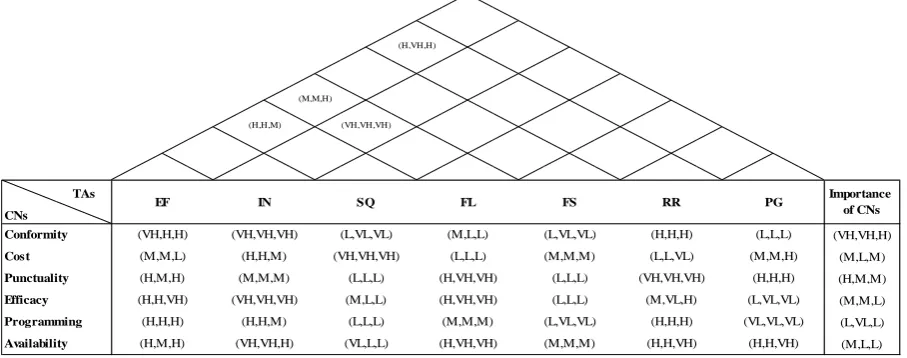
Fig. 2. House of quality for the supplier selection problem.
The analysis is performed for the selection of clutch plate suppliers for a medium-to-large enterprise that manufactures complete clutch coupling. There are ten suppliers who are in contact with the company. There are six fundamental characteristics (CNs) required of products or services purchased from outside suppliers by the company considered in this study. These can be listed as product conformity, cost, punctuality of deliveries, efficacy of corrective action, availability and customer support, and programming of deliveries. Seven criteria relevant to supplier assessment are identified as “experience of the sector (EF)”, “capacity for innovation to follow up the customer’s evolution in terms of changes in its strategy and market (IN)”, “quality system certification (SQ)”, “flexibility of response to the customer’s requests (FL)”, “financial stability (FS)”, “ability to manage orders on-line (RR)”, and “geographical position (PG)”. The evaluation is conducted by a committee of three decision-makers. The decision-makers used the linguistic variables given in Table II to denote the level of importance of each CN, the impact of each TA on CNs, and the ratings of the suppliers with respect to each TA.
TABLEII
LINGUISTIC TERM SET
Very low (VL) (0, 0.1, 0.2) Low (L) (0.2, 0.3, 0.4) Medium (M) (0.4, 0.5, 0.6) High (H) (0.6, 0.7, 0.8) Very high (VH) (0.8, 0.9, 1)
The inner dependencies among TAs, which were ignored in the supplier selection problem addressed in Bevilacqua et al. [12], were considered in here as shown in Figure 2.
First, the weights of CNs, the fuzzy assessment corresponding the impact of each TA on each CN, and the inner dependencies among TAs are converted into the BLTS employing formulations (9)-(11). Next, by using the linguistic quantifier ‘most’ and the formulations (3) and (4), the OWA weights for three decision-makers are computed as w
0.067,0.666,0.267
. Then, the weights of CNs, the fuzzy assessment corresponding the impact of each TA on each CN, and the inner dependencies among TAs converted into the BLTS are aggregated employing formulations (12) - (17). The values of these weights,TABLEIII
PRIORITIZATION OF THE TAS USING THE PROPOSED FRAMEWORK
CNs Weights
of CNs TAs
EF IN SQ FL FS RR PG
Conformity (s5,0.20) (s3,0.07) (s4,-0.23) (s2,0.24) (s4,-0.26) (s1,-0.16) (s4,0.24) (s2,-0.14)
Cost (s3,-0.12) (s3,-0.02) (s3,0.01) (s4,0.36) (s3,-0.12) (s3,0.01) (s2,0.21) (s3,0.01)
Punctuality (s3,0.14) (s4,0.07) (s4,0.04) (s3,-0.26) (s4,0.14) (s2,-0.14) (s5,-0.20) (s4,0.18)
Efficacy (s3,-0.12) (s4,-0.37) (s5,0.28) (s3,-0.06) (s5,0.07) (s2,-0.14) (s4,-0.42) (s1,-0.16)
Programming (s2,-0.28) (s3,0.44) (s4,-0.45) (s3,-0.21) (s4,-0.36) (s1,-0.16) (s4,0.18) (s1,-0.30)
Availability (s2,0.01) (s4,-0.22) (s5,0.20) (s3,-0.35) (s5,-0.05) (s3,0.01) (s4,0.20) (s4,0.32)
2-tuple linguistic weighted
average (s3,0.44) (s4,0.08) (s3,-0.12) (s4,0.01) (s2,-0.22) (s4,-0.11) (s2,0.45)
TAs CNs
(VH,VH,H)
(M,L,M)
(H,M,M)
(M,M,L)
(L,VL,L)
(M,L,L) (M,M,M)
(VH,VH,VH)
(H,H,H)
(H,M,H)
(H,H,M)
(VH,VH,H)
Importance of CNs
Cost Punctuality Efficacy Programming Availability
(H,M,H)
(H,H,VH)
(L,L,L)
(M,M,H)
(H,H,H)
(L,VL,VL)
(VL,VL,VL)
(H,H,VH) (H,H,H)
(L,L,VL)
(VH,VH,VH)
(M,VL,H)
(H,H,H)
(H,H,VH)
(M,M,L) (H,H,M)
(L,VL,VL)
(VH,VH,VH)
(H,H,M)
(VH,H,H)
FS RR PG
(H,VH,H)
EF IN
Conformity
SQ FL
(VH,VH,VH)
(M,M,H)
(L,L,L)
(M,L,L)
(L,L,L)
(VL,L,L)
(M,L,L)
(L,L,L)
(H,VH,VH)
(H,VH,VH)
(M,M,M)
(VH,VH,VH)
(H,VH,VH)
(L,VL,VL)
(M,M,M)
(L,L,L)
(L,L,L)
(L,VL,VL)
ratings, and dependencies are computed and transformed into a linguistic 2-tuple using formulations (5) and (6), respectively. The original relationship measure between TAs and CNs is computed employing Eq. (18) and 2-tuple linguistic weighted average. Then, the 2-tuple linguistic weighted averages for each TA are calculated. The results are shown in Table III.
The ratings of each supplier converted into the BLTS are aggregated and transformed into a linguistic 2-tuple. Finally, the 2-tuple linguistic weighted average for each supplier is calculated and the suppliers are ranked according to the 2-tuple linguistic weighted average score. The ranking order of the suppliers is obtained as Sup 2Sup 5Sup 7Sup 8Sup 3Sup 6Sup 1Sup 4Sup 9Sup 10.
Table IV summarizes the results obtained from the proposed decision algorithm. Supplier 2 is determined as the most suitable supplier, which is followed by supplier 5. While the fuzzy ranking principle of Bevilacqua et al. [12] cannot compare suppliers 1, 9, and 10, the methodology proposed in this study provides a complete ranking of all suppliers. This is due to the minimization of the loss of information by using the 2-tuple fuzzy linguistic representation model.
TABLEIV
RANKING OF THE SUPPLIERS USING THE PROPOSED ALGORITHM
Suppliers 2-tuple linguistic
weighted average score Rank Sup 1
Sup 2 Sup 3 Sup 4 Sup 5 Sup 6 Sup 7 Sup 8 Sup 9 Sup 10
(s2,0.46)
(s3,0.32)
(s3,-0.24)
(s2,0.37)
(s3,0.29)
(s3,-0.44)
(s3,0.22)
(s3,-0.08)
(s2,0.25)
(s2,0.16)
7 1 5 8 2 6 3 4 9 10
VII. CONCLUSION
In today’s competitive environment, comprehensive decision aids for selection of suppliers are essential for the success of a manufacturing firm. In this paper, a fuzzy multi-criteria group decision making algorithm based on the concepts of QFD, fusion of fuzzy information, and 2-tuple linguistic representation model is presented to rectify the problems encountered when using classical decision making methods in supplier selection. The proposed decision framework enables both relationship between purchased product features and supplier assessment criteria, and inner dependencies between supplier assessment criteria to be taken into consideration. The decision making approach presented in this paper disregards the troublesome fuzzy number ranking process, which may yield inconsistent results for different ranking methods, and as a result improves the quality of decision. Moreover, the decision methodology enables managers to deal with heterogeneous information, and thus, allows for the use of different semantic types by decision-makers.
Future research will address the implementation of the proposed methodology in real-world group decision making
settings across diverse disciplines that can be represented in HOQ structure.
REFERENCES
[1] D. Simchi-Levi, P. Kaminsky, and E. Simchi-Levi, Designing and
Managing the Supply Chain: Concepts, Strategies, and Case Studies, McGraw-Hill, New York, 2003.
[2] L. Boer, E. Labro, P. Morlacchi, “A review of methods supporting
supplier selection,” European Journal of Purchasing & Supply Management, vol. 7, pp. 75-89, 2001.
[3] G. Dickson, “An analysis of vendor selection systems and decisions,”
Journal of Purchasing, vol. 2, pp. 28-41, 1966.
[4] A. Amid, S. H. Ghodsypour, and C. O’Brien, “Fuzzy multiobjective
linear model for supplier selection in a supply chain,” Int J Prod Econ, vol. 104, pp. 394-407, 2006.
[5] C. Araz, P. M. Özfırat, and I. Özkarahan, “An integrated multicriteria
decision-making methodology for outsourcing management,” Computers & Operations Research, vol. 34, pp. 3738-3756, 2007.
[6] A. Amid, S. H. Ghodsypour, and C. O’Brien, “A weighted additive
fuzzy multiobjective model for the supplier selection problem under price breaks in a supply chain,” Int J Prod Econ, vol. 121, pp. 323-332, 2009.
[7] C. T. Chen, C. T. Lin, and S. F. Huang, “A fuzzy approach for
supplier evaluation and selection in supply chain management,” Int J Prod Econ, vol. 102, pp. 289-301, 2006.
[8] A. Awasthi, S. S. Chauhan, and S.K. Goyal, “A fuzzy multicriteria
approach for evaluating environmental performance of suppliers,” Int J Prod Econ, vol. 126, pp. 370-378, 2010.
[9] S. Vinodh, R. A. Ramiya, and S. G. Gautham, “Application of fuzzy
analytic network process for supplier selection in a manufacturing organization,” Expert Systems Appl, vol. 38, pp. 272-280, 2011.
[10] S. Y. Wang, “Applying 2-tuple multi-granularity linguistic variables
to determine the supply performance in dynamic environment based on product-oriented strategy,” IEEE Transactions on Fuzzy Systems, vol. 16, pp. 29-39, 2008.
[11] W. P. Wang, “A fuzzy linguistic computing approach to supplier
evaluation,” Applied Mathematical Modelling, vol. 34, pp. 3130-3141, 2010.
[12] M. Bevilacqua, F. E. Ciarapica, and G. Giacchetta, “A fuzzy-QFD
approach to supplier selection,” Journal of Purchasing & Supply Management, vol. 12, pp. 14-27, 2006.
[13] S. H. Amin, and J. Razmi, “An integrated fuzzy model for supplier
management: A case study of ISP selection and evaluation,” Expert Systems Appl, vol. 36, pp. 8639-8648, 2009.
[14] A. Bhattacharya, J. Geraghty, and P. Young, “Supplier selection
paradigm: An integrated hierarchical QFD methodology under multiple-criteria environment,” Applied Soft Computing, vol. 10, pp. 1013-1027, 2010.
[15] E. E. Karsak, “Robot selection using an integrated approach based on
quality function deployment and fuzzy regression,” Int J Prod Res, vol. 46, pp. 723-738, 2008.
[16] J. B. Revelle, J.W. Moran, and C.A. Cox, The QFD Handbook, John
Wiley & Sons, New York, 1998.
[17] E. E. Karsak, “Fuzzy multiple objective decision making approach to
prioritize design requirements in quality function deployment,” Int J Prod Res, vol. 42, pp. 3957-3974, 2004.
[18] F. Herrera, E. Herrera-Viedma, and L. Martínez, “A fusion approach
for managing multi-granularity linguistic term sets in decision making,” Fuzzy Sets and Systems, vol. 114, pp. 43-58, 2000.
[19] R. R. Yager, “On ordered weighted averaging aggregation operators
in multi-criteria decision making,” IEEE Transactions on Systems Man and Cybernetics, vol. 18, pp. 183–190, 1988.
[20] M. Zarghami, and F. Szidarovszky, “Fuzzy quantifiers in sensitivity
analysis of OWA operator,” Computers & Industrial Engineering, vol. 54, pp. 1006–1018, 2008.
[21] F. Herrera, and L. Martínez, “A 2-tuple fuzzy linguistic representation
model for computing with words,” IEEE Transactions on Fuzzy Systems, vol. 8, pp. 746-752, 2000.
[22] Z.P. Fan, B. Feng, Y.H. Sun, and W. Ou, “Evaluating knowledge
management capability of organizations: a fuzzy linguistic method,” Expert Systems Appl, vol. 36, pp. 3346–3354, 2009.
[23] F. Herrera, and L. Martínez, “A model based on linguistic 2-tuples for
dealing with multigranular hierarchical linguistic contexts in multi-expert decision-making,” IEEE Transactions on Systems, Man, and Cybernetics – Part B: Cybernetics, vol. 31, pp. 227–234, 2001.
[24] F. Herrera, and L. Martínez, “An approach for combining linguistic
model in decision-making,” International Journal of Uncertainty, Fuzziness and Knowledge-Based Systems, vol. 8, pp. 539-562, 2000.
[25] E. Herrera-Viedma, F. Herrera, L. Martínez, J.C. Herrera, and A.G.
López, “Incorporating filtering techniques in a fuzzy linguistic multi-agent model for information gathering on the web,” Fuzzy Sets and Systems, vol. 148, pp. 61-83, 2004.
[26] Y. P. Jiang, Z. P. Fan, and J. Ma, “A method for group decision
making with multi granularity linguistic assessment information,” Information Sciences, vol. 178, pp. 1098-1109, 2008.
[27] R. Y. K. Fung, J. Tang, Y. Tu, and D. Wang, “Product design
resources optimization using a non-linear fuzzy quality function deployment model,” Int J Prod Res, vol. 40, pp. 585-599, 2002.
[28] J. Tang, R. Y. K. Fung, B. Xu, and D. Wang, “A new approach to