Computational Intelligence Based Data
Aggregation Technique in Clustered WSN:
Prospects and Considerations
Muhammad Umar Farooq
Abstract— Data aggregation in wireless sensor networks is very important and hot research topic in recent times. Data aggregation is defined as the process of aggregating the data from multiple sensors to eliminate redundant transmission and provide fused information to the base station. The main goal of data-aggregation algorithms is to gather and aggregate data in an energy efficient manner so that network lifetime is enhanced. Data aggregation helps in improving the performance of the wireless sensor network protocols especially the routing protocols which in turn improve the overall performance of the network. Hierarchical networks or Clustering is very important for data aggregation, where the sensor nodes are divided into groups and assigned various roles. Computational Intelligence combines elements of learning, adaptation, evolution and fuzzy logic to solve complex problems. The paradigms of CI include neuro-computing, reinforcement learning, evolutionary computing and fuzzy computing, techniques that use swarm intelligence, artificial immune systems and hybrids of two or more of the above. Paradigms of CI have found practical applications in areas such as product design, robotics, intelligent control, biometrics, and sensor networks. Researchers have successfully used CI techniques to address many challenges in WSNs in various fields including data aggregation. In this paper, the prospects and considerations for a CI based data aggregation technique in clustered networks is discussed and concluded that apart from the conventional data aggregation techniques, there is a need to look for non conventional solutions like CI for making efficient data aggregation techniques.
Keywords—Data Aggregation, Computational Intelligence, Clustering, Wireless Sensor Networks, Routing
I- INTRODUCTION
Wireless Sensor Networks (WSNs) consist of small nodes which have sensing, computation, and wireless communications capabilities apart from many optional capabilities e.g. mobilizer etc. WSN have diverse features including homogeneous devices, dispersed large network size, self- organization, no wired infrastructure and potential multi hop routes. The nodes can be stationary or mobile and all nodes in the network act as routers. Communication between two unconnected nodes is achieved through intermediate nodes. Every node that falls inside the communication range of a node is considered reachable. WSN applications in various fields of life include Habitat monitoring, disaster relief and target tracking etc.
Manuscript received July 1, 2012;
Muhammad Umar Farooq is a MS (Computer Science) Scholar at Allama Iqbal Open University, Islamabad, Pakistan. He received his BS (Computer Science) degree from the Allama Iqbal Open University, Islamabad and is an active researcher. His research interests include wireless sensor networks, Data aggregation techniques in WSN and computational intelligence, its paradigms and applications in WSN. (Phone: +923365263286, email: [email protected])
collect the most critical data from the sensors and make it available to the sink in low latency, energy efficient manner.
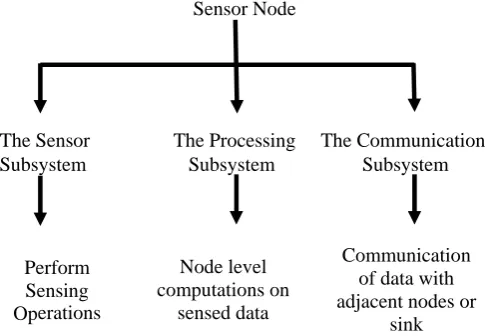
Sensor Node
[image:2.595.47.291.89.257.2]The Sensor The Processing The Communication Subsystem Subsystem Subsystem
Figure 1: Subsystems of a Sensor Node
Data latency is important in many applications such as environment monitoring, where the freshness of data is also an important factor. It is critical to develop energy-efficient data-aggregation algorithms so that network lifetime is enhanced. There are several factors which determine the energy efficiency of a sensor network, such as network architecture, the data-aggregation mechanism, and the underlying routing protocol. The main goal of data-aggregation algorithms is to gather and aggregate data in an energy efficient manner so that network lifetime is enhanced. Data aggregation techniques can be used to combine several correlated data signals into a smaller set of information that maintains the effective data (i.e., the information content) of the original signals. Therefore, much less actual data needs to be transmitted from the cluster to the base station. CI combines elements of learning, adaptation, evolution and fuzzy logic to create intelligent machines. In addition to paradigms like neuro-computing, reinforcement learning, evolutionary computing and fuzzy computing, CI encompasses techniques that use swarm intelligence, artificial immune systems and hybrids of two or more of the above. Paradigms of CI have found practical applications in areas such as product design, robotics, intelligent control, biometrics, and sensor networks. Researchers have successfully used CI techniques to address many challenges in WSNs in various fields including data aggregation. Rest of the paper is organized as: in section II WSN network architectures and routing protocols based on the network architectures are discussed, section III discusses data aggregation and data fusion in wireless sensor networks, Data aggregation protocols based on network architectures are discussed in section IV, section V discusses computational intelligence and data aggregation in wireless sensor networks, conclusion and considerations are presented in section VI.
II. WSN NETWORK ARCHITECTURES AND ROUTING PROTOCOLS
Wireless sensor networks can follow various network architectures according to the requirements and constraints of the specific network environment and purpose of the network. The routing protocols in WSN can be categorized
[image:2.595.303.559.520.769.2]on the basis of protocol operation, how a source selects route to the destination and network structure. The routing protocols can be divided in Multipath-based, query-based, negotiation-based, QoS-based, or coherent-based routing on the basis of protocol operation [3]. As regards how the source selects a route to the destination, there can be proactive routing protocols, reactive routing protocols, and hybrid protocols. The reactive protocols calculate a route when it is needed whereas the proactive routing protocols calculate different routes and keep them before they are actually needed. A blend of reactive and proactive routing is used in Hybrid protocols. In case of static sensor nodes, the proactive approach of having a table of all possible routes is better than creating a route on demand as in reactive routing, because the routes will not change quickly. This would save considerable energy which would have been spent in the creating of a reactive route. The network structures in WSN can be classified as flat networks, hierarchical networks and location based networks and deal with routing differently. For routing in a flat network, the nodes are same, have same capabilities and similar tasks. In contrast to flat networks, the nodes perform different tasks based on their position and role in the network, in case of hierarchical networks, where the nodes are divided in groups called clusters. The other one that is location based networks, the locations of the sensor nodes are used in calculating and selecting a route from source to the destination. The routing protocols where the values of some of contributing factors can be dynamically adjusted to make the routing protocol conversant with the in hand network scenario are called adaptive routing protocols. In wireless sensor networks, cooperative routing protocols have found good utility. The nodes in a group or cluster send data to cluster head or sink node in cooperative routing, which aggregates data from many nodes and eliminates the redundant data at this stage, which ultimately enhances the node and network lifetime. Figure 2 shows the examples of routing protocols which fall under the different categories of routing protocols for wireless sensor networks.
Figure 2: Categories of Routing Protocols for WSNs Perform
Sensing Operations
Node level computations on
sensed data
Communication of data with adjacent nodes or
sink
Data-centric
Hierarchic al
Mobility Based
Multi path Based Location
Based
Heter- -ogen-
-eity
Based
SPIN
DD
RR
COUGAR
ACQUIRE
EAD
LEACH
E-LEACH
LEACH-C
PEGASIS
Hierarch- -ical PEGASIS
EB- PEGASIS
HEED
TEEN
APTEEN
SEAD
JMR
Data MULES
Dissemi- -nation
Sensor-Disjoint Multipath
Braided Multipath
N-to-1 Multipath Discovery GAF
GEAR
Span
TBF
BVGF
GeRaF
MECN
SMECN
IDSQ
Network Structure Based Protocols
Routing protocols depend heavily on the network structure in wireless sensor networks. Determination of routes from source to destination can vary according to the structure of the network. The routing protocols that fall under this category especially the hierarchical or cluster based networks are discussed here.
Routing in Flat Networks
Flat networks are those networks where the nodes in the network have similar capabilities and similar kind of roles is assigned to the nodes. The sensor nodes work cooperatively for performing the assigned role. The communication is achieved in multi-hop style. Nodes are not identified by unique identifiers as there are a big number of nodes in the network. In Flat networks data centric routing is suitable for the reason that there are a large number of nodes. In data centric routing, the Base Station sends queries to specific areas and the sensors located in that area send their sensed data to the Base Station. For data centric routing the naming is important as the data is requested from different nodes through queries. SPIN and directed diffusion are examples of data centric routing, and use techniques like data negotiation and elimination of redundant data to save energy. Subsequently many other data centric routing protocols were developed. The flooding phenomena used in data centric routing leads to a lot of energy wastage in flat networks, but flat networks are simple, the nodes in for example SPIN need to know only their one hop neighbors for communication which considerably decreases energy utilization as against flooding, there are limitations also, e.g. in the case where source and destination nodes are far apart, there is no guarantee of data delivery which is not suitable for situations that demand reliable data delivery.
Location based routing protocols
The location of the sensor nodes can be used in many ways in wireless sensor networks. The location of the sensor node is used to address that node in the network. Received signal strength is used to calculate the distance between the neighboring nodes. The neighboring nodes can calculate the coordinates of each other by exchanging information between them. On the other hand, other methods for determining the location of the nodes can be used such as through satellites Global Positioning System, for that the sensor nodes need to be equipped with the GPS receiver. Energy efficiency is of immense importance in wireless sensor networks as the nodes have limited battery power and often they are not rechargeable. Therefore, to efficiently utilize the scarce battery power, many location based schemes use the sleep mode i.e. when a node is not in use, it goes to sleep mode. By having as many nodes in sleep mode, energy saving s can be increased. In literature, the scheduling of the sleep periods of different nodes in the network has been discussed and schemes have been devised. Geographic Adaptive Fidelity (GAF) protocol is an example which is an Energy-aware location-based protocol. In this protocol, GPS is used by the nodes to get their location, after getting their location the nodes associate them with a point on the grid. All the nodes associated with the same point on the grid need same resources for the routing data to them. The protocol uses three states for the nodes, The Discovery state used to find neighbors in the grid, and Active and
Sleep states. The nodes inform neighbors on leaving the network. For effective routing the nodes adjust their sleeping times with the neighboring nodes in the network.
Hierarchical Based Routing
[image:3.595.305.552.346.743.2]In contrast to the two network structures discussed above, Hierarchical or cluster-based routing offers more scalability and effective energy efficient communication. Hierarchical routing is more in use for the wired networks where the clients can be grouped according to different factors. So is this concept in use for especially energy efficient routing in wireless sensor networks. In hierarchical network structure, the nodes are divided into groups called clusters. The nodes in a cluster select a cluster head on the basis of some criterion which normally is the residual battery power. The cluster head node is used to receive data from other nodes in the cluster, processing it and then transmitting the processed information. The member nodes perform the sensing task in their respective area and transmit to the cluster head node. In this way, by utilizing the nodes’ battery power in energy efficient manner the network lifetime can be increased. Data aggregation and fusion can be performed in the clustered networks to decrease the volume of data, and therefore the number of packets that are being transmitted in the network which ultimately results in decreased energy utilization.
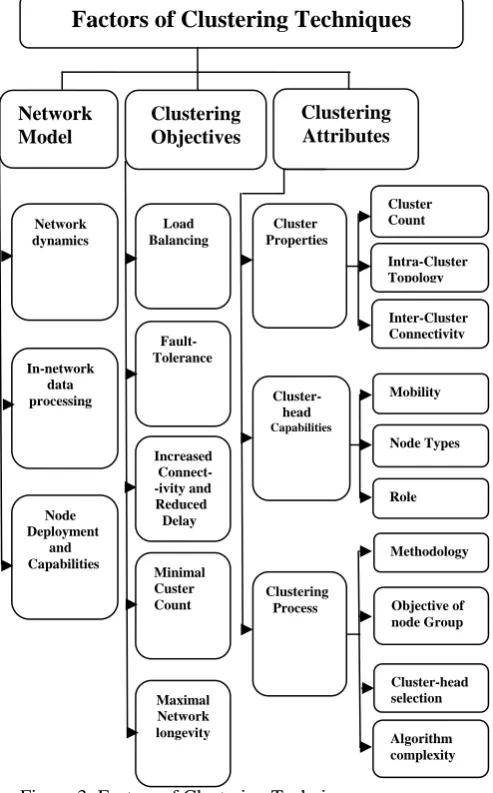
Figure 3: Factors of Clustering Techniques
Cluster based routing protocols work in two levels mostly, cluster heads are selected in first level and the second level
Network dynamics
In-network data processing
Node Deployment
and Capabilities
Load Balancing
Fault- Tolerance
Increased Connect- -ivity and Reduced
Delay
Minimal Custer Count
Maximal Network longevity
Factors of Clustering Techniques
Network Model
Clustering Objectives
Clustering Attributes
Cluster Properties
Cluster-head Capabilities
Clustering Process
Cluster Count
Intra-Cluster Topology
Inter-Cluster Connectivity
Mobility
Node Types
Role
Methodology
Objective of node Group
Cluster-head selection
is used for routing. The selection of the cluster by the nodes and the attributes for the selection of cluster head is very important and a hot topic among the researchers. Figure 3 shows the different factors for clustering techniques. The important factors that contribute towards the formation of a clustering technique include the Network model, Clustering objectives and Clustering attributes [4]. The network model consists of the architecture and design of the underlying sensor network. There can be further sub factors in network model. First is the network dynamics like the node, cluster head and base station can be static or mobile. The sensor nodes are static normally with a few exceptions, the mobility of cluster head or base station can cause serious problems in clustering process. The events sensed by the nodes can be irregular or continual depending on the situation, and effect in selection of reactive or adaptive clustering. Second is the in-network data processing. The sensor nodes in the same area can generate a lot of redundant data, so there is need for techniques like data aggregation and fusion to eliminate this redundancy. Third one is the node deployment and node features. The nodes can be deployed manually or randomly. In the first case, routing becomes easier as all routes are predefined. Whereas, the nodes self-organize in case of random deployment, so the clustering process is difficult and thought consuming. The nodes can have different features and selection of proper nodes for the application, the selection of cluster head nodes is also of importance in the clustering process. The clustering objectives vary a great deal from application to application. Different objectives of clustering include the following: load balancing is needed in clustering to divide and allocate the work load among different nodes in the cluster. Fault tolerance is especially required in the networks where the nodes are placed in harsh locations, the nodes are more prone to failures and hence efficient fault tolerance mechanisms are desirable. Improved connectivity and reduced delay is also a desirable feature. The cluster heads usually remain interconnected with few exceptions, so that timely information without much delay keeps flowing through the network. Another objective in clustering is the minimal cluster count, especially when the sensor nodes are resource rich and big sized, there is need to keep the cluster count to the minimum. The prime objective of clustering is the energy efficient use of the scarce node resources, to achieve the maximum network lifetime. Clustering attributes are the factors on the basis of which different clustering algorithms can be classified. These can be broadly the cluster properties, cluster head capabilities and clustering process. The cluster properties include cluster count i.e. the number of clusters can be pre-fixed or variable, the stability of the clusters formed can be provisioned or assumed, intra-cluster topology i.e. the communication between the sensor nodes and the cluster head can be direct link or multi-hop and inter-cluster head connectivity which is required when the cluster head does not have direct communication capacity with the BS, so it has to be connected with other cluster heads in the network. Cluster head capabilities include: it can be static or mobile, in case it is mobile the clusters are formed dynamically and cause problems. The cluster head can either be sane as a member sensor node or may be a node with more
computation and energy resources. The role of cluster head can be simple forwarding of the data received from sensor nodes or they can perform data aggregation and fusion function, while sometimes it can also act as BS. Clustering process and characteristics of different clustering algorithms presented in literature vary a great deal. The methodology of clustering process can be distributed, centralized or hybrid of the earlier two approaches. The objectives of clustering as discussed earlier include load balancing, fault tolerance, increased connectivity and reduced delay, minimal cluster count and maximal network lifetime. The cluster head selection can be done either randomly or it may be pre-assigned. Algorithm complexity of different clustering techniques presented in literature varies and it can be constant or variable.
[image:4.595.305.556.244.555.2]
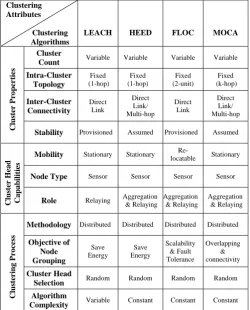
Figure 4: Clustering Attributes for Clustering Algorithms
The above mentioned clustering attributes for selected clustering algorithms including are presented in Figure 4. It is observed that the cluster count for all algorithms is variable. The intra-cluster topology is fixed for all with one or multiple hops. Direct link is present in all whereas HEED and MOCA also use multi hop for inter-cluster connectivity. Stability for LEACH and FLOC is provisioned and assumed for HEED and MOCA. The cluster head is stationary for HEED, LEACH and MOCA and re-locatable for FLOC. Cluster head is a sensor node for all techniques. Cluster head in LEACH only performs relaying, while in others performs relaying and aggregation. Methodology of clustering is distributed for all and CH selection is random for all also. Algorithm complexity of LEACH is variable and constant for HEED, MOCA and FLOC. The objective for LEACH and HEED is to save energy, scalability and fault tolerance for FLOC and overlapping and connectivity for MOCA.
Clustering Attributes
Clustering Algorithms
LEACH HEED FLOC MOCA
Cluster Proper
tie
s
Cluster
Count Variable Variable Variable Variable Intra-Cluster
Topology
Fixed (1-hop)
Fixed (1-hop)
Fixed (2-unit)
Fixed (k-hop)
Inter-Cluster Connectivity
Direct Link
Direct Link/ Multi-hop
Direct Link
Direct Link/ Multi-hop
Stability Provisioned Assumed Provisioned Assumed
Cluster Head Capabilities
Mobility Stationary Stationary
Re-locatable Stationary
Node Type Sensor Sensor Sensor Sensor
Role Relaying Aggregation & Relaying
Aggregation & Relaying
Aggregation & Relaying
Clustering Proces
s
Methodology Distributed Distributed Distributed Distributed
Objective of Node Grouping
Save Energy
Save Energy
Scalability & Fault Tolerance
Overlapping & connectivity Cluster Head
Selection Random Random Random Random Algorithm
III. DATA AGGREGATION AND FUSION IN WIRELESS SENSOR NETWORKS
Data aggregation is a process whereby data from sensors in an area is gathered for performing fusion to eradicate redundant data collected by the nodes in the same area and provide only the useful fused information to the base station. The sensor nodes send their data to the intermediate nodes for data aggregation which also normally includes the fusion process and then transmitting the condensed data the base station or sink node. The aim of data aggregation is to get the most relevant data from the data collected by the sensor nodes and make it available to the base station with minimum energy consumption and also with minimum delay. As delay in transmission of data cannot be acceptable in some situations which need fresh data from nodes to complete their task. The correlated data signals from sensor nodes are combined and processed in data aggregation to reduce their data while maintaining the effective data or information sensed by the sensor nodes. As a result, the actual data that is transmitted to the base station is reduced. It is imperative to make data aggregation technique that is energy efficient resulting in the enhancement of network lifetime. Data aggregation mechanism is an important factor in the energy efficiency of a sensor network along with network architecture and the underlying routing protocol. Data aggregation techniques include data centric and address centric routing heuristics [2]. The making of an optimal aggregation tree is NP-hard, but there exist some sub optimal solutions which include for example:
Center at Nearest Source Data Centric (CNSDC): In CNSDC, the node closest to the sink acts as the aggregator and the remaining nodes send their data to that node. Shortest Path Tree Data Centric (SPTDC): A SPC is formed and merges the shortest paths from each source wherever these overlap in an opportunistic manner.
Greedy Incremental Tree Data Centric (GITDC): The algorithm starts with the path from sink to the nearest source, and sequentially adds the next nearest source to the existing tree.
Address Centric (AC): In address centric no data aggregation is performed and all the nodes communicate directly with the sink by using the shortest paths available. Data aggregation has proven to save energy in many network applications. But data aggregation results in increased delay due to in network processing, it is a tradeoff, and routing algorithms may be designed to cater for this.
Data Fusion in Sensor Networks
The limited resources in terms of power and shorter communication range arises the need for sensor nodes to perform in-network data fusion. In data fusion at a sensor node the data aggregated from multiple nodes is processed in such a way that the data generated after fusion has reduced the transmission overhead in the network or the resulting data is better and more relevant than the individual data gathered from the sensor nodes. In sensor networks the sensors are deployed in vast quantities, and generate massive amounts of data, so there is need for efficient collection and transmission of relevant data. Due to large-scale deployment of sensors, voluminous data is generated,
efficient collection of which is a critical issue. Conventionally the techniques used for data fusion include Kalman filter, Bayesian networks and Dempster-Shafer method [5]. The data fusion process includes the collection of data at the fusion node from other nodes and fusing the sensed data with its own on the basis of pre decided criterion. After fusion it transmits the data to another node or directly to the base station. The important considerations in data fusion include the reporting time, fusion criteria and the data fusion architecture. Reporting of data by sensor nodes to the fusion node can be periodic, in response to the inquiry from base station or can be triggered by some pre defined event. Data fusion criteria can be voting, probability-based Bayesian model and stack generalization. Voting is by far the most popular method as it is quite simple and accurate. The voting scheme can be based on majority voting, complete agreement and weighted voting. The fusion architecture can be centralized, decentralized and hierarchical. In centralized architecture, the fusion process is performed at a central node. In decentralized architecture, each node performs data fusion itself and no gathering of data at a fusion node is required. In hierarchical architecture, the nodes are divided into clusters or levels, and nodes send their data to the higher level nodes for fusion. Synchronizing the nodes during data fusion is very important because if the nodes at higher levels perform fusion without waiting for data from lower level nodes, the results will not be truly representative. So the protocol should be capable of assigning proper timings to nodes at different levels for proper data fusion process.
IV. DATA AGGREGATION PROTOCOLS BASED ON NETWORK ARCHITECTURE
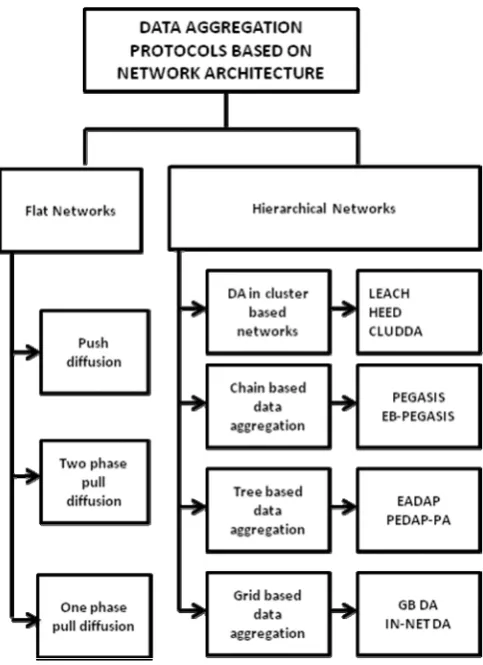
The architecture of the network impacts the performance of the data aggregation technique being used. The network structures as already discussed can mainly be divided into Flat networks and hierarchical or cluster based networks.
Flat Networks:
The sensor nodes in flat networks have almost similar resources and roles to perform. The data aggregation techniques designed for flat networks include Push Diffusion, one phase Pull Diffusion and two phase Pull Diffusion. SPIN protocol is the example of push diffusion, whereas directed diffusion is representative of two phase pull diffusion. These algorithms improved the performance of the network as compared to simple flooding in flat networks.
Hierarchical Networks:
data aggregation (CLUDDA) are the examples of cluster based hierarchical networks. The cluster based hierarchical networking and data aggregation protocols for this category need some unconventional solution from the fields like CI.
Figure 5: DA Protocols based on Network Architecture
V. COMPUTATIONAL INTELLIGENCE AND DATA AGGREGATION IN SENSOR NETWORKS
CI is defined as the computational models and tools of intelligence capable of inputting raw numerical sensory data directly, processing them by exploiting the representational parallelism and pipelining the problem, generating reliable and timely responses and withstanding high fault tolerance [6]. Paradigms of CI are designed to model the aspects of biological intelligence. Some of CI paradigms include neural networks, reinforcement learning, swarm intelligence, evolutionary algorithms, fuzzy logic and artificial immune systems. Hybrids of these paradigms, such as neuro-fuzzy systems, fuzzy-immune systems are also used. Other CI techniques are not suitable for WSNs.
Data aggregation and fusion techniques based on computational intelligence have been proposed. For effective fusion of information gathered from different sensor nodes, the techniques that can adjust automatically and self adapt are desirable. From the many CI paradigms, the best suited ones for the problems of data aggregation and sensor fusion evolutionary algorithms GA, fuzzy logic, RL and NNs. These paradigms are suited to either data aggregation or the sensor fusion process. Efficient data aggregation routes have been achieved by GA in a mobile
agent based WSN because of their inherent parallel nature and ability to deal with difficult real world problems like non-homogeneous, noisy, incomplete and/or obscured information [7]. Particle swarm optimization PSO can be a good alternate to GA because of PSO' capability to converge quickly to the optimal solution, in the same way, Aunt colony optimization ACO due to its distributed nature becomes alternate to GA, in order to determine the optimal route it needs that the base station already has the required information. For fusion process neural networks are well suited because neural networks can learn and dynamically adapt to the changing scenarios. Reinforcement learning is fully distributed and it can adapt quickly to network topology change or any node failure. It has been used efficiently for finding the optimal path for aggregation. Fuzzy Logic based distributed approach using fuzzy numbers and weighted average operators to perform energy efficient flooding-based aggregation has also been proposed in literature. In wireless sensor networks many situations demand aggregating data at a central node e.g. monitoring events. For these situations, the centralized approaches like neural networks, GA or PSO can be used efficiently to know the features of the data.
VI. CONCLUSION
In this paper the network architectures of wireless sensor networks are discussed and the routing and data aggregation and fusion protocols based on these network architectures are also discussed. The use of computational intelligence and its paradigms in data aggregation and fusion is discussed and the appropriateness of certain CI paradigms for them is concluded as; for data aggregation and fusion, fuzzy logic, evolutionary algorithms and neural networks are the most appropriate CI techniques, as their characteristics and features suit the data aggregation and fusion process. Data aggregation needs centralized approaches i.e. the data is gathered at a central node for performing processing and transmitting results, it results in increased communication overhead. Data fusion contrary to it is mostly performed once the data has been gathered at the cluster head or the BS, which makes the approaches well suited. The other CI paradigms are not well suited and applied in the field of data aggregation and data fusion in literature by researchers, as their characteristics do not suit data aggregation and fusion.
REFERENCES
[1]. Online: www.xbow.com/Products/Product_pdf_files/Wireless_pdf/ MICAZ_Datasheet.pdf
[2]. Rajagopalan et. al., “Data aggregation techniques in sensor network: a suervey,” in IEEE Communications Survey, 4th quarter, 2006.
[3]. Jamal et. al. "Routing techniques in wireless sensor networks: a survey" IEEE Wireless Communications, Dec 2004
[4]. Abbasi et al "A Survey on clustering algorithms for wireless sensor networks, Computer Communications 2007, Elsevier
[5]. K. Dasgupta, K. Kalpakis and P. Namjoshi, “An Efficient Clustering-based Heuristic for Data Gathering and Aggregation in Sensor Networks,” IEEE WCNC, 2003.
[6]. A. Konar, Computational Intelligence: Principles, Techniques and applications. Springer, 2005.