Parameter Analysis of CARP &E-CARP Protocol
for Underwater Wireless Sensor Network in the
Internet of Underwater Things
Priyanka Ashok Powar1, Prof. S. B. Patil2
1, 2
Dept. of Electronics and Telecommunication Engineering, DYPCET, Kolhapur
Abstract: The advance of the Internet of Underwater things, smart things are deployed under the water and form the underwater wireless sensor networks (UWSNs), to facilitate the discovery of vast unexplored ocean volume. A routing protocol, which is not expensive in packets forwarding and energy consumption, is fundamental for sensory data gathering and transmitting in UWSNs. To address this challenge, this paper proposes Enhanced CARP (E-CARP), which is an enhanced version of the channel-aware routing protocol (CARP) developed to achieve the location-free and greedy hop by-hop packet forwarding strategy. In general, CARP does not consider the reusability of previously collected sensory data to support certain domain applications afterward, which induces data packets forwarding which may not be beneficial to applications. Besides, the PING-PONG strategy in CARP can be simplified for selecting the most appropriate relay node at each time point, when the network topology is relatively steady. These two research problems have been addressed by our E-CARP. Simulation results validate that our technique can decrease the communication cost significantly and increase the network capability to a certain extent.
Keywords: Energy efficient routing protocol, underwater wireless sensor networks.
I. INTRODUCTION
The advance of sensing technologies, sensor networks have been used to support widespread domain applications, and underwater wireless sensor networks (UWSNs) has recently been attracted significant attention and considered as a promising alternative to explore the underwater environment. The smart underwater physical objects, called sensor nodes, are sense and record current and historical information about underwater environment. In fact, the knowledge about the underwater environment is negligible compared with that of land. Since the ocean plays more and more important roles in human’s life, discovering the vast unexplored ocean volume becomes critical and urgent from the last decades. Generally, smart underwater physical objects, called sensor nodes, sense and record current and historical information about underwater environment. These underwater objects interconnect with each other, and forward sensory data to the sink nodes, which are usually son buoys on the water surface. These underwater objects interconnect with each other, and forward sensory data to the sink nodes.
The world-wide network of smart interconnected underwater objects establishes the Internet of Underwater Things (IoUT) to collaboratively study the vast unexplored ocean volume. IoUT supports applications in scientific, industrial, military, home security, and other domains. Different from terrestrial WSNs [6],[11], acoustic signals, rather than radio frequencies, are adopted in UWSNs for wireless communication [5] which suffers from limitations including long and variable prorogation delay, narrow bandwidth, slow power signal attenuation, high error rate, noise etc. Therefore, link quality is an important factor to be considered when forwarding packets to sink nodes [2].
A routing protocol, which is not expensive in packets forwarding and energy consumption, is fundamental for sensory data gathering and transmitting in UWSNs. Therefore, to address this challenge, proposes Enhanced CARP (E-CARP), which is an enhanced version of the channel-aware routing protocol (CARP) use, to achieve the location-free and greedy hop-by- hop packet forwarding strategy. In general, CARP does not consider the reusability of previously collected sensory data, while E CARP allows the caching of sensory data at the sink node, for avoiding extra data packets forwarding in the network. Besides, the PING-PONG strategy in CARP can be simplified using proposed E-CARP by broadcasting EPING control packet for selecting the most appropriate relay node.
source sensor nodes to the sink node. As presented in the Channel-Aware Routing Protocol (CARP) [4] , “in the quickly varying conditions of the underwater channel, fact that two nodes can exchange short control packets correctly, may not be sufficient to guarantee that longer data packets are also going to be safely delivered”. Generally, CARP is a location free and greedy hop-by-hop routing protocol, whose performance is proved better than FBR [12].Therefore, sensory data may not need to be forwarded to the sink node always at every time point. Taken these into consideration, we propose E-CARP, which is an enhanced version of CARP, to provide a more energy efficient routing protocol in UWSNs. Generally, Enhanced CARP (E-CARP) tries to avoid the forwarding of control packets when selecting relay nodes, and to reduce the routing of sensory data packets to the sink node. These strategies may decrease the energy consumption when the environment to be monitored is relatively steady
II. ECARPPROTOCOL
This section introduces E-CARP, which is an enhancement upon CARP, to develop a location-free and greedy hop-by-hop routing protocol for forwarding packets from sensor nodes to the sink node in an energy efficient manner.
Fig.1. Control Packet Forwarding
Fig.2.Relay Node Selection and Data Packet Forwarding Strategy
A. Network Initialization
1) The network is initialized and hop counting is computed for all sensor nodes.
2) At the network initialization stage, no packets have been forwarded.
B. Control & Data Packets Forwarding
1) The threshold is pre-determined according to the requirement of certain applications.
2) Sensor node detects its sensory data which is required to be routed to a relay node only when the bias between sensor data and
the value cached at sensor node is more than the pre-specified threshold.
3) Otherwise INFORM control packet is forwarded to relay node and acknowledged ACK control packet is expected to be
returned from the relay node.
4) If ACK has not been received within certain time duration, then INFORM control packet should be resend.
C. Relay Node Selection
1) When the monitored ocean volume is relatively steady and the network topology does not change significantly, a sensor node
which was chosen as the relay node at the preceding time point is highly possible to be the relay node at this moment.
2) After network initialization every sensor node replies a PONG control packet when senor node broadcasts a PING control packet and relay node is selected according to sensor nodes replying PONG control packets.
3) EPING is broadcasted to neighboring sensor node and it contains two additional fields, which is different from the PING control packet.
4) The sensor node determines whether a PONG control pocket should be replied or not, upon received EPING for appropriate
selection of relay node.
III.IMPLEMENTATIONANDEVALUATION
For underwater communication world oceanographic simulation system (WOSS) libraries are required which includes shallow water, fading channel, losses model. Installation of WOSS is done along with NS-2 miracle & dessert. We have established link between two nodes for UW communication testing purpose.
Script is written for testing static routing protocol. Steps for script are
1) Load all underwater libraries.
2) Set routing protocol and MAC layer for UW communication.
3) Configure node and declare nodes with their positions in ocean.
4) Establish CBR connection.
5) Establish end to end connection.
6) Start application.
7) Evaluate performance.
A. Environment Setting
For proposed dissertation work following simulation environment will be used.
A. Sr B. Parameter &
Specification C. Setting
D. 1 Routing protocol Static routing protocol &
CARP protocol
G. 2 H. MAC Underwater CSMA Aloha
3 No of nodes 8
M. 4 Packet size(bytes) O. 125,512,1024 bytes
5 Q. Rate of
CBR(seconds)
10s, 30s, 60s.
6 Frequency U. 100KHz
IV.EXPERIMENTALEVALUATION
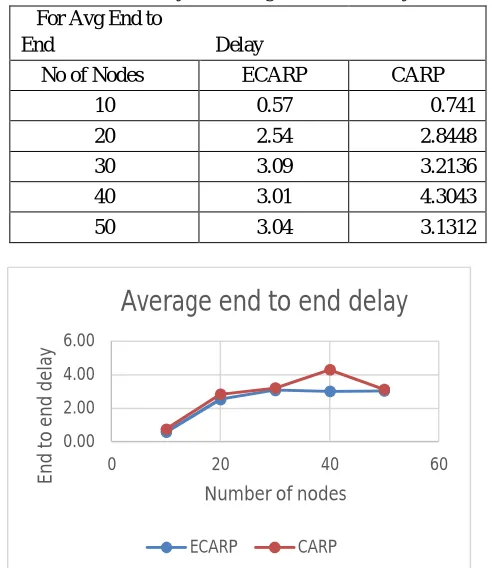
Table 4-Node wise analysis for Avg end to end delay For Avg End to
End Delay
No of Nodes ECARP CARP
10 0.57 0.741
20 2.54 2.8448
30 3.09 3.2136
40 3.01 4.3043
50 3.04 3.1312
[image:4.612.207.453.99.383.2][image:4.612.218.469.434.705.2]
Fig.4. Comparison of Average end to end delay between two protocols i.e. ECARP & CARP. This figure shows that the Average delay increases when no of nodes increases.
Table 5 -Node wise analysis for routing overhead
For Routing overhead
No of Nodes ECARP CARP
10 0.1 0.113
20 0.1021 0.088827
30 0.1238 0.12999
40 0.1362 0.122989
50 0.1436 0.132112
Fig.5. Comparison of Routing overhead between two protocols i.e ECARP & CARP. This figure shows that the energy consumption 0.00
2.00 4.00 6.00
0 20 40 60
E
n
d
t
o
e
n
d
d
el
ay
Number of nodes
Average end to end delay
ECARP CARP
0 0.05 0.1 0.15 0.2
0 20 40 60
R
o
u
ti
n
g
o
ve
rh
e
ad
Number of nodes
Routing Overhead
V. CONCLUSION
The advent of the Internet of Underwater Things, smart things form underwater wireless sensor networks (UWSNs), for gathering and transmitting sensory data to the sink node. A routing protocol, which is efficient in packet forwarding and energy consumption, to address this `challenge, this paper proposes E-CARP, which is an enhanced version of the Channel-Aware Routing Protocol (CARP) protocol [4]. Generally, CARP does not consider the reusability of sensory data collected previously by domain applications in the following time points, which induces sensory data packets forwarding which may not be beneficial to certain applications. Therefore, E-CARP allows the caching of sensory data at the sink node, for avoiding these data packets forwarding in the network. CARP requires to reply a PONG control packet whenever receiving a PING control packet, when selecting the most appropriate relay node for packet forwarding. This PING-PONG strategy may not be mandatory when the network topology is relatively steady. This observation drives us to improve the relay node selection strategy in CARP, and the relay node adopted previously is given a higher priority to be reused at this moment. Simulation results validate that our E-CARP can decrease the communication cost and increase the network capability to a large extent, especially when the ratio of packet size between control packets and sensory data packets is relatively large.
REFERENCES
[1] Zhangbing Zhou, Beibei Yao, Riliang Xing, Lei Shu, “E-CARP: An Energy Efficient Routing Protocol for UWSNs in the Internet of Underwater Things”IEEE Sensors Journal, vol. 16, no. 11, June 1, 2016.
[2] R. Agarwal, S. Kumar, and R. M. Hegde, “Algorithms for crowd surveillance using passive acoustic sensors over a multimodal sensor network,” IEEE Sensors J., vol. 15, no. 3, pp. 1920–1930, Mar. 2015
[3] Priyanka powar,Prof S.B.Patil, “Routing Techniques For Energy Efficient Protocol Of Underwater Wireless Sensor Network (Uwsn) In The Internet Of Underwater Things,” IEEE Trans. Ind. InformatPowar * et al., 7(6): June, 2018
[4] S. Basagni, C. Petrioli, R. Petroccia, and D. Spaccini, “CARP: A channel-aware routing protocol for underwater acoustic wireless networks,” Ad Hoc Netw., doi: 10.1016/j.adhoc.2014.07.014
[5] M. Zuba, “Connecting with oceans using underwater acoustic networks,” XRDS: Crossroads, ACM Mag. Students, Cyber-Phys. Syst., vol. 20, no. 3, pp. 32– 37, 2014.
[6] M. Akhlaq, T. R. Sheltami, and E. M. Shakshuki, “C3: An energyefficient protocol for coverage, connectivity and communication in WSNs,” Pers. Ubiquitous Comput., vol. 18, no. 5, pp. 1117–1133, 2014.
[7] G. Xu, W. Shen, and X. Wang, “Applications of wireless sensor networks in marine environment monitoring: A survey,” Sensors, vol. 14, no. 9, pp. 16932– 16954, 2014.
[8] M. T. Kheirabadi and M. M. Mohamad, “Greedy routing in underwater acousticsensor networks: A survey,” Int. J. Distrib. Sensor Netw., vol. 2013, pp. 1–21, Jun. 2013.
[9] G. Han, J. Jiang, L. Shu, Y. Xu, and F. Wang, “Localization algorithms of underwater wireless sensor networks: A survey,” Sensors, vol. 12, no. 2, pp. 2026– 2061, 2012.
[10] M. Ayaz, I. Baig, A. Abdullah, and I. Faye, “A survey on routing techniques in underwater wireless sensor networks,” J. Netw. Comput. Appl., vol. 34, no. 6, pp. 1908–1927, 2011
[11] N. Srivastava, “Challenges of next-generation wireless sensor networks and its impact on society,” J. Telecommun., vol. 1, no. 1, pp. 128–133, 2010.