VOL. IV, No. 2 DECEMBER 1926
RELATION OF COMBINED NITROGEN TO THE
PHYSIOLOGICAL ACTIVITY OF AZOTOBACTER
BY ALEXANDER ZOOND,
Department of Bacteriology, Macdonald College, Canada. {Received 20th April 1926.)
(With Four Text-figures.) 1. INTRODUCTION.
THE nitrogen nutrition of Azotobacter has been extensively studied. Interest has centred principally on the conditions which govern the fixation of atmospheric nitrogen in the soil, and on the influence of cultural methods upon it. The greater part of the conclusive experimental evidence has been derived from experiments with pure solution cultures of Azotobacter.
The salient facts which emerge from the mass of literature on the subject are as follows:
1. Azotobacter is able to utilise nitrates, ammonium salts, amino acids, and peptones as a source of nitrogen, and will only assimilate atmospheric nitrogen when nitrogen in a combined form is absent from the substrate.
This was shown for nitrates by Lipman (1903), Stoklasa (1908), Bonazzi (1921), and Winters (1924); for ammonium salts by Lipman and Winters; and for urea, glycocol, formamide and allantoin by Reed and Williams (1915). There is, how-ever, one dissenting voice: that of Hills (1918), who arrives at exactly the opposite conclusion and claims that the presence of nitrates increases the assimilation of atmospheric nitrogen. A simple calculation of the amount of nitrogen contained in 100 mg. of NO3 reveals the fact that with the stated addition of nitrate the initial
nitrogen content of his cultures must have been considerably greater than the figures given in his table, and, when the necessary correction is made, it appears that with increasing additions of nitrate there was a corresponding decrease in the amount of nitrogen fixed, a result which is in full accord with the findings of other in-vestigators.
2. The nitrogen utilised by the organism, whether derived from the air or from a combined source, is built up into insoluble organic material, and is not present in the circumambient liquid medium.
This important fact, which has not been sufficiently recognised by subsequent writers, was early established by Lipman, who analysed the filtrates of Azotobacter cultures, and found them to contain no nitrogen.
^ P The assimilation of atmospheric nitrogen by Azotobacter is stimulated by the addition of vegetable material in the form of fresh plant tissues, manure, and humus.
straw, by Hanzawa (1914) with humus; and in soil by Murray (1916) with the tissues of eighteen common crop plants, by Greaves and Carter (1916) with barnyard manure, by Brown and Allison (1916) with manure, hay, and straw, and by Fulmer (1917) with chopped clover, oats, and wheat.
The vegetable material added always contains a certain amount of combined nitrogen. Since it has been shown that Azotobacter will utilise combined nitrogen in a variety of forms, it is logical to enquire whether albuminous material at different stages of hydrolysis may not be similarly preferred by the organism, and whether the combined nitrogen contained in organic manures may not serve to satisfy the nitrogen requirement of the organism, and thus tend to inhibit the accumulation of nitrogen from the air. When viewed in this light it is not easy to account for the marked stimulation of nitrogen fixation which has invariably resulted from the application of vegetable material both to solution cultures and to soil, and no satisfactory solution of the problem has as yet been put forward. In this paper a possible explanation of the phenomenon is offered.
2. EXPERIMENTAL DATA.
Azotobacter chroococcum was grown in pure culture in a modified Ashby's
mannite solution1, with the addition of potassium nitrate, tyrosine, peptone ("Bacto" peptone) and aqueous extracts of plants in varying concentrations. The extracts were prepared from dried green material ground to a fine powder, and were sterilised by filtration through porcelain. The cultures were analysed for total nitrogen by the micro-Kjeldahl Nesslerisation method of Koch and McMeekin
(1924)-Fig. 1 shows that the addition of nitrate, amino acid and peptone in concentra-tions exceeding -003 per cent, nitrogen depressed proportionally the fixation of atmospheric nitrogen. The slight stimulation resulting from the addition of the lowest concentration of nitrogenous substance is in agreement with the observations of Bonazzi and Winters, and no explanation for it can as yet be offered, although there appears to be some justification for the suggestion that this stimulation is not due to the nitrogenous nature of the added material at all, but is merely a manifesta-tion of the general biological phenomenon of the stimulative acmanifesta-tion of low con-centrations of ions (cf. the observation of Winslow and Falk (1926) on the influence of increasing concentrations of NaCl and CaCl2 upon the rate of dying of B. colt).
These results are in full accord with those of other investigators cited above, and show that Azotobacter is able to derive its nitrogen from any of these three com-pounds, and that when nitrogen is supplied in a combined form, and in sufficient quantity, the organism does not assimilate the nitrogen of the air.
1
Mannite ...
Magnesium sulphate crystals ... Monobasic potassium phosphate Sodium chloride
IS gm. •I gm. •2gm. •2 gm.
Calcium sulphate, precipitated Ferric chloride
Calcium carbonate ...
Distilled water
Relation of Combined Nitrogen to Activity of Azotobacter 107
K 5 3 3
8. 3
•a
X «3
1
I 2 3 4 5 6 7 8 9 \ 1 O
[image:3.451.87.367.67.320.2]mg. of nitrogen added to ioo c.c. of culture Fig. i. Nitrogen fixed in the presence of increasing concentrations of ni
12 13
litrogenous substances.
11
10
O ft 6
o 7
8. 6
ao 4
8
'« 3
"S
f
2
1
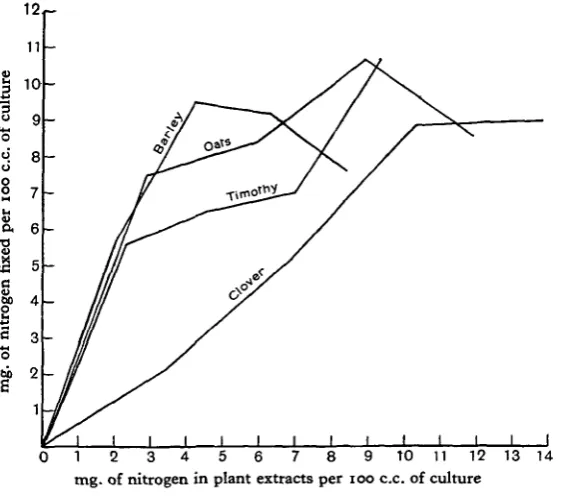
j 0 1 2 3 4 5 6 7 8 9 tO 11 12 13 14
mg. of nitrogen in plant extracts per ioo c.c. of culture
[image:3.451.80.361.368.616.2]their nitrogen content in order to afford a direct comparison with Fig. i, and the amounts added were so chosen that the initial nitrogen contents of the cultures in the two experiments were as nearly identical as possible. Increasing doses of plant extract produced an increasing stimulation, until, apparently, an optimum concentration was reached at which fixation was at a maximum. This seems re-markable when it is borne in mind that each additional dose of plant extract
16
15
14
13
12
11
10
| 9
6
5
4
3
2
1
-14 W
1 1 Y 1 |
98,304000
f*^ 24^76000
/ £A2,288000
/ A cf/A. / / \ / 4 \ 144000
/ y 3,072000 / v ' 1,536000
t*-—7*l 768000
// JI /
II ( \ 384000
/ / / . — ' ' ~v^ b / 192000 w / / ^V
— J / \ 96000
\ PJ / \
^ l \ ^ y \ 48000
i / \ 24000
\J \i2000
'6000
3000
i i i i i i i i i
0 2 4 6 8 10 12 14 16 18 20 22 24 26 28 30
Days
Fig. 3. Growth of Azotobacter in cultures containing unheated plant extracts.
represents also an increase in the initial nitrogen content of the culture, and that the amount of nitrogen fixed represents the difference between the initial content and the content at the end of the experiment.
Relation of Combined Nitrogen to Activity of Azotobacter 109
ates, amino acids and peptones. The plant extracts contained only minute ^ ^ of protein. It may therefore be inferred that the nitrogen contained in them was also available for the organism. From that assumption it follows that the fixation of atmospheric nitrogen in the plant extract cultures occurred subsequent to the utilisation of the combined nitrogen present, and that the plant extracts served in some way to increase the nitrogen-requirement of the organism. It is difficult to conceive of any way in which this could be effected other than by direct stimulation of growth. Experimental results show that such was actually the case. The organism was cultivated in culture solutions containing unheated plant extracts in concentrations equivalent to three doses in Fig. 2. The cultures were plated on alternate days on clear mannite agar. This medium was prepared in the same way as the culture solution, except that no calcium carbonate was added. 1-5 per cent, agar was used. The reaction was adjusted to pH 7-4 with 1 per cent. NaOH. The resulting medium was quite transparent, so that the Azotobacter colonies, which developed with vigour, could be counted with accuracy and ease.
[image:5.451.121.336.281.414.2]Increasing concentrations of plant material
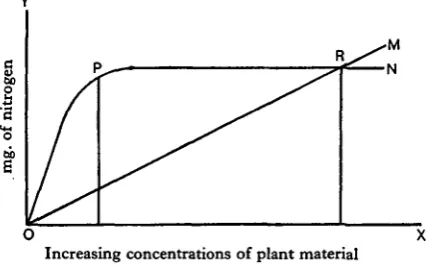
Fig. 4. Theoretical representation of the relation of stimulated nitrogen fixation to the nitrogen content of the medium.
The results of the plate counts appear in Fig. 3. The counts are expressed in genera-tions, each generation being double the preceding one, and the initial count of 3000 per c.c. being taken as the starting-point. The curve is therefore a logarithmic one to the base 2. Such a procedure is justifiable when dealing with the multipli-cation of a Schizomycete, and yields a more accurate picture of what actually happens than do the curves obtained by the direct plotting of counts. The numerical values are given on the right-hand side of Fig. 3 for comparison.
The nitrogen requirement of the organism is directly proportional to the maximum count attained by the culture (since, as shown by Lipman, the nitrogen utilised by the organism is built up into the organic constituents of the cytoplasm), and both are. represented by the curve ON. The nature of stimulative action is such that the maximum count will increase rapidly with respect to the early doses of plant extract, and will soon attain the limit, beyond which further excess of growth stimulant will exert no influence upon it. The curve then becomes a horizontal line. If the ordinates of the line OM are represented by y, and the ordinates of the curve ON by y', then the difference between y' and y will represent the amount of atmospheric nitrogen fixed. It is seen that the value of y'-y increases up to the point P where it attains its maximum, and then decreases steadily to the inter-section of the two curves at R, where y' = y. At this point the nitrogen require-ment of the culture is completely satisfied by the nitrogen content of the medium, and there is consequently no fixation of atmospheric nitrogen.
The application of the above-stated conclusions to soil furnishes a satisfactory explanation for the observations of Greaves and Carter (1916) that the stimulation of nitrogen fixation decreases with increasing additions of manure, and of Lipman and Burgess (1915) that the assimilation of nitrogen is less vigorous in soils with a high nitrogen content.
Maximum growth stimulation is produced with comparatively moderate appli-cations of vegetable material, after which further additions serve only to increase the nitrogen content of the soil solution, and thus to depress the fixation of atmo-spheric nitrogen. The following experiment was carried out in order to determine whether it is possible, by making very heavy applications, to arrest completely the fixation of nitrogen in soil.
Screened soil was mixed with 1 per cent, of calcium carbonate and 10 per cent, of ground plant material. One lot received CaCO3 only, and one CaCO3 and 2 per
cent, mannite. The soils were inoculated with a suspension of Azotobacter, and incubated at 25° C , the moisture content being kept constant throughout the experiment. Analyses for total nitrogen were made by the Kjeldahl-Gunning method on the first and twenty-eighth day. At the end of the incubation period the soil solution was obtained by extracting 10 gm. of soil with 50 c.c. of water and filtering through porcelain with suction. All cellular material was thus elimi-nated. The dilute solution was analysed by the micro-Kjeldahl method.
Relation of Combined Nitrogen to Activity of Azotobacter
I l lTable I.
Nitrogen content of soils treated with io per cent, of plant material.
Treatment io % alfalfa
io % barley io % clover
io % oats io % timothy None
2 % mannite
mg.N per o days 422-9 427-4 346-S 422-3 399-8 433-6 443'9 458-1 362-1 355-5 242-3 228-8 236-5 256-4 203-2 2485 425-2 384'4 4167 451 0 358-8 235-9 236-0
100 gm. 0; soil 28 days 393-4 4296 3839 3890 389-1 376-4 408-1 4 1 9 6
351-9 354-5 267-3 2618 274-2 260-4 271-1 261-2 4"-5 386-5
3 8 2 8
4 1 3 9
353-2
267-8
264-2
Gain or loss
-137
+ 2 1
-339
- 3 7 - i
- 5-6 + 31-9 + 28-2 Nitrogen content of soil mg. per 2 1 0 1 8 0
1 4 2 1 9 2
1 5 1 1 7 1
1 7 1
17-1 19-2 5'° — 2-O 3 0 o-o
i - o
solution 100 c.c.
19-5
1 6 7
1 7 1
1 7 1
?
2-5
o-5
3. DISCUSSION.
It appears, therefore, that the nitrogen-fixing ability of the organism is a sort of reserve power that is resorted to only in the case of nitrogen scarcity. It is well known that the supply of dissolved nitrogen in the soil solution is normally very limited, and that of the elements necessary for plant growth it is usually the least abundant, and is in fact commonly the limiting factor in plant growth. It is reason-able to infer that it is similarly the limiting factor in the development of the micro-organic population of the soil. Azotobacter, however, is independent of this factor by virtue of its nitrogen-fixing power. The addition to soil of readily soluble
chemical nitrogenous fertilisers produces a sudden increase in the concentration
of combined nitrogen in the soil solution with which the microbial flora is not able immediately to adjust itself. There results, therefore, a temporary abundance of available nitrogen which would serve to arrest the fixation of atmospheric nitrogen by Azotobacter.
be supposed, therefore, that the growth of other organisms would be similarly stimulated, and the increased activity of the microflora of the soil would result in a rapid consumption of the food material derived from the green manures, and the concentration of nutrients in the soil solution would speedily return to normal. That being so, the concentration of available nitrogen would not be increased by the addition of green manures to nearly as great an extent as by chemical nitro-genous fertilisers. On the other hand, the growth stimulation produced by the plant material would greatly increase the nitrogen requirement of Azotobacter and thus increased fixation from the air would occur.
With very large applications of plant material, the nitrogen content of the soil solution is raised to such an extent that even the greatly stimulated bacterial flora is not able to utilise it. Under these conditions there would be a superabundance of available nitrogen in the soil solution which would be more than sufficient to supply the nitrogen requirement of Azotobacter, and consequently no fixation of atmospheric nitrogen could be expected to take place. Such a condition of affairs prevailed in the experiment reported in Table I.
It appears, then, that the composition of the soil solution as a culture medium exerts a similar influence upon the activities of the Azotobacter growing in it as does the composition of the nutrient solution used in the laboratory. When the nitrogen content of the medium is low (about -003 per cent.) the organism utilises the nitrogen of the air. The addition of certain unknown "essential food sub-stances" present in plant tissues stimulates growth to such an extent that the organism is able to absorb greater amounts of combined nitrogen, and still requires a further supply from the air, thus explaining the pronounced fixation that occurred in solution cultures containing plant extracts with a comparatively high nitrogen content, and the frequently observed stimulating influence of the application of vegetable material upon nitrogen fixation in soil. When the application of plant tissue is very large, the nitrogen content of the nutrient solution is increased to such an extent that even the stimulated growth of the organism is not able to absorb it, and there is consequently no fixation from the air. In practice, however, such heavy applications are rarely made, and the consequent superabundance of available nitrogen in the soil solution does not frequently occur.
SUMMARY.
1. Increasing concentrations of nitrate, amino acid and peptone decreased proportionally the amount of atmospheric nitrogen fixed in culture solutions oi
Azotobacter.
2. Increasing concentrations of sterile, unheated, plant extracts increased the amount of atmospheric nitrogen fixed up to a maximum limit, after which the fixation gradually decreased with further additions.
Relation of Combined Nitrogen to Activity of Azotobacter 113
Very heavy applications of plant material to soil effectively checked the ilation of nitrogen, and at the same time greatly increased the concentration of nitrogen in the soil solution.
5. It is suggested that Azotobacter always prefers to derive its nitrogen from a combined source but that plant tissues contain certain unknown "essential food substances" which stimulate the growth of the organism to such an extent that the supply of available nitrogen derived from moderate applications of vegetable material is soon exhausted, and the organism then assimilates nitrogen from the air.
REFERENCES.
BACHMANN, F. M. (1919). " Vitamine requirements of certain yeasts." Joum. Biol. Chem. 39, 235. BONAZZI, A. (1921). "Studies in Azotobacter chroococcum Beijerinck." Joum. Bad. 6, 331-369. BROWN, P. E. and ALLISON, F. E. (1916). " The influence of some common humus-forming materials
of narrow and wide N.-C. ratio on bacterial action." Soil Science, 1, 49-75.
FULMER, H. L. (1917). "Relation of green manures to nitrogen fixation." Soil Science, 4, 1-17. GREAVES, J. E. and CARTER, E. G. (1916). "Influence of barnyard manure and water upon the
bacterial activities of the soil." Journ. Agric. Res. 6, 889-926.
HANZAWA, J. (1914). "Einige Beobachtungen iiber Stickstoffbindung durch Azotobacter im Stick-stoffarmen- und im Stickstoffreichen-Substraten." Centblt.f. Bakt. Abt. II, 41, 573-576. HILLS, T. L. (1918). " Influence of nitrates on nitrogen-assimilating bacteria." Journ. Agric. Res.
12, 183-230.
KOCH, F. C. and MCMEEKIN, T. L. (1924). "A new direct Nesslerisation micro-Kjeldahl method and a modification of the Nessler-Folin reagent for ammonia." Journ. Amer. Chem. Soc. .46, 2066-2069.
KRZEMIENIEWSKI, S. (1908). " Investigations on Azotobacter chroococcum." Bui. Internat. Acad. Sci.
Cracovie, 9, 929-1051.
LIPMAN, J. G. (1903). "Experiments on the transformation and fixation of nitrogen by bacteria."
N.J. Agr. Exp. Sta. 24th Ann. Rpt. 217-285.
LIPMAN, C. B. and BURGESS, P. S. (1915). "Studies on nitrogen fixation and Azotobacter forms in soils of foreign countries." Centblt.f Bakt. Abt. II, 44, 481-511.
LdHNis, F. and GREEN, H. H. (1914). "Ueber die Entstehung und die Zersetzung von Humus, sowie uber dessen Einwirkung auf die Stickstoffassimilation." Centblt. f. Bakt. Abt. 11, 40, , 52-60.
MURRAY, T. J. (1916). " The effect of different plant tissues on the fixation of atmospheric nitrogen."
Va. Agr. Exp. Sta. Tech. Bui. 15, 93-102.
REED, H. S. and WILLIAMS, B. (1915). "The effect of some organic soil constituents upon nitrogen fixation by Azotobacter." Va. Agr. Exp. Sta. Tech. Bui. 4, 81-95.
SANBORN, J. R (1926). "Physiological studies of the accessory and stimulating factors of certain media." Journ. Bad. 12, 1-11.
STOKLASA, J. (1908). "Beitrag zur Kenntnis der chemischen VorgSnge bei der Assimilation des elementaren Stickstoffs durch Azotobacter und Radiobacter." Centblt. f. Bakt. Abt. 11, 21, 484-509, 620-632.
THJ&TTA, T. and AVERY, O. T. (1921). " Studies on bacterial nutrition. III. Plant tissues as a source of growth-accessory substance in the cultivation of B. influenzae." Journ. Exp. Med. 34, 455. WiLDiERS, E. (1901). " Nouvelle substance indispensable au deVeloppement de la levure." La Cellule,
1 8.
3I3-33I-WILLIAMS, R. J. (1919). "The vitamine requirement of yeast." Journ. Biol. Chem. 38, 465-485. WINSLOW, C.-E. A. and FALK, I. S. (1926). "A contribution to the dynamics of toxicity and the
theory of disinfection." Journ. Bad. 11, 1-25.