686
Unsupervised Adversarial Domain Adaptation for Implicit Discourse
Relation Classification
Hsin-Ping Huang
Department of Computer Science The University of Texas at Austin
Junyi Jessy Li Department of Linguistics The University of Texas at Austin
Abstract
Implicit discourse relations are not only more challenging to classify, but also to annotate, than their explicit counterparts. We tackle sit-uations where training data for implicit rela-tions are lacking, and exploit domain adapta-tion from explicit relaadapta-tions (Ji et al., 2015). We present an unsupervised adversarial do-main adaptive network equipped with a recon-struction component. Our system outperforms prior works and other adversarial benchmarks for unsupervised domain adaptation. Addi-tionally, we extend our system to take advan-tage of labeled data if some are available.
1 Introduction
Discourse relations capture the relationship be-tween units of text—e.g., sentences and clauses— and are an important aspect of text coherence. While some relations are expressed explicitly with a discourse connective (e.g., “for example”, “how-ever”), relations are equally often expressed im-plicitly without an explicit connective (Prasad et al.,2008); in these cases, the relation needs to be inferred.
Resources for implicit discourse relations are scarce compared to the explicit ones, since they are harder to annotate (Miltsakaki et al., 2004). For example, among corpora annotated with dis-course relations such as Arabic (Al-Saif and Mark-ert, 2010), Czech (Pol´akov´a et al., 2013), Chi-nese (Zhou and Xue, 2015), English (Prasad et al., 2008), Hindi (Oza et al., 2009), and Turk-ish (Zeyrek et al.,2013), only the Chinese, English and Hindi corpora include implicit discourse rela-tions (Prasad et al., 2014). In this low-resource scenario, Ji et al. (2015) proposed training with explicit relations via unsupervised domain adapta-tion, viewing explicit relations as a source domain with labeled training data, and implicit relations
as a target domain with no labeled data. The do-main gap between explicit and implicit relations is acknowledged by prior observations that the two types of discourse relations are linguistically dis-similar (Sporleder and Lascarides, 2008; Ruther-ford and Xue,2015).
We present a new system for the unsuper-vised domain adaptation setup on the Penn Dis-course Treebank (Prasad et al., 2008). Our sys-tem is based on Adversarial Discriminative Do-main Adaptation (Tzeng et al., 2017), which de-couples source domain training and representa-tion mapping between source and target. We im-prove this framework by proposing a reconstruc-tion component to preserve the discriminability of target features, and incorporating techniques for stabler training on textual data.
Experimental results show that even with a simple architecture for representation learn-ing, our unsupervised domain adaptation sys-tem outperforms prior work by 1.4-2.3 macro F1, with substantial improvements on Temporal and Contingency relations. It is also superior to DANN (Ganin et al.,2016), an adversarial frame-work widely used in NLP (Chen et al.,2018;Gui et al., 2017;Zhang et al., 2017; Fu et al., 2017;
Joty et al., 2017; Xu and Yang, 2017), by 5.7 macro F1.
Finally, we extend the system to incorporate in-domain supervision as it is sometimes feasible resource-wise to build a seed corpus that may not be large enough to train a fully supervised system. We simulate this scenario by enabling the system to jointly optimize over a varying number of la-beled examples of implicit relations. Our system consistently outperforms two strong baselines.
2 Related Work
and Xue(2015) observed that explicit and implicit relations are linguistically dissimilar, warranting an unsupervised domain adaptation approach in Ji et al. (2015). They used a marginalized denois-ing autoencoder to obtain generalized feature rep-resentations across the source and target domains with a linear SVM as the classification model. Our system improves upon this work using an adver-sarial network; we further generalize our network to semi-supervised settings.
To supplement the training data of implicit dis-course relations, prior works have used weak su-pervision from sentences with discourse connec-tives (Marcu and Echihabi, 2002; Sporleder and Lascarides,2008;Braud and Denis,2014;Ji et al.,
2015), by analyzing connectives (Zhou et al.,
2010a,b; Biran and McKeown,2013; Rutherford and Xue,2015;Braud and Denis,2016;Wu et al.,
2017), using a multi-task framework with other corpora (Lan et al., 2013; Liu et al., 2016; Lan et al., 2017), or utilizing cross-lingual data (Wu et al.,2016;Shi et al.,2017). The important dis-tinction between this work and the research above is that these are supervised systems that used all of the annotatedimplicitannotation from PDTB dur-ing traindur-ing, while explordur-ing non-PDTB corpora for additional, noisy discourse cues; on the con-trary, our main goal is to assume no labeled train-ing data for implicit discourse relations.
Unsupervised domain adaptation with adver-sarial networks has become popular in recent years; this type of approach generates a repre-sentation for the target domain with the goal that the discriminator unable to distinguish between the source and target domains. Prior works pro-posed both generative approaches (Liu and Tuzel,
2016; Bousmalis et al., 2017;Sankaranarayanan et al., 2018; Russo et al., 2018) and discrimina-tive approaches (Ganin et al.,2016;Tzeng et al.,
2015,2017). The discriminative DANN algorithm fromGanin et al.(2016) is frequently used in NLP tasks (Chen et al., 2018;Gui et al., 2017; Zhang et al.,2017;Fu et al., 2017;Joty et al.,2017;Xu and Yang,2017). Our method builds upon Adver-sarial Discriminative Domain Adaptation (Tzeng et al.,2017), shown to outperform DANN in vi-sual domain adaptation but has not been used in NLP tasks. The key differences between the two are discussed in Section3.
Qin et al. (2017) adopted adversarial strate-gies to supervised implicit discourse classification.
They train an adversarial model using implicit dis-course relations with and without expert-inserted connectives. Note again that theirs is a fully su-pervised system using signals in addition to the implicit relation annotations themselves, while our main focus is unsupervised domain adaptation that does not train on implicit relations.
3 Model Architecture
To classify discourse relations, our system takes a pair of sentence argumentsxas input, and outputs the discourse relation y between these two argu-ments. With unsupervised domain adaptation, we have examples(Xs, Ys) from the source domain, i.e., explicit discourse relations, and unlabeled ex-amples (Xt) from a target domain, i.e., implicit discourse relations.
We use ADDA (Tzeng et al., 2017) as our underlying framework for domain adaptation. ADDA first learns a discriminative representa-tion for the classificarepresenta-tion task in the source do-main, then learns a representation for the target domain that mimics the distribution of the source domain. The key insight here is asymmetric map-ping, where the target representation is “updated” until it matches with the source, a process more similar to the original Generative Adversaial Net-works (Goodfellow et al., 2014) than joint train-ing as in DANN (Ganin et al.,2016). Intuitively, since ADDA learns distinct feature encoders for the source and target domains instead of using a shared encoder, the same network doesn’t have to handle instances from different domains.
Summarized in Figure 1, we first pre-train a source encoderMs and source classifierC (Sec-tion3.1), then train the target encoderMt (initial-ized withMs) and discriminatorDin an adversar-ial way, to minimize the domain discrepancy dis-tance between the target representation distribu-tionMt(Xt) and that of the sourceMs(Xs) (Sec-tion 3.2). Eventually, the target feature space is trained to match the source, and the source classi-fierCcan be directly used on the target domain.
3.1 Base encoder and classifier
The source and target encodersMs and Mt fol-low the same architecture; Mtis initialized to be
Ms during adaptation. The encoders encode re-lation arguments into latent representations, and then feeds the representations into a classifierC
Figure 1: The framework of our proposed adversarial domain adaptation model, containing the pre-training stage, the adversarial adaptation stage, and the testing stage. The dashed box shows the supervised component.
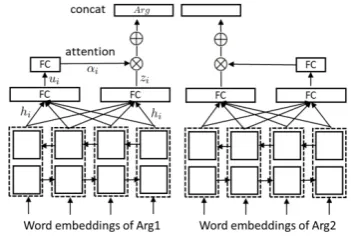
Encoder The encoder generates a representation for each argument with an inner-attention Bidirec-tional LSTM (Yang et al., 2016) shared between the two arguments. Then, the representations of the two arguments are concatenated to form the fi-nal representation, shown in Figure2.
Specifically, we encode each word in an argu-ment into its word embeddings, which are fed into a BiLSTM, to get the hidden representationszi us-ing a fully-connected layerWcon top of the con-catenated hidden stateshi = [~hi, ~hi]. We then ap-ply an attention mechanism to induce a distribu-tion of weights over all tokens in the argument; the final argument representation Arg is a weighted sum ofzibased on the attention weightsαi:
zi =Wchi+bc
ui =tanh(Wwhi+bw)
αi =
exp(uTi uw) P
iexp(uTi uw)
Arg=X
i
αizi (1)
WhereWc, bc, Ww, bw, uware model parameters.
Classifier The classifier consists of a single fully-connected layer on top of the encoder, fin-ished with a softmax classification layer.
The source encoderMsand the classifierCare trained using a supervised loss:
min
Ms,C
Lcls(Xs, Ys) =
E(xs,ys)− X
k
1[k=ys] logC(Ms(xs)) (2)
Figure 2: Neural structure of inner-attention BiLSTM to encode relation argument pairs.
3.2 Unsupervised adversarial domain adaptation
We then learn a target encoderMtto generate fea-tures for the target data which can be classified with classifier C, without assuming labels Yt in the target domain. This is achieved by training a domain discriminatorD, which classifies whether a feature is from the source or the target domain, and the target encoderMt, that produces features similar to the source domain features and tries to fool the discriminator to predict the incorrect do-main label.
The discriminatorDis optimized according to a standard supervised loss:
min
D LadvD(Xs, Xt, Ms, Mt) =
−Exs[logD(Ms(xs))]
−Ext[log (1−D(Mt(xt)))] (3)
[image:3.595.327.503.292.410.2]The target encoder Mt is optimized according to a standard GAN loss with inverted labels:
min
Mt
LadvM(Xs, Xt, D) =
−Ext[logD(Mt(xt))] (4)
Spectral normalization To stabilize the train-ing of the discriminator, we employ spectral normalization, a weight normalization technique (Miyato et al., 2018), which controls the Lips-chitz constant of the discriminator function by constraining the spectral norm of each layer. Spec-tral normalization is easy to implement without tuning any hyper-parameters and has a small ad-ditional computational cost.
Label smoothing We utilize label smooth-ing (Szegedy et al.,2016) to regularize the classi-fier during pre-training, which prevents the largest logit from becoming much larger than all oth-ers, and therefore prevents overfitting and makes the classifier, trained in the source domain, more adaptable.
For a source domain training example xs with ground-truth label ys and ground-truth distribu-tion q(k|xs), the classifier computes the classifi-cation probability over relation classes asp(k|xs) for k ∈ {1...K}. With label smoothing, we re-place the ground-truth label distributionq(k|xs)in the standard cross-entropy loss as a linear combi-nation ofq(k|xs) and a uniform distribution over classesu(k) = 1/K.
min
Ms,C
Lcls(Xs, Ys) =− X
k
q0(k) log (p(k))
q0(k|xs) = (1−)1[k=ys] +/K (5)
Reconstruction loss In order to classify the tar-get representations using the source classifier, the target encoder is trained to produce tions that mimic the source domain representa-tions in the adversarial training stage. Since there is no supervised loss applied in this stage, the tar-get encoder may lose its ability to produce dis-criminative features that are helpful during clas-sification. We propose a reconstruction loss to preserve the discriminability of the target encoder when adversarially adapting its features.
[image:4.595.352.488.63.139.2]Since we initialize the target encoder with the source encoder, the initial representation (before domain adaptation) of a target instance xt is the
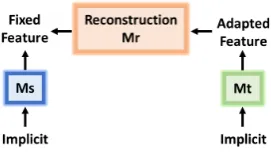
Figure 3: The reconstruction loss component augment-ing our unsupervised adversarial domain adaptor.
representation oftargetinstances produced by the
sourceencoderMs(xt)(which is then fixed). Af-ter training, Mt(xt) adapts to the source domain and becomes dissimilar to Ms(xt). The recon-struction loss encourages the target encoder to pro-duce features that can be reconstructed back to
Ms(xt)(Figure3).
For a target examplext, we learn a reconstruc-tion mappingMr that maps the target representa-tionMt(xt)toMs(xt):
xt→Mt(xt)→Mr(Mt(xt))≈Ms(xt) (6)
The target encoder Mt and the reconstruction mapping Mr are optimized jointly with a recon-struction loss:
min
Mt,Mr
Lrecon(Xt, Ms) =
Ext[||Mr(Mt(xt))−Ms(xt)|| 2 2] (7)
Mrconsists of three fully-connected layers on top of the encoder.
Unsupervised objective For unsupervised do-main adaptation, our full objective is:
Lunsup(Xs, Ys,Xt, Ms, Mt, D) =
min
Ms,C
Lcls(Xs, Ys)+
min
D LadvD(Xs, Xt, Ms, Mt)+
min
Mt
LadvM(Xs, Xt, D)+
min
Mt,Mr
Lrecon(Xt, Ms) (8)
3.3 Training
Summarized in Algorithm 1, the training proce-dure consists of three stages: pre-training, adver-sarial adaptation, and testing. During pre-training, we train the source encoderMs and the classifier
C according to Eq.(2). In the adversarial adap-tation stage, we alternately train the discriminator
Algorithm 1:Adversarial Adaptation
Input: explicit sentences with labels{xs, ys} implicit sentences without labels{xt}
Notations:source encoderMs, classifierC, target encoderMt,
reconstruction mappingMr, domain discriminatorD 1 TrainMs, Cthrough Eq.(2) with{xs, ys}; 2 InitializeMtasMs;
3 Repeat
4 TrainDthrough Eq.(3) with{xs, xt}and trainMt through Eq.(4) with{xt};
5 TrainMt, Mrthrough Eq.(7) with{xt};
Output:MtandCfor relation prediction
Mr according to Eq.(3), Eq.(4), Eq.(7). Finally, we test the model using the target encoderMtand classifierC. The steps (lines 4 and 5) in the Re-peat loop execute once in one iteration, and we optimized the model in two-step units.
4 Unsupervised Domain Adaptation Experiments
We first evaluate our model for the default task: unsupervised domain adaptation from explicit dis-course relations to implicit disdis-course relations.
4.1 Settings
Data We train and test our model on the PDTB, following the experimental setup of Ji et al.
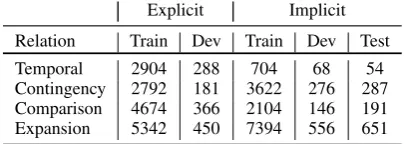
(2015). The test examples are implicit relation in-stances from PDTB sections 21-22. The explicit training set consists of explicit examples from sec-tions 02-20 and 23-24, and the explicit develop-ment set consists of the explicit examples from sections 00-01. The implicit training set and the implicit development set consist of examples from the same sections as the explicit sets. Evaluation is done for the first-level relations—Temporal, Com-parison, Contingency, and Expansion. Table 1
summarizes the statistics of the four top-level im-plicit and exim-plicit discourse relations in the PDTB.
Training Details We early-stopped training for both stages before total convergence if the macro F1 on the development set does not improve. Dur-ing pre-trainDur-ing (Line 1 in Algorithm1), we train and validate the model on the explicit training and development set. Early stopping happened after around 20 epochs. During adversarial adaptation (lines 4 and 5 in Algorithm 1), we train the model on the explicit and implicit training sets without relation labelsYt, and validate on the implicit
de-Explicit Implicit
Relation Train Dev Train Dev Test
[image:5.595.315.518.62.134.2]Temporal 2904 288 704 68 54 Contingency 2792 181 3622 276 287 Comparison 4674 366 2104 146 191 Expansion 5342 450 7394 556 651
Table 1: The number of examples of the four top level discourse relations in PDTB 2.0.
velopment set1. Early stopping happened after around 5 epochs (with lines 4 and 5 executed once in each epoch).
Model configuration The hyperparameters, as well as the number of fully connected layers for the classifier C, discriminator D and the recon-struction mappingMr, are all set according to the performance on the development sets. We first set the hyper-parameters of the encodersMs, Mtand classifier C based on development performance during the pre-training stage. Then, we set the hyper-parameters ofDandMrbased on develop-ment performance of the adaptation stage.
We use GloVe (Pennington et al., 2014) for word embeddings with dimension 300. The max-imum argument length is set to 80. The encoder contains an inner-attention BiLSTM with sion 50, producing a representation with dimen-sion 200 for each example. The discriminatorD
consists of 2 hidden layers with 200 and 200 neu-rons on each layer. The reconstruction mapping
Mr contains 3 hidden layers with 120, 15 and 120 neurons on each layer. The label smooth-ing parameter is 0.1. We use Adam (Kingma and Ba,2015) with learning rate 1e-4 for the base encoder and classifier, and 1e-6 for the adversar-ial domain adapter. We use SGD optimizer with learning rate 1e-2 for the reconstruction compo-nent. All the models were implemented using Py-Torch (Paszke et al.,2017) and adapted from Con-neau et al.(2017).
4.2 Systems
We experiment with three settings:
Implicit →Implicit A supervised implicit dis-course relation classifier using the base encoder and classifier, optimizing the standard cross-entropy loss, using the full implicit training and
1Using a development set in the target domain is common
in unsupervised domain adaptation (Ganin et al.,2016;Liu
and Tuzel,2016;Tzeng et al.,2017;Bousmalis et al.,2017;
Temporal Contingency Comparison Expansion MacroF1
Implicit→Implicit 25.53 41.02 30.35 65.38 40.57
Explicit→Implicit 22.22 22.35 23.06 57.86 31.37 +Domain Adaptation 30.62 42.71 25.00 52.23 37.64 +Spectral Normalization 30.20 45.42 21.90 58.72 39.06 +Label Smoothing 31.58 46.40 24.64 58.03 40.16 +Reconstruction 31.25 48.04 25.15 59.15 40.90
(Ji et al.,2015) 19.26 41.39 25.74 68.08 38.62
+weak supervision 20.35 42.25 26.32 68.92 39.46
DANN 26.19 34.20 25.74 54.70 35.21
Table 2: Per-class and macro average F1 (%) of unsupervised domain adaptation from explicit to implicit relations.
development sets. This model does not use the ex-plicit relations.
Explicit → Implicit A discourse relation clas-sifier using the explicit training set and implicit development set, optimizing the standard cross-entropy loss. This serves as a baseline without any domain adaptation.
Domain adaptation Our full adaptation model trained on the explicit training set, and adapted to the implicit training set without relation labels. We perform ablation study with different extensions describe in Section3: spectral normalization, label smoothing, and reconstruction loss.
For benchmarking, we train an unsupervised domain adaptation system using DANN (Ganin et al.,2016), which jointly learns domain-invariant representations and the classifier and is often used in NLP (c.f. Section2). We use the same encoder, classifier and discriminator structures, with pa-rameters tuned on the implicit development data. The system is optimized using Adam with learn-ing rate 2e-4 and the adaptation parameter 0.25, chosen between 0.01 and 1 on a logarithmic scale.
4.3 Results
To evaluate our model, we train four-way classi-fiers and report per-class and macro F1 scores. Table2 tabulates the experimental results for un-supervised domain adaptation.
We also show reported results from Ji et al.
(2015). Even though they trained four binary clas-sifiers (instead of doing multi-class classification), it is the only prior work exploring unsupervised domain adaptation for implicit discourse relation classification. We include two settings: their best system with labeled data from PDTB explicit re-lations only (and an implicit development set), and their system with additional weak supervision
from non-PDTB sources.2
Our full system achieves the best average F1 measure, a 9.53% absolute increase from Explicit→Implicit. It also performs 2.28% better thanJi et al.(2015)’s model trained without weak supervision, and 1.44% better than their model trained with weak supervision. The full system achieved an average F1 comparable to the super-vised Implicit→Implicit, whileJi et al. (2015)’s models did not. Comparing with DANN, our sys-tem achieved superior performance for 3 of the 4 relations, showing that training target representa-tions and the classifier in two stages outperforms doing both jointly.
The largest improvements from the Explicit→
Implicit baseline are from Temporal (from 22.22 to 31.25) and Contingency (from 22.35 to 48.04) relations. Our system performs ∼11% better for Temporal, and∼6% better for Contingency, than
Ji et al.(2015)’s binary classifiers. The Compar-ison and Expansion relations improved by about 2% from the baseline, a smaller improvement compared to the other two relations. Our Com-parison performance is comparable with Ji et al.
(2015)’s model without weak supervision.
Notably, the performance for Expansion dropped after domain adaptation (without ex-tensions) by about 5%. We suspect that this is because the distributions of Expansion among other relations are very different (33% for ex-plicit and 53% for imex-plicit, c.f. Table 1). By applying Spectral Normalization, the performance improved and surpassed Explicit→Implicit.
Component-wise, Spectral Normalization helps two of the four relations (Contingency and Expan-sion), but hurts the performance of Comparison.
2The weakly labeled data includes sentences extracted
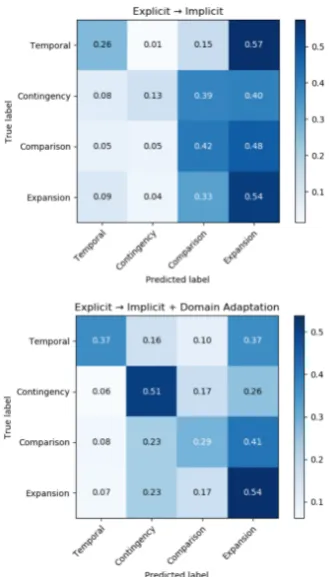
Figure 4: Normalized confusion matrices before and after unsupervised domain adaptation.
Label smoothing improves performance for all re-lations except Expansion; applying the reconstruc-tion loss improves performance for all relareconstruc-tions except Temporal. Overall, the best result on this task is to incorporate all components.
Error analysis Figure 4 shows the normalized confusion matrices before and after unsupervised domain adaptation. Before adaptation, Temporal and Contingency relations are often misclassified as Expansion, which is substantially improved af-ter adaptation. The improvement in F score for Comparison is milder due to lower precision and higher recall, which is also reflected in the matri-ces. Finally, the drop of performance in Expansion adaptation can be traced through increased confu-sion between Expanconfu-sion and Contingency.
5 How about a little supervision?
[image:7.595.351.481.66.171.2]We have so far presented an unsupervised domain adaptation system that is not trained on any la-belsYtin the target domain. However, it is some-times feasible to have some seed annotation that can be used to improve prediction. Hence we ex-tend the model with an optional supervised com-ponent. We evaluate this extension by gradually
Figure 5: An extension component to incorporate su-pervision with our unsupervised adversarial domain adaptor.
adding labeled examples of implicit discourse re-lations, simulating situations when different num-bers of labeled examples are available.
5.1 Incorporating supervision
We extend the model with a supervised compo-nent, where a subset XtL ⊆ Xt has labels YtL. Illustrated in Figure5, we jointly optimize the tar-get encoderMt and the classifier C according to an additional supervised loss:
min
Mt,C
Lsup(XtL, YtL) =
E(xL t,yLt)−
X
k
1[k=ytL] logC(Mt(xLt)) (9)
Effectively, we encourage the target encoder to jointly extract more discriminative features for all target examples(Xt), and learning target domain representations close to the source.
The full objective incorporates supervision of the in-domain labels by addingLsup(XL
t, YtL) to the unsupervised objective:
Lsup(Xs, Ys, Xt, Ms, Mt, D) =
Lunsup(X
s, Ys, Xt, Ms, Mt, D)+
min
Mt,C
Lsup(XtL, YtL) (10)
5.2 Data and settings
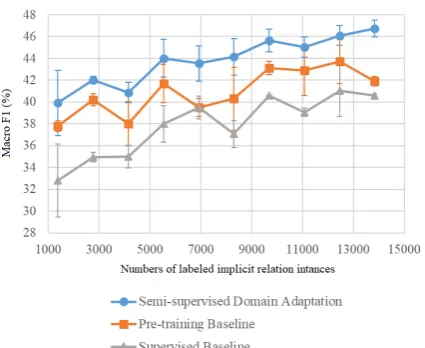
Figure 6: The average F1 (%) with varying numbers of labeled implicit relation training data.
We use the same hyper-parameters as the unsuper-vised experiment, except that we tune the learning rate on the implicit development set.
5.3 Systems
We compare three settings:
Supervised baseline The encoder and classi-fier trained on the sampled implicit instances
(XtL, YtL), optimizing Eq.(9).
Pre-training baseline Our model with the su-pervised component, but without the domain adap-tation component. This setting is equivalent to pre-training on the explicit instances then fine-tuning on the sampled implicit instances. This is trained on the explicit training set (Xs, Ys), plus the sampled implicit instances (XtL, YtL), opti-mizing Eq.(5) and Eq.(9).
Semi-supervised domain adaptation Our full model with both the supervised and adaptation components, optimizing Eq.(10). The supervised component uses the sampled implicit instances
(XL
t , YtL)for training.
5.4 Results
Since the added training data is randomly sam-pled, we average the performance across 3 differ-ent runs. Figure 6 shows the average F1 mea-sure (y-axis) of the above three supervised sys-tems, with varying numbers of labeled implicit re-lation training data (x-axis). Standard errors are also shown in the graph.
Our full system outperforms both the super-vised baseline and the ptraining baseline,
re-gardless of the amount of labeled target data. This evaluation also reveals that the pre-training base-line also improves upon the supervised basebase-line across the board, which means that the perfor-mance of implicit relation classification can be im-proved with pre-training on explicit relations.
Finally, the macro F1 of our system using full supervision is 47.50. Since we focus on domain adaptation and used very simple encoders, we do not attempt to achieve state-of-the-art (e.g., Dai and Huang(2018),Bai and Zhao (2018)). How-ever this performance is on-par with many recent work using multi-task or GANs, including Lan et al.(2017) (47.80),Qin et al.(2017) (44.38, Re-produced results on four-way classification), and
Liu et al. (2016) (44.98). These results confirm that our framework generalizes well with respect to the amount of supervision in the target domain.
6 Conclusion
Our work tackles implicit discourse relation clas-sification in a low resource setting that is flexible to the amount of supervision. We present a new system based on the adversarial discriminative do-main adaptation framework (Tzeng et al., 2017) for unsupervised domain adaptation from explicit discourse relation to implicit discourse relation. We propose a reconstruction loss to preserve the discriminability of features during adaptation, and we generalize the framework to make use of pos-sibly available seed data by jointly optimizing it with a supervised loss. Our system outperforms prior work and strong adversarial baselines on un-supervised domain adaptation, and works effec-tively with varying amount of supervision.
Acknowledgments
We thank Ray Mooney, Eric Holgate, and the anonymous reviewers for their helpful feedback. This work was partially supported by the NSF Grant IIS-1850153.
References
Amal Al-Saif and Katja Markert. 2010. The leeds ara-bic discourse treebank: Annotating discourse con-nectives for arabic. InLREC.
Or Biran and Kathleen McKeown. 2013. Aggregated word pair features for implicit discourse relation dis-ambiguation. InACL.
Konstantinos Bousmalis, Nathan Silberman, David Dohan, Dumitru Erhan, and Dilip Krishnan. 2017. Unsupervised pixel-level domain adaptation with generative adversarial networks. InCVPR.
Chlo´e Braud and Pascal Denis. 2014. Combining nat-ural and artificial examples to improve implicit dis-course relation identification. InCOLING.
Chlo´e Braud and Pascal Denis. 2016. Learning connective-based word representations for implicit discourse relation identification. InEMNLP. Xilun Chen, Yu Sun, Ben Athiwaratkun, Claire Cardie,
and Kilian Weinberger. 2018. Adversarial deep av-eraging networks for cross-lingual sentiment classi-fication. Transactions of the Association for Com-putational Linguistics, 6:557–570.
Alexis Conneau, Douwe Kiela, Holger Schwenk, Lo¨ıc Barrault, and Antoine Bordes. 2017. Supervised learning of universal sentence representations from natural language inference data. InEMNLP. Zeyu Dai and Ruihong Huang. 2018. Improving
im-plicit discourse relation classification by modeling inter-dependencies of discourse units in a paragraph. InNAACL.
Lisheng Fu, Thien Huu Nguyen, Bonan Min, and Ralph Grishman. 2017. Domain adaptation for re-lation extraction with domain adversarial neural net-work. InIJCNLP.
Yaroslav Ganin, Evgeniya Ustinova, Hana Ajakan, Pascal Germain, Hugo Larochelle, Franc¸ois Lavi-olette, Mario Marchand, and Victor Lempitsky. 2016. Domain-adversarial training of neural net-works. Journal of Machine Learning Research, 17(1):2096–2030.
Ian Goodfellow, Jean Pouget-Abadie, Mehdi Mirza, Bing Xu, David Warde-Farley, Sherjil Ozair, Aaron Courville, and Yoshua Bengio. 2014. Generative ad-versarial nets. InNIPS.
Tao Gui, Qi Zhang, Haoran Huang, Minlong Peng, and Xuanjing Huang. 2017. Part-of-speech tag-ging for twitter with adversarial neural networks. In
EMNLP.
Yangfeng Ji, Gongbo Zhang, and Jacob Eisenstein. 2015. Closing the gap: Domain adaptation from ex-plicit to imex-plicit discourse relations. InEMNLP. Shafiq Joty, Preslav Nakov, Llu´ıs M`arquez, and Israa
Jaradat. 2017. Cross-language learning with adver-sarial neural networks. InCoNLL.
Diederik P. Kingma and Jimmy Ba. 2015. Adam: A method for stochastic optimization. InICLR.
Man Lan, Jianxiang Wang, Yuanbin Wu, Zheng-Yu Niu, and Haifeng Wang. 2017. Multi-task attention-based neural networks for implicit discourse re-lationship representation and identification. In
EMNLP.
Man Lan, Yu Xu, and Zhengyu Niu. 2013. Leveraging synthetic discourse data via multi-task learning for implicit discourse relation recognition. InACL. Ming-Yu Liu and Oncel Tuzel. 2016. Coupled
genera-tive adversarial networks. InNIPS.
Yang Liu, Sujian Li, Xiaodong Zhang, and Zhifang Sui. 2016. Implicit discourse relation classification via multi-task neural networks. InAAAI.
Daniel Marcu and Abdessamad Echihabi. 2002. An unsupervised approach to recognizing discourse re-lations. InACL.
Eleni Miltsakaki, Rashmi Prasad, Aravind Joshi, and Bonnie Webber. 2004. The Penn Discourse Tree-bank. InLREC.
Takeru Miyato, Toshiki Kataoka, Masanori Koyama, and Yuichi Yoshida. 2018. Spectral normalization for generative adversarial networks. InICLR. Umangi Oza, Rashmi Prasad, Sudheer Kolachina,
Dipti Misra Sharma, and Aravind Joshi. 2009. The Hindi Discourse Relation Bank. InThe Third Lin-guistic Annotation Workshop.
Adam Paszke, Sam Gross, Soumith Chintala, Gre-gory Chanan, Edward Yang, Zachary DeVito, Zem-ing Lin, Alban Desmaison, Luca Antiga, and Adam Lerer. 2017. Automatic differentiation in pytorch. InNIPS-W.
Jeffrey Pennington, Richard Socher, and Christo-pher D. Manning. 2014. Glove: Global vectors for word representation. InEMNLP.
Lucie Pol´akov´a, Jiˇr´ı M´ırovsk`y, Anna Nedoluzhko, Pavl´ına J´ınov´a, ˇS´arka Zik´anov´a, and Eva Hajiˇcov´a. 2013. Introducing the prague discourse treebank 1.0. InIJCNLP.
Rashmi Prasad, Nikhil Dinesh, Alan Lee, Eleni Milt-sakaki, Livio Robaldo, Aravind Joshi, and Bonnie Webber. 2008. The Penn Discourse TreeBank 2.0. InLREC.
Rashmi Prasad, Bonnie Webber, and Aravind Joshi. 2014. Reflections on the Penn Discourse Treebank, comparable corpora, and complementary annota-tion. Computational Linguistics, 40(4):921–950. Lianhui Qin, Zhisong Zhang, Hai Zhao, Zhiting Hu,
and Eric Xing. 2017. Adversarial connective-exploiting networks for implicit discourse relation classification. InACL.
Paolo Russo, Fabio Maria Carlucci, Tatiana Tommasi, and Barbara Caputo. 2018. From source to target and back: symmetric bi-directional adaptive gan. In
Attapol Rutherford and Nianwen Xue. 2015. Im-proving the inference of implicit discourse relations via classifying explicit discourse connectives. In
NAACL.
Swami Sankaranarayanan, Yogesh Balaji, Carlos D. Castillo, and Rama Chellappa. 2018. Generate to adapt: Aligning domains using generative adversar-ial networks. InCVPR.
Wei Shi, Frances Yung, Raphael Rubino, and Vera Demberg. 2017. Using explicit discourse connec-tives in translation for implicit discourse relation classification. InIJCNLP.
Caroline Sporleder and Alex Lascarides. 2008. Using automatically labelled examples to classify rhetori-cal relations: An assessment. Natural Language En-gineering, 14(3):369–416.
Christian Szegedy, Vincent Vanhoucke, Sergey Ioffe, Jon Shlens, and Zbigniew Wojna. 2016. Rethinking the inception architecture for computer vision. In
CVPR.
Eric Tzeng, Judy Hoffman, Trevor Darrell, and Kate Saenko. 2015. Simultaneous deep transfer across domains and tasks. InICCV.
Eric Tzeng, Judy Hoffman, Kate Saenko, and Trevor Darrell. 2017. Adversarial discriminative domain adaptation. InCVPR.
Changxing Wu, Xiaodong Shi, Yidong Chen, Yanzhou Huang, and Jinsong Su. 2016. Bilingually-constrained synthetic data for implicit discourse re-lation recognition. InEMNLP.
Changxing Wu, Xiaodong Shi, Yidong Chen, Jinsong Su, and Boli Wang. 2017. Improving implicit dis-course relation recognition with disdis-course-specific word embeddings. InACL.
Ruochen Xu and Yiming Yang. 2017. Cross-lingual distillation for text classification. InACL.
Zichao Yang, Diyi Yang, Chris Dyer, Xiaodong He, Alexander J. Smola, and Eduard H. Hovy. 2016. Hi-erarchical attention networks for document classifi-cation. InNAACL.
Deniz Zeyrek, Is¸ın Demirs¸ahin, AB Sevdik-C¸ allı, and Ruket C¸ akıcı. 2013. Turkish discourse bank: Port-ing a discourse annotation style to a morphologically rich language. Dialogue and Discourse, 4(2):174– 184.
Yuan Zhang, Regina Barzilay, and Tommi Jaakkola. 2017. Aspect-augmented adversarial networks for domain adaptation. Transactions of the Association for Computational Linguistics, 5:515–528.
Yuping Zhou and Nianwen Xue. 2015. The Chinese Discourse TreeBank: a Chinese corpus annotated with discourse relations. Language Resources and Evaluation, 49(2):397–431.
Zhi Min Zhou, Man Lan, Zheng Yu Niu, Yu Xu, and Jian Su. 2010a. The effects of discourse connectives prediction on implicit discourse relation recognition. InSIGDIAL.