Original citation:
Huh, K. K., Kunc, Martin and O'Brien, F. A.. (2013) Resource conceptualization : the role of group dynamics in defining a firm's strategic resources. Academy of Management Proceedings, 2013 (1). p. 13067.
Permanent WRAP url:
http://wrap.warwick.ac.uk/75789
Copyright and reuse:
The Warwick Research Archive Portal (WRAP) makes this work of researchers of the University of Warwick available open access under the following conditions. Copyright © and all moral rights to the version of the paper presented here belong to the individual author(s) and/or other copyright owners. To the extent reasonable and practicable the material made available in WRAP has been checked for eligibility before being made available.
Copies of full items can be used for personal research or study, educational, or not-for-profit purposes without prior permission or charge. Provided that the authors, title and full bibliographic details are credited, a hyperlink and/or URL is given for the original metadata page and the content is not changed in any way.
A note on versions:
The version presented here may differ from the published version or, version of record, if you wish to cite this item you are advised to consult the publisher’s version. Please see the ‘permanent WRAP url’ above for details on accessing the published version and note that access may require a subscription.
Resource conceptualization: The role of group dynamics in defining a firm's strategic
resources
ABSTRACT
This study extends the Dynamic Resource-based view, which suggests managerial processes as a source of resource heterogeneity between firms, to analyze the role that group dynamic processes may have in the identification of strategic resources. The paper contends that resource heterogeneity is not only determined by substantive characteristics of a management team, but also by the very process of the group decision process. Two different groups’ resource conceptualization processes were analyzed in search for the relationship between resource conceptualization process and the conceptualized set of resources. Contrasting group processes indicated differences in various group dynamic variables; deliberateness, cognitive overload, and cognitive and affective conflicts during the process of identifying strategic resources. The distinct group dynamics, in turn, determined diverse levels of understanding of the contribution of strategic resources to firm performance.
Keywords:
INTRODUCTION
The Resource-based view (RBV) of the firm defines firms as bundles of resources,
which have to be valuable, rare and non-imitable to provide firms with superior performance
(Barney, 1991; Wernerfelt, 1984). However, mainstream RBV does not explain the process of
realizing and acquiring valuable resources (Kraaijenbrink, Spender, & Groen, 2010). Detailed
analysis of managerial process related to resource development can help to explain the origin
of resource heterogeneity between firms (Kraaijenbrink et al., 2010; Maritan & Peteraf, 2011)
but it still remains largely unexplored (for an exception, see Kunc & Morecroft, 2010).
In this paper, we expand the dynamic RBV perspective (Foss & Ishikawa, 2007; Kunc &
Morecroft; 2010; Martian & Peteraf, 2011) by analyzing group-based resource
conceptualization processes occurring in strategic planning activities. More specifically, our
objective is to explore how group decision processes affect the conceptualization of the set of
valuable resources of a firm. We conducted a behavioral experiment (Gist, Hopper, & Daniels,
1998) where we compared the group dynamics of two groups of experienced managers who
were given the task of conceptualizing the set of resources for two different firms. We analyzed
the data both qualitatively and quantitatively to reach satisfactory theoretical saturation
(Eisenhardt, 1989a).
The paper is organized as follows. The first section provides a theoretical discussion
regarding the dynamic RBV and the role of group processes in identifying resources. The
second section explains the overall research methodology and presents two analyses
employed for the case study. Based on these analyses, the overall findings of the case study,
along with the theoretical framework are presented. The final section discusses the limitations
and contributions of the study.
Following the cognitive perspective of strategic management research (Hodgkinson
& Healey, 2008; Porac, Thomas, & Baden-Fuller, 1989; Walsh, 1995), we take the stance that
the development of strategic resources, whether that be an identification (Barney, 1986), or an
accumulation (Dierickx & Cool, 1989), are spawned from managerial strategic decisions
(Maritan & Peteraf, 2011).
The cognitive perspective contends that strategic cognitions serve as a basis for strategic
decision making (Hodgkinson & Healey, 2008). Strategic cognition comprises understanding
firm’s capabilities and resources. Past strategic cognition research has made empirical and
theoretical advancements in strategic issue diagnosis (Dutton & Jackson, 1987; Jackson &
Dutton, 1988). However, there is not empirical research to analyze the impact of strategic
cognition on resource development.
Research into the managerial process during resource building can help explaining the
resource heterogeneity between firms (Alvarez & Busenitz, 2001; Foss & Ishikawa, 2007;
Kunc & Morecroft, 2010) for a number of reasons. First, the environment that managers are
facing is uncertain and complex (Amit & Schoemaker, 1993), and there are often delays on
the effect of managerial decisions (Adner & Helfat, 2003). Thus, the relationship between
managers’ decisions and the decision outcomes remain causally ambiguous (Lippman &
Rumelt, 1982; Powell, Lovallo, & Caringal, 2006). Second. faced with such a complex
environment, managers with limited cognitive abilities engage in simplifying heuristics
generating blind spots (Zajac & Bazerman, 1991) and cognitive biases (Barnes & James,
1984; Das & Bing-Sheng, 1999; Schwenk, 1984; Schwenk, 1986). Third, managers attend
selectively to a small number of competitors (Clark & Montgomery, 1999; Porac & Thomas,
1994), and competitor dimensions (Hodgkinson, 1997; Walton, 1986). Fourth, these
simplifying mental models tend to persist in the face of shifting competitive dynamics, being
Palmer, 1996). Fifth, using their mental models, managers perceive and interpret particular
information differently and have different strategic insights even in situations when similar
analytical frameworks are used (Gavetti & Levinthal, 2004). Therefore, the origin of resource
heterogeneity between firms arose from differences in resource conceptualization processes.
Resource conceptualization process
If the process of resource conceptualization is attributed as a domain of an individual,
such as a CEO, it may possess only a limited explanatory power towards firm heterogeneity, as
the CEO is not the only actor engaged in strategy development (Hambrick, Cannella, &
Pettigrew, 2001). With various stakeholders in a firm, strategies are ultimately the product of a
negotiated order (Walsh & Fahey, 1986), in which the conflicting cognitions of diverse
stakeholders must somehow be reconciled (Forbes & Milliken, 1999; Pettigrew, 1973, 1985).
Therefore, rather than seeing resource conceptualization as a product of a rational or lucky
manager (Barney, 1986), we analyze resource conceptualization as a process occurring within
group of managers.
The role of group decision making process during resource conceptualization
One fundamental challenge that exists with the study of top management team is that
managers within the same organization are likely to have different mental models as they
have heterogeneous experiences (Kunc & Morecroft, 2010; Pitcher & Smith, 2001). If a
group’s characteristic is only measured in terms of substantive cognition, having diverse
mental models co-existing within a firm at the same time will imply multi-dimensional
insights towards its competitive environment (Boone & Hendriks, 2009; Cannella, Park, &
Lee, 2008). Accordingly, managers with different insights and skills may help the firm to
recognize and acquire valuable resources earlier than its competitors, thus leading to the
Simply having different mental models within a firm does not guarantee an effective strategic
decision since a group mental model is not a simple summation of individual mental models
(Mohammed, Ferzandi, & Hamilton, 2010). Rather, there is a complex process of interactions
between mental models to reach the firm level mental model (Foss, 1997; Lawrence, 1997;
Pelled, 1996). Such a process may involve conflicts (Amason, 1996; Pelled, Eisenhardt, & Xin,
1999), information exchange (Boone & Hendriks, 2009), politics (Eisenhardt & Bourgeois,
1988), advice seeking (McDonald & Westphal, 2003), and the comprehensive assessment of
options (Forbes, 2007; Simons, Pelled, & Smith, 1999). In other words, a particular decision of
a firm is an outcome of a negotiated order (Walsh & Fahey, 1986) or an interaction process
between heterogeneous mental models. Just as substantive mental models differ between
managers, so too group decision making processes varies from group to group determining
differences in group outcome effectiveness (Knight et al., 1999; Pelled, 1996) in terms of
resource conceptualization.
Although there is a number of theoretical papers (Foss & Ishikawa, 2007; Helfat & Peteraf,
2003) that attribute substantive mental models as an explanatory factor of resource
heterogeneity between firms, there is a lack of empirical studies that specifically investigate
the role of a group decision process in the process of conceptualizing strategic resources. Our
study intends to answer the following question.
How do group processes lead to the conceptualization of the set of strategic resources
responsible for firm performance?
To investigate the above question, we referred to the group process dynamics literature.
Group process dynamic
Group decision process has been theorized and tested from various angles in the
Seidl, 2007). We identified four theoretical concepts that are relevant for the analysis of group
processes of resource conceptualization: deliberateness may refer to the level of analysis
employed in the resource conceptualization process, overload indicates the level of stress
generated by the amount of information processed to identify resources, and intra-group
conflict captures the impact of conflicts on the selection of those resources deemed strategic.
Deliberateness. Strategy process research has a long tradition of theoretical debates
regarding the level of rationality involved in the strategy development process (Das &
Bing-Sheng, 1999). Among many contesting views, Mintzberg and Waters (1985) provide a clear
distinction between rationally designed (deliberate approach) and natural and flexible
(emergent) approaches. Deliberate strategy scholars suggest the strategy process as a set of
rationally intended behaviors of managers (Andrews, 1987; Ansoff, 1987; Goold, 1992). In
order for a strategy to be completely deliberate, it must have a detailed plan, shared intentions,
and have an outcome as expected (Mintzberg & Waters, 1985). Emergent strategy process, on
the other hand, does not rely on the analytical nature of strategy process. Rather, it
emphasizes a spontaneous flexibility or social interaction process such as politics (De Wit &
Meyer, 2004; Eisenhardt & Bourgeois, 1988). This emergent process is often compared to the
process of a weed growing out in a garden (Mintzberg & McHugh, 1985), i.e. an idea which
spawned from a disordered series of ideas. Mintzberg and Waters (1985) state that every
strategy process inevitably has partial characteristic of both deliberate and emergent strategy;
yet it may elucidate more characteristic towards one of the two. Thus, deliberateness
corresponds to a systematic process of discussion within a group of managers leading to a
certain set of resources to be employed in a strategy.
Overload. Some scholars define organizations as information processors (Tushman &
Nadler, 1978). One of the roles of an organization, as an information processor, is to store,
ability to process key information is an important attribute of a firm. However, due to limited
cognition and unmanageable inflow of information (Simon, 1991), the required amount of
information often exceeds organizational actors’ processing capacity; thus causing ‘overload’ of
information (Speier, Valacich, & Vessey, 1999). The role of overload has been studied and
tested against various fields such as budget decision (Swain & Haka, 2000), organizational
decision quality (Speier et al., 1999) and cognitive ability (Fayol, Largy, & Lemaire, 1994;
Kirsh, 2000) and it has been agreed that overload is detrimental to decision quality. Thus, group
of managers may be overloaded with too much information regarding the right set of resources
to develop, such as characteristics (e.g. value, rareness) or linkages between them (Kunc and
Morecroft, 2010).
Intra-group conflicts. Conflict has been extensively examined in the group process
literature. The construct is a common component of group processes that has a strong
influence towards the strategic decision outcome; yet the effect of conflict has been
paradoxically identified as positive and negative (Cray, Mallory, Butler, Hickson, & Wilson,
1991; Janis, 1982; Schweiger, Sandberg, & Ragan, 1986). A group of researchers
disentangled the paradox by categorizing the conflict into two categories; one being a
functional task-related conflict (cognitive conflict), and the other being the dysfunctional
emotion-related conflict (affective conflict) (Jehn, 1995; Mooney, Holahan, & Amason, 2007;
Pelled et al., 1999). Task-related conflicts stimulate the discussion between the decision makers,
leading the group to be able to evaluate the issue from various angles; whereas emotional
conflict hinders a fluent discussion between the group members (Amason, 1996). Although the
above distinction has been tested and supported, it has also been found that cognitive conflicts
can be developed into affective conflicts, as the heated discussion during cognitive conflicts can
lead into emotional clashes (Jehn, 1997). Hence, under the norm of intra-group conflict, the key
conflict at minimal level. Many resources are difficult to identify due to their characteristics
(tangible vs. intangible) and impact on performance (causal ambiguity) that may transform a
cognitive conflict into an affective conflict if the discussion between a group of managers is not
properly conducted.
Using the above four group dynamic constructs as a primary reference, we conducted an
exploratory study using two groups that were engaged in a group resource conceptualization
process.
RESEARCH METHODOLOGY
For method, we conducted observational study (Henderson, Trope, & Carnevale,
2006; Weingart, Brett, Olekalns, & Smith, 2007) with an aim of uncovering the role of group
dynamics within resource conceptualization processes. The core objective of the study is to
unfold the dynamics of resource conceptualization processes using the group dynamic
constructs: deliberateness, overload, intra-group conflicts, and decision comprehensiveness.
Our methodology follows three steps. First, we required two groups to conceptualize the
resources of two firms while we observed their group dynamic processes. Second, we
contrasted the two groups dynamic processes quantitatively using the constructs mentioned
previously. Third, using the findings from the quantitative analysis, we analyzed the two
groups’ heterogeneous processes in depth using qualitative analysis in order to identify the
origin and development of the groups’ differences. The research uses mixed method approach
(Creswell, 2003); the mixed method approach is a complementary one ensuring both
objectivity and richness of the analysis (Eisenhardt, 1989a; Jehn, 1997; Yin, 2009).
For our observational study, we anticipated that a close examination of managerial interaction
behavior would provide rich detail of a managerial decision process. For this reason, we
conducted an observational study using behavioral simulations (Gist et al., 1998; Hodgkinson,
The simulation was performed with two groups of experienced managers with an average age
of 35. The participants were recruited from a part-time MBA program at a university-based
business school. Each group consisted of seven members from diverse cultural background.
The overall task of the two groups was to develop a strategy for their given firms. Group A
was in charge of developing a strategy for a low-cost airline company, whereas Group B
developed a strategy for a computer devices manufacturing firm.
Behavioral simulation constructs an artificial environment which can reflect managers’
decision making processes. This approach allows a close examination at specific decision
levels. This gives an advantage compared to firm level analysis which often has to make the
assumption that the firm goes through similar decision processes for every decision (Hough &
White, 2003). Furthermore it gives researchers the option of directly observing the process of
decision making. We observed the process without intervening using video recording. Analysis
is divided into two parts. The first part compares the quantitative difference between the two
teams, the difference is preliminarily accepted, and serves as a reference in the qualitative
analysis. The second part seeks the drivers of such difference between the two teams. For
qualitative analysis, we followed the group discussion through the transcripts and videos and
validated the propositions by looking for appropriate quotations. This was to ensure that the
impressions were thoroughly grounded with empirical evidence (Eisenhardt, 1989a).
Task - Resource conceptualization process
Since mental models are qualitative in their nature (Rouse & Morris, 1985) and
difficult to retrieve, we chose to view the managers’ resource conceptualization as a map
(Eden, 2004; Hodgkinson et al., 1999; Huff, 1990; Kunc & Morecroft, 2009; Reger & Palmer,
1996). Among several mapping technique, we chose resource mapping as a technique to
Resource mapping (Kunc & Morecroft, 2009) considers the performance of firms as being
driven by asset stock accumulation processes (Dierickx & Cool, 1989) . The technique views
a firm as a system of complexly intertwined resources determining the firm’s performance
over time (Kunc & Morecroft, 2009; Morecroft, Sanchez, & Heene, 2002). A standard
resource map has stocks and flows (Sterman, 2000), which represent the resources and their
accumulation rates (Dierickx & Cool, 1989) respectively. Such a representation is used to
map the management perspective about the resources that can be purposefully adjusted
(Dierickx & Cool, 1989). Another aspect of resource mapping is that it shows the linkages
between resources themselves and external/critical success factors leading to a representation
of the firm as a resource system (Miller & Shamsie, 1996; Morecroft et al., 2002); comprised
by complex interrelationship between the resources.
Procedure
The experiment took place as a part of strategy development project for their assigned
firms. The participants were given prior knowledge of various strategy development tools
(O'Brien & Dyson, 2007) such as visioning, SWOT analysis and scenario planning.
Instructions on resource mapping were also given. The participants were engaged in a
resource mapping process in order to make sense of the competitive environment as well as
the firm’s resource system to support their strategic development process. The groups were
asked to develop the resource map for their firm within a timeline of one hour.
ANALYSIS
Step 1 - Quantitative comparison between groups
The analysis was conducted using both quantitative and qualitative data sources. Use
objectivity of the study and protect the researchers from being overwhelmed by the deceiving
qualitative data (Jehn, 1997; Yin, 2009).
Quantitative data was collected from three sources: resource map, a survey to group members,
and independent coders. The resource map was used to compare the two groups’ mental model
complexity. From group members, we collected satisfaction scores regarding the group process.
Lastly, we used independent, third party, coders to measure various group dynamic process
constructs. Based on the quantitative data, we conducted a preliminary comparison between the
two groups; the comparison provided an insight into the aspects of the group process that were
different between the two groups. This gave us a more refined focus for the qualitative analysis.
We conducted a quantitative analysis to have preliminary insights towards the two groups’
discrepancies. The following describes each of the measures used:
Strategic cognitive complexity
Strategic cognitive complexity refers to a level of cognitive ability to use complex
and multiple constructs when perceiving phenomena (Bieri, 1955; Hitt & Tyler, 1991; Wally
& Baum, 1994). A high level of cognitive, or mental model, complexity enables a decision
maker to use multiple constructs or perspectives to assess information, leading to a broader
set of evaluation criteria during the decision making process. Having a complex mental model
is found to assist a decision maker to make sense of the complex competitive environment;
hence positively affecting the competitive success (McNamara, Luce, & Tompson, 2002).
Following the above notion, we adopted resource map complexity as a tentative measure for
group resource conceptualization effectiveness. Following Gary and Wood’s (2011) measure
of mental model complexity; we measured the number of inferred causal linkages between the
constructs within the resource map. Since the two groups industries were different, we were
aware that this complexity score could not serve as a definite measure of group effectiveness;
Satisfaction
We also used group members’ perceived satisfaction towards their group process as
another measure of preliminary group outcome. Intra-group conflicts were found have a
negative relationship with group members’ satisfaction, where affective conflict particularly
exhibits a stronger negative relationship with the satisfaction (Jehn, 1995; Jehn & Mannix,
2001). Although past research indicates that group effectiveness and group satisfaction do not
have any significant relationship (Schweiger et al., 1986; Schwenk & Cosier, 1980), group
satisfaction has been used as an important construct to measure group viability (Amason,
1996; Jehn, 1995; Jehn, Greer, Levine, & Szulanski, 2008). We employed intra-group conflict
research methodology (Jehn, 1995); three seven point Likert-scale questions were asked
directly to the participants after their resource conceptualization process.
Deliberateness of the group process
Following Mintzberg and Waters’ (Mintzberg & Waters, 1985)‘s distinction on
strategy process, we measured the extent of deliberateness of the groups’ resource
conceptualization process. We were unable to find a previous study that specifically measured
the level of deliberateness quantitatively. Based on the review of strategy process literature
(De Wit & Meyer, 2004; Goold, 1992; Mintzberg, Pascale, Goold, & Rumelt, 1996;
Mintzberg & Waters, 1985), we identified three factors that could be used to determine the
level of deliberateness in a process: level of structure, analytical nature and level of formality
of the process. We created three seven point Likert-scale questions asking the above three
dimensions and asked the third party coders to rate their perceptions.
Overload
We reviewed literature that discusses the concept of overload and conditions that
for cognitive process exceeds the cognitive process capacity (Speier et al., 1999), and found
three conditions that can cause overload to managerial cognition: information over-supply;
high demand for information; high need for multi-tasks (Edmunds & Morris, 2000; Eppler &
Mengis, 2004; Kirsh, 2000; O'Reilly, 1980) that were the base for three seven point
Likert-scale questions. We presented the questions to the independent coders.
Intra-group conflicts
We examined previous data analysis methodologies for cognitive and affective conflicts.
There were two categories of data that researchers had examined. The first category of data
captured the general atmosphere of the team (e.g. amount of conflict under normal occasion)
(Jehn, 1997; Knight et al., 1999). The second category of data captured conflicts during a
decision making or a project (e.g. conflict under the most recent decision making or a 10
weeks project) (Amason & Sapienza, 1997; Jehn et al., 2008; Mooney et al., 2007). Our data
fitted into the second category. Based on the literature on intra-group conflicts, we found that
questions mostly originates from Jehn’s (1994) conflict measures (Amason & Sapienza, 1997;
Jehn, 1997; Jehn et al., 2008; Mooney et al., 2007). Following this stream of the literature, we
created three seven point Likert-scale questions for each conflict type, based on Jehn’s (1994)
questions.
We compared the differences of the two teams using the previously defined measures.
In order to maximize the reliability of our analysis, we showed the videos of the two group’s
discussions to coders who were blind to the hypotheses under investigation (Jehn et al., 2008).
The coders were asked to complete a questionnaire containing questions designed to measure
the group’s group dynamics variables. Following Shah and Jehn’s (1993), we briefed the
coders about the theoretical concepts prior to showing the videos. Afterwards, we asked them
to complete the questionnaire, and then averaged their ratings across each question, which are
--- Insert Table 1 about here
---Table 1 shows scores of seven quantitative items and Cronbach’s alphas where applicable. We
were aware that the quantitative findings could be vulnerable to two types of variability:
inter-questions and inter-coders. To confirm that the collected data was reliable from both types of
variability, we computed Cronbach’s alpha and intraclass correlation. As can be seen, for all
five constructs the α scores were above 0.75, which meant that the questions exhibited internal
consistency (Knight et al., 1999; Mooney et al., 2007). Furthermore, we tested two-tailed
intra-class correlation (Shrout & Fleiss, 1979) to see if the coders perceived the questions in a similar
manner. The intra-class correlation value was 0.927; this showed a satisfactory level of
conformities among the coders. Based on this agreement level, we concluded that the both the
questions’ internal consistency and inter-coder consistency were acceptable (Jehn et al., 2008).
It is noticeable that each group received substantially different scores for most of the criteria.
Group A showed a more deliberate form of resource conceptualization, certainly less overload
and affective conflict compared to Group B. Although there is a difference of 0.8 for the
cognitive conflict construct, it is debatable whether coders thought that Group A exhibited
more cognitive conflict compared to Group B since the difference is not large. Therefore, we
decided not to develop any preliminary assumption towards the level of cognitive conflicts
the groups experienced. For other constructs, we accepted the differences and chose to use
them as a basis of the qualitative analysis.
Step 2 - Qualitative analysis of groups dynamic processes
The purpose of the qualitative analysis was to gain more in depth insights behind the
exposed differences that were found in the quantitative analysis. In other words, the
qualitative analysis was conducted to analyze the causal mechanisms that led to the
1989a) for the qualitative analysis. That is, we narrowed the analytical lens as the analysis
progressed. Starting from the constructs of focus and preliminary propositions developed
from the quantitative analysis, we compared the two groups; the focus became narrower and
more refined as the analysis progressed. The iterative analysis was made until a satisfactory
theoretical saturation was reached.
For the qualitative analysis, we used video recorded group discussions during the resource map
building, along with the transcripts of the discussions. We then observed the videos while going
through the transcripts. Use of transcriptions is a common practice in decision process research
(McComb, Kennedy, Perryman, Warner, & Letsky, 2010; Shah & Jehn, 1993; Weingart et al.,
2007), as it provides vivid discussions which researchers can easily refer to. Furthermore, the
use of video recordings enables more robust analysis, as it gives more understanding of the
mood of the speakers by their tone and facial expressions (Haw & Hadfield, 2011).
Overall, we generally supported the quantitative findings. The two groups’ resource
conceptualization processes are described in a chronological order along with appropriate
quotations to support the findings. We divided the process into a number of phases; the phases
were distinguished when the nature of the task changed or a major breakdown occurred.
Group A: Incremental and causal linkage oriented resource conceptualization process
Group A, consisting of seven managers, conceptualized the resource system of a low
cost airline company in a time limit of one hour. The group gained higher score than Group B
in satisfaction, complexity and deliberateness. We retained an unbiased perspective towards
the discrepancy of the cognitive conflicts between the two groups. They gained a lower score
in affective conflicts and overload. If the quantitative findings hold, Group A was engaged in
a well-organized rational group process in relation to Group B. We analyzed the group’s
discussion to find whether the quantitative findings could be supported and also to identify the
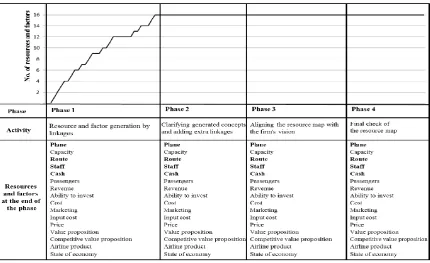
We divided the group’s conceptualization into four major phases. Figure 1 shows the changes
in number of resources and factors, along with the list of resources (in bold font) and factors
at the end of each phase. The group finished their resource conceptualization in the first two
phases and spent the next two phases on improving the resource map.
--- Insert Figure 1 about here
---The first impression that arose from observing group A’s resource conceptualization
was the orderly fashion of the process. Members did not interrupt while other members were
speaking, nor did they bring in another topic of discussion unless the discussion of the current
topic was finished. Although it was only an impression at this stage, it seemed that this
orderly process helped the group to maintain a comprehensive process. We further observed
the discussion and found a distinctive characteristic of the group; the group was
conceptualizing the resources based on the causal linkages between them.
Phase 1. The group started with ‘planes’ as the first important resource, and then
developed the resource map based on the causal linkages from it. The group agreed that an
increased number of planes led to an increase in routes, which in turn increased the number of
staff. As can be seen from the following quotation, it was evident that the group paid equal
amount of attention to both resource conceptualization and the linkages between resources.
Male A1: “Well I guess you'd start... I would start by planes.” Male A1: “Planes. We should have capacity somewhere.”
Male A4: “But that means if you have more number of planes, then more capacity.” Male A1: “Yeah.”
Male A2: “We can have more planes, more routes.” Male A4: “We have got more routes…then..” Male A1: “We can have staff also.”
Male A1: “But staff also fall into ... More capacity into staff.”
There were a number of occasions when group members had different opinions regarding the
firm’s resources and factors and their causal relationships. This disagreement sometimes led
a certain level of cognitive conflicts. However, even though cognitive conflicts were clearly
present, group members did not intervene while others were speaking. Moreover, the
members did not move onto a new topic until the debate regarding the current topic was over.
Due to this systematic discussion process, group members were able to exchange their
opinions more freely and could successfully conceal the differences of their opinions without
being disturbed. Considering that cognitive conflicts can be developed into affective conflicts
(Mooney et al., 2007), the group managed its conflict well and reached closure before it could
be potentially developed into affective conflicts. The following quotation illustrates how the
group systematically moved from one discussion to another.
Female A1: “I think you also need to have... Have you finished with that bit of discussion? Because you also need to link sales, sales to somewhere passenger numbers and marketing.”
The fact that the group members all agreed upon the topic of discussion before they moved
onto another topic helped the group members to maintain the resources or causal relationships
they were building throughout the group work. This was evident as all 16 concepts that were
discussed during the task were all incorporated into the final resource map. The systematic
resource identification process resembled the structured and formal nature of deliberate
strategy process.
Phase 2. Once the group conceptualized all the resources, the group revisited the
resource map to further understand the causal relationships between resources and factors.
Since the group conceptualized the resources based on causal linkages, major linkages were
already incorporated into the resource map. The group confirmed the existing causal linkages
between resources and factors, and then searched for further potential linkages between them.
Through this process, the resources that were loosely related with each other through major
causal linkages were tightened with extra linkages via intervening concepts. Furthermore, the
organization. In other words, the individual mental models of group members were
successfully merged into a group mental model.
When the group verified all the linkages, they confirmed that their resource conceptualization
process had ended. However, because they finished the conceptualization process in a
relatively short time, the group was able to substantiate their resource map with their business
strategy by going through two additional processes.
Phase 3. The group aligned their conceptualized resources with the firm’s vision;
becoming Europe's best value airline. The group shifted their vision from world’s best to
Europe’s best, and discussed whether the vision was appropriate. They then further discussed
how improving resources would relate to their value proposition (e.g. No. of passengers and
value proposition). This process allowed the group to bind tight relationships between their
corporate level strategy, which often is noted as a high level strategy, and the resources of
their firm. Stated differently, the group was able to develop a better understanding between
the key resources and the firm’s vision.
Phase 4. Once the group aligned their vision with the resource map, the group
followed the causal linkages of the resource map, and discussed a potential scenario involving
the increase and then the decrease of one resource or factor at a time (e.g. low vs. high state of
economy). A number of scenarios were created based on these increase/decrease scenarios.
This scenario planning aspect (O'Brien & Dyson, 2007) of their process helped the group to
improve the robustness of the resource map. Furthermore, via this process, the group
attempted to make sense of the firm’s resource accumulation process in regard to a change in
one external factor, which provided insights towards the resource management perspective.
Considering that the group utilized two other strategy support tools, we concluded that the
group took a comprehensive approach to their decision making as they have used multiple
After all processes, the group was satisfied with their resource map and concluded their
resource map conceptualization. Figure 2 shows the final resource map of the group.
--- Insert Figure 2 about here
---Group B: Divergent, resource oriented process
Group B conceptualized the resource system of a computing devices manufacturing
firm. The group’s satisfaction score was 3.9/7 and they inferred 17 linkages across 14
resources and factors. Unlike Group A, Group B spent the entire time conceptualizing
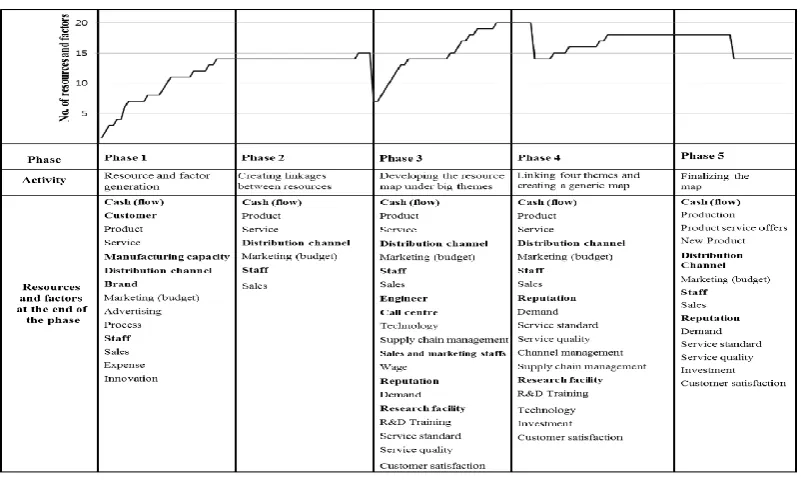
individual resources. We divided the process into five phases. Figure 3 shows the changes in
number of resources and factors chronologically, and resources and factors at the end of each
phase.
--- Insert Figure 3 about here
---As can be seen from Figure 3, Group B’s resource conceptualization process was much more
complex than the first group. Group B experienced three major breakdowns during resource
conceptualization, which forced them to abandon the majority of resources/factors and causal
linkages. We thoroughly examined the video of the group process to understand the reasons
behind such breakdowns, and we found that the group dynamics of Group B were notably
different to those of Group A.
Phase 1. First of all, Group B conceptualized resources without considering potential
linkages between them. Ignoring the linkages, Group B members listed concepts without any
restriction. Any resource/factor that a member mentioned was added directly onto the
whiteboard where they were drawing their resource map. This process was somewhat similar
clarify the definition of a resource/factor. A typical resource map building conversation for
the group is shown below.
Male B1: “So what resources are relevant to a company then?” Male B1: “Staff?”
Male B6: “Cash”
Female B1: “Yeah, everybody needs cash.” Male B3: “Product?”
Male B6: “Customer..” Female B1: “Premises?” Male B1: “Equipment?”
Phase 2. A problem arose as soon as they started to link the resources and factors.
Group members had different ideas about how resources/factors should be linked. Clearly,
linking them was not a simple task; the problems seemed to be caused by two issues. Firstly,
the relationships between resources were not one-to-one. One resource could affect various
resources and trying to understand these non-linear relationships of multiple resources/factors
required group members to process too much information. Secondly, the
‘resources-performance’ relationship could not be directly linked (Kaplan & Norton, 1996). In other
words, although some resources definitely were inter-related, it was not possible to link those
resources unless a mediating resource or factor was added. The following quotation describes
a situation where the group faced difficulties in terms of understanding both the non-linear
relationships of factors and the resource system.
Male B2: “Sales... Sales staffs generate cash flow.”
Female B1: “Well they generate... They take cash flow away, but they create sales so they're creating cash.”
Female B1: “But a negative isn't it? Because it's a cost.”
Male B2: “But the sales team sells through the stores and they―”
Male B5: “Generate more revenue and at the same time if you increase their sales through number you bleed from wages so...”
Female B1: “Hmm…”
As the group tried to find interrelationships, a series of heated discussions were triggered
because they had all different ideas about the interlinking concepts. However, unlike Group A,
Such interruptions were caused by the multiple tasks facing the group. The group was actually
doing two tasks simultaneously: identifying causal relationships between existing factors; and,
creating new mediating factors. Furthermore, since the concepts were already created, there
was always more than one issue that arose at the same time. For example, one group member
was trying to clarify the marketing concept, while another group member was trying to
articulate the causal link between R&D and cash flow. This anarchic group process not only
had adverse effects on the group’s ability to pursue rational debates, but it also created
emotional tensions between the members who became unsatisfied with the communication
failure within the group. In other words, the group failed to develop effective cognitive
conflicts, and unintentionally, developed affective conflicts. Group members realized that the
resource map was getting out of hand, so they decided to abandon their current resource map.
Female B1: “I think we are going through error of doing this; building the whole thing at the same time… It's supposed to build a bit at a time, so you put two things in a link in the way they need to be, then another one linking from it. You go one at a time, one relationship at a time because that's how you build a whole block.”
Phase 3. After the group agreed to change their approach, they decided to split the
tasks into more manageable chunks, linking the pieces together afterwards. The tasks were
divided into key themes: marketing, production, R&D, and supply chain. Two to three group
members joined to discuss the themes that they were in charge of. There was no
communication between the sub-groups during this phase, which led the four sub-groups to
develop rather independent resource maps of the business units.
Phase 4. The group attempted to link the four themes once they were all developed,
yet a second breakdown occurred. As mentioned, the sub-groups did not communicate while
they were building the resource maps for their themes. Having independent resource maps
from one another, the group struggled to link the themes with the intervening concepts. They
abandon their resource map for a second time. They restarted the map building with less than
15% of the time remaining. Pressed for time and suffering from difficulty in understanding
the complex interrelationships between resources/factors, the group attempted to build the
resource map as a single group; they built it as simple as possible.
Phase 5. After the generic resource conceptualization process, the group finalized the
resource map. They merged two resources that they perceived to be duplicated and they also
renamed resources in a more distinguishable way. The final resource map of the group was
missing a number of well-developed firm-specific resources/factors that they had developed
during earlier phases. As can be seen from the quotation below, group members seemed
noticeably unsatisfied with their resultant resource map.
Female B1: “We made a quite generic map which can fit pretty much any company not only our firm. It's pretty much an ordinary company's map we have here, isn't it?”
Male B4: “I suppose so, but you know, I think we need to be more firm specific… or... I don't know, they are―”
Female B1: “You are going to now? [looks at watch]” Male B3: “We do only have five minutes.”
Female B1: “We could have done… I don't know…” Male B1: “So this is our resource map…”
Male B2: “If I was the CEO, I would have said so what, you need to tell me why, what's good about it.”
As Figure 3 suggests, there were numerous concepts discussed by Group B members. Some
concepts were merged (e.g. product, service to product and service offers) and renamed (e.g.
brand to reputation) but others disappeared due to the difficulties the group experienced
during synthesizing. Out of nine resources and 23 factors, only four resources and 11 factors
survived in the final resource map. As can be seen in Figure 4, Group B’s resource map is
much simpler compared to Group A’s. Although the number of constructs does not guarantee
the quality of the resource map, for Group B, it is clear that the final resource map did not
reflect the full discussion of the group at all. It is worth noting that the group ran out of time
resource map twice. The hectic resource conceptualization justified group B’s high scores on
Overload, as well as their low score on satisfaction, deliberateness.
--- Insert Figure 4 about here
---DISCUSSION
After carefully going through the two groups’ decision processes, we confirmed the
quantitative scores and the discrepancies between the two groups. After the analysis, we
identified three key differences the two groups experienced during their resource
conceptualization process.
1. Group A appreciated the relationship between the resources and conceptualized the
resources one by one in a causally oriented manner, whereas Group B conceptualized
resources without any restriction and attempted to link the resources that had been
generated; this led Group A to be engaged in a much more structured and orderly
process of resource conceptualization compared to Group B.
2. Both Group A and Group B experienced disagreements between their members in the
course of resource conceptualization, which sometimes led to cognitive conflicts
between the members. However, Group A experienced a clearer form of cognitive
conflict as the members did not interrupt nor introduce other topics during the
discussion. Group B, on the other hand, often experienced disrupted discussions due
to the continuous introduction of other topics. Moreover, this anarchic style of
discussion triggered emotional tension between the members of Group B.
3. The orderly process adopted by Group A strictly restricted the members to discuss
one strategic resource at a time; leading the group to enjoy a process free from
breakdowns. In contrast, Group B experienced a number of breakdowns as they were
We divided the discussion of the findings into three subsections; theoretical alignment and
limitation of the study.
Theoretical alignment
We observed different decision processes during resource conceptualization
processes. As can be seen from the above qualitative analysis, the two groups approached the
resource conceptualization process differently. Group A appreciated that individual resources
were highly interrelated and paid equal amount of attention to both resources and causal
linkages; i.e. this group saw the firm’s resources as systemic resources (Miller & Shamsie,
1996). On the other hand, Group B saw resources as independent of one another, and listed
strategically relevant resources without worrying about the interrelationships between them;
in other words, this group saw the firm’s resources as discrete resources (Miller & Shamsie,
1996). Along with this identification of the heterogeneous approach to resource
conceptualization, the qualitative analysis revealed that the two groups differed in their
utilization of cognitive conflicts and the structure of the group process. We will now link the
findings with the three group process constructs that we compared quantitatively.
Deliberateness of resource conceptualization
The systemic resources oriented group, Group A, experienced a more structured and
formal process as the group followed a clear process defining relevant resources/factors one
by one based on causal linkages between the resources/factors. Furthermore, using their
resource map, they updated their vision as well as created a number of scenarios based on
changes in external factors in the resource map. Using various analytical frameworks, the
group was able to engage in a comprehensive resource conceptualization process. Hence, in
this group, it can be argued that they followed a more systematic and analytical formation of
Group B, the process was rather unstructured; they proposed several resources without a clear
idea of their usefulness or the underlying causal linkages between them, which led to
continuous discussions and distractions ending in a rather general set of resources. For them,
strategic resources come from creative ideas within a flexible and unbounded environment
leading to a rather messy process (De Wit & Meyer, 2004). However, merging the resources
and factors by causal linkages provided them a great challenge, and the group in the end
experienced severe breakdowns in their resource conceptualization process. The group lacked
an important attribute that was needed to handle a messy process; to manage and synthesize
large amount of information (Eisenhardt, 1989b). The discrete resource oriented group failed
to cope with this challenge, and thus ended with an unsatisfactory group decision outcome.
The systemic resources oriented group conceptualized their resources in a structured manner;
they analyzed the resources and their relationships extensively with their members.. More
importantly, their comprehensive process was well managed; hence, the group was able to
maximize their effectiveness while not losing their efficiency.
The discrete resource oriented group, on the other hand, merely finished the resource
conceptualization in a given time of one hour; they did not manage to synthesize the resource
map with other analytical frameworks. The group’s resource/factor identification stage was
somewhat ambitious as their identification process followed a divergent pattern; they
generated more resources and factors than the systemic resource oriented group.
Effect of causal ambiguity towards group cognitive overload
The two groups’ different processes determined the level of overload of each group.
The discrete resources oriented group, Group B, with its anarchic process, experienced a high
level of overload during their resource conceptualization. They seemed to be struggling to
handle various resources at the same time, overloading their capacity to process the complexity
several resources; this increased the supply and demand of information as well as the need for
multi-tasking. Furthermore, the group did not agree in which order they would investigate the
resources and causal linkages. This caused additional burdens to their cognition and more
confusion within the group. The first group, Group A did not have these problems, as the group
followed a well-structured group process.
Role of intra-group conflicts in resource conceptualization
Cognitive conflicts were evident in both the systemic resources oriented group and the
factor oriented group. Cognitive conflict is a vital component in a resource conceptualization
process. Since individual managers have different insights towards their firm’s resource system
(King & Zeithaml, 2001; Kunc & Morecroft, 2010; Walsh, 1995), it is natural for managers to
disagree to each other and to experience conflict. However, such clashes between insights may
harm the overall efficiency of the group process (Milliken & Martins, 1996). The systemic
resources oriented group, with its highly structured conceptualization process, did not have to
sacrifice their efficiency. Furthermore, they were able to maximize the effectiveness of
cognitive conflicts, as the group was able to focus on the topic of discussion during episodes of
cognitive conflict; this helped the group to build a solid understanding of the resource system of
the firm.
The discrete resources oriented group, on the other hand, had unclear and discontinuous
episodes of cognitive conflicts; caused by an anarchic group process with a high level of
interruptions from other topics. As a result of this process, the group members were not able
to take a full advantage of the cognitive conflicts as most of conflicts did not reach agreement.
Not being able to reach agreements under time pressure, the group members were forced to
incorporate only the most obvious resources and factors that all group members agreed upon;
Affective conflict was arguably more evident in the discrete resources oriented group as the
group had more tension between members, possibly triggered by unproductive cognitive
conflicts, along with stress and frustration that was caused by lack of time and wasted effort.
Affective conflicts hindered the resource conceptualization process with unnecessary
emotional tension. Furthermore, this left a potential threat to any subsequent group processes
as the emotional tension may have caused further affective conflicts in different contexts
(Jehn, 1997) and increasing communication barriers among the members of the team.
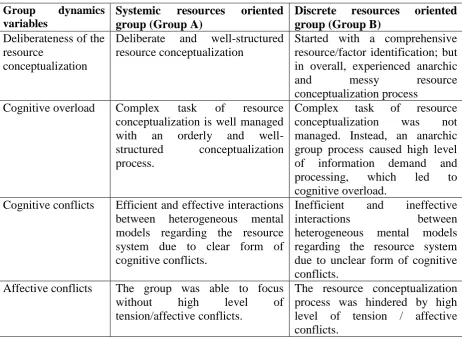
Table 2 summarizes the differences in the group dynamic constructs based on the theories that
we have selected.
--- Insert Table 2 about here
---This study allowed us to look into a complex dynamics hidden under group resource
conceptualization processes. The limited number of cases restricts us to present strong
theoretical propositions. However, we reached a conclusion from the study that the adopted
style of process, systemic vs. discrete resource oriented, can affect the level of structure
during a group’s resource conceptualization process. We expect a group enjoying effective
cognitive conflicts with low level of overload and affective conflicts is capable of
conceptualizing a systemically, firm specific, idiosyncratic set of resources. On the other hand,
a group that experiences a resource conceptualization process focused on discrete resources is
more likely to conceptualize a resource set with loose linkages between the resources.
Limitations
Use of experimental design
Using MBA students in an experimental setting instead of managers discussing a real
strategic problem in their own firms is susceptible to criticism. However, we aimed to
resources rather than a critical evaluation of its content in terms of VRIN dimensions (Barney,
1995).
Potential effects from other variables
In this research, there were two major differences between the groups. From the
study, we believe, ceteris paribus, a group’s orientation towards resource conceptualization
affects the group process dynamics as has been discussed. However, countless variables affect
a group’s process and outcome (Finkelstein, Hambrick, & Cannella, 2009). Firstly, the groups
were likely to have heterogeneous substantive group characteristics (e.g. cognitive ability),
and we accept that the group process may have been affected by heterogeneity in them.
Secondly, the two groups conceptualized resources for two different firms from two different
industries. We accept that the poor group process may have been caused by the distinct
complexity of the two industries (Porter, 1980). Future research needs to assess the
abovementioned variables.
CONCLUSION
This study, employing a dynamic behavioral RBV perspective (Kunc & Morecroft, 2010)
shows that the group processes adopted during resource conceptualization can lead to diverse
levels of insights into the relationship between strategic resources and firm performance.
Based on this finding, we present a number of distinct contributions to the RBV paradigm.
We believe this paper advances the dynamic RBV paradigm by introducing the concept of
group decision process. Bringing this idea into the RBV helps to illustrate how managerial
processes can affect the configuration of the set of resources considered to be strategically
relevant to a strategy (Maritan & Peteraf, 2011).
This study also conforms to the traditional RBV and its VRIN/O framework. The ultimate
VRIN/O characteristics (Barney, 1991; 1995). However, this is not a simple process; it can be
confounded by the group dynamics observable during the top management team discussions,
as this paper has illustrated.
In our study, the group that focused on causal linkages presented a clearly conceptualized and
causally linked set of resources compared to the group that focused on resource generation.
We found that increasing the understanding of the linkages between resources and firm
performance may reduce the potential causal ambiguity (King, 2007). For that reason, firms
which develop a clear understanding of linkages between resources during their resource
conceptualization process are likely to be less susceptible to causal ambiguity. In turn, this
leads to the improvement of organizational learning and resource management actions (Kunc
& Morecroft, 2010).
For the discrete resources oriented group, it is worth mentioning that they produced more
resources and concepts than the systemic resources oriented group. For this reason, we
conjecture that if a discrete resources oriented group can successfully develop causal
relationships while maintaining a rich collection of concepts, they would be able to build a
REFERENCES
Adner, R., & Helfat, C. E. 2003. Corporate effects and dynamic managerial capabilities.
Strategic management journal, 24(10): 1011-1025.
Alvarez, S. A., & Busenitz, L. W. 2001. The entrepreneurship of resource-based theory.
Journal of Management, 27(6): 755-775.
Amason, A. C. 1996. Distinguishing the Effects of Functional and Dysfunctional Conflict on Strategic Decision Making: Resolving a Paradox for Top Management Teams.
Academy of Management Journal, 39(1): 123-148.
Amason, A. C., & Sapienza, H. J. 1997. The Effects of Top Management Team Size and Interaction Norms on Cognitive and Affective Conflict. Journal of Management, 23(4): 495-516.
Amit, R., & Schoemaker, P. J. H. 1993. Strategic assets and organizational rent. Strategic management journal, 14(1): 33-33.
Andrews, K. 1987. The concept of corporate strategy. Homewood: Richard D Irwin.
Ansoff, H. I. 1987. Corporate strategy (Rev. ed. ed.). London :: Penguin.
Barnes, J., & James, H. 1984. Cognitive biases and their impact on strategic planning.
Strategic Management Journal, 5(2): 129-137.
Barney, J. B. 1986. Strategic factor markets: expectations, luck, and business strategy.
Management Science, 32(10): 1231-1241.
Barney, J. B. 1991. Firm resources and sustained competitive advantage. Journal of Management, 17(1): 99-120.
Barney, J. B. 1995. Looking inside for Competitive Advantage. The Academy of Management Executive (1993-2005), 9(4): 49-61.
Barr, P. S., Stimpert, J. L., & Huff, A. S. 1992. Cognitive Change, Strategic Action, and Organizational Renewal. Strategic Management Journal, 13(S1): 15-36.
Bieri, J. 1955. Cognitive complexity-simplicity and predictive behavior. Journal of Abnormal and Social Psychology, 51(2): 263-268.
Boone, C., & Hendriks, W. 2009. Top management team diversity and firm performance: Moderators of functional-background and locus-of-control diversity. Management Science, 55(2): 165-180.
Cannella, A. A., Jr., Park, J., & Lee, H. 2008. Top management team functional background diversity and firm performance: Examining the roles of team member colocation and environmental uncertainty. The Academy of Management Journal (AMJ), 51(4): 768-784.
Cray, D., Mallory, G. R., Butler, R. J., Hickson, D. J., & Wilson, D. C. 1991. Explaining decision processes. Journal of Management Studies, 28(3): 227-252.
Creswell, J. W. 2003. Research design : qualitative, quantitative, and mixed methods approaches (2nd ed. ed.). London :: Sage.
Das, T. K., & Bing-Sheng, T. 1999. Cognitive biases and strategic decision processes: An integrative perspective. Journal of Management Studies, 36: 757-778.
De Wit, B., & Meyer, R. 2004. Strategy : process, content, context : an international perspective / Bob de Wit, Ron Meyer (3rd ed. ed.). London :: Thomson Learning.
Dierickx, I., & Cool, K. 1989. Asset stock accumulation and sustainability of competitive advantage. Management Science, 35(12): 1504-1511.
Dutton, J. E., & Jackson, S. E. 1987. Categorizing strategic issues: Links to organizational action. Academy of management review, 12(1): 76-90.
Eden, C. 2004. Analyzing cognitive maps to help structure issues or problems. European Journal of Operational Research, 159(3): 673-686.
Edmunds, A., & Morris, A. 2000. The problem of information overload in business organisations: a review of the literature. International Journal of Information Management, 20(1): 17-28.
Eisenhardt, K. 1989a. Building theories from case study research. Academy of management review: 532-550.
Eisenhardt, K. 1989b. Making fast strategic decisions in high-velocity environments.
Academy of Management Journal, 32(3): 543-576.
Eisenhardt, K., & Bourgeois, L. J., III. 1988. Politics of strategic decision making in high-velocity environments: Toward a midrange theory. Academy of Management Journal, 31(4): 737-770.
Eppler, M. J., & Mengis, J. 2004. The concept of information overload: A review of literature from organization science, accounting, marketing, MIS, and related disciplines. The information society, 20(5): 325-344.
Fayol, M., Largy, P., & Lemaire, P. 1994. Cognitive overload and orthographic errors: When cognitive overload enhances subject-verb agreement errors. A study in French written language. The quarterly journal of experimental psychology, 47(2): 437-464.
Finkelstein, S., Hambrick, D. C., & Cannella, A. A., Jr. 2009. Strategic leadership : theory and research on executives, top management teams, and boards. New York: Oxford University Press.
Forbes, D. P. 2007. Reconsidering the strategic implications of decision comprehensiveness.
The Academy of Management Review, 32(2): 361-376.
Foss, N. 1997. Resources, firms, and strategies: a reader in the resource-based perspective. Oxford: Oxford University Press
Foss, N. J., & Ishikawa, I. 2007. Towards a dynamic resource-based view: Insights from Austrian capital and entrepreneurship theory. Organization Studies, 28(5): 749-772.
Gary, M. S., & Wood, R. E. 2011. Mental models, decision rules, and performance heterogeneity. Strategic management journal, 32(6): 569-594.
Gavetti, G., & Levinthal, D. A. 2004. The strategy field from the perspective of management science: Divergent strands and possible integration. Management Science, 50(10): 1309-1318.
Gist, M. E., Hopper, H., & Daniels, D. 1998. Behavioral simulation: application and potential in management research. Organizational Research Methods, 1(3): 251-295.
Goold, M. 1992. Design, learning and planning: a further observation on the design school debate. Strategic Management Journal, 13(2): 169-170.
Hambrick, D., Cannella, A. A., Jr., & Pettigrew, A. 2001. Upper Echelons: Donald Hambrick on Executives and Strategy [and Commentary]. The Academy of Management Executive (1993), 15(3): 36-44.
Haw, K., & Hadfield, M. 2011. Video in social science research : functions and forms New York: Routledge.
Helfat, C. E., & Peteraf, M. A. 2003. The dynamic resource based view: capability lifecycles.
Strategic management journal, 24(10): 997-1010.
Henderson, M. D., Trope, Y., & Carnevale, P. J. 2006. Negotiation from a near and distant time perspective. Journal of Personality and Social Psychology, 91(4): 712-729.
Hitt, M., & Tyler, B. 1991. Strategic decision models: Integrating different perspectives.
Strategic management journal, 12(5): 327-351.
Hodgkinson, G. P. 1997. Cognitive inertia in a turbulent market: The case of UK residential estate agents. Journal of Management Studies, 34(6): 921-945.
Hodgkinson, G. P., Bown, N. J., Maule, A. J., Glaister, K. W., & Pearman, A. D. 1999. Breaking the frame: An analysis of strategic cognition and decision making under uncertainty, Strategic Management Journal, Vol. 20: 977-985.
Hodgkinson, G. P., & Healey, M. P. 2008. Cognition in organizations. Annu. Rev. Psychol., 59: 387-417.
Hodgkinson, G. P., & Starbuck, W. H. 2008. The Oxford Handbook of Organizational Decision Making. Oxford: Oxford University Press.
Hough, J. R., & White, M. A. 2003. Environmental dynamism and strategic decision-making rationality: an examination at the decision level. Strategic Management Journal, 24(5): 481-489.