Algorithms for Image Denoising using Hard
Thresholding in Curvelet Domain
Mohammed Saleem Ahmed
Assistant Professor, Department of Computer Science Engineering, Sri Indu College Of Engineering & Technology, Hyderabad, India
Abstract: Generally due to random variation of pixel values, Speckle Noise will occur in images. So it is essential to apply various filtering Algorithms to denoise such an images. There are Wiener filtering and Wavelet based thresholding methods to denoise noisy images. In this paper initially I used Wiener filter for the purpose of reducing the noise but this does not exhibit satisfactory performance. Curvelet transform represents natural image better than any other transformations. Therefore, Curvelet coefficient can be used to segment true image and noise. In this, threshold based denoising algorithm has been developed using hard thresholding techniques in Curvelet domain, the experimental results shows its efficacy over Wiener filtering method. So Speckle noise can be effectively reduced by using Thresholding in Curvelet domain.
Index Terms: Speckle Noise, Wiener filtering, Curvelet transform, Image thresholding techniques.
I. INTRODUCTION
For better quality, analysis with good vision, Image denoising is required. There are different types of noises which can degrade the quality of images. In this paper I concentrate on the Speckle noise occurs due to random variation of the pixel values. Mathematically this noise is modelled as:
Speckle noise=I*(1+N)
Where ‘I’ is the original image matrix and ‘N’ is the noise with zero mean value having normal distribution. Wiener filtering comes under the non-coherent type of denoising method, which is mainly used as a restoration technique for all type of noisy images. However this filter does not giving better quality of images. Curvelet transform was introduced to overcome this disadvantage. Curvelet transform is developed from Wavelet as multi-scale representation. In Curvelet domain the large coefficients value are shown as original image signal and the small coefficients value shown as noise signal. In this paper, I proposed first discrete Curvelet transform with Hard thresholding method. The proposed method consist of three parts, Curvelet transform(FDCT), Curvelet coefficients processing and inverse transform(IFDCT). In the first step Curvelet transform of noisy image is calculated which are threshold by different thresholding function. Finally, inverse Curvelet transform is found to reconstruct denoising image. The reconstructed denoised image was compared with original image. Here Hard thresholding without logarithm and with logarithm is performed.
II. WIENER FILTERING ALGORITHM
An optimum linear filter which is involved only for linear estimation of a desired signal sequence is Wiener filter. The Wiener filter
algorithm considers a signal Sx (f) corrupted with noise Sn (f). The noise has zero mean and variance of . The resulting signal
obtained after Wiener filtering will be H (f). The transfer function corresponding to Wiener filter was given by:
………….. (1)
This filter-optimization problem is to minimize the mean-square error of the signal that is defined by the actual filter output. This resulting solution is commonly known as the Wiener filter. The block diagram of a Wiener filter is shown in figure 1.
Here,
... (2)
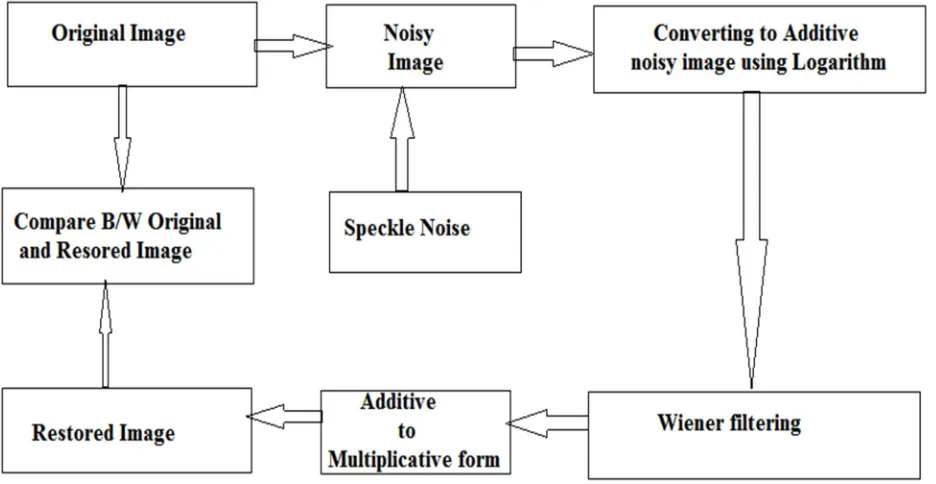
w[n] and s[n] are random process signal. The filter output is x[n] and e[n] are the estimation error. An input signal w[n] is convolved with the Wiener filter G[z] and the result is compared to a reference signal s[n] to obtain the filtering error e[n]. The image denoising using the Wiener filter is shown in the flowchart in figure 2.
Figure 2: Flowchart of Denoising using Wiener Filter Algorithm
Step by step Algorithm for denoising using Wiener Filter:
1) Step 1: Take an original image.
2) Step 2: Add different variance of multiplicative (speckle) noise with original image.
3) Step 3: Convert the multiplicative noisy image into additive noisy image using logarithmic Transformation.
4) Step 4: Applying the Wiener filtering to additive noisy image. Here, I am using different size of Wiener filter mask. The mask
size depending upon noise variance.
5) Step 5: Showing the restored image after Wiener filtering.
6) Step 6: Convert the restored image from additive to multiplicative form using anti- logarithmic transformation.
7) Step 7: Compare the restored image that obtained in step 6 with original image.
III. ALGORITHM OF IMAGE DENOISING IN CURVELET DOMAIN
The idea of the Curvelet transform is first to decompose the image into Subband. The discrete Curvelet transform is mathematically expressed as:
... (3)
Where, f [t1, t2] is 2D signal of Cartesian arrays with t1≥ 0 and t2< n. CD (j, l, k) are Curvelet coefficients at scale j, location l and
coordinates k =(k1;k2) € Z2, and φDj;l;kis a digital Curvelet waveform, here the superscript D is stands for digital. Here, I proposed
A. Algorithm For Image Denoising In Curvelet Domain Using Hard Thresholding
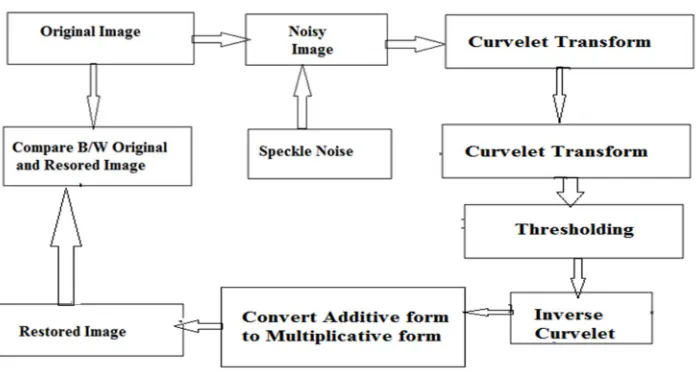
Figure 3: Flowchart of Curvelet Transform Algorithm for image Denoising using Hard Thresholding.
Step by step Algorithm for denoising using Hard Thresholding
1) Step 1: Take the original image.
2) Step 2: Add different variance of multiplicative (speckle) noise with original image.
3) Step 3: Apply the Curvelet transformation of noisy image.
4) Step 4: Apply different thresholding approach over the Curvelet coefficient.
5) Step 5: Applying inverse Curvelet transformation to obtain the restored image over the thresholded Curvelet coefficient.
6) Step 6: Compare the restored image that obtained in step 6 with original image.
B. Algorithm For Image Denoising In Curvelet Domain Using Hard Thresholding With Logarithm
Figure 4: Flowchart of Curvelet Transform Algorithm for image Denoising using Hard Thresholding with Logarithm.
Step by step Algorithm for denoising using Hard Thresholding:
1) Step 1: Take the original image.
2) Step 2: Add different variance of multiplicative (speckle) noise with original image.
3) Step 3: Convert the multiplicative noisy image into additive noisy image using logarithmic transformation.
4) Step 4: Apply the Curvelet transformation on noisy image.
5) Step 5: Apply different thresholding approach over the Curvelet coefficient.
6) Step 6: Applying inverse Curvelet transformation to obtain the restored image over the thresholded Curvelet coefficient.
7) Step 7: Convert the restored image from additive to multiplicative form using anti-logarithmic transformation.
Hard-thresholding is a type of global thresholding, in this thresholding method thresholds the complete image with a single threshold value. So using that method for image denoising select one threshold value for whole image. Hard thresholding sets to zero those elements whose absolute value is lower than the threshold value and neglecting zero element. Hard thresholding function is as follows:
... (4)
Where, y and f(y) are the Curvelet coefficients before and after hard threshold processing, λ is a threshold value.
IV. RESULT & DISCUSSIONS
In this paper results of two different image restoration techniques are presented. First one is analysis of Wiener filter based method and the second one is proposed method in sparse/ transform domain using hard thresholding with and without logarithm function. The statistical parameters are computed for original and restored as well as original and noisy images. A comparative result is presented
A. Original Image with Different Noise Variance for Standard Image (Lena)
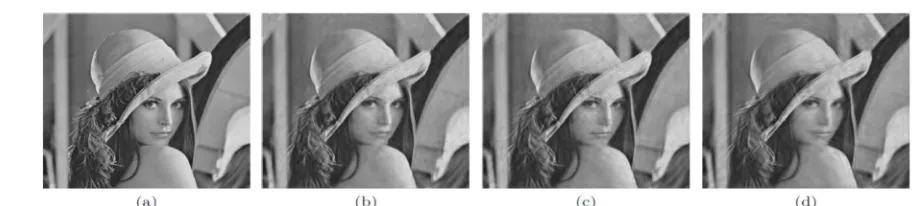
Figure 5: (a) Original image, 512 by 512, 8bits/pixel,with MSE = 0, PSNR = 1, (b) Speckle noisy image with var.0.04,(c)Speckle
noisy image with var. 0.06, (d) Speckle noisy image with var. 0.08
B. Denoised Standard Image (Lena) in Frequency Domain using Wiener Filtering with Different Noise Variance
Figure 6: (a) Original image, 512 by 512, 8bits/pixel,with MSE = 0, PSNR = 1, (b) Restored image of noise var.0.04,(c)Restored
image of noise var. 0.06, (d) Restored image of noise var.0.08
C. Denoised Standard Image (Lena) in Sparse/Transform Domain with Different Noise Variance using Hard-thresholding
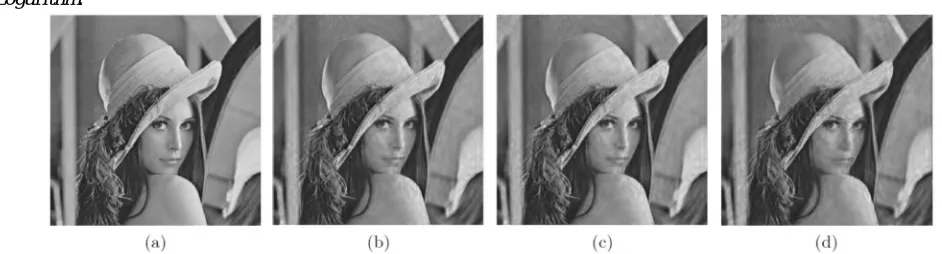
D. Denoised Standard Image (Lena) in Sparse/Transform Domain with Different Noise Variance using Hard-thresholding with Logarithm.
Figure 8: (a) Original image, 256 by 256, 8bits/pixel, with MSE = 0, PSNR =1, (b) Restored image of noise var.0.04,(c)Restored image of noise var. 0.06, (d) Restored image of noise var.0.08
V. CONCLUSION
The results of all restoration techniques such as the nonlinear Wiener filtering method in Frequency domain, Hard-thresholding in sparse domain without logarithm and Hard-thresholding in sparse domain with logarithm have been described. The obtained restored image is compared with original image. So I conclude that the restoration method Hard-thresholding in sparse domain using logarithm is better than other nonlinear Wiener filtering in Frequency domain and Hard-thresholding in sparse domain without logarithm methods.
REFERENCES
[1] S. Kumar, P. Kumar, M. Gupta, and A. Nagawat, “Performance comparison of median and wiener filter in image de- noising,” International Journal of
Computer Applications (0975{8887) Volume, 2010.
[2] E. Candes, L. Demanet, D. Donoho, and L. Ying, “Fast discrete curvelet transforms,” Multiscale Modeling & Simulation, vol. 5, no. 3, pp. 861–899, 2006.
[3] J. Starck, E. Cand`es, and D. Donoho, “The curvelet transform for image denoising,” Image Processing,IEEE Transactions on, vol. 11, no. 6, pp. 670–684,
2002.
[4] N. R. Pal, “On minimum cross-entropy thresholding,” Pattern Recognition, vol. 29, no. 4, pp. 575–580,1996.
[5] A. Al-Ajlan and A. El-Zaart, “Image segmentation using minimum cross-entropy thresholding,” in Systems, Man and Cybernetics, 2009. SMC 2009. IEEE
International Conference on. IEEE, 2009, pp.1776–1781.
[6] G. Al-Osaimi and A. El-Zaart, “Minimum cross entropy thresholding for sar images,” in Information and Communication Technologies: From Theory to
Applications, 2008. ICTTA 2008. 3rd International Conference on. IEEE, 2008, pp. 1–6.
[7] E. Cands, L. Demanet, D. Donoho, and L. Ying, “Fast discrete curvelet transforms,” 2005.
[8] M. Sezgin et al., “Survey over image thresholding techniques and quantitative performance evaluation,” Journal of Electronic imaging, vol. 13, no. 1, pp. 146–
168, 2004.
[9] J. Kittler and J. Illingworth, “Minimum error thresholding,” Pattern recognition, vol. 19, no. 1, pp. 41–47, 1986.
[10] J. Kapur, P. K. Sahoo, and A. Wong, “A new method for gray-level picture thresholding using the entropy of the histogram,” Computer vision, graphics, and
image processing, vol. 29, no. 3, pp. 273– 285, 1985.
[11] C. Li and P. Tam, “An iterative algorithm for minimum cross entropy thresholding,” Pattern Recognition Letters, vol. 19, no. 8, pp. 771–776, 1998.
[12] J. Sauvola and M. Pietik¨ainen, “Adaptive document image binarization,” Pattern Recognition, vol. 33, no. 2, pp. 225–236, 2000.
[13] M. Sezgin and R. Ta,saltın, “A new dichotomization technique to multilevel thresholding devoted to inspection applications,” Pattern Recognition Letters,
vol. 21, no. 2, pp. 151–161, 2000.
[14] Anandbabu Gopatoti, Kiran Kumar Gopatoti “Image Denoising Using Contourlet Transform with Total Variation and Nonlocal Similarity Model”
International Journal of Pure and Applied Mathematics, Volume 118 No. 18 2018.
[15] Anandbabu Gopatoti1, Kiran Kumar Gopathoti, Sai Prasanna Shanganthi, Chappali Nirmala,” Image Denoising using spatial filters and Image Transforms: A
[image:5.612.62.533.95.222.2]