Abstract— The medical institutions generally did not provide a systematic way for patient's education. In this paper, we proposed the personal patient's education service by integrating of clinical radiation oncology workflow. This service is established by Single sign-on (SSO) portal to connect to Moodle (an e-learning platform), Learning Content Management System (LCMS), the e-form system and the radiation oncology system (ARIATM). In this service, the
digital contents for patient's education and the questionnaires which build from the e-form system are stored and managed in LCMS. The related medical staffs can classify the contents into different type of cancer, and then use the classification results to create the education courses on Moodle. When a patient confirmed the cancer type and came to cancer center, the patient's information will be automatic uploaded from the radiation oncology system to the SSO portal and other systems. After the successful upload for the patient’s information, the oncologists can depend on the patient’s need and systematically assign the related education courses to patient before, during or after the radiology therapy process. Therefore, the patients log in to the portal; they can access the courses relevant to their treatment progress.
Index Terms—e-learning, patient education, knowledge management, single sign-on, radiation therapy
I. INTRODUCTION
In recent years, with the development of the information networks and the evolution of the service model, the medical care transforms into more active healthcare services. The cross-industry vendors of information and communication technologies (ICT) engage in the medical information domain aggressively and propose the integration of the medical information framework, such as Service-Oriented Architecture (SOA)-based healthcare information systems and personal health record (PHR) systems, etc. It is the current trend to upload the daily diet, blood pressure records, and physiological information to the database and provide the mobile healthcare services which customs need. There are some systems in Taiwan, shown in Table I; each system provides services are not the same. The Google Health provides the personal portal let consumers upload themselves
Manuscript received March 18, 2012; revised April 08, 2012. This work was financially supported in part by the Ministry of Education, Aim for the Top University Plan, Taiwan ROC, and the National Science Council, Taiwan ROC (NSC 100-2221-E-320 -002; NSC 100-2321-B-010-023).
Y.-H. Shih is with Institute of Biomedical Engineering, National Yang Ming University, Taipei 112, Taiwan (e-mail: [email protected]).
H.-T. Yang is with Department of Medical Informatic Tzu Chi University, Hualien 970, Taiwan (e-mail: [email protected]).
C.-H. Hsiao is with Department of Medical Informatic Tzu Chi University, Hualien 970, Taiwan (phone: 886-3-8565301~2392; fax: 886-3-8579409; e-mail: [email protected]).
W.-C. Chu is with Institute of Biomedical Engineering, National Yang Ming University, Taipei 112, Taiwan (phone: 886-2-8267000~5496; fax: 886-2-8210847; e-mail: [email protected]).
daily health data and online search resources for medical assistance [1]. The Microsoft HealthVault integrates with medical instruments and proposes 15 applications such as weight scale, blood pressure/glucose monitors and medication reconciliation services, etc. [2]. Taiwan’s Telehealth Pilot Project emphasizes the abnormal state of health data analysis, alert and online video consulting services with medical professionals [3]. The NTUH Telehealth Center supplies the medical staffs to monitor the health information of the patient through devices provided by the center. Therefore, the service will reduce the time that the patient needs to go to hospital and increase the chance of getting help in real-time emergency [4].
When Google announced to discontinue the Google Health, we thought about one of the problem of these types of the service is that the PHR systems failed to communicate with the hospital system and people do not have the habit of sharing their health information on the internet. In Taiwan, the patient’s medical information is stored in the medical institutions. Whereas the above problem, the PHR systems’ information need to upload from the electronic medical records by the medical institutions. If the personal health records are not established completely and automatically, the PHR systems will not be able to provide the healthcare services.
II.BACKGROUND
Before beginning the medical behavior, the oncologists have an obligation to inform patients of the purpose and the attention for the medical treatment to avoid patients searching the wrong information on the internet that would decrease the patient’s treatment cooperative and the successful rate.
TABLEI
DIFFERENT OF PHR SYSTEMS’ SERVICES
Construct Clinical and E-learning Systems
Integration Framework for Patient Education in
Radiation Therapy
Yueh-Hsun Shih, Hui-Ting Yang, Chia-Hung Hsiao, and Woei-Chyn Chu Proceedings of the World Congress on Engineering 2012 Vol I
However, in the rush medical environment, the medical staffs give education or consultation to each patient may increase their work. The medical operations process includes many steps and professional procedures. It is hard to patients and their families receiving these huge number of health education information. Using the computer information systems should be able to provide the multimedia health education contents, reducing the health care workers burden. However, the processes of medical are professional and complex, many educational materials need to provide to the patient to make sure they understand that what they have to do or what are the side effects may happen in every steps during the treatment process. In this paper, we use cancer therapy as the case study. Cancer patients usually require several different types of therapies and lots of clinical examinations, which may endure for many years, as shown in Figure 1.
The cancer therapy is more complexity than other treatments. The patients need many examinations before, during and after treatment. Meanwhile, they must know the relevant information in a short time. If they still do not understand the meaning of the process, health care workers have to remind them again. However, these duplicate works may increase the burden of the medical staffs. The medical institutions generally did not provide a systematic way for patient's education, this paper proposed the personal patient's education service by integrating of clinical radiation oncology workflow. The personal health record (PHR) systems are used by individuals to maintain their own comprehensive, lifelong health and wellness records. However, users do not have the habit of sharing or managing their health information on the internet. In our opinion, the PHR may extract the data from the EMR systems of multiple health care providers and/or organizations. Our PHR service is established by Single sign-on (SSO) portal to connect to Moodle (an e-learning platform), Learning Content Management System (LCMS), the e-form system and the radiation oncology system (ARIATM). In this service, the digital contents for patient's education and the questionnaires which build from the e-form system are stored and managed in LCMS. The clinical oncologists can classify the contents into different type of cancer, and then use the classification results to create the education courses on Moodle. When a patient confirms the cancer type and comes to cancer center, the patient's information will be automatic uploaded from the ARIATM to the SSO portal and other systems. After the patient’s information is uploaded successfully, the oncologists can base on the patient’s needs and systematically assign the education courses to patient
before, during or after the radiology therapy process. Therefore, the patients log in to the portal; they can access the courses relevant to their treatment progress. Hence, not only can reduce the psychological pressure of the patient but also decrease the burden of health care workers.
III. MATERIALS AND METHODS A. The Clinical and E-learning Systems Integration Framework
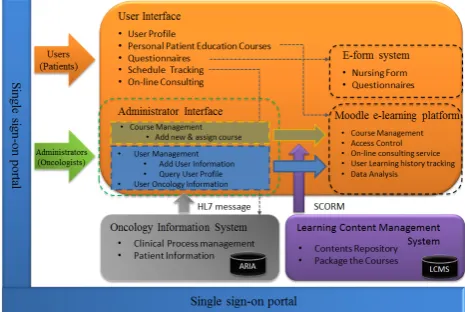
This integration framework, as shown in Figure 2, consists of four main concepts, authentication and authorization (AA), synchronization user information, assigning proper courses to user, and tracking user’s learning history. The SSO portal provides the AA mechanism when the user logs in. As the authentication process is finished, the user will be redirected into the homepage that shows the link of user profile page, Moodle e-learning platform and the e-form system. The authenticated user can choose these links from the homepage and the portal will do the single sign-on process to redirect the page to the service. The user does not need to login the system again. If the user is an administrator, the homepage will show the administrator interface, such as adding user information, creating or assigning the course, querying the patient’s information or treatment schedule, etc. The user information in the portal is provided from the ARIATM in the cancer center.
The framework is composed of the following systems: 1) The Single sign-on (SSO) portal:
We implement an SSO portal to combine Moodle, the e-form system, ARIATM and other services. The portal in whole framework is in charge with the access control and single sign-on mechanism. The authenticated user can link to the other system or service and without log in again. 2) The E-form system:
The cancer patient’s diagnosis and treatment information will be stored and managed in the different of professional systems. However, some of these systems cannot communicate among each other that may cause the medical staffs hard to understand the whole picture of the patient’s treatment statement. In this paper, we establish the e-form system for integrating the important examination data, images, diagnosis information from the different systems. Using the special form format to show the specification record and assist the medical staffs (e.g., referring physicians, radiologists, nurses, and oncologists) to cooperate each other during the treatment process. Furthermore, the paper-based Proceedings of the World Congress on Engineering 2012 Vol I
[image:2.595.61.275.627.775.2]questionnaires are used for evaluating the patient’s cancer risk. In our framework, we transform the paper-based documents into web-based forms and store in our e-form system.
3) Moodle E-learning Platform:
The clinical oncologists can classify the digital contents into different type of cancer. Using these classification results, they can create the education courses on Moodle. 4) The Oncology Information System (ARIATM):
ARIATM is a comprehensive information and image management system that aggregates patient data into a fully-electronic medical form. It is the source of the portal user’s information, including demographic data, stage of treatment information and related records.
5) Learning Content Management System (LCMS):
LCMS provides is a digital contents repository and a course management system. The administrator can upload the contents to LCMS and use these contents to create a course.
In this paper, we store the patient education contents of all the cancer therapy in our LCMS. The oncologists can collect and classify these contents into education courses using SCORM format to descript the structure. When a new patient comes, the oncologist will get the patient’s treatment way and schedule information from the ARIATM. In our workflow, the patient’s profile will upload from the oncology information system to upload the user ID for the portal and other services. When the patient logs into the portal, the homepage will show the links of Moodle and the e-form system. All the contents of these services are prepared by the oncologist. According to the patient's every step of treatment or patient's status, the oncologist can assign the proper courses to the patient.
B. Creating course workflow
In this paper, Moodle is the interactive platform between the medical staffs and the patients. At the first step, the oncologists will collect the suitable cancer education contents (e.g., word, power point, video…etc.) and create the course by the type of cancer. For the effective management of the courses, the oncologists login to the Learning Content Management System (LCMS) via the SSO portal. In the LCMS framework, the administrator can reuse the contents which are stored in the repository for creating the courses.
[image:3.595.306.552.49.202.2]Secondly, using the Shareable Content Object Reference Model (SCORM) to package the courses (for one specific patient) and upload to Moodle e-learning platform. The SCORM is a specification of the Advanced Distributed Learning (ADL) initiative, which is a collection of standards and specifications for web-based e-learning. Moodle will transform the SCORM information into personal user interface. When the patients logs in moodle via SSO portal, they will get the personal cancer education courses which is prepared from the oncologists by their treatment schedule. Figure 3 shows the manifest document of describing the package structure and referring resources
C. The Request / Reply Message Profile
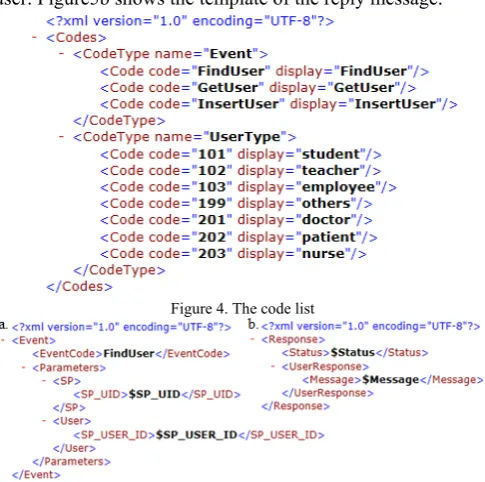
In this paper, we defined the xml format of transmit message to communicate with different systems. There are two type of code lists show in the Figure 4: “Event” informs the portal what kind of service in this transmission; and the other type
Figure 3. The sample of manifest.xml.
[image:3.595.308.551.306.547.2]“UserType” lists the parameter of role type when the event is the “InsertUser”. In Figure 5a, we use the “FindUser” as the example of message. The description of the parameters is showed in Table 2. The new service will get an UID from the portal for identification. Therefore, it is necessary to add the UID in the message to tell the portal which service has the request of “FindUser”. The portal will use the UID and user ID that is provided from the service as the index to find the user. Figure5b shows the template of the reply message.
Figure 4. The code list
Figure 5. The template of message (FindUser). a.The request message from the service. b. The reply message format from the portal.
TABLE Ⅱ
THE REQUEST PARAMETER LIST OF FINDUSER
Identifier Definition Data type Note
EventCode The event of the message. int Required
SP_UID Each service has unique UID
for identification. string Required
SP_USER_ID The user ID from the service provider. string Required
TABLE Ⅲ
THE REPLY PARAMETER LIST OF FINDUSER
Identifier Definition Value Note
Status Indicated whether this request success or not Success Failure Required
Message Indicated whether this user is exist or not Not Exist Exist Required Proceedings of the World Congress on Engineering 2012 Vol I
[image:3.595.298.555.596.776.2]Figure 6. The message flow of the web service
Figure 7. The SSO transaction of the portal
[image:4.595.321.537.231.353.2]Due to the consideration of security, the web service will use the encoder to encrypt the message into base64 based text. The transaction is based on the HTTPS (port 443) that create a secure channel over an insecure network to protect the message of the web service. The message flow shows in Figure 6.
D. Single sign-on and Access Control
The single sign-on (SSO) portal provides the authentication and authorization (AA) mechanism when user logs in. As the authentication process is finished, the user will be redirected into the homepage that shows the link of personal user profile page, Moodle e-learning platform and the e-form system. Authenticated user can choose these links from the homepage and the portal will do the SSO transaction using the Security Assertion Markup Language 2.0 (SAML 2.0) to redirect the page to the service, as shown in figure 7 [5]. There are four steps in the SSO transaction: Step1. The portal distinguish the service that user request is provided from the service provider.
Step2. & 3. The SSO service transmits the SAML message to the SP via the Assertion Consumer Service to validate the user ID.
Step4. If the user ID is validated, the portal will redirect the page to the service.
IV. RESULTS
Figure 8 shows the flow of cancer patient ‘s clinic treatment is indicated by ①-②-③-④-⑤-⑥. In this case, we use the brain tumor as the example. When the patient had a constant headache and went to the outpatient department (OPD) seek for treatment. According to the symptoms of the patient, the doctor arranged some tests and consulted the
Figure 8. The clinic treatment flow of the cancer patient and the data flow of the information systems
neurologist. After arranging in hospital and doing futher checks, the brain tumor was diagnosed. The patient decided to take the radiation therapy. Therefore, the patient went to the cancer center and arranged a series of treatment processes.
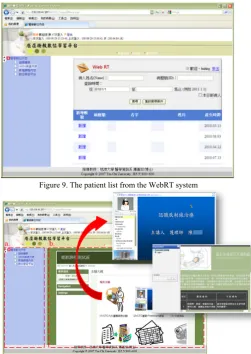
The data flow of the information systems is indicated by A.-B.-C.-D.-E.-F. The hospital information system (HIS) and the picture archiving and communication system (PACS) will store the patient’s diagnosis records and images during the clinic treatment process. As the patient decided to take the radiology treatment, the related information would upload to ARIATM. In our framework, we use the WebRT system to collect and integrate the records (e.g. patient’s profile, images, etc.). At the first time, the patient comes to the cancer center, the related medical staff logs in to the WebRT via the portal and finds the patient profile from the patient list to creat the user account in the portal, the e-form system, and moodle as indicated by F., the patient list page is shown in Figure9. After creating the user account, the medical staffs prepare the apporiate cancer education courses for the patient from the LCMS and upload the SCORM message to the moodle for displaying the personal cancer patient course for the patient. This workflow is indicated by Ⅰ-Ⅱin Figure 8.
Figure 10 shows the user interface for the cancer patients. As they log in to the portal, the personal services are prepared and listed on the left side of homepage, as shown in Figure 10a. They can link to the moodle via the portal without log in again. Moodle shows the cancer education courses that are prepared by the medical staffs according to their cancer treatment schedule. The patient can get the professional education materials (e.g. videos, power point,etc.) and answer the questionnaires that are stored in Proceedings of the World Congress on Engineering 2012 Vol I
Figure 9. The patient list from the WebRT system
Figure 10. The user interface of the portal. a. The list shows the services that the user has the permission to use. b. The user logs in to the moodle via the portal
the e-form system. In that case, the medical staffs can evaluate the patient’s cancer risk and feedback immediately. Furthermore, according to the result of the questionnaires, the staffs can prepared more suitable course to the specific cancer patient.
V.DISCUSSIONS
In this study, we take a medical center of radiation therapy as a case study of applying the E-learning and knowledge management concepts and technologies in cancer patient education. The project is still ongoing, through the user experiment of the medical staffs and the patients from the cancer center. The following points show the considerations and improvements.
1) The User Interface:
Figure 11a shows the initial page of the e-learning platform. The users log in to the system at the first time, the medical staffs will teach them how to use the system. It may increase the burden of medical staffs. If the number of works is much more than the traditional way, in that situation, they may keep the old way. Consequently, the systems interface must design more simple and intuitive way, shown in Figure 11b.
2) The communication of server-to-server:
In our framework, the system uses the web service to communicate with others. One of the key challenges in the framework is to make sure all the web services are successfully done. For example, the transaction of adding
Figure 11. The user interface of moodle.
new user needs to establish the user ID in the portal, the e-form system and moodle. If the account does not create successfully in the e-form system, the medical staffs still can assign the appropriate courses and the questionnaires to the patient but the patient cannot log into the e-form system.
Therefore, we should check every reply message from the web service. If the message shows “success” then continue the next step, otherwise the process will be stopped.
3) The Data Synchronization:
Although, we defined the format of message for communication, the systems update the information at the different time may cause the data unsynchronization. In that case, we should define the data synchronized mechanism to maintain the data consistency.
4) The Security and the Contents Protection
The PHR system needs to protect the patient’s privacy. Hence, we need to implement the Public key infrastructure (PKI) to enhance the AA layer in the portal. We also need to integrate the eXtensible Access Control Markup Language (XACML) into the access control of the courses or services [6].
VI. CONCLUSION
In this paper, we have constructed a framework that integrates Single Sign on (SSO) Portal, Moodle e-learning platform, Learning Content Management System (LCMS), and radiation therapy system in this study. In the framework, all the contents and questionnaires for patient education were prepared, stored, and organized in LCMS. Basing on the integration, we can use the data about patient conditions and therapy stages (pre, within, or post therapy) that stored in radiation therapy system to decide what education contents should be deploy to patient; We can create education course on the e-learning platform automatically for a specific patient first. And then, according patient’s conditions, we can assign the proper education contents that stored in LCMS to the patient’s specific course in Moodle learning platform.
Consequently, the clinicians can systematically and automatically assigned education contents to patients in radiation therapy processes. And after patients have took the course on Moodle, the result data about the patient education can also be easily collected and evaluated by the integrated system.
REFERENCES
[1] Google Health. (2008) [Online]. Available: http://www.google.com/health
[2] Microsoft HealthVault. (2007) [Online]. Available: http://www.microsoft.com/en-us/healthvault
[3] Taiwan’s Telehealth Pilot Project. (2001) [Online]. Available: http://doh.telecare.com.tw/eng_Index.htm
[4] The NTUH Telehealth Center. [Online]. Available: http://www.ntuh.gov.tw/en/telehealth/Introductoin/Home.aspx
[image:5.595.48.300.50.405.2][5] N. Ragouzis, J. Hughes, R. Philpott and E. Maler. (2006, October 9) Security Assertion Markup Language (SAML) V2.0 Technical Overview (Draft 10) [Online]. Available: http://www.oasis-open.org/committees/download.php/20645/sstc-saml -tech-overview-2%200-draft-10.pdf
[6] T. Moses. (2005, February 1) eXtensible Access Control Markup Language (XACML) Version 2.0 [Online]. Available: http://docs.oasis-open.org/xacml/2.0/access_control-xacml-2.0-core-s pec-os.pdf