International Journal of Emerging Technology and Advanced Engineering
Website: www.ijetae.com (ISSN 2250-2459,ISO 9001:2008 Certified Journal, Volume 3, Issue 7, July 2013)
The Design of Collaborative Learning Activities in Web 2.0
Environment: A Review of the Field
Ismail Mohamed Ali
1, Ab. Razak Che Hussin
21Faculty of Computer Science and Technology, Simad University, Mogadishu, Somalia, 2
Faculty of Computer Science and Information Systems, Universiti Teknologi Malaysia (UTM), Johor, Malaysia
Abstract—The development of technologies affects every
aspect of our life including the way we learn. As new methods of learning emerge, a supporting technology becomes necessary. One newer method of learning is Collaborative Learning (CL). In CL paradigm, learners’ input and contribution are highly valued. The method requires support of technology and web 2.0 best meets that requirement. The adoption of CL in Web 2.0 technologies still remains the demand of learning communities and software practitioners struggle to provide it. One way to simplify the adoption process is modeling. Models are used to visualize the software system prior to its actual construction. This paper analyzes several existing models and frameworks in field of the study. The paper tries to implement Web2.0 CL Framework which is a published work for the authors of this paper. The implementation of the above-mentioned framework was missing from the previous publication. The paper approaches the implementation by modeling and prototyping.
Keywords—CL, web2.0, modelling, learning design,
prototyping, framework
I. INTRODUCTION
Web-based applications enabled users on a network especially the internet to communicate and share resources. The advances in web technologies provide a major impact on learning development. Web 1.0 has led to the introduction of e-learning 1.0. E-learning1.0 has viewed the teachers as information providers and the students as consumers of information. One major problem exists in the platform of web 1.0 is that learners are not able to collaborate on online contents. They can do little to contribute to learning process. The web 1.0 uses read-only platform. The communication is in one way. The content is passive and participation is missing. Learning is very restrictive in the web 1.0 environment meaning that social factors in learning are ignored [1].
The restricted ability of web 1.0 caused to consider another way of learning improvement. Web 2.0 meets modern learning requirements.
According to [2] “Web 2.0 is a set of economic, social, and technology trends that collectively form the basis for the next generation of the Internet—a more mature, distinctive medium characterized by user participation, openness, and network effects”. Web 2.0 has a great potential to solve the problems of web1.0. It introduces a shift from passive learning to active participation, content creation and collaboration. Web 2.0 changes the role of learners from simple consumer to a potential provider of web contents [3]. Web 2.0 environments introduce the shift from Teacher-centered learning to a learner-centered approach which is maneuvered by students themselves [4].
According to [2], one of the effective methods of learning supported by web technologies is Collaborative Learning (CL). They say that “CL is a social interaction that involves a community of learners and instructors where members acquire and share experience or knowledge” . CL views learning as social process through participation, interaction and conversation among learners. The CL’s Social and open view of learning best fits in web 2.0 environments.
One thing to consider is how collaborative learning activities can be simulated or modeled in web 2.0 environment. Modeling CL activities in web 2.0 has received little focus and become a question for researchers [5].
The rest of this paper is organized as follows. First, the paper scrutinizes the importance of modeling in e-learning context. Second, web 2.0-supported CL models and frameworks in the literature will be examined. The paper will specifically try to implement the Web 2.0 CL Framework. Web 2.0 CL Framework is published work of the authors of this paper. So the contribution of this paper is the implementation of the above-mentioned framework.
II. LITERATURE REVIEW
International Journal of Emerging Technology and Advanced Engineering
Website: www.ijetae.com (ISSN 2250-2459,ISO 9001:2008 Certified Journal, Volume 3, Issue 7, July 2013)
First, the role of modeling in e-learning is examined. Second, existing models and frameworks are analyzed.
A.CL Modeling in web environment
For any product, a design or blueprint is something necessary and software is no exception. Modeling and simulation are used to provide a level of understanding prior construction of systems. According to [6], Modeling is “the process of producing a model; a model is a representation of the construction and working of system of interest”. A model provides an abstract view of a system; it is aimed to simplify the understanding of the system prior its actual construction[7].
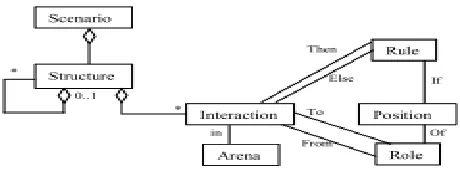
[image:2.612.331.570.356.524.2]In traditional learning settings, teachers and learners may know the process or the sequence of learning activities but the process to follow in e-learning environment is primarily absent [8]. Some authors [9] argue that designing activities in web environment remained an open question. Other researchers [10] addressed the complexity of e-learning framework and the need for use of Unified Modeling Language (UML) in order to manage the complexity. More recently [11], it has been written about what they called “Disorientation Problems in Web-Based Learning”. The believers of Disorientation Problems developed Web-based learning system, which employs the principles of “Interaction design”. Their system consists of several sections including user control and freedom, match between the system and the real world, flexibility and efficiency of use, and consistence and standards. Another study [12] indicated some constituents of learning design by proposing Learning Design Language (LDL). LDL considers learning design in terms of 5 elements namely interactional structure which involves how participants interact with each other, roles of each participant, the arenas or platform on which activities should occur, rules that govern the session, and the positions or points that participants should express during the process of learning activities. Fig. 1 shows how above elements work together.
Fig. 1 Learning Design Language (LDL). Adopted from ( Martel et al, 2006)
B.Existing Models and Frameworks
It has been understood that Web 2.0 enhances collaboration among members of community of interests, but the question is that what are components make up web-based CL? In this paper, several frameworks are examined. Frameworks or models were chosen in terms of their practicality and relevance to web 2.0 technologies.
1.A framework for Web 2.0 driven learning.
[image:2.612.57.287.591.678.2]The Web 2.0 driven learning framework [13] provides holistic view of using web 2.0 in learning.The framework encompasses three important components: networking and collaboration, intelligent search, and knowledge creation, as shown in Fig. 2. If the three components are merged, we obtain three other possibilities those are social search, collaborative knowledge creation, and cross-media federated search.
Fig. 2 A framework for Web 2.0 driven learning.adopted from (Chatti et al,2007)
Networking and Collaboration: This refers need for communication channels among members of community of practices (COPs). After communication channels are set, members of COPs can collaborate. It was indicated that collaboration can promote participatory culture among members of these communities because strong support for sharing one’s creations is encouraged.
International Journal of Emerging Technology and Advanced Engineering
Website: www.ijetae.com (ISSN 2250-2459,ISO 9001:2008 Certified Journal, Volume 3, Issue 7, July 2013)
Intelligent Search: Effective learning models need to take an open, knowledge-pull approach but the main obstacle of the knowledge-pull model lies in the information overflow on the web. Therefore, there is a need for intelligent search mechanisms for reliable access to information, services, communities and expertise.
Social Search: Helps you discover relevant content from your social circle, which is a set of online friends and contacts.
Collaborative knowledge Creation: To complete a task as a result of collaborative effort.
Cross-Media-Federated-Search: Simultaneous search of multiple online databases or web resources that were distributed across the media.
2. 3A interaction model
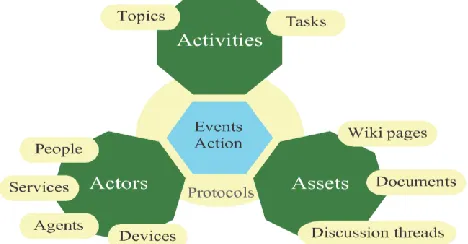
[image:3.612.52.286.446.568.2]In the previous model, three important components were discussed. But the question is that: How do these components work together? What can they achieve together? Are there other components that contribute to building Web-based Collaborative Learning? In order to answer the above questions, Elogbook 3A interaction model is considered[14]. Elogbook 3A interaction model is a combination of three entities: Actors, Activities and Assets as shown in Fig. 3
Fig. 3 Elogbook 3A interaction model adopted from Gillet et al 2007
Table 1.
Description of Elogbook 3A interaction model
Component Description
Actors Anything that can generate an event. It can be people services, agents, devices
Assets Resources for use such as documents, discussion threads, and wiki pages Activities Activities that are generated by the actors Protocols Rules and regulations that govern relationship
among the three entities mentioned above Action/event Occurs as a result of interaction between two
or more entities
3.Web 2.0 supported CL Model.
So far, we have discussed two important frameworks. The two frames depicted holistic view of CL in web 2.0 platform. Therefore, another that deeply examines the structures of CL in web.20 platform is required. For this reason, Web 2.0 CL Framework (Fig. 4) was developed. Web 2.0 CL Framework helps eliminate the abstraction of previous models. There are five basic components in this framework. The role of every component is clear. For example, the types of users and their actions are determined. Another important component is the resources which have been obtained in seven ways facilitated by web technologies. Moreover, three activities were provided in order to make use of the resources. Privileges are also added in order to control user sessions. Search engines help locate resources easily. In this framework, resources facilitated by web 2.0 tools (i.e. blogs, wikis etc) are used online CL activities (Jigsaw, Double-Entry-Journal, Thinks-Pair-Share). A more analysis of the framework is provided below.
[image:3.612.336.556.531.692.2]
International Journal of Emerging Technology and Advanced Engineering
Website: www.ijetae.com (ISSN 2250-2459,ISO 9001:2008 Certified Journal, Volume 3, Issue 7, July 2013)
Users: In this section, the user involvement of proposed model is defined. There are two types of users in this model namely, teachers and students. Teachers’ role is to control and guide the whole activities. Their role also involves setting the goals of learning, managing conflicts, and assigning tasks. Students are also key users of this system. They make use of available resources and generate events based on certain activities.
Resources. There are resources that users can share among themselves. The table below summarizes these resources.
1.User-Generated Contents/Down/Uploads: Both teachers and students can generate their own contents. The students can search for articles, papers and other documents that are relevant to their work. Then, they can share these documents with other students. Teachers’ involvement is also important because resources may be inadequate, and finding further information may become necessary. In addition, some students may upload information that is irrelevant to the topic. In this situation, teachers’ involvement is very critical.
2.RSS Feeds: An RSS stands for “Rich Site Summary”
or “Really Simple Syndication”. RSS is a service that lets users subscribe to online content using an RSS “reader” or “aggregator,” The aggregator software checks subscribed Web pages and automatically downloads new content. The aggregators display a list of subscriptions, with highlighting or underlining or another indicator of RSS feeds that have added content since the user last logged in. Without having to go to all of the individual Web sites, users can quickly and easily access new material from sites of their interest.
3.Media Sharing: Nowadays, there are so many services that facilitate the storage and sharing of Multimedia contents. Well-known examples include YouTube for videos, Flickr for photographs, and podcasts for audio files. Recently, there are considerate educational uses for these services. For example, students view video clips that are related to their work. They can view these videos without need for downloading them to their computers. This definitely saves memory. But to make the task easier, it is better that teachers prepare appropriate video clips and link them to central interface accessed by all students.
4. Weblogs: Weblogs are Web sites, usually created by individuals, that are updated frequently, usually provide links to news items elsewhere on the Web and often contain commentary, etc., on a very specific topic. It is good technique that promotes knowledge sharing. It enables readers to use expertise of other people that they cannot reach them physically. This is because experts create their own blogs where they can post articles related to their field of expertise. A number of useful blogs can be linked to university or schools websites so that students can access them easily.
5. Wiki pages. A wiki is a system that allows one or more people to build up a corpus of knowledge in a set of interlinked web pages, using a process of creating and editing pages. It allows users unrestricted access to create, edit and link pages. The most famous wiki is Wikipedia8. Wikis enable teacher to create annotated reading lists. Wikis also groups of learners to produce a collaboratively edited material, such as documenting group projects.
Search Engine. One major problem in Web environment is information overload. Information overload refers to the situation that a person has a difficulty to understand an issue and make decision. Information overload is caused by a presence of too much information. In this situation, there is a need for an intelligent search engine that helps users obtain easily the information that they are looking for.
Privileges. Privileges are the rules and regulation that users follow to make use of resources and activities. For example, all new users should register and old users should login. Some users may have some privileges whereas others don’t. For example, teachers can upload, download and delete resources whereas students can only upload and download resources. Protocols can also appear as guideline to the type of resources that is suitable to a certain activities
International Journal of Emerging Technology and Advanced Engineering
Website: www.ijetae.com (ISSN 2250-2459,ISO 9001:2008 Certified Journal, Volume 3, Issue 7, July 2013)
III. RESEARCH METHOD
This research utilizes secondary data which mainly comes from literature analysis. The main focus is on CL design on web 2.0 environment. To achieve this, the research follows the following steps. First, the research provides a comparative study of existing models or frameworks in the area of web 2.0 and CL. Three models have been analyzed and compared. The analysis of the models has led to finding out the basic component that may make up web 2.0 based CL platform. Second, the study proceeded to model a selected framework. Unified Modeling Language (UML) has been used for modeling and three basic diagrams were presented. Finally a prototype has been developed to implement the selected framework.
IV. MODELING WEB 2.0SUPPORTED COLLABORATIVE
LEARNING
Shifting from traditional structured analysis to Object-oriented analysis and design provides a great promise in modeling settings. Unified Modeling Language (UML) is most preferable tool when it comes to object modeling. It is widely used by software practitioners. However, in the area of web 2.0 and collaborative learning, UML seems less utilized. As the modeling leads to operational software, the missing UML utilization affects the practicality of web 2.0 –based collaborative learning. This research paper tries to develop a logical model for web-based collaborative learning. Three UML diagrams have chosen to model web2.0-based CL. The three diagrams namely are Activity diagram, Use case diagram and Class diagram. It is important to know that these diagrams are based on Web 2.0 Supported CL Model.
C. Activity Diagram
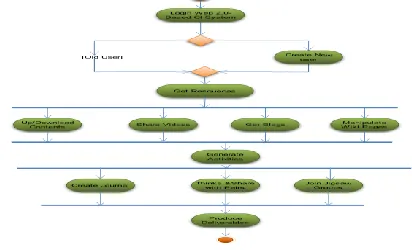
[image:5.612.343.549.142.267.2]As usual, Activity diagrams present the flow of activities throughout the system. Fig. 5 shows a possible activity diagram for Web 2.0-supported CL. The diagram demonstrates the flow of actions in the system. Once the users logs in, they find four types of resources available. These resources are intended to be utilized by the users. Afterwards, the workflow continues to show other set of parallel action that show three important activities. These activities provide the means to utilize the resources. After that deliverables are produced. The Fig. 5 shows the activity diagram for Web 2.0 –supported CL system.
Fig. 5 Activity diagram for Web 2.0 –supported CL system
D.Use Case Diagram for Web 2.0 –supported CL
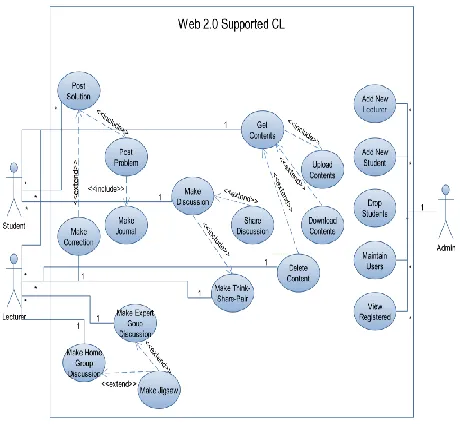
In general, a use case shows an interaction between a user and a system. It basically displays the relationship among actors and their roles. The advantage of uses diagram is to show the specification of high-level user goals that the system should achieve. Fig. 6 shows students, lecturers and admin as actors because they are the users of the system. The diagram presents the steps that above actors may flow in order to interact with system. Textually describing the steps is as follows:
1. Some roles of lecturers are to : a. Make jigsaw groups b.Make double entry- Journal c. Post problems
d.Post solutions
e. Make discussion boards f. Manoeuvre discussion 2. The roles of the students are to:
a. Get the contents b.Think about them
c. Share their understanding with peers d.Make discussions
e. Make expert group discussions f. Make home group discussion 3. The role of admin user are to:
a. Add new lecturer b.Add new student c. Drop students
d.View registered students
It is important to know is that the use case diagram as well as other diagrams and screenshots in this section are
International Journal of Emerging Technology and Advanced Engineering
Website: www.ijetae.com (ISSN 2250-2459,ISO 9001:2008 Certified Journal, Volume 3, Issue 7, July 2013)
The rectangle in the use case diagram represents the boundaries of the system. The uses cases or the bubbles show what the system performs in response to the users’ actions. You can observe that users are out the system boundaries. The aim is to show the interaction between the system and users. The use case diagram roughly illustrates the functionality of web 2.0 based CL. As far a Web 2.0 CL Framework (see Fig. 4) is concerned, the following conclusions can be reached.
First, three selected CL activities, namely Double-Entry Journal, Think-Pair-Share, jigsaw are elaborated. It is observable that Double-Entry-Journal can be as a conversation between users and documents. And Think-pair-share can support real-time communication between two or more people. Jigsaw helps students cover course contents quickly.
Second, the interaction among users, contents and activities is also observable. This is due to the capabilities of Web 2.0 technologies.
[image:6.612.338.547.192.351.2]
Fig. 6 Use Case for Web 2.0 –supported CL system
4.1 Class Diagram
Classes contain attributes (member variables) of the objects and operations (member functions) that the class can perform.
[image:6.612.58.288.369.582.2]Another important element in class diagram is relationship. Lines between two or more classes show relationships. Fig. 7 Shows the Class diagram for this system.
Fig. 7 A class diagram for Web 2.0 –supported CL system
V. SYSTEM PROTOTYPE
So far, we have seen, in this paper, diagrams or models that provide an abstract representation of Web 2.0 – Supported CL System. Model provided good information but it would be even better if the functionality of the system in the real world can be spotted. As proof of concept, a prototype has been developed. The prototype is trying to demonstrate some functionality of the proposed model of Web 2.0 CL Framework presented earlier in this paper. The interface has been designed and some basic functionality has been demonstrated. To simplify development process, the prototype is divided into workable modules. Entire working system was not built because of a time constraint. The prototype has been developed using PHP as programming language and MySQL as Database.
International Journal of Emerging Technology and Advanced Engineering
[image:7.612.52.286.108.307.2]Website: www.ijetae.com (ISSN 2250-2459,ISO 9001:2008 Certified Journal, Volume 3, Issue 7, July 2013)
Fig. 8 The Login page
[image:7.612.326.554.112.328.2]Clients’ Homepage. This is the Clients’ (students and lecturers)Home page. All modules being used by students and lecturers are presented here. In the left side, you can see a list of resources such as Downloads, Video Sharing, Wikis, Blogs and RSS feeds. Download link provides users documents such as papers, articles, and books etc that have been uploaded by other users. Fig.9 shows Screenshot for Clients’ home page.
Fig. 9 Clients’ home page.
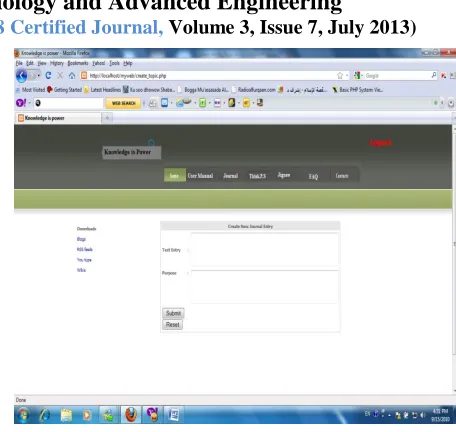
Double-Entry-Journal. In addition to the resources mentioned above, there are some online activities that stimulate the process of knowledge creation and content contribution. One important online activity is the journal. The journal facilitates mastering course material. The journal (Double-Entry-Journal) activity is done through two steps process. First, student posts a problem or a question from the text book and other students respond to this problem to this problem or question. The questions may also come from the lecturer and then students are asked to react to them.
Fig. 10 Online Double-Entry-Journal
VI. CONCLUSION
The advance in web technologies created a paradigm shift in learning settings. The introduction of e-learning 1.0 (known as e-learning) enabled instructors to send course contents to their students. Students’ role was just to download the contents for reading. This was something valuable in its time. As new learning methods have been introduced, supporting technologies were needed. One of the methods which promotes the students’ contribution is Collaborative Learning (CL). CL follows participatory culture and networked, student-centered approach of learning. CL may change traditional methods but it needs suitable web environment to operate. Web 2.0 best suits that need. Web 2.0 platform may provide the interactivity required by CL. A successful implementation of CL in web 2.0 environment is something being demanded by educational institutions. One way is to start with modeling in order to visualize applications before actual implementation. Prototyping which enables earlier customer feedback is another one. In general, this paper centers around all above concepts. In particular, the following conclusions can be drawn from this paper.
[image:7.612.49.287.416.558.2]International Journal of Emerging Technology and Advanced Engineering
Website: www.ijetae.com (ISSN 2250-2459,ISO 9001:2008 Certified Journal, Volume 3, Issue 7, July 2013)
2.The paper also analyzed several models and frameworks. The models and frameworks were chosen based on the relevance to web 2.0 and CL. Then paper tried to implement Web 2.0 CL Framework (Fig. 4). The web 2.0 CL Framework is a published work for authors of this paper. But the implementation of the framework was missing in the previous publication. 3.Therefore, the major contribution of this paper lies in
modeling and implementing of CL on web 2.0. Unified Modeling Language (UML) was used to represent 3 important diagrams. The diagrams namely are Activity Diagram, Use Case Diagram and Class Diagram.
4.As proof of concept, a prototype has been developed. Based on Web 2.0 CL Framework, the prototype provides means of utilization of online resources. The prototype shows three online activities that simplify the resource utilization.
REFERENCES
[1 ] Fiaidhi, J., & Mohammed, S. (2006). Collaborative virtual learning model for web intelligence. Computer Supported Cooperative Work in Design II, 563-572.
[2 ] Dahlan, H. M., Ali, I. M., & Hussin, A. R. C. (2010, December). Suitability of Collaborative Learning activities in Web 2.0 environment. In User Science and Engineering (i-USEr), 2010 International Conference on (pp. 65-70). IEEE.
[3 ] Sbihi, B., & Kadiri, K. E. E. (2010). Towards a participatory E-learning 2.0 A new E-E-learning focused on learners and validation of the content. arXiv preprint arXiv:1001.4738.
[4 ] March, T. (2010). Revisiting WebQuests in a Web 2 World. How developments in technology and pedagogy combine to scaffold personal learning. Digital Education Review, (15), 1-17.
[5 ] Zhao, J., & McConnell, D. Group Modeling Method in Web-Based Collaborative Learning Environment.
[6 ] Maria, A. (1997, December). Introduction to modeling and simulation. In Proceedings of the 29th conference on Winter simulation (pp. 7-13). IEEE Computer Society.
[7 ] Padma, S., Seshasaayee,A. (2011). Modeling on Personalized Web based Collaborative Learning in Web 3.0 . International Research Publication House .
[8 ] Dalziel, J. (2003). IMPLEMENTING LEARNING DESIGN: THE LEARNING ACTIVITY MANAGEMENT SYSTEM . ASCILITE . [9 ] Karampiperis, P. and Sampson, D. (2005). Designing Learning
Services: From Content-based to Activity-based Learning Systems. [10 ]Vivekananthamoorthy, N., & Sarukesi, K. (2012). Enhancing
effectiveness of e-learning framework using UML modeling and Self Regulation: A Case Study. International Journal, 48.
[11 ]Shih,Y. Huang, P., Hsu, Y., Sherry Y.(2012). A COMPLETE UNDERSTANDING OF DISORIENTATION PROBLEMS IN. The Turkish
[12 ] Martel, C., Vignollet, L., Ferraris, C., David, J. P., & Lejeune, A. (2006, July). Modeling collaborative learning activities on e-learning platforms. In Advanced Learning Technologies, 2006. Sixth International Conference on (pp. 707-709). IEEE.
[13 ]Chatti, M. A., Klamma, R., Jarke, M., & Naeve, A. (2007, July). The Web 2.0 driven SECI model based learning process. In Advanced Learning Technologies, 2007. ICALT 2007. Seventh IEEE International Conference on (pp. 780-782). IEEE.