Multiword Expressions
Spence Green
∗ Stanford UniversityMarie-Catherine de Marneffe
∗∗ Stanford UniversityChristopher D. Manning
† Stanford UniversityMultiword expressions lie at the syntax/semantics interface and have motivated alternative theories of syntax like Construction Grammar. Until now, however, syntactic analysis and multiword expression identification have been modeled separately in natural language process-ing. We develop two structured prediction models for joint parsing and multiword expression identification. The first is based on context-free grammars and the second uses tree substitution grammars, a formalism that can store larger syntactic fragments. Our experiments show that both models can identify multiword expressions with much higher accuracy than a state-of-the-art system based on word co-occurrence statistics.
We experiment with Arabic and French, which both have pervasive multiword expres-sions. Relative to English, they also have richer morphology, which induces lexical sparsity in finite corpora. To combat this sparsity, we develop a simple factored lexical representation for the context-free parsing model. Morphological analyses are automatically transformed into rich feature tags that are scored jointly with lexical items. This technique, which we call a factored lexicon, improves both standard parsing and multiword expression identification accuracy.
1. Introduction
Multiword expressions are groups of words which, taken together, can have un-predictable semantics. For example, the expression part of speech refers not to some aspect of speaking, but to the syntactic category of a word. If the expression is altered in some ways—part of speeches, part of speaking, type of speech—then the idiomatic meaning is lost. Other modifications, however, are permitted, as in the plural parts of speech. These characteristics make multiword expressions (MWEs) difficult to identify and classify. But if they can be identified, then the incorporation of MWE knowledge has been shown to improve task accuracy for a range of NLP applications
∗Department of Computer Science. E-mail:[email protected]. ∗∗Department of Linguistics. E-mail:[email protected].
†Departments of Computer Science and Linguistics. E-mail:[email protected].
including dependency parsing (Nivre and Nilsson 2004), supertagging (Blunsom and Baldwin 2006), sentence generation (Hogan et al. 2007), machine translation (Carpuat and Diab 2010), and shallow parsing (Korkontzelos and Manandhar 2010).
The standard approach to MWE identification isn-gram classification. This tech-nique is simple. Given a corpus, all n-grams are extracted, filtered using heuristics, and assigned feature vectors. Each coordinate in the feature vector is a real-valued quantity such as log likelihood or pointwise mutual information. A binary classifier is then trained to render a MWE/non-MWE decision. All entries into the 2008 MWE Shared Task (Evert 2008) utilized variants of this technique.
Broadly speaking,n-gram classification methods measure word co-occurrence. Sup-pose that a corpus contains more occurrences ofpart of speechthanparts of speech. Surface statistics may erroneously predict that only the former is an MWE and the latter is not. More worrisome is that the statistics for the twon-grams are separate, thus missing an obvious generalization.
In this article, we show that statistical parsing models generalize more effectively over arbitrary-length multiword expressions. This approach has not been previously demonstrated. To show its effectiveness, we build two parsing models for MWE iden-tification. The first model is based on a context-free grammar (CFG) with manual rule refinements (Klein and Manning 2003). This parser also includes a novel lexical model—the factored lexicon—that incorporates morphological features. The second model is based ontree substitution grammar(TSG), a formalism with greater strong generative capacity that can store larger structural tree fragments, some of which are lexicalized.
We apply the models to Modern Standard Arabic (henceforth MSA, or simply “Arabic”) and French, two morphologically rich languages (MRLs). The lexical sparsity (in finite corpora) induced by rich morphology poses a particular challenge forn-gram classification. Relative to English, French has a richer array of morphological features— such as grammatical gender and verbal conjugation for aspect and voice. Arabic also has richer morphology including gender and dual number. It has pervasive verb-initial matrix clauses, although preposed subjects are also possible. For languages like these it is well known that constituency parsing models designed for English often do not generalize well. Therefore, we focus on the interplay among language, annotation choices, and parsing model design for each language (Levy and Manning 2003; Kübler 2005, inter alia), although our methods are ultimately very general.
Our modeling strategy for MWEs is simple: We mark them with flat bracketings in phrase structure trees. This representation implicitly assumes a locality constraint on idioms, an assumption with a precedent in linguistics (Marantz 1997, inter alia). Of course, it is easy to find non-local idioms that do not correspond to surface con-stituents or even contiguous strings (O’Grady 1998). Utterances such asAll hell seemed to break loose and The cat got Mary’s tongue are clearly idiomatic, yet the idiomatic elements are discontiguous. Our models cannot identify these MWEs, but then again, neither cann-gram classification. Nonetheless, many common MWE types like nominal compounds are contiguous and often correspond to constituent boundaries.
Consider again the phrasal compoundpart of speech,1 which is non-compositional: The idiomatic meaning “syntactic category” does not derive from any of the component
words. This non-compositionality affects the syntactic environment of the compound as shown by the addition of an attributive adjective:
(1) a. Nounis a part of speech.
b. *Nounis a big part of speech.
c. *Nounis a big part.
(2) a. Liquidity is a part of growth.
b. Liquidity is a big part of growth.
c. Liquidity is a big part.
In Example (1a) the copula predicate part of speech as a whole describes Noun. In Examples (1b) and (1c)big clearly modifies only part and the idiomatic meaning is lost. The attributive adjective cannot probe arbitrarily into the non-compositional com-pound. In contrast, Example (2) contains parallel data without idiomatic semantics. The conventional syntactic analysis of Example (2a) is identical to that of Example (1a) except for the lexical items, yetpart of growthis not idiomatic. Consequently, many pre-modifiers are appropriate forpart, which is semantically vacuous. In Example (2b),big clearly modifies part, and of growth is just an optional PP complement, as shown by Example (2c), which is still grammatical.
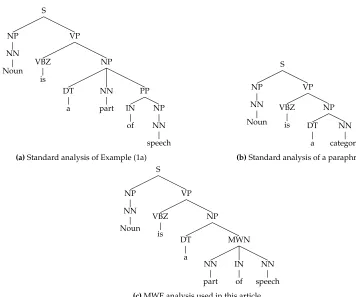
This article proposes different phrase structures for examples such as (1a) and (2a). Figure 1a shows a Penn Treebank (PTB) (Marcus, Marcinkiewicz, and Santorini 1993) parse of Example (1a), and Figure 1b shows the parse of a paraphrase. The phrasal compound part of speech functions syntactically like a single-word nominal like category, and indeed Noun is a big category is grammatical. Single-word para-phrasability is a common, though not mandatory, characteristic of MWEs (Baldwin and Kim 2010). Starting from the paraphrase parse, we create a representation like Figure (1c). The MWE is indicated by a label in the predicted structure, which is flat. This representation explicitly models the idiomatic semantics of the compound and is context-free, so we can build efficient parsers for it. Crucially, MWE identifi-cation becomes a by-product of parsing as we can trivially extract MWE spans from full parses.
We convert existing Arabic and French syntactic treebanks to the new MWE representation. With this representation, the TSG model yields the best MWE iden-tification results for Arabic (81.9% F1) and competitive results for French (71.3%), even though its parsing results lag state-of-the-art probabilistic CFG (PCFG)-based parsers. The TSG model also learns human-interpretable MWE rules. The fac-tored lexicon model with gold morphological annotations achieves the best MWE results for French (87.3% F1) and competitive results for Arabic (78.2% F1). For both languages the factored lexicon model also approaches state-of-the-art basic parsing accuracy.
2. Multiword Expressions in Arabic and French
In this section we provide a general definition and taxonomy of MWEs. Then we discuss types of MWEs in Arabic and French.
2.1 Definition of Multiword Expressions
MWEs, a known nuisance for both linguistics and NLP, blur the lines between syntax and semantics. Jackendoff (1997, page 156) comments that MWEs “are hardly a marginal part of our use of language,” and estimates that a native speaker knows at least as many MWEs as single words. A linguistically adequate representation for MWEs remains an active area of research, however. Baldwin and Kim (2010) define MWEs as follows:
Definition 1
Multiword expressions are lexical items that: (a) can be decomposed into multi-ple lexemes; and (b) display lexical, syntactic, semantic, pragmatic, and/or statistical idiomaticity.
S
NP
NN
Noun
VP
VBZ
is
NP
DT
a
NN
part
PP
IN
of NP
NN
speech
S
NP
NN
Noun
VP
VBZ
is
NP
DT
a
NN
category
(a)Standard analysis of Example (1a) (b)Standard analysis of a paraphrase S
NP
NN
Noun
VP
VBZ
is
NP
DT
a
MWN
NN
part IN
of NN
speech
[image:4.486.47.403.274.571.2](c)MWE analysis used in this article
Figure 1
(a) A standard PTB parse of Example (1a). (b) The MWEpart of speechfunctions syntactically like the ordinary nominalcategory, as shown by this paraphrase. (c) We incorporate the presence of the MWE into the syntactic analysis by flattening the tree dominatingpart of speech
Table 1
Semi-fixed MWEs in French and English. The French adverbà terme(‘in the end’) can be modified by a small set of adjectives, and in turn some of these adjectives can be modified by an adverb such astrès(‘very’). Similar restrictions appear in English.
French English
à terme in the near term
à court terme in the short term
à très court terme in the very short term
à moyen terme in the medium term
à long terme in the long term
à très long terme in the very long term
MWEs fall into four broad categories (Sag et al. 2002):
1. Fixed—do not allow morphosyntactic variation or internal modification (in short, by and large).
2. Semi-fixed—can be inflected or undergo internal modification (Table 1).
3. Syntactically flexible—undergo syntactic variation such as inflection (e.g., phrasal verbs such aslook upandwrite down).
4. Institutionalized phrases—fully compositional phrases that are statistically idiosyncratic (traffic light,Secretary of State).
Statistical parsers are well-suited for coping with lexical, syntactic, and statistical idiomaticity across all four MWE classes. However, to our knowledge, we are the first to explicitly tune parsers for MWE identification.
2.2 Arabic MWEs
The most recent and most relevant work on Arabic MWEs was by Ashraf (2012), who analyzed an 83-million-word Arabic corpus. He developed an empirical taxonomy of six MWE types, which correspond to syntactic classes. The syntactic class is defined by the projection of the purported syntactic head of the MWE. MWEs are further subcategorized by observed POS sequences. For some of these classes, the syntactic distinctions are debatable. For example, in the verb-object idiom
Daraba cSfuurayn bi-Hajar (‘he killed two birds with one stone’)2 the composition of
(‘two birds’) with
(‘stone’) is at least as important as composition with the verb(‘he killed’), yet Ashraf (2012) classifies the phrase as a verbal idiom.The corpus in our experiments only marks three of the six Arabic MWE classes:
Nominal idioms (MWN) consist of proper nouns (Example 3a), noun compounds (Example 3b), and construct NPs (Example 3c). MWNs typically correspond to NP bracketings:
(3) a. N N:
abuu Dabii(‘Abu Dhabi’)
b. D+N D+N: al-cnaaya al-faaOqa (‘intensive care unit’)
c. N D+N:
! "#
kura al-qudum(‘soccer’)Prepositional idioms (MWP) include PPs that are commonly used as discourse con-nectives (Example 4a), function like adverbials in English (Example 4b), or have been institutionalized (Example 4c). These MWEs are distinguished by a prepositional syntactic head:
(4) a. P D+N:
$%&
Hataa al-aan(‘until now’)b. P+N:
'
bi-cnf (‘violently’)c. P+D+N D+N:
()* +
,
bi-al-twqiit al-maHalii(‘local time’)Adjectival idioms(MWA) are typically the so-called “false”iDaafaconstructs in which the first term is an adjective that acts as a modifier of some other noun. These constructs often correspond to a hyphenated modifier in English such as Examples (5a) and (5b). Less frequent are coordinated adjectives that have been institutionalized such as Examples (5c) and (5d):
(5) a. A D+N:
-.)* ,
rafiica al-mustuuaa(‘high-level’) b. A D+N:/ ,0
swfiiaatiia al-Sanac(‘Soviet-made’)c. D+A C+D+A:
!1 2.
al-shaqiiqa w-al-Sadiiqa(‘neighborly’) d. D+A C+D+A:1 3
al-bariia w-al-baHariia(‘land and sea’)These idiom types usually do not cross constituent boundaries, so constituency parsers are well suited for modeling them. The other three classes of Ashraf (2012)—verb-subject, verbal, and adverbial—tend to cross constituent boundaries, so they are dif-ficult to represent in a PTB-style treebank. Dependency representations may be more appropriate for these idiom classes.
2.3 French MWEs
In French, there is a lexicographic tradition of compiling MWE lists. For example, Gross (1986) shows that whereas French dictionaries contain about 1,500 single-word adverbs there are over 5,000 multiword adverbs. MWEs occur in every part of speech (POS) category (e.g., nountrousse de secours(‘first-aid kit’); verbfaire main-basse[do hand-low] (‘seize’); adverb comme dans du beurre [as in butter] (‘easily’); adjective à part entière (‘wholly’)).
one of the words in the expression (e.g., a possessive as infrom the top of one’s hat). It also notes whether the MWE displays some selectional preferences (e.g., it has to be preceded by a verb or by an adjective).
We discuss three of the French MWE categories here, and list the rest in Appendix A.
Nominal idioms (MWN) consist of proper nouns (Example (6a)), foreign common nouns (6b), and common nouns. The common nouns appear in several syntacti-cally regular sequences of POS tags (Example (7)). Multiword nouns allow inflection (singular vs. plural) but no insertion:
(6) a. London Sunday Times, Los Angeles
b. week - end, mea culpa, joint - venture
(7) a. N A:corps médical(‘medical staff’),dette publique(‘public debt’)
b. N P N:mode d’emploi(‘instruction manual’)
c. N N:numéro deux (‘number two’),maison mère[house mother] (‘headquar-ters’),grève surprise(‘sudden strike’)
d. N P D N: impôt sur le revenu(‘income tax’),ministre de l’économie (‘finance minister’)
Adjectival idioms (MWA) appear with different POS sequences (Example (8)). They include numbers likevingt et unième(‘21st’). Some MWAs allow internal variation. For example, some adverbs or adjectives can be added to both examples in (8b) (à très haut risque,de toute dernière minute):
(8) a. P N:d’antan[from before] (‘old’),en question(‘under discussion’)
b. P A N:à haut risque (‘high-risk’),de dernière minute [from the last minute] (‘at the eleventh hour’)
c. A C A:pur et simple[pure and simple] (‘straightforward’),noir et blanc(‘black and white’)
Verbal idioms(MWV) allow number and tense inflections (Example (9)). Some MWVs containing a noun or an adjective allow the insertion of a modifier (e.g.,donner grande satisfication(‘give great satisfaction’)), whereas others do not. When an adverb inter-venes between the main verb and its complement, the two parts of the MWV may be marked discontinuously (e.g., [MWV [Vprennent]] [ADVdéjà] [MWV [Pen] [N cause]]
(‘already take into account’)):
(9) a. V N:avoir lieu(‘take place’),donner satisfaction(‘give satisfaction’)
b. V P N:mettre en place(‘put in place’),entrer en vigueur(‘to come into effect’)
c. V P ADV:mettre à mal[put at bad] (‘harm’),être à même [be at same] (‘be able’)
d. V D N P N: tirer la sonnette d’alarme(‘ring the alarm bell’),avoir le vent en poupe(‘to have the wind astern’)
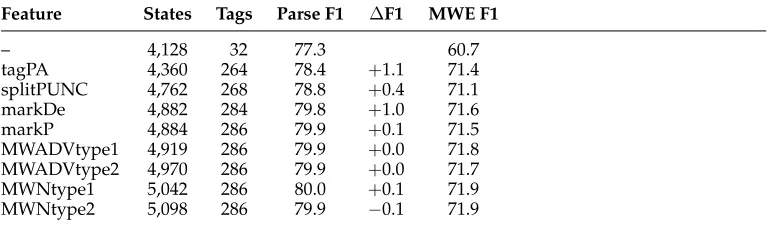
Table 2
French grammar development. Incremental effects on grammar size and labeled F1 for each of the manual grammar features (development set, sentences≤40 words). The baseline is a parent-annotated grammar. The features tradeoff between maximizing two objectives: overall parsing F1 and MWE F1.
Feature States Tags Parse F1 ΔF1 MWE F1
– 4,128 32 77.3 60.7
tagPA 4,360 264 78.4 +1.1 71.4
splitPUNC 4,762 268 78.8 +0.4 71.1
markDe 4,882 284 79.8 +1.0 71.6
markP 4,884 286 79.9 +0.1 71.5
MWADVtype1 4,919 286 79.9 +0.0 71.8
MWADVtype2 4,970 286 79.9 +0.0 71.7
MWNtype1 5,042 286 80.0 +0.1 71.9
MWNtype2 5,098 286 79.9 −0.1 71.9
by a span over the MWE composed of a phrasal label indicating the MWE type and pre-terminal labels indicating the internal POS sequence. MWE identification then becomes a trivial process of extracting such subtrees from full parses.
3. Context-Free Parsing Model: Stanford Parser
In this section and Section 4, we describe constituency parsing models that will be tuned for MWE identification. The algorithmic details of the parsing models may seem removed from multiword expressions, but this is by design. MWEs are encoded in the syntactic representation, allowing the model designer to focus on learning that representation rather than trying to model semantic phenomena directly.
The Stanford parser (Klein and Manning 2003) is a product model that combines the outputs of a manually refined PCFG with an arc-factored dependency parser. Adapting the Stanford parser to a new language requires: (1) feature engineering for the PCFG grammar, (2) specification of head-finding rules for extracting dependencies, and (3) development of an unknown word model.3
After adapting the basic parser, we develop a novel lexical model, which we call a factored lexicon. The factored lexicon incorporates morphological information that is predicted by a separate morphological analyzer.
3.1 Grammar Development
Grammar features consist of manual splits of labels in the training data (e.g., marking base NPs with the rich label “NP-base”). These features were tuned on a development set. Some of them have linguistic interpretations, whereas others (e.g., punctuation splitting) have only empirical justification.
French Grammar Features.Table 2 lists the category splits used in our grammar. Most of the features are POS splits as many phrasal tag splits did not improve accuracy. This result may be due to the flat annotation scheme of the FTB.
Parent annotation of POS tags captures information about the external context. For example, prepositions (P) can introduce a prepositional phrase (PP) or an infinitival complement (VPinf), but some prepositions will uniquely appear in one context and not the other (e.g.,sur(‘on’) will only occur in a PP environment). ThetagPAprovides this kind of distribution. We also split punctuation tags (splitPUNC) into equivalence classes similar to those present in the PTB.
We tried different features to mark the context of prepositions. markPidentifies prepositions which introduce PPs modifying a noun (NP). Marking other kinds of prepositional modifiers (e.g., verb) did not help. The featuremarkDethe preposition deand its variants (du,des,d’), which are very frequent and appear in many contexts.
The features that help MWE F1 depend on idiom frequency. We mark MWADVs under S nodes (MWADVtype1), and those with POS sequences that occur more than 500 times (“P N” –en jeu,à peine, or “P D N”dans l’immédiat,à l’inverse) (MWADVtype2). Similarly, we mark MWNs that occur more than 600 times (e.g., “N P N” and “N N”) (MWNtype1andMWNtype2).
Arabic Grammar Features. The Arabic grammar features come from Green and Manning (2010), which contains an ablation study similar to Table 2. We added one additional feature,markMWEPOS, which marks POS tags dominated by MWE phrasal categories.
3.2 Head-Finding Rules
For Arabic, we use the head-finding rules from Green and Manning (2010). For French, we use the head-finding rules of Dybro-Johansen (2004), which yielded an approxi-mately 1% development set improvement over those of Arun (2004).
3.3 Unknown Word Models
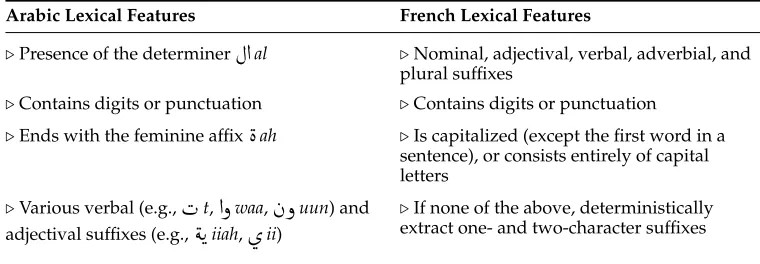
[image:9.486.51.431.537.669.2]For both languages, we create simple unknown word models that substitute word signatures for rare and unseen word types. The signatures are generated according to the features in Table 3. For tagt and signatures, the signature parameters p(t|s) are estimated after collecting counts for 50% of the training data. Thenp(s|t) is computed via Bayes rule with a flat Dirichlet prior.
Table 3
Unknown word model features for Arabic and French.
Arabic Lexical Features French Lexical Features
Presence of the determiner
4
al Nominal, adjectival, verbal, adverbial, and plural suffixesContains digits or punctuation Contains digits or punctuation
Ends with the feminine affix
"
ah Is capitalized (except the first word in a sentence), or consists entirely of capital lettersVarious verbal (e.g.,
t,1
waa,$1
uun) and adjectival suffixes (e.g.,iiah,-
ii)3.4 Factored Lexicon with Morphological Features
We will apply our models to Arabic and French, yet we have not dealt with the lexical sparsity induced by rich morphology (see Table 5 for a comparison to English). One way to combat sparsity is to parse afactored representation of the terminals, where factors might be the word form, the lemma, or grammatical features such as gender, number, and person (φfeatures) (Bilmes and Kirchoff 2003; Koehn and Hoang 2007, inter alia).
The basic parser lexicon estimates the generative probability of a word given a tagp(w|t) from word/tag pairs observed in the training set. Additionally, the lexicon includes parameter estimates p(t|s) for unknown word signatures sproduced by the unknown word models (see Section 3.3). At parsing time, the lexicon scores each input word type waccording to its observed count in the training set c(w). We define the unsmoothed and smoothed parameter estimates:
p(t|w)= c(t,w)
c(w) (1)
psmooth(t|w)=
c(t,w)+αp(t|s)
c(w)+α (2)
We then compute the desired parameterp(w|t) as
p(w|t)=
⎧ ⎪ ⎪ ⎨ ⎪ ⎪ ⎩
p(t|w)p(w)
p(t) ifc(w)> β
psmooth(t|w)p(w)
p(t) ifc(w)>0
p(t|s)p(s)
p(t) otherwise
(3)
We found thatα=1.0 andβ=100 worked well on both development sets.
In the factored lexicon, each token has an associated morphological analysis m, which is a string describing various grammatical features (e.g., tense, voice, definite-ness). Instead of generating terminals alone, we generate the word and morphological analysis using a simple product:
p(w,m|t)=p(w|t)p(m|t) (4)
where p(m|t) is estimated using exactly the same procedure as the lexical insertion probability p(w|t). Because there are only a few hundred unique t,m tuples in the training data for each language, we tend to get sharper parameter estimates, namely, we usually estimatep(t|m) directly as in Equation (1). Moreover, at test time, even if the word typewis unknown, the associated morphological analysismis almost always known, providing additional evidence for tagging.
We also experimented with an additional lemma factor, but found that it did not improve accuracy. We thus excluded the lemma factor from our experiments.
4. Fragment Parsing Model: Dirichlet Process Tree Substitution Grammars
For our task, a shortcoming of CFG-based grammars is that they do not explicitly capture idiomatic usage. For example, consider the two utterances:
(10) a. He kicked the bucket.
b. He kicked the pail.
Unless horizontal markovization is applied, PCFGs generate words independently. Consequently, no phrasal rule parameter in the model differentiates between Exam-ples (10a) and (10b). Recall, however, that in our representation, Example (10a) should receive a flat analysis as MWV, whereas Example (10b) should have a conventional analysis of the transitive verbkickedand its two arguments.
TSGs are weakly equivalent to CFGs, but with greater strong generative capacity (Joshi and Schabes 1997). TSGs can store lexicalized tree fragments as rules. Conse-quently, if we have seen [MWV kicked the bucket] several times before, we can store that
whole lexicalized fragment in the grammar.
We consider the non-parametric probabilistic TSG (PTSG) model of Cohn, Goldwater, and Blunsom (2009) in which tree fragments are drawn from a Dirichlet process (DP) prior.4 The DP-TSG can be viewed as a data-oriented parsing (DOP)
model (Scha 1990; Bod 1992) with Bayesian parameter estimation. A PTSG is a 5-tuple V,Σ,R,♦,θwherec∈Vare non-terminals;t∈Σare terminals;e∈Rareelementary trees;5 ♦ ∈V is a unique start symbol; and θc,e∈θ are parameters for each tree
fragment. A PTSG derivation is created by successively applying the substitution operator to the leftmostfrontier node (denoted by c+). All other nodes areinternal (denoted byc−).
In the supervised setting, DP-TSG grammar extraction reduces to a segmentation problem. We have a treebankTthat we segment into the setR, a process that is modeled with Bayes’ rule:
p(R|T)∝p(T|R)p(R) (5)
Because the tree fragments completely specify each tree,p(T|R) is either 0 or 1, so all work is performed by the prior over the set of elementary trees.
The DP-TSG contains a DP prior for each c∈V and generates a tree fragment e rooted at non-terminalcaccording to:
θc|c,αc,P0(·|c)∼DP(αc,P0)
e|θc ∼θc
4 Similar models were developed independently by O’Donnell, Tenenbaum, and Goodman (2009) and Post and Gildea (2009).
Table 4
DP-TSG notation. For consistency, we largely follow the notation of Liang, Jordan, and Klein (2010).
αc DP concentration parameter for each non-terminal typec∈V P0(e|c) CFG base distribution
x Set of all non-terminal nodes in the treebank S Set of sampling sites (one for eachx∈x)
S A block of sampling sites, whereS⊆ S
b={bs}s∈S Binary variables to be sampled (bs=1 for frontier nodes) z Latent state of the segmented treebank
m Number of sitess∈Ss.t.bs=1 n={nc,e} Sufficient statistics ofz
ΔnS:m Change in counts by settingmsites inS
Table 4 defines notation. The data likelihood is given by the latent state z and the parametersθ:p(z|θ)=z∈zθnc,e(z)
c,e . Integrating out the parameters, we have:
p(z)=
c∈V
e(αcP0(e|c))nc,e(z) αnc,·(z)
c
(6)
wherexn=x(x+1). . .(x+n−1) is the rising factorial.
Base Distribution.The base distributionP0is the same maximum likelihood PCFG used
in the Stanford parser.6After applying the manual grammar features, we perform
sim-ple right binarization, collapse unary rules, and replace rare words with their signatures (Petrov et al. 2006).
For each non-terminal type c, we learn a stop probability qc∼Beta(1, 1). Under
P0, the probability of generating a tree fragment A+→B−C+ composed of
non-terminals is
P0(A+→B−C+)=pMLE(A→B C)qB(1−qC) (7)
Unlike Cohn, Goldwater, and Blunsom (2009), we penalize lexical insertion:
P0(c→t)=pMLE(c→t)p(t) (8)
wherep(t) is equal to the MLE unigram probability oftin the treebank. Lexicalizing a rule makes it very specific, so we generally want to avoid lexicalization with rare words. Empirically, we found that this penalty reduces overfitting.
Type-Based Inference Algorithm. To learn the parametersθ we use the collapsed, block Gibbs sampler of Liang, Jordan, and Klein (2010). We sample binary variables bs
associated with each sampling sitesin the treebank. The key idea is to select a block
NP+
PUNC−(1)
“
N+
Jacques
N−
Chirac
PUNC+(2)
[image:13.486.54.243.63.130.2]“
Figure 2
Example of two conflicting sites of the same type in a training tree. Define the type of a sitet(z,s)def=(Δns:0,Δns:1). Sites (1) and (2) have the same type becauset(z,s
1)=t(z,s2). The two sites conflict, however, because the probabilities of settingbs1andbs2both depend on counts for
the tree fragment rooted at NP. Consequently, sites (1) and (2) are not exchangeable: The probabilities of their assignments depend on the order in which they are sampled.
of exchangeable sites S of the sametype that do not conflict(Figure 2). Because the sites inSare exchangeable, we can setbS randomly if we knowm, the number of sites
withbs=1. This algorithm is not a contribution of this article, so we refer the interested
reader to Liang, Jordan, and Klein (2010) for further details.
After each Gibbs iteration, we sample each stop probability qc directly using
binomial-Beta conjugacy. We also infer the DP concentration parametersαc with the
auxiliary variable procedure of West (1995).
Decoding.To decode, we first create a maximum a posterior (MAP) grammar in which tree fragments have fixed estimates according to a single sample from the DP-TSG:
θc,e=
nc,e(z)+αcP0(e|c)
nc,(z)+αc (9)
This MAP grammar has an infinite rule set, however, because elementary trees with zero count innhave some residual probability underP0. We discard all zero-count trees
except for the zero-count CFG rules inP0. Scores for these rules follow from Equation (9)
with nc,e(z)=0. This grammar represents most of the probability mass and permits
inference using dynamic programming (Cohn, Goldwater, and Blunsom 2009).
Because the derivations of a TSG are context-free (Vijay-Shanker and Weir 1993), we can form a CFG of the derivation sequences and use a synchronous CFG to translate the most probable CFG parse to its TSG derivation. Consider a unique tree fragment ei rooted atcj with frontierγ, which is a sequence of terminals and non-terminals. We
encode this fragment as an SCFG rule of the form
[cj→γ,cj→i,ck,cl,. . .] (10)
whereck,cl,. . . is a finite-length sequence of the non-terminal frontier nodes inγ.7The
SCFG translates the input string to a sequence of tree fragment indices. Because the TSG substitution operator applies to the leftmost frontier node, the best TSG parse can be deterministically recovered from the sequence of indices.
Table 5
Gross corpus statistics for the pre-processed corpora used to train and evaluate our models. We compare to the WSJ section of the PTB: train (Sections 02–21); dev. (Section 22); test (Section 23). Due to its flat annotation style, the FTB sentences have fewer constituents per sentence. In the ATB, morphological variation accounts for the high proportion of word types to sentences.
ATB FTB WSJ
Train
#sentences 18,818 13,448 39,832 #tokens 597,933 397,917 950,028 #word types 37,188 26,536 44,389
#POS types 32 30 45
#phrasal types 31 24 27
avg. length 31.8 29.6 23.9
Dev.
#sentences 2,318 1,235 1,700
#tokens 70,656 38,298 40,117
#word types 12,358 6,794 6,840
avg. length 30.5 31.0 23.6
OOV rate 15.6% 17.8% 12.8%
Test #sentences 2,313 1,235 2,416
#tokens 70,065 37,961 56,684
The SCFG formulation has a practical benefit: We can take advantage of the heavily optimized SCFG decoders for machine translation. We usecdec(Dyer et al. 2010) to find the Viterbi derivation for each input string.
5. Training Data and Morphological Analyzers
We have described two supervised parsing models for Arabic and French. Now we show how to construct MWE-aware training resources for them.
The corpora used in our experiments are the Penn Arabic Treebank (ATB) (Maamouri et al. 2004) and the French Treebank (FTB) (Abeillé, Clément, and Kinyon 2003). Prior to parsing, both treebanks require significant pre-processing, which we perform automatically.8 Because parsing evaluation metrics are sensitive to the
terminal/terminal ratio (Rehbein and van Genabith 2007), we only remove non-terminal labels in the case of unary rewrites of the same category (e.g., NP → NP) (Johnson 1998). Table 5 compares the pre-processed corpora with the WSJ section of the PTB. Appendix C compares the annotation consistency of the ATB, FTB, and WSJ.
5.1 Arabic Treebank
We work with parts 1–3 (newswire) of the ATB,9which contain documents from three
different news agencies. In addition to phrase structure markers, each syntactic tree also contains per-token morphological analyses.
8 Tree manipulation is automated with Tregex/Tsurgeon (Levy and Andrew 2006). Our pre-processing package is available athttp://nlp.stanford.edu/software/lex-parser.shtml.
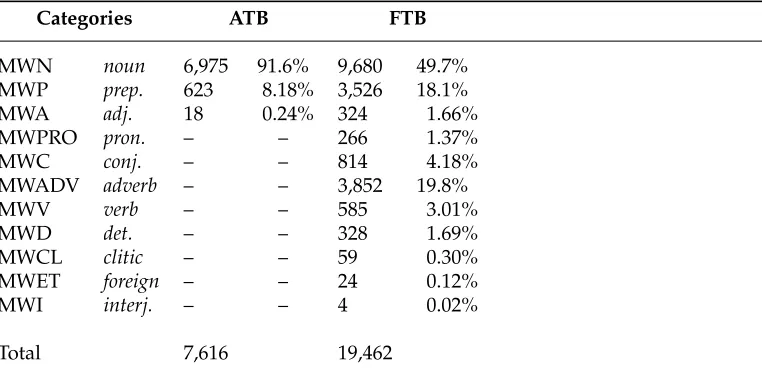
Table 6
Frequency distribution of the MWE types in the ATB and FTB training sets.
Categories ATB FTB
MWN noun 6,975 91.6% 9,680 49.7%
MWP prep. 623 8.18% 3,526 18.1%
MWA adj. 18 0.24% 324 1.66%
MWPRO pron. – – 266 1.37%
MWC conj. – – 814 4.18%
MWADV adverb – – 3,852 19.8%
MWV verb – – 585 3.01%
MWD det. – – 328 1.69%
MWCL clitic – – 59 0.30%
MWET foreign – – 24 0.12%
MWI interj. – – 4 0.02%
Total 7,616 19,462
Tokenization/Segmentation.We retained the default ATB clitic segmentation scheme.
Morphological Analysis.The ATB contains gold per-token morphological analyses, but no lemmas.
Tag Sets.We used the POS tag set described by Kulick, Gabbard, and Marcus (2006). We previously showed that the “Kulick” tag set is very effective for basic Arabic parsing (Green and Manning 2010).
MWE Tagging.The ATB does not mark MWEs. Therefore, we merged an existing Arabic MWE list (Attia et al. 2010b) with the constituency trees.10For each string from the MWE list that was bracketed in the treebank, we flattened the structure over the MWE span and added a non-terminal label according to the MWE type (Table 6). We ignored MWE strings that crossed constituent boundaries.
Orthographic Normalization. Orthographic normalization has a significant impact on parsing accuracy. We remove all diacritics, instances oftaTwiil,11and pro-drop markers.
We also appliedalif normalization12 and mapped punctuation and numbers to their
Latin equivalents.
Corpus Split. We divided the ATB into training/development/test sections according to the split prepared by Mona Diab for the 2005 Johns Hopkins workshop on parsing Arabic dialects (Rambow et al. 2005).13
10 The list of 30,277 distinct MWEs is available at:http://sourceforge.net/projects/arabicmwes/. 11taTwiil(
6
) is an elongation character for justifying text. It has no morphosyntactic function or phoneticrealization.
12 Variants ofalif[
,,,%
] are inconsistent in Arabic text.5.2 French Treebank
The FTB14contains phrase structure trees with morphological analyses and lemmas. In
addition, the FTB explicitly annotates MWEs. POS tags for MWEs are given not only at the MWE level, but also internally: Most tokens that constitute an MWE also have a POS tag. Our FTB pre-processing is largely consistent with Lexicon-Grammar, which defines MWE categories based on the global POS.
Tokenization/Segmentation.We changed the default tokenization for numbers by fusing adjacent digit tokens. For example, 500 000 is tagged as an MWE composed of two words500and000. We made this500000and removed the MWE POS. We also merged numbers like “17,9”.
Morphological Analysis.The FTB provides both gold morphological analyses and lemmas for 86.6% of the tokens. The remaining tokens lack morphological analyses, and in many cases basic parts of speech. We restored the basic parts of speech by assigning each token its most frequent POS tag elsewhere in the treebank.15This technique was too coarse for
missing morphological analyses, which we left empty.
Tag Sets. We transformed the raw POS tags to the CC tag set (Crabbé and Candito 2008), which is now the standard tag set in the French parsing literature. The CC tag set includes WH markers and verbal mood information.
MWE Tagging.We added the 11 MWE labels shown in Table 6. We mark MWEs with a flat bracketing in which the phrasal label is the MWE-level POS tag with an MW prefix, and the preterminals are the internal POS tags for each terminal. The resulting POS sequences are not always unique to MWEs: They appear in abundance elsewhere in the corpus. Some MWEs contain normally ungrammatical POS sequences, however (e.g., adverbà la va vite(‘in a hurry’): P D V ADV [at the goes quick]), and some words appear only as part of an MWE, such asinsuinà l’insu de(‘to the ignorance of’). We also found that 36 MWE spans still lacked a global POS. To restore these labels, we assigned the most frequent label for that internal POS sequence elsewhere in the corpus.
Corpus Split.We used the 80/10/10 split described by Crabbé and Candito (2008). They used a previous release of the treebank with 12,531 trees. Subsequently, 3,391 trees were added to the FTB. We appended these extra trees to the training set, thus preserving the original development and test sets.
5.3 Morphological Analysis for Arabic and French
The factored lexicon requires predicted per-token morphological analyses at test time. We used separately trained, language-specific tools to obtain these analyses (Table 7).
14 Version from June 2010. We used the subset of the FTB with functional annotations, not for those annotations but because this subset is known to be more consistently annotated. Appendix B compares our pre-processed version of the FTB to other versions in prior work.
Table 7
Linguistic resources required by the factored lexicon. Equivalent resources for Arabic and French do not presently exist. The ATB lacks gold lemmas and a French morphological ranker
equivalent to MADA—which can produce the full set of morphosyntactic features specified in the ATB—has not been developed. Morfette is effectively a discriminative classifier that treats analyses as atomic labels, whereas MADA utilizes a morphological generator.
Arabic (ATB) French (FTB)
Gold Morphological Features Gender, Number, Tense, Person, Mood, Voice, Definiteness
Gender, Number, Tense, Person
Gold Lemmas ×
Morphological Analyzer (SAMA) ×
Morphological Ranker (MADA) (Morfette)
Lemmatizer (MADA) (Morfette)
Arabic. The morphological analyses in the ATB are human-selected outputs of the Standard Arabic Morphological Analyzer (SAMA),16 a deterministic system that relies
on manually compiled linguistic dictionaries. The latest version of SAMA has complete lexical coverage of the ATB, thus it does not encounter unseen word types at test time. To rank the output of SAMA, we use MADA (Habash and Rambow 2005),17 which makes predictions based on an ensemble of support vector machine (SVM) classifiers.
French. The FTB includes morphological analyses for gender, number, person, tense, type of pronouns (relative, reflexive, interrogative), type of adverbs (relative or inter-rogative), and type of nouns (proper vs. common noun). Morfette (Chrupala, Dinu, and van Genabith 2008) has been used in previous FTB parsing experiments (Candito and Seddah 2010; Seddah et al. 2010) to predict these features in addition to lemmas. Morfette is a discriminative sequence classifier that relies on lexical and greedy left con-text features. Because Morfette lacks a morphological generator like SAMA, however, it is effectively a tagger that must predict a very large tag set. We trained Morfette on our split of the FTB and evaluated accuracy on the development set: 88.3% (full morpho-logical tagging); 95.0% (lemmatization); and 86.5% (full tagging and lemmatization).18
6. Experiments
For each language, we ran two experiments: standard parsing and MWE identifica-tion. The evaluation included the Stanford, Stanford+factored lexicon, and DP-TSG models.
All experiments used gold tokenization/segmentation. Unlike the ATB, the FTB does not contain the raw source documents, so we could not start from raw text for both
16 LDC catalog number LDC2010L01.
17 We used version 3.1. According to the user manual, the training set for the distributed models overlaps with our ATB development and test sets. Training scripts/procedures are not distributed with MADA, however.
languages. We previously showed that segmentation errors decrease Arabic parsing accuracy by about 2.0% F1 (Green and Manning 2010).
Morphological analysis accuracy was another experimental resource asymmetry between the two languages. The morphological analyses were obtained with signifi-cantly different tools: in Arabic, we had a morphological generator/ranker (MADA), whereas for French we had only a discriminative classifier (Morfette). Consequently, French analysis quality was lower (Section 5.3).
6.1 Standard Parsing Experiments
Baselines.We included two parsing baselines: a parent-annotated PCFG (PAPCFG) and a PCFG with the grammar features in the Stanford parser (SplitPCFG). The PAPCFG is the standard baseline for TSG models (Cohn, Goldwater, and Blunsom 2009).
Berkeley Parser.We previously showed optimal Berkeley parser (Petrov et al. 2006) pa-rameterizations for both the Arabic (Green and Manning 2010) and French (Green et al. 2011) data sets.19 For Arabic, our pre-processing and parameter settings significantly
increased the best-published Berkeley ATB baseline. Others had used the Berkeley parser for French, but on an older revision of the FTB. To our knowledge, we are the first to use the Berkeley parser for MWE identification.
Factored Lexicon Features.We selected features for the factored lexicon on the develop-ment sets. For Arabic, we used gender, number, tense, mood, and definiteness. For French, we used the grammatical and syntactic features in the CC tag set in addition to grammatical number. For the experiments in which we evaluated with predicted morphological analyses, we also trained the parser on predicted analyses.
Evaluation Metrics. We report three evaluation metrics.Evalb is the standard labeled precision/recall metric.20Leaf Ancestormeasures the cost of transforming guess trees to the reference (Sampson and Babarczy 2003), and is less biased against flat tree-banks like the FTB (Rehbein and van Genabith 2007). The Leaf Ancestor score ranges from 0 to 1 (higher is better). We report micro-averaged (Corpus) and macro-averaged (Sent.) scores. Finally, EX%is the percentage of perfectly parsed sentences according to Evalb.
Sentence Lengths. We report results for sentences of lengths ≤ 40 words. This cutoff accounts for similar proportions of the ATB and FTB. The DP-TSG grammar extractor produces very large grammars for Arabic,21 and we found that the grammar constant
was too large for parsing all sentences. For example, the ATB development set contains a sentence that is 268 tokens long.
19 Berkeley training settings: right binarization, no parent annotation, and six split-merge cycles. Results are the average of three runs in which the random number generator was seeded with the system time. 20 Available athttp://nlp.cs.nyu.edu/evalb/(v.20080701). We used a Java re-implementation included
Table 8
Arabic standard parsing experiments (test set, sentences≤40 words). SplitPCFG is the same grammar used in the Stanford parser, but without the dependency model. FactLex uses basic POS tags predicted by the parser and morphological analyses from MADA. FactLex* uses gold morphological analyses. Berkeley and DP-TSG results are the average of three independent runs.
Arabic Leaf Ancestor Evalb
Sent. Corpus LP LR F1 EX%
PAPCFG 0.777 0.745 69.5 64.6 66.9 12.9
SplitPCFG 0.821 0.797 75.6 73.4 74.5 17.8
Berkeley 0.865 0.853 83.3 82.7 83.0 24.0
DP-TSG 0.822 0.800 75.5 75.4 75.4 17.7
Stanford 0.851 0.835 81.3 80.7 81.0 23.5
Stanford+FactLex 0.849 0.835 81.2 80.8 81.0 22.8
Stanford+FactLex* 0.852 0.837 81.8 81.3 81.5 24.0
Results.Tables 8 and 9 show Arabic and French parsing results, respectively. For both languages, the Berkeley parser produces the best results in terms of Evalb F1. The gold factored lexicon setting compares favorably in terms of exact match.
6.2 MWE Identification Experiments
The predominant approach to MWE identification is the combination of lexical associa-tion measures (surface statistics) with a binary classifier (Pecina 2010). A state-of-the-art, language-independent package that implements this approach for higher ordern-grams ismwetoolkit(Ramisch, Villavicencio, and Boitet 2010).
[image:19.486.56.436.531.666.2]mwetoolkitBaseline.We configuredmwetoolkitwith the four standard lexical features: the maximum likelihood estimator, Dice’s coefficient, pointwise mutual information, and Student’s t-score. We also included POS tags predicted by the Stanford tagger (Toutanova et al. 2003). We filtered the training instances by removing unigrams and
Table 9
French standard parsing experiments (test set, sentences≤40 words). FactLex uses basic POS tags predicted by the parser and morphological analyses from Morfette. FactLex* uses gold morphological analyses.
French Leaf Ancestor Evalb
Sent. Corpus LP LR F1 EX%
PAPCFG 0.857 0.840 73.5 72.8 73.1 14.5
SplitPCFG 0.870 0.853 77.9 77.1 77.5 16.0
Berkeley 0.905 0.894 83.9 83.4 83.6 24.0
DP-TSG 0.858 0.841 77.1 76.8 76.9 16.0
Stanford 0.869 0.853 78.5 79.6 79.0 17.6
Stanford+FactLex 0.877 0.860 79.0 79.6 79.3 19.6
Table 10
Arabic MWE identification per category and overall results (test set, sentences≤40 words).
#gold PAPCFG SplitPCFG Berkeley DP-TSG Stanford FactLex FactLex*
MWA 1 0.0 0.0 0.0 0.0 0.0 0.0 0.0
MWP 34 36.9 76.9 81.2 91.8 88.2 88.2 86.6
MWN 465 9.8 66.7 74.6 81.1 76.6 77.0 77.5
Total: 500 13.2 67.4 74.8 81.9 77.5 77.9 78.2
non-MWEn-grams that occurred only once. For each resultingn-gram, we created real-valued feature vectors and trained a binary SVM classifier with Weka (Hall et al. 2009) with an RBF kernel. See Appendix D for further configuration details.
Results.Because our parsers mark MWEs as labeled spans, MWE identification is a by-product of parsing. Our evaluation metric is category-level Evalb for the MWE non-terminal categories. We report both the per-category scores (Tables 10 and 11), and a weighted average for all categories. Table 12 shows aggregate MWE identification results. All parsing models—even the baselines—exceedmwetoolkitby a wide margin.
7. Discussion
7.1 MWE Identification Results
The main contribution of this article is Table 12, which summarizes MWE identification results. For both languages, our parsing models yield substantial improvements over then-gram classification method represented bymwetoolkit. The best improvements come from different models: The DP-TSG model achieves 66.9% F1 absolute improve-ment for Arabic and the Stanford+FactLex* achieves 50.0% F1 absolute improveimprove-ment for French.
[image:20.486.48.433.529.667.2]Differences in how the training resources were constructed may account for differ-ences in the ordering of the models. The Arabic MWE list consists mainly of named entities and nominal compounds, hence the high concentration of MWN types in the
Table 11
French MWE identification per category and overall results (test set, sentences≤40 words). MWI and MWCL do not occur in the test set.
#gold PAPCFG SplitPCFG Berkeley DP-TSG Stanford FactLex FactLex*
MWET 3 0.0 0.0 0.0 0.0 0.0 0.0 0.0
MWV 26 6.1 56.1 54.3 56.2 57.1 44.9 83.3
MWA 8 42.9 29.6 36.7 36.0 26.1 25.0 33.3
MWN 457 41.1 56.0 67.4 65.7 64.8 64.9 86.3
MWD 15 60.0 70.3 74.4 65.1 68.4 64.9 70.3
MWPRO 17 83.9 70.3 87.6 75.3 72.2 72.2 81.3
MWADV 220 46.8 68.0 72.5 77.2 75.0 76.0 87.9
MWP 162 49.0 78.9 81.4 79.5 81.2 81.9 92.9
MWC 47 74.2 80.7 83.7 85.8 86.3 88.2 97.9
Table 12
MWE identification F1 of the parsing models vs. themwetoolkitbaseline (test set, sentences ≤40 words). FactLex∗uses gold morphological analyses at test time.
Model Arabic F1 French F1
mwetoolkit(baseline) 15.0 37.3
PAPCFG 13.2 46.0
SplitPCFG 67.4 64.2
Berkeley 74.8 71.4
DP-TSG 81.9 71.3
Stanford 77.5 70.5
Stanford+FactLex 77.8 70.5
Stanford+FactLex* 78.2 87.3
pre-processed ATB (Table 10). Consequently, this particular Arabic MWE identification experiment is similar to joint parsing and named entity recognition (NER) (Finkel and Manning 2009). The DP-TSG is effective at memorizing the entities and re-using them at test time. It would be instructive to compare the DP-TSG to the discriminative model of Finkel and Manning (2009), which currently represents the state-of-the-art for joint parsing and NER.
The Berkeley and DP-TSG models are equally effective at learning French MWE rules. One explanation for this result could be the CC tag set, which was explicitly tuned for the Berkeley parser. The CC tag set improved Berkeley MWE identification accuracy by 1.8% F1 and basic parsing accuracy by 1.2% F1 over the previous version of our work (Green et al. 2011), in which we used the basic FTB tag set. However, this tag set yielded only 0.2% F1 and 1.1% F1 improvements, respectively, for the DP-TSG.
Interpretation of the factored lexicon results should account for resource asym-metries. For French, the extraordinary result with gold analyses (Stanford+FactLex*) is partly due to annotation errors. Gold morphological analyses are missing for many of the MWE tokens in the FTB. The factored lexicon thus learns that when a token has no morphology, it is usually part of an MWE. In the automatic setting (Stanford+FactLex), however, Morfette tends to assign morphology to the MWE tokens because it has no semantic knowledge. Consequently, the morphological predictions are less consistent, and the parsing model falls back to the baseline Stanford result. Certainly more consistent FTB annotations would help Morfette, which we found to be significantly less accurate on our version of the FTB than MADA on the ATB (see Habash and Rambow 2005). Another remedy would be to incorporate MWE knowledge into the lexical analyzer, a strategy that Constant, Sigogne, and Watrin (2012) recently found to be very effective.
Table 13
Sample of human-interpretable Arabic TSG rules. Recursive rules like MWA→A MWA result from memoryless binarization ofn-ary rules. This pre-processing step not only increases parsing accuracy, but also allows the generation of previously unseen MWEs of a given type.
MWN MWP MWA
789 7
‘Los Angeles’ MWP ‘with MWP’-.)* ,
‘high-level’: 78
‘Prime Minister’$%&
‘until now’/ ,0
‘Soviet-made’-;.
N ‘military N’()* +
,
‘local time’ A MWA1!
N79<
‘national N council’- =
‘on the other hand’7.2 Interpretability of DP-TSG MWE Rules
Arabic. Table 13 lists a sample of the TSG rules learned by the DP-TSG model. Fixed expressions such as names (Los Angeles) and titles (Prime Minister) are cached in the grammar. The model also generalizes over nominal compounds with rules like military N, which captures military coup, military council, and so forth. For multiword adjectives, the model caches several instances of false iDafa in full ( high-level,Soviet-made). Memoryless binarization permits the grammar to capture rules like MWA → A MWA, which permits generation of a previously unseen multiword ad-jectives. Some of these recursive rules are lexicalized, as in the multiword preposition rule MWP→
MWP.French.We find that the DP-TSG model also learns useful generalizations over French MWEs. A sample of the rules is given in Table 14. Some specific sequences like “[MWN
[coup de N]]” are part of the grammar: such rules can indeed generate quite a few MWEs, for example, coup de pied (‘kick’), coup de coeur, coup de foudre (‘love at first sight’),coup de main(‘help’),coup d’état,coup de grâce. Certain of these MWEs are unseen in the training data. For MWV, the grammar contains “V de N” as in avoir de cesse (‘give no peace’),perdre de vue[lose from sight] (‘forget’),prendre de vitesse[take from speed] (‘outpace’). For prepositions, the grammar stores full subtrees of MWPs, but also generalizes over very frequent sequences: “en N de” occurs in many multiword prepositions (e.g., en compagnie de,en face de, en matière de, en terme de,en cours de,en faveur de,en raison de,en fonction de). The TSG grammar thus provides a categorization of MWEs consistent with the Lexicon-Grammar. It also learns verbal phrases which contain discontiguous MWVs due to the insertion of an adverb or negation such as “[VN [MWV va] [MWADV d’ailleurs] [MWV bon train]]” [go indeed well], “[VN [MWV a]
[image:22.486.49.435.582.657.2][ADVjamais] [MWVété question d’]]” [has never been in question].
Table 14
Sample of human-interpretable French TSG rules.
MWN MWV MWP
sociétés de N sous - V de l’ordre de
chef de N mis en N y compris
coup de N V DET N au N de
N d’état V de N en N de
N de N V en N ADV de
7.3 Basic Parsing Results
The relative rankings of the different models are the same for Arabic and French (Berkeley>Stanford parser>DP-TSG>PAPCFG), and these rankings correspond to those observed for English (Cohn, Blunsom, and Goldwater 2010). Although statistical statements cannot be made about the difficulty of parsing the two languages by com-paring raw evaluation figures, we can compare the differences between PAPCFG and the best model for each language. From this perspective, manual rule splitting in the Stanford parser is apparently more effective for the ATB than for the FTB. Differences in annotation styles may account for this discrepancy. Consider the unbinarized treebanks. The ATB training set has 8,937 unique non-unary rule types with mean branching factor M= 2.41 and sample standard deviationSD= 0.984. The FTB has a flat annotation style, which leads to more rule types (16,159) with a higher branching factor (M=2.87, SD=1.51).
A high branching factor can lead to more brittle grammars, an empirical observa-tion that motivated memoryless binarizaobserva-tion in both the Berkeley parser (Petrov et al. 2006, page 434) and the DP-TSG. The Berkeley parser results also seem to support the observation that rule refinement is less effective for the FTB. Automatic rule refinement results in a 16.1% F1 absolute improvement over PAPCFG for Arabic, but only 10.0% F1 for French.
Of course, the FTB contains 28.5% fewer sentences than the ATB, so the FTB rule counts are also sparser. In addition, we found that the FTB has lower inner-annotator agreement (IAA) than the ATB (Appendix C), which also negatively affects super-vised models. Finally, Evalb penalizes flat treebanks like the FTB (Rehbein and van Genabith 2007). To counteract that bias, we also included a Leaf Ancestor evaluation. Nonetheless, even Leaf Ancestor showed that, with respect to PAPCFG, the best Arabic model improved nearly twice as much as the best French model.
The DP-TSG improves over PAPCFG, but does not exceed the Berkeley parser. One crucial difference between the two models is the decoding objective. The Berkeley parser maximizes the expected rule count (max-rule-sum) (Petrov and Klein 2007), an objective that Cohn, Blunsom, and Goldwater (2010) demonstrated could improve the DP-TSG by 2.0% F1 over Viterbi for Englishwith no changes to the grammar. We decoded with Viterbi, so our results are likely a lower bound relative to what could be achieved with objectives that correlate with labeled recall. Because MWE identification is a by-product of parsing, we expect that MWE identification accuracy would also improve.
Because the DP-TSG and PAPCFG have the same weak generative capacity, the improvement must come from relaxing independencies in the grammar rules (by sav-ing larger tree fragments). This is the same justification for manual rule refinement for PCFGs (Johnson 1998, page 614). We observe an 8.5% F1 absolute improvement for Arabic, but just 3.8% F1 for French. Nonetheless, we chose this model precisely for its greater strong generative capacity, which we hypothesized would improve MWE identification accuracy. The MWE identification results seem to bear out this hypothesis.
8. Related Work
8.1 Analysis of MWEs in Linguistics and NLP
An underlying assumption of mainline generative grammatical theory is that words are the basic units of syntax (Chomsky 1957). Lexical insertion is the process by which words enter into phrase structure, thus lexical insertion rules have the form [N→dog, car, apple], and so on. This assumption, however, was questioned not long after it was proposed, as early work on idiomatic constructions likekick the bucket—which functions like a multiword verb in syntax—seemed to indicate a conflict (Katz and Postal 1963; Chafe 1968). Chomsky (1981) briefly engagedkick the bucketin a footnote, but idioms remained a peripheral issue in mainline generative theory.
To others, the marginal status of idioms and fixed expressions seemed inappropri-ate given their pervasiveness cross-linguistically. In their classic work on the English construction let alone, Fillmore, Kay, and O’Connor (1988) argued that the basic units of grammar are not Chomskyan rules butconstructions, or triples of phonological, syntac-tic, and conceptual structures. The subsequent development of Construction Grammar (Fillmore, Kay, and O’Connor 1988; Goldberg 1995) maintained the central role of idioms. Jackendoff (1997) has advanced a linguistic theory, the Parallel Architecture, which includes multiword expressions in the lexicon.
In NLP, concurrent with the development of Construction Grammar, Scha (1990) conceptualized an alternate model of parsing in which new utterances are built from previously observed language fragments. In his model, which became known as data-oriented parsing(DOP) (Bod 1992), “idiomaticity is the rule rather than the exception” (Scha 1990, page 13). Most DOP work, however, has focused on parameter estimation issues with a view to improving overall parsing performance rather than explicit mod-eling of idioms.
Given developments in linguistics, and to a lesser degree DOP, in modeling MWEs, it is curious that most NLP work on MWE identification has not utilized syntax. More-over, thewords-with-spacesidea, which Sag et al. (2002) dismissed as unattractive on both theoretical and computational grounds,22has continued to appear in NLP evaluations such as dependency parsing (Nivre and Nilsson 2004), constituency parsing (Arun and Keller 2005), and shallow parsing (Korkontzelos and Manandhar 2010). In all cases, the conclusion was drawn that pre-grouping MWEs improves task accuracy. Because the yields (and thus the labelings) of the evaluation sentences were modified, however, the experiments were not strictly comparable. Moreover, gold pre-grouping was usually assumed, as was the case in most FTB parsing evaluations after Arun and Keller (2005). The words-with-spaces strategy is especially unattractive for MRLs because (1) it intensifies the sparsity problem in the lexicon; and (2) it is not robust to morphological and syntactic processes such as inflection and phrasal expansion.
8.2 Syntactic Methods for MWE Identification
There is a voluminous literature on MWE identification, so we focus on syntax-based methods. The classic statistical approach to MWE identification, Xtract (Smadja 1993), used an incremental parser in the third stage of its pipeline to identify predicate-argument relationships. Lin (1999) applied information-theoretic measures to automatically extracted dependency relationships to find MWEs. To our knowledge,
Wehrli (2000) was the first to propose the use of a syntactic parser for multiword expression identification. No empirical results were provided, however, and the MWE-augmented scoring function for the output of his symbolic parser was left to future research. Recently, Seretan (2011) used a symbolic parser for collocation extraction. Col-locations are two-word MWEs. In contrast, our models handle arbitrary length MWEs.
To our knowledge, only two previous studies considered MWEs in the context of statistical parsing. Nivre and Nilsson (2004) converted a Swedish corpus into two versions: one in which MWEs were left as tokens, and one in which they were grouped (words-with-spaces). They parsed both versions with a transition-based parser, showing that the words-with-spaces version gave an improvement over the baseline. Cafferkey (2008) also investigated the words-with-spaces idea along with imposing chart constraints for pre-bracketed spans. He annotated the PTB using external MWE lists and an NER system, but his technique did not improve two different constituency models. At issue in both of these studies is the comparison to the baseline. MWE pre-grouping changes the number of evaluation units (dependency arcs or bracketed spans), thus the results are not strictly comparable. From an application perspective, pre-grouping assumes high accuracy identification, which may not be available for all languages.
Our goal differs considerably from these two studies, which attempt to im-prove parsing via MWE information. In contrast, we tune statistical parsers for MWE identification.
8.3 Related Experiments on Arabic and French
Arabic Statistical Constituency Parsing. Kulick, Gabbard, and Marcus (2006) were the first to parse the sections of the ATB used in this article. They adapted the Bikel parser (Bikel 2004) and improved accuracy primarily through punctuation equivalence classing and the Kulick tag set. The ATB was subsequently revised (Maamouri, Bies, and Kulick 2008), and Maamouri, Bies, and Kulick (2009) produced the first results on the revision for our split of the revised corpus. They only reported development set results with gold POS tags, however. Petrov (2009) adapted the Berkeley parser to the ATB, and we later provided a parameterization that dramatically improved his baseline (Green and Manning 2010). We also adapted the Stanford parser to the ATB, and provided the first results for non-gold tokenization. Attia et al. (2010a) developed an Arabic unknown word model for the Berkeley parser based on signatures, much like those in Table 3. More recently, Huang and Harper (2011) presented a discriminative lexical model for Arabic that can encode arbitrary local lexical features.
Arabic MWE Identification. Very little prior work exists on Arabic MWE identi-fication. Attia (2006) demonstrated a method for integrating MWE knowledge into a lexical-functional grammar, but gave no experimental results. Siham Boulaknadel and Aboutajdine (2008) evaluated several lexical association measures in isolation for MWE identification in newswire. More recently, Attia et al. (2010b) compared cross-lingual projection methods (using Wikipedia and English Wordnet) with standard n-gram classification methods.
that included MWEs. Recent statistical parsing work on French has included stochas-tic tree insertion grammars (STIG), which are related to TAGs, but with a restricted adjunction operation.23 Both Seddah, Candito, and Crabbé (2009) and Seddah (2010)
showed that STIGs underperform CFG-based parsers on the FTB. In their experiments, MWEs were grouped. Appendix B describes additional prior work on CFG-based FTB parsing.
French MWE Identification.Statistical French MWE identification has only been investi-gated recently. We previously reported the first results on the FTB using a parser for MWE identification (Green et al. 2011). Contemporaneously, Watrin and Francois (2011) appliedn-gram methods to a French corpus of multiword adverbs (Laporte, Nakamura, and Voyatzi 2008). Constant and Tellier (2012) used a linear chain conditional random fields model (CRF) for joint POS tagging and MWE identification. They incorporated external linguistic resources as features, but reported results for a much older version of the FTB. Subsequently, Constant, Sigogne, and Watrin (2012) integrated the CRF model into the Berkeley parser and evaluated on the pre-processed FTB used in this article. Their best model (with external lexicon features) achieved 77.8% F1.
9. Conclusion
In this article, we showed that parsing models are very effective for identifying arbitrary-length, contiguous MWEs. We achieved a 66.9% F1 absolute improvement for Arabic, and a 50.0% F1 absolute improvement for French over n-gram classifica-tion methods. All parsing models discussed in the paper improve MWE identificaclassifica-tion overn-gram methods, but the best improvements come from different models. Unlike n-gram classification methods, parsers provide syntactic subcategorization and do not require heuristic pre-filtering of the training data. Our techniques can be applied to any language for which the following linguistic resources exist: a syntactic treebank, an MWE list, and a morphological analyzer.
More fundamentally, we exploited a connection between syntax and idiomatic semantics. This connection has been debated in linguistics, yet overlooked in statistical NLP until now. Although empirical task evaluations do not always reinforce linguistic theories, our results suggest that syntactic context can help identify idiomatic language, as posited by some modern grammar theories.
We introduced the factored lexicon for the Stanford parser, a simple extension to the lexical insertion model that helps combat lexical sparsity in morphologically rich languages. In the gold setting, the factored lexicon yielded improvements over the basic lexicon for both standard parsing and MWE identification. Results were lower in the automatic setting, suggesting that it might be helpful to optimize the morphological analyzers for specific features included in downstream tasks like parsing. We evaluated on in-domain data, but we expect that the factored lexicon would be even more useful on out-of-domain text with higher out-of-vocabulary rates.
We have also provided empirical evidence that TSGs can capture idiomatic usage as well as or better than a state-of-the-art CFG-based parser. The suitability of TSGs for idioms has been discussed since the earliest days of DOP (Scha 1990), but it has never been demonstrated with experiments like ours. Although the DP-TSG, which is a relatively new parsing model, still lags other parsers in terms of overall labeling