Seeing and framing mentoring through the lens of
knowledge practices
POUNTNEY, Richard <http://orcid.org/0000-0002-5672-0811>
Available from Sheffield Hallam University Research Archive (SHURA) at:
http://shura.shu.ac.uk/24532/
This document is the author deposited version. You are advised to consult the
publisher's version if you wish to cite from it.
Published version
POUNTNEY, Richard (2019). Seeing and framing mentoring through the lens of
knowledge practices. Working Paper. Leeds Beckett University.
Copyright and re-use policy
See
http://shura.shu.ac.uk/information.html
1
Seeing and framing teacher mentoring through the lens of knowledge practices
Richard Pountney, Sheffield Institute of Education, Sheffield Hallam University
[email protected], @dead_of_night
February 2019
Abstract
In this paper I draw on empirical work I have been involved in since 2016, involving over
1200 teacher mentors, to discuss a key issue that has arisen – the professional knowledge
required to mentor effectively. This work includes the development of a curriculum for
training school-based mentors of trainee and newly qualified teachers, Enhance your Mentoring Skills, delivered regionally across South Yorkshire (Pountney and Grasmeder, 2018), as well as nationally for mentors of mid-career teachers on the Chartered Teacher
programme of the Chartered College of Teaching. I begin by discussing briefly what is
known about teachers’ mentoring practices, and understandings of what constitutes
professional knowledge. Next, I discuss the nature of mentor teachers’ learning for practice,
and the difficulties inherent in articulating this to themselves, and to others. I illustrate this
with examples, to show how the problem can be differentiated in two dimensions of
meaning: the first is closeness to context (semantic gravity) and the second is the degree of
conceptual complexity (semantic density). Finally, I discuss the need for a specialised
language for mentoring and how this can promote the professional status of mentors, as well
as building knowledge about, and for, effective mentoring practice.
Introduction
The importance of mentoring in teachers’ professional development is well recognised (Hobson et al., 2009) and was singled out for ‘needing much greater status and recognition’
by the Carter Review (2015) of initial teacher education in England, leading to the
development of the national standards for school-based mentors (DfE, 2016). The urgency
to respond to this is heightened by calls in the Early Career Framework (DfE, 2019) for ‘fully trained mentors’. However, there is a considerable variation in the quality of training
programmes, with a predominant emphasis on induction (Ingersoll and Strong, 2011),
leading to claims that mentoring is ‘a practice which is ill-defined, poorly conceptualized and weakly theorized’ (Colley, 2003, p.13). While the material arrangements for mentoring, and
how they vary greatly between schools, affects the practical conditions for mentoring, it is the
socio-political ones that can shape the relationships between mentors and mentees. As
socio-2
political, constitute mentoring as a form of social practice. What mentors do, what they say
and how they relate is informed by these meanings and how they emerge and are sustained
in practice. This meanings perspective on mentoring knowledge (the know that and know
how) is informed by the extensive fieldwork in my research.
The link between teaching and mentoring
The calls within the field to identify the knowledge base for teaching (and mentoring)
highlight the importance of mentoring in a teaching career. Often overlooked here is the
notion that teachers in mentoring contexts are themselves learners, in which they ‘struggle to maintain their confidence in an ever-shifting, demanding, and new professional role’ (Hall et
al., 2008, p.330). Evaluations of the Enhance your Mentoring Skills course (see
https://blogs.shu.ac.uk/mentorshooc) show considerable gains in mentors’ confidence levels
in knowledge and skills resulting from the development of a curriculum mapped to the
mentor standards (Pountney and Grasmeder, 2018). This is a form of professional learning
that is underpinned by a developmental model of mentoring (Furlong and Maynard, 1995).
We need to examine what is being developed and how.
Knowledge for mentoring and how it develops
A relatively unchallenged rationale for how teachers learn to teach is the idea of being ‘in practice’, in which student teachers acquire practical knowledge or the know-how of
professional knowledge by iterative involvement in planning, teaching and review.
Experience as the bridge to practice knowledge is central here, and the assumption that by
being exposed to novel situations teachers will develop practical wisdom, characterised as
the tacit know how held by experts. The parallel with how mentors develop their practice is
striking, with many respondents in our research reporting learning to mentor ‘on the job’, and
far too often with minimal teaching experience themselves. While many teachers in our
research cite the value of thinking and talking about their own practice in order to guide that
of the mentee, this often relies on a form of ‘making sense’ of practice, much of which takes a ‘common sense’ form of explanation of action that otherwise remains tacit.
Collins (2011) challenges the notion of tacit knowledge, suggesting that it is possible to
differentiate between what can, and what cannot, be made explicit. When mentors make
judgements on what is and what is not good practice for example, they apply a form of tacit
understanding of practice that they are called upon to articulate to the mentee in feedback,
and/or in a written report. Points for improvement arising from this evaluation are a synthesis
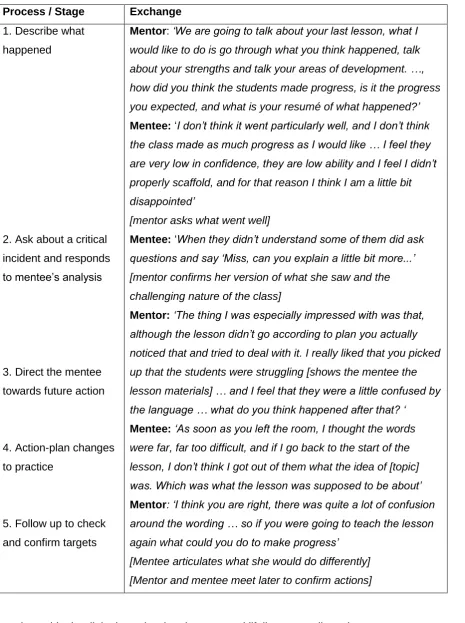
of the mentor’s expertise, realised in a form that the mentee can interpret as shown in this
3
Table 1: Exchange 1 - between mentor and mentee (excerpts)
Process / Stage Exchange
1. Describe what
happened
2. Ask about a critical
incident and responds
to mentee’s analysis
3. Direct the mentee
towards future action
4. Action-plan changes
to practice
5. Follow up to check
and confirm targets
Mentor: ‘We are going to talk about your last lesson, what I
would like to do is go through what you think happened, talk about your strengths and talk your areas of development. …,
how did you think the students made progress, is it the progress you expected, and what is your resumé of what happened?’
Mentee: ‘I don’t think it went particularly well, and I don’t think
the class made as much progress as I would like … I feel they are very low in confidence, they are low ability and I feel I didn’t
properly scaffold, and for that reason I think I am a little bit disappointed’
[mentor asks what went well]
Mentee: ‘When they didn’t understand some of them did ask
questions and say ‘Miss, can you explain a little bit more...’
[mentor confirms her version of what she saw and the challenging nature of the class]
Mentor:‘The thing I was especially impressed with was that,
although the lesson didn’t go according to plan you actually
noticed that and tried to deal with it. I really liked that you picked up that the students were struggling [shows the mentee the lesson materials] … and I feel that they were a little confused by the language … what do you think happened after that? ‘
Mentee: ‘As soon as you left the room, I thought the words
were far, far too difficult, and if I go back to the start of the lesson, I don’t think I got out of them what the idea of [topic] was. Which was what the lesson was supposed to be about’
Mentor: ‘I think you are right, there was quite a lot of confusion
around the wording … so if you were going to teach the lesson again what could you do to make progress’
[Mentee articulates what she would do differently] [Mentor and mentee meet later to confirm actions]
Leaving aside the dialogic tactics that the mentor skilfully uses to direct the mentee to
examine her own practice, notable in Exchange 1 is the closeness to context, and the
4
(SG - the relative context dependency of meaning). The mentee talks about her concrete
actions, how the class asked questions, and her preparation. The mentor introduces various
concepts including ‘progress’, and the ‘language’ of the lesson. One analysis of this point in
the exchange is a weakening of the semantic gravity (becoming more abstract) and a
strengthening of what Maton conceptualises as semantic density (SD - the relative
complexity of meanings). For example, the notion of ‘progress’ is dense and abstracted because it references not only the pupils’ learning but has inferences of monitoring and testing of their work. In this sense, the mentor’s use of the word ‘progress’ is quite vague and
circumspect (it is mainly tacit) and its broader inferences may be lost on the mentee. Now
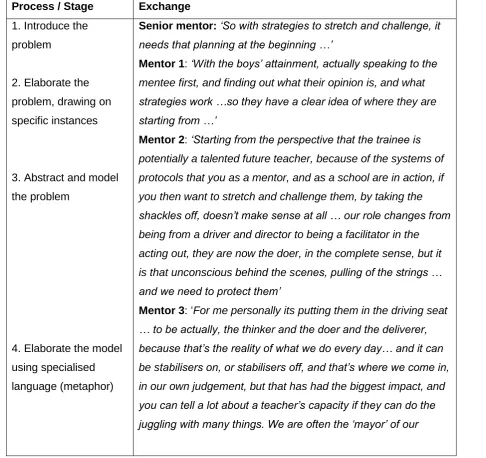
compare this to Exchange 2, below, between a senior mentor and a group of mentors talking
[image:5.595.66.553.310.768.2]about how to stretch and challenge mentees:
Table 2: Exchange 2 - between senior mentor and mentors (excerpts)
Process / Stage Exchange
1. Introduce the
problem
2. Elaborate the
problem, drawing on
specific instances
3. Abstract and model
the problem
4. Elaborate the model
using specialised
language (metaphor)
Senior mentor:‘So with strategies to stretch and challenge, it
needs that planning at the beginning …’
Mentor 1: ‘With the boys’ attainment, actually speaking to the
mentee first, and finding out what their opinion is, and what strategies work …so they have a clear idea of where they are starting from …’
Mentor 2: ‘Starting from the perspective that the trainee is
potentially a talented future teacher, because of the systems of protocols that you as a mentor, and as a school are in action, if you then want to stretch and challenge them, by taking the shackles off, doesn’t make sense at all … our role changes from
being from a driver and director to being a facilitator in the acting out, they are now the doer, in the complete sense, but it is that unconscious behind the scenes, pulling of the strings … and we need to protect them’
Mentor 3: ‘For me personally its putting them in the driving seat … to be actually, the thinker and the doer and the deliverer, because that’s the reality of what we do every day… and it can be stabilisers on, or stabilisers off, and that’s where we come in,
5 5. Return to problem
and action plan
classrooms, that’s where the practice is, and that’s where the majority of their learning is …’
Senior Mentor: ‘So what I am hearing is, push them out of that comfort zone, and saying to them, look you can be even better tomorrow than you are today’
In Exchange 2 we can observe a less-gradual decrease in semantic gravity (the
conversation becomes more abstract and further from context more quickly) and a steeper
increase in semantic density (there is a more rapid rise in the complexity of the language
used), before the senior mentor brings it back to concrete practice - what to say and what
they ask mentees to do (significant here, also, is that the senior mentor does not re-articulate
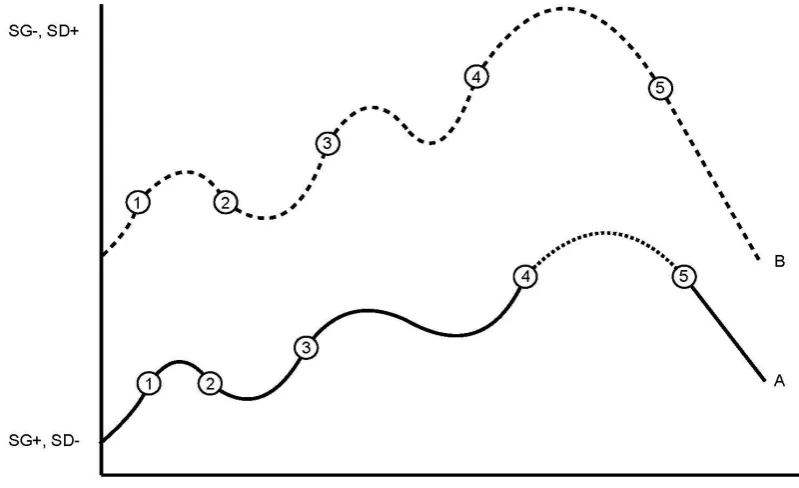
the key ideas as tangible concepts). I have plotted these two exchanges on a timeline as
‘semantic waves’ in Figure 1 below. The solid line A shows Exchange 1 and the dashed line
B indicates Exchange 2, and the numbers on the lines refer to the process/stages in the
appropriate tables above. For example, point 3 on line A shows the semantic coding of when
the mentor directs the mentee towards future action. And point 3 on line B is where the
[image:6.595.93.493.445.689.2]mentor abstracts the problem and models it for the other mentors.
6
This mapping shows only a broad impression of how semantic gravity and density vary in
these exchanges, and space does not allow close analysis in this working paper. In our
ongoing research (Grasmeder and Pountney, forthcoming) we are making a more detailed
analysis across a large data set of such exchanges. However, these semantic profiles
highlight important differences and shifts in meanings used in both instances. Exchange 1 is
closer to practice and context, and the meanings generated are less abstract. The mentors
in Exchange 2 start with context (albeit further from context and with more complexity than
Exchange 1) and they quickly begin abstraction into a model of mentoring (the curve is
steeper and semantic density is stronger).
Note however, that at its most dense and abstract (i.e. the elaboration of the model of
mentoring by mentor 3) the language used is metaphorical – e.g. the stabilisers (the mentee
learning to ride), being a mayor (mentee in charge of the classroom), juggling (having to multitask). This reliance on metaphor is more than a rhetorical technique: the words chosen
stand for, and do not merely replace, conceptual understandings, that are otherwise tacit.
What, then, are the specialised concepts, inferences and language that teacher mentors
use, and how might this specialisation of language assist mentoring practice?
Towards a specialised language and knowledge base for teacher mentors
Few would argue that to discuss things well requires a level of language and a conceptual
grasp of the subject, and that to exchange ideas on complex ideas such as practice involves
giving accounts and receiving and interpreting explanations of practice from others.
However, it becomes clear in analysing the accounts of teachers, both in the act of
mentoring and in talking and reflecting on their mentoring practice, that the knowledge base
for these mentoring practices is unclear. Therefore, I argue that, contrary to what the
literature on relational and therapeutic mentoring might suggest, teachers as mentors need
more specialised language (and conceptual knowledge) not less. This goes beyond
understanding what mentors mean when they talk about practice. It raises the question of
what meanings mentors have access to, and how these meanings shape their
understandings of their practice. But most importantly, specialised professional knowledge
(know that and know how) of and for mentoring enables mentors to imagine how their
practice can be different – in other words it is powerful knowledge.
References
Carter, A. 2015. Carter Review of Initial Teacher Training (ITT). Online:
www.gov.uk/government/publications/carter-review-of-initial-teacher-training
7
mentoring relationships. London: Routledge Falmer.
Collins, H. (2011). Language and practice. Social Studies of Science, 41(2), 271-300.
Department for Education (DfE) (2016) National Standards for school-based initial teacher
training (ITT) mentors. Online:
https://www.gov.uk/government/publications/initial-teacher-training-government-response-to-carter-review
Department for Education (DfE), 2019, Early Career Framework. Online:
https://www.gov.uk/government/publications/supporting-early-career-teachers
Furlong, J. and Maynard, T. (1995) Mentoring student teachers: The growth of professional knowledge, London: Routledge.
Hall, K. M., Draper, R. J., Smith, L. K., & Bullough Jr, R. V. (2008). More than a place to
teach: Exploring the perceptions of the roles and responsibilities of mentor teachers.
Mentoring & Tutoring: Partnership in Learning, 16(3), 328-345.
Hobson, A. J., Ashby, P., Malderez, A., & Tomlinson, P. D. (2009). Mentoring beginning
teachers: What we know and what we don't. Teaching and teacher education, 25(1), 207-216
Ingersoll, R. M., & Strong, M. (2011). The Impact of Induction and Mentoring Programs for
Beginning Teachers: A Critical Review of the Research. Review of Educational Research,
81(2), 201-233.
Kemmis, S., Heikkinen, H. L., Fransson, G., Aspfors, J., & Edwards-Groves, C. (2014).
Mentoring of new teachers as a contested practice: Supervision, support and collaborative
self-development. Teaching and teacher education, 43, 154-164.
Maton, K. (2013). Making semantic waves: A key to cumulative
knowledge-building. Linguistics and Education, 24(1), 8-22.
Pountney, R. and Grasmeder, A. (2018) Building bridges: enhancing mentoring skills,
knowledge and practice through an online course, CollectivEd 3: 50–56, Carnegie School of