The effect and interactions of interstitial hydrogen and
nitrogen in ferritic steels.
HIGGINS, Andrew D.
Available from Sheffield Hallam University Research Archive (SHURA) at:
http://shura.shu.ac.uk/19790/
This document is the author deposited version. You are advised to consult the publisher's version if you wish to cite from it.
Published version
HIGGINS, Andrew D. (2009). The effect and interactions of interstitial hydrogen and nitrogen in ferritic steels. Doctoral, Sheffield Hallam University (United Kingdom)..
Copyright and re-use policy
See http://shura.shu.ac.uk/information.html
ProQuest Number: 10697092
All rights reserved INFORMATION TO ALL USERS
The qu ality of this repro d u ctio n is d e p e n d e n t upon the q u ality of the copy subm itted. In the unlikely e v e n t that the a u th o r did not send a c o m p le te m anuscript and there are missing pages, these will be note d . Also, if m aterial had to be rem oved,
a n o te will in d ica te the deletion.
uest
ProQuest 10697092
Published by ProQuest LLC(2017). C op yrig ht of the Dissertation is held by the Author.
All rights reserved.
This work is protected against unauthorized copying under Title 17, United States C o d e M icroform Edition © ProQuest LLC.
ProQuest LLC.
789 East Eisenhower Parkway P.O. Box 1346
The Effects and Interactions of Interstitial Hydrogen
and Nitrogen in Ferritic Steels
by
Andrew D. Higgins
A thesis submitted in partial fulfilment of the requirements of
Sheffield Hallam University
for the degree o f Doctor of Philosophy
June 2009
The Effects and Interactions of Interstitial Hydrogen
and Nitrogen in Ferritic Steels
Thesis presented fo r a Doctorate in Philosophy
by
Andrew D. Higgins
Abstract
This thesis details work that has been carried out in three main areas, these are: The evaluation of a physical as opposed to a chemical method for measuring the quantity of ammonia formed when hydrogen is reacted with the free nitrogen in a steel sample. Unfortunately the work has shown that due to the very small quantities of ammonia produced this is not a viable technique. The findings also indicate that any method using hydrogen to extract nitrogen as ammonia will give an over estimate of the free nitrogen content.
The commissioning of a Vibran Interstitial Analyser and the design and development of a mathematical model which allows the free (uncombined) nitrogen and carbon contents to be determined from the measured data. The results from this work have been used to produce a modified equation for the predicting of the Impact Transition Temperature. There is also the possibility of developing a new method for measuring hydrogen in steel
CONTENTS
Page
Acknowledgements
41.0 Introduction
6
1.1 Objectives 10
2.0 Literature Review
11
2.1 Effects of Nitrogen in Steel 11
2.2 Measurement of Free Nitrogen 22
2.3 Effect of Hydrogen in Steel 28
2.4 Metallic Hydrogen 37
3.0 Experimental Work
433.01 Experimental Materials 43
3.1 Evaluation of the Feasibility of using a Thermistor Bridge to Measure a Small Concentration of Ammonia
in a Hydrogen Gas Stream. 44
3.2 The Measurement of Internal Friction using the Vibran
Interstitial Analyser. 55
Observations on the effect of Free Nitrogen on the Impact
Transition Temperature 82
The Effects of Hydrogen dissolved in Armco Iron. 93
3.3 Experiment to examine the Nature of Hydrogen dissolved in Iron. 93
3.4 Experiment to ascertain if Hydrogen gives rise to Dynamic Strain
Ageing in Iron. 110
4.0 General Discussion
1275.0
Conclusions
1436.0
Recommendations
1457.0
References
146Acknowledgements
I would like to thank the following people without whose help this project
would have been either much more difficult or much more expensive.
Professor John Atkinson, Professor Mike Bramhall, Keith Wright, Tim
O’Hara and Tony Eamshaw at Sheffield Hallam University, Stuart
Southeran at Coras Swinden Technology Centre and my friend Dr Paul
Roebuck who patiently let me try out ideas on him. And finally to my wife
Heather and Mark and Rachael my children for listening to my arguments,
challenging my ideas, correcting my English and putting up with me.
Andrew D. Higgins June 2009
Declaration
No material contained in this thesis has been used in any other submission
for an academic award.
Some results from the Internal Friction work are now in the public domain
in the following papers:
J.D. Atkinson, M.R. Corrigan and A.D. Higgins, Presentation at the
International. Co-operative Group on Environmentally Assisted Cracking
Annual Meeting. Antwerp, April 2005.
J.D. Atkinson, M.R. Corrigan, A.D. Higgins andZ.J. Zhao, The Interaction
fh
o f EAC and IDS A in C-Mn Piping Steels, 13 Environmental Degradation of
“If, in some cataclysm, all o f scientific knowledge were to be
destroyed, and only one sentence passed on to the next
generations o f creatures, what statement would contain the most
information in the fewest words? I believe it is the
atomic
hypothesis
that
all things are made o f atoms
-
little particles that
move around in perpetual motion, attracting each other when
they are a little distance apart, but repelling upon being squeezed
into one another.
In that one sentence, you will see, there is an
enormous
amount o f information about the world, if just a little
imagination and thinking are applied.”
Richard P. Feynman
1.0 Introduction
Due to the massive economic importance of steel in modem society, the role of the
interstitial element carbon has been extensively studied for over a hundred years. By
contrast for many years the role of nitrogen in steel was virtually ignored, yet steels
produced by Bessemer converters, where air was blown through the molten steel, had
significant nitrogen contents. With the introduction o f oxygen steelmaking, the loss of
the effects of nitrogen became apparent and this led to various major investigations into
the roles of carbon and nitrogen being carried out in the 1950s and 60s.
As a result o f the problems o f brittle failure that had occurred in large welded structures
this work tended to concentrate on the deleterious effects of nitrogen (and carbon) on
both fracture properties and the problems caused by yielding. This led to the
introduction of various techniques for removing or tying up interstitial elements and the
development of the Interstitial Free Steels (IFS). This particular aspect o f the work
being primarily driven by the needs o f the car manufacturers for formable sheet steel for
body panels.
Another area where the damaging effects of nitrogen (and carbon) has led to on going
investigations is in Dynamic Strain Ageing (DSA) where at temperatures in the region
of 250°C slow strain rate tensile testing results in a peak in the tensile strength and a
corresponding drop in ductility (normally measured as reduction o f area). This drop in
ductility at the temperature at which the blue patina forms on tempering a ground steel
surface was first reported by Stromeyer in the 1880s and gave rise to the term ‘blue
brittleness'k h. The problem had almost certainly been known to blacksmiths for many
Le Chatelier’s work in 1909 showed that at slow strain rates there was a corresponding
increase in the tensile strength of mild steel when tested in this blue brittle temperature
region(2).
In 1919 Fettwiess showed that this behaviour and the multiple or serrated yielding that
accompanied it was related to the static ageing phenomena and this gave rise to the term
‘dynamic strain ageing’(3) i.e. this appeared to be the same mechanism but due to the
increased temperature was occurring continuously rather than after a period of hours.
The work by Taylor(4), in 1934, on the concept of slip occurring as a result of the
movement o f dislocations within a crystal along with the experimental work of
Davenport and Bainp), in 1935, laid the foundation for Nabarro’s 1948 paper(6)
proposing that serrated yielding in steel occurred when the temperature was high
enough to allow carbon and nitrogen atoms to diffuse sufficiently fast to allow strain
ageing to take place during plastic deformation(7). Cottrell and Bilby’s work(8) refined
this concept of carbon (and later nitrogen) atmospheres locking dislocations.
Carbon tended to feature as the prime interstitial atom for dislocation locking probably
because carbon contents in steel were much easier to measure than nitrogen contents.
The value of nitrogen was recognised in the nineteen sixties particularly in the
aluminium killed C - Mn steels where aluminium nitride pinned austenite grain
boundaries giving a refined ferrite grain size on transformation1^ and the additional
benefit when coupled with controlled rolling110). However, relatively little attention was
paid to the role of ‘free’ or uncombined nitrogen.
In the nineteen nineties nitrogen’s value in producing fine alloy carbo-nitrides as
studies on the beneficial effects of nitrogen, with particular emphasis on corrosion
resistance, have continued and led in the 1990’s to the development by several
European steel makers of new hard stainless steels where carbon, which degrades the
corrosion resistance, was partially replaced with nitrogen, which enhances corrosion
resistance. These steels, in replacing some of the carbon with nitrogen, form nitrogen
rich martensites and fine carbo-nitrides rather than big brittle carbides. An example of
this type is Cronidur 30 made by a subsidiary of Krupps and Thyssen which only
contains 0.3% carbon but can be hardened to 700HV as a result of the 0.4% nitrogen it
contains. However, getting this high level o f nitrogen into the steel requires remelting
using a Pressurised Electro Slag Reactor (PESR). Silicon nitride is added during the
electro slag remelting and breaks down releasing nitrogen into the steel. The whole
process being carried out under nitrogen at a pressure o f -10 bar.
The French steelmakers Aubert and Duval have also developed a high nitrogen stainless
steel which does not require the use of a PESR. These developments have been mainly
driven by the needs of the aerospace industry.
Despite the promise shown by nitrogen in these more esoteric materials, relatively little
work has been done on the potential benefits of increased nitrogen levels in non-
stainless steels or on how the deleterious effects of nitrogen may be moderated.
The other major interstitial element that occurs in steel is hydrogen. Unlike the other
interstitial elements hydrogen does not appear to have any benefits and all the major
research has been on its removal, usually at the liquid steel stage, or on the production
of hydrogen resistant steels. However, the actual behaviour of hydrogen in steel still
presents some anomalies, a more detailed study of which may give a better
Similarly the interaction of relatively low levels of nitrogen and hydrogen in steel is a relatively unexplored area of metallurgy with possible new applications to be
1.1 Objectives of the Present Work
The initial objectives of this work
were;-1) Develop two separate methods for the determination of free nitrogen in steel,
one by hydrogen extraction and one by internal friction.
2) Use the free nitrogen values obtained to determine if an improved equation for
predicting Impact Transition Temperatures could be developed.
3) To detennine the nature of hydrogen dissolved in iron.
4) To see if there was any evidence o f Dynamic Strain Ageing, in steels with high
and low nitrogen contents, due to Hydrogen at temperatures below 0°C.
The experimental work for this project has divided down to four main
areas;-i) Determining the feasibility of using a thermistor bridge to measure the ammonia
produced when using hydrogen extraction to measure the nitrogen content o f a steel
sample.
ii) Measurement of the free nitrogen content by internal friction.
iii) Investigation o f the behaviour of dissolved hydrogen.
iv) Low strain rate tests to look for evidence of DSA due to hydrogen and to determine
2.0 Literature Review
2.1 Effects of Nitrogen in Steel
Early in the 20th century nitrogen’s fate might have appeared to have been settled;
"The injurious influence o f nitrogen on the mechanical properties o f iron is now firmly
proved. As shown by its position in Mendeleeffls periodic system, nitrogen would
necessarily be an injurious impurity. "!l2)
Whilst the benefits of carbon in giving steel its useful properties were recognised, for
nitrogen it would appear to be a case of'give a dog a bad name' syndrome (as nitrogen
was in the same group as phosphorus this ‘proved’ it must be bad). Tschischewski’s
paper, of which the above quote is the opening statement, dealt entirely with the loss of
ductility caused by nitrogen but with no mention of an increase in tensile strength. This
was probably the result of the very high quantities o f nitrogen (the lowest level
mentioned in the paper is 0.025%) used in his experiments which produced brittle
coatings of iron nitride on the surface of the iron wires used for determining the
ductility (measured as % strain). It should be pointed out however, that in the
subsequent discussion of the paper, Dr W. H. Hatfield felt Tschischewski had gone 'a
great deal too far' in his denunciation of nitrogen. However, the paper went on to
examine how nitrogen got into iron and the effects it had on the main alloying additions
but again only in very large amounts. The effects of this ‘bad name’ have been slow to
disappear and Tschischewski’s results were still being cited as late as the 1950’s(13).
Nitrogen, like carbon, when in solution as an interstitial in steel results in increases in
hardness and yield strength in the temperature range 100 - 200°C and a corresponding
decrease in toughness1l4). Various workers115,16) have also shown that nitrogen increases
nitrogen can result in a change in the fracture energy to occur above room temperature
with a resultant change from ductile to brittle behaviour. In pure body centred iron it
has been shown that nitrogen segregates to the grain boundaries and that this
segregation can result in intergranular embrittlement(17,18). This mechanism probably
occurs in steels, as killed steels where nitrogen is tied up by silicon or aluminium show
improved impact properties compared to un-killed or semi-killed steels(19). Bramhall
showed that additions of titanium and aluminium, in an 8%Mn steel, reduced the
Ductile Brittle Transition Temperature (DBTT) presumably by tying up free nitrogen
but also reduced the hardness in both the air cooled and the water quenched condition'20).
However, it is the effect on the yield that for many commercial steel applications has
resulted in nitrogen being simply regarded as an ‘undesirable residual’ due to the
phenomenon of strain ageing. Strain ageing is the reappearance of a yield point in steel
that has previously been deformed beyond the yield point into the plastic region. The
current interpretation for this phenomena was first put forward by Cottrell and Bilby in
1948(g). Their paper specifically dealt with carbon but they pointed out that the
arguments could 'with very little modification’ be applied to nitrogen. Nitrogen, and to
a lesser extent carbon, gradually diffuse to the preferential sites around the new
dislocations that have formed when the steel initially yielded This leads to the
reappearance of the yield phenomena and the associated problems this causes when
attempting to produce smooth cold formed shapes. Normally this only occurs after the
steel has been allowed to stand at room temperature for a period of several weeks or
m onths<21) but even a small rise in temperature can significantly speed up the diffusion
and so shorten this time. As a result, a lot of work has been carried out on producing
‘interstitial free’ steels, such that bulk steels with <20ppm of nitrogen are now routinely
Nitrogen generally causes more of a problem with strain ageing than carbon as a result
of its higher solubility in ferrite(23), the carbon being precipitated out on existing
carbides whilst the nitrogen is still free to migrate to new dislocations.
At temperatures above ambient but below ~400°C the return of the yield point occurs
much more rapidly and yielding becomes a continuous event known as dynamic strain
ageing as nitrogen (and some of the carbon) rapidly migrates to the preferential sites
around new dislocations as they form. This results in an increase in the tensile strength
of the steel, and a drop in the ductility and fracture toughness. These effects tend to
peak at temperatures around 250°C. This was explained (for carbon) by Cottrell and
Bilby as the formation of saturated atmospheres around new dislocations which would
only require a carbon level of 0.003wt%(8) (or a similar level of nitrogen). However,
Gladman has pointed out that the interstitial levels associated with strain age hardening
and strain age embrittlement are well in excess of this level(24). His suggested
explanation being that carbide (and nitride) precipitation occurs on the dislocations
giving an additional precipitation strengthening effect. Work initially by Baird and
MacKenzie(25) and later by Baird and Jamieson(26) showed that whilst nitrogen alone in
pure iron gave a high rate of strain hardening (a symptom of dynamic strain ageing) up
to 225°C a manganese and nitrogen addition to iron continued this effect up to 450°C.
Baird and Jamieson suggested that this effect was due to pairs or small clusters of
manganese and nitrogen atoms where the presence of the manganese restricted the
mobility of the nitrogen atoms around moving dislocations.
Nitrogen can exist in steel, either as uncombined ‘free’ nitrogen (sometimes called
lattice nitrogen), or chemically combined with other elements in the form o f nitrides or
be removed from low nitrogen steels by the addition of strong nitride formers such as
titanium which ties up any free nitrogen, preventing it’s migration to sites around
dislocations. However this is not a straight forward phenomena as Brindley and Bamby
have shown that in coarse grained low nitrogen mild steel strained in the temperature
range 200 - 300°C new dislocations form at such a rate that yielding, as evidence by a
drop in the stress without a previous rise, occurs repeatedly but this phenomena does not
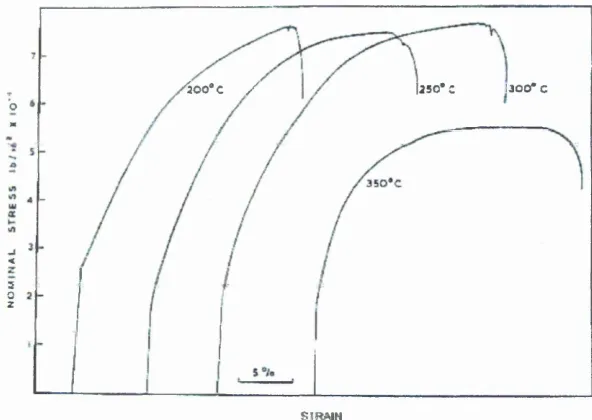
occur in a similar steel with a high free nitrogen content(27) (see figures 2.1 and 2.2).
Their explanation is that in the low nitrogen steel there is insufficient nitrogen to lock
the newly forming dislocations immediately, whereas in the high nitrogen steel the
dislocations are locked as they form and remain locked. This is reflected in the greater
capacity for work-hardening in the high nitrogen steel.
*
Ut
a.
3
-J
<
2
O2
Fig. 2.1 Stress - Strain curves for coarse grained low nitrogen material as a
function o f temperature.
(from Brindley and Barnby ' ')2 C O C
W c / 1250* C 1300* C
O
m
<
3
0 z
SSRAIH
Fig. 2.2 Stress - Strain curves for coarse grained high nitrogen
material as a function o f temperature.
(from Brindley and Barnby2.1.1 Interaction Effects
Work has been carried out by various groups on combined nitrogen and the benefits it
gives in terms o f fine precipitates and improved corrosion resistance. Pickering has
produced a review o f much o f this work(28).
Gavriljuk et al. have shown that nitrogen in austenitic stainless steel reduces the
damaging effects of hydrogen(29) but the main mechanism appears to be the stabilisation
o f the y phase(austenite) which hydrogen would normally cause to transform to the s
(epsilon) phase.
Plasma nitriding has been shown to reduce the absorption o f hydrogen in both Armco
iron and austenitic stainless steef30^ 1*. Various workers have also shown that nitriding,
and carbo-nitriding, give beneficial effects in fatigue(32,33,34,35) and moreover, nitrogen
whether from nitriding or in the bulk steel has been shown to reduce corrosion
fatigue(35). However, relatively little work has been done on understanding the
[image:18.614.118.414.36.246.2]with interstitial hydrogen, and on the role of possible precipitates of nitrides and
hydrides acting as nuclei for brittle fracture.
Hydrogen does react with nitrogen in the presence of iron to form ammonia;
N2 + 3H2 = 2NH3
And whilst the equilibrium constant, at room temperature, for the reaction is high
(6 x 10⁵) the process is extremely slow at room temperature(36).
Rogers' '7’, working with Armco iron specimens, showed that the yield point could be
removed when high levels of hydrogen were introduced into the specimen by
electrolytic charging. He postulated that hydrogen did not displace the carbon and
nitrogen atmospheres attached to dislocations but attached itself to loops o f dislocations
which were released from carbon and nitrogen atoms by thermal fluctuations, lowering
the energy, and thereby the stress, necessary for the formation of a critical-size loop.
This was based on internal friction measurements that showed there was no increase in
free nitrogen after hydrogen charging.
However, later work suggested that the loss of the yield point was not due to the
hydrogen per se but probably a result o f the plastic strain caused by the hydrogen
charging which gives hydrogen contents equivalent to those produced by exposure to
very high pressure hydrogen gas.
The explanation for the yield point at that time (-1950) was that yielding occurred when
the stress was sufficient to break the dislocation from its carbon and nitrogen
atmosphere. The current view, based on Cottrell and Bilby’s work(8), that yielding is
due to the formation of new dislocations which on subsequent ageing collect their own
The possibility still exists that hydrogen may affect the yield behaviour as Ferreira et
al(38) demonstrated that hydrogen reduced the elastic interactions between dislocations
and elastic centres which act as barriers, such as nearby dislocations and solute pinning
points. Based on the fact that this occurred in various crystal structures they suggested
that this was a general mechanism. The experimental work that they carried out
supported a ‘hydrogen shielding mechanism’ previously proposed by Sofronis and
Bimbaum(39,40,41) where the presence of a hydrogen atmosphere around a dislocation
‘shields’ its interaction with other elastic centres such as dislocations and solute atoms.
However, Ferreira's experimental materials, pure aluminium and stainless steel
containing molybdenum and vanadium, would have had very low levels of free
interstitials such as nitrogen for dislocation pinning.
Work has also been carried out which suggests that the peak conditions for stress
corrosion cracking, a hydrogen related phenomena, correspond to the peak conditions
for dynamic strain ageing(42), an effect known to be due to nitrogen, yet the two effects
are apparently due to two different mechanisms.
2.1.2 Impact Transition Temperature
Free nitrogen is known to increase the Impact Transition Temperature (ITT) and various
models have been proposed for estimating ITT(16), the most widely used o f these being
that due to Pickering and
Gladman(9,43);-ITT = - 19 + 44*(Si%) + 700*VNf + 2.2*(Pearlite %) - 11.5*d'I/2
However, this equation was a development of an equation for a simple plain carbon
steel produced by multiple regression analysis of a range of test results (9). There
appears to be no theoretical basis for the factor of 700xVNt- (Nf = free nitrogen content)
and the equations given in Pickering’s Kyoto paper(43) for flow stress and fracture stress
use straight free nitrogen values. (Brittle failure will occur when the flow stress, which
increases with decreasing temperature exceeds the fracture stress, which is relatively
unaffected by temperature.) Data generated by Mintz(16) indicated that the 700xVNf
factor only fitted steels with a low (<0.1 %) silicon content and that for steels with a
silicon content o f >0.1% a factor o f 2750 x %Nf gave a better fit.
From figure 2.3 it can be clearly seen that the square root of the free nitrogen content
gives a reasonable linear fit to the low silicon steels but not to the silicon killed steels.
Mintz’s equation for the silicon killed steels is ;
8 9
U-I
<(
Or.
i
UJ
z
o
1
o
Fig. 2.3 Influence of free nitrogen on impact temperature of low-silicon (-0.03%) and silicon-killed (~0.3%), 0.6%Mn steels Data standardized to grain size of d 4 =
8 mm'/2 and to zero A1 and Si levels using calculated correction factors and a Pearlite volume fraction of 16 ± 2%(16)
Similarly Bucher et al. (quoted in ref. 16) had found the following formula fitted their
data for as-rolled steels:
ITT = 60+ 1500*Nf% + 2*P % - 191 *d'1/2 - 48*Mn%
Again this formula uses the free nitrogen weight percentage rather than the square root
value. (It should also be noted that in both these equations the constant has a positive
value and is much larger than in the Pickering Gladman equation. )
30
y = 2960.2X- 32.847 R2 = 0.8167 20
10
0
A
-30
-40
o 0 .0025 0 .005 0 .0075 0.01 0 .0 1 2 5 0 .0 1 5
F ree N itrogen (wt%)
Fie. 2.4 Data for silicon-killed steels nlotted against % free nitrogen
Based on a Microsoft Excel plot the replotted values give a nitrogen factor of 2960
which is similar to the value of 2750 used in Mintz’s equation. (The plot shown in
figure 6 o f Mintz’s 1973 paper ‘I9) actually gives a factor o f 2570 for the free nitrogen
but this is probably a typing error.)
However, any attempt to model impact transition temperatures run into the problem that
the Charpy test has a very high level of variance‘44), i.e. poor reproducibility. Figures
2.5a and 2.5b show the scatter and the variance for Charpy and tensile results from 50
100
=2 80
a f3 £ 60 40 20
10 20 30 40
Test number
(a) 50 100 as 80 >» o ff 60 o cr CL 40
20
0
Mean
20 —10 0 10 20
Percent variation
(b)
Fig. 2.5a Variance encountered with Charpy impact testing of SAE 1040 at 21°C (70°F). AH tests were identical, (a) Scatter data, (b) Frequency distribution.
(from Van V lack(44))
100 c © o W) a CL c a> 80 60 40 20
10 20 30
Test number
(a)
40 50
100
Mean
- 2 0 - 1 0
Percent variation
Fig. 2.5b Variance encountered with tensile testing of SAE 104^ at 21°C (70°F). AH tests were identical, (a) Scatter data, (b) Frequency distribution.
2.2 Measurement of T ree’ Nitrogen
Measurements of nitrogen in steel can be either, total nitrogen which includes free or
lattice nitrogen, nitrogen combined as nitrides and carbo-nitrides and nitrogen in pores
or separate measurements of free, combined or pore nitrogen(45). Nitrogen can also be
measured in the liquid steel by the Nitris® technique where a mixture o f nitrogen and
helium o f known composition is bubbled through the liquid steel and the gas collected
and the composition compared with that of the original mixture(46).
The aim of this work is the effect o f free nitrogen in solid steel and there are three main
methods for determining free
nitrogen;-i) Hydrogen carrier gas method.
ii) Internal Friction measurements.
iii) Total nitrogen figure minus chemically insoluble fraction.
2.2.1 Hydrogen Carrier Gas Method
This method effectively uses the Haber Bosch process to react the free nitrogen with
hydrogen to form ammonia at around 450°C, the steel acting as a catalyst. The quantity
of ammonia formed is measured by a chemical titration. This method was refined by
Headridge and Long but requires the use of standardising solutions which have to be
freshly prepared for each set o f measurements(47,48). However, the method assumes that
any combined nitrogen (nitrides) will not break down at the temperature at which the
extraction is carried out. For instance manganese forms a range of compounds with
nitrogen (MnN, M ^N s, M113N2, Mn2N, Mn4N and MXN (9.2<x<25.3)<49>. (This supports
the idea put forward by Baird and Jamieson'26)). These have varying stability and along
metallic azides (AgN3, Cu(N3 ) 2 and Pb(N3)2) are unstable to the point of being shock-
sensitive and will detonate readily(49).
2.2.2 Internal Friction
There are two possible sites in a BCC alpha iron lattice that a small interstitial atom
could occupy; these are the tetrahedral and the octahedral sites. The average radii of
these sites are 0.36A for the tetrahedral and 0.19A for the octahedral. The common
interstitial elements all have larger radii than these sites, carbon 0.77A, nitrogen 0.72A
and hydrogen 0.46A. It would appear then that the tetrahedral sites would be the ones
most likely to be occupied. However, interstitial atoms such as carbon and nitrogen
occupy octahedral positions in body centred cubic iron, as in order to occupy a
tetrahedral site would involve displacing four surrounding atoms, whereas only two
nearest neighbour atoms need to be displaced in order to fit an interstitial atom into an
octahedral sitep0). This results in distortion in the structure, causing an elongation in a
tetrad direction and a small contraction in the corresponding diad axes, see figure 2.6|49).
o<C
CO
2*75 A O Iron atom # Nitroqen atom
In the absence of stress all the octahedral sites are equivalent and will be randomly
occupied. If a tensile stress is applied to the crystal these interstitial atoms will tend to
move to sites where the tetragonal extension is in line with the stress. This will occur
over a period of time dependant on the diffusion coefficient of the solute atoms.
If an oscillating stress is applied to the iron the solute atoms will move to preferred sites
with each alternate half cycle. This will take a finite time and so result in a phase lag
between stress and strain and energy will be absorbed by the system; this damping is
referred to as 'internal friction'. The amount of damping will be proportional to the
number of solute atoms and the frequency of the maximum damping will vary with the
type of solute atom and the temperature.
The internal friction is normally expressed as the logarithmic decrement 5 which is given
by;-8 = ]og(A„/Anl|)
(1)
Where A„ and An+i are the amplitudes of successive oscillations. If the system
is not allowed to freely decay, but driven at constant amplitude, then 8 is given
by;-5 = AW
(2)
2 W
Where AW is the energy lost (to heat) per cycle and W is the maximum amount
of energy stored in the sample during an oscillation. The phase angle a , between stress
and strain is directly related to the logarithmic decrement
by;-tan a = 5/
tc(3)
It is normal practice to express the magnitude of the damping (internal friction) in terms
given metal sample at a given temperature tan a is strongly frequency dependant and
can be expressed
by;-tan a = A
too(4)
( l + ( T C O ) 2)
Where A is the relaxation strength of the process and is directly proportional to the
number of solute atoms taking part, co is the frequency of vibration and x is the
relaxation time for the mechanism02’, x is related to the diffusion coefficient D, for the
solute atoms in a body centred cubic lattice,
by;-t = _ § L
(5)
36D
Where a is the lattice parameter and the diffusion coefficient is given
by;-D = by;-D0 exp (-Q/RT) (6)
Where R is the gas constant, T the absolute temperature, D0 a constant and Q the
activation energy for the diffusion process. From equation 4 it can be seen that the
damping is a maximum when xco = 1 giving
tan ot(max)
/ iA
(7)
Tan a(maX) can be determined by plotting tan a against temperature for a constant
frequency or tan a against frequency for a constant temperature. Normally a fixed
frequency is used as this is easier experimentally. The maximum damping, tan a<max) is
directly proportional to the number of solute atoms taking part in the damping process.
The most common form o f apparatus for measuring internal friction is the torsion
pendulum. The test specimen is in the form o f a wire attached to a pendulum bob which
around 1 Hertz (1 cycle per second). The specimen is enclosed in an oven so that the
temperature can be varied. Full details of the standard apparatus are given in reference
52.
Using a torsion pendulum Gladman and Pickering(x3) showed that manganese influenced
the position of the nitrogen peak and suggested that the displacement was in direct
relation to the manganese content. They concluded that the jump o f a nitrogen atom
between equivalent positions relative to a pair of manganese atoms would occur at a
lower temperature than a jump from such a position to a position between two iron
atoms. Further work by Couper and Kennedy(;>4)using a more advanced computer
analysis of the nitrogen peaks for several manganese contents showed that the peak was
actually made up of three (and in the case of high nitrogen levels four) peaks, which
corresponded to jumps in a pure iron lattice (Fe - Fe), a peak due to nitrogen jumping
around equivalent sites in a iron -manganese lattice (Fe-Mn) and a third peak equating
to a j ump from a Fe-Mn site to a Fe-Fe site.
This effect o f manganese may be due to the distortion o f the lattice caused by the
presence of a manganese atom (manganese has an atomic radius of 0.137nm compared
to 0.124nm for iron). It could also be due to a chemical attraction forming manganese
nitrides. In either case atoms such as silicon (0.1273nm), molybdenum (0.136nm), and
possibly chromium, should show similar effects. In the case of chromium which has a
radius of 0.125nm, there is no significant distortion of the lattice, as evidenced by the
fact that chromium additions to pure iron do not cause an increase in strength, however,
a chemical effect is likely as all three elements form stable nitrides. (Atomic radii taken
It is of interest to note that in the discussion following the presentation of
Tschischewski’s 1915 paper112) several speakers noted that the presence of manganese
appeared to increase the nitrogen retained in a steel.
In 1960 Heller, using a torsion pendulum operating at -1H z inside a Collins liquid
helium cryostat, showed that hydrogen gave an internal friction peak at 30K (-243°C)
and deuterium gave a broader peak around 37K (-236°C)p5).
Questions were raised as to whether this was a true internal friction peak but Gibala and
2.3 Effects of Hydrogen in Steel
The way that hydrogen is taken up by a metal depends upon a range of factors but
generally the metals can be divided into two main groups; the endothermic occluders,
where solubility increases with temperature and the exothermic occluders that form
pseudo-metallic hydrides and show decreasing solubility with increasing temperature^7’.
The first group the endothermic occluders include iron, cobalt, nickel, copper, silver and
gold and the Group Via metals. These metals only form solid solutions or very unstable
hydrides.
Iron will form a complex organic molecule with carbon, hydrogen and nitrogen,(58)
however the very large size of the molecule (FeC3 2Hi6N8) and its planar structure
containing benzene rings would preclude its formation within a steel.
The presence of hydrogen in ferritic steel, in virtually every instance, results in a
degradation of the steel’s mechanical properties. This is normally seen as an increased
tendency to cracking and this led to the use o f the term 'hydrogen embrittlement'.
However, with hydrogen the degradation is not a typical embrittlement which would
normally imply an increase in yield strength as well as a reduction in toughness, and
various workers have shown that for a range o f different steels there is either no
increase in yield strength or a slight drop(59 ~67). Furthermore hydrogen embrittlement is
enhanced by slow strain rates, unlike normal carbon and nitrogen embrittlement, and by
elevated temperatures 68’. Beachem<69' suggested that rather than embrittlement, the
basic hydrogen - steel interaction appeared to be an easing of dislocation motion and /
or generation. This is supported by ffactographic evidence for plastic flow and the
lowering o f the torsion flow stress in AISI 1020 samples subj ected to hydrogen pick
between dislocations and elastic centres such as nearby dislocations and solute pinning
points in fee structures, which act as barriers to slip. A similar effect was observed by
Matsumoto et al.(70) when low pressure hydrogen was admitted into an HVEM
containing a thin foil of high purity iron under a fixed strain: "An extremely rapid
dislocation motion and generation occurred resulting in a very high density o f
dislocations in the form o f tangles \ This did not occur when the experiment was
repeated with helium or air. Hanninen et al.(71) has also shown that hydrogen causes
movement o f dislocations in specimens of A533B under strain. In view of this
Hydrogen Assisted Cracking (HAC) is probably a better term to describe the
phenomenon. However, Hirth(72) suggested that enhanced dislocation motion is not the
complete solution but simply a contributory factor to the overall degradation process.
Mathematical analysis o f the concentration o f hydrogen at dislocations and cracks' 7 '
has given results that suggest unstable hydrides may form at such locations. This has
also been supported by other workers(74).
Hydrogen does appear to show a yield point effect at sub zero temperatures but there is
some question as to the actual temperature; some workers have suggested that it only
occurs below -120°C(75), whilst others have demonstrated a yield point at -70°C(76).
The issue is complicated by the fact that hydrogen, particularly when introduced by
cathodic electrolysis can cause plastic strain in iron and steel, strain which can reduce or
completely remove the yield.
As a result, Farrell(76) wrongly concluded that there was no true yield effect from
hydrogen. However, Adair and H ook<77) showed that hydrogen would give a yield
point which could be restored by "annealing" at -70 deg C, whilst not restoring the yield
appear to be conclusive proof that hydrogen does behave in a similar manner to carbon
and nitrogen but at lower temperatures. Furthermore, laboratory work at Sheffield
Hallam suggests that there is a yield point at room temperature but, due to the rapid
diffusion of hydrogen out of the specimens, the effect is only noticeable for a short time
after hydrogen charging(78). Lunarska claimed that at normal temperatures and
pressures almost all the lattice hydrogen, in a pure iron specimen, will diffuse out within
a few minutes after charging(79). This may be the case but other workers have suggested
that in normal steels it will take 24 to 48 hours for the hydrogen levels to drop back to
the pre-charged levels(80).
Additional evidence that hydrogen can show typical interstitial behaviour has come
from the work of Gove and Charles(81). Using a specially designed high temperature
micro-hardness tester(82), that could be operated in a pressurised hydrogen atmosphere,
they were able to show that hydrogen, when introduced under pressure as a gas, could
cause a reduction in the dynamic strain-ageing peak hardnesses in commercially pure
iron and in a mild steel(81), see figures 2.7 and 2.8. The size o f the reduction was found
to vary with strain rate, increasing with higher strain rates and when the hydrogen was
removed the peak reappeared. They looked at the possibility that the hydrogen was
reacting with the carbon and nitrogen to form methane and ammonia, however, the
highest temperature used in their experiment would have been too low to generate
methane and if ammonia had been formed it is highly unlikely that the process would
120
1200
1 0 0 0- 100
8 00
-E 600
40 4 0 0
-2 0 c i - o i n e r t a t m o s p h e r e
• hydrogen atmosphere 200kN /m 2 A hydrogen atmosphere 1-11 N/mm2
Fig. 2.7 The effect o f hydrogen on the hardness o f nominally pure iron.
from Gm e and Ctrarfes(81)
1 500 150
TOGO — CM £ E z OS SC-500—
- o inert atmosphere
• hydrogen atmosphere 200 kN/rrv
100 200 300 400 500 600
TEMPERATURE 7 *C
0
Fig. 2.8 The effect o f hydrogen on the hardness o f nominally pure iron.
from Gove and Charles
This led them to conclude that due to hydrogen’s greater mobility it would migrate to
preferential sites around dislocations formed during straining and so prevent carbon and
nitrogen atoms from occupying these sites and locking the dislocations. (The strain
aging peaks occurred at 250 - 350°C at which temperatures hydrogen has very little
locking effect on dislocations.) This effect is only a temporary phenomena as due to
hydrogen having a lower interaction energy than carbon and nitrogen (0.28eV compared
to 0.55eV) with a dislocation site it is displaced by carbon and nitrogen atoms when the
gas pressure is reduced.
This suggests that hydrogen may give rise to strain ageing phenomena similar to that
shown by nitrogen but at a lower temperature. This is the case with niobium where
Wilcox et al. found that a hydrogen content of 89 ppm. gave serrated yielding, a typical
feature o f strain ageing behaviour, at 25°C(83).
Furthermore, Hardie and McIntyre have shown that hydrogen caused a strain rate
dependant ductility minimum in niobium at sub-zero temperatures, see figure 2.9(S4).
elevated temperatures. However, they did not report any corresponding tensile stress
peak (a typical feature of strain ageing in steel). This may be due to the poor ductility
causing cracking and subsequent failure at loads lower than the true maximum strength.
This would appear to be an area where, if hydrogen really does show similar behaviour
to nitrogen but at lower temperatures, testing of hydrogen containing steel specimens at
sub-zero temperatures may show a dynamic strain ageing effect.
100 9 0
8 0
-£6 0
o
3 30
250 300
200 150
TEMPERATURE. °K.
100
Fig. 2.9 Effect of 25ppm H on the % reduction in area of
niobium as a function of temperature at various strain rates*84*.
Hydrogen has been shown to have similar effects to radiation damage which tends to
negate any increase in tensile strength due to DSA(85). (Radiation causes an increase in
the number of vacancies.)
Hydrogen is also known to damage fatigue properties o f steels both as a g a s(86 8 7 V a n d
when generated during corrosion134-. It has been shown that even the most 'resistant*
steel shows a sixteen-fold increase in fatigue crack growth rate in hydrogen at 150 bar
The issue is further complicated, as Cain and Troiano showed that the time to a
hydrogen induced fracture at a given stress level varied with the heat treatment of the
steel(87), i.e. varied with the microstructure. This effect was supported by later work by
Marsh and Gerberich(88).
2.3.1 The Movement and Transport of Hydrogen
The mobility o f hydrogen in metals is very large, exceeding by many orders o f
magnitude that o f the other interstitials. The cause o f this large mobility is not clear
because the nature o f the interaction o f hydrogen with metal lattices is not known well
enough.(89)
H2 has three possible alternatives for the distribution o f its valency electrons, since there
are two ionic states (H+ and H') and one covalent bonding arrangement between any
pair of hydrogen atoms (90). In the gas at room temperature the covalently bonded
molecule is the most common. However, when hydrogen is dissolved in a metal it exists
as an interstitial atom. The diffusion coefficient (D) of an interstitial atom is given by;
D = D0 c,-Q/RT)
Where D0 is the diffusion constant*9!) (or frequency factor*92*) and Q is the activation
energy for diffusion. The respective values for hydrogen, carbon and nitrogen are;
Hydrogen Dc= 1.14 x HT4 m2s 1 Q = 35.5 kJmole"]
Carbon D0= 4.88 x 10'7 m V 1 Q = 76.7 kJmole"1
Nitrogen D0= 3.94 x 10"7 m2s 1 Q = 82.0 kJmole"1 (91)
This gives diffusion coefficients at 20°C (293K) of 5.35 x 10"11 m V 1 for hydrogen
that with a reasonable concentration gradient significant diffusion of hydrogen will
occur at room temperature but not for carbon or nitrogen. The actual rate of diffusion
at room temperature for hydrogen will be in the order o f 25mm per day(85). However,
workers using tritium have reported that absorption and evolution of the gas during
plastic deformation is faster than can be accounted for by standard diffusion theory (93,94).
It has even been suggested that hydrogen diffuses by quantum mechanical tunnelling
(5 5,7 2) j | eper usecj concept of quantum mechanical tunnelling to explain why the
hydrogen internal friction peak was at 30K (-243°C) rather than the 50K (-223°C) the
temperature predicted by the classical theory. Quantum tunnelling does occur with very
small light particles, such as electrons, but this is unlikely to be the case with hydrogen
atoms as the probability of tunnelling decreases exponentially with the width of the
barrier and the square root of the mass o f the particle(9:)).
The absorption of hydrogen into SAE 4340 steel has been shown to be independent of
the microstructure at low to medium stresses <350 MPA (<50 ksi) but as the tensile
stress increases above 350MPa (50 ksi) the absorption increases rapidly in martensite
whilst remaining the same for ferrite (96).
In tests on hydrogen diffusion rates through metals, alloys and oxides Huffine and
Williams discovered that diffusion through a continuous oxide film is much lower than
through the metal (an FeCrAl alloy)(97).
However, simple diffusion is not the only mechanism for transport in hydrogen through
a metal lattice as lattice distortion, as in internal friction, can effect the diffusion rate.
Based on measurements of incubation times for crack initiation in hydrogen charged
metals Johnson et al. concluded that the tri-axial stress field ahead of a crack tip would
tip as a result of the lattice distortion(98). This was supported by Troiano based on
evidence that the log of the ratio of the incubation time to the absolute temperature
varied linearly with the reciprocal o f the absolute temperature167*.
Tien et al. produced a kinetic model for the transport of hydrogen, as Cottrell
atmospheres on dislocations. This gives a higher rate of transfer of hydrogen than
normal lattice diffusion and appears to fit data for ductile fracture, but would only apply
in these and similar high stress plastic flow situations(99).
As a consequence o f Matsumoto et al.’s findings on the effect of hydrogen on
dislocations^0' King and Block devised a mechanism for hydrogen induced dislocation
motion(100). They suggested that in addition to the solid solution softening proposed by
Matsumoto et al. and others(37,81) hydrogen induced motion could be a cause rather than
a result of the dislocation motion. Starting from the work done to move an edge
dislocation and the force exerted by a crack tip stress field on a solute atom (in this case
hydrogen ) they calculated that at a distance of 0.02mm ffom the crack tip each
hydrogen atom would experience a force of 3.2 x 10'15 N. Therefore based on a force
of 6.8 x 10'3 N to move a dislocation of one metre in length, if the dislocation Cottrell
atmosphere contained 2 x 10¹² atoms per metre (6.8 x 10 3/3.2 x 10 ^) the dislocation
would be drawn towards the crack tip. (This was based on the assumption that the
hydrogen atoms are all strongly enough bound to the dislocation to apply the individual
force on each atom to the dislocation as a whole.)
This value was higher than the value range suggested by Hirth (7I) o f 5 x 10⁹ to 1 x 10¹¹.
(These values were based on the Boltzman approximation used by Cottrell and Bilby
C = Co exp (W/kT)
Where C is the atom fraction at the defect field (dislocation), Co is the atom fraction
remote from the defect (equilibrium concentration) and W is the interaction energy
between solute and defect (k is the Boltzman constant - the ratio of universal gas
constant R to Avodagro’s constant NA).) Hirth’s values correspond to an equilibrium or
perfect lattice concentration of 6.13 x 10'7 this converts to a hydrogen content of 2 x
109 atoms per metre, which is additional to the dislocation core solute atmosphere. In
order to reach the hydrogen contents needed for dislocation motion the bulk lattice
concentration would need to be increased to a high level by electrolytic charging (10! )
Hydrogen can also be trapped within metals. This trapping can occur at lattice
defects*'3*, by adsorption at the interfaces of non-metallic inclusions and in microvoids
where the hydrogen forms gas molecules(100,101). Hirth suggested that the strong binding
energy between nitrides (and carbides) and hydrogen would draw hydrogen to the
interface1102). Podgurski and Oriani observed trapping of hydrogen in in nitrogen
treated Fe-Al alloys1103). The binding was believed to occur at the aluminium
nitride/ferrite interface. It has also been suggested that the apparently very high
hydrogen contents in Armco iron, reported by early workers, were due to trapping at
oxides which were present in these materials(104).
Several groups have shown that trapping occurs at interfaces and grain boundaries*105*.
Trapping at lattice defects has been put forward as an explanation of the anomalously
low and variable diffusivity o f hydrogen at temperatures below 200°C(I(>6) and Hargi et
al. have shown that at temperatures below 0°C grain boundaries actually reduce the
2.4 Metallic Hydrogen
One area of uncertainty is the state of hydrogen dissolved in steel. The position of
hydrogen in the Periodic Table suggests that solid hydrogen should be metallic. In 1935
Wigner and Huntington published their results of theoretical calculations on the density
and heat of vapourisation of a potential metallic hydrogen(108). The paper gave details of
the method used for estimating the density and heat of vapourisation o f metallic
hydrogen based on a calculated energy for the hydrogen electron. The initial
approximate figures gave a density of 0.8 (as compared to 0.087 for solid molecular
hydrogen) and a heat of vapourisation into atomic hydrogen of 48.7 cal as compared to
52.5 cal, the heat of formation of the molecular form. Both these values show that the
molecular form is the more stable but suggest that under high pressure it may be
possible to alter the crystal structure to the metallic form. However, the paper went on
to refine the calculation and points out that the wave function is more complex than that
for sodium, on which the original calculation had been based, due to the electron being
restricted to a single shell.
The calculations are reworked using several different methods all of which indicate a
slightly lower density (0.59 to 0.62) and a much lower range for the heat of
vapourisation (10 to 16 cal) both of which properties would make metallic hydrogen far
less stable than the normal molecular form.
The conclusion gives further information on normal solid hydrogen which consists of
molecules with an inter atomic distance o f 0.075nm held together by Van der Waals
forces giving a distance of 0.33 nm between atoms in adjacent molecules. In a metallic
structure these two distances would be equal as all the bonds would be metallic, i.e. a
molecules together and the atoms within individual molecules apart but Wigner
calculated that the pressure to achieve equidistant spacing would be in the order of
250,000 atmospheres. However, later work showed that even when subjected to a
pressure of 2.5Mbar solid crystalline hydrogen does not show metallic properties(109).
In 1979 Bell and Mao working at the Carnegie Institute for Science, using a diamond
anvil high pressure cell, produced a new form of solid hydrogen which they believed
was a step towards solid metallic hydrogen1110).
Work at Carnegie has continued and model studies have indicated that metallic
hydrogen could exist in the centre of gas giant planets such as Jupiter1111,112).
In 2002 a French team compressed hydrogen to a pressure o f 320 GPa at 100 Kelvin.
They noted that at 290 GPa the hydrogen turned white then as the pressure increased
went through yellow, orange, red and final became opaque at 320 GPa. Above 300
GPA the team found evidence of a lowered energy band gap - a feature of
semiconductors. The band gap narrowed as the pressure increased to 320 GPa (this was
the maximum pressure they could achieve with their existing equipment). Extrapolating
from these results the team calculated that at 450 GPa the band gap would disappear i.e.
the hydrogen would become fully metallic1113,114).
In hydrogen at ambient pressure the band gap between the highest filled electron energy
level and the next available level is 15eV which would qualify it as an insulator. In
1996 a group from the Lawrence Livermore Laboratory11151 using a shock pulse system
were able to lower this gap down to 0.3eV in fluid hydrogen, using pressures in the
range 1.0 - 1.4 Mbar. This is a level comparable to the thermal energy o f the fluid, i.e.
calculations for fluid deuterium, from which it was concluded that insulator to metal
transition during a shock pulse is driven by molecular dissociation016).
Gibaia M7> referred to hydrogen in metal as being ‘ionized’. However, ionization
normally results from either the splitting of a molecule to form positively charged
cations and negatively charged anions or as a result of direct high voltage charging o f an
atom. Neither of these situations occur when hydrogen dissolves in a metal.
However, a possible explanation for hydrogen’s rapid diffusion, that this work seeks to
clarify, would be that hydrogen when dissolved in a metal exists in a metallic state, that
is it’s electron is part of the metallic electron cloud leaving a single proton with a
diameter in the order of 4 x 10~6 nm. As a result of work on metal clusters in large
organic molecules, Cavanaugh et al. speculated that hydrogen could exist as 'screened
protons' as well as H2 molecules and as though it were negatively charged ligands (118).
However, in bulk metal the negatively charged particles would only exist, as they
pointed out, if the hydrogen interacted with impurities. Similarly gas molecules will
form if there are voids in the metal. However, in the absence of voids and impurities
then a possible state of dissolved (interstitial) hydrogen could be as protons i.e. a
metallic state. A concept suggested by Farrell(77) back in 1965.
If hydrogen exists in this metallic state this could account for the very high diffusion
rates, reported by Donovan et al. {93-94\ as the proton would diffuse rapidly through the
structure. In their work on the structure of the atom Geiger and Marsden had shown
that when a thin beam o f alpha particles (helium nucleii consisting of two protons and
two neutrons) was shone on a thin gold foil -90% of the particles passed through the
foil with very little deviation and only 1 in 8000 was scattered straight back towards the
through a metallic lattice. The work by Heller in 1961(53) and later repeated by Gibala
and Kumnick(56) both found an internal friction (Snoek) peak for hydrogen at 30 Kelvin
(-243°C) when stressed at ~1 Hz, i.e. behaviour consistent with atomic hydrogen. This
would appear to indicate that at very low temperatures a significant proportion of the
hydrogen is in an atomic interstitial state rather than a metallic ‘proton’ state. However,
the peak found by Heller was at a lower temperature than predicted by classical theory
(this predicted a peak for atomic hydrogen at 50K). Heller suggested quantum
tunnelling as an explanation. However, it could be better accounted for if the hydrogen
were ‘metallic’ when it would be a proton that moved to the new site leaving its original
electron as part of the electron cloud and collecting a ‘new’ electron at the new site.
The presence of some of the hydrogen in a metallic state could be expected to show
behaviour similar to a solid state ionic solution and could be an explanation for some of
the trapping phenomena if the proton (hydrogen ion) was forming metastable ionic
compounds as has been suggested by Hirth and Carnahan(73).
Theoretical calculations of the effects on the electron structure (the energy bands and
electron density) of carbon, nitrogen and hydrogen in iron, by Graviljuk et al.(121) have
shown that nitrogen and hydrogen promote the metallic character by increasing the
concentration of free electrons whilst carbon has the opposite effect, enhancing
localisation of electrons at the iron atoms promoting the covalent characteristic o f the
inter-atomic bonds. They also conclude that the increased concentration o f free
electrons in the dislocation atmospheres due to the effect of hydrogen should decrease
the line tension, the distance between the dislocations (as reported by Ferreira et a l.(37))
An increase in plasticity and reduction in dislocation spacing would suggest that a small
addition of hydrogen should reduce the work hardening (strain hardening) rate. This
will be the case at simple dislocation pile-ups, such as occur at grain boundaries and
obstructions such as small incoherent precipitates. However, work hardening is not
simply related to dislocation spacing but also to the interaction of dislocations on
differing slip planes. Any dislocation moving in a specific slip plane will have to
intersect dislocations in other slip planes that cross the specific plane. These intersected
dislocations are known as ‘forest dislocations,(122,123). The actual effect on dislocation
mobility depends upon the types o f dislocation, edge or screw, that intersect and
hydrogen will have less effect on these interactions.
Having said this Gourmelon did find that in a single crystal of high purity iron at low
strains the strain hardening rate and the flow stress were reduced when hydrogen was
present but at higher strains the opposite effects occurred1124). Lunarska et al related
this behaviour to the differing methods of slip that occurred within a single crystal with
increasing strain(79).
At room temperature in pure iron a three stage shear stress - shear strain can be seen in
iron crystals. ‘In Stage I, dislocations o f the primary slip system glide over large
distances. With increasing strains, dislocations become jogged as a result o f there
mutual interactions and cross slip. These jogs restrain dislocation mobility, but act as
dislocation sources. At the end o f Stage I, dislocations are accumulated in sheets
parallel to the primary slip plane. These dislocation sheets (about 2pm wide) are stable
throughout Stages II and III, being the main obstacle fo r dislocation motion. The
long-range stresses produced by dislocation sheets are considered to be the cause o f work
hardening in Stage III. ,<12y'
These variations in slip that can be observed in a single crystal would not be apparent in
a normal polycrystal fine grained steel, therefore any change in the strain hardening rate
that could be observed would depend upon the main slip mechanism that was in
operation.
This leaves open the following questions:
Does hydrogen when dissolved in steel show metallic behaviour and can the increased
micro ductility of a hydrogen treated steel be used to increase the measured ductility of
3.0 Experimental Work
3.0.1 Experimental Materials
The following materials have been acquired for these
investigations;-♦ Armco iron bar - purchased from Goodfellow Cambridge Ltd.
♦ Mild steel plate with medium low nitrogen content.
♦ Mild steel plate with high free nitrogen content.
The compositions and cast numbers for these metals are given in table 1.
Table l.C hem ical Analysis (ppm)
Material Cast C
wt % Si wt%
Mn wt %
P wt %
s
wt %
Cu wt %
Al wt %
N (total) ppm Armco
iron
Fe7970 0.001
* <0.1 0.05 0.003 0.005 0.007
- 30
Mild Steel F8104 0.17 0.33 0.83 0.008 0.005 - 0.03 44
Mild Steel F8105 0.16 0.33 0.84 0.010 0.005 - <0.004 130
3.1 Evaluation of the Feasibility of using a Thermistor Bridge to
Measure a Small Concentration of Ammonia in a Hydrogen Gas
Stream
The determination of free nitrogen in steel can be carried out by passing pure hydrogen
over filings of the sample steel at a temperature of 450°C. The principle is that
hydrogen reacts with the free nitrogen, but not with that combined as nitrides, to form
ammonia. The quantity o f ammonia is then measured to give the original free nitrogen
content. The ammonia can be measured by various techniques based on either
potentiometric titration or the indophenol blue colourmetric method. An improved
version o f this technique was developed by L ong(126) who used an ammonium ion
selective electrode to measure the amount of ammonia released. However, in order to
calibrate the measurement a set of standard strength solutions have to be freshly made
up, making a single measurement expensive and time consuming.
The weight of nitrogen in a one gram sample steel containing lOOppm of free nitrogen
is 0.0001 g.
Nitrogen has a Gram Atomic weight of 14 g and ammonia has a Gram Molecular
Weight of 17 g.
N + 3H —► NH3
As one atom of nitrogen combines with hydrogen to give one molecule o f ammonia,
therefore lg of steel will give 0.0001 x 17/14 grams of ammonia.
Which = 0.0001 x 17 Gram Molecules of Ammonia
14 x 17
This will give 22.4 x 1000 x 0.0001 / 14 = 0.16 ml of ammonia at STP.
With a hydrogen flow rate of 140ml/min and assuming all the nitrogen is extracted as
ammonia in 30 minutes this would give an average concentration of ammonia in the gas
stream o f 4.08 x 10³ %. However, it is likely that the bulk of the nitrogen will be
extracted from fine filings within a few minutes of the metal reaching temperature.
Assuming that three quarters of the nitrogen is extracted in the first five minutes then
the concentration during that time would be 0.018%.
The aim of this section of the work was to determine if this small quantity of ammonia
could be measured by its effect on the heat transfer efficiency of the hydrogen gas
stream. Convective heat transfer is governed by the conduction across the boundary
layer the thickness of that layer depending on the viscosity of the fluid and the velocity
of flow. Hydrogen has the highest thermal conductivity of any gas at 0.167 W.m'1! ' 1
(127> compared to ammonia gas which has a thermal conductivity o f 0.022 W .m^.K'1
(128). A simple calculation based on these values would suggest that a concentration of
0.018% ammonia in the gas stream would decrease the thermal conductivity by 0.26%.
The thermal conductivity o f a pure gas (k) can be modelled by the following equation;
k = V3Cmnlc
where cm is the heat capacity per molecule,
n is the number o f molecules
1 is the mean free path
c is the mean velocity of the molecules.
Using a simplified estimation for the mean free path 1 the equation predicts that the
thermal conductivity will not vary with pressure except at very high or very low
pressures1129*. This has been found to be the case for noble gases such as argon when
predict the effect of changing temperature on thermal conductivity. This is because in
the equation the assumption is made that there is an equilibrium distribution of energy
between molecules (or atoms) that have just collided but even with monatomic argon
this is not the case as work by Kannuluik and Carman has shown0 30).
The problem becomes even more complex for a mixture o f molecular gases as the mean
free path is affect by interactions between the molecules and the distribution o f energy
cannot be treated as an equilibrium distribution due to the different masses of the
colliding molecules. This makes the calculation of the actual thermal conductivity o f a
mixture of gases extremely complex031,132,133,134). The conductivity is influenced by a
range of factors all of which would tend to increase the effect of the higher molecular
weight gas (ie. increases the apparent concentration o f ammonia).
However, changes in thermal conductivity of a gas mixture have been used as a means
of analysising the composition of gas mixtures particularly binary mixtures one
component o f which is hydrogen035 1361.
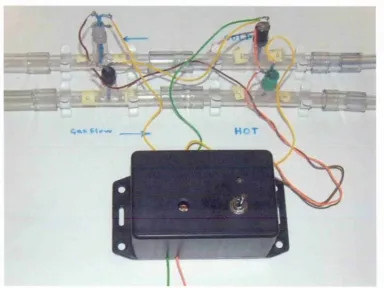
In this work it was hoped that the actual change in the thennal conductivity could be
measured to an acceptable degree of accuracy by using a set of thermistors in a
Wheatstone bridge network.
The thermistor is a temperature sensitive device where, unlike normal resistance
materials, the resistance decreases with increasing temperature0371. However, the
relationship between resistance and temperature is highly nonlinear compared to other
temperature sensing devices, see figure 3.1.1.
For a 10,000 ohm base level thermistor (measured at 25°C) over a small range the
R
es
is
ta
n
ce
(R
)
thermistors very useful for detecting small changes in temperature. If four matched
thermistors are used in a Wheatstone bridge network then very small changes in
temperature can