
An assessment of the use of conifer
plantations by the Kerry Slug
Geomalacus maculosus with
reference to the potential impacts of
forestry operations
An assessment of the use of conifer plantations by the Kerry Slug
(Geomalacus maculosus) with reference to the potential impacts
of forestry operations
Inga Reich, Kim O’Meara, Rory Mc Donnell and Mike Gormally
Applied Ecology Unit, Centre for Environmental Science, School of Natural Sciences, NUI Galway,
Ireland.
Citation:
Reich, I., O’Meara, K., Mc Donnell, R.J. and Gormally, M.J. (2012) An assessment of the use of conifer
plantations by the Kerry Slug (Geomalacus maculosus) with reference to the impact of forestry operations. Irish Wildlife Manuals, No. 64. National Parks and Wildlife Service, Department of Arts, Heritage and the Gaeltacht, Ireland.
Keywords: Kerry Slug, Geomalacus maculosus, Mollusca, Arionidae, protected species, conifer plantation, forestry operations, Connemara
Cover photo: Kerry slug © Timothy Collins
The NPWS Project Officer for this report was: Dr Brian Nelson; [email protected]
Irish Wildlife Manuals Series Editors: F. Marnell & N. Kingston
© National Parks and Wildlife Service 2012
Contents
Contents ... 1
Executive Summary... 1
Acknowledgements... 2
Introduction ... 3
Background information on Geomalacus maculosus... 3
Research Objectives ... 4
Investigation of potentially suitable Geomalacus maculosus habitats in previously unsurveyed hectads in Ireland ... 5
Analysis of the spatial distribution of Geomalacus maculosus in Cloosh Forest, Co. Galway ...11
Locations of Geomalacus maculosus within Cloosh Forest...11
Detailed investigation of Geomalacus maculosus distribution at Seecon...14
Habitat requirements of G. maculosus at Cloosh Forest...22
Environmental parameters...22
Geomalacus maculosus feeding trials ...24
The potential impact of forestry operations on the distribution and abundance of G. maculosus at Cloosh Forest ...31
Management Recommendations ...36
Future Research ...36
Bibliography & Relevant Literature ...38
Appendix 1: Results of hand search and trapping for the presence/absence survey...40
Appendix 2: Detailed description of the sites visited for the presence/absence survey ...41
Appendix 3: Number of slugs of each species found under the traps in each hectad ...44
Appendix 4: Number of G. maculosus found under traps during sampling at Seecon, Cloosh Forest....45
Appendix 6: Environmental parameters measured for each trapping tree in all transects at Seecon,
Cloosh Forest ...50
Appendix 7: Number of G. maculosus found under the traps in the clearfell and in the mature plantation at Lettercraffroe, Cloosh Forest. ...55
Appendix 8: Minimum, maximum and average temperatures measured in the clearfell and mature
Executive Summary
The Kerry Slug, Geomalacus maculosus is listed on Annex II and IV of the EU Habitats Directive 92/43/EC. The slug is also protected under the Wildlife Act 1976 (as amended) having been added under Statutory Instrument No. 112 of 1990. Historically, within Ireland, G. maculosus was thought to be restricted to the Devonian Old Red Sandstone strata of West Cork and Kerry. However, during July 2010, the species was collected on granite outcrops and on the trunks of conifer trees in Cloosh Forest, a conifer plantation near Oughterard, Co. Galway (Kearney, 2010). The widespread planting of
commercial conifer forestry was originally thought to have had a detrimental effect on populations of
G. maculosus (NPWS, 2010) but results from McDonnell and Gormally (2011a) indicate otherwise. The discovery of the protected slug in Cloosh Forest provided the incentive to survey possible habitats of G. maculosus in the counties which lie between the known populations in Kerry and Cork and the newly discovered population in Co. Galway, to determine the possibility of an existing corridor through which the slug might have migrated. A presence / absence survey of G. maculosus at a total of 42 sites within 15 hectads in counties Galway, Clare, Limerick and Kerry was undertaken between 10/10/2011 and 22/11/2011 but no G. maculosus were found.
Given that the Kerry Slug was not found at the above sites, research focused on the recently discovered Kerry Slug population in the conifer plantation in Cloosh Forest, Co. Galway. In order to establish if and how habitat factors affect the occurrence of G. maculosus within Cloosh,hand searches and live trapping were undertaken from November 2011 to April 2012 to determine the outer extremities of the distribution of the slug at the site. Results found a localized population of the Kerry
Slug at Cloosh and it is, therefore, likely that the species was introduced through anthropogenic sources possibly stemming from activities associated with commercial forestry operations.
Transects were utilized from October 24, 2011 to January 23, 2012 to determine the distance from the main public road (along a selected forest road) the slug was found in addition to the distance (up to
90m) the slug had penetrated into dense forestry plantations from the edge of the forest road. Throughout the 13 week survey, a total of 1009 slugs (7 species) were trapped of which 27% were G. maculosus. While the species was trapped in dense forest up to 90m from the forest road edge, it was only trapped up to 1.2km from the main public road although suitable habitat exists for a further ~2km.
An investigation of environmental parameters and food sources available to the Kerry Slug in Cloosh Forest took place between December 2011 and April 2012 to address the paucity of information
regarding the ecology of the species. A weak positive correlation between Kerry Slug abundance and bryophyte cover and Kerry Slug abundance and the circumference of the trunk at breast height (CBH) was found. It was also found that lichens were the preferred food source with preliminary studies on lichens taken from conifers in Cloosh showing that the foliose lichen Platismatia glauca is the most favoured species while Lepraria incana is the least favoured species. Six crustose lichen species taken from granite rock outcrops around the conifer plantation at Cloosh were also consumed by the Kerry
The creation of buffer zones to ensure the protection of the endangered Freshwater Pearl Mussel (Margaritifera margaritifera), has resulted in the felling of conifers along water bodies within plantations. In the case of Cloosh forest, tree stumps (about 3m high) were left in place in buffer zones
as a possible mitigation measure for the protection of G. maculosus (Nelson, pers. comm.). The success of the remaining tree stumps and clearfell in supporting G. maculosus by comparison with an adjacent mature plantation was investigated from October 24, 2011 to April 30, 2012. While numbers of Kerry
Slugs in the mature plantation were significantly higher throughout the sampling period, the tree stumps left in situ at the clearfell site also provided a habitat for the slugs. No correlation was found between temperature and slug abundance in the clearfell or mature plantation, neither on the day of sampling nor on the day prior to sampling.
Acknowledgements
Sincerest thanks to Paul Whelan for his time, effort and advice with lichen identification and to
Eamonn O’Sullivan for his assistance with bryophyte identification. We are grateful to Dr Brian Nelson for useful discussions on all aspects of this report and also to Dr Roy Anderson for advice on slug ecology and identification. Thanks to Barry Rintoul of Coillte for providing information on the
Background information on
Geomalacus maculosus
The Kerry Slug, Geomalacus maculosus, was first discovered in Co. Kerry, Ireland in 1842 and described as a new species in 1843 (Allman, 1843, 1844, 1846). In 1868 the species was discovered in northern Spain and five years later it was collected in northern Portugal. Although it has been reported from
Brittany in France (Desmars, 1873), the absence of museum specimens means that the French record is now widely regarded as being erroneous (Platts & Speight, 1988; Falkner et al., 2002). While three other species of Geomalacus are recognized i.e. G. anguiformis, G. malagensis and G. oliveirae (Castillejo et al., 1994), these are not known, nor is there any evidence to suggest that they exist in Ireland (Platts & Speight, 1988).
Although, in recent times, G. maculosus has been repeatedly collected in south-west Ireland and northern Spain, it is listed as ‘vulnerable’ in Spain by Verdu & Galante (2005) and in Ireland there is a lack of quantitative data on favourable management practices, the habitat size required to sustain
populations and genetic variation across its home range (NPWS 2008). For these reasons and because of its narrow global distribution, G. maculosus is listed on Appendix II of the Bern Convention and subsequently on Annex II and Annex IV of the EU Habitats Directive 92/43/EC. Annex II lists fauna
and flora species that require the designation of Special Areas of Conservation for habitats that contribute to conserving these species. In Ireland, seven Special Areas of Conservation (SACs) have been designated for Geomalacus maculosus (NPWS, 2010).
Annex IV lists fauna and flora species of community interest that require strict protection. In addition,
under Irish legislation the slug is protected by the Wildlife Act 1976 under Statutory Instrument No. 112 of 1990. The main threats to G. maculosus in Ireland were considered to be afforestation and forestry management, invasion of woodland by Rhododendron ponticum, agricultural reclamation and infrastructure development (NPWS, 2010).
A recent conservation assessment of the species in Ireland (NPWS, 2008) concluded that it was in Favourable Conservation Status and that there was no evidence of any recent range reduction. However, this assessment was based on limited data on populations, distribution and habitat condition, particularly outside SACs (NPWS, 2008). In addition, Byrne et al. (2009) concluded that Irish populations of G. maculosus were strong, globally important, could expand with global warming and the species was assessed as of least concern under IUCN red list criteria.
(Platts & Speight, 1988; NPWS, 2010). Mc Donnell et al. (in press) also cited wet grassland as a potentially suitable habitat for the species. Within these habitats, G. maculosus tends only be present if there is outcropping of Devonian Old Red Sandstone (NPWS, 2010), humid conditions and lichen,
liverworts and/or mosses in which the species can shelter and on which it can feed (Platts & Speight, 1988). While Platts & Speight (1988) and Boycott & Oldham (1930) reported the species disappearing in limestone areas and reappearing with the occurrence of sandstone, a recent laboratory investigation
by Barrett (2011) did not find that the Kerry Slug had a significant preference for either sandstone, granite or limestone.
Individuals that occur in woodlands tend to be brown with yellow spots whereas in more open situations specimens are grey/black with white spots. Juveniles, on the other hand, usually have two dark lateral stripes which become less obvious with age. G. maculosus is also capable of rolling into a ball (Plate 1) when it is disturbed (Platts & Speight, 1988) and this is a useful identification character for the species.
Plate 1: Specimen of Geomalacus maculosus collected in a woodland (© Eugene Cush).
Like many slugs, G. maculosus is a crepuscular animal and it takes refuge in crevices in rocks or under the bark of trees during the day. However, Platts & Speight (1988) and Taylor (1907) recorded diurnal activity during or after rain. In terms of life history, the species is hermaphroditic and can self-fertilise. Eggs are deposited between July and October in batches of 18-30 with hatching taking place after 6-8
weeks (Rogers, 1900). Juveniles usually reach maturity after two years and specimens can live for more than 6 years (Oldham, 1942).
Research Objectives
1. To provide data on the range of the species by investigating potentially suitable habitat in unsurveyed areas of counties Clare, Galway, Limerick and Kerry through presence/absence
surveys.
2. To provide detailed information on the spatial distribution of the species in a conifer plantation at Cloosh Forest, Co. Galway.
Investigation of potentially suitable
Geomalacus maculosus
habitats in previously unsurveyed hectads in Ireland
Rationale
The range of G. maculosus in the south-west of Ireland was updated during 2009 and 2010 by Mc Donnell et al. (in press) and at the same time, the species was discovered in Cloosh Forest, Connemara, Co. Galway (Kearney, 2010). This provided the incentive to survey suitable habitats in the counties
which lie between the known populations in SW Ireland and the newly discovered population in Co. Galway, with a view to determining the presence of a corridor through which the slug may have migrated.
Materials and methods
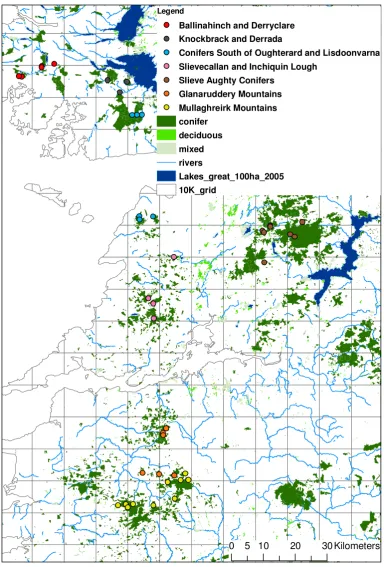
The presence or absence survey for G. maculosus in a total of 42 sites within 15 hectads in counties Galway, Clare, Limerick and Kerry (Figures 2.1, 2.2, Appendices 1 & 2) took place between October 10, 2011 and November 22, 2011 was initiated by a hand search, which took place in damp weather and lasted for about 45 minutes at each site. Searching for the species in woodlands involved checking under carpets of epiphytic bryophytes and lichens growing on tree trunks while on blanket bogs and heaths, specimens were often found between the vegetation and the base of rock outcrops Each of the
15 hectads had a maximum of 3 different survey sites and if no Kerry Slugs were found by hand searching, up to two metric traps were placed on tree trunks (Mc Donnell & Gormally, 2011b) within
the forests at each site (Plate 2). Traps were baited with carrot and checked after three weeks. A licence under section 23 of the Wildlife Act was acquired from NPWS before commencing the study.
Figure 1: Location of study sites in counties Galway, Clare, Limerick and Kerry used for the G. maculosus
presence/absence survey between October 10, 2011 and November 22, 2011.
Legend
Ballinahinch and Derryclare Knockbrack and Derrada
Conifers South of Oughterard and Lisdoonvarna Slievecallan and Inchiquin Lough
Slieve Aughty Conifers Glanaruddery Mountains Mullaghreirk Mountains conifer
deciduous mixed rivers
Lakes_great_100ha_2005 10K_grid
Kerry slug distribution
Legend
=
Historic records, confirmed
2009-2011
= Historic records,
unconfirmed 2009-2011
= New confirmed hectads
2009-2011
= Surveyed 2009-2011, not
recorded
= Surveyed 2011-2012, not
recorded
0 20 40 80Kilometers
North
Kerry slug distribution
Legend
=
Historic records, confirmed
2009-2011
= Historic records,
unconfirmed 2009-2011
= New confirmed hectads
2009-2011
= Surveyed 2009-2011, not
recorded
= Surveyed 2011-2012, not
recorded
0 20 40 80Kilometers
[image:12.595.93.544.74.726.2]North
Figure 2:Partial map of Ireland showing hectads (10km grid-squares) surveyed for G. maculosus (source of data pre-2011: Mc Donnell et. al., in press)
R22 R12 L74 L84
M10 M04
M13
R17
R29 R59 R69
R23
Results and discussion
No G. maculosus were recorded from any of the surveyed sites. The habitats searched included low and medium density conifer plantations, mixed deciduous/coniferous stands and adjacent clearfells as
well as open areas with heather dominated vegetation which were deemed suitable for the species.
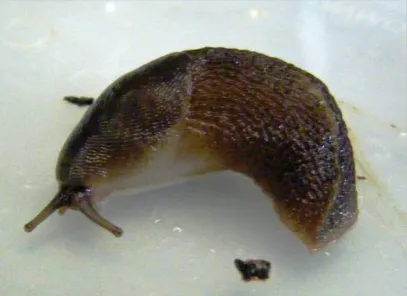
Eleven other slug species were trapped during the survey: Lehmannia marginata (Plate 3)was found in all hectads and was the most abundant species, comprising 50% of the overall catch. Arion subfuscus
(20%), Arion ater agg. (9%) and Deroceras laeve (8%) were trapped at a number of sites and only a few specimens of Deroceras reticulatum (5%), Arion flagellus (2%, Plate 4), Arion distinctus (1%), Arion circumscriptus (2%), Arion fasciatius (1%), Arion intermedius (1%) and Arion hortensis (1%)were recorded (Figures 2.3, 2.4, Appendix 3). All of the above species are considered relatively common in Irish woodlands and have a red list status of least concern (Byrne et al., 2009).
Plate 3: Lehmannia marginata in a Kerry Slug-like ‘ball’. This behaviour was only observed once by the authors, so appears unusual. This species was found in all sites and is very common in woodlands and on rocks in open
areas (© Inga Reich).
Plate 4: Juvenile Arion flagellus - easy to distinguish from other arionid slugs due to its continuous band between mantle and body and only 7 rows of tubercles between the bands. It inhabits a range of different habitats and is a
50.0%
20.2%
8.7%
8.2%
5.3%
2.9%
1.9%
1.4%
0.5%
0.5%
0.5%
2.9%
L. marginata
A. subfuscus
A. ater agg.
D. laeve
D. reticulatum
A. circumscriptus
A. flagellus
A. distinctus
A. hortensis
A. fasciatus
[image:14.595.87.558.90.354.2]A. intermedius
0
5
10
15
20
25
30
35
40
45
50
H
ec
ta
d
L8
4
H
ec
ta
d
L7
4
H
ec
ta
d
M
04
H
ec
ta
d
M
13
H
ec
ta
d
M
10
H
ec
ta
d
R
29
H
ec
ta
d
R
59
H
ec
ta
d
R
69
H
ec
ta
d
R
17
H
ec
ta
d
R
23
H
ec
ta
d
R
12
H
ec
ta
d
R
22
H
ec
ta
d
R
01
H
ec
ta
d
R
11
H
ec
ta
d
R
21
Hectad
N
u
m
b
e
r
o
f
s
lu
g
s
A. intermedius
[image:15.595.87.812.100.411.2]A. fasciatus
A. hortensis
A. distinctus
A. flagellus
A. circumscriptus
D. reticulatum
A. ater agg.
D. laeve
A. subfuscus
L. marginata
Analysis of the spatial distribution of
Geomalacus maculosus
in Cloosh Forest, Co. Galway
Locations of
Geomalacus maculosus
within Cloosh Forest
Rationale
In Ireland, G. maculosus was long believed to be restricted to mixed deciduous woodlands and open moor or blanket bog (Platts & Speight, 1988). However, Mc Donnell & Gormally (2011a) showed that the species occurs on conifer trunks in commercial forestry plantations in the south-west of Ireland. Surprisingly these authors also demonstrated that such areas can support large populations of G. maculosus suggesting that relatively open conifer forests with abundant epiphytic bryophytes can be suitable habitats for the species. Such conditions exist in parts of Cloosh Forest, Co. Galway. As G. maculosus is a protected species, management practices in forestry plantations in which it is found must take the protection of this species into account. This is particularly important considering that
conifer plantations account for over 90% of the forested area of Ireland (www.unece.org).
As the Kerry Slug was not found at any other sites surveyed, our research was focused on the occurrence of the slug in Cloosh Forest, Co. Galway. In order to establish if and how forest structure (age of planted trees, tree species), habitat type (plantation forest or blanket bog) and varying abiotic
habitat factors such as light intensity, temperature or humidity affect the occurrence of G. maculosus
within Cloosh,it was important to determine the extent of its distribution at the site.
Site description
Cloosh Forest is located approximately 7km south of the village of Oughterard in Connemara, Co. Galway and covers an area of approximately 7,000 hectares (Coillte, 2009) (Figure 5). The forest was planted mainly throughout the 1960s and 1970s on blanket bog (Coillte, 2009) and the soils range from
shallow to deep blanket peat. The combination of extreme wind exposures and the poor soil quality makes broadleaf establishment difficult (Coillte, 2009) and therefore, tree species selection was limited mainly to Picea sitchensis (Sitka Spruce) and Pinus contorta (Lodgepole Pine) with some broadleaves such as Betula pendula (Silver Birch) and Alnus sp. (Alder). Large areas of the forest are now on their second rotation, i.e. they have been felled and subsequently replanted (Coillte, 2003, 2009). Thinning is not appropriate for this type of forest because, when trees are removed, the bog is not stable enough to
support the remaining trees which would be subject to the constant threat of wind blow (Coillte, 2009).
Cloosh Valley is part of the Connemara bog complex which occupies an area north of Clifden in the west to Galway city in the east. The bog complex is protected under NHA (National Heritage Areas) and SAC (Special Areas of Conservation) designations (Coillte, 2009). The natural geology of
Cloosh forest is made up of a number of properties including Seecon, Letter, Lettermass, Knockalough, Finnaun, Lettercraffroe and Derradda (Coillte, 2009). This report encompasses a number of the above properties and unless otherwise stated the sites are located in Cloosh.
Figure 5: Location of Cloosh Forest in Connemara, Co. Galway (© OSI).
Materials and methods
Hand searching at Cloosh began in November 2011, using existing forestry roads to determine the boundaries between Kerry Slug presence and absence at the forest. If, after a 45 minute hand search no Kerry Slugs were found, a number of metric traps were put in place and checked weekly thereafter for
four weeks (trapping method as described in previous chapter). If, during the 45 minute hand search a Kerry Slug was found, then the search moved further through the forest and the procedure was repeated. Searches at Cloosh which depended on appropriate weather conditions (damp weather,
according to Platts & Speight, 1988) took place throughout the winter of 2011 until April 2012.
Results and discussion
Since the distribution of the Kerry Slug at Cloosh was found to be localized (Figure 6), it is likely that
the species was introduced through anthropogenic sources possibly stemming from activities associated with commercial forestry operations. However, the less likely possibility that they form part of a relic population, undiscovered during ecological surveys of the Connemara Bog Complex
Detailed investigation of
Geomalacus maculosus
distribution at Seecon
Rationale
Knowledge of the distribution of G. maculosus in Cloosh Forest could provide a valuable insight into factors limiting its occurrence. As previously mentioned, Cloosh Forest contains a number of properties and the area of focus for this study is herein referred to as Seecon. Seecon was selected for a
detailed investigation, the aim of which was to determine the distance along a forest road connected to the main public road that the Kerry Slug was found. In addition, the distance at which the Kerry Slug occurred (up to 90m) into the dense forest from the edge of the forest road was also determined.
Site description
Seecon was planted in the early 1970s and is dominated by a non-native conifer plantation (WD4) of mixed tree ages (Fossitt, 2000). The dominant tree species are P. sitchensis and P. contorta. The conifers were planted on an upland blanket bog (PB2) habitat and the ground vegetation reflects this type of habitat (Fossitt, 2000). While the majority of the under-storey is covered by pine needles, some species of ground flora, which are typical of blanket bogs, are visible e.g. Schoenus nigricans (Black Bog-rush),
Sphagnum spp. and Molinia caerulea (Purple Moor-grass). Small areas of Scrub (WS1) comprising Rubus fruticosus agg. (Bramble) and Ulex europaeus (Gorse) were also found although the closed canopy of the mature conifers limited the diversity of vegetation at most of the site by reducing the level of light
available to ground flora.
Materials and methods
Ten transects (each with ten sampling points) were set up along the main forest road, east of the main Oughterard to Rossaveel road (Figure 7). The transects were 200m apart from each other and each
consisted of ten trees located approximately 0, 10, 20, 30, 40, 50, 60, 70, 80, and 90 metres into the forest on the northern side of the forest road (Figure 8). On each tree a single metric trap was nailed at breast height onto the north side of the trunks. All traps were soaked in water from a local water source
before they were put up and baited with a piece of organic carrot (Mc Donnell & Gormally, 2011b). The traps were checked on a weekly basis, during which time their underside was sprayed with a mist gun to keep them moist and baited with a fresh piece of carrot. To avoid counting the same individual
twice, Kerry Slugs found under the traps were removed under licence and brought back to the laboratory where they were kept in a plastic container filled with moss and fed on a diet of carrots until the end of the survey at which stage all Kerry Slugs were released at the location from where they were removed. All other species of slugs captured were preserved for identification. Sampling
Figure 7: Seecon area of Cloosh Forest, Co Galway showing locations of the transects for the detailed Kerry Slug distribution investigation.
Figure 8: Schematic showing the arrangement of traps and transects in Seecon. FOREST ROAD
10m 100m
Results and discussion
A total of 1009 slugs (7 species) were trapped in the transects during the 13 week survey. Lehmannia marginata was the most abundant species with 517 specimens (38%) trapped in transects 1-10 followed by G. maculosus with 373 individuals (27%) trapped in transects 1-6 only (Appendix 4). Arion subfuscus
and species of the A. ater agg. complex were also found in comparably high numbers, with total catches of 269 (19%) and 194 (14%) specimens respectively. Both of these species were found throughout transects 1-10. Less than 5% of the slugs trapped were A. circumscriptus (22 specimens),
Limax cinereoniger (6 specimens) and A. flagellus (1 specimen) (Figure 9, Appendix 5). The discovery of
L. cinereoniger (Plate 5) in the plantation is surprising in that it is classed as Vulnerable on the latest Irish Red List (Byrne et al., 2009) and is a species of high conservation interest due to its restricted distribution. It is also believed to be a biological indicator of high quality woodlands (Byrne et al., 2009) but this may now have to be revised due to its presence in a commercial forestry plantation.
0
50
100
150
200
250
1
2
3 4
5
6
7
8 9 10
Transect
N
u
m
b
e
r
o
f
s
lu
g
s
Arion flagellus
Limax cinereoniger
Arion intermedius
Arion ater agg.
Arion subfuscus
Lehmannia marginata
[image:21.595.89.539.286.696.2]Geomalacus
maculosus
Plate 5: Limax cinereoniger, a species with a red list status of Vulnerable. Finding this species in a commercial forestry plantation sheds a different light on the value and importance of this habitat for slugs (© Inga Reich).
The median number (14) of G. maculosus trapped at Transect 1 i.e. the transect nearest the main public road (Table 1) is significantly greater than the median numbers caught at any of the other transects (Kruskal Wallis Test, H = 36.36 (adjusted for ties), p < 0.01). The species was trapped at all distances
into the forest on this transect and despite the slight variations in slug numbers between the different distances (Figure 10), the differences between the medians were not significant (Kruskal Wallis Test, H = 8.54 (adjusted for ties), p > 0.05). The results might suggest that the distribution of G. maculosus in Seecon is either due to a dramatic change in habitat conditions between transects 6 and 7, which is not the case at Seecon, or due to the slug having been introduced (accidentally or otherwise) to the site possibly near the main public road and that it simply has not yet spread throughout the whole surveyed area. The correlation of habitat factors with the abundance of G. maculosus will be discussed later in this report.
0 10 20 30 40 50 60
0m 10m 20m 30m 40m 50m 60m 70m 80m 90m
Location of trap in relation to the forestry road
[image:22.595.210.414.57.205.2]N u m b e r o f G . m a c u lo s u s
Table 1: Total catch, mean ± SD and median numbers of slugs per transect for the four dominant slug species (October 24, 2011 to January23, 2012) in Seecon, Cloosh Forest.
G. maculosus L. marginata A. subfuscus A. ater agg.
Transect 1 n
Mean ± SD Median
203 15.62 ± 9.61 14
42 3.23 ± 2.39 3
4
0.31 ± 0.48 0
6
0.46 ± 0.88 0
Transect 2 n
Mean ± SD Median
50 3.85 ± 3.65 4
27 2.08 ± 1.75 2
5
0.38 ± 0.51 0
2
0.15 ± 0.38 0
Transect 3 n
Mean ± SD Median
12 0.92 ± 0.95 1
92 7.08 ± 6.05 7
32 2.46 ± 1.94 2
15 1.15 ± 0.90 1
Transect 4 n
Mean ± SD Median
33 2.54 ± 2.22 3
47 3.62 ± 2.14 3
39 3.00 ± 3.42 2
27 2.08 ± 3.50 1
Transect 5 N
Mean ± SD Median
62 4.77 ± 3.65 4
33 2.54 ± 2.15 2
19 1.46 ± 0.88 1
28 2.15 ± 1.52 2
Transect 6 N
Mean ± SD Median
13 1.0±1.29 0
34 2.62 ± 1.85 3
27 2.08 ± 1.93 1
13 1.0±1.68 0 Transect 7 n
Mean ± SD Median
0 0 0
46 3.54 ± 2.15 3
28 2.15 ± 1.52 2
27 2.08 ± 2.25 1
Transect 8 n
Mean ± SD Median
0 0 0
68 5.23 ± 4.38 4
50 3.85 ± 2.88 3
23 1.77 ± 2.28 1
Transect 9 n
Mean ± SD Median
0 0 0
98 7.54 ± 6.39 7
47 3.62 ± 3.50 3
36 2.77 ± 3.14 2
Transect 10 n
Mean ± SD Median
0 0 0
30 2.31 ± 1.97 1
18 1.38 ± 1.45 1
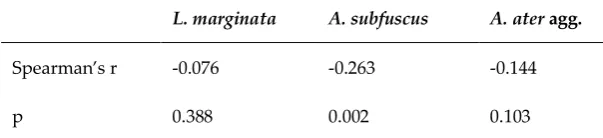
marginata caught per trap is significantly higher in transects 7-10, where G. maculosus is absent (Figure 11). In addition, there is a significant (Spearman’s Rank Test, r = -0.263, p <0.05) negative correlation
between the number of G. maculosus and A. subfuscus trapped per week during the sampling period (Table 2, Figure 12). No correlation could be found between the number of G. maculosus and A. ater
and L. marginata (Table 2, Figures 13, 14). It is possible therefore that the Kerry Slug out competes A. subfuscus where they co-occur but replicated studies in multiple forest are required to substantiate this. 6.2 2.1 0 6 1.5 4.6 3.6 2.5 0 1 2 3 4 5 6 7
G. maculosus A. subfuscus A. ater agg. L. marginata
[image:24.595.90.534.239.423.2]S lu g s p e r tr a p Transect 1-6 Transect 7-10
Figure 11:Number of slugs divided by the number of traps for the four dominant species in transects 1-6 and transects 7-10 during the 13 week sampling period between October 24, 2011 and January 23, 2012 in Seecon,
Cloosh Forest.
Table 2: Spearman’s Rank Test performed on the weekly abundance of G. maculosus and the three other dominant slug species found during the 13 week sampling period between October 24, 2011 and January 23, 2012 in Seecon,
Cloosh Forest.
L. marginata A. subfuscus A. ater agg.
Spearman’s r -0.076 -0.263 -0.144
[image:24.595.160.462.578.647.2]35 30 25 20 15 10 5 0 12 10 8 6 4 2 0 Geomalacus maculosus A ri o n s u b fu sc u s
Figure 12: Scatterplot showing numbers of Geomalacus maculosus and Arion subfuscus trapped per week at Seecon, Cloosh Forest (October 24, 2011 – January 23, 2012) and regression curve.
35 30 25 20 15 10 5 0 12 10 8 6 4 2 0 Geomalacus maculosus A ri o n a te r a g g .
[image:25.595.95.529.438.726.2]35 30
25 20
15 10
5 0
20
15
10
5
0
Geomalacus maculosus
Le
h
m
a
n
n
ia
m
a
rg
in
a
[image:26.595.97.528.78.364.2]ta
Habitat requirements of
G. maculosus
at Cloosh Forest
Rationale
A key deficiency regarding Kerry Slug studies to date has been the paucity of information regarding the ecological requirements of the species, an issue discussed by Mc Donnell & Gormally (2011a), who suggest that this area requires urgent investigation to ensure the successful conservation of the
species. To address this issue, a study of the environmental conditions in areas where the Kerry Slug is found, in addition to food sources available to the species was undertaken at Cloosh Forest between December 2011 and April 2012.
Environmental parameters
Materials and methods
Tree CBH (circumference at breast height), tree species, bark structure (smooth, flaky, cracked), bryophyte cover (%) and light intensity were recorded for all traps in Seecon from transects 1-6 where
G. maculosus was found (Appendix 6). The temperature was recorded at traps 1 and 10 in transects 5 and 7 using a Tinytag data logger and a Hanna Lux meter (HI 97500) was used to record the light intensity at each of the 100 trapping points.
Results and discussion
[image:27.595.100.523.671.761.2]A significant positive correlation (Table 3) was found between Kerry Slug abundance and both CBH (Spearman’s Rank Test, r = 0.336, p < 0.01) and bryophyte/lichen cover (Spearman’s Rank Test, r = 0.338, p < 0.01) was found in transects 1-6. Bryophyte and lichen cover is likely to be beneficial to G. maculosus as it provides shelter and food for the species (Platts & Speight, 1988). The CBH is most likely linked to the bryophyte/lichen cover, as the trunks of more mature trees which have a greater CBH usually have more lichen and bryophyte cover than the younger trees with a smaller CBH.
Table 3: The correlation of CBH (circumference at breast height), light intensity, bryophyte/lichen cover, bark structure and tree species to the abundance of G. maculosus found in transects 1-6, measured in April 2012 in
Seecon, Cloosh Forest. CBH (cm) Light intensity
(klux)
Bryophyte/lichen
cover (%)
Bark structure Tree
species
Spearman’s r 0.336 -0.015 0.338 0.238 -0.067
Whitney U Test, W = 3473.5, p < 0.01) at transects 7-10 where the Kerry Slug was absent than at transects 1-6 where it was present (Table 4). This adds weight to our hypothesis that bryophyte/lichen
[image:28.595.81.561.209.335.2]cover is a key microhabitat requirement for the species in conifer plantations. However, no significant difference in median CBH was detected in the two sets of transects (i.e. 1-6 and 7-10).
Table 4: Mean ± SD, median and W-value of CBH and bryophyte/lichen cover measured in April 2012 in Seecon, Cloosh Forest, between the transects where G. maculosus has been found (transects 1-6) and where it is absent
(transects 7-10).
CBH (cm) Bryophyte/lichen cover (%)
Transect 1-6 Transect 7-10 Transect 1-6 Transect 7-10 Mean ± SD 72.43 ± 20.79 77.1 ± 30.2 2.05 ± 0.77 1.53 ± 0.68
Median 73.5 75.5 2 1
W 2963.0 3473.5
P 0.6398 (adjusted for ties) 0.0009 (adjusted for ties)
* The mean and median values shown for bryophyte cover (%) are derived from categorical values. 0-30% bryophyte cover was referred to as ‘1’, 30-60% cover as ‘2’ and >60% cover as ‘3’.
The temperatures that were recorded with the Tiny Tags between February 14 and May 24, 2012 are not significantly different in transects 5 and 7 (Table 5), so it is not likely that the absence of G. maculosus from transect 7 to 10 is due to a change in temperature.
Table 5: Mean ± SD, median and W-value for the minimum, maximum and average temperatures measured between February 14 and May 24, 2012 in transects 5 and 7 in Seecon, Cloosh Forest.
Minimum Maximum Average
Transect 5 Transect 7 Transect 5 Transect 7 Transect 5 Transect 7 Mean ± SD 4.3°C ± 3.82 4.9°C ± 3.43 11.4°C ± 4.67 12.0°C ± 4.95 7.8°C ± 3.89 8.5°C ± 3.86
Median 3.7°C 4.3°C 10.1°C 10.4°C 7.1°C 7.7°C
W 10378.0 10501.5 10228.0
[image:28.595.86.552.522.647.2]Geomalacus maculosus
feeding trials
Materials and methods
According to Platts & Speight (1988) G. maculosus feeds on or takes shelter under lichens, liverworts and/or mosses. With regard to this, samples of bryophytes and lichens were collected from granite rock outcrops and conifer trees in Cloosh and offered to Kerry Slugs under laboratory conditions. Throughout the experiments, only slugs collected from forested areas were used.
A number of preliminary feeding trials were carried out to assess the lichen species for which G.
maculosus had the greatest affinity. Prior to experimentation, individuals were starved for 24 hours. The slugs were then placed in Petri dishes with moist filter paper and a lichen sample. Ten individual slugs were each presented one of the following lichen species: Cladonia ramulosa, Cladonia portentosa,
Cladonia uncialis ssp. biuncialis, Cladonia squamosa, Parmotrema perlatum and Cladonia coniocrea. Individuals were observed for one hour and the time spent feeding on the individual lichen species
was noted. The same procedure was followed for 10 moss, 3 liverwort, 2 heather or 1 fern species. According to Simroth (1891), a G. maculosus specimen is feeding when they take up a hunched position with the head and eyes protruding only very slightly from under the mantle.
As the results from the preliminary tests showed that lichens were the most palatable to G. maculosus, they were used for the following experiments:
1. Experiment 1: focused solely on lichens that were collected from tree bark. Six different
species were tested (2 fruticose, squamulose, cup lichens, 2 foliose lichens, 1 crustose, leprose lichen and 1 fruticose lichen). One sample of each lichen species was randomly placed in a plastic container (32cm x 42cm) and sprayed with water using a mist gun. Slugs were starved for 24 hours prior to being placed in the container to encourage feeding during the 2 hour
experiment. Thirty-two Kerry Slugs, both juveniles and adults, were put into the container at the same time and observed: Every ten minutes, it was noted how many slugs were feeding on each lichen species. A total of ten experiments were carried out using the same individuals,
although numbers declined due to mortality and suspected cannibalism (no slug carcasses were found and it was not possible for the slugs to escape out of their container) among specimens. By experiment number 10, 25 slugs were alive.
2. Experiment 2: focused solely on crustose lichens taken from granite rock outcrops on blanket
bog surrounding Cloosh Forest. Slices of the rock, which were cut using a con saw, were placed in a large plastic container which was filled with ~2cm of water to prevent the slugs from moving between rocks (Plate 6). Five slugs were placed on each rock sample and were observed every five minutes for a period of one hour. The slugs were moistened every 15
Plate 6: Rock samples in water-filled (~ 2cm) plastic container as used in experiment 2 (© Kim O’Meara).
Results and discussion
During preliminary experiments, G. maculosus was observed feeding on all the species of fruticose and foliose lichen they were offered (Table 6), suggesting that the majority of lichen species growing on granite taken from Cloosh are palatable to G. maculosus. In contrast, the slugs were only observed feeding on 2 of the 8 moss species offered (i.e. Campylopus introflexus and Pleurozium schreberi), indicating that mosses are not as important a food source for G. maculosus. This is unsurprising as mosses are known to be unpalatable to most slugs due to the large amount of phenolic compounds they produce (Davidson & Longton, 1987; Davidson et al., 1989). P. schreberi, a moss on which the slugs were observed feeding has been shown to contain relatively low concentrations of phenolics
Table 6: Preliminary results of feeding trials showing species of lichens, mosses, liverworts, heathers and fern consumed/not consumed by G. maculosus.
Vegetation type Consumed species Species which were not consumed
Lichen Cladonia cariosa
Cladonia coniocrea Cladonia fimbriata Cladonia portentosa Cladonia ramulosa Cladonia rangiferina Cladonia squamosa
Cladonia uncialis ssp. buncialis Parmelia saxatilis
Parmotrema perlatum Sphaerophorus globosus Stereocaulon vesuvianum
Moss Campylopus introflexus Sciuro-hypnum populeum
Pleurozium schreberi Hylocomiastrum umbratum Hypnum cupressiforme Isothecium myosuroides Polytrichum commune Racomitrium heterostichum Sphagnum sp.
Trichostomum crispulum
Liverwort Frullania dilatata
Metzgeria furcata Saccogyna viticulosa
Heather Calluna vulgaris
Erica cinerea
Throughout the ten feeding trials, feeding behaviour was determined using 1,517 observations. Figure 15 shows the percentage of each tested lichen species that G. maculosus was observed to be feeding on. The foliose lichen Platismatia glauca was the most favoured species (487 observed feedings), followed by the fruticose species Usnea cornuta (358 observed feedings) (Plate 7), the fruticose squamulose
Cladonia uncialis (260 observed feedings), the foliose Paromtrema perlatum (246 observed feedings) (Plate 8) and the fruticose squamulose Cladonia coniocraea (125 observed feedings). The leprose Lepraria incana (41 observed feedings) (Plate 9) was the least favoured lichen species (Figure 15), which might be due to its crustose growth form, which is comparably hard to graze for slugs (Whelan, pers. com.).
32%
24% 17%
16%
8% 3%
Platismatia glauca Usnea cornuta Cladonia uncialis Paromtrema perlatum Cladonia coniocraea
[image:32.595.108.511.237.459.2]Lepraria incana
Figure 15: Percentage of observed feedings of G. maculosus on each tested lichen species (total n = 1517).
The differences in the preferences were highly significant (χ² Test for the Goodness of Fit, p < 0.01) for five out of the six tested lichen species (Table 7). Future research should establish if the preferences are due to the nutrient values of the lichens, secondary compounds deterring or favouring consumption
of the lichen species or if they are simply due to the growth form of the lichen.
Table 7: χ²- Values indicating the preferences (based on the 1517 feeding observations) of G. maculosus for the lichen species offered to the species during 10 feeding trials.
P. glauca L. incana P. perlatum U. cornuta C. coniocraea C. uncialis 91.514¹ 176.886¹ 0.2914 19.516¹ 54.218¹
P. glauca 456.110¹ 104.480¹ 27.296¹ 268.230¹
L. incana 161.726¹ 289.988¹ 44.966¹
P. perlatum 25.930¹ 44.962¹
U. cornuta 133.682¹
[image:32.595.75.549.636.762.2]Plate 7: Usnea cornuta lichen at Cloosh Forest, Connemara, Co. Galway (© Inga Reich).
Plate 9: Lepraria incana lichen at Cloosh Forest, Connemara, Co. Galway (© Inga Reich).
Figure 16: Schematic showing the preferred lichen species of G. maculosus as established in the ten feeding trials.
Cladonia uncialis
Lepraria incana
Platismatia glauca
Cladonia coniocraea
Paromtrema
perlatum
Usnea cornuta
Experiment two – Lichens collected from granite rock outcrops
Lichens are known to absorb compounds such as atranorin, salazinic and lobaric from their environment which form crystals within their structure. It has been shown that the presence of such
secondary compounds reduces herbivory, meaning that they play an important role in protecting lichens from grazing pressures (Gauslaa, 2005). It is therefore likely that the species of lichens on which G. maculosus were observed feeding did not contain significant quantities of these secondary compounds or that G. maculosus has evolved mechanisms to cope with the chemicals (Table 8).
Porpidia flavocruenta is known to accumulate large quantities of iron, which often causes it to become orange in colour (Fryday, 2005), as was the case with the P. flavocruenta tested in this study. It is likely that this high concentration of iron is a defence against grazing pressures and causes this particular species to be unpalatable to G. maculosus. Crustose lichens including other Porpidia species collected from Burren limestone were not eaten by G. maculosus. This might be due different secondary compounds accumulating in lichens growing on limestone and that these compounds may influence the palatability of a species to G. maculosus. This may help explain why G. maculosus is not known to inhabit limestone areas. The apparent unpalatability of the Verucaria species on the rock samples tested may be due to G. maculosus experiencing difficulty in scraping the very thin, tar like layers that this species forms on the substrate (Whelan, pers. comm.). As the other lichen species on the rock samples grew in much thicker formations this would make them less labour intensive for G. maculosus
[image:35.595.88.534.449.596.2]to remove from the substrate and therefore easier to feed upon.
Table 8: Crustose lichens from Connemara offered to G. maculosus
Consumed species Species which were not consumed
Pertusaria lactescens Porpidia flavocruenta Porpidia tuberculosa Verucaria sp. Porpidia crustulata
Porpidia cinereoatra Lecanora sulphurea
and abundance of
G. maculosus
at Cloosh Forest
Rationale
As G. maculosus is a protected species, management practices in forestry plantations in which it is found must take the protection of this species into account. In addition, the creation of buffer zones to ensure the protection of the endangered freshwater pearl mussel (Margaritifera margaritifera), has resulted in the felling of conifers along water bodies within plantations. The implications of this practice for G. maculosus have yet to be determined and in the case of Cloosh forest and in particular the Lettercraffroe property, tree stumps (approximately 3m high) were left in place in felled areas to mitigate potential negative effects on G. maculosus (Nelson, pers. comm.). This section of the project investigates the success of the remaining tree stumps and clearfell in supporting the population of G. maculosus by comparison with an adjacent mature plantation.
Site description
[image:36.595.145.410.450.697.2]This survey was carried out in the most mature forested area in Cloosh Forest, herein referred to as Lettercraffroe which was planted in the late 1950s and early 1960s. Traps were set up in two areas to distinguish between G. maculosus use of a clearfell and mature plantation (Figure 17). The plantation consists predominantly of Sitka Spruce and the adjacent site which was clearfelled in September 2011 holds the remains of tree trunks which were left in place to maintain G. maculosus populations.
Figure 17: Photograph showing the clearfell and mature plantation study sites at Lettercraffroe, Cloosh Forest.
(Oughterard – Rossaveel). Consisting of a dense stand of mature P. contorta and P. sitchensis which was planted in the 1950s, it is classified as a conifer plantation (WD4) (Fossitt, 2000). There is a notable amount of brash in this site, and the ground flora is comprised of a carpet of bryophytes (Plate 10).
Plate 10: Mature plantation which was used to assess G. maculosus populations in Lettercraffroe, Cloosh Forest (© Eugene Cush).
The forest in the clearfell site was felled in September 2011 to create a buffer zone next to a stream which enters Lettercraffroe Lough. Tree stumps of 2-3 meters in height were left in situ to provide a microhabitat for G. maculosus in the area. The site is classified as recently felled woodland (WS5) (Fossitt, 2000). It contains numerous stumps of Pinus contorta and Picea sitchensis (Plate 11), upon which bryophytes and lichens grow. Brash covers the ground throughout the site leading to a scarcity of ground flora although some lichens and bryophytes are present. The study area is divided by a
small stream running through the centre towards Lettercraffroe Lough.
Materials and Methods
Fifteen metric traps were set up on randomly spaced trees or stumps on October 17, 2011 in each of the sites described above with both trapping areas measuring approximately 50m². Traps were soaked
with water from a local water source, baited with a piece of organic carrot and nailed onto the north side of the trunks. The traps were checked on a weekly basis, the underside sprayed with water using a mist gun to keep them moist and re-baited with a fresh piece of carrot. To avoid counting the same
Plate 11 Tree stumps on a clearfell in Lettercraffroe, Cloosh Forest, which
were left in place for Geomalacus maculosus (left © Eugene Cush; right © Kim O’Meara).
Results and discussion
Throughout the 14 week sampling period from October 24, 2011 to April 30, 2012at Cloosh Forest, Kerry Slugs were collected on all but one sampling date (January 2, 2012) (Figure 18, Appendix 7).
This day saw minimum temperatures of below 1°C, which is the most likely explanation for the absence of G. maculosus under the traps. Hand searching for Kerry Slugs in cold weather was predominantly unsuccessful at Cloosh and it is therefore suspected that under such conditions the species take refuge inside cracks in bark and below the soil/ tree root or rock outcrop interface.
Simroth (1891) also observed Kerry Slugs showing a worm-like ability to vanish into the narrowest of fissures.
The median number of Kerry Slugs was significantly higher in the mature plantation than in the clearfell throughout the sample period (Mann-Whitney U Test, W = 557.0, p < 0.05, Table 9), although
on six out of 14 sampling dates, more Kerrys Slugs were captured in the clearfell than the forested area. The fact that the traps on the tree stumps in the clearfell are more exposed than traps in the
Table 9: Total abundance, mean ± SD, median and W-value of G. maculosus trapped in a recent clearfell and adjacent conifer plantation at Lettercraffroe, Cloosh Forest from October 24, 2011 to April 30, 2012.
Clearfell Forest
Total number of G. maculosus trapped 320 522
Mean ± SD 12.26 ± 16.62 19.33 ± 15.13
Median 4 15.5
W 557.0
[image:39.595.79.500.289.607.2]p 0.0158 (adjusted for ties)
Figure 18: The abundance of G. maculosus in a recent clearfell and adjacent conifer plantation at Lettercraffroe, Cloosh Forest from October 24, 2011 to April 30, 2012.
Figure 19 shows the average daily temperatures recorded (Appendix 8) using Tiny Tag data loggers
for the clearfell and the mature plantation. The daily minimum, maximum and average temperatures in the clearfell and plantation are significantly different (Table 10). The clearfell experienced significantly higher temperatures (Mann-Whitney U Test, W = 23038.5, p <0.00), which when coupled
Figure 19: Average daily temperatures (°C) for the mature plantation and clearfell areas surveyed at Lettercraffroe, Cloosh Forest, from December 6, 2011 to May 24, 2012.
Table 10: Mean SD, median, W- value for the daily minimum, maximum and average temperatures measured in a recent clearfell and adjacent conifer plantation at Lettercraffroe, Cloosh Forest from December 6, 2011 to May 24,
2012.
Minimum Maximum Average
Clearfell Plantation Clearfell Plantation Clearfell Plantation Mean ± SD 3.7°C ± 3.14 4.4°C ± 2.66 13.6°C ±7.14 9.0°C ± 2.86 8.6°C ± 4.01 6.7°C ± 2.54
Median 3.5°C 4.3°C 10.5°C 9.0°C 8.4°C 6.6°C
W 31006.0 23038.5 23024.5
p 0.0258 (adjusted for ties) 0.00 (adjusted for ties) 0.00 (adjusted for ties)
No significant correlation was found between temperature and slug abundance in the clearfell or plantation, neither on the day of sampling nor on the day before sampling. Factors such as humidity might play a bigger role in trapping success, but more research is needed to prove this.
[image:40.595.82.541.488.613.2]Management Recommendations
1. While no G. maculosus specimens were found or trapped in commercial forests situated between counties Cork and Galway, the presence of the species at a conifer plantation in Oughterard, Co. Galway suggests that it could be present in forests in other parts of Ireland. It is recommended that a simple information leaflet be developed to increase awareness of the possible presence of the species in forestry plantations outside its currently known range.
2. G. maculosus was found in various locations throughout Cloosh Forest i.e. mature plantation, clearfell and open areas. No individuals were found in very young plantations (plant year 2005). These observations should be taken into account when management plans are made
and mitigation measures might have to be installed to accommodate slug populations in newly planted areas.
3. In this short term study, average G. maculosus abundances were lower in the selected clearfelled area (with retained stumps) than in the nearby mature plantation. Nevertheless,
Kerry Slugs were still trapped in the clearfell site almost one year after the felling occurred. The retained tree stumps in the clearfell site were being used by G. maculosus up to the end of this study and it is likely that they offer the species both shelter under the moss and in the cracks of the tree bark as well as food in form of lichens growing on the trunks. However,
given that the longevity of the stumps is limited the site should be revisited on an annual basis to check for the presence of G. maculosus.
4. Laboratory trials have indicated those lichen species associated with conifer plantations which are preferred by G. maculosus. It is recommended that a simple guide to these lichens be produced for forest managers to inform commercial forestry practices for those sites in which
G. maculosus is found. Selected stands of trees on which the preferred lichens grow could be maintained within sheltered clearfelled areas if necessary.
Future Research
1. The effects of clearfelling and re-planting on populations sizes of G. maculosus should be investigated using the capture-mark-recapture procedure described in Mc Donnell &
Gormally (2011a).
2. Our results show a correlation between the presence of G. maculosus and bryophyte and lichen cover. However, replicated trapping needs to be carried out in areas with Kerry Slug
populations other than Cloosh Forest to investigate whether this could be a critical factor in determining the presence or absence of the species in woodlands and conifer plantations nationwide.
species was introduced, then the vector of introduction needs to be identified, as it may provide information on where other potentially undiscovered populations exist within
Ireland.
4. The extent of competition between G. maculosus and other slug species such as A. ater, A. subfuscus, or L. marginata needs further investigation. If our preliminary observations of a decline in abundance of other slug species where G. maculosus is present is substantiated, the implications of the spread of the Kerry Slug for other rare slug species i.e. L. cinereoniger needs to be determined.
Bibliography & Relevant Literature
Allman, G.J. (1843) On a new genus of terrestrial gastropod. Athenaeum, 829, 851.
Allman, G.J. (1844) On a new species of terrestrial gastropod. Rep. Br. Ass. Advmt. Sci., 1843, 77. Allman, G.J. (1846) On a new species of pulmonary gastropod. Ann. Mag. Nat. Hist., 17, 297-299.
Barrett, D. (2011) The Impact of Afforestation on Slugs with Particular Reference to the Protected Species Geomalacus Maculosus. National University of Ireland Galway.
Boycott, A.E. & Oldham, C. (1930) The food of Geomalacus maculosus. Journal Of Conchology, 19, 157-161. Byrne, A., Moorkens, E.A., Anderson, R., Killeen, I.J. & Regan, E.C. (2009) Ireland Red List No. 2 – Non-Marine
Molluscs. National Parks and Wildlife Service, Department of the Environment, Heritage and Local Government, Dublin, Ireland.
Castillejo, J., Garrido, C., Iglesias, J. (1994) The slugs of the genus Geomalacus, Allman 1943, from the Iberian Peninsula (Gastropoda: Pulmonata: Arionidae). Basteria, 58, 15-26.
Coillte. (2003) Special Feature, Cloosh Valley Forest Management Plan. Newtownmountkennedy, Co. Wicklow. Coillte. (2009) Forest Management Plan, Cloosh Forest, GY21. Newtownmountkennedy, Co. Wicklow.
Davidson, A.J. & Longton, R.E. (1987) Acceptability of mosses as food for a herbivore, the slug Arion hortensis.
Symp. Biol. Hung., 35, 707-720.
Davidson, A.J., Harborne, J.B. & Longton, R.E. (1989) Identification of hydroxycinnamic and phenolic acids in
Mnium hornum and Brachythecium rutabulum and their possible role in protection against herbivory. Journal of the Hattori Botanical Laboratory, 0, 415-422.
Desmars, J. (1873) Essai D’un Catalogue Méthodique Et Descriptif Des Mollusques Terrestres, Fluviatiles Et Marine Observes Dans l’Ille De Vilaine Les Departments Limitrophes De l’Ouest De France, Et Sur Les Côtes De La Manchede Brest á Cherbourg. Redun, Chauvin.
Falkner, G., Ripken, T.E.J. & Falkner, M. (2002) Mollusques Continenteaux De France Liste Des References Annoteeet Bibliographie. Patrimonie Naturels, Museum d’Histoire Naturelle, Paris.
Fossitt, J.A. (2000) A Guide to Habitats in Ireland. The Heritage Council, Kilkenny.
Fryday, A.M. (2005) The genus Porpidia in northern and western Europe, with special emphasis on collections from the British Isles. The Lichenologist, 37, 1-35.
Gauslaa, Y. (2005) Lichen palatability depends on investments in herbivore defence. Oecologia, 143, 94-105. Kearney, J. (2010) Kerry Slug (Geomalacus maculosus Allman 1843) recorded at Lettercraffroe, Co. Galway. Irish
Naturalists’ Journal, 31, 68-69.
Mc Donnell, R.J., O’Meara, K., Nelson, B., Marnell, F., Gormally, M.J. (in press) Revised distribution and habitat associations for the protected slug, Geomalacus maculosus (Stylommatophora: Arionidae) in Ireland. Basteria. NPWS. (2008) Conservation Status Assessment Report for Geomalacus maculosus. National Parks and Wildlife
Service, Department of the Environment, Heritage and Local Government, Dublin.
NPWS. (2010) Threat Response Plan Kerry Slug Geomalacus Maculosus. National Parks and Wildlife Service, Department of the Environment, Heritage and Local Government, Dublin.
Oldham, C. (1942) Notes on Geomalacus maculosus. Proc. Malac. Soc. Lond., 25, 10-11.
Platts, E.A. & Speight, M.C.D. (1988) The taxonomy and distribution of the Kerry Slug Geomalacus maculosus
Allman, 1843 (Mollusca: Arionidae) with a discussion of its status as a threatened species. Irish Naturalists’ Journal, 22, 417-430.
Rogers, T. (1900) The Eggs of the Kerry Slug , Geomalacus maculosus , Allman. Irish Naturalists’ Journal, 9, 168-170. Simroth, H. (1891) Die Nacktschnecken der portugiesisch-azorischen Fauna in ihrem Verhaeltniss zu denen der
palaearktischen Region ueberhaupt. Nova Acta Acad. Caesar. Leop. Carol., 56, 203-424.
Taylor, J.W. (1907) Monograph of the Land & Freshwater Mollusca of the British Isles 2. Taylor Brothers, Leeds. Verdu, J.R. & Galante, E. (2005) Libro Rojo De Los Invertebrados De Espana. Madrid.
Personal Communications
(1) Dr. Brian Nelson, National Parks and Wildlife Services, Dublin.
(2) Prof. Marin Feely, National University of Ireland, Galway.
(3) Dr. Roy Anderson, Belfast, Northern Ireland.
(4) Mr. Paul Whelan, Saleen, Co Cork.
Websites
www.habitas.org.uk/molluscireland (April 2012)
Appendix 1: Results of hand search and trapping for the presence/absence survey
Hectad County No of sites Date hand search Date trapping
L84 – Derryclare Nature Reserve Galway 3 10/10/2011 01/11/2011 L74 – Conifers at Ballynahinch Galway 2 10/10/2011 01/11/2011 R59 – Extensive conifer plantations Clare/Galway 3 18/10/2011 08/11/2011 R69 – Extensive conifers around Slieve Aughty Galway 3 18/10/2011 08/11/2011 R23 – Conifer plantations west of Newcastle West Limerick 3 19/10/2011 09/11/2011 R12 – Glanaruddery Mountains Kerry 2 19/10/2011 09/11/2011 R22 – Conifer plantations on Mullaghareirk Mountains Kerry 3 19/10/2011 09/11/2011 R01 – Conifers east of Castleisland Kerry 3 20/10/2011 09/11/2011
R11 – Conifers Kerry 2 20/10/2011 10/11/2011
Grid reference Site description Elevation (m)
L 83030 49806 Medium density Sitka Spruce plantation, trees covered in beard lichen 63
L 82965 49450 Derryclare Nature Reserve, native oak forest surrounded by Lodgepole Pine 25
L 86906 50510 * Medium density Sitka Spruceplantation 67
L 76766 46508 Low density plantation ofSitka Spruceand Lodgepole Pine with a slight undergrowth of Rhododendron ponticum 54
L75832 46651 Low density plantation of Sitka Spruce with a few Grand Fir, close to lake 34
R 52604 97779 Medium density Sitka Spruceplantation in boggy area surrounded by birch 64
R 54621 99571 Low density Sitka Spruce plantation with birch and holly trees next to creek 87
R 52703 88328 * Medium density Sitka Spruce plantation at a hiking trail 221
M 64638 00942 * Low density Sitka Spruce plantation next to a clearfell fringed by birch 124
R 60843 97158 Low density plantation of Sitka Spruce and Lodgepole Pine with some birch close to a creek 130
R 62216 96407 Medium density Sitka Spruce plantation next to a lake 138
R 20998 35032 Medium density Sitka Spruce plantation next to a clearfell 173
R 21079 34257 Medium density Sitka Spruce plantation at a forestry road 256
R 21985 36454 Sitka Spruces and willows in a wet area 280
R 14602 22470 Medium density Sitka Spruce plantation surrounded by wet grassy area full of brambles 240
R 19757 22094 Low density Sitka Spruce plantation with undergrowth of Rhododendron ponticum, brambles and heather in open patches 282
Grid reference Site description Elevation (m)
R 28952 20302 Medium density Sitka Spruce plantation close to windturbines 316
R 27980 22298 Low density Sitka Spruce plantation on steep hill 325
R 06857 12347 Medium density Sitka Spruce plantation 287
R 09341 12678 Low density Sitka Spruce plantation in boggy area 347
R 17987 12281 Low density Sitka Spruce plantation at forestry road 268 meters
R 11610 12754 Low density Sitka Spruce plantation in swampy area close to river; fringed by laurel, Rhododendron ponticum and sycamore 213 meters
R 09962 11648 * Low density plantation of Sitka Spruce and Lodgepole Pine on steep hill fringed by heather and brambles 336 meters
R 22453 19536 Low density Sitka Spruce plantation with many small creeks 290 meters
R 26493 20248 * Low density Sitka Spruce plantation at forestry road fringed by birch 360 meters
R 24672 14386 Low density Sitka Spruce plantation at forestry road 309 meters
R 17975 75515 Medium density Sitka Spruce plantation at forestry road, close to house 141 meters
R 18106 70802 Medium density Sitka Spruce plantation at water reservoir 177 meters
R 16427 77091 Very low density plantation of Sitka Spruce, with laurel and Rhododendron ponticum growing in many areas, close to a small river 115 meters
M 14385 34572 Medium density Sitka Spruce plantation next to a clearfell 147 meters
M 12785 34534 Low density Sitka Spruce plantation with small creeks 93 meters
M 11359 34477 Medium density Sitka Spruce plantation close to river 76 meters
M 17859 02690 Medium density Sitka Spruce plantation fringed by birch next to a clearfell 226 meters
M 13553 02803 Low density plantation of Sitka Spruce and Lodgepole Pine 218 meters
M 13662 01785 Medium density Sitka Spruce plantation at creek fringed with rushes 233 meters
R 24371 90066 Medium density, very dark Sitka Spruce plantation with some gorse and brambles at the fringes 102 meters
M 07526 40540 Low density Sitka Spruce and Lodgepole Pine plantation 113
M 07109 41199 Low density Lodgepole Pine plantation 47
Appendix 3: Number of slugs of each species found under the traps in each hectad
Species/Hectad L84 L74 R59 R69 R23 R12 R22 R01 R11 R21 R17 M13 M10 R29 M04 Total
Lehmannia marginata 3 10 31 1 2 1 2 7 3 2 18 3 4 14 3 104
Arion subfuscus / 1 6 1 13 / 3 1 2 4 4 1 3 1 2 42
Arion ater agg 2 / 2 / 1 2 / / 1 2 4 1 / 1 2 18
Deroceras laeve / / / / 2 / 6 2 2 2 3 / / / / 17
Deroceras reticulatum / / 5 / / / / / / / 6 / / / / 11
Arion flagellus / 1 / / 1 / / / / 3 / / / / / 5
Arion circumscriptus / / / 2 / / / / / 3 / / / / / 5
Arion distinctus / / / / / / / 1 1 1 / / / / / 3
Arion fasciatus / / / / 1 / / / / / / / / / / 1
Arion hortensis / / / / / / / / 1 / / / / / / 1
Arion intermedius / / / / / / / / / / 1 / / / / 1
Date Transect Trap 1 Trap 2 Trap 3 Trap 4 Trap 5 Trap 6 Trap 7 Trap 8 Trap 9 Trap 10
24/10/2011 1 5 2 0 0 1 1 1 0 1 1
31/10/2011 1 0 0 0 0 0 0 0 2 0 0
07/11/2011 1 4 0 2 3 1 3 0 3 1 1
14/11/2011 1 4 2 2 4 3 1 2 1 1 1
21/11/2011 1 6 3 1 1 1 0 1 0 0 0
28/11/2011 1 3 3 4 1 4 0 1 9 5 5
05/12/2011 1 0 6 2 3 2 3 0 1 4 4
12/12/2011 1 1 1 7 0 6 0 5 4 0 0
19/12/2011 1 1 0 0 0 0 0 0 0 1 1
02/01/2012 1 0 1 2 1 1 1 0 0 0 0
09/01/2012 1 3 0 1 2 0 0 2 0 1 1
16/01/2012 1 0 1 1 0 3 0 4 2 0 0
23/01/2012 1 1 8 2 1 4 0 2 5 1 1
24/10/2011 2 0 0 0 0 1 0 3 0 0 0
31/10/2011 2 1 0 1 2 0 0 0 0 0 0
07/11/2011 2 1 3 2 0 0 3 2 0 3 0
14/11/2011 2 0 0 0 0 0 2 0 0 0 0
28/11/2011 2 0 0 0 0 0 0 0 0 0 2
05/12/2011 2 0 0 0 0 0 0 0 0 0 0
12/12/2011 2 0 0 0 0 0 1 0 2 0 2
19/12/2011 2 0 0 0 0 0 0 0 0 0 0
02/01/2012 2 0 0 1 0 0 0 0 0 1 1
09/01/2012 2 0 0 0 1 2 0 0 0 1 0
16/01/2012 2 0 0 1 0 0 0 0 2 0 1
23/01/2012 2 0 0 3 0 0 0 0 1 1 2
24/10/2011 3 1 0 0 0 0 0 0 0 0 0
31/10/2011 3 0 0 0 0 0 0 0 0 0 0
07/11/2011 3 0 0 0 0 0 0 0 0 0 0
14/11/2011 3 1 0 0 0 0 1 0 0 0 0
21/11/2011 3 0 0 1 0 0 0 0 0 0 0
28/11/2011 3 0 1 0 0 1 0 0 0 0 0
05/12/2011 3 0 0 0 0 0 1 0 0 0 0
12/12/2011 3 0



![(2R,3R,4S,5R) 2 (4 Amino 5 iodo 7H pyrrolo[2,3 d]pyrimidin 7 yl) 5 methyltetrahydrofuran 3,4 diol](data:image/gif;base64,R0lGODlhAQABAIAAAP///wAAACH5BAEAAAAALAAAAAABAAEAAAICRAEAOw==)