DEVELOPMENT AND EVALUATION OF A SUSTAINED RELEASE
MICROENCAPSULES OF THEOPHYLLINE
Shidhaye Supriya Shrihari1*, Surve Chaitali Vibhakar1, 2
1Department of Pharmaceutics, Vivekanand Education Society’s College of Pharmacy,
Affiliated to Mumbai University, India.
2
Pacific Academy of Higher Education and Research University, Udaipur, Rajasthan, India
ABSTRACT
A sustained release dosage form of Theophylline in the form of microspheres was prepared by the solvent evaporation method. Solvent evaporation method was attempted in oily manufacturing vehicles. Different polymers such as Ethyl Cellulose, Eudragit® RS PO, Eudragit® RL PO, Eudragit® S 100,Eudragit® RL 100 and different combinations of these polymers were tried and the resulting microspheres were evaluated for entrapment efficiency, drug loading and percent yield of the process and dissolution profile. The aim was to develop a multiparticulate sustained release drug delivery system to be converted to a orally disintegrating formulation, so that patient suffering from dysphagia, stroke, difficulty in swallowing, paediatric, geriatric patients etc. may consume it easily and long term therapy may be maintained as required in patients suffering from osteoarthritis, diabetes.
Keywords: Theophylline, microspheres, solvent evaporation, taste masking, orally disintegrating, factorial design.
INTRODUCTION
Much of the research efforts in developing novel drug delivery systems have been focused on
per oral sustained or controlled release dosage forms. Among the oral dosage forms, multiunit formulations such as microparticles have become more popular becauseof their advantages over single unit dosageforms. They may be spread out more uniformlyin the gastrointestinal tract leading to moreuniform drug absorption, reduced localirritation, and decreased retention of polymericmaterials. They have been reported to berelatively *Correspondence for
Author Shidhaye Supriya Shrihari
Department of Pharmaceutics,
Vivekanand Education
Society’s College of Pharmacy,
Affiliated to Mumbai
University, India.
Volume 3, Issue 4, 1281-1291. Research Article ISSN 2277 – 7105
Article Received on 30 April 2014,
unaffected by digestive tractactivities, causing less variation in the resultsof pharmacokinetic studies. Attention hasbeen recently devoted to liquid sustainedrelease preparations that are more palatable topaediatric and convenient to geriatric patients. This formulation may also help in givingdrug delivery to patients suffering fromdysphagia; stroke where consuming a tabletwill be very difficult. This problem becomesmore acute for the administration of sustainedaction dosage forms due to the increase in thevolume of the delivery system and necessity totake it intact without breaking. Formulating such systems as an orally disintegrating tablet presents anovel means of circumventing the potentialproblems associated with the administration ofsuch system. Multiparticulate systems could also be formulated as an orally disintegrating tablet allowing ease of swallowing and flexibility inthe dose adjustment for pediatric and geriatric patients. Many techniques for thepreparation of micro capsules have been developed and reviewed.Theophylline, a xanthine bronchodilator, is used in a dose of 100mg, 200mg 300mg, 400mg, 450mg t.i.d to prevent and treat wheezing, shortness of breath, and difficulty in breathing caused by asthma, chronic bronchitis, emphysema, and other lung diseases. Amongst the currently available means of treatment, oral dosage forms are associated with lag time and delayed onset of action. However, aerosols and parenterals have rapid onset of action but strongly affect patient compliance. Theophylline is available as conventional as well as sustained release tablets, syrups, elixirs, capsules and injections for the use by all age groups. However it is not yet marketed as mouth disintegrating tablets. Also, Asthmatic patients have to strictly follow daily dosage regimen for preventing occurrence of acute attacks. Hence, possibilities of missing out the doses should be minimized. Theophylline is also used to treat breathing problems in pediatric patients. Thus, an attempt was made to prepare taste masked sustained releasemicrospheres of Theophylline which would then be incorporated in orally disintegrating tablets to improve patient compliance. This drug delivery system would be an effective alternative for administration of theophylline.[1,2,3,4,5,6] Hence the aim of investigation was to formulate effective, palatable fast disintegrating tablets of theophylline for target patients like pediatrics.
MATERIALS
METHOD Preformulation
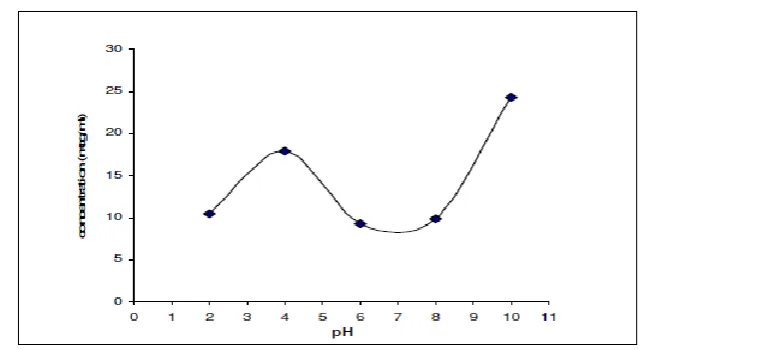
The drug was identified by means of melting point, colour reaction and FTIR. The physical characterization of the drug was carried out. The pH solubility profile was also obtained. The interaction between the drug and polymer was assessed by means of differential scanning calorimetry.[7,8]
Formulation
The drug was formulated into microspheres which helped in masking the highly bitter taste of theophylline.
Preparation of Microspheres
Theophylline microspheres were prepared by solvent evaporation technique. The polymer Ethyl cellulose was dissolved in organic solvent by using a magnetic stirrer (REMI, Mumbai). Powdered theophylline was dispersed in the polymeric solution. The polymeric solution was then poured in liquid paraffin while stirring by over head mechanical stirrer (VEEGO, Mumbai). Stirring was continued until complete evaporation of organic solvent took place resulting in microspheres formation. The microspheres obtained were filtered under suction. The filtrate was evaluated for the presence of drug by extraction with water. The microspheres were washed with 0.5% sodium lauryl sulphate and dried in ovenat 60°C for one hour. The microspheres were then passed through mesh # 44.[9, 10, 11, 12, 13]
Optimization of the process
Table 1 Formulations trials for microspheres using different organic solvents
Ingredients F-1 F-2
[image:4.595.70.532.256.470.2]Theophylline Ethyl Cellulose Isopropyl alcohol Acetone Liquid paraffin Speed Duration 1g 1g 10ml - 60ml 700 rpm 45mins 1g 1g - 10ml 60ml 700 rpm 45mins
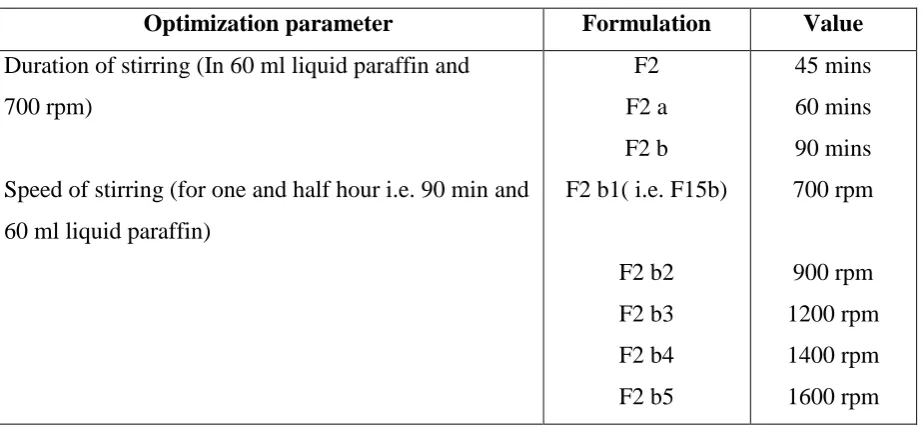
Table 2 Optimization of microsphere formula
Optimization parameter Formulation Value
Duration of stirring (In 60 ml liquid paraffin and 700 rpm)
Speed of stirring (for one and half hour i.e. 90 min and 60 ml liquid paraffin)
F2 F2 a F2 b F2 b1( i.e. F15b)
F2 b2 F2 b3 F2 b4 F2 b5 45 mins 60 mins 90 mins 700 rpm 900 rpm 1200 rpm 1400 rpm 1600 rpm
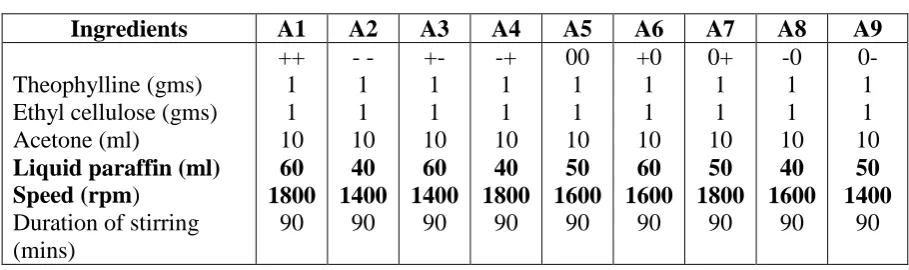
Further F2b5 formulation was optimized using two factors speed of stirring and volume of liquid paraffin. The particle size and yield was considered as response. A 32 factorial design was carried out using Design Expert 8.0 software Table 3 and 4.
Table 3 Factors, Responses and levels
Levels Factors
-1 0 +1
Liquid paraffin(X1) Speed (X2) Response (Y)
40ml 1400 rpm Particle size (Y1)
[image:4.595.95.491.574.703.2]Table 4 Optimization formulations
Ingredients A1 A2 A3 A4 A5 A6 A7 A8 A9
Theophylline (gms) Ethyl cellulose (gms) Acetone (ml)
Liquid paraffin (ml) Speed (rpm)
Duration of stirring (mins) ++ 1 1 10 60 1800 90 - - 1 1 10 40 1400 90 +- 1 1 10 60 1400 90 -+ 1 1 10 40 1800 90 00 1 1 10 50 1600 90 +0 1 1 10 60 1600 90 0+ 1 1 10 50 1800 90 -0 1 1 10 40 1600 90 0- 1 1 10 50 1400 90
Preparation of sustained release microspheres
The optimized formula was tried with different sustained release polymers to assess the suitability of the formulation for sustained release. [16, 17] Also varying levels of finalized polymer were tried out Table 5 and 6.
Table 5 Effect of various sustained release polymer
Ingredients A6 a A6 b A6 c A6 d
Theophylline Ethyl cellulose Eudragit RS 100 Eudragit RL 100 Eudragit S 100
1g 1g - - - 1g - 0.5g 0.5g - 1g 0.5g - 0.5g - 1g 0.4g - - 0.2g
Table 6 Effect of various levels of polymer Ethyl cellulose
Ingredients A6 a1 A6 a2 A6 a3
Theophylline Ethyl cellulose Acetone Liquid paraffin Speed Duration 1g 1g 10ml 60ml 1600 rpm 90mins 1g 0.5g 10ml 60ml 1600 rpm 90mins 1g 0.4g 10ml 60ml 1600 rpm 90mins
Evaluation of microspheres
1) Percentage yield
The percentage yield of microspheres was calculated using the following formula: % Yield = (Practical Yield x 100 ) / Theoretical Yield
2) Drug Entrapment efficiency
The amount of drug entrapped was estimated by crushing the spherules and extracting with water. The concentration was determined spectrophotometrically against appropriate blank. The % DEE was calculated using the following formula:
3) Particle Size Analysis
The particle size analysis and particle size distribution of microspheres was carried out by means of optical microscopy method under 10 x 10 magnifications.
4) Scanning Electron Microscopy Analysis
The microspheres were characterized further using scanning electron microscopy. Shapes and surface characteristics of the microspheres were investigated and photographed. The coated microspheres were then placed in SEM (Model: JEOL JSM-5400 SEM) and the images were procured using Unimation Prime SEM software.
5) Subjective Taste Evaluation
Taste evaluation was done using the time intensity method on 10 healthy human volunteers from whom informed consent was first obtained. The microspheres equivalent to 100 mg of theophylline was held in the mouth for 60 seconds and then spat out. Bitterness was recorded at different time intervals, according to the bitterness intensity scale from 0 to 3 where 0, 1, 2, and 3 indicate bland taste, Partially masked, masked but an after taste and strong bitterness respectively. [18, 19]
6) In Vitro Drug Release Studies
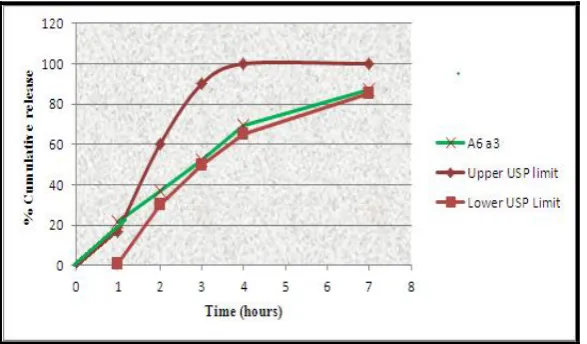
Release of Theophylline from the microspheres was determined using USP type II apparatus at 50 rpm using 0.1N HCl for the first one hour and phosphate buffer pH 7.4 for the next six hours. The drug: polymer ratio was varied to achieve the USP specifications for Extended release Theophylline capsule. [20, 21]
7) Flowability of Microspheres
The static angle of repose was measured according to the fixed funnel and free standing cone method. The bulk density of the mixed powders before compression was calculated by determining the Hausner's ratio and Carr's index.
RESULTS AND DISCUSSIONS
the drug showed an endotherm at 271 oC (figure 2). The mixture of drug and polymer also showed a distinct drug peak without change in position, which indicated that there was no interaction between the drug and the polymer.
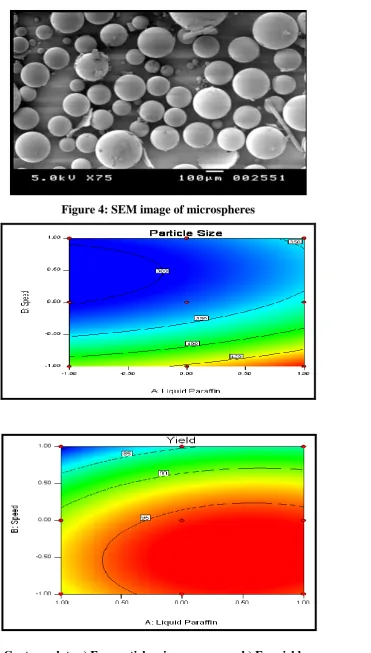
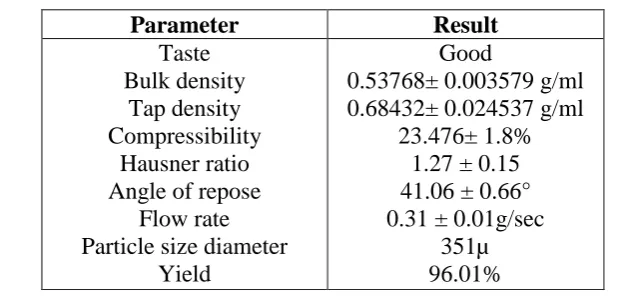
[image:7.595.133.520.454.629.2]For preparing microspheres, various trials were conducted and final selection was done on the basis of particle geometry and size distribution. The organic solvent evaporation method using iso propyl alcohol (F1) was not successful in formation of microspheres; while method using acetone (F2) yielded spherical particles as desired. Thus the method using acetone and 60 ml of liquid paraffin, stirred at 1600 rpm for 90 minutes duration yielded best microspheres of particle size 351± 10 µ. The final formulation containing Theophylline : Ethyl cellulose in the ratio 1:0.4 gave the desired release profile (Figure 3) and was subjected to assay, taste evaluation, flow characteristics (Table 7) and scanning electron microscopy and the results are as shown in Table 4. The yield was 96.57 ± 2 % (figure 5) and the assay results showed entrapment of 99.71 ± 0.53 % drug. No drug release was observed in simulated salivary fluid from microspheres, indicating complete masking of bitter taste has been achieved. Also, this was confirmed by subjective taste evaluation in healthy volunteers. The scanning electron microscopy was carried out for the final formula and the results were as shown in Figure 4. The photographs confirmed the spherical nature of microspheres.
Figure 2: DSC Thermograms a) Thermogram of plain Theophylline b) Thermogram of Theophylline:Ethyl Cellulose (1:0.4)
Figure 4: SEM image of microspheres
[image:9.595.148.448.70.256.2]Table 7 Flow properties
Parameter Result
Taste Bulk density
Tap density Compressibility
Hausner ratio Angle of repose
Flow rate Particle size diameter
Yield
Good
0.53768± 0.003579 g/ml 0.68432± 0.024537 g/ml
23.476± 1.8% 1.27 ± 0.15 41.06 ± 0.66° 0.31 ± 0.01g/sec
351µ 96.01%
CONCLUSION
The method of volatile solvent evaporation emulsification was successful in yielding microspheres which made the drug palatable. The method using acetone/liquid paraffin gave better results as compared to that using isopropyl alcohol. The trial conducted for 90 minutes at 1600 rpm using 60 ml of liquid paraffin resulted into spherical microspheres of particle size 351 ± 10 µ. The formulation containing Theophylline : Ethyl cellulose in the ratio of 1: 0.4 produced not less than 87 % release at the end of 7 hours.
REFERENCES
1. F.Wilkosz, H. Bogner; US Pharmacist; 27; 2003.
2. Indurwade, N.H., Rajyaguru, T.H., Nakhat, P.D., Indian Drugs 2002, 405-409. 3. Habib W, Khankari R, Hontz J,.Crit Rev Ther Drug Carrier Syst 2000; 17:61-72.
4. Lesko L, Canada A, Eastwood G, Walker D, Brousseau D., J Pharm Pharmaceutical Science; 2006, 68: 1392 - 1394.
5. Horn, Dieter, Krueger, Goetz, Spengler, Reinhard. United States Patent 4950654, August 21,(1990).
6. Kjellman I, Croner S, Leijon I, Friberg K and Thuresson S. Eur J Pediatrics; 2004148: 278-280.
7. Pharmaceutical Preformulation Services information from Ricerca chemical development. 8. Lachmam L, Lieberman L; The theory and practise of Industrial pharmacy; 3 rd
edition;66-99,171-196.
9. Ortega, Aracelis M. United States Patent 4837032, April 2, (1986)
13.MatteoCerea. A novel powder coating process for attaining taste masking and moisture protective films applied to tablets. International Journal of Pharmaceutics; 2004, 279: 127-139.
14.Dashevsky A, Zessin G. The effect of ethylcellulose molecular weight on the properties of theophylline microspheres.J Microencapsulation, 1997, 14; 3: 273-80.
15.Patrick B. O'Donnell and James W. McGinity. Preparation of microspheres by the solvent evaporation technique. Advanced Drug Delivery Reviews, 1997, 28, 1: 13, 25-42.
16.Stithit S. and Price .J. Development and characterization of buoyant theophyliine microspheres with near zero order release kinetics. J Microencapsulation, 1998, 15(6), 725-737.
17.Obeidat WM, Obaidat I.., Effect of the dispersion of Eudragit S100 powder on the properties of cellulose acetate butyrate microspheres containing theophylline made by the emulsion-solvent evaporation method. J Microencapsulation, 2007 May; 24(3):263-73. 18.J. Sjövall et.al. Methods for evaluating the taste of paediatric formulations in children: A
comparison between the facial hedonic method and the patients' own spontaneous verbal judgement. European Journal of Pediatrics, 1984, 141, (4).
19.Khan S, Kataria P, Nakhat P, Yeole P. Taste masking of ondansetron hydrochloride by polymer carrier system and formulation of rapid-disintegrating tablets. AAPS Pharm Sci Tech. 2007; 8(2): 46.
20.Shukla A.J.; Price J.C Effect of Drug (Core) Particle Size on the Dissolution of Pharmaceutical Research, Pharm Res. 1989, 6(5):418-421(4).