The reliability and validity of gas exchange kinetics,
maximal aerobic power, anaerobic threshold and sport
specific protocols as determinants of fitness in elite
athletes.
EDWARDS, Andrew Mark.
Available from Sheffield Hallam University Research Archive (SHURA) at:
http://shura.shu.ac.uk/23510/
This document is the author deposited version. You are advised to consult the publisher's version if you wish to cite from it.
Published version
EDWARDS, Andrew Mark. (2003). The reliability and validity of gas exchange
kinetics, maximal aerobic power, anaerobic threshold and sport specific protocols as determinants of fitness in elite athletes. Doctoral, Sheffield Hallam University (United Kingdom)..
Copyright and re-use policy
Short Title: The physiological assessment o f elite athletes
Long Title: The reliability and validity o f gas exchange kinetics, maximal aerobic
power, anaerobic threshold and sport specific protocols as determinants o f fitness in
elite athletes.
Andrew Mark Edwards
REFERENCE
Published works submitted in partial fulfilment o f the requirements o f Sheffield
Hallam University fo r the degree o f Doctor o f Philosophy on the basis ofpublished
work.
PLEASE NOTE:
This thesis is reference material
fo r structure and references only.
November
2003
ft cannot be taken out of th e building.
SHEFFIELD HALLAM UNIVERSITY LEARNING CENTRE COLLEGIATE CRESCENT
ProQuest N um ber: 10760407
All rights reserved
INFORMATION TO ALL USERS
The q u a lity of this re p ro d u c tio n is d e p e n d e n t u p o n the q u a lity of the c o p y s u b m itte d .
In the unlikely e v e n t that the a u th o r did not send a c o m p le te m a n u s c rip t and there are missing p a g e s , these will be n o te d . Also, if m a te ria l had to be re m o v e d ,
a n o te will in d ic a te the d e le tio n .
uest
P roQ uest 10760407
Published by ProQuest LLC(2018). C o p y rig h t of the Dissertation is held by the A u tho r.
All rights reserved.
This work is p ro te c te d a g a in s t u n a u th o riz e d c o p y in g under Title 17, United States C o d e M icro fo rm Edition © ProQuest LLC.
ProQuest LLC.
789 East Eisenhower Parkway P.O. Box 1346
VV.
Z k
Acknowledgements
Contents
Abstract... 3
Introduction... ... 4
Analysis o f the component parts... ...6
i) Gas exchange kinetics in elite athletes ...6
ii) Anaerobic threshold and maximal oxygen consumption...17
iii) Sport specific fitness: Soccer specific fitness test . ...21
Research synthesis... 26
Conclusions..;... 31
References... 33
Abstract
The aim of this research was to produce reliable and valid new fitness assessments utilising both gas exchange kinetics and sport specific field testing for the
determination of fitness in elite athletic groups. A series of studies were conducted on both track runners and soccer players to examine the usefulness o f maximal,
submaximal and sport specific procedures. The physiological measurements utilised
in this research were: gas exchange kinetics, maximum aerobic power (VO2 max),
anaerobic threshold and a soccer specific fitness test. The research developed new procedures and modified existing protocols to challenge athletes appropriately in the examination o f relevant athletic performance indicators. For the determination of test reliability and validity, test-retest analysis was performed and cross-sectional
comparisons were made between performers o f both different standards of performance and event specialisms. The submaximal gas exchange kinetics test enabled the differentiation o f elite sprinters from elite endurance runners. A test-retest reliability study of that procedure revealed high test variability (measurement error range: 18 - 35%), possibly due to breath-by-breath fluctuations. The development of a mean response time through a mathematical modelling technique improved the
confidence in this procedure (test - retest measurement error: 16%) and produced a single, overall, measurement to enhance the future application of the procedure for the assessment of aerobic fitness in different population groups. Nevertheless, relatively high test-retest variability remains a feature of the test. Further research examined the validity of standard laboratory and sport specific measurements in the determination o f training status in professional soccer players. Maximal aerobic power was shown to be unaffected by short-term (5 weeks) changes in training status (63.3 ±5.8 ml-kg'
^min'Wd 62.1 ±4.9 ml-kg'^min'1) , questioning the relevance o f this measurement to routine assessment of fitness and training status. Conversely, the soccer specific fitness test enabled the differentiation between soccer players performing at different
standards where there was no difference in estimated VO2 max, however there was no
Introduction
Physiological assessment is an important part of the training process for athletes
aspiring to achieve or maintain an elite standard o f performance. Appropriately
designed fitness assessment procedures provide constructive feedback about specific
aspects of performance related fitness which would prove useful to gauge training
intensities accurately, monitor progress and identify strengths and weaknesses.
The aim of this research was to produce reliable and valid measurements of fitness,
utilising new and innovative procedures which incorporate the application of gas
exchange kinetics (Edwards et al. 1999,2000,2001a, 2001b, 2002b, 2003a), maximal
aerobic power and anaerobic threshold (Clark and Edwards 2003, Edwards et al.
2003c, Fysh et al. 1999) and sport specific fitness testing (Edwards et al. 2002a,
2003b, 2003d) in the identification of fitness in elite athletes. A prominent
consideration o f the research was to utilise procedures that provide constructive
feedback for athletes and their coaches with minimum imposition to training routines.
Therefore, practicality, validity and test re-test reliability were of great importance to
the successful application of the procedures.
The fitness assessment procedures utilised in this research applied physiological
principles underlying the mechanisms of both aerobic and anaerobic energy provision.
The studies of oxygen uptake ( V O2) and carbon dioxide output (VCO2) kinetics
investigated whether low intensity dynamic exercise could reflect aerobic fitness as an
alternative to maximal intensity testing (Edwards et al. 1999,2000,2001a, 2001b,
2003a, Fysh et al. 1999). Previous studies have shown VO2 kinetics to be faster in
individuals possessing better aerobic fitness (Epfeld et al. 1987, Hagberg et al. 1980,
Hickson et al. 1978, Powers et al. 1985, Zhang et al. 1991), but there have only been a
few studies where VO2 and VCO2 kinetics have been applied to sport (Fukuoka et al.
1995,1997). This is surprising since pulmonary VO2 kinetics provides a useful
non-invasive estimate o f muscle V 0 2 kinetics (Epfeld et al. 1991, Hoffmann et al. 1992).
Aerobic power, aerobic capacity, anaerobic power and anaerobic capacity are key
physiological variables that have previously been identified as important factors in the
physical capacity o f a sports performer (Reilly et al. 2000). However, none o f these
measures in themselves accurately predicts the ability to perform a running race or
prolonged intermittent exercise with alternating intensities, as performed in sports
such as soccer (Bangsbo and Lindquist 1992). Consequently, an innovative and
practical fitness test was developed in this research to examine the specific fitness
requirements o f elite athletes who in this case were professional soccer players
(Edwards et al. 2002a, 2003b, 2003d).
The aims of this research were to:
1. Devise a new, low intensity procedure for the assessment o f aerobic fitness
utilising the principles o f moderate intensity gas exchange kinetics.
2. Determine the reliability of the new procedure for the assessment o f
breath-by-breath responses to a pseudo-random binary sequence protocol.
3. Examine test validity for the pseudo-random binary sequence test through a
cross-sectional comparison o f test performances in elite endurance and sprint
4. Propose a standard form o f results expression for oxygen uptake responses to
pseudo-random binary sequence exercise, following examination of current and
new procedures.
5. Examine the validity o f existing laboratory based aerobic fitness assessments to
the identification of aerobic fitness in professional soccer players.
6. Determine the practical application and validity of a new sport specific through a
comparison of test performances between elite and sub elite athletes.
Analysis of the component parts
i) Gas exchange kinetics in elite athletes
Gas exchange kinetics describes the rate of change o f VO2 and VCO2 in response to
the onset of exercise or to a change in work rate (Whipp and Wasserman 1972, Whipp
et al. 1982). It has previously been shown that individual variations in either VO2 or
VCO2 kinetics could describe aerobic fitness (Epfeld et al. 1987, Fukuoka et al. 1995,
1997, Zhang et al. 1991) and, consequently, a reliable and valid low intensity test
would have potential for both the assessment of aerobic fitness in elite athletes and
also in a clinical context in patients unable to perform high intensity exercise (Massin
et al. 1998,2000).
Two studies completed as part of this research (Edwards et al. 2002b and Fysh et al.
1999) identified a significant relationship between VO2 max and VO2 kinetics. These
studies demonstrated that VO2 kinetics could be used to assess cardiovascular fitness,
but it seems likely that VO2 kinetics may be more indicative of other aspects of
aerobic fitness than VO2 max since an R2 of 0.46 (Edwards et al. 2002b) shows that
VO2 kinetics are not solely reflective of VO2 max.
Both VO2 and VCO2 are characterised by three time related phases (Whipp et al.
1982). Phase I is the initial period, lasting -15-20 s and covers the period in which
venous blood from the active muscle has not yet reached the lungs (Whipp and
Wasserman 1972). Phase II describes the period in which venous blood from the
t
active muscle arrives at the lungs and has a lower O2 content and higher C O2 content
than during Phase I. Consequently, phase II reflects the period of major increase in
cellular respiration and lasts from about 15 s to 3 min. The phase II response was the
area o f interest in this research (Edwards et al. 1999, 2000,2001a, 2001b, 2002b,
2003a) as dynamic, low intensity assessment o f gas exchange kinetics offers a novel
approach to the assessment of aerobic fitness. Phase III starts 3 min after exercise
onset, and reflects the start of the VO2 steady state period if the work rate is below
the anaerobic threshold. If the work rate is above the subject’s anaerobic threshold,
the rate of increase in VO2 correlates with the magnitude o f the lactate increase
(Whipp and Wasserman 1972, Zhang et al. 1993). Carbon dioxide output is slower to
reach phase III, due to the enhanced capacity to store C O2 in the tissues, and is
consequently reached at - 4 min (Whipp et al. 1982).
A pseudo-random binary sequence exercise protocol was selected for the research
(Edwards et al. 1999) as it switches between two work loads over a predefined period
be placed in series over the duration of the exercise test and consequently each
sequence can be utilised as a repeated test measure for ensemble averaging purposes.
This potentially reduces non-physiological noise associated with breath-by-breath
procedures (Lamarra et al. 1987). It was anticipated that the dynamic metabolic
challenges of the pseudo-random binary sequence exercise would provide a more
representative test of aerobic fitness than the traditional assessment o f exercise
capacity (Kowalchuk and Hughson 1990) and because it is a sub-maximal test, it can
be applied repeatedly with minimal imposition to the subjects (Hughson et al. 1990).
This is advantageous for testing o f large groups and subjects with limited available
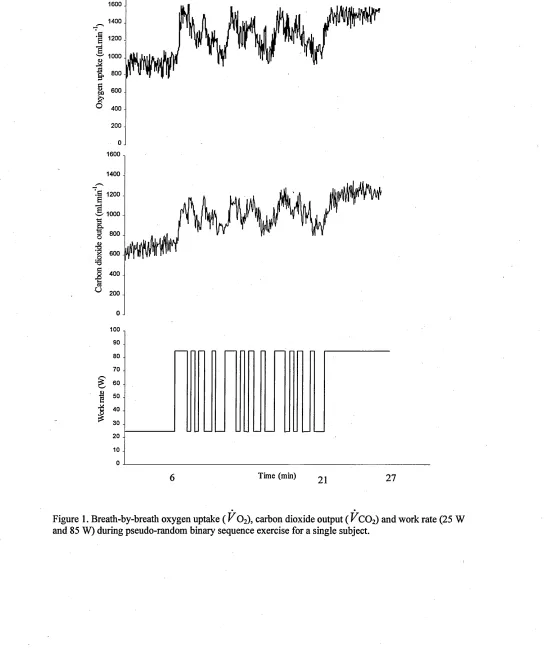
time, as assessment would require minimal laboratory contact. The pseudo-random
changes in work rate were designed to reflect the Phase II response o f gas exchange
kinetics (Figure 1) through a series o f low-intensity dynamic challenges within a
single test, whereby O2 uptake and CO2 output at the lungs reflect the O2 consumed
by the cells and the CO2 produced from muscle metabolism (Epfeld et al. 1987,
Hoffmann etal. 1994).
D. 800 §> 600 ° 400
g 600
100
90 80 70 60 50 40 30 20
10
0
Time (min)
21 27
[image:13.612.17.561.34.682.2]A standard method of analysis for multiffequent tests, such as the pseudo-random
binary sequence test, is in the frequency domain by application of Fourier analysis
(Epfeld et al. 1987,1991, Hoffmann et al. 1992,1994). In this technique, the length of
the pseudo-random binary sequence is treated as a sine wave with different composite
harmonic frequencies. The lowest frequency that completes a full sine wave in the
length of the pseudo-random binary sequence cycle is known as the fundamental
frequency and displays the highest power output (Epfeld et al. 1991, Hoffmann et al.
1992,1994). As the frequencies become progressively higher, the input power (work
rate power) becomes dissipated leading to progressively output power (individual gas
exchange kinetics response) being retained at each frequency and thus the underlying
response becomes less discernible from non-physiological background noise (Epfeld
et al. 1991, Hoffman et al. 1992, Lamarra et al. 1987).
Fourier analysis yields estimates of the response to a pseudo-random binary sequence
protocol at each harmonic frequency, but the standard expression o f results for multi
frequent tests such as the pseudo-random binary sequence are difficult to reconcile
with physiological conclusions. This is due to the method o f expression within
Fourier analysis according to the terms 1) amplitude ratios (the magnitude of the
response) and 2) phase shift angles (the delay in the response). Although amplitude
ratios and phase shift angles are calculated for each harmonic, they correspond to a
frequency, which is determined by the design o f the particular pseudo-random binary
sequence utilised. As the construction of pseudo-random binary sequences vary
according to the requirements of researchers, it is difficult to attach specific
physiological conclusions to each frequency. For example, the first frequency in a 300
s protocol (15 units of 20 s) is calculated as 1/300 = 0.0033 Hz (3.3 mHz). The first
frequency of a 450 s protocol (15 units o f 30 s) is thus calculated as 1/450 = 0.0022
Hz (2.2 mHz). Therefore direct comparison o f the output response between protocols
is difficult as the frequencies representing the responses differ. As the base units are
also different (20 s and 30 s respectively), each protocol examines different aspects of
the dynamic response which further complicates accurate comparisons.
In the first study of this research (Edwards et al. 1999), standard Fourier analysis was
applied for the expression o f V0 2 kinetics. That study provided evidence that the 300
s pseudo-random binary sequence exercise test could be used to elicit significantly
faster gas exchange kinetics in elite endurance runners compared with elite sprinters.
However, this finding was not of statistical significance at each harmonic frequency
measured and the physiological implications of this observation remain unclear,
although it is most likely related to the progressive decline in input power at the
higher frequencies.
It was expected that the elite endurance runners would display faster V 0 2kinetics that
the elite sprinters as there are many characteristic physiological differences between
these groups (Andersen and Henriksson 1977, Bergh et al. 1978, Bemus et al. 1993).
The findings were also consistent with the theory that endurance training adaptations
interact to accelerate the adjustment of 0 2 supply to 0 2 demand during submaximal
exercise (Hagberg et al. 1980, Hickson et al. 1978). This further supports earlier
studies in which V0 2 kinetics were shown to improve in response to endurance
training (Babcock et al. 1994, Berry and Moritani 1985, Fukuoka et al. 1997, Phillips
et al. 1995a). One study did not show an overall improvement in phase II V0 2
their subjects were subdivided according to levels of training, the less well trained
displayed improved V 0 2 kinetics where there was no change in the well trained
subjects. This finding supports the view that V 0 2 kinetics might be of use in the
identification of aerobic fitness in the general population but is likely to be less useful
among previously well trained elite athletes.
Following the observation o f faster V 0 2 kinetics in elite endurance runners utilising
the pseudo-random binary sequence fitness test, examination was made o f
FCC^kinetics (Edwards et al. 2000). Since a previous study (Fukuoka et al. 1997)
showed V C 02 kinetics to be delayed after 6 months sprint and strength training in
footballers, it might be expected that V C 02 kinetics would also differentiate elite
endurance runners from elite sprinters. This was not shown to be the case in this
research (Edwards et al. 2000). Although both amplitude ratio and phase shift for
V C 02 kinetics were consistently slower in the sprinters compared with the endurance
runners at all frequencies, this observation was not of statistical significance. This is
most likely due to the high standard deviations observed for V C 02 kinetics in
comparison to V 0 2 kinetics, which could either be attributable to the effects of higher
tissue capacitance for CO2 than 0 2> or technical imprecision of CO2 measurement.
The main finding o f this element o f the research (Edwards et al. 1999a, 2000) was
that the pseudo-random binary sequence exercise test might become a useful
assessment of V 0 2 kinetics, but an issue o f reliability emerged from the variability
observed in V C 02 kinetics. A test-retest study was therefore conducted to establish
The results of the test-retest study (Edwards et al. 2001a) demonstrated that the limits
o f agreement as defined by Bland and Altman (1986) were substantially closer for
VO2 kinetics than VCO2 kinetics. This offered some explanation for the failure of
VCO2 kinetics to differentiate between the elite endurance runners and elite sprinters
(Edwards et al. 2000). Likely causes for the observed variability are differences in the
signal to noise ratio between VO2 kinetics and VCO2 kinetics, greater variations in
ventilation in VCO2 kinetics compared with V 0 2 kinetics, or a change in CO2 storage
during the test period.
In this research, both V 0 2 kinetics and VCO2 kinetics displayed levels o f test-retest
variability, which question the practical application of the pseudo-random binary
sequence test. For comparison between test-retest reliability across amplitude ratios
and phase shift angles, measurement error was calculated according to the definition
of Atkinson and Nevill (1998) (Edwards et al. 2001a). Measurement error for VO2
kinetics ranged between 18-35% and VCO2 kinetics between 39-108%. It is therefore
unsurprising that VCO2 kinetics did not differentiate between the athletic groups and,
consequently, the subsequent development of this research concentrated on V 0 2
kinetics rather than VCO2 kinetics utilising the pseudo-random binary sequence
exercise test (Edwards et al. 2001a).
Conclusions drawn from the research suggest that further development o f the pseudo
random binary sequence exercise test would be dependent on improved test-retest
(Edwards et al. 2001a). Either sporting or clinical application of an exercise test
would have greater relevance when expressed by a single quantifiable test score or
time. Oxygen uptake kinetics in response to step test procedures have been routinely
expressed in the time domain by description o f the time constant o f the response
(Hughson et al. 1988, Whipp et al. 1982). In this method, a mathematical model is
fitted to the test data for the subsequent calculation o f a mean response time. A
limitation o f the step test procedure is that it requires multiple repeats o f the step to
generate sufficient data for analysis (Hughson et al. 1988, Stegemann et al. 1985). In
comparison, the pseudo-random binary sequence test has the advantage o f being able
to generate adequate information about V 0 2 kinetics from a single test, although the
physiological interpretation of frequency responses is more complex.
The development o f a single time score for V 0 2 kinetics would enable researchers or
clinical practitioners to compare subjects test performances quickly and in a
meaningful way. For example, a typical 300 s (15 units of 20 s) pseudo-random
binary sequence V 0 2 kinetics test response analysed in the frequency domain yields
three usable values for amplitude ratio at frequencies 3.3 mHz (typically ~ 8.02 ±0.7
ml-min'^W'1, 6.7 mHz (5.47 ±0.9 ml-min'^W'^, 10 mHz (3.56 ±0.7 ml-min'^W'1)
and a further three for phase shift (typically — 41.26 ±5.82 degrees, -73.74 ±7.93
degrees and -99.53 ±9.29 degrees), i.e. before the underlying physiological response
is obscured by breath-by-breath background noise. This research has not shown a
consistent pattern of reliability for individual frequencies o f either amplitude ratio or
phase shift and it is therefore difficult to attach meaningful physiological conclusions
to the test results. The high test retest variability of the frequency domain results is a
probable cause for this, but a reliable single test score would remove the uncertainty
surrounding the meaning o f individual frequencies.
To generate a single overall test response from the pseudo-random binary sequence
exercise test, two time domain procedures have been proposed as alternatives to
frequency domain analysis (Hughson et al. 1991, Massin et al. 1998,2000,
Stegemann et al. 1997). The test-retest reliability o f the two procedures has not been
reported and therefore this research compared both methods with frequency domain
results (Edwards et al. 2001,2003) for the identification of the most reliable and
practical method o f result expression.
The procedure described by Hughson et al. (1991) utilised a mathematical modelling
technique to generate a mean response time that might be comparable with the
analysis procedures used in step tests (Linnarsson 1974, Whipp et al. 1982). This
procedure utilises the auto- (work rate correlated with itself) and cross-correlation
(work rate correlated with V 0 2 response) functions for the model fitting. As the auto
correlation appears in the shape o f a triangular pulse, the mean response time method
is derived by fitting a linear summation of the ramp form o f a two-component
exponential function to the test data. Although complex, this method utilises time
delays and gains in the calculation of the mean response time and is an example o f a
functional, rather than empirical model.
A second, and simpler, approach is possible utilising the known lag in time between
auto and cross-correlation functions derived from the pseudo-random binary sequence
(Massin et al. 1998,2000). This approach merely describes the time lag between
auto-and cross-correlation functions auto-and has been termed a ‘peak cross-correlation time’
(Edwards et al. 2003a).
Preliminary analysis was conducted to examine the application o f the mean response
time method on the data previously reported for elite sprinters and elite endurance
runners (Edwards 1999,2001b). That study demonstrated the mean response time
could be used to differentiate between the V 0 2 kinetics o f the two groups and
consequently further research was conducted to compare the application of the two
time domain procedures on both the sprint and endurance data and the test-retest data
previously reported in the frequency domain (Edwards et al. 2003a).
The results o f this research demonstrated different reliability between the assessment
procedures (Edwards et al. 2003a). The most reliable method in this research was the
mean response time method with a measurement error of 16%. This compared
favourably with the previously reported measurement error of 18-35% in the
frequency domain (Edwards et al. 2001a) and the peak cross-correlation time o f 25%
(Edwards et al. 2003a).
The expression of an overall response either by mean response time or peak cross
correlation time potentially offers greater application o f the pseudo-random binary
sequence exercise test to either sports groups or in a clinical context through the
expression of a single test result. Test-retest reliability of VO2 kinetics was improved
using the mean response time and the most likely explanation for this is a reduced
susceptibility to breath-by-breath noise in an overall response.
ii) Anaerobic threshold and maximal oxygen uptake
Maximal aerobic power (V O2 max) is widely considered the most objective measure
o f endurance capacity. However, the specificity principle o f training suggests that
care must be taken when interpreting VO2 max as an absolute indicator o f fitness
(Kemi et al. 2003, Pechar et al. 1974). The VO2 max is poorly related to the demands
of many sports and an improvement or change of V O2 max does not necessarily lead
to a practical change in sports performance (Gergley et al. 1984).
Although an individual’s highest attainable VO2 max is usually reached within two
years of endurance conditioning (Saltin et al. 1977), endurance performance continues
to improve with continued training for many additional years. Improvement in
endurance performance without improvements in VO2 max is probably due to the
body’s ability to perform at increasingly higher percentages of VO2 max for extended
periods following training (Donovan and Pagliassotti 1990, Phillips et al. 1995b). It
seems likely that this increase in performance without an increase in V 0 2 max is the
result of an increase in lactate threshold (Denis et al. 1982), because endurance steady
state is directly related to the VO2 value at lactate threshold (Bassett and Howley
2000, Denis et al. 1982, Donovan and Pagliassotti 1990).
The purpose o f the maximal aerobic power ( V 0 2 max) and anaerobic threshold
research was to compare the sensitivity of both measurements after changes in
measurement of V 0 2 max, in particular, has often been used as a standard fitness
assessment procedure for athletes in endurance based sports, the identification of
specific fitness in multi sprint sports such as soccer is more complex due to the
diverse requirements of the game (Bangsbo and Lindquist 1992, Kemi et al. 2003,
Reilly et al. 2000). Nevertheless, research suggests that a V 0 2 max of 60 ml*kg*-1min"
1 as a minimum requirement for professional soccer performance (Tumilty 1993) and
many soccer clubs continue to utilise the multi-stage fitness test (MSFT)
(Ramsbottom et al. 1988) to estimate V 0 2 max. For this purpose, a group o f English
1st team Professional Division 1 soccer players were tested both in a highly trained
state and also following a 5 weeks off season period (Clark and Edwards 2003,
Edwards et al. 2003c).
It has previously been shown that an inclined treadmill recruits a larger muscle mass
than when running on the flat and a slower cadence allows the individual to reach a
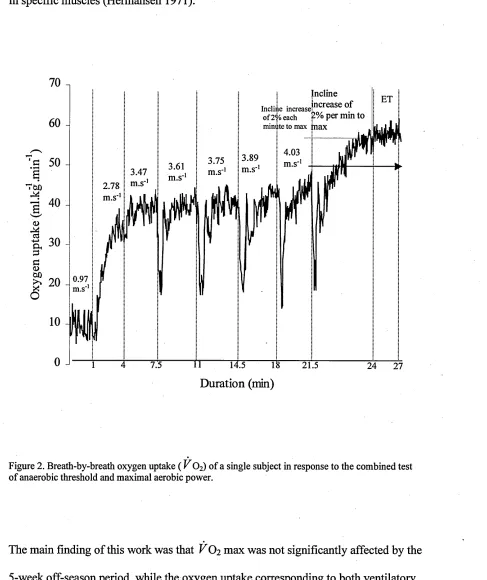
‘true’ VO2 max (Astrand et al. 2003). In consideration of this, a series o f flat running
incremental steps were used for the assessment o f anaerobic threshold prior to a
subsequent series o f increases in incline at a constant speed o f 14.5 km-h'1 for the
measurement of VO2 max (Figure 2).
Measurement of anaerobic threshold can be assessed by a number o f measures but in
this research was identified by both the initial rise in lactate above the resting baseline
and also by the V slope method for assessment o f ventilatory parameters V 0 2 and
V C 0 2. Onset of blood lactate accummulation (OBLA) at a fixed concentration of
4mmoM'1 was not used in this research as it has been criticised due to variability
between subjects (Coyle 1995) and because it may be a result of not only muscle
anaerobisis, but also a decreased total lactate clearance or increased lactate production
in specific muscles (Hermansen 1971).
70
60
' S 5 0 a T1
^4
•d 40
<L) a +-» Oh 3 a <L> bD
s
30 20 10 0 Incliney * •: . increase of Incline increase:
o f 2^0 each g % per mm to miniite to max jnax
ET
21.5
Duration (min)
[image:23.612.60.547.68.648.2]24 27
Figure 2. Breath-by-breath oxygen uptake (
V
0 2) of a single subject in response to the combined test of anaerobic threshold and maximal aerobic power.The main finding of this work was that VO2 max was not significantly affected by the
5-week off-season period, while the oxygen uptake corresponding to both ventilatory
(Clark and Edwards 2003, Edwards et al. 2003c). Although a limited amount o f
training was conducted over the off-season, it was performed at lower intensities and
on a less demanding schedule compared to the regular match play and training o f the
on-season. The change observed in V O2 corresponding to both lactate threshold and
ventilatory threshold suggests that either measure o f anaerobic threshold is a more
useful indicator o f training status than V 0 2 max. Consequently, although a maximal
intensity test is certainly o f importance in the identification of maximum heart rate
and the production of a V 0 2 max ‘score’, the place o f regular and routine direct
assessment of V 0 2 max during soccer training is questionable. Therefore, although
maximal aerobic power is undoubtedly o f importance to soccer performance, it
represents only one o f several strands in the fitness requirements of soccer.
The failure o f V 0 2 max assessment to identify a change in the training state o f the
soccer players might be explained by the duration of exercise tolerance at V 0 2 max
(Edwards et al. 2003c). This aspect of the research demonstrated that when the
players were in the highly trained state they were able to sustain maximal exercise for
significantly longer than when less well trained. This is consistent with the theory that
sustained running speed is directly related to the accumulation of lactic acid in the
muscle (Bassett and Howley 2000, Denis et al. 1982, Donovan and Pagliassotti 1990).
In the highly trained state, lactate threshold was improved which demonstrated that
higher steady state running speeds could be achieved prior to the onset o f acidosis.
This finding suggests that V 0 2 max has little scope for further improvement in elite
well-trained subjects who may have reached a genetic ceiling of aerobic performance,
but it is also possible that existing training methods are not sufficiently focused to
change maximal aerobic power.
iii) Sport specific fitness: Soccer specific fitness test
A progression o f this research was the development of a sport specific fitness testing
procedure that might prove an accurate method o f obtaining objective information
about fitness and training for coaches and athletes. Physiological adaptations in
r'
response to physical training are highly specific to the nature of the training activity
(Kemi et al. 2003, Saltin et al. 1976) and research demonstrates that the more specific
the training programme is to the given sport or activity, the greater the improvement
in performance in that sport or activity (Gergley et al. 1984, Helgerud et al. 2001).
Bangsbo and Lindquist (1992) proposed that to measure performance-related
improvements in fitness accurately, athletes should be tested while they are engaged
in an activity similar to the sport or activity in which they usually participate. No
single measure o f overall muscular strength or aerobic fitness exists, instead, an
individual displays an array of qualities relevant to the fitness requirements o f the
sport undertaken. It is possible that these qualities of muscle function and
performance relate poorly to each other, if at all, and likewise, testing a person for
aerobic fitness could produce different fitness results, depending on the mode of
activity (McArdle et al. 1971, Toner et al. 1983).
Measurement o f fitness should most closely resemble the actual requirements o f the
duration and pace of the task. Therefore, it is likely that the most effective evaluation
of sport-specific fitness occurs when laboratory or field measurement closely
simulates the actual sport activity and uses the muscle mass required by the sport
(Bilodeau et al. 1995, Gergley et al. 1984).
The aim of this section of the research was to develop a fitness testing procedure of
specific relevance to a selected sport. Reilly et al. (2000) identified a need for
representative assessment o f fitness or training status for soccer and although other
researchers have devised and developed soccer specific protocols (Bangsbo et al
1991, Bangsbo and Lindquist 1992, Bangsbo 1994, Drust et al. 2000, Nicholas et al.
1995, Wragg et al. 2000), many o f these have been designed to replicate the full
demands of the game (Drust et al. 2000, Nicholas 1995,2000) for the assessment of
match like intervention measures in isoloation from matchplay, while others represent
single strands of fitness (Bangsbo 1994, Wragg et al. 2000) or were designed as
training ground ‘drills’ (Bangsbo and Lindquist 1992, Bangsbo 1994). Bangsbo and
Lindquist (1992) compared various exercise tests with the endurance performance of
professional soccer players and suggested that specific interval field tests could be
used to evaluate long-term endurance performance o f elite soccer players. They
further concluded that V 0 2 max and blood lactate concentration during submaximal
running were not sensitive measurements o f endurance capacity for intermittent
exercise. Their observation is consistent with the findings in this research (Edwards et
al. 2003b) but are in contrast to the results reported by Helgerud et al. (2001) in which
VO2 max increased from 58.1 to 64.3 ml-kg'1-min'1 over eight weeks o f aerobic
training in youth team professional trainees. However, the magnitude o f the increase
in that study could be related to the initial training status of the athletes, genetic
characteristics or maturation.
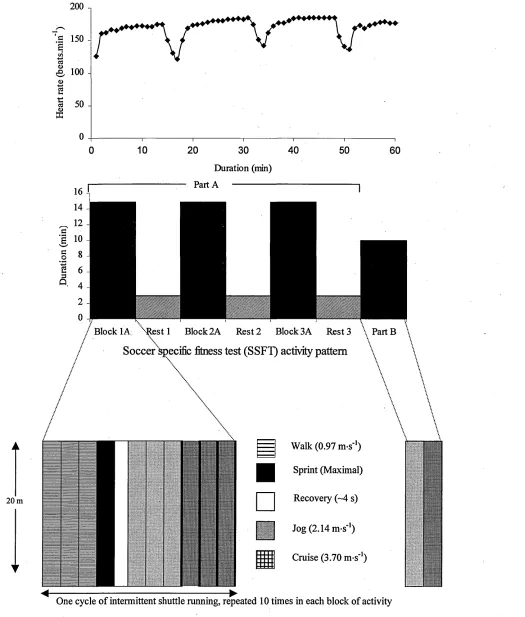
In this research, a single and practical exercise test was developed to assess soccer
specific fitness over a range o f indicators. The basic movement pattern o f an existing
protocol was used (Nicholas et al. 1995, 2000), although that procedure was designed
to replicate the demands o f a full 90 min game with which to investigate dietary
interventions and hydration status. While the 90 min protocol did not offer immediate
indication of practical use as a fitness test, the close resemblance of the test to the
demands o f the game suggested that it might have application in a modified form.
A limits of agreement study conducted by Nicholas and co-workers (2000) provided a
solid base for further development of the procedure as a fitness test. Modifications
were made to condense the new protocol and to facilitate multiple testing o f subjects
at one time (Edwards et al. 2003b). A combination of verbal and audio cues was used
to improve pace judgement in the multi-speed test and physiological assessment was
introduced across a range o f fitness indicators. The fitness indicators designed in this
research were developed to represent both aerobic and anaerobic components o f the
test. The selected fitness indicators were: Exercise heart rates, recovery heart rates,
blood lactate concentration, peak and average sprint times, and a fatigue rate
expressed as the drop off from peak sprint performance. Therefore, consideration was
made to ensure that the aerobic and anaerobic components of multi sprint activities
200 n
/ — N
03
<L>
e 100
-+->
2 i
tS
50
-10 20 30 40 50
0 60
Duration (min)
/ Block 1A 'Rest 1 Block 2A Rest 2 Block 3A Rest 3 \ Part B
Soccer specific fitness test (SSFT) activity pattern
2 0 m
□
Walk (0.97 m-s'1)
Sprint (Maximal)
Recovery (~4 s)
Jog (2.14 m-s'1)
Cruise (3.70 m-s'1)
[image:28.613.30.555.51.668.2]One cycle of intermittent shuttle running, repeated 10 times in each block of activity
Figure 3. The heart rate (1 min average) response of a single subject to a schematic representation of the Soccer Specific Fitness Test protocol.
The results of the first study utilising the soccer specific fitness test (Edwards et al.
2003b) demonstrated that Academy players from a professional soccer club
performed the test at a significantly different level compared to a group of
recreational players. An important observation in this study was that a progressive
shuttle run test to exhaustion did not differentiate between the predicted aerobic
capacities of the two groups. This further demonstrated that a generic and non
specific test is less likely to prove useful to athletes and coaches on fitness or training
status. The results o f the first study (Edwards et al. 2003b) showed that the highly
trained players were able to sustain and recover more quickly from the high intensity
intermittent work which was evidenced by a faster sustained maximal sprint time and
a more rapid decline in heart rate following each of the activity blocks. The Academy
players also completed the test with a significantly higher blood lactate concentration
and it seems likely that this represents a more pronounced activation o f anaerobic
glycolysis in comparison to the less highly trained Recreational players. The most
likely explanation for the observed difference in test performances between the two
groups is that the standardised speeds utilised in the test imposed less o f an overall
stress on the Academy players due to their enhanced soccer specific fitness. In
addition, maturation could have been a factor between the two groups which may
have contributed to the surprising observation of no difference between the estimated
V 0 2 max between the Academy and Recreational players.
In a second study (Edwards et al. 2003d), the test procedure was further modified to
remove Part B of the test, which had not differentiated between groups. Practical use
more closely related to motivation than an accurate assessment of exercise capacity.
The removal of this section reduced the exercise time to 45 min.
In the second study (Edwards et al. 2003d), a group of 1st team professional soccer
players and a group of Academy players completed the procedure. The aim of this
work was to identify whether the test might be sensitive to the different soccer
performances between two well-trained groups o f soccer players performing and
training regularly. The main finding of this study was that the 1st team players were
able to sustain sprint times and recover from exercise bouts more quickley, consistent
with previous observations o f different test performances between Academy and
recreational players. This finding supports the development of the soccer specific
fitness test as a relatively sensitive assessment of soccer specific fitness.
A consistent finding from the two studies was that the more highly trained group in
each study completed the test with significantly elevated blood lactate concentrations.
It seems likely that the ability to attain and sustain elevated blood lactate
concentrations is an important consideration in the specific fitness assessment of
soccer players.
Research synthesis
The common theme for the research was the identification of fitness in elite athletes
across both gas exchange kinetics and sport specific fitness testing. This research
contributed new knowledge in the identification o f appropriate analysis procedures
and the test reliability of gas exchange kinetics in response to pseudo-random binary
sequence testing. That work presented a novel alternative to maximal testing for the
identification o f aerobic fitness where previously gas exchange kinetics had not been
applied in such a context. A subsequent study revealed greater sensitivity to training
status in the measurement of anaerobic threshold than maximal aerobic power testing
and further research developed a new soccer specific fitness test that demonstrated
differentiated test performances according to levels o f soccer performance.
The gas exchange kinetics studies (Edwards et al. 1999,2000,2001a, 2001b, 2002b,
2003a) demonstrated a distinctive contribution to gas exchange kinetics research
through the use o f the dynamic pseudo-random binary sequence protocol as an
aerobic fitness test. Before this research, there had not been a consistent rationale for
either the potential of the procedure or the method o f analysis for gas exchange
kinetics assessed by this technique.
The first study o f this research (Edwards et al. 1999) was one of the earliest occasions
where gas exchange kinetics has been utilised as a sports fitness test for elite athletes
and was the first utilising the pseudo-random binary sequence test. Equally, test-retest
reliability for pseudo-random binary sequence exercise testing had not previously
been reported and so Edwards et al. (2001a) demonstrated new knowledge in this
area. As Edwards et al. (2001a) demonstrated high test-retest variability, further work
was required to improve reliability. Edwards et al. (2003a) provided further evidence
supporting alternative data analysis procedures that both identified more reliable and
The practical application o f VO2 kinetics by pseudo-random binary sequence remains
limited by the issue o f breath-by-breath noise (Lamarra et al. 1987). This questions
the use of the procedure as a sports fitness test, although further development might
be possible in a clinical context for patients undergoing rehabilitation programmes. In
that context, the low intensity demands of the procedure would be useful for subjects
for whom maximal work is inappropriate. As the pseudo-random binary sequence test
enables aerobic fitness assessment in the non-steady state, it might also be of
particular relevance to the lifestyle demands o f the general population. However, the
research reported in this thesis does not currently support the application o f the test
for individual assessment o f fitness in elite athletes, where a small change in training
status might not be accurately reflected in pseudo-random binary sequence test
performance.
Further research demonstrated a correlation between V O2 kinetics and V O2 max
(Edwards et al. 2002b, Fysh 1999). However, mechanistic research (Bassett and
Howley 2000, Pringle et al. 2003, Rossiter et al. 1999, Tschakovsky and Hughson
1999, Whipp et al. 1999) suggests that the two measurements may reveal different
aspects of aerobic fitness, which would explain the relatively low statistical
significance in their relationship.
The role of VO2 max and anaerobic threshold in the ongoing assessment o f aerobic
fitness in elite athletes was examined (Clark and Edwards 2003, Edwards et al.
2003c). This work reinforced previous observations that VO2 max seems less
responsive to change in training state than measures o f anaerobic threshold (Donovan
and Pagliassotti 1990, Katz and Sahlin 1990). A novel and interesting finding was that
the duration of exercise tolerance at VO2 max increased in the highly trained state
(Clark and Edwards 2003, Edwards et al. 2003c). This supports the view that aerobic
event performance might improve without an increase in maximal aerobic power,
especially in elite athletes. The research findings further suggest that measures of
anaerobic threshold or maximal exercise tolerance might be more relevant as
performance indicators than VO2 max in highly trained subjects where changes could
be minimal.
The soccer specific research made a distinctive contribution to the development of a
representative measure of fitness for soccer. Reilly et al. (2000) identified the need for
such measurement and future research and practical application of the soccer specific
fitness test will identify whether the test might perform such a function.
An advantage of the soccer specific fitness test procedure was that the speeds o f the
test were standardised to enable comparison of players in one session. This
maximised the test opportunity with minimal time imposition, which was a key
consideration for the coaches seeking to identify players’ strengths and weaknesses.
Therefore, players performed the maximal sprint elements of the test at different
intensities corresponding to their fitness, and their physiological responses to the
requirements of the test became their test results.
The common themes of this research are demonstrated in Table 1 in which the tests
have been assessed by a series of relevant factors. The factors specified examine the
procedures and their practical application for the routine assessment o f fitness in elite
athletes.
Table 1. The reliability and validity of selected exercise protocols.
Tests Factors
Reliability Cross-sectional Longitudinal Practical application
To elite athletes
V O2 kinetics Medium Medium Medium Weak
PRBS test
V O2 max Strong Strong Medium Medium
Anaerobic threshold Strong Strong Strong Medium
(VT & LT)
SSFT Medium Medium Medium Medium Strong
PRBS = Pseudo-random binary sequence, VT = Ventilatory threshold, LT = Lactate
threshold, SSFT = Soccer specific fitness test. Links between test and factor: weak to
strong.
It is evident from Table 1 that the traditional laboratory tests of VO2 max and
anaerobic threshold compare favourably with both the V O2 kinetics test and the
soccer specific fitness test. However, the soccer specific fitness test has the strongest
practical validity, although it remains unclear to what extent it is related to match
performance as estimated V O2 max was not correlated with test performance
indicators.
Although sport specific tests present difficulties in cross comparisons and regulation
of test conditions outside the laboratory, they might prove the most relevant to sports
performers. Improved technology such as portable gas analysers makes comparisons
of exercise intensity more practical and results from this research suggest that the
soccer specific fitness test in particular is o f direct relevance to performance (Edwards
etal. 2003b, 2003d).
Conclusions
In conclusion, this research utilised the principles of moderate intensity V O2 kinetics
to develop a new aerobic fitness test (aim one). The reliability of pseudo-random
binary sequence exercise had not previously been reported and this research identified
greater reliability in VO2, compared with VCO2 kinetics in this form o f exercise (aim
two). Oxygen uptake kinetics differentiated between elite sprinters and elite
endurance runners (aim three), however, the relatively high test retest variability
observed questioned the application of this procedure as a sensitive fitness test. An
evaluation o f methods to express VO2 kinetics results revealed that there was no
common procedure for this form o f test and therefore research was undertaken to
identify the most reliable and practical methods (aim four). This resulted in the
identification of the mean response time procedure as both a more reliable form o f
analysis and also produced a single test score compared with the series o f values
derived from Fourier analysis. This method can therefore be taken forward as a
standard method o f expression for pseudo-random binary sequence tests in the future.
Relatively high test-retest variability remains a feature o f pseudo-random binary
sequence testing and this poses clear difficulty in accurately determining fitness in
athletic populations where a small change in test performance could be o f great
study and cross-sectional studies o f sport specific fitness testing revealed contrasting
results (Table 1). The traditional maximal test o f VO2 max is known to display good
reliability but did not reflect seasonal changes soccer players' fitness (aim five). The
development of a new soccer specific fitness test resulted in significant differences in
the test performances o f elite and sub elite players (aim six) suggesting it might have
more relevance to sport specific fitness than the other measures examined.
For the future direction of similar research, the low intensity demands o f the pseudo
random binary sequence exercise test provide a reasonable premise for the further
development of the procedure for subjects of low aerobic fitness such as the elderly or
those recovering from serious illness. Further investigation of noise reduction
methods might increase the confidence in the procedure and ultimately provide a low
intensity alternative aerobic fitness test for subjects unable to perform maximal
intensity exercise. In terms o f elite athletes, specificity of testing is a key concern and
the soccer specific fitness test warrants further investigation as a method of
identifying fitness requirements o f match performance.
References
Andersen P, Henriksson J. (1977). Capillary supply of the quadriceps femoris muscle
o f man: adaptive response to exercise. Journal o f Physiology 270: 677-690.
Astrand PO, Rodahl K, Dahl HA, Stromme SB. (2003). Textbook o f work
t f i
physiology: Physiological bases o f exercise 4 Edition. Human Kinetics.
Atkinson G, Nevill AM. (1998). Statistical methods for assessing measurement error
(reliability) in variables relevant to sports medicine. Sports Medicine 26(4): 217-238.
Babcock MA, Paterson DH, Cunningham DA, Dickinson JR. (1994) Exercise
on-transient gas exchange kinetics are slowed as a function of age. Medicine and Science
in Sports and Exercise 26(4): 440-446.
Bangsbo J. (1994). Fitness training in football - a scientific approach. HO Storm,
Bagsvaerd.
Bangsbo J, Lindquist F. (1992). Comparison o f various exercise tests with endurance
performance during soccer in professional players. International Journal o f Sports
Medicine 13: 125-132.
Bangsbo J, Norregaard L, Thorso F. (1991). Activity profile o f competition soccer.
Canadian Journal o f Sports Science 16(2): 110-116.
Bassett DR, Howley ET. (2000). Limiting factors for maximal oxygen uptake and
determinants of endurance performance. Medicine and Science in Sports and Exercise
32(1): 70-84.
Bennett FM, Reischl P, Grodins FS, Yamashiro SM, Fordyce WE. (1981). Dynamics
of ventilatory response to exercise in humans. Journal o f Applied Physiology 51(1):
Bergh U, Thorstensson A, Sjodin B, Hulten B, Piehl K, Karlsson J. (1978). Maximal
oxygen uptake and muscle fibre types in trained and untrained humans. Medicine and
Science in Sports 10(3): 151-154.
Bemus G, Gonzales De Suso JM, Alonso J, Martin PA, Prat JA, Arus C. (1993).
31P-MRS of quadriceps reveals quantitative differences between sprinters and long
distance runners. Medicine and Science in Sports and Exercise 25: 479-484.
Berry M, Moritani T. (1985). The effects o f various training intensities on the kinetics
of oxygen consumption. The Journal o f Sports Medicine and Physical Fitness
Quarterley Review 25: 77-83.
Bilodeau B, Roy B, Boulay MR. (1995). Upper-body testing of cross-country skiers.
Medicine and Science in Sports and Exercise 27: 1557-1562
Bland JM, Altman DG. (1986). Statistical methods for assessing agreement between
two methods of clinical measurement. Lancet I: 307-310.
Carter H, Jones AM, Barstow TJ, Burnley M, Williams C, Doust J. (2000). Effect of
endurance training on oxygen uptake kinetics during treadmill running. Journal o f
Applied Physiology 89: 1744-1752.
Clark N, Edwards AM. (2003). Anaerobic threshold and exercise tolerance are
improved following training in elite soccer players where V 0 2 max is unchanged. 5th
World Congress on Science and Football (Portugal).
Coyle EF. (1995) Integration of the physiological factors determining endurance
performance in athletes. Exercise and Sports Sciences Reviews 23: 25-31.
Denis C, Fouquet R, Poty P, Geyssant A, Lacour JR. (1982). Effect of 40 weeks of
endurance training on anaerobic threshold. International Journal o f Sports Medicine
3:208-214.
Donovan CM, Pagliassotti MJ. (1990). Enhanced efficiency o f lactate removal after
endurance training. Journal o f Applied Physiology 68: 1053.
Drust B, Reilly T, Cable NT. (2000). Physiological responses to laboratory-based
soccer-specific intermittent and continuous exercis q. Journal o f Sports Sciences 18:
885-92.
Edwards AM, Claxton DB, Fysh ML. (2003a). A comparison of two time domain
analysis procedures in the determination of V 0 2 kinetics by PRBS exercise testing.
European Journal o f Applied Physiology 88 (4-5): 411 -416.
Edwards AM, Clark N, Macfadyen AM. (2003b). Test performance indicators from a
single soccer specific fitness test differentiate between highly trained and
recreationally active soccer players. Journal o f Sports Medicine and Physical Fitness
43: 14-20.
Edwards AM, Clark N, Macfadyen AM. (2003c). Lactate and ventilatory thresholds
reflect the training status of professional soccer players where maximum aerobic
power is unchanged. Journal o f Sports Science and Medicine I: 23-29.
Edwards AM, Clark N. (2003d). A soccer specific fitness test differentiates between
1st team professional soccer players and academy trainees. 5th World Congress on
Science and Football (Portugal): 189-190.
Edwards AM, Macfadyen AM, Clark N. (2002a). A comparison of soccer specific
performance test indicators in highly trained and recreationally active soccer players.
Journal o f Science and Medicine in Sport 5 (4): 34.
Edwards AM, Fysh MF, Claxton DB, Bacon CB. (2002b). V 0 2 kinetics expressed as
MRT is correlated with VO2 max when measured using a PRBS protocol. 7th Annual
Edwards AM, Claxton DB, Challis NV, Chapman JH, Fysh ML. (2001a). The
test-retest reliability of gas exchange kinetics using a pseudo-random binary sequence
exercise test. European Journal o f Applied Physiology 85 (3-4): 333-338.
Edwards AM, Claxton DB, Challis NV, Chapman JH, Fysh ML. (2001b). Time
domain analysis of oxygen uptake kinetics in elite runners by pseudo-random binary
sequence exercise. Medicine and Science in Sports and Exercise 33 (5): S21.
Edwards AM, Challis NV, Chapman JH, Fysh ML. (2000). Gas exchange kinetics in
elite runners. Journal o f Sports Sciences 18 (7): 535-536.
Edwards AM, Claxton DB, Challis NV, Chapman JH and Fysh ML. (1999). Oxygen
uptake kinetics determined by PRBS techniques differentiate elite endurance runners
from elite sprinters. International Journal o f Sports Medicine 20: 1-6.
Fysh M, Chapman JH, Edwards AM and Paggiosi MA. (1999). Relationships between
tli
oxygen uptake kinetics and maximal oxygen uptake. 4 Annual Congress o f the
European College o f Sport Science (Rome): 610.
Epfeld D, Hoffmann U, Stegemann J. (1987). VO2 kinetics in subjects differing in
aerobic capacity: investigation by spectral analysis. European Journal o f Applied
Physiology 56:508-515.
Epfeld D, Hoffmann U, Stegemann J. (1991). A model for studying the distortion of
muscle oxygen uptake patterns by circulation parameters. European Journal o f
Applied Physiology 62: 83-90.
Fukuoka Y, Gwon O, Sone R, Ikegami H. (1995). Characterization of sports by the
VO2 dynamics of athletes in response to sinusoidal workload. Acta Physiologica
Scandinavica 153: 117-124.
Fukuoka Y, Shiematsu M, Itoh M, Fujii N, Homma S, Ikegami H. (1997). Effects of
football training on ventilatory and gas exchange kinetics to sinusoidal workload.
Journal o f Sports Medicine and Physical Fitness 37: 161-167.
Gergley TJ, McArdle WD, DeJesus P, Tonert MM, Jacobowits S. (1984). Specificity
o f arm training on aerobic power during swimming and running. Medicine and
Science in Sports and Exercise 16(4): 349-54.
Hagberg J M, Hickson RC, Ehsani AA, Holloszy JO. (1980). Faster adjustment to and
recovery from submaximal exercise in the trained state. Journal o f Applied
Physiology 48 (2): 218-224.
Helgerud J, Engen LC, WisloffU, Hoff J. (2001). Aerobic endurance training
improves soccer performance. Medicine and Science in Sports and Exercise 33(11):
1925-1931.
Hermansen L. (1971) Lactate production during exercise. In: Muscle metabolism
during exercise. Ed: Pemow B, Saltin B. New York: Plenum.
Hickson RC, Bomze HA, Holloszy JO. (1978). Faster adjustment of O2 uptake to the
energy requirement o f exercise in the trained state. Journal o f Applied Physiology 45:
877-881.
Hoffmann U, Epfeld D, Leyk D, Wunderlich HG, Stegemann J. (1994). Prediction of
individual oxygen uptake on-step transients from frequency responses. European
Journal o f Applied Physiology 69: 93-97.
Hoffmann U, Epfeld D, Wunderlich H, Stegemann J. (1992). Dynamic linearity o f
V O2 responses during aerobic exercise. European Journal o f Applied Physiology 64:
Hughson RL, Cuervo LA, Patla AE, Winter DA, Xing HC, Dietrich BH, Swanson,
GD. (1991). Time domain analysis o f oxygen uptake during pseudo-random binary
sequence exercise tests. Journal o f Applied Physiology 71: 1620-1626.
Hughson RL, Winter DA, Patla AE, Swanson GD, Cuervo LA. (1990). Investigation
of kinetics in humans with pseudo-random binary sequence work rate change.
Journal o f Applied Physiology 68: 796-801.
Hughson RL, Sherrill DL, Swanson GD. (1988). Kinetics o f VO2 with impulse and
step exercise in humans. Journal o f Applied Physiology 64: 451-459.
Katz A, Sahlin K. (1990). Role o f oxygen in regulation o f glycolysis and lactate
production in human skeletal muscle. Exercise and Sport Science Review 18: 1-28.
Kemi OJ, Hoff J, Engen LC, Helgerud J, Wisloff U. (2003). Soccer specific testing of
maximal oxygen uptake. The Journal o f Sport Medicine and Physical Fitness 43:
139-144.
Kerlin TW. (1974). Properties of important test signals. Frequency Response Testing
in Nuclear Testing, New York: Academic Press: 52-83.
Kowalchuk JM, Hughson RL. (1990). Effect of P-adrenergic blockade on V 0 2
kinetics during pseudorandom binary sequence exercise. European Journal o f Applied
Physiology 60: 365-369.
LamarraN, Whipp BJ, Ward SA, Wasserman K. (1987). Effect o f interbreath
fluctuations on characterizing exercise gas exchange kinetics. Journal o f Applied
Physiology 62: 2003-2012.
Linnarsson D. (1974). Dynamics o f pulmonary gas exchange and heart rate exchanges
at the start and end o f exercise. Acta Physiologica Scandinavica 415: 1-68.