FORMULATION AND COMPARATIVE EVALUATION OF
SUSTAINED RELEASE TABLETS OF LEVOFLOXACIN USING
DIFFERENT POLYMERS
Pavithra N., Haripriya S., Jibeen K., Akelesh T.* and Sam Johnson Udaya Chander J.
RVS College of Pharmaceutical Sciences, Sulur, Coimbatore.
ABSTRACT
Levofloxacin is a Fluoroquinoline antimicrobial drug. The aim of the
study is to formulate and evaluate sustained release matrix tablets of
levofloxacin, to reduce the side effects and improved patient
compliance. In Levofloxacin the active component is race mate
ofloxacin, is used in variety of clinical conditions that are sinusitis,
lower respiratory tract infections, uncomplicated skin and soft tissues
infections, urinary tract infections and bacterial conjunctivitis. By
using HPMC, guar gum and xanthan gum, as polymer, microcrystalline
as a filler and starch as a binder, prepared different batches of
sustained release matrix tablets of levofloxacin by wet granulation method.
KEYWORDS: Levofloxacin, Sustained Release, HPMC, Polymer.
INTRODUCTION
Sustained Release Drug Delivery
Traditional drug delivery system has been characterized by immediate release and repeated
dosing of the drug which might lead to the risk of dose fluctuation, this arises the need of a
formulation with control release that maintain a near-constant or uniform blood level.
Sustained release[1] with the introduction of extended release matrix tablet has proved to be
an effective tool to control the release of drug without involving the complex production
procedures.[2,3] By the sustained release method therapeutically effective concentration can be
achieved in the systemic circulation over an extended period of time, thus achieving better
compliance of patients. The sustained release helps to achieve the following goals.[4,6]
Volume 7, Issue 5, 755-762. Research Article ISSN 2277– 7105
Article Received on 13 Jan. 2018,
Revised on 03 Feb. 2018, Accepted on 24 Feb. 2018
DOI: 10.20959/wjpr20185-11142
*Corresponding Author
Dr. Akelesh T. RVS College of
Pharmaceutical Sciences,
ii) Reduced dosing frequency.
iii) Less fluctuating blood levels.
Parameters for Drug to be formulated in Sustained Release Dosage form
There are some physicochemical parameters for the drug selection to be formulated in
sustained release dosage form which mainly includes the knowledge on the absorption
mechanism of the drug form the Gastro Intestinal (G.I.) tract, its general absorbability, the
drug’s molecular weight, solubility at different pH and apparent partition coefficient.[7,8]
Hence, an attempt was made to formulate sustained release matrix tablets for the broad
spectrum antibacterial agent levofloxacin.[9] This is to study the effect of nature of the
polymer and drug: polymer ratio on the rate of drug release The present study was designed
with the following objectives.[10]
1. Pre formulation studies to find out the compatibility between the drug and the polymer by
FT-IR spectroscopy.
2. Preparation and characterization of granules.
3. Formulation of different batches of sustained release matrix tablets.
4. Evaluation of formulated tablets as per Pharmacopoeia standards
Physicochemical characterization
Uniformity of drug content
In vitro drug release studies
5. Release kinetics studies.
MATERIALS AND METHOD
Preparation of levofloxacin tablets
Levofloxacin tablets are prepared by wet granulation method. The quantities of the
levofloxacin and different polymers to be added to the granules such as HPMC, guar gum,
xanthan gum, locust bean gum and Amorphophallus starch, Avicel PH 102, were weighed
according to the formula given in Table and transferred in a mortar pestle and mixed
thoroughly. The obtained powder mass were then mixed with 5% starch paste to obtain a
sluggy mass. The mass was passed through sieve no 12 and the granules separated were dried
at 40oC for 4 h. The dried granules were screened through sieve no 22 and stored for further
Table 1: Formulation trials. Ingredients Levo-floxacin (mg) HPMC (mg) Guar Gum (mg) Xanthan Gum (mg) Micro-crystalline cellulose (mg) Starch Paste (mg) Magnesium Stearate (mg) Talc (mg)
X-1 100 - - - 191 q.s 6 3
X-2 100 40 - - 151 q.s 6 3
X-3 100 80 - - 111 q.s 6 3
X-4 100 120 - - 71 q.s 6 3
X-5 100 150 - - 41 q.s 6 3
X-6 100 180 - - 11 q.s 6 3
X-7 100 - 40 - 151 q.s 6 3
X-8 100 - 80 - 111 q.s 6 3
X-9 100 - 120 - 71 q.s 6 3
X-10 100 - 150 - 41 q.s 6 3
X-11 100 - 180 - 11 q.s 6 3
X-12 100 - - 40 151 q.s 6 3
X-13 100 - - 80 111 q.s 6 3
X-14 100 - - 120 71 q.s 6 3
X-15 100 - - 150 41 q.s 6 3
X-16 100 - - 180 11 q.s 6 3
qs = Quantity sufficient.
The dried granules obtained were taken and specified quantity of magnesium stearate and talc
were added and mixed for the compression of tablets. An ideal mixture was directly punched
into tablets weighing about 300 mg containing 100 mg of levofloxacin by Rotary tablet
compression machine (12 stations, Karnavati, India), using 9 mm diameter concave punches.
The different batches of levofloxacin tablets were collected and stored in air tight and light
resistant containers.
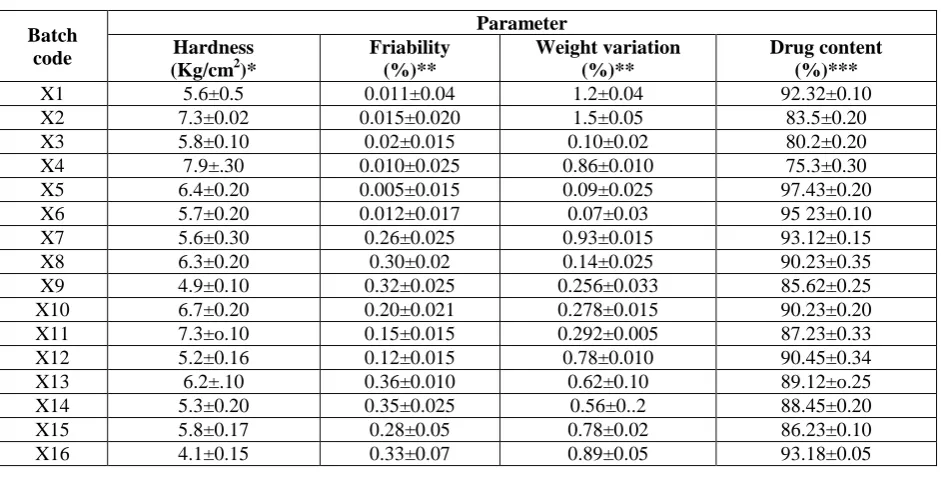
Table 2: Physicochemical evaluation of levofloxacin tablets.
Batch code
Parameter Hardness
(Kg/cm2)*
Friability (%)** Weight variation (%)** Drug content (%)***
X1 5.6±0.5 0.011±0.04 1.2±0.04 92.32±0.10
X2 7.3±0.02 0.015±0.020 1.5±0.05 83.5±0.20
X3 5.8±0.10 0.02±0.015 0.10±0.02 80.2±0.20
X4 7.9±.30 0.010±0.025 0.86±0.010 75.3±0.30
X5 6.4±0.20 0.005±0.015 0.09±0.025 97.43±0.20
X6 5.7±0.20 0.012±0.017 0.07±0.03 95 23±0.10
X7 5.6±0.30 0.26±0.025 0.93±0.015 93.12±0.15
X8 6.3±0.20 0.30±0.02 0.14±0.025 90.23±0.35
X9 4.9±0.10 0.32±0.025 0.256±0.033 85.62±0.25
X10 6.7±0.20 0.20±0.021 0.278±0.015 90.23±0.20
X11 7.3±o.10 0.15±0.015 0.292±0.005 87.23±0.33
X12 5.2±0.16 0.12±0.015 0.78±0.010 90.45±0.34
Preparation of Solutions
In this levofloxacin tablet different type of buffer solution can be used for as:
Phosphate buffer (pH 6.8) solution
Potassium dihydrogen phosphate (0.2 M) solution Sodium hydroxide (0.2 M) solution
Acid Buffer (pH 1.2) Solution
Design of Oral Sustained Release Drug Delivery System
The oral route administration is mostly adopted route because of its comfortable dosage form,
design and patient care. Several parameters should be kept in mind before formulating
sustained release dosage form which includes various pH in GIT, the gastrointestinal motility,
the enzyme system and its effect on the dosage form and the drug. Most of sustained release
dosage form follows the mechanism of diffusion, dissolution or combination of both, to
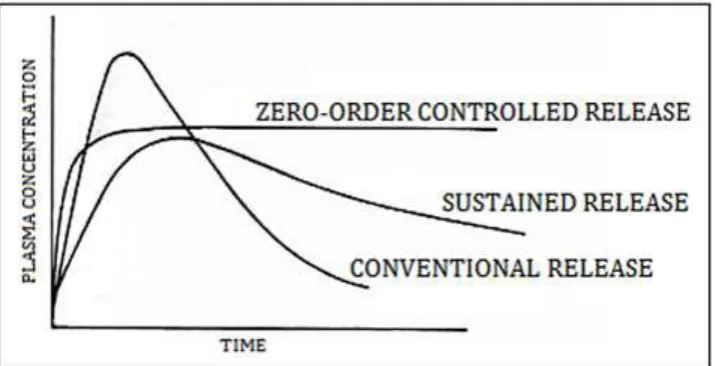
produce slow release of drug at predetermined rate. Hypothetically, a sustained release
dosage form should release the drug by a zero-order mechanism which maintains drug
plasma level time similar to intravenous infusion. Plasma drug concentration profiles for
conventional tablet or capsule formulation, a sustained release formulation and a zero order
sustained release formulation are as follow in given figure 1.1.
Figure 1.1: Plasma drug concentration profile for conventional release, a sustained
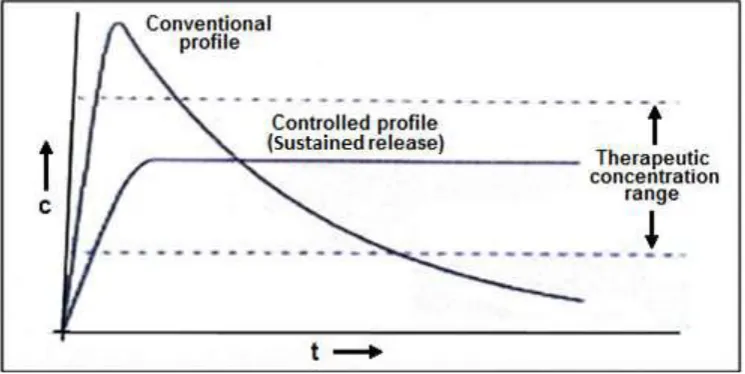
[image:4.595.121.479.456.639.2]Figure 1.2: Comparison of conventional and controlled release profiles.
RESULTS
Preformulation study of active ingredient
a) Physicalstate: Levofloxacin is a light-yellowish-white to yellow-white crystal or
crystalline powder.
b) Meltingpoint: 214-216°C
c) Solubility: Slightly soluble in water, soluble in glacial acetic acid, slightly soluble or soluble in
dichloromethane, slightly soluble in methanol.
UV Scanning
a) Scanning of Levofloxacin in pH 1.2
The prepared solution of levofloxacin in pH1.2 HCl was scanned in UV spectrophotometer
and λmax was found to be 293 nm.
b) Scanning of Levofloxacin in pH 6.8 phosphate buffer
The prepared solution of levofloxacin in pH 6.8 phosphate buffer was scanned in UV
spectrophotometer and λmax was found to be at 293 nm.
DISCUSSION
Preparation of levofloxacin tablets
Wet granulation method is mainly used for the preparation of levofloxacin matrix tablets.
Because of good drug release profile and cost effective the hydrophilic matrix systems are
Characterization of Levofloxacin tablets
Pre compression parameters
The pre compression studies are used for identifying the good flow property of the granules
and thus give homogenous filling of dies. The pre compression parameters are angle of
repose, bulk density, tapped density and compressibility index.
percentage yield : 91.73 to 98.12%
Bulk density : 0.412 to 0.493 gm/ml
Tapped density : 0.456 to0.579 gm/ml
Compressibility index : 8.90 to 13.67
Mean particle size : 0.492± to0.664±0.15
Angle of repose : 28.12±0.16 o to 30.90±0.220
CONCLUSION
Levofloxacin is one of the most widely used fluoroquinolones. Designing a sustained release
formulation for the drug levofloxacin may improve the efficacy of drug and patient
compliance. It prolongs therapeutic concentration of drug in the blood and decrease the
frequency of dosing and hence, an attempt was made to formulate a sustained release matrix
tablet for the broad spectrum antibacterial agent levofloxacin for increased margin of safety
and better therapeutic control.
The main objective of the study was to develop sustained release matrix tablets of
levofloxacin and compare their release. The study led the following conclusions:
The drug levofloxacin was selected for the study, because of its proved activity and better
clinical applications.
The pre formulation FT-IR studies revealed that there was no interaction between the
drug levofloxacin and the polymer HPMC, guar gum and xanthan gum.
The physicochemical parameters of the prepared granules observed support the ideal flow
nature of the formulated granules.
The physicochemical parameters of the prepared tablets comply with the official
standards.
The effect of drug to polymer ratio on the in vitro drug release behavior was significant.
Formulation X4, X10 and X14 showed better sustained release when compared to other
batches and this shows the ideal drug, polymer and excipients combination. From these
Release of drug from the tablets was first order diffusion controlled as indicated by higher
R2 values in first order and Higuchi kinetic model. Then, value of Korsemeyer-Peppas
equation indicated that the release mechanism was non-Fickian.
Based on the observations, it can be concluded that the formulated sustained release matrix
tablets of levofloxacin using widely accepted safe polymers and other excipients was capable
of exhibiting sustained release properties. They are thus may be reducing the dose intake,
minimize the blood level oscillations, dose related adverse effects and cost and ultimately
improve the patient compliance and drug efficiency.
REFERENCES
1. Bhowmik D, Kumar KPS, Dutta A, Paswan S. “Trends in scope and opportunities of
control release oral drug delivery systems”. Critical review in pharmaceutical sciences,
2012; 1: 20-33.
2. Vamsy KA, Srinath KR, Chowdary PC. “Formulation development and evaluation of
Divalproex sodium extended release tablet”. International Journal of Research
pharmaceutical and Biomedical Science, 2011; 2: 809-832
3. Patel H, Panchal DR, Patel U, Brahmbhatt T. “Matrix Type Drug Delivery System: A
Review”. JPSBR., Nov-Dec 2011; 1(3): 143-151.
4. Kumar KPS, Bhowmik D, Srivastava S. “Sustained Release Drug Delivery System
Potential”. The Pharma Inovation., 2012; 1(2): 48-60.
5. Lee TW and Robinson JR, “In Remington: The science and practice of pharmacy,
Gennaro”, 20th
edition, Baltimore, Lippincott Williams and Wilkins, 2000; 903-929.
6. Ansel HC, Allen LV, and Popovich NG, “Pharmaceutical dosage forms and drug delivery
system”, 9th
edition, Lippincott William & Wilkins, 2005; 257-271.
7. WWW.fda.gov
8. Chauhan MJ, Patel SA. “A Concise Review on Sustained Drug Delivery System and Its
Opportunities”. Am. J. Pharm Tech Res., 2012; 2(2): 227-238.
9. Onlinelibrary.wiley.com
10.Ho WH, and Lee VHL, “Influence of drug properties on design”, Controlled Drug
Delivery Fundamentals and Applications, Marcel Dekker, 2nd edition, New York, 1987;
12.Sarika Pundir, Ashuthosh Badola, Deepak Sharma, (2013) “Sustained release matrix
technology and recent advance in matrix drug delivery system: A review” International
journal of drug research and technology, 3(1): 12-20.
13.V.T.Thakkar, P.A.Shah, T.G.Soni, (2009) “Goodness-of-Fit Model-Dependent Approach
for Release Kinetics of Levofloxacin Hemihydrates Floating Tablet” Dissolution tech,