Abstract— Business process simulation software designed for sales and distribution business processes using web-based platform. Business process simulation applications has two major subsystems, namely wholesale and retail sales. The business activities that will be developed in the business process simulation system are the incoming inquiries, sales orders, delivery and billing. In addition there is also a part of the procurement cycle such as purchase orders. With this software, the students will be able directly interact with the simulation systems and business process practice has been applied to the industry. In this application there are some additional features that support simulation analysis, such as wholesale analysis and billing list generation process. And there are also features related reporting process such as purchase order reports, reports of wholesale and retail sales orders, profits and loss, cash flow, balance sheet and capital reports. We hope through research and development of this system, the students will get an overview of the actual business process-related business processes of sales, distribution, and business workflow in the company. By creating a business process simulation applications, we hope this application can help students to learn the business processes of sales and distribution processes more effectively.
Index Terms—business process; simulation; learning
activities; information systems; systems design
I. INTRODUCTION
Currently the development of information systems and its use has become a very important thing. Public can access the technology anytime and anywhere. The use of information systems in the industry has played as an important role. In many companies, the division of information systems have become part of the main activities. Based Achimugu, Olugwabemi & Oluwaranti, the technology now has been in a position of unprecedented [1].
Manuscript received December 12, 2016; revised Jan 11, 2017. Johan is with information systems department, school of information systems, Bina Nusantara University, 11480, Indonesia (e-mail: [email protected]).
Yohannes Kurniawan is with information systems department, school of information systems, Bina Nusantara University, 11480, Indonesia (phone: +6221.53696969 ext. 2258; e-mail: [email protected]).
Fredy Jingga is with information systems department, school of information systems, Bina Nusantara University, 11480, Indonesia (e-mail: [email protected]).
Natalia Limantara is with information systems department, school of information systems, Bina Nusantara University, 11480, Indonesia (e-mail: [email protected]).
The development of information systems is causing companies seek to apply information systems in running business processes. The goal is to integrate all business processes in the company and improve the transparency, efficiency, and effectivity of daily operations in real time. However, the barriers faced by the company is difficult to study the existing business processes and create a system that can accommodate business processes that are running. One solution is performed by the company is to provide training for employees to be able to understand the business processes of the company.
But at the university level, they don’t have sufficient learning tools to help students to understand the business processes within the company. In theory, it is easy for students to understand the company's business processes. But when it falls directly into a company, students or fresh graduates difficult to understand the business processes of the company. One of the causes is the student never done practice for running the existing business processes.
Business process simulation is the very popular technique of modelling to understand of business processes in the organization [2]. The simulation modelling is considered definition of problem, data collection, hierarchical modelling, modular modelling, and the integration issues [3].
Based on the research results from several researchers, the average tools are not yet available for the business process modelling [4]. The goal of business process modelling is to create the model that can reflects the business activities, it can be simulated using the software as a tools [5]. Business process modelling usually reflecting a business process analysis and behaviors under the variation of conditions and scenarios (what-if) [6,7].
Becker et al. provides some points to consider in making modeling, such as accuracy, relevance, efficiency, clarity and also the systematics of the design that will be used in making the system modeling [8]. In addition, it should be noted is features that are supported by user friendly interface [9].
This paper showed the development steps to develop a prototype of business process simulation of sales and purchases. And with this prototype the students can directly study the process by becoming parties involved in business processes significantly. And learners will play a role for running the existing business processes.
Development Business Process Simulation for
Supporting Learning Activities
(A Case Study Approach)
II.METHODS
Primary data collection methods used in this study are:
A.Questionnaires
This research data collection method uses a quantitative approach with the questionnaires, namely by taking a sample from a population and using questionnaires as the primary means of collecting data. Questionnaires will be distributed to prospective users of business process applications in this case are students (semesters 2 and 4) and lecturers in business process fundamental to the study program information system, XYZ University, to obtain information related to the needs of the features of the simulation system.
B.In-depth interviews
In-depth interviews were conducted to identify more deeply related to the needs and the problems are associated with this research, the interviews will be conducted to professors who taught courses in the fundamental business process and also to companies that will be involved in the application development process simulation sales and purchases.
C.Observation
This study also used a qualitative approach with the observation method by visiting and studying the process of selling and buying in a few companies to get the appropriate references for system development.
III. RESULTS AND DISCUSSIONS
One concept in business process management is the visualization of the operational activities of the organization by using business process modes. Business process models in this case is used as a system design approach to describe the business activities, events, workflow, and also the relationship between all stakeholders.
In recent years, business process modeling has been regarded as an important and highly significant factor for the organization. So this is the reason why the early stages of designing this system begins with business process modeling.
The design of the systems consists of: Designing a simulation model business processes, database design, and business process simulation design.
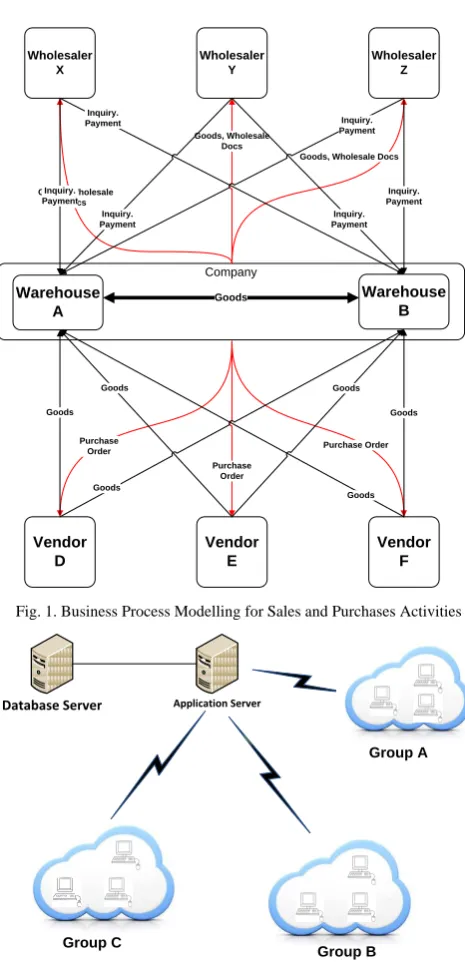
There are models that can be seen in Figure 1, where sales made in each group according to Figure 2, but sales were made to the Virtual Market (Bot), where the price and the purchase amount will be at random in accordance with the principle of economy.
In the figure, it is depicted that there are three main roles in the Business Process Simulation consisting of Wholesaler, Company and the Vendor. Between the Wholesaler and the Company, there will be a wholesale trade activity, where the Wholesaler will create inquiries that will be given to the company. If the company decides to fulfill the inquiry, they will proceed to the next steps of the wholesale activity. At the end of the transaction, Wholesaler will receive their ordered goods and the company will receive the payments.
Company Wholesaler
X
Wholesaler Y
Wholesaler Z
Warehouse A
Warehouse B
Vendor D
Vendor E
Vendor F
Goods, Wholesale Docs
Goods, Wholesale Docs
Goods, Wholesale Docs
Goods
Inquiry. Payment
Inquiry. Payment
Inquiry. Payment
Inquiry. Payment
Inquiry. Payment Inquiry. Payment
Purchase
Order Purchase Order
Purchase Order
Goods
Goods Goods Goods
Goods
[image:2.595.307.540.55.542.2]Goods
Fig. 1. Business Process Modelling for Sales and Purchases Activities
Application Server
Database Server
Group A
Group B Group C
Fig. 2. A Framework of System Collaboration using Business Process Simulation Software
The next process is between warehouses in each company. Each warehouse are given the ability to transfer products to another warehouse that is in the same company. This allows support amongst warehouses that is within one company. However though, in transferring products, there is a time-constraint that has to be taken into consideration.
The last process that is in the Business Process Simulation is the Procurement process between the Company and the Vendors. Procurement Process is included in the Business Process Simulation in showing the activity of supplying goods from a Vendor to a Company. When a Company runs out of products, they can send a Purchase Order to the selected Vendor to order more goods and the selected Vendor will deliver the ordered goods to the company.
Initiation Phase. In the Project Initiation Phase includes the current problem identification along with the permitted activities to be done afterwards. In identifying the problem, a questionnaire has been distributed with the participants of the School of Information System Immersion Program on May 2014 to Singapore, who at that time also experienced
another version of a Business Process Simulation developed by another company. The outcome of the questionnaire is made into reference for the analysis and the design of the Business Process Simulation.
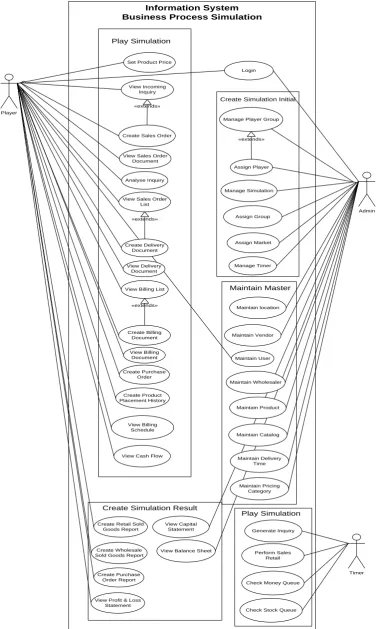
This is the use case diagram for simulation system to define the functionality of the software.
Player
Set Product Price
Information System Business Process Simulation
Create Sales Order
Create Billing Document View Billing List
Create Purchase Order Report
Create Purchase Order
Create Retail Sold Goods Report
Create Wholesale Sold Goods Report
Create Product Placement History
Assign Market
View Capital Statement
View Profit & Loss Statement
Assign Player
Admin
View Delivery Document
Maintain User Login
«extends»
Manage Simulation View Incoming
Inquiry
«extends» «extends»
View Sales Order Document
View Billing Document
Manage Timer Analyse Inquiry
View Billing Schedule
Timer Generate Inquiry
Check Money Queue
Check Stock Queue Perform Sales
Retail Maintain location
View Cash Flow
View Balance Sheet
Maintain Pricing Category Maintain Delivery
Time Assign Group
Maintain Catalog Maintain Product Maintain Wholesaler
Maintain Vendor View Sales Order
List
Create Delivery Document
Manage Player Group
Maintain Master Play Simulation
Create Simulation Initial
Create Simulation Result
Play Simulation
[image:3.595.109.486.132.762.2]«extends»
Based on the studies above, it has been concluded that the most fitted business process that should be within the Business Process Simulation is as elaborated below.
A. Between Vendor and Company
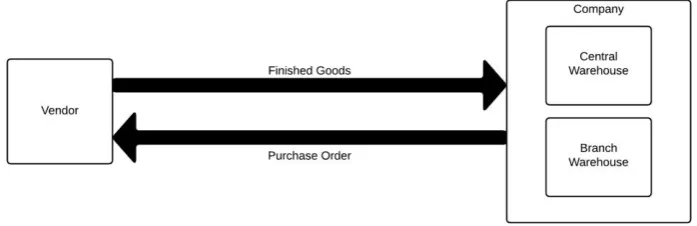
Vendors are in charge of supplying products to the company, based on a purchase order created by the company. If a company runs out of products or if their products are at a small amount, the company may create a Purchase Order to the Vendor to order more products. Purchase Order contains information such as the selected Vendor, Product, Quantity, Price, and Destination of the Warehouse. With this Purchase Order, the vendor will prepare the ordered goods and delivers it to the destination noted in the Purchase Order. The delivery time of the purchased products depends on the vendor. Once the goods have been received by the company, the vendor will get the payment of the purchase. The business process between vendor and company showed in figure 4.
B. Between Central Warehouse and Branch Warehouse
Across warehouses, products can be transferred. The activity of product transfer allows the activity of supporting other warehouses when the amount of products in a certain warehouse is lower than the others, especially in situations where the products are needed as soon as possible (Fig. 5). During products movement between the warehouses, there are no documents created. However, the time that the product movement needs is a concern for the company, because the different location of the warehouses creates a distance and the distance created travel time for the movement.
C. Between Company and Wholesaler
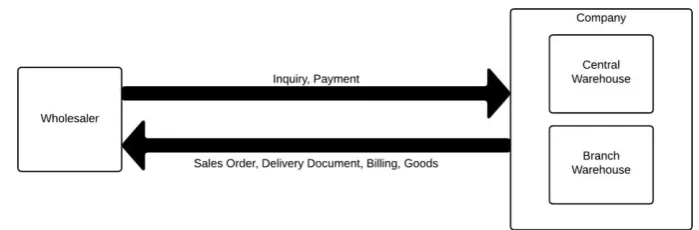
The process of wholesale is available in the simulation. It begins with a series of inquiries that wholesalers offer to the company. The company is given the freedom to choose which inquiry they want to fulfill. Once the company has
chosen which inquiry they want to fulfill, they will create sales order in accordance to the inquiry. Sales Order document contains information such as Wholesaler, Product, Quantity, Expected Delivery Date, and Inquiry Price. Once the Sales Order document has been created and the goods are ready, it is available for delivery. When performing delivery, a Delivery Document is also created. Within the Delivery Document, there information such as Wholesaler and Sales Order number that it correlates to. If the goods are delivered on time, company will get full payment of the order. However, if there is a delay in the delivery time, the amount of payment that the company gets will be deducted as a fine. After the delivery process is cleared out, only then will the Billing be available to be processed. Once the company issues a Billing for a certain Sales Order, after that the company will receive the payment for the goods that has been sold. The business process between vendor and company showed in figure 6.
D. Helping Features
There are 2 (two) helping features that are going to be developed for Business Process Simulation. Those features are developed in order to help players in making decision and managing business process, those helping features are:
a. Wholesale Analysis
This feature helps player to analyze whether can fulfill wholesaler’s incoming inquiries in certain cycle, so that player can avoid from fine. Player enters both requested delivery date from wholesaler and delivery time, and then program will calculate the estimated delivered date.
b. My Billing List
[image:4.595.123.472.541.654.2]This feature helps player to manage billing will be send to wholesalers to avoid billing fine. Player may see detail information about the billing including billing cycle, billing amount and billing status.
Fig. 5. Business Process between Central Warehouse and Branch Warehouse
Fig. 6. Business Process between Wholesaler and Company
IV. CONCLUSIONS
In this study showed that the business process modeling plays an important role in conducting the preparation of the organization's business process simulation. Through this modeling process will help the developers of this systems in the design, documentation and also the development of conditions that will be used to build a simulation software. The purpose of this study is to provide a reference for future research that will develop business process modeling. The main stages that must be done for building business process simulation is a process understanding, process analysis, and process design. And based on the business process simulation software that we developed, it will help increasing students understanding about the business process in the organization.
REFERENCES
[1] P. Achimugu, O. Oluwagbemi, and A. Oluwaranti, ―An evaluation of the impact of ICT diffusion in Nigeria’s higher educational institutions,‖ Journal of Information Technology Impact, 2010 [2] A. Serrano and M. Hengst, ―Modeling the integration of BP and IT
using business process simulation,‖ Journal or Enterprise Information Management, vol. 18, no. 6, pp. 740-759, 2005. [3] A. Popovic and J. Jaklic, ―Problematika simuliranja poslovnih
procesov,‖ Proceedings of DSI 2004 - Management in informatika, Portoroz, pp. 166-172, 2004.
[4] K.D Barber, F.W. Dewhurst, R.L.D.H Burns, and J.B.B Rogers, ―Business-process modelling and simulation for manufacturing
management: A practical way forward,‖ Business Process
Management Journal, vol. 9, no. 4, pp. 527-542, 2003.
[5] N. Damij and T. Damij. A Multi-disciplinary Guide to Theory, Modeling, and Methodology. Progress in IS. Berlin Heidelberg: Springer, 2014.
[6] S. Patig and M. Stolz, ―A pattern-based approach for the verification of business process descriptions,‖ Information and Software
Technology. 2013, vol. 55, no. 1, pp. 58–87. Special section: Best papers from the 2nd International Symposium on Search Based Software Engineering, 2010.
[7] R. Savén and J. Olhager, ―Integration of product, process and functional orientations: principles and a case study,‖ In: Jagdev H, Wortmann J, Pels H, editors. Collaborative Systems for Production Management. vol. 129 of IFIP—The International Federation for Information Processing. Springer US; pp. 375– 389, 2003.
[8] J. Becker, M. Rosemann, and C. Von Uthmann, ―Guidelines of Business Process Modeling,‖ In: van der Aalst, W., Desel, J., &
Oberweis, A. (ed.), Business Process Management. Models,
Techniques, and Empirical Studies, pp. 241-262, 2000.
[image:5.595.120.470.220.335.2]