Abstract — Reported in this paper are the results of a simulated experimental comparison of Genetic Algorithm (GA) and Ant Colony Optimization (ACO) meta-heuristics, with regards to their suitability and performance in addressing the problem of energy consumption minimization in ad-hoc wireless networks. An energy function model based on Geographic Adaptive Fidelity (GAF) topology management scheme is used in setting the simulation experiment. Results show that GA and ACO meta-heuristics are suitable optimization techniques for energy consumption minimization in ad-hoc wireless networks, with GA giving the least energy consumption in comparison to ACO.
Index Terms — Ad-hoc Networks, Meta-heuristics, Geographic Adaptive Fidelity, Genetic Algorithm, Ant Colony Optimization
I. INTRODUCTION
ireless ad-hoc network is a network of nodes that are connected together without the use of a central base station. Nodes in ad-hoc wireless networks are usually battery-operated and are mostly deployed in critical environments such as the military zones, hostile, hazardous, flooded areas and in an emergency healthcare situation where it is almost impossible to replenish the batteries. This makes it necessary to conserve battery energy for the network lifespan to be prolonged, and hence the sustainability of operations. The rates at which nodes in the network consume energy differ depending on whether the nodes are in a transmitting, receiving, listening or sleeping state [1]. The least energy is consumed when the node is in a sleeping state. However, all nodes will not always be in the sleeping state. The energy ratio between nodes in listening, receiving and transmitting states is indicated as 1:1.05:1.4 and 1:1.2:1.7 [1], [2]. Equal and adjustable grids as well as genetic algorithm models were described in [1] for energy
Manuscript received July, 2012; revised August 01, 2012.
Ibukunola A. Modupe is currently a master student with the Department of Information, Tshwane University of Technology, Pretoria, 0001, South Africa (email: [email protected])
Oludayo, O. Olugbara is with department of Information Technology, Durban University of Technology in South Africa, where he is currently a Full Professor of Computer Science and Information Technology (e-mail:
Sunday, O. Ojo is a dean, Faculty of Faculty of Information and Communication Technology and Research Professors at the Tshwane University of Technology's (TUT), Soshanguve South Campus.(email:
A. Modupe is with the Department of Information, Tshwane University of Technology, Pretoria, 0001, South Africa (email: modupea@tut,ac,za)
optimization in ad hoc wireless networks. The results show that a genetic algorithm enhances more energy saving in the entire network compared to equal and adjustable grid model. Bhondekar et al [3] operated on a high number of sensors for GA to generate its design. The uniformity of the sensing points was made optimal and the communication energy consumption was minimized with the constraints met. Hussain et al [4] addressed the energy optimization problem by using GA to determine the energy-efficient clusters and to identify the cluster heads for the transmission of data. The result shows that GA retains small energy efficient for longer time duration. Srisathaporn et al [5] and Okdem et al [6] propose protocols on Ant Colony Optimization (ACO) for energy optimization in wireless ad hoc networks. Srisathaporn et al [5] propose an Ant-Based Energy Conservation (ABEC) protocol that conserves energy in ad hoc networks using pheromone trail process in ant colony to set up the broadcasting of packets for the transmission of data in order to prolong the lifetime of the network. Okdem et al [6] propose a protocol that uses Ant Colony Optimization (ACO) to optimize wireless sensor networks routing paths and also provide an effective multi-path data transmission method to achieve a reliable communication.
In this study, we describe the Geographical Adaptive Fidelity (GAF) energy model for addressing the energy consumption minimization problem in ad-hoc wireless networks using two meta-heuristics techniques Genetic Algorithm (GA) and Ant Colony Optimization (ACO). These meta-heuristics are used to generate smallest amount of energy in both direction ( and ) of the ad-hoc wireless networks. GAF is described as a topology management scheme that is used to save more energy in wireless network by grouping the nodes in a network into virtual grids. The nodes that fall within the same grid are similar and responsible for data transmission. As a result, only one node can be active at a given time (that is node that receives and transmits data to the next grid) while the remaining nodes are made to sleep in order to save energy. The similarities of these nodes are computed using location information such as Global Positioning System (GPS) to partition the network area into grids. The consumption of energy can then be balanced by rotating the transmitting data among the nodes in each grid to facilitate the active nodes to correspond effectively during the broadcast of data from the source nodes to destination node [1].
This paper reports on the results of a study on how energy consumption in a wireless Ad-hoc network can be minimized using the GAF energy model. The model was simulated
Experimental Comparison of Genetic Algorithm
and Ant Colony Optimization to Minimize
Energy in Ad-hoc Wireless Networks
Ibukunola A. Modupe, Oludayo O. Olugbara, Sunday O. Ojo and Abiodun Modupe
using GA and ACO toolboxes in MATLAB. These two methods (GA and ACO) are parts of meta-heuristics used for solving convoluted optimization problems. A comparison is then made on the minimal energy generated by the meta-heuristics toolboxes based on ACO and the GA model. The remaining part of this paper is succinctly summarized as follows. In Section II, we describe the GAF analysis of energy consumption formulation. In Section III, we describe the GAF genetic algorithm model. In Section IV, we describe the GAF ant colony optimization model. In Section V we present experimental results of the meta-heuristics techniques of genetic algorithm and ant colony optimization. In Section VI, we give a concluding remark and provide motivation for future work.
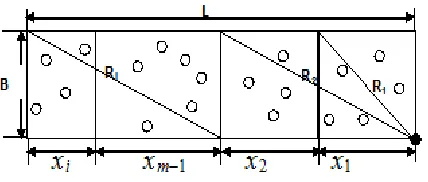
II. GEOGRAPHICADAPTIVEFIDELITYMODEL GAF protocol conserves energy by partitioning the nodes in the network area into virtual grids as illustrated in Fig. 1. In this model, ad hoc wireless network within a
L
×
B
[image:2.595.52.266.345.436.2]rectangular area is divided into grids so that data can be forwarded grid by grid to the destination node. Fig. 1 shows the energy consumption model in a rectangular GAF model [1].
Fig. 1: Energy consumption in adjustable rectangular GAF Model
The total energy consumed in a grid
E
i is the addition ofthe energy generated by the node when in the listening, receiving, sleeping and in sleeping states represented as follows [1]:
s s l l r r t t
i
e
T
e
T
e
T
e
T
E
=
+
+
+
(1)where
e
t is the power generated when the node is transmitting,e
ris the power generated when the node is receiving,e
l is the power generated when the node is in listening state ande
s is the power generated by the node when in a sleeping state.T
t,
T
r,T
s andT
lrepresent the time duration for the network in transmitting, receiving, listening and sleeping states, respectively, as compared to the network states in [7].
=
=
+
=
+
=
d
e
a
e
b
a
e
cR
a
e
s l r
n t
(2)
d
and
c
b
a
,
,
are constants that are determined by electronic components of the node with a correspondingvalue of
"
a
"
as0
.
083
J
/
S
, followed by"
b
"
asS
J
/
017
.
0
, followed by"
c
"
as0
.
0002
J
/
S
and"
"
d
as0
.
013
J
/
S
/
m
2, where'
n
'
represent the power index for communication path loss with a value of 3.Fig.1 shows
R
represents the nominal range that ensures that any two nodes that are in adjacent grids can directly communicate. The parameterse
sande
l are equivalent [8] andd
has a very small value that is close to zero compared toa
andb
. The result of the energy consumed by the gridi
E
is computed as the summation of powers in transmittingt
e
, receivinge
rand sleepinge
s states multiplied by time durationT
t andT
r. However, we substitute equation (2) into equation (1) to obtain a model that describes the amount of energy consumed in the entire grid as follows:t n r
i
a
bT
cR
T
E
=
+
+
(3)
Where
T
t=
D
tdR
andT
r=
D
rdR
are the time durations for transmitting and receiving the traffic data respectively. The parameterµ
is defined as the transmitted or received data rate in bits per second with a given values of 250kps (kilobit per second). The data traffic demand in wireless networks is usually assumed to be static, but recent studies indicated that the data traffic demand in wireless network is highly dynamic and unpredictable in nature [7]. The variable intensity of the ad-hoc networkλ
is described as the ratio of the traffic dataD
to the network area measure in bit/sec. Thus,
×
=
B
L
D
λ
(4)From equation (4), it is immediately obvious that
D
is equivalent to:λ
×
×
=
L
B
D
(5)Active nodes in a grid that are closer to the destination node will have more data to be transmitted than those that are far from it. This implies that these nodes will have a shorter transmission range than those that are far for energy efficiency. The transmitted and the received data traffic in the
i
thgrid can be obtained by deducting the grid length for both transmissions and receiving in thei
thposition of the grid from the length of the entire network. The distance between the nodes in each grid for transmittingL
ti and receivingL
ri data to and from the destination node is obtained by subtracting the summation of the grids lengthi
x
from the network length to give the following equations:(
)
(
)
+
+
+
−
=
+
+
+
−
=
−i ri
i ti
x
x
x
L
L
x
x
x
L
L
L
L
2 1
1 2
1
(6) We substitute equation (6) into equation (5) to give the transmitted traffic data
D
ti and received traffic dataD
ri
×
×
−
=
×
×
−
=
∑
∑
= − =λ
λ
B
x
L
D
B
x
L
D
k i i ri k i i ti 1 1 2 (7)As shown in Fig. 1, the nominal range
R
ensures the direct communication between the nodes in the adjacent grids and by Pythagoras theorem, the nominal range when the number of grid is one is given as follows:2 2
1
X
B
R
=
+
(8)Similarly, the nominal rang
R
fori
thgrid in the network is determined as:(
)
2 21
B
X
X
R
i=
i+
i−+
(9)Equations (8) and (9) as well as
T
t andT
r are substituted into equation (3) to obtain the total energy consumed in the firstE
1andi
thgridE
i of the network respectively. This isobtained as follows:
(
)
tin
r
c
X
B
D
D
b
a
E
1=
+
×
+
×
2+
2×
µ
(10)The total energy therefore consumed in the entire network is:
(
)
tin k
i
i i
ri
c
x
x
B
D
D
b
a
E
×
+
+
+
×
+
=
∑
= − 2 2 2 1µ
(11) III. GAFGENETICALGORITHMODEL This work employs Genetic Algorithm (GA) meta-heuristic technique embedded into GAF energy model generated in equation (11) to obtain minimum energy consumption in the entire wireless ad-hoc network as shown in Fig.1. GA is often described as one of the most effective meta-heuristic techniques that are widely used for solving convoluted optimization problems by mimicking the biological evolution computing model to find the possible optimal solution [9]. GA minimizes the fitness function or the objective function of the optimization model by depending on its main operators. The three parametric operators, Selection, Mutation and Crossover, are defined in GA algorithm as follows.Selection
This function chooses parents for the next generation based on their scaled values from the fitness scaling function.
Mutation
This function makes small random changes between the individuals in the population, which provide genetic diversity and enable the GA to search a broader solution space.
Crossover
This function combines two individuals or parents to form a new individual or child for the next generation. Thus, the GAF energy model given by equation (11) is applied as the fitness function so that the GAF/GA-based constraint
optimization problem becomes: Minimize:
(
)
tin i i ri k i
D
B
X
X
c
D
b
a
f
×
+
+
+
×
+
=
− =∑
2 1 2µ
(12) Subject to the constraint:∑
==
k iL
x
11 (13) where is the length of the entire network as shown in Fig.1 and each
x
irepresents the GA variable. GA generates the best fitness function by choosing the appropriate operator as summarized in Table 1. The total energy generated by the GA functions shows that stochastic uniform, Gaussian and scattered functions generate the best fitness function by meeting the constraint in equation (13).TABLEI
ENERGY CONSUMPTION GENERATED BY GAOPERATORS
Operators Experimental Result Selection Mutation Crossover Energy
(J) Is Constrain t met? (Y/N) Functions Stochastic
Uniform Gaussian Scattered 7.7163 Y Remainder Uniform Single Point 7.6500 N Uniform
Adaptive
Feasible Two Point 13.3358 N Roulette Gaussian Intermediate 15.5370 N Tournament Gaussian Heuristic 9.7332 N
The manner in which these functions were used in GA MATLAB toolbox to generate the minimum energy as well as meeting the constraint of the fitness function is described as follows:
(A) The selection functions available in GA toolbox of MATLAB include: stochastic uniform, remainder, uniform, roulette and tournament. The stochastic uniform generated the minimum energy by laying out a line in which each parent corresponds to a section of the line of length proportional to its expectation. The algorithm moves along the line in steps of equal size, one step for each parent. At each step, the algorithm allocates a parent from the section it lands on. The first step is a uniform random number less than the step size.
parameter is 0, the variance is constant. If the shrink parameter is 1, the variance shrinks to 0 linearly as the last generation is reached.
(C) The crossover functions available in GA toolbox include: scattered, single point, two points, intermediate, heuristic and arithmetic. Scattered function generates the minimum lowest minimum energy compared to other functions by creating a random binary vector. It then selects the genes where the vector is a 1 from the first parent and the genes where the vector is a 0 from the second parent and combines the genes to form the child.
The application of these operators was demonstrated in GA toolbox to implement Equations (12) and (13) to give the optimal energy of 7.7163 Joules compared to the optimal of energy of 8.6590 Joules obtained in [3], we obtained a lower energy in our design model.
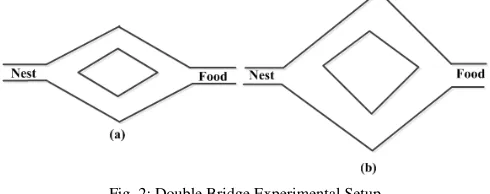
[image:4.595.46.291.546.643.2]IV. GAF ANT COLONY OPTIMIZATION MODEL Ant Colony Optimization (ACO) is a meta-heuristic technique introduced in the 1990s by Dorigo et al [7] as a novel nature inspired meta-heuristic. ACO is an approximation algorithm for generating good optimal solutions to hard combinatorial optimization problems in a reasonable amount of computational time [8]. ACO can be successfully used in solving optimization problems by inspiring the foraging behavior of real ants. Real ants search for food by finding the shortest path from their nest to the food source without having the strength of vision but with the exchange of information by depositing chemical substance called pheromone on the ground. The deposit of pheromone by the ants marks the favorable path that other ants in the colony will travel and it creates pheromone trails with various concentrations which links the food source to the nest. Fig 2 depicts double bridge experimental setup in ACO research by Deneubourg et al [9]. It imitates the foraging behavior of and pheromone trail lying of ant species. The double bridge connects a nest of ants of the Argentine ant species.
Fig. 2: Double Bridge Experimental Setup
In this study, energy consumption in wireless ad hoc networks is optimised using ACO-GAF by following the hybrid framework approach proposed by Schluter et al [10]. Each node in the network finds its corresponding neighboring nodes in the network by transmitting information from one node in the grid to the other until it reaches its destination node. The choice of a node in the subsequent grid is a probabilistic choice based on Probabilistic Density Function (PDF). In principle, any function
P
(
y
)
≥
0
satisfies the property:∫
∞
∞ −
=
1
)
(
y
y
P
δ
(14)It uses this instead of a pheromone table used in the original ACO as described in Srisathapornphat et al [5]. Gaussian function is one of the examples of functions used in PDF. It has the advantage of generating random numbers within a fast sampling time. A single Gaussian function
g
v(
y
)
z is
only able to focus on one mean and cannot handle two or more disjoint areas of the search domain. Keeping track of the benefits of a Gaussian function can overcome this problem. A PDF
G
v(
y
)
consisting of a weighted sum of several one-dimensional Gaussian functionsg
zv(
y
)
is considered for every dimensiony
of the original domain. The Gaussian function is therefore given as:∑
=
×
=
k
z
v z v z v
y
g
w
y
G
1
)
(
)
(
(15)where
2
2
)
(
2
1
)
(
2
v z v z v
z v
z
q
y
g
σ
ω
π
σ
×
−
−
×
=
l
(16)where:
w
= The weights for individual Gaussian functions for PDFσ
= Standard Deviationsω
= Corresponding Gaussian functionsy
=y
th dimension of the problem and,z
=z
th Kernel numbers of the individual Gaussian function The above function is characterized byw
vz,σ
zv,ω
vz. They guide the sample solutions throughout the search domain and they represent the pheromones. The update of these pheromones is directly connected to the update process of the solution. The weightw
that indicates the importance of an ant is calculated with a linear proportion and is given as:(
)
∑
=+
−
=
kz v
z
j
z
k
w
1
1
(17)
(A) ACOmi starts by choosing the fitness function evaluations
(B) It chooses the feasible solution to be attained from the objective function which serves as the stopping criteria (C) States the population size of the ant
(D) States the number of PDF kernel
(E) Provides the oracle parameter for the penalty method (F) Looks into its performance with the call of its local
solver at every iteration using the best fittest value as the starting point and local solver after the last iteration using the current best fittest value as the starting point (G) Stores the solution found into the archive.
V. EXPERIMENTALRESULTS
The GA finds its optimal energy value for the optimization problem considered by optimizing the corresponding variables
x
i of the fitness model given byequations (12) and (13). We started the experiment by determining the appropriate population size for the fitness value. After several runs, a population size of 350 was achieved. The 350 population size was run alongside with GA operators as shown in Table 1 to determine the best fitness value (that is the minimum energy consumed). The best fitness value was obtained with the selection of stochastic uniform (selection function), followed by Gaussian (mutation function) with a scale and shrink factor of 1 and finally followed by scattered (crossover function). The performances of these functions yielded the best fitness value as discussed in Section III.
[image:5.595.306.547.224.370.2]Fig. 3 shows the minimum energy obtained. The result shows that at each generation, energy is consumed. When the generation was at its initial (between 0 and 3), the energy consumption generated increased, but as the generation steadily progresses, energy consumption reaches its maximum and started decreasing as the generation progresses until a constant value is reached when the generation was at 5. The energy consumption then began to fluctuate as the generation progresses until it reaches the minimum energy consumed.
Fig. 3: Minimization of the network energy by GA-GAF
The objective function was implemented in equation (11) with ACOmi software alongside with the extended framework by Schluter et al [10] in MATLAB to obtain the minimum energy consumed in the network. ACOmi is
software owned by IIM-CSIC for solving optimization problems using Ant Colony Optimization technique. In ACOmi, the fitness of an ant is evaluated by the penalty function value, which serves as the fitness standard for the objective function.
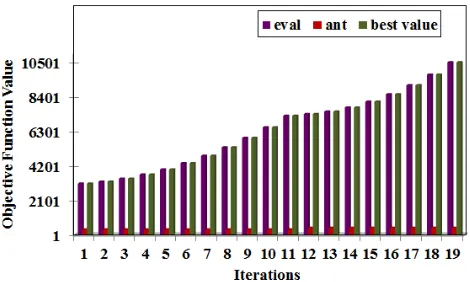
Our implementation to generate the minimum energy consumption in ad hoc networks is achieved using the detailed information in section IV and also applying the standard set by Schluter et al [10]. Fig. 4 and Fig. 5 give the details on how ACO-GAF generated the minimum energy value in the network. There are 18 feasible solutions obtained and saved into the solution archive for the first-three simulation run in MATLAB.
Fig. 4: The fitness function value for first three runs using ACO-GAF
Fig. 4 indicates that in 3030 evaluations, the number of ant for obtaining the optimal value for the energy consumption increases. The incremental constructions of new solutions are generated in Fig. 5 by running the program two more time. This is done in accordance with the weight function defined in equation (17) and implemented in MATLAB.
Fig. 5: The fitness function value for the last two runs using ACO-GAF
The result shows that the best energy consumption of 7.65J was generated. Additionally, we observed that as the number of ant increases, the rate at which the nodes consume energy reduces, thereby leading to minimum energy consumption by the whole network. We can deduce from Fig. 4 and Fig. 5 that as the evaluation performance increases, the outcome of the energy consumption in the network improves.
VI. CONCLUSION
[image:5.595.308.543.479.620.2] [image:5.595.51.287.539.706.2]metaheuristics techniques to obtain the minimum energy consumption in ad-hoc wireless networks. During the experiment, the appropriate population size was determined and used with the selected GA operator (stochastic uniform, Gaussian and scattered) to get the best fitness function value. The ACOmi software in MATLAB is applied to the objective function to generate the minimum energy consumption value. This was performed in order to achieve the minimum energy consumption.
The minimum energy consumption generated by the GAF/GA is 7.716J while GAF/ACO generated minimum energy of 7.650J. From these results, the energy generated from both meta-heuristics, the minimal energies generated by both models are smaller when compared to the fitness function generated by Wei et. al [3]. We can therefore infer that the selected meta-heuristics optimization techniques are highly effective for solving energy minimization problem in wireless ad-hoc network.
Our result shows that the energy generated by GA-GAF model is not significantly different from the energy generated by ACO-GAF model. This shows that metaheuristics based optimization methods are effective and useful for minimizing energy consumption in ad-hoc wireless networks to prolong battery lifespan. Future study will be conducted to compare other meta-heuristics such as the particle swarm optimization and tabu search to verify if they can equally minimize energy consumption in ad-hoc wireless networks effectively the way GA and ACO achieved in this study
REFERENCES
[1] W. Feng, H. Alshaer, and J.M.N. Elmirghani, “Optimization of Energy Consumption in Rectangular Ad hoc Wireless Networks”, Fourth International Conference on Communication and Networking, Xian, China, pp1-5, 2009.
[2] B. Chem, K. Jamieson, H. Balakrishnan, and R. Morris, “Span: An Energy-efficient Coordination Algorithm for Topology Maintenance in Ad hoc Wireless Networks”, Mobicom, vol. 8, 2002.
[3] A.P. Bhondekar, R. Vig, M.L. Singla, C. Ghanshyam and P. Kapur, “Genetic Algorithm Based Node Placement Methodology for Wireless Sensor Networks”, Proc. International MultiConference of Engineers and Computer Scientists (IMEC 09), Hong Kong, 2009. [4] S. Hussain, A.W. Matin and O. Islam, “Genetic Algorithm for
Energy Efficient Clusters in Wireless Sensor Networks”, Proc. International Conference on Information Technology (ITNG 07), IEEE Computer Society, 2007, doi:10.1109/ITNG.2007.97.
[5] Srisathapornphat, C. and Shen, C.-C. “Ant-based Energy Conservation for Mobile Ad hoc Networks”, The 12th International Conference on Computer Communications and Networks (ICCCN 2003), DE, USA, pp 32-37, 2003
[6] Okdem, S. and Karaboga, D. “Routing in Wireless Sensor Networks using an Ant Colony Optimization (ACO) Router Chip”, Sensors Journal, 9(2), pp 909-921, 2009.
[7] Dorigo M, Colorni A, Maniezzo V. “Investigation of some Properties of an Ant Algorithm”, Proceedings of Parallel Problem Solving from Nature, Elsevier, pp 509-520, 1992.
[8] Blum C, Roli A. “Metaheuristics in Combinatorial Optimization: Overview and Conceptual Comparison”, ACM Computing Survey, pp 268-308, 2003.
[9] Deneubourg J.-L, Aron S, Goss S, Pasteels J.-M. “The Self Organizing Exploratory Pattern of the Argentine”, Journal of Insect Behaviour, pp 159-168, 1990.