ISSN: 2278 – 7798 All Rights Reserved © 2014 IJSETR 2185
Face Detection using Skin Color Segmentation
Algorithm with MSRCR in MATLAB GUI
Mr. SABITH SANAL and Mr. RENEESH ZACHARIA
Abstract—Face Detection is an important process used to extract faces from static images or video frames. In this paper, a face detection system is demonstrated using skin color segmentation algorithm. The skin pixels of the face are mapped to a modified YUV color space to avoid brightness included in RGB color space and for easy segmentation of skin. In order to tackle the variation in illumination and color constancy of the face image, MSRCR algorithm is used. These algorithms are implemented using MATLAB GUI. The significance of MSRCR is studied by evaluating and comparing the contrast and luminance performance factor with histogram equalization.
Keywords—Face Detection System, MultiScale Retinex Color Restoration (MSRCR), YUV color space, Contrast Factor, Luminanace Factor, MATLAB GUI (Graphical User Interface).
I. INTRODUCTION
The face detection, which is an initial step of face recognition system, is used to determine the location and sizes of human faces in static digital images or video frames. It is an important step used in wide range of applications such as face verification and identification, facial expression, lip movement capturing, feature extraction, video surveillance, gender classification, advanced interaction of human-computer visual systems. A lot of face detection approaches have been categorized such as knowledge-based, structural matching, template matching, appearance-based and other feature invariant methods including skin color [1]. Among these approaches, the skin color based face detection is more efficient and useful method for detecting face as it requires low computational cost while being vulnerable to facial expressions, lighting, occlusions factors [7] and other challenges of face detection [1].
In this paper, we propose a skin color segmentation algorithm using modified YUV color space [13] for determining face regions. The color element provides guidance for detecting objects, tracking, recognition, segmentation, etc. [2]. A large number of color spaces are used for different tasks of visual. For instance, the modified YUV color space along with HSV and YCbCr are most suited for face detection and image
segmentation [2]-[4]. Before detecting the face from the image, a MSRCR algorithm is applied. The MSRCR technique is used to sustain or tackle the effect of variations in color constancy, shadowing and illumination of image. The MSRCR provides good color rendition and dynamic range compression of the image [6]. It gives good luminance without sacrificing the contrast. The significance of the MSRCR technique is studied by evaluating the performance factors of it. These performance factors are compared with an existing enhancement technique called histogram equalization which is commonly used to pre-process an image. The main aim of the work is to prove that MSRCR technique is more efficient than histogram equalization and contribute in detecting a face image degraded with various factors.
The remaining section of this paper is organized as follows: The related works of face detection is described in section 2. The skin color segmentation algorithm is described in section 3. The MSRCR algorithm and performance factors are described in section 4. The implementation of face detection process is described in section5. The experimental result is described in section 6. The conclusion is described in section 7 followed by the references of the paper.
II. RELATED WORKS
Face Detection is used to extract faces in an image regardless of the illumination, facial expression, occlusion [7], pose, scale etc. Many techniques in face detection area have been proposes [1]. The most important or cited approaches include the neural network appearance-based system proposed by Rowley, Baluja and Kanade [8]. Osuna, Freund and Girosi used support vector machines to detect faces [9]. The “graph matching” method to find static portable faces from obtained image was proposed by Leung [10]. These graphs or nodes are detected from obtained features. Another face detection method was proposed by Viola and Jones that computes speedily features using integral images [11]. The PCA analysis was proposed by Kirby and Sirvoich in which each face is represented based on high variances termed Eigen faces [12]. Yang and Huang used knowledge based method to detect faces [1]. Sakai and Silhouettes used several sub templates to detect frontal faces in images [1]. Many methods have been proposed to build a skin color mode. It maps the skin pixels to various color spaces [1].
The proposed work explains a skin color segmentation algorithm using modified YUV color space. This work is implemented in MATLAB using the Graphical User Interface.
ISSN: 2278 – 7798 All Rights Reserved © 2014 IJSETR 2186
III. SKIN COLOR SEGMENTATION
The skin color segmentation with YUV color space [13] is used to detect the face regions of an image. The color segmentation is an effective approach due to its low computation cost and implementation ease. It requires less training compared to any other approaches.
ALGORITHM
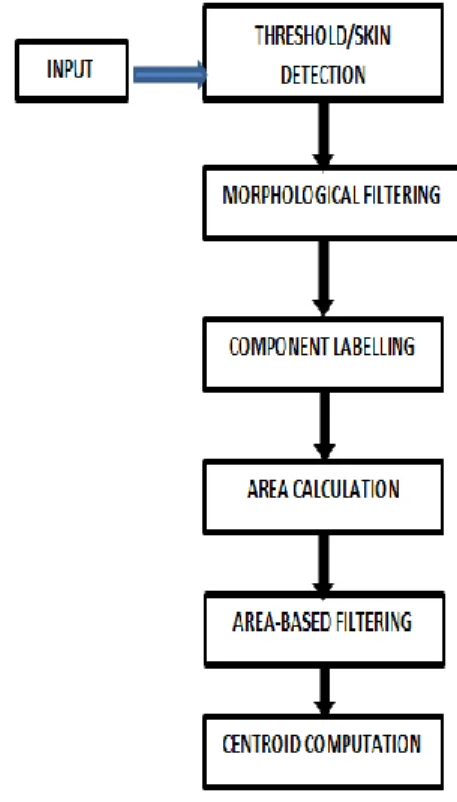
The image, represented in RGB color space, is converted to a modified YUV color space to distinguish the skin pixels of face. The skin pixels of the face are segmented based on appropriate U and V range. The U and V range is determined based on the experiments. It requires less training. The Y component known as the luminance component provides variation in lighting in the image. Therefore, it is normalized. Fig.1 shows the block diagram of main stages of the skin color segmentation algorithm using modified YUV color space.
FIG 1: BLOCK DIAGRAM OF SKIN COLOR SEGMENTATION
Step 1: Threshold/Skin Detection:
The skin pixels are converted to modified YUV color space using equations (1) (2) (3). The skin pixels falls within a certain range of U and V components, other-wise known as chrominance component of model [13].The luminance component Y is removed as it differ lighting in each part of the image.
4
/
)
2
(
R
G
B
Y
(1)G
R
U
(2)G
B
V
(3) Step 2: Morphological Filtering:
Many objects have similar color of the skin. Therefore lots of false representation may arise. At the same time, the skin region may comprise of holes as it represents nonskin region (such as eyes, nose hole, etc.) In order to reduce the false positives and holes, a morphological filtering is used. It includes erosion and hole filling stages. It reduces the background noise and fills the missing pixels in the face region resulting in one connected face region.
Step 3: Component Labeling: Each group of the skin-detected pixels are one connected, the connected component labeling is applied. This process labels a face image.
Step 4: Area Calculation: The area of the labeled component is calculated to obtain face region.
Step 5: Area-based Filtering: It removes all background noise and skin region that is not likely to be a face that is been labeled.
Step 6: Centroid Computation: The face location is determined by calculating the centroid of each labeled face components. It tracks the location of the face.
The skin color segmentation algorithm helps to detect the face from an image or video frame. Due to the variation in illumination and color constancy, the skin algorithm may fail to proceed. To overcome this, the image is pre-processed using MSRCR technique. The MSRCR provides good luminance and color rendition.
IV. MSRCR
The color appearance is an important feature in identifying and recognizing an object [14]. The variations in light reduce the relevancy of color appearance as a feature for identifying the object. As a result, the image degrades leaving dark or
ISSN: 2278 – 7798 All Rights Reserved © 2014 IJSETR 2187 brighter regions in an image. The machine vision cannot adapt
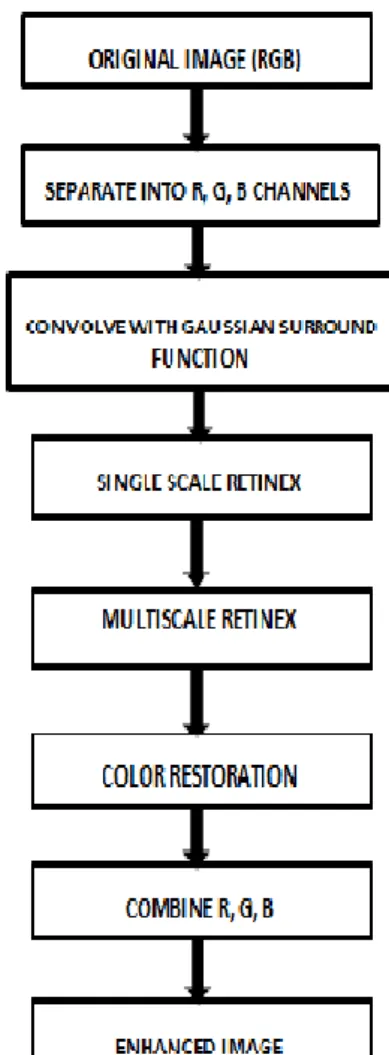
itself to color changes but the human vision does. Therefore, an image enhancement technique name MSRCR is used to enhance images distorted by irregular lighting conditions. The MSRCR provides a bridging gap between images and human observations from scenes [5]. It compensates blurring of the image and provides color constituency. It also provides fidelity to human observers. It also maintains dynamic range compression where the pixels of large values are not obscured with low values. The block diagram of MSRCR is shown in figure 2. The steps of the MSRCR are explained briefly and the performance evaluation factor is defined and calculated.
FIG 2: BLOCK DIAGRAM OF MSRCR
ALGORITHM
A color image can be represented by using equation (4).
}
,
,
{
),
,
(
)
,
(
y)
(x,
f
i
l
ix
y
r
ix
y
i
R
G
B
(4)Where, 0 <
li
( y
x
,
)
< denotes illumination component of an image and 0 <ri
( y
x
,
)
< 1 denotes the reflectancecomponent of an image. The illumination component represents a lower frequency and the reflectance component varies rapidly in higher component. Based on image formation model described in equation (4), the image enhancement is applied to R, G, and B components.
Step 1: The enhancement is applied on the power color components of an image. The components are separated.
Step 2: The Single Scale Retinex [5] is estimated by applying a linear low pass filter (LPF) to the image. The low frequency component, i.e. the part of illumination component is obtained. The single scale retinex output by subtracting the 2D convolution surround function of estimated illumination with the original image of the component. The equation (5) shows the output of single scale retinex.
)]
,
(
*
)
,
(
log[
)
,
(
log
)
,
(
y
x
I
y
x
F
y
x
I
y
x
R
i i i i
(5)Where i {R, G, B},
Ri
( y
x
,
)
is the retinexoutput for channel „i‟,
Ii
( y
x
,
)
is the image ofith channel, * denotes convolution and
Fi
( y
x
,
)
is a Gaussian surround function. The second term of equation (5) represents the illumination estimation and is formed by the convolution of Gaussian function with original image.
Step 3: The Multi Scale Retinex [5] is the weighted summation of the single scale retinex. The equation (6) shows the multi scale retinex.
N n i MSRix
y
w
R
x
y
F
1))
,
(
(
)
,
(
(6)Where,
W
n is called weight factor. Step 4: In order to avoid gray-world violation [5], the color restoration block is used. The multi scale retinex output is combined with color restoration as shown in equation (7).
}
,
,
),
,
(
)
,
(
)
,
(
B
G
R
i
y
x
F
y
x
C
y
x
F
MSRi i MSRCi
(7)ISSN: 2278 – 7798 All Rights Reserved © 2014 IJSETR 2188 Where C is the color restoration factor
Step 5: The components are combined and enhanced. The enhancement provides color consistency between original image and enhanced image. The gain and canonical offset is provided to provide a good enhanced image. The values are independent of each image. Step 6: The performance evaluation is
calculated on the enhanced image.
The performance of the enhanced image is obtained by calculating the contrast performance and the luminance performance. The contrast performance reveals the contrast of the image making the dark portion of the image darker and the light portion of the image lighter.
The contrast performance and the luminance performance are calculated by using equation (8) and equation (9).
C
out
in
in
(8)
L
Iout
Iin
/
Iin
(9)Where out is the variance of output image and in is variance in input image, the Iout is the mean of the output image and the Iin is the mean of the input image. The contrast and the luminance do not differ much in the enhanced image.
V. IMPLEMENTATION PROCESS
In this work, the input face image of low illumination and contrast is passed to a MSRCR block for enhancement. The MSRCR enhances the degraded image by achieving higher luminance compensation without sacrificing the contrast. The performance factors of MSRCR define the efficiency of the technique. The enhanced image is passed to a skin segmentation algorithm to perform face detection. The face is detected by segmenting the skin pixels present in the image. The fig.3 shows basic blocks for implementation.
FIG 3: BASIC BLOCKS OF THE SYSTEM
The MSRCR parameters are adjusted based on the image. The U and V are components are found based on the experimental images.
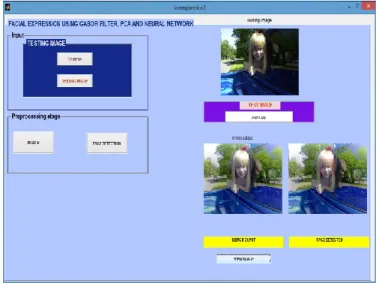
The particular system is designed in MATLAB GUI. The GUI has two pushbuttons: MSRCR and Face Detection. The MSRCR pushbutton provides the functionality of MSRCR operation on the test image. After the image is processed, the face is detected using the Face Detection pushbutton. The MSRCR is design using another GUI and linked it with the main design. The fig.4 shows the design of MATLAB GUI. The fig.5 shows the design layout of MSRCR.
FIG 4: DESIGN OF SYSTEM IN GUI
FIG 5: MSRCR GUI LAYOUT.
The MSRCR layout comprises of various parameter edit box. Each parameter is changed depending on the image. The performance evaluation is computed for each image. The
INPUT IMAGE
MSRCR FACE
ISSN: 2278 – 7798 All Rights Reserved © 2014 IJSETR 2189 contrast factor and luminance factor of the image is displayed
in the GUI layout design.
In this work, a degraded image is used in the experiment. The image is represented in a color form and is affected with high shadowing and illumination. This image is passed to a MSRCR algorithm to remove the variation factors such as low illumination, noise, color inconsistency, and high shadowing. The performance factors such as contrast and luminance is evaluated. In order to define its significance, it is compared with a common existing enhancement called histogram equalization. The performance factors of each technique is evaluated and compared.
The enhanced image is passed to a skin color segmentation algorithm to detect face. The MSRCR contributes high rate of face detection compared to histogram equalization. The skin pixels of the image are separated with the help of modified of YUV color space model. These pixels are connected together to form a surface which helps the algorithm to detect a face.
I. SIMULATION RESULTS
The simulation results for the given process are provided in this section. The process is simulated in MATLAB R2013a GUI and the results are obtained.
A degraded image is given as a test image in this process. The fig 6 shows the input image of illumination irregularity and shadowing present in them. The fig 7 shows the MSRCR enhanced image of good contrast and luminance. The fig 8 shows the histogram equalized enhanced image. The MSRCR provides good fidelity compared to histogram equalization enhanced image.
The fig 7, which is the MSRCR enhanced image, provides a good quality image. The fig 8, which is normal histogram equalized provides less quality.
FROM (LEFT TO RIGHT)
FIG:- 6: ORIGINAL IMAGE. FIG:-7 MSRCR FIG:-8 HISTOGRAM EQUALIZATION
The enhanced image is used in color skin segmentation for extracting the face. The MSRCR eliminates the variation factors in the image, therefore the fidelity is high. This helps in detecting face from any degraded images. The performance evaluation is compared and the efficiency of MSRCR technique is determined.
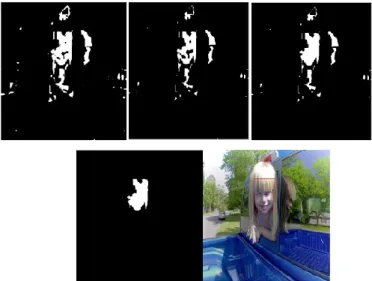
The fig 9 shows the color image is mapped into YUV color space. The fig 10 shows background noise of the image is eroded. The fig 11 shows missing pixels of the face caused due to non-skin regions such as eyes, mouth etc. is filled, and this forms a connected region. The fig 12 shows the connected region undergoes an area based filtering and the unnecessary pixels are removed. The final skin pixel region is formed. The fig 13 shows the connected image is detected as face. The centroid is created to locate the face.
FROM (FIRST ROW STARTING FROM LEFT TO RIGHT) FIG 9: MODIFIED YUV COLOR IMAGE
FIG 10: ERODED IMAGE.
FIG 11: MISSING PIXELS FILLED IN REGION.
FROM (SECOND ROW STARTING FROM LEFT RIGHT) FIG 12: FINAL CONNECTED IMAGE.
FIG 13: FACE DETECTED.
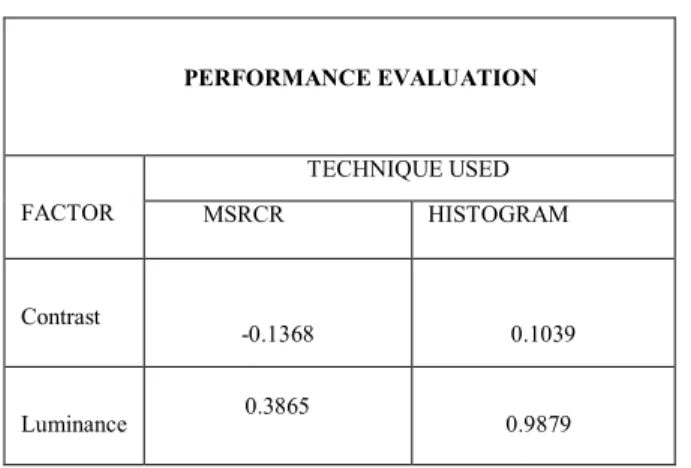
The performance evaluation of the MSRCR technique and histogram equalization technique is shown in table 1.
ISSN: 2278 – 7798 All Rights Reserved © 2014 IJSETR 2190
TABLE 1: PERFORMANCE EVALUATION
PERFORMANCE EVALUATION FACTOR TECHNIQUE USED MSRCR HISTOGRAM Contrast -0.1368 0.1039 Luminance 0.3865 0.9879
The MSRCR achieves a good luminance factor without sacrificing the contrast. For the obtained performance, the blurring and shadowing effects of the image are eliminated. The experimental values obtained for histogram equalization technique results huge variation between contrast and luminance.
II. CONCLUSION
In this paper, a face detection system using skin color segmentation with MSRCR technique is introduced. The purposed system provides good face detection of images that have high illumination changes. The MSRCR technique provides a good solution to degraded images of irregular illumination and contrast. The image is enhanced, providing good illumination without sacrificing the contrast. It restores the color of the image and shadowing effect is reduced. This technique provides high efficiency in detecting face image. The processed image is given to skin color segmentation algorithm having YUV color space. By using this algorithm, a highly efficient and fast face detection system can be achieved.
ACKNOWLEDGMENT
I would like to express my sincere gratitude to the Ms.Asha Panicker, HOD of Department of Electronics and Communication Engineering, Mr.Reneesh Zacharia and Mr.Rijo Sebastian, Assistant professors of Department of Electronics and Communication Engineering in Mangalam College of Engineering for the immense support and guidance for the successful completion of the work.
REFERENCES
[1] Ming-Hausan Yang, Member, IEEE, David.J.Kriegman, Senior Member, IEEE, Narendra Ahuja, Fellow, IEEE, “ Detecting Faces in Images: A Survey”, IEEE Transactions on Pattern Analysis and Machine Intelligence, Vol 24, No 1, January 2002.
[2] Jian Yang, Chengin Liu, Lei Zhang. “ Color Space Normalization: Enhancing the Discriminating Power of Colorspaces for Face Recognition”, Pattern Recongition, 43 (2010) 1454-1466.
[3] R.I.Hsu, M.Abdel-Mottaleb, A.K.Jain. “Face detection in color images”, IEEE Transaction on Pattern Analysis and Machine Intelligence 25 (5) (2002) 696-706.
[4] G.Dong, M.Xie, “Color Clustering and Learning for Image Segmentation based On Neural Networks Vol 16, (4) (2005) 925-936.
[5] Hanumantharaju M.C. Ravishankar.M, Rameshbabu D.R, Ramachandran .S, “Color Image Enhancement using Multiscale Retinex with Modified Color Restoration Technique”, 2011 Second International Conference on Emerging Applications of Information Technology.
[6] Z.Rahman, D.Jobson and G.A Woodbell, “Multiscale Retines for Color Image Enhancement”, in Proceedings of the IEEE International Conference on Image Processing, IEEE, 1996.
[7] S.Patilkulakarni, H.C. Vijay Lakshmi, “Segmentation Algorithm for Multiple Face Detection in Color Images with Skin Tone Regions using color spaces and Edge Detection Technqiues”, International Journal of Computer theory and engineering, Vol 2,No 4, August 3010,1793-8201.
[8] H.Rowley, S.Baluja , F.Girosi, “Neural network based face detection”, IEEE Transactions on Pattern Analysis and Machine Intelligence, Vol 20, No. 1,1998, 23-28.
[9] E. Osuna, R. Freund, F.Girosi, “Training Support Vector Machines: application to face detection”, IEEE CVPR, 1997, 130-136.
[10] T.Leung, M.C.Burl, P.Perona,” Finding faces in Cluttered
Scenes using Random Labeled Graph
Matching”,ICCV,1995.
[11] P.Viola, M.Jones, “Robust Real-time Object Detection”, Second International Workshop On Statistical and Computational Theories of Vision-Modelling Learning, Computing and Sampling,2001.
[12] Navneet Jindal, Vikas Kumar,” Enhanced Face Recognition Algorithm using PCA with Artificial Neural Netwoks”, International Journal of Advanced Research in Computer Science and Software Engineering, Vol.3, No.6,June 2013.
[13] Sonia Chhetri, “Approach to Design and Develop Highly Efficient Face Detection System”, Internation Journal of
Computer Science Trends and Technology,
Vol.2,No.2,March-April 2014.
[14] R.C.Gonzalez, R.E. Woods, Digital Image Processing, MA: Addison-Wesley, 1992.
ISSN: 2278 – 7798 All Rights Reserved © 2014 IJSETR 2191 SABITH SANAL has completed his B.E degree in
Electronics and Communication Engineering in Noorul Islam College of Engineering in the year 2012. Presently, he is doing his masters in VLSI and Embedded System in Mangalam College of Engineering. His research interest includes VLSI Design, Image Processing and Facial Expression Recognition System.
RENEESH ZACHARIA is the Assistant Professor of the Department of Electronics and Communication Engineering in Mangalam College of Enginnering.