R-Tree Based Indexing Scheme using RT_HCN
(Hierarchical Irregular Compound Network)
Shashank Bharadwaj N, Vidyarani.H.J
Abstract— Cloud stockpiling framework postures new
undertakings to the group to bolster powerful synchronized questioning assignments for different information concentrated applications, where lists dependably hold critical positions. Here, we investigate a functional strategy to develop a two layer coupled ordering plan for information that is present in the featured space in assorted server driven distributed storage framework. We initially prescribe RT_HCN, an ordering plan incorporating R-tree based ordering structure and HCN-based directing convention. RT_HCN systematizes capacity and process hubs into a HCN overlay, one of the recently proposed separate driven server farm topologies .
Index Terms—Distributed Index, R-Tree, Data Center Network. 1. INTRODUCTION
Distributed storage frameworks continue picking up contemplations from both academe and business these days. From customary frameworks for widespread information administrations, for example, Google's Global Forecast System, The Dynamo DataBase from Amazon, Facebook provides similar Structural storage of database , to recently planned frameworks with claims to fame, for example, Haystack, Megastore, Spanner, different disseminated stockpiling frameworks were manufactured to fulfill the expanding interest of online information serious applications that require enormous adaptability, solid reasonability, immovable accessibility, and almost no downtime in the capability layer. More than few proposals have been made for scheming new ordering plan and information administration framework to arrangement vast scale information investigative.
To accomplish inquiry proficiency, most existing propelled distributed storage frameworks utilize an immaculate key-esteem information depicting some of its options , which are inadequate in implicit maintain for multi-dimensional file, which is observed in Dynamo and Big Table. Really, two-layer file is only a powerful and fitting structure for multi-dimensional questioning in Cloud frameworks. This paradigm has been put to useful practice in. Notwithstanding, they build their worldwide lists on the peer to peer systems, similar to BATON and CAN. It has been realized that peer to peer systems provide efficient representations for associations on the rationale level than the Internet level, however their fundamental environments are really indistinct and the hubs
may disseminate generally with physical jump remove that has no bounds, bringing unsteadiness of execution. As we know, increasingly cloud frameworks today support a foundation called server farm, which comprises of a community of servers interconnected by a singular Data Center Network (DCN) For example, Cisco applies Fat-Tree topology as its DCN engineering for provably compelling correspondence. Planning compelling ordering plan on server farm topologies has been put on the motivation. Not the same as PEER TO PEER system, DCN is more rigorous with low gear cost, commendable system limit, and scalability. Especially, DCN has particular environments, with the relationship among center points completely described. It is not canny to simply transplant the requesting arrangement for PEER TO PEER frameworks onto its topologies. Such establishments pass on new challenges for pros to arrange fruitful requesting plan to reinforce request dealing with for various applications. One of the main aims of this initiative is to demonstrate the progression of a streamed multi-dimensional asking for plan for server driven server develop systems. Let’s begin from one of the standard server driven topologies, named Hierarchical Irregular Compound Networks (HCN). This is numerically a major and delightful environment in perspective of the trademark consistency and symmetry, which secures comfort for the asking for building and potential for improvement. Simultaneously there is a two layer asking for plan, RT-HCN. Datasets are traversed by or moved to various servers and hence an R-tree like structure can be implemented to covertly to put varied information in to the servers. Next, RT_HCN respectably courses these range archives crosswise over servers as their general records. In order to avoid the bottleneck caused by a single master server, every server just keeps up generally general record for its potential asking for range. An archive mapping strategy is used to carry the task of driving general records in to the PC, this is with respect to the qualities that are possessed by the HCN. Relating question dealing with calculations are likewise demonstrated then. This can be summed up in a simple manner, saying that RT-HCN pursues demand and can be completed with much less space. Before examination, let’s look at the possibility of branching out into another server development technology called as DCell. It separates our game plan and RT-CAN, a commensurate chart for customary PEER TO PEER deal with, comparatively as execution on multi varied and pressed information. Tests are carried out to bolster the proficiency of
demand and return more positive results than falsified data.. The aim here is to conclude that
This methodology is used to recommend an appropriated multidimensional ordering plan for server-driven DCN structures, and furthermore the first to build up a general and commonsense technique to extend this two-layer ordering plan onto other server farm systems;
It introduces a specific mapping method to enhance worldwide list dispersion in the system, bringing question proficiency and load-adjusting for the cloud framework; Other than join commonsense procedures to explain information that is pressed and the integrity of falsified data is in question, extraordinarily expanding the versatility and questioning execution of RT_HCN;
This hypothetically demonstrates the productivity of RT_HCN, and contrast it numerically and RT-CAN, an ordering plan for PEER TO PEER arrange. Investigates genuine stages demonstrate that our plan performs fantastically for point question.
The above mentioned points will be discussed further in depth in the coming sections. The second section compresses the related work. The third portion presents the outline of our framework, that includes a coding technique for HCN hubs and meta-servers. we delineate the system of two-layer ordering development with an abundance of subtle elements, including a few procedures for multi-measurement ordering, information skewness taking care of, and false positives controlling. quickly delineates the inquiry preparing calculations. we grow the RT_HCN ordering plan to fit another server-driven server farm systems, DCell Verifies the productivity of our outline and performs numerical trials in correlation with the RT-CAN. At long last, this Segment gives a conclusion and gives some discourse about future work.
2 RELATED WORK
2.1 Two-layer Indexing
The necessity of parallel addressing tool is stressed upon with much importance here since the aim is to change the speed with which data change recuperates. A secondary level requesting structure is a conventional choice. One important factor thought in regards to the mix of two-level requesting with the overlay frameworks. There is a briefer method is presented for generalization in the requesting framework, taking care of center points are dealt with in a sorted out overlay orchestrate, and each get ready center point manufactures its neighborhood rundown to quicken data get to An overall document is worked by picking and dispersing a touch of the adjacent record in the overlay compose, while the overall document is passed on and kept up in all centers over the framework. A couple tries have starting at now been finished on peer to peer overlay frameworks. RT-CAN is a secondary option for requesting arrangements in view of top of neighborhood R-tree records and dealt with using a CAN overlay organize. It gives suitable data recuperation organization to far reaching scale shared-nothing bundles. Not
the same as this, CG-record deals with PC center points into a composed PEER TO PEER framework, BATON, and fabricates B-tree records to allow maximum throughput for any request that is related to a one dimensional information set. The briefed out work gives a scalable structure that easily integrates with DBMS-like records in the cloud in perspective of the observation that various PEER TO PEER overlays are events of the Cayley outline. This extensible structure can reinforce various sorts of spread records in the meantime, for instance, hash, B-tree-like and multi varied document, basically diminishing the bolster cost and giving the required flexibility.
2.2 Data Center Networks
This methodology looks for a method of function that proves to be more versatile for two-layer requesting developing these networking frameworks. The fact that this a specific server driven structure is a focal point of this approach. Server cultivate mastermind (DCN) is the framework structure for a server ranch, which interfaces a far reaching number of servers through quick associations and switches. Appeared differently in relation to customary cloud structure which is ordinarily in perspective of PEER TO PEER framework, incredibly and carefully sketched out and this network specifies that requirement with utter ease, high adaptability, below game plan overhead, quality and imperativeness saving. DCN structures can be for the most part segregated into two classes, one is switch-driven, which infers that the limit of changes is moved up to suit the need of the interconnection and guiding, while the servers require no modification. There are three sorts of it, tree-like, level and optical switch based. The Fat-Tree, VL2 and Aspen trees has a place with the tree-like kind. The other characterization is server-driven, which infers that each server engages the components of interconnection and coordinating while the switches require no change and simply give basic crossbar work. Among them, DCell, FiConn, Dpillar, SWCube and SWKuatz are expected for uber server ranches. While BCube, MDCube, uFix , snowflake, hyper-fat-tree sort out (HFN) are topologies for the specific server ranches. Consecutively, they by and large have a more prominent number of good conditions than the past blueprints. HCN, the topology picked in our system falls into the server-driven topology. It is an inside and out formed framework for server homestead and offers an abnormal state of consistency, versatility, and symmetry. Remarkable in connection to standard PEER TO PEER mastermind, the physical relationship of DCN is known, we can get the ready time can be guaranteed by making sense of the physical skips required for a given question, while in PEER TO PEER sort out simply reliable hops of the overlay framework can be evaluated. Care should be taken about the physical topology when we are analyzing DCN and that is the reason the mapping framework should be improved for passing on overall record to settle a given framework. Truly, practically identical wears down the DCN-based requesting arrangement has yielded incredible results. FT-Index is an appropriated
requesting arrangement in perspective of Fat-Tree topology. In FT-Index, the B+-tree and the Interval tree are gotten to deal with educational file locally and all around. FT-Index has an average execution on false positives and space-viability, with the help of two partner instruments FT-Gap and FT-Bloom. In another work, the B+-tree is joined with Segment tree, and the two-layer requesting is executed on three tree-like switch-driven DCN topologies. Regardless, either FT-Index or the later one performs more unfortunate for general range request than point address. This is fundamentally the most distant purpose of B+-tree requesting for one-dimensional data. Awakened by this, the sorts of addressing should be propelled in our new requesting arrangement.
2.3 R-tree in Distributed Platform.
The other focus fragments are a multi-estimation arranged requesting structure. The tree technique is employed. R-trees, made for requesting multi_dimensional information, are the most standard records for spatial question get ready in view of their straightforwardness and profitability. The R-tree built up the Btree from one estimation to multi-estimations for requesting static parts. Spatial components and their associations were seen and secured in a tree structure with the objective that components could be more quickly recuperated by taking after along the tree structure. R-tree's purposes of enthusiasm for multi_dimensional question have additional a motivating force in the appropriated systems. With the causing of region based web business and flexible preparing, the prerequisite for moving articles addressing begins to develop. Pretentious challenge improvement headings are known as priori, Salteniset al planned the Time-Parameterized R-tree (TPR-tree) for requesting moving articles. By joining with the improved UK-suggests estimation, Ben Kao et al use a R-tree rundown to deal with the issue of collection questionable articles whose regions are depicted by probability thickness limits. In Kai Zheng et al made capable computations to answer fleecy articles addressing, by building up the R-tree requesting structure and surmising a couple significantly suitable heuristic fundamentals.
3 SYSTEM OVERVIEW
We focus on the server-driven DCN get together for the appropriated requesting arrangement improvement, and take HCN as the primary case to diagram our arrangement. In this Segment, some essential topographies of HCN topology will be accounted for and outlined. By then, we illuminate some preliminary definitions for further portrayal of rundown improvement framework.
3.1 Hierarchical Irregular Compound Network
HCN (Hierarchical whimsical Compound Network) is an especially plot deal with for server farm and offers an anomalous condition of normality, adaptability, and symmetry. A level-h HCN with n servers in each and every
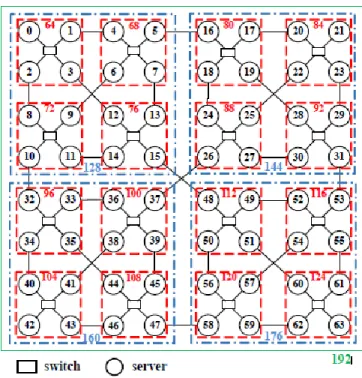
unit is exhibited as HCN(n; h). HCN is a recursively depicted structure. A sporadic state HCN(n; h) utilizes n low level HCN(n; h � 1) as a unit pack and accomplices every one of the social events by procedures for an entire chart. HCN(n; 0) is the littlest module (key change unit) that contains n twofold port servers and a n-port scaled down switch. For every server, its at first port is utilized to interface with the smaller than basic switch while the second port is utilized to interconnect with another server in various humblest modules for constituting a more noteworthy system. Figure. 1 addresses an occurrence of HCN with n = 4 and h = 2, which contains 64 servers. Every server is named by a coding technique. The underneath picture demonstrates the system topology
.
Figure 3.1 HCN(4,2) with Coding for Meta-Server.
It is anything but difficult to see that there are constantly different courses between any two servers in HCN and this is called multi-way steering which gives great system highlights like high data transfer capacity, great adjusting and adaptation to internal failure. This is the principle perspective we need to worry amid record development and furthermore turns into a fundamental motivation behind why extraordinary composed file conspire for particular system is well worth being talked about. For lucidity, we compress the images with their implications in Table. 1. Some of them will be portrayed in the accompanying.
4 INDEX PUBLISHING
As is introduced some time as of late, every data server Sn manufacture a R-tree list for its adjacent data to energize multi_dimensional chase. By then, Sn adaptively picks a game plan of record center points Nn = fN1 n;N2 n;};Ndn n g from its neighborhood R-tree and circulates each Nin to the operators of a specific meta-server whose potential requesting range just covers the base skipping extent of Nin. Develop channels of the taking a gander at focuses is likewise made and circled. The pick of the circling focus focuses begins from the second level of R-tree to a completing level probabilistically. For each level before the conclusion level, we pass on focuses who have no scattered predecessors with a settled likelihood. For the conclusion level, we pass on all the left focus focuses who have no scattered forerunners. Consequently , the standard of report summit and striking record while doing record coursing are both fulfilled. In the interim, one of a kind sizes of R-tree focus indicates initiate a possibility be scattered, which fits in with the RT_HCN's outline thoughts of "asking for various leveled association". We set the conclusion level as antepenult level and the likelihood as 0.7, giving all the all the additionally appropriating potential results for the more noteworthy focus focuses with the motivation driving checking the develop channels of atypical state focuses as quick as time permits in the point address technique and keeping the aggregate number of general records at a fairly low level. The arrangement of the scattered R-tree focus focuses is (n; mbr), where n exhibits the cause server for securing the information and mbr is the irrelevant ricocheting degree of the appropriated R-tree focus point. In the wake of enduring the appropriated focus focuses, pros bolsters the once-over in memory
. Alg. 1 portrays the procedure of list distributing.
Figure. 4 gives an immediate example of a range R-tree. On the off chance that the middle point R1 is been appropriated, it ought to be scattered to server S17; S18; S19, which are administrators of the HCN(4; 0) appeared in red. So also, if the inside R3 is been coursed, it ought to be dispersed to server S16; S26; S31, which are specialists of the HCN(4; 1) appeared in blue. The conventional planning taken a toll for formed development in HCN is O(2h+1), and the cost for data transmission between agents of the same meta-server is o(2h+1), accordingly the cost to pass on an once-over focus point ought to be O(2h+1) all around, and it reciprocals to O(pN) when n = 4, where N is the aggregate number of servers in the given HCN. For more broad condition, the cost is given by N^logn and can be decreased as n get more noteworthy. We in like way need to state here that the cost appeared above is unquestionably physical bounces between servers while past works insists that all that is required is O(logN) to scatter report in PEER TO PEER engineer at any rate they are just talking about sways in the overlay create. Since the physical relationship of PEER TO PEER system is questionable, the physical skips can be difficult to exam and inclination. Another enhanced part for record passing on in our structure is that under this outline we can ensure that every summary focus indicate is scattered unequivocally just three servers in the framework. Regardless, the technique utilized as a bit of passes on the more prominent record focus focuses to different servers the length of the degree of a helper skim focused with the appropriating focus point's inside spreads with the time tested question degree of them. By then, the measure of record focus focuses appropriated in the structure is difficult to control. Concerning report support, the record strengthen activated by neighborhood information thought is been considered. On the off chance that an extension makes the degree of a leaf focus point be extended, we in a general sense appropriated this leaf focus point with a starting late made sprout channel to the perfect place, which costs 1 or 3 or 4 HCN planning messages (subordinate upon the measure of agents) with data of the starting late scattered focus and at most various range hashing. In the event that a development does not accomplish any enlargement, it needs to resuscitate the remote develop channel of its appropriated ancestor focus point and there must exist such one. For this situation, the resuscitating still costs 1 or 3 or 4 HCN controlling messages (subordinate upon the measure of agents) with data of new piece demonstrate positions to be set to 1 and two or three
times of neighboring hashing. In this way, the accuracy of point and range question can both be ensured. We in like way execute another translation of once-over animating when develop channel is not utilized for our examination, which is the same with RT-CAN: when circled focus is section an aftereffect of near to extension, we basically erase the remote appropriated ones and republish two new focus focuses, which costs triple HCN planning messages separating and the past restoring framework.
Figure 4. Index Distribution
5 PERFORMANCE EVALUATION
In this Segment, we review the execution of RT_HCN. We propose an association of the planning taken a toll between RTHCN asking for directing system and the most short organizing method here. The briefest organizing methodology is the most comprehensively seen managing technique for standard coursed asking for parts. It goes about as a wellspring of perspective in the running with examination, mirroring the relative execution of the RT_HCN asking for controlling framework. The point ask for prepare for diagram is been taken. The RT_HCN asking for planning structure for point demand can be delineated as four stages. Instantly, a question comes at a flighty beginning focus point S in HCN(n; h), and S advances the demand to the closest hth level delegate Snh which is responsible for it. Likewise, Snh moves the question to the closest h � 1th level administrator Snh1, and this development recursively proceeds until the 0th level delegate is come to. Thirdly, each time an expert is proficient, it returns back qualified asking for focus focuses to the beginning focus point S. Fourthly, S look at for the last outcome with the got asking for focus focuses. Notwithstanding, in the event that the most confined controlling technique is utilized for point ask for, one fundamental precondition is that each inside point has supported all the nearby records of the diverse focus focuses. For whatever timeframe that a question comes at a beginning focus point S, it knows which focus the last outcome is masterminded at, with no need of any additional controlling. Next, we make the additional organizing cost
more formalized to allude to change discernment. Taking after are the figuring systems of 3 components depicted for the two coordinating
approach.
6 CONCLUSION
The proposal an asking for plan named RT_HCN for multi_dimensional demand dealing with in server farms is been carried out in this framework, which are the foundations for building dispersed limit structures and are interconnected utilizing a particular server develop engineer (DCN). RT_HCN is a two-layer asking for course of action, which arranges HCN-based coordinating convention and the R-Tree based asking for headway, and is segment capability spread on each server. In context of the qualities of HCN, A particular mapping technique with update general record task in the structure is been familiarized in present paper, happening demand proficiency and load-modifying for the cloud framework. We likewise consolidate helpful techniques in face of information skewness and tending to false positives, tremendously developing the versatility and tending to execution of RT_HCN. We display hypothetically that RT_HCN is both demand productive and space-powerful, by which every server will essentially keep up an obliged number of records while a general number of clients can at the same time handle ask for with low controlling cost. We also give an understanding into within relationship between the HCN and other server develop topologies, and apply the two-layer asking for plan to the DCell topology summed up. A separate our plan and RT-CAN is been carried out., a relative design for consistent PEER TO PEER engineer. Tests bolster the effectiveness of our proposed plot and portray its potential use in server farms.
REFERENCES
[1] S. Ghemawat, H. Gobioff, and S. T. Leung. The google file system. In ACM SIGOPS operating systems review, volume 37, pages 29–43, 2003.
[2] G. DeCandia, D. Hastorun, M. Jampani, et al. Dynamo: amazon’s highly available key-value store. In ACM SIGOPS
Operating Systems Review, volume 41, pages 205–220, 2007.
[3] A. Lakshman and P. Malik. Cassandra: a decentralized structured storage system. ACM SIGOPS Operating Systems
Review, 44:35–40, 2010.
in haystack: Facebook’s photo storage. In OSDI, volume 10, pages 1–8, 2010.
[5] J. Baker, C. Bond, J. C. Corbett, et al. Megastore: Providing scalable, highly available storage for interactive services. In CIDR, volume 11, pages 223–234, 2011.
[6] J. C. Corbett, J. Dean, M. Epstein, et al. Spanner: Googles globally distributed database. ACM Transactions on Computer
Systems (TOCS), 31:8, 2013.
[7] S. Wu and K. L. Wu. An indexing framework for effective retrieval on the cloud. IEEE Data Eng. Bull.,
32:75–82, 2009.
[8] J. Wang, S. Wu, H. Gao, et al. Indexing multidimensional data in a cloud system. In Proceedings of the 2010 ACM
SIGMOD International Conference on Management of data,
pages 591–602, 2010.
[9] S.Wu, D. Jiang, B. C. Ooi, and K. L.Wu. Effective b-tree based indexing for cloud data processing. Proceedings of the
VLDB Endowment, 3:1207–1218, 2010.
[10] G. Chen, H. T. Vo, S. Wu, et al. A framework for supporting dbms-like indexes in the cloud. Proceedings of the