Abstract—Fractional Fourier transform (FrFT) is one of the interesting research areas for time–frequency analysis. As Fourier transform is not effective to detect accelerated targets, FrFT is one of the alternative. This paper comprises information about the time-frequency analysis and time –frequency analysis methods. As the target is an accelerated one, the Doppler shift will affect the signal detection. A novel time frequency analysis method based on FrFT is used to solve the detection problem. This paper also discussed the some of the other time frequency methods like STFT and Wigner-Ville distribution.Acceleration estimation for received echo of the accelerated target for different SNR is analyzed and the simulation results validates the effectiveness of the accelerated target detection method using FrFT technique.
Index Terms—Accelerated Target, Fractional Fourier Transform, Target Detection, Time Frequency Analysis.
I. INTRODUCTION
The fractional Fourier transform is a family of linear transformations generalizing the Fourier transform. It can be thought of as the Fourier transform to the nth power, where n need not be an integer — thus, it can transform a function to any intermediate domain between time and frequency. Its applications range from filter design and signal analysis to phase retrieval and target detection method.The classic Fourier transform generalized fractional Fourier transform (FrFT) having good energy concentration on linear frequency modulation (LFM) signals.Linear frequency modulated (LFM) signal is widely used for the radar system, acoustic communication, and sonar system. In a noisy environment detection and estimation of the LFM signal are extremely important.
Radar transmitted signal is modulated as LFM signal due to the relative motion between radar and target, and nonlinearity exists due to the acceleration of target. Nonlinearity in the signal makes the spectrum aberrant.The significance of this research lies in the interest in developing target detection of radial accelerated target with radar.There are several methods for extracting the time-varying characteristics of a signal, among them simplest method is the STFT (Short Time-Frequency Transform). STFT uses a sliding window function to extend Fourier Transform, but the narrow or time-variant window results in a poor resolution in the time-frequency domain. Wigner-Ville Distribution (WVD) could be used for moving target detection and parameter estimation, but the presence of cross terms in multicomponent signals causes the WVD to suffer [1]. Although the effect of interference can be suppressed by
carefully selecting the kernel function of TFD, but meanwhile, their time-frequency localization performance will be certainly degraded.
In this paper depicts on the estimation of acceleration of by Fractional Fourier Transform (FrFT) for different time periods and different SNR values. Good precision and accuracy wise this technique have the better effect also one advantage is the high computation speed. On the other side, its anti-noise interference capability is better than any other method. To verify these characteristics, a mathematical model for a target with uniform acceleration is deduced and then the computational formula is established. Also this paper has the relation between accuracy of estimation with other parameters and MATLAB simulations.
II. PROBLEM FORMULATION
The concept of Accelerating targets is to introduce chirped signals in the radar backscatter signal which cannot be effective to detected by the Fourier transform (FT). But they can appear to be easy to detect by the help of the Fractional Fourier Transform (FrFT) and thus can be efficiently detected with the same coherent integration gain achievable by the FT on pure tone signals. FrFT can be successful by the help of the achievable optimum focusing of chirped signals when applied to the FrFT, whereas the clutter signal is always defocused.In recent era, the radar functionality was specified to detect the target and determine the range. With the change of time and technology, there has been a tremendous evolution in the radar technology witnessed. Modern communication systems and signal processing have been playing an important role for detecting the required targets with a background of active clutters. Hence traditional techniques have been performing a key role in order to gain modern techniques in radar. The non linearities that are active in radar causes large interference by affecting the small desired signal and it is difficult to know information about the target from the interference. The purpose of the Time-Frequency analysis methods are implemented in the radar to estimate accurate parameters[2].
Linear frequency modulated (LFM) signal has wide uses for radar system, acoustic communication and sonar system. LFM signal plays a vital role in noisy environment detection and estimation [2]. Radar transmitted signal is modulated in terms of LFM signal due to the relative motion between Radar and target, and non-linearity exists due to the acceleration of target. Target detection using a conventional FFT(Fast Fourier Transform) cause the performance to decrease because of non-linearity. The aberrant spectrum contains the information of radial acceleration. In military case, radar did notprovide acceleration information because time aircrafts have low mobility nowadays. Inthese days with the help of development in science and technology, the
An Efficient Detection Method for Accelerated
Targets
1
Bindu Bothra, 2Subhasis Pradhan, 3Md. AsfaqueHussain, 4Apurbarani Panda, 5Dillip Dash 1,2,3,4,5
mobility of aircraft get increased so that the effect of acceleration on the signal spectrum of FFT can‘t be neglected the signal spectrum. Fourier transform fails to indicate the time location of the spectral components even if it provides the signal‘s spectral content, for example, when we consider non-stationary or time-varying signals.This dissertation work has relation with the study of RADAR signals processing with the important target of parameter estimation of Accelerated Radar Target. The parameter estimation accuracy of the system is also analyzed withdifferent values of the signal to noise ratio (SNR) [3].
III. TIME FREQUENCY ANALYSIS
Generally, there are three ways to explore the information about any signal that is time domain analysis, frequency domain and time frequency analysis. As time and frequency domain representations are not exactly efficient to give all the information passes by the signal, an obvious solution in to seek a representation of the signal as a ‗two-variable‘ function. Its constant-time cross-section provides the frequencies present at any time and constant frequency cross-section shows the times at which those frequencies get obtained. Such a representation is called time-frequency distribution (TFD). Similarly, the plane in which signal is analyzed can be expressed as the time-frequency plane [4]. Fourier transformation maps one-dimensional time domain signal into a one-dimensional frequency domain signal. Even if the Fourier transform provides the signal‘s spectral content, but it can‘t indicate the time location of the spectral components, which is vital, for example, when we consider non-stationary or time-varying signals. As per the description these signals, time-frequency representations are used. A time-frequency representation maps one-dimensional time domain signal into a two-dimensional function of time and frequency.
Time frequency analysis methods are generally get used in order to analyze a signal in time and frequency domains at once. Astraight forward extension of the conventional Fourier transform, called Short-TimeFourier transform (STFT) brings out the evolutionary nature of the signals,both in time and frequency domain. Other than STFT, time frequency methods have alarge limitation on academic research because of the complex nature of the algorithms and the limitations incomputing power. TFMs are mainly of two categories that is linear time frequency methods such as STFT, FrFT, WD and quadratic time frequency methods such as WVD, Cohen class [5].
A. Short Time Fourier Transform
Short-Time Fourier transform (STFT) is widely known to be the first TFM that has applied in practical systems e.g. speech processing systems, radar tracking etc.Fourier analysis becomes insufficient when the signal has non-stationary ortransitory characteristics like transients, trends etc. In order correct this, DennisGabor adapted the Fourier transform to observe small sections of the signal at a time.To introduce time-dependency in the Fourier transform, a simple and intuitive solution consists in pre-windowing the signal to be observed x(t) around a particular instant of timet, calculating its Fourier transform, and doing that for each time instant t. The resultingtransform called the Short-Time Fourier transform [3].
𝑆𝑇𝐹𝑇(𝜏, 𝑓) = < 𝑥, 𝑔𝑡,𝑓>
𝑥 𝑡 𝑔𝑡,𝑓∗ 𝑡 𝑑𝑡 = 𝑥 𝑡 𝑔 𝑡
− 𝜏 𝑒−𝑖2𝜋𝑓𝑡𝑑𝑡 (1)
B. Fractional Fourier Transform
The FrFT is generally a time- frequency distribution. It shows us with an additional degree of freedom (order of the transform p), which in most cases results in effective gains over the classical Fourier transform. With the development of FrFT, we observe that the ordinary frequency domain is mainly a special case of a continuum of fractional Fourier domains. Each property and application of the ordinary Fourier transform becomes a special case of the FrFT. By applying FrFT in every arena of Frequency domain analysis, the simulation becomes more reliable and flexible. FrFT is most likely to improve the solutions to problems where chirps signals are involved. Chirp signals are not compact in time or frequency domain. They appear as inclined lines in the T-F plane and there exists an order for which such a signal is compact. In time-frequency representation, the orthogonal axes corresponding to time & frequency are represented. FrFT is a linear operator that corresponds to the rotation of the signal through an angle which is not multiple of π/2 [4]. The FrFT is a generalized form of Fourier Transform. It belongs to the class of time-frequency analysis. It can be regarded as a counter-clockwise rotation of the signal through an angle which is not a multiple ofπ
2. In other words,
it is a representation of the signal along the axis making an angle α with the time axis. If the rotation angle (α) is π
2 , the
result is Fourier transform of the signal [4, 3]. The FrFT of the signal 𝑥(𝑡) can be represented as
Xα u = Fα[x(t)] = x t K
α t, u dt ∞
−∞ (2)
Where, α is the rotational angle of the FrFT, Fα denotes the FRFT operator and 𝐾(𝑡, 𝑢) is the kernel function of the FRFT where𝑝 is the order of FrFT and is equal to 2𝛼/𝜋.
K(t,u)= 1−j cot α 2π exp j t2+ u2 2 cotα − jtu csc α , α ≠ nπ δ t − u , α = 2nπ δ t + u , α = (2n + 1)π (3) C. Winger-Ville Distribution
The Wigner-Ville distribution (WVD) is one member of the Cohen class which is a simple and powerful tool to analyze the Doppler of SAR signals. Wigneroriginally developed the distribution for use in quantum mechanics in 1932, and it wasintroduced for signal analysis by Ville sixteen years later [6]. To obtain the Wigner-Villedistribution at a particular time, we add up pieces made from the product of the signal at apast time multiplied by the signal at a future time.
𝑊𝑉𝐷 𝑡, 𝑓 = 1 𝑠 exp −𝑗2𝜋𝑓𝜏 𝑠 𝑡 − 𝜏 2 𝑠 ∗ 𝑡 −𝜏 2 ∞ −∞ 𝑑𝜏 (4) The problem arises by using the WVD is that, when signals consisting ofmultiple components. Since it is a non-linear transformation, the WVD signal is notsimply the sum of the WVD of each part.
IV. ACCELERATED TARGET DETECTION USING FRFT The Radar transmits a chirp signal (signal with linearly varying frequency) to detect the target. If a target is present, the echo signal is received by the radar. Then the radar uses this signal to extract the information about the target. For a moving target, there is Doppler Effect on the received echo signal that is frequency changes as the target is moving towards or away from the radar. There are many techniques to process the received signal. One of the methods is classical Fourier transform but in this, the spectrum of chirp signal will spread which makes target detection difficult in a noisy background. If FrFT is used, the energy of chirp signal is concentrated for an appropriate angle of rotation [7]. So, it is advantageous to use FrFT over FFT.
A. Mathematical model of Accelerated Target Detection
The linear frequency modulated signal transmitted by radar is given by
𝑠(𝑡) = 𝐴 𝑒𝑥𝑝(𝑗(2𝜋(𝑓0𝑡 + 𝑘𝑡2/2) + ∅0) (5)
where𝐴, 𝑓0, 𝑘, ∅ 0represent amplitude, starting frequency,
chirp rate and an initial phase of the transmitted signal. For a moving target, there is relative motion between radar and target. As a result, the frequency of the echo signal changes linearly with time (as chirp signal). Let us assume the target is moving towards the radar with constant acceleration. So the received echo signal is considered as follows
𝑅(𝑡) = 𝐴 𝑒𝑥𝑝(𝑗 2𝜋 𝑓0𝑡 + 𝑓𝑑𝑡 + 𝑘𝑡2
2 + ∅0 (6)
Where, 𝑓𝑑= 2𝑣 𝜆 is theDoppler frequency chirp rate 𝑘 has 0
a linear relationship with the acceleration 𝑎 of the target which is given as 𝑘 = 2𝑎 𝜆 . The instantaneous frequency 0
of the received echo signal is given by f𝑖 t =
1 2𝜋
𝑑∅
𝑑𝑡= 𝑓0+ 𝑓𝑑+ kt (7) Due to noisy environment, Additive White Gaussian Noise (AWGN) is added up with the reflected signal𝑅(𝑡). The optimal order of FrFT (𝑃𝑜𝑝𝑡)is the order at which most of the
energy of the signal is concentrated in the bandwidth of 𝐵𝑚 = |2 𝑠𝑖𝑛 𝛼/𝑇| and |𝑋𝑝(𝑢)|2reaches the peak value if
and only if 𝑘 + 𝑐𝑜𝑡 𝛼 = 0 and𝑓0 – 𝑢 𝑐𝑠𝑐 𝛼 = 0.As per the
above property, estimation of the signal 𝑅(𝑡) parameters can be derived as [2].
𝑝 , 𝑞 = 𝑎𝑟𝑔 𝑚𝑎𝑥 𝑌𝑝 𝑢 2(8)
The target acceleration estimation is based on the two-dimensional search. According to (6), the peak position is at 𝑢 and 𝑝 is the estimated FrFT order. Using that value the acceleration estimation formula is derived as:
𝑎 = 𝜆𝑓𝑠 𝑐𝑜𝑡𝑎 /2𝑇 (9)
Where, 𝑓𝑠 is the sampling frequency and 𝛼 = 𝑝 𝜋/2 . To
detect the acceleration radar target, a chirp signal is transmitted by radar towards the target. Target reflected signal is processed using FrFT to estimate its acceleration. The length of received echo signal is assumed same as the processing length of the receiver. By estimating the optimum order by bisection method and taking the FrFT of echo, the threshold is applied to check that the target is present or not. After detecting the target, acceleration is estimated with the help of optimum order [11].
V. SIMULATION RESULTS AND ANALYSIS
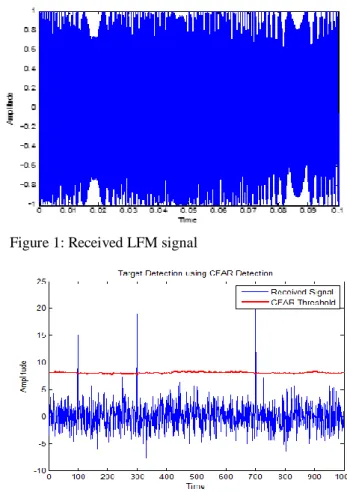
In order to estimate the parameter of an accelerated target, it is considered that the initial speed of the target is 45 m/s, acceleration is 245 m/s2, the radar wavelength λ = 20 mm, duration of received signal is 100ms, the initial frequency is 50Hz and the sampling frequency is 20 KHz. Figure (1) represents the received signal by the radar and the target detection using CFAR detection method is shown in Fig. (2), where three targets are detected whose returned echo is above the threshold level.
Figure 1: Received LFM signal
Figure 2: Target Detection using CFAR
The values of FrFT order (p) using search algorithm for 14 steps are given in Table 1 for noise free chirp signal. The corresponding FrFT peak values are also recorded. Estimated value of p corresponding to maximum FrFT peak is 0.9219. Table1: Iterative computation of p-value in search algorithm for noise free echo of accelerated target.
Step p1 p2 FrFT peak value popt 1 0.2500 0.7500 1.7324 0.2500 2 -0.1250 0.6250 1.4781 0.6250 3 0.4375 0.8125 1.4136 0.8125 4 0.7188 0.9063 3.6599 0.9063 5 0.8594 0.9531 2.6829 0.9531 6 0.9297 0.9766 5.3955 0.9297 7 0.9180 0.9414 7.2913 0.9180 8 0.9121 0.9239 10.9999 0.9239
9 0.9209 0.9269 11.2171 0.9209 10 0.9194 0.9224 14.2342 0.9224 11 0.9217 0.9231 14.9631 0.9217 12 0.9213 0.9221 14.9108 0.9221 13 0.9219 0.9223 15.1024 0.9219 14 0.9218 0.9220 15.0762 0.9218
The value of acceleration is calculated by putting the value of𝑝𝑜𝑝𝑡 in (9). The estimated value of acceleration is
246.597m/s2. The error is found to be 1.597m/s2.
Figure 3:FrFT of the accelerated target echo at optimum order.
Figure 4: FrFT output of received echo at different values of SNR
To verify the performance of optimum order estimation algorithm in the noisy environment, an optimum order is estimated at the different value of SNR. The estimated optimum order 𝑝𝑜𝑝𝑡and acceleration of the target is given in
table 2, and FrFT output corresponding to estimated order is shown in Figure 4.
Table 2: Optimum order and acceleration estimation for different values of SNR SNR (dB) popt Acceleration(m/s2) -8 0.9220 246.2778 -4 0.9216 247.5535 -2 0.9220 246.2778 2 0.9217 247.2346 8 0.9220 246.2778
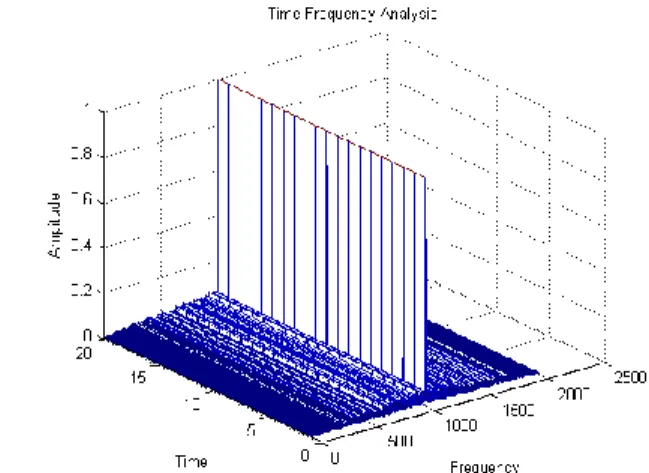
Time-Frequency analysis can be analyzed by the help of ambiguity functionimplementation between time, frequency and amplitude. Figure (5) and Figure (6) shows the plot of ambiguity function of the fractional Fourier Transform both in absence and presence of noise.
Figure 5: Time-Frequency analysis in absence of noise
Figure 5: Time-Frequency analysis in presence of noise VI. CONCLUSION
In this paper, the echo of the radially accelerated target is analyzed. To estimate the parameters of radial accelerated target, the algorithm is proposed. It isanalyzed that the FrFT is good enough to estimate the parameters even at low SNR. Simulation results proved that this method will be able to improve the operational speed, control operational precision and give better anti-noise interference capability than other scheme. The results also show that side bands of time-frequency plot increase as noise increases.
REFERENCES
[1]W. Du and G. Wang, ―Research of Calculation of Radial Acceleration of Maneuvering Target within One Pulse 0 500 1000 1500 2000 2500 0 2 4 6 8 10 12 14 16 FrFT bins A m p lit u d e Optimum p = 0.9219 0 1000 2000 3000 0 10 20 FrFT bins A m p li tu d e 0 1000 2000 3000 0 10 20 FrFT bins A m p li tu d e 0 1000 2000 3000 0 10 20 FrFT bins A m p li tu d e 0 1000 2000 3000 0 10 20 FrFT bins A m p li tu d e 0 1000 2000 3000 0 10 20 FrFT bins A m p li tu d e 0 1000 2000 3000 0 10 20 FrFT bins A m p li tu d e SNR = -8dB SNR = -4dB NO NOISE SNR = -2dB SNR = 2dB SNR = 8dB
Echo,‖ Proceedings of 2006 CIE International conference on radar, Shanghai, pp. 1589-1601, October 2006.
[2] Q. Lin and T. Ran, ―Detection and Parameter Estimation of Multi-component LFM Signal Based on the Fractional Fourier Transform,‖ Science in China Series Information Science, vol. 47, no. 2, pp. 184-198, 2003
[3]R. Melino and H.T. Tran,‖ Application of the Fractional Fourier Transform in the Detection of Accelerating Targets in Clutter‖, DSTO-RR-0365.
[4] V. Ashok Narayanan, K.M.M. Prabhu, ―The fractional Fourier transform: theory, implementation and error
analysis‖, Microprocessors and Microsystems 27 (2003), pp. 511–521
[5] I. Samil and A. Nehrai,‖ Beamforming using Fractional Fourier Transform,‖ IEEE Transactions on Signal
Processing, vol.51, no.6, pp. 1663-1668, 2003.
[6]W. Rieck, ―Time-Frequency Distribution of Multichannel SAR-Data for Autofocusing of Moving Targets,‖ In Radar Conference Publication, no. 449, pp. 224–228, 1997. [7] C. Capus and K. Brown,―Short-Time Fractional Fourier Methods for Time-Frequency Representation of Chirp Signals,‖ Journal of Acoustical Science of America, vol.113, no.6, pp. 234-240, 2003.