D I S C U S S I O N
Open Access
Proposal for a harmonised PBT identification
across different regulatory frameworks
Caren Rauert
1*, Anton Friesen
2, Georgia Hermann
3, Ulrich Jöhncke
4, Anja Kehrer
2, Michael Neumann
4, Ines Prutz
5,
Jens Schönfeld
5, Astrid Wiemann
5, Karen Willhaus
2, Janina Wöltjen
3and Sabine Duquesne
3Abstract
European regulatory frameworks for chemicals (i.e. registered under REACH, plant protection products (PPPs), biocides, human and veterinary medicinal products) require that substances undergo an assessment to identify whether they are persistent (P), bioaccumulative (B) and toxic (T), or very persistent (vP) and very bioaccumulative (vB), i.e. to identify them as PBT substances or vPvB substances according to their properties. We screened current practices, evaluated possibilities and made a proposal for a harmonised assessment. Our proposal assumes that it should be possible to identify PBT and vPvB substances on the basis of the data available according to the requirements of the respective legal frameworks. For substances registered as PPPs and mostly also biocides and medicinal products, a‘definitive assessment’is often possible. Within REACH, the registrant has to provide all information necessary for PBT assessment regardless of the yearly tonnage of chemicals. But in cases of limited data availability, we suggest using a weight of evidence approach to account for such differences in data availability and type of data across different frameworks and to make use of valuable additional information. We propose to base the evaluation of persistence on degradation half-lives and to normalise a number of parameters (e.g. type of kinetics used, temperature). But further work is needed, e.g. for deriving DegT50for water and sediment compartments. For the
B-criterion, information other than BCF in fish could be considered and more information related to bioaccumulation processes should be gathered (e.g. in species other than fish, different uptake routes). Testing for T identification is focused on standard aquatic species but could also be complemented by e.g. information from other species. Information such as those read-across from structurally related substances and QSAR are often of importance for screening assessments. The aim of PBT and vPvB identification is to reliably target the problematic substances, with as few false negatives or positives as possible, regardless of the regulatory framework. Each aspect was thus considered in the context of the others for a final balanced decision. As the need for conservatism is interpreted differently under the various frameworks, harmonizing this identification is a challenging task.
Keywords:PBT identification; Persistence; Bioaccumulation; Toxicity; REACH; Plant protection products; Biocides; Human medicinal products; Veterinary medicinal products; Harmonisation; Regulatory framework
Background
The different European substance regulations (e.g. REACH [1], plant protection products regulation [2], biocidal ucts regulation [3], human and veterinary medicinal prod-ucts regulations [4,5]) have all recognised that substances that are either persistent (P), bioaccumulative (B) and toxic (T) (PBT substances) or very persistent (vP) and very bioaccumulative (vB) (vPvB substances) must be
considered as hazardous for the environment due to their potential for eliciting long-term adverse effects. The goal of preventing exposure of humans and the envir-onment to PBT and vPvB substances is thus shared among all EU-based regulatory frameworks. In a comparison be-tween different European and International regulations, Moermond et al. [6] reported that there are differences in how this goal is achieved, not only regarding technical cri-teria but also conceptual cricri-teria (e.g. regulatory conse-quences for PBT and vPvB substances).
In terms of numerical criteria, the identification of PBT and vPvB substances is based on substance properties
* Correspondence:[email protected] 1
Section International Chemicals Management, Federal Environment Agency (UBA), Wörlitzer Platz 1, 06844 Dessau-Roßlau, Germany
Full list of author information is available at the end of the article
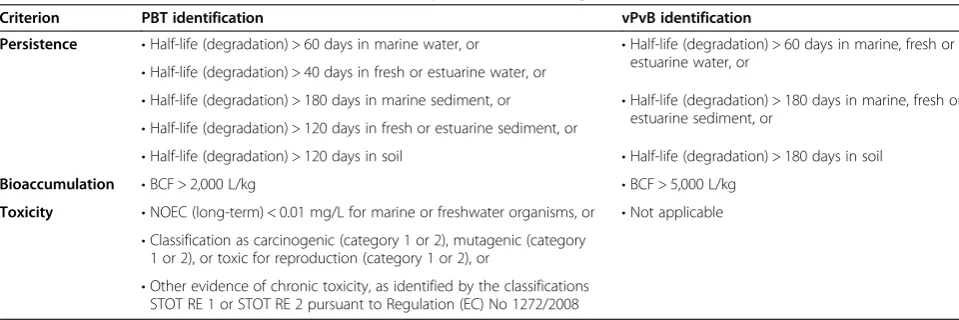
which are addressed by the same trigger values in all European substance regulations (see Table 1).
Therefore, it could be assumed that the identification of a PBT or vPvB substance should be independent of both the use of the substance and the regulatory frame-work under which it is assessed. However, the decision on whether a substance fulfils the PBT or vPvB criteria not only depends on substance properties, but also on the framework under which the substance is evaluated. For substances whose properties are near the trigger values, this decision may differ due to differences between the different legal frameworks in
(i) The assessment procedures,
(ii) The interpretation of PBT/vPvB criteria, (iii) Available data within the assessment process
(see next subsection), and (iv) The regulatory consequences
Although based on the same principle (i.e. avoiding emissions of potentially harmful substances to the envir-onment), the mandatory measures imposed by regulation for a substance identified as a PBT or vPvB vary between the different regulatory frameworks:
– For substances registered under REACH, the revised Annex XIII [7] not only gives the criteria but also the information relevant for the screening and assessment of P, vP, B, vB and T properties. Also, ECHA provides extensive guidance on PBT/vPvB assessment [8,9]. Substances of very high concern (SVHC) (e.g. PBT/vPvB) are included in the
‘candidate list’for authorisation, based on the outcome of the scientific assessment of intrinsic properties. Substances on the‘candidate list’can then be prioritised for authorisation and finally listed in Annex XIV of the REACH regulation. Some substances may be listed with specific exemptions that do not require authorisation. For each
substance included in Annex XIV, a deadline will be set after which use of that substance in the EU must stop (known as the‘sunset date’), unless authorized by the European Commission.
– The EU Biocidal Products Regulation [3] refers to Annex XIII of REACH [7] and to the ECHA guidance for PBT/vPvB assessment [8,9]. However, for biocides, generally no authorisation will be granted for products containing substances identified as PBT or vPvB. Additionally, biocides that fulfil two of the three criteria are flagged as candidates for substitution and are subjected to a comparative assessment.
– For the assessment of veterinary medicinal products, guidance has been developed by the European Medicines Agency [10], which also refers to ECHA guidance [8,9]. A benefit-risk analysis is conducted in support of the decision on whether to authorise the substance or not [5]. In this context, an identification as a PBT substance is generally regarded as a serious concern.
– For medicinal products for human use (which are usually emittedviasewage treatment plants), no restrictions are envisaged as human health is prioritised over environmental issues [4]. ECHA guidance [8,9] is used for the assessment.
– By contrast, the PPP Regulation [2] simply stipulates the PBT/vPvB criteria, oblivious to any other guidance. As for biocides, no authorisation will be granted for those substances identified as PBT or vPvB. Additionally, PPPs that fulfil two of the three criteria are flagged as candidates for substitution and are subjected to a comparative assessment, as is the case for biocides. The draft guidance developed by DG Sanco [11] focuses primarily on the
identification of candidates for substitution.
Although the substances differ in their properties, uses, exposure pathways and regulatory consequences,
Table 1 PBT and vPvB criteria across the various European substance regulations
Criterion PBT identification vPvB identification
Persistence •Half-life (degradation) > 60 days in marine water, or •Half-life (degradation) > 60 days in marine, fresh or estuarine water, or
•Half-life (degradation) > 40 days in fresh or estuarine water, or
•Half-life (degradation) > 180 days in marine sediment, or •Half-life (degradation) > 180 days in marine, fresh or estuarine sediment, or
•Half-life (degradation) > 120 days in fresh or estuarine sediment, or
•Half-life (degradation) > 120 days in soil •Half-life (degradation) > 180 days in soil
Bioaccumulation •BCF > 2,000 L/kg •BCF > 5,000 L/kg
Toxicity •NOEC (long-term) < 0.01 mg/L for marine or freshwater organisms, or •Not applicable
•Classification as carcinogenic (category 1 or 2), mutagenic (category 1 or 2), or toxic for reproduction (category 1 or 2), or
the outcome of a PBT/vPvB assessment should not de-pend on the framework under which they are evaluated, since the protection goals do not differ. This will avoid situations where a substance with different uses is iden-tified as a PBT substance under one regulation, and not under another. This is relevant because, for example, many biocides are also used as PPPs or veterinary medi-cinal products. Since regulatory authorities should aim at making predictable and consistent decisions, a strat-egy for harmonised PBT identification across the differ-ent frameworks is needed. The focus of this paper is on the assessment procedure; it proposes a reasonable in-terpretation of the available data while considering not only substance properties but also keeping in mind the regulatory consequences.
Dealing with differences in data requirements and data availability between regulatory frameworks
For substances registered as plant protection products (PPPs), as well as most biocides and medicinal products, requirements for environmental risk assessment usually include sufficient information for PBT/vPvB identifica-tion. Therefore, a‘definitive assessment’based on a dir-ect comparison to the trigger values (see Table 1) of the three criteria should be possible in most cases.
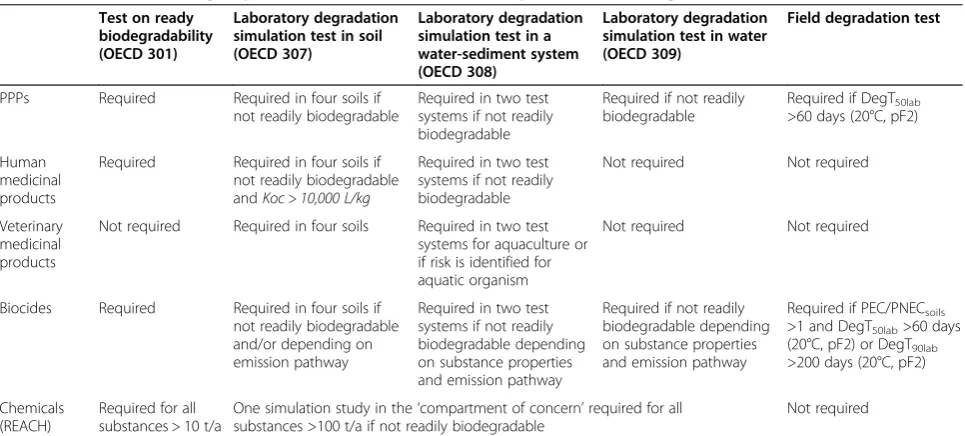
For chemicals registered under REACH, data require-ments depend on the quantities which are manufactured or imported per year; for high production volume (HPV) chemicals, more data has to be provided, and for sub-stances below 10 t/a, only a basic data set is mandatory. Table 2 provides an overview of test requirements for persistence. The registrant also has to provide all infor-mation needed for PBT/vPvB assessment regardless of
the tonnage manufactured or imported annually. How-ever, the necessary information is not always included in the dossiers so a direct comparison of measured data with the criteria is not always possible. Unfortunately, in many cases, registrants submitted dossiers which show deficien-cies and do not comply with the requirements of REACH or the Technical Guidance Document, e.g. necessary tests are missing [12,13]. In such cases, only a‘screening assess-ment’can be performed. In such an assessment screening information such as that listed in Annex XIII of REACH [7] should be considered; this should be supplemented by data from non-standardised tests and from the literature, by information on relevant endpoints based on quantita-tive structure-activity relationships (QSARs) if adequately documented as well as by read-across from structurally re-lated substances or grouping approaches. Only if the avail-able information is considered unreliavail-able or insufficient and/or does not permit a conclusion on each criterion to be drawn with sufficient confidence, additional testing will be necessary.
Because of the large differences in data requirements across the different frameworks and type of data (e.g. QSARs, non-standardised tests), we recommend consider-ing all available information in a weight of evidence (WoE) approach - as suggested in REACH (Annex XI 1.2 of [1]). The WoE approach means that all available information is assessed through expert judgement for its suitability and reliability, and relative weights are assigned (e.g. quality of the data, consistency of results and/or data, nature and severity of effects, relevance of the informa-tion for the given regulatory endpoint). The use of this WoE approach depends on the amount of information needed, the importance of the decision to be taken, and
Table 2 Persistence testing requirements under the various European substance regulations
Test on ready biodegradability (OECD 301)
Laboratory degradation simulation test in soil (OECD 307)
Laboratory degradation simulation test in a water-sediment system (OECD 308)
Laboratory degradation simulation test in water (OECD 309)
Field degradation test
PPPs Required Required in four soils if not readily biodegradable
Required in two test systems if not readily biodegradable
Required if not readily biodegradable
Required if DegT50lab >60 days (20°C, pF2)
Human medicinal products
Required Required in four soils if not readily biodegradable andKoc > 10,000 L/kg
Required in two test systems if not readily biodegradable
Not required Not required
Veterinary medicinal products
Not required Required in four soils Required in two test systems for aquaculture or if risk is identified for aquatic organism
Not required Not required
Biocides Required Required in four soils if not readily biodegradable and/or depending on emission pathway
Required in two test systems if not readily biodegradable depending on substance properties and emission pathway
Required if not readily biodegradable depending on substance properties and emission pathway
Required if PEC/PNECsoils >1 and DegT50lab>60 days (20°C, pF2) or DegT90lab >200 days (20°C, pF2)
Chemicals (REACH)
Required for all substances > 10 t/a
One simulation study in the‘compartment of concern’required for all substances >100 t/a if not readily biodegradable
the likelihood and consequences of taking a wrong deci-sion [14]. The WoE approach also has the advantage, such that it uses valuable additional information whose submission is not mandatory (e.g. field data, alternative testing strategies). This approach is proposed in REACH, and we suggest that it should also be used to improve PBT assessment under the other frameworks in cases where it could deliver valuable additional information.
Discussion
Persistence, bioaccumulation and toxicity criteria
In this chapter, we introduce the three criteria, i.e. per-sistence (P), bioaccumulation (B) and toxicity (T). The general scheme is to test sequentially for P, then B and lastly for T, as only substances with high persistence must be considered further for PBT identification. This se-quence is further justified by the need to limit testing for animal welfare reasons.
A substance is considered a PBT or vPvB substance if it fulfills the P, B and T or the vP and vB criteria. In the following sections, for each PBT criterion, the criteria for the‘definitive assessment’are presented first. This is followed by the criteria for the ‘screening assessment’, which is carried out in cases of limited data availability.
Persistence
The persistence of a substance in soil, water or sediment is controlled by its intrinsic properties and also influ-enced by environmental conditions (e.g. temperature, presence of degraders, pH, moisture content in case of soil, bioavailability of the substance). The assessment of persistence is influenced by the type and quality of able studies and also by the interpretation of the avail-able data.
Persistence is not characterised consistently in the dif-ferent frameworks, but, as suggested by Boethling et al. [15] and in [9], it is the degradation half-life (DegT50)
which should be compared to the trigger values in the various compartments, as a mere transfer (dissipation) from one compartment to the other does not affect the persistence of a substance. DegT50 values are commonly
estimated from the parent substance in extractable resi-dues in degradation simulation studies performed accord-ing to e.g. OECD test guidelines 307, 308 or 309 [16-18].
In the context of PBT identification, DT50 should not
refer to dissipation half-lives (DissT50) as these refer to
cases where the substance may not be degraded but only redistributed (e.g. from the water phase to sediment or the atmosphere, or leaching, run-off, volatilisation or up-take into plants). This is explicitly mentioned in the re-vised Annex XIII of the REACH regulation [7], while the PPP Regulation [2] only refers to half-lives in general.
Definitive assessment. If degradation simulation tests have been conducted to meet legal requirements, a suffi-cient amount of reliable data is usually available to complete a definitive assessment by comparing the DegT50
values directly to the criteria as reported in Table 1. How-ever, a number of issues related to these values should be addressed.
Type of kinetics for deriving DegT50. We suggest
using single first-order (SFO) kinetics to derive DegT50
values for the purpose of comparing them to the trigger values. Best fit kinetics such as first-order multi-compartment (FOMC) can be used if they are recalcu-lated by dividing the DegT90values by a factor of 3.32 or
by using the degradation rate constant of the slower phase in case of double first-order in parallel model (DFOP) or Hockey stick (HS) kinetics. This proposal is based on the Guidance Document on Estimating Persist-ence and Degradation Kinetics from Environmental Fate Studies on Pesticides in EU Registration [19]. This docu-ment gives detailed guidance on the derivation of DegT50
values, which is used for risk assessment of biocides, medi-cinal products and PPPs and could be applied to other sub-stance groups as well.
Normalisation of the DegT50 to specific conditions. Variable conditions such as temperature, humidity, mi-crobial populations and others have a large influence on the rate of degradation of a chemical substance. Simula-tion studies in the laboratory are conducted at various temperatures: OECD test guidelines 307 and 308 on transformation in soil and in water-sediment systems [16,17] recommend testing at 20°C and 10°C (if the sub-stance is used in colder climates), the US EPA recom-mends 22°C for soil testing [20] and for many pesticides, tests have been performed both at 20°C and 10°C. For the purpose of comparing different data, half-lives should thus be normalised to a defined temperature since it is a criterion which strongly influences the outcome of a deg-radation test and, furthermore, is quantifiable unlike other related criteria such as differences in microorganism pop-ulations. For PBT identification, normalisation of DegT50
values to a temperature of 12°C has been applied to many biocides and other chemicals, as prescribed in the TGD [21], and is included as an option in the REACH guidance on information requirements and chemical safety as-sessment (Chapter R.7b [8]). This temperature of 12°C is also included in the draft ‘Guidance on the assess-ment of persistent, bioaccumulative and toxic (PBT) or very persistent and very bioaccumulative (vPvB) sub-stances in veterinary medicine’[22]. By contrast, DegT50
a consistent approach between frameworks, we propose normalising the DegT50 values to 12°C because this
temperature is established or suggested under the majority of frameworks (i.e. Biocides Regulation, REACH and me-dicinal products Directives).
Degradation in soil: inclusion of field studies. Labora-tory simulation studies can provide information on both route and rate of degradation. This permits the estima-tion of primary degradaestima-tion rates (DegT50), as well as
the measurement of carbon dioxide evolution and of for-mation of metabolites and bound residues. But the small size of the test systems is a limiting factor for both the test duration and the diversity of the microbial population (which may limit the probability of having competent de-graders and which usually also decreases over time).
For PPPs, terrestrial field (dissipation) studies under realistic outdoor conditions are required when the DegT50
exceeds 60 days at 20°C in laboratory studies [2]. Such field studies allow DT50values to be derived under
condi-tions going beyond the limitacondi-tions of laboratory tests. A number of conditions may be more realistic compared to laboratory studies (e.g., prolonged duration, fluctuating temperature and humidity, higher biological activity, lar-ger test system), but may not be as easy to compare or reproduce. A limiting aspect in such testing is that a dissi-pation half-life, and not a degradation half-life, will be derived. The measured residues result from biotic degrad-ation but also from photolytic transformdegrad-ation and field dissipation processes like volatilisation, leaching and run-off. However, a novel approach to estimate a DegT50 in
field studies has recently been proposed by EFSA [23] in which dissipation processes on the soil surface are esti-mated separately from biodegradation in the soil compart-ment. This DegT50has to be normalised for temperature
and humidity for comparability reasons. Although this guidance was developed for the evaluation of persistence of PPPs in field studies, in principle, its rationale and approach should also be applicable to other types of sub-stances. Thus, we suggest including field studies in persist-ence assessment as additional data, provided that it is possible to derive DegT50 values. This is in line with the
WoE approach, which considers all available information in the decision process.
Evaluation of DegT50values for the water and sediment
compartments. There is no standardised test that mea-sures true degradation only in the sediment compart-ment. The test on‘aerobic and anaerobic transformation in aquatic sediment systems’ (OECD test guideline 308 [17]) is generally used to assess the fate of compounds in water and sediment systems, but reliable separate DegT50values for water and for sediment cannot usually
be derived from the study results. Therefore, separate
DegT50values are generally not available for comparison
with the trigger values.
Available DT50 values for the water phase in many
cases only refer to dissipation, as many substances, espe-cially those with high log KOC and low water solubility,
are quickly transferred to the sediment. The Aerobic Mineralisation in Surface Water – Simulation Biodeg-radation Test (OECD 309 [18]) is available to measure degradation in the water phase, but to date it has rarely been used for the assessment of environmental fate.
We suggest comparing the DegT50 of the total system
to the two trigger values for water and sediment. More specifically, in the case of a substance that is rapidly transferred into the sediment, the DegT50 of the total
system should be compared with the trigger value for sediment (120 and 180 days for persistence assessment). For substances that mostly remain in the water phase, the DegT50 values should be compared with the trigger
values for water (40 and 60 days for persistence assess-ment). There will be many cases where a substance can be found in both the water and sediment phases, which means that clear criteria are necessary to judge which of the trigger values is appropriate.
Selection of an adequate DegT50from multiple studies. As explained above, testing requirements for persistence differ greatly between regulatory frameworks. The infor-mation is summarized in Table 2.
If several valid degradation studies for one compartment are available, their quality and reliability are an important consideration. We propose the following approach to pro-cessing the information gathered:
– When a small number of studies is available (i.e. up to 4 DegT50values), we suggest selecting the
worst-case DegT50rather than performing a weak
statistical evaluation.
– When more studies are available (i.e. 5 and more DegT50values), various approaches are possible:
The most conservative approach would be to use the worst-case DegT50;
A less conservative approach is the geometric mean, which gives a medium degradation rate, but does not provide information on the range of variability of the values and may produce some false negatives, i.e. fail to recognise some persistent substances;
An intermediate approach is the 90th percentile which may produce some false positives.
– In cases where the studies are not equally reliable, the range and distribution of all available DegT50
select an acceptable value (or range of values) to represent the persistence of the substance.
If five or more DegT50values are available, we suggest
selecting the geometric mean. This is to be considered together with the decision to normalise the DegT50
values to a temperature of 12°C, in order to achieve an overall reasonable conservatism (i.e. target the problem-atic substances).
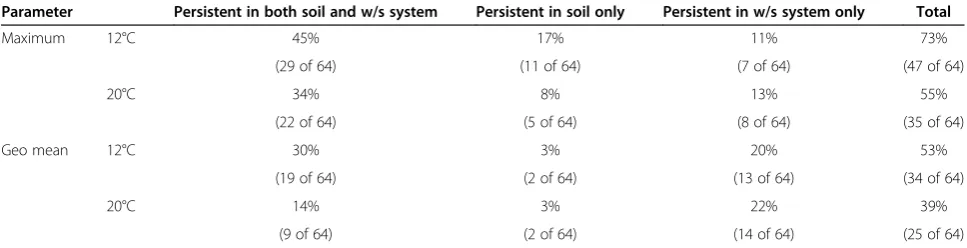
This choice is illustrated by the evaluation of a number of substances (64) with 5 and more soil laboratory DegT50
values available, whose the degradation data have been re-cently assessed as part of the regular national PPP regis-tration process in Germany. This exercise indicates how many substances would be identified as P, on the basis of the above evaluation parameters.
– For degradation in soil, only data from laboratory studies was used. Field studies were excluded since no evaluations according to the new EFSA scientific opinion [23] were available yet.
– For water-sediment studies, the total system DegT50
was used and compared to the sediment value of 120 days.
– Temperature was normalised both to 12°C and 20°C;
– The maximum DegT50value (worst-case scenario)
and the geometric mean of all DegT50were used.
The results indicate that the percentage of substances fulfilling the P criterion varies from about 39% for the least conservative approach (20°C and geometric mean) to 73% for the most conservative approach (12°C and maximum DegT50) and is intermediate (i.e. about 53%) when the
geo-metric mean and a temperature of 12°C are used (Table 3).
Screening assessment
For many chemicals, especially those registered under REACH, only a limited data set is available, as explained in Chapter 2. In this case, the assessment of persistence has to be based on screening data. If no further data are presented, the result of the screening assessment (i.e.
screening P) should be used for further regulatory action unless refuted by more definitive data such as valid simulation test data.
In the screening approach, the evaluation of persist-ence is mainly based on tests on ready biodegradability (OECD 301 A-F [24] and OECD 310 [25]).
Substances which are readily degradable are consid-ered not to be persistent (not P) [26], as the test is fairly stringent. Due to the high rate of mineralisation, an accu-mulation or formation of relevant metabolites is improb-able. On the other hand, substances that are not readily biodegradable are considered to be potentially persistent (potentially P, sometimes also called ‘screening P’), until further data are presented. Due to the stringency of the test, this results in a high number of false positives; thus,
‘enhanced ready biodegradability’ tests (based on ready biodegradability tests but with prolonged test duration, higher concentration of microbial biomass, increased test volumes, but no pre-adaptation) may be used for chemi-cals registered under REACH to prove their degradability without having to conduct more expensive and time-consuming simulation studies.
Other available data on persistence also have to be ex-amined. This may include data on abiotic degradation, monitoring data, QSAR estimations and read across from structurally related substances.
Main outcomes and open points
Our proposal is to base P identification on degradation, and not on dissipation, as recommended previously [6,17]. Thus, trigger values should be compared to DegT50values.
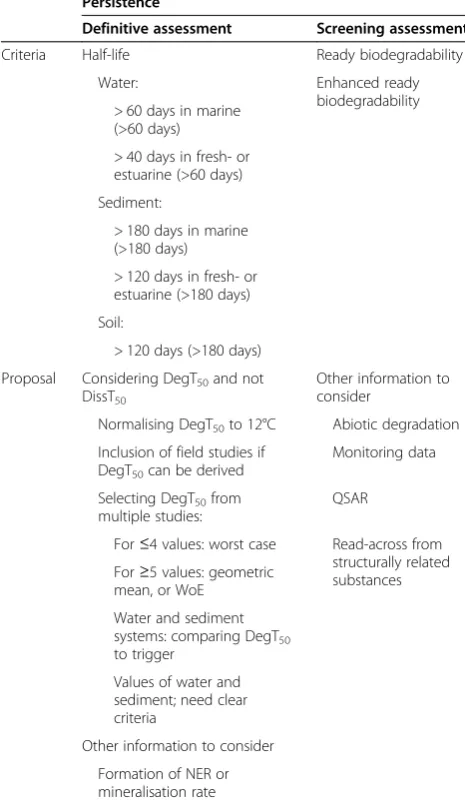
The final identification of substances as persistent should be based on a reasonable conservatism for the various regulatory frameworks and not on a combination of vari-ous worst-case choices. Our proposal is summarised in Table 4.
It should be noted that in the P assessment, other in-formation generated in degradation simulation studies such as the formation of non-extractable residues (NER) or the mineralisation rate are not formally considered. Such information can only be taken into account in a
Table 3 Estimation of percentages of substances fulfilling P criterion
Parameter Persistent in both soil and w/s system Persistent in soil only Persistent in w/s system only Total
Maximum 12°C 45% 17% 11% 73%
(29 of 64) (11 of 64) (7 of 64) (47 of 64)
20°C 34% 8% 13% 55%
(22 of 64) (5 of 64) (8 of 64) (35 of 64)
Geo mean 12°C 30% 3% 20% 53%
(19 of 64) (2 of 64) (13 of 64) (34 of 64)
20°C 14% 3% 22% 39%
(9 of 64) (2 of 64) (14 of 64) (25 of 64)
WoE approach but should not be ignored. Where NER are the result of degradation and incorporation into the microbial biomass, their formation can be considered as a detoxification step. On the other hand, where the original substance may be remobilised, NER formation should be interpreted as a specific form of compound persistency. The issue of NER is currently being examined in various contexts [27-29].
Bioaccumulation
Substances with a high potential for bioaccumulation are of special concern even if introduced into the environ-ment in low concentrations. They are taken up by biota and their concentrations in the tissues result from the combination of uptake and depuration. Uptake occurs
eitherviathe surrounding medium - water or soil - (bio-concentration), food (dietary bioaccumulation) or the food chain (biomagnification). These processes are driven by the properties of the substance (mostly hydrophobicity as determined by octanol/water or octanol/air partition coef-ficient, i.e.KOWorKoa, as well as other characteristics, e.g.
protein-binding properties) but they also depend on the environmental matrices (i.e. aquatic, terrestrial) and on the biological, ecological and trophic characteristics of the organisms.
The bioconcentration factor (BCF) is the usual basis for defining the B criterion in PBT assessment although it is not always the most relevant indicator of the envir-onmental bioaccumulation potential of a substance, as stated in [30]. Indeed other available data (e.g. monitoring data, biomagnification, bioaccumulation in other species, literature data) should also be taken into account [30-32]. We propose therefore that all available relevant informa-tion on bioaccumulainforma-tion should be considered in a WoE approach.
Definitive assessment. The definitive assessment of the bioaccumulation potential is based on the bioconcentra-tion factor (BCF) in an aquatic species. The trigger value for the BCF is set at >2,000 L/kg for B assessment and at >5,000 L/kg for vB assessment.
Bioconcentration. The bioconcentration factor (BCF) is defined as the ratio of concentration in fish to the con-centration in the surrounding medium. It is generally derived experimentally according to OECD Test Guide-line 305 I (bioconcentration flow-through fish test [33]). This test is appropriate for substances with moderate hydrophobicity, so it is necessary to determine the con-centration of the test substance in the exposure medium and in fish. The test is mandatory for risk assessment for PPPs, biocides and human medicinal products if logKOW
exceeds 3, and for veterinary pharmaceuticals if log KOW
exceeds 4. It is also required for REACH substances with a production volume above 100 t/a and a logKOW>3.
The BCF should be normalised to a lipid content of 5% of total body weight (average lipid content of fish commonly used in [33,34]). Potential growth dilution should also be taken into account [26,33], as well as in-dications of slow or poor depuration.
Bioaccumulation and biomagnification.
Bioaccumula-tion and biomagnificaBioaccumula-tion should also be taken into ac-count for species such as fish since the relevant route of exposure may be the food, especially for substances with high log KOWand for substances poorly soluble or
non-soluble in water. Indeed for such substances, it may be technically difficult or not feasible (i) to conduct a bio-concentration fish test since aqueous exposure via gill Table 4 Main elements of our proposal for a harmonized
assessment of persistence across regulatory frameworks
Persistence
Definitive assessment Screening assessment
Criteria Half-life Ready biodegradability
Water: Enhanced ready
biodegradability > 60 days in marine
(>60 days)
> 40 days in fresh- or estuarine (>60 days)
Sediment:
> 180 days in marine (>180 days)
> 120 days in fresh- or estuarine (>180 days)
Soil:
> 120 days (>180 days)
Proposal Considering DegT50and not DissT50
Other information to consider
Normalising DegT50to 12°C Abiotic degradation
Inclusion of field studies if DegT50can be derived
Monitoring data
Selecting DegT50from multiple studies:
QSAR
For≤4 values: worst case Read-across from structurally related substances For≥5 values: geometric
mean, or WoE
Water and sediment systems: comparing DegT50 to trigger
Values of water and sediment; need clear criteria
Other information to consider
Formation of NER or mineralisation rate
uptake is reduced and no longer accounts for the dom-inant exposure pathway, and/or (ii) to analyse the con-centration in water. Instead, a dietary fish test has been developed to determine uptake by ingestion, yielding a biomagnification factor (BMF) [33].
A BMF >1 is a supportive indication of high bioaccumu-lation and the B criterion is thus considered as fulfilled. Nevertheless, a definitive trigger value for BMF has not yet been established. Hence, a bioaccumulation potential cannot be excluded in cases of BMF < 1. Recalculation of the dietary study data into aquatic BCF values has been suggested [26] but these methods have to be checked carefully for their domain of applicability [35].
Supplementary information. Other reliable data should also be considered, when available:
– High bioaccumulation in organisms other than fish, as mentioned in the Stockholm Convention [36] and the revised Annex XIII criteria in REACH [7]; e.g. bioaccumulation in mussels [37] or oligochaetes [38]. In some cases, lipid normalisation
concentrations should be revised since a
normalisation to a lipid content of 5% of the body weight - as proposed for fish (see above) - may not be suitable for species with low lipid content (e.g. mussels);
– Indicators other than BCF calculated from
environmental data (i.e. measured in mesocosms or in the field), assessing the accumulation of
substances from water and diet such as the bioaccumulation factor (BAF), their specific accumulation in food webs expressed as biomagnification factor (BMF) or trophic magnification factor (TMF);
– Bioaccumulationviadifferent uptake routes, e.g. terrestric or benthic oligochaetes [38,39]. As bioaccumulation may differ between water- and air-breathing organisms, aquatic bioaccumulation data should not be transfered to air-breathing organisms [31];
– Accumulation in specific tissues, e.g. substances such as PCBs accumulate extensively in fatty tissues and organs from wildlife samples [40]. In some cases, inefficient or nonexistent detoxification processes may be responsible for high BCF values (e.g. TBT in molluscs) [41,42].
– Non-lipid-based accumulation for substances such as perfluorinated acids, which bioaccumulate in blood plasma proteins [43,44]. Perfluorooctane sulfonate (PFOS) can be considered as
bioaccumulative even though the BCF is below the trigger value (<2,000) but it has a long half-life, high toxicity and high biomagnification.
– Toxicokinetic and chronic studies with mammals as well asin vitrodata on aquatic bioaccumulation as required for human toxicological assessment are also available.
Screening assessment.The screening criterion for asses-sing bioaccumulative properties is derived from the hydro-phobicity of the compound. A substance is considered to potentially fulfil the B criterion when logKOWexceeds a
value of 4.5 [21].
Suitable quantitative structure-activity relationship (QSAR) models for estimating the BCF could be used if log KOW is between 4.5 and 6, as the available BCF
QSAR models are linear between logKOW2 to 6 [21,45].
For highly hydrophobic substances (logKOW> 6), the
po-tential for bioaccumulation must be assessed through ex-pert judgement and on a case-by-case basis, taking into account the specific physico-chemical properties of the substance (e.g. molecular size and weight, log KOW) and
the available BCF QSAR models (e.g. parabolic equation in [21,46]).
Since hydrophobicity does not drive all bioaccumula-tion processes, other informabioaccumula-tion has to be considered, e.g. surface activity, structural alerts, high logKOA
(octa-nol/air partition coefficient) as an indicator of a possible bioaccumulation in air-breathing organisms or read-across approaches from structurally related substances.
Main outcomes and open points. Our proposal (see
Table 5) is to consider all available endpoints in addition to the BCF for aquatic organisms in the WoE approach, as there are other standardised tests resulting in the derivation of other BAFs (e.g. benthic oligochaetes [38]; terrestric oligochaetes [39]) and BMFs (fish dietary test guideline [33]). Currently, a comparison between the re-sults of these tests (e.g. BMF, BAF) and a BCF is difficult to make for several reasons such as different uptake mechanisms of different taxa. Also,in vitrotests for bio-accumulation (e.g. [47]) are being developed and using information from field studies and TMF (e.g. [42,48]) is being considered. Taking into account these various as-pects will improve the assessment of bioaccumulation.
Toxicity
Definitive assessmentThe substance fulfils the T criter-ion in any of the following situatcriter-ions:
1. Long-term or chronic NOEC or EC10values from
ecotoxicological tests with aquatic organisms are below the trigger of 0.01 mg/L, or
2. It is classified as carcinogenic, categories 1 and 2 [49] or 1A and 1B [50], mutagenic, categories 1 and 2 [49] or 1A and 1B [50] or toxic for reproduction, categories 1, 2 and 3 [49] or 1A, 1B and 2 [50], so-called CMR substances, or
3. There is other evidence of chronic toxicity, as identified by the classification of the substance as T, R45, R46, R48, R60 and R61 or Xn, R48, R62, R63, R64 [49], or specific target organ toxicity and repeated exposure (STOT RE category 1 or 2) [50].
If any classification criteria under 2 or 3 are met, there is no need to perform any further aquatic studies for evaluation of toxicity.
Supplementary information. When substances such as
PPPs and biocides (i.e. produced to control pests) are tested for toxic effects, it is likely that these will occur both in the target species and in non-target species be-longing to the same taxonomic group. Testing for the T criterion refers only to aquatic organisms. However, ef-fects on non-aquatic species could be relevant as well, bearing in mind, however, that the use of vertebrates for testing should generally be minimised.
In this context, we recommend that other reliable data should also be considered where available:
– For PPPs and biocides, results of subchronic, chronic or reproduction studies with birds and
mammals may be available. In this context, a NOEC of≤30 mg/kg food in a long-term bird study should be considered as an indication that the T criterion is met [21,26].
– It could be relevant to use toxicity data from long-term ecotoxicological tests on terrestrial organisms, e.g. OECD TG 222 [51]. However, in such a case, it has to be clarified whether such an assessment should (i) be based on trigger values comparable to those used in the assessment of toxicity for aquatic organisms (e.g. <0.01 mg/kg dry soil), and (ii) take into account differences in the exposure of the re-spective organisms.
– For substances with high logKow, tests performed
with sediment-dwelling species may provide better information than tests with pelagic species. Indeed, the results may be more reliable if the substance partitions out of solution. Also, the information gathered may be more useful if it is focused on the compartment in which the substance will likely be found. A way to determine whether a substance has equivalent toxicity in sediment as in the water column should be proposed.
Furthermore, information on aquatic toxicity other than that gathered from standard studies and provided for in relevant test guidelines, i.e. information from non-standard studies and non-non-standard endpoints, could be used as supporting data. Also, the endocrine disrupting potential of chemical substances is an issue. It is planned to develop a general concept for EDCs which should be consistent and should ensure that endocrine disruptors are dealt with in a consistent and coordinated manner across the different regulatory frameworks [52]. This issue has been discussed by a panel of experts of the German Table 5 Main elements of our proposal for a harmonized assessment of bioaccumulation across the regulatory
frameworks
Bioaccumulation
Definitive assessment Screening assessment
Criteria BCF > 2,000 L/kg (>5,000 L/kg) LogKOW> 4.5
Proposal BCF (normalised to 5% lipid content) QSAR if logKOWis between 4.5 and 6, logKOW> 6: expert judgement, case- by-case
For high logKOWand poorly soluble or non-soluble: consider BAF, BMF (BMF > 1 indicative)
Other information to consider
Other information to consider Surface-activity
High bioaccumulation in species other than fish Structural alerts
Different uptake routes High logKOAfor air-breathing organisms
Accumulation in specific tissues Read-across from structurally related substances.
Non-lipid based accumulation
Toxicokinetic and chronic studies with mammals
In vitrodata on aquatic bioaccumulation
Federal Environment Agency (UBA) [53]. This could be considered for inclusion of EDC potential in the harmo-nised assessment of the T criterion.
Screening assessment. The screening criteria for asses-sing toxicity are based on short-term (acute) toxicity of the compound on aquatic organisms. They are as follows:
– A substance with at least one acute LC50/EC50value
below 0.1 mg/L is considered to be potentially toxic (potentially T, sometimes called‘screening T’under REACH). This classification can only be revoked by adequate chronic data, i.e. for determination of definitive criteria for T [26];
– A substance with acute LC50/EC50values below 0.01
mg/L is considered to be toxic (T), as NOEC or EC10values from prolonged or chronic toxicity
studies will always be below acute LC50or EC50
values for the same taxon [26].
Other possibilities include the use of QSAR and read-across from structurally related substances, if testing of the substance is technically impossible because of its physico-chemical properties or in cases of data poor situations.
Main outcomes The criteria for the definitive and the screening assessment of the T criterion are to a large ex-tent consisex-tent between the different regulatory frame-works. However, in situations where data availability or adequacy is too poor to support a definitive or a screen-ing assessment, we propose that other indications of tox-icity potential should be taken into account (Table 6). These include, for example, endpoints from toxicity tests with terrestrial organisms, endocrine-disrupting proper-ties, QSAR calculations or harmonised toxicological clas-sifications. Since trigger values have not yet been set for these endpoints, a WoE approach is needed to decide on a case-by-case basis whether a substance fulfils the T cri-terion as part of PBT assessment.
Considering metabolites and transformation products Transformation products can be as or even more per-sistent than their parent compounds and thus must be included in chemical assessment. However, the regula-tory frameworks for substances differ with respect to the inclusion of metabolites or transformation products in PBT identification. For PPPs, the consideration of me-tabolites in the context of PBT identification has been controversially discussed, as PPPs Regulation 1107/2009 [2] does not address this issue precisely and only refers to the relevance of metabolites in a general sense (Art. 3 (32) Annex II point 3.3). However, a current proposal envisages excluding metabolites in the process of PBT identification and in the identification of candidates for
substitution (i.e. substances that meet two of the three criteria) [11]. REACH requires that registration docu-ments for chemicals produced or imported in excess of 100 t/a include information about metabolites and trans-formation products [54]. They are to be considered in PBT identification if they exceed 0.1% of the substance weight [9,26]. For both human and veterinary medicinal products, transformation products >10% are considered to be ‘relevant’and thus included in risk assessment as well as in PBT assessment. In the assessment of biocides, major metabolites (≥10% or ≥5% at two consecutive sampling points or maximum not reached but ≥5% of the active substance at the final time point) are consid-ered in PBT identification and minor metabolites only if data are available or there is any reason for concern. It is questionable whether relevance can be defined in terms of any percentage. Since humans and the environment should be protected from exposure to PBT and vPvB substances, the same criteria should apply to metabolites or transformation products as to the parent compounds. We suggest that in all regulatory frameworks, metabo-lites and transformation products should be included in the assessment.
Conclusions
The various European regulatory frameworks on chemical substances agree that exposure of humans and the envir-onment to substances identified as PBT or vPvB must be avoided. But the decision-making process is not straight-forward and harmonisation between the frameworks is a Table 6 Main elements of our proposal for a harmonized assessment of toxicity across regulatory frameworks
Toxicity
Definitive assessment Screening assessment
Criteria NOEC (long-term) < 0.01 mg/L, marine or freshwater species ≥
1 value for acute LC50/EC50< 0.1 mg/L: potentially toxic
CMR substances Acute LC50/EC50 values < 0.01 mg/L: toxic Other evidence of chronic
toxicity
Proposal Other information to consider Other information to consider
NOEC≤30 mg/kg food, birds and mammals
QSAR
Long-term tests on terrestrial organisms
Read-across from structurally related substances. High logKOW:
sediment-dwelling species tests
Information from non-standard aquatic studies and endpoints
Endocrine-disrupting potential
real challenge. Indeed, despite the same trigger values, the identification of a PBT or vPvB substance will depend on how the criteria are used in the various frameworks to determine.
(i) For persistence, the half-lives in terms of e.g. temperature normalisation, how field studies are considered, appropriate statistics, and others, (ii) For bioaccumulation, e.g. the endpoints - in addition to the BCF for aquatic organisms -considered in a WoE approach, and
(iii) For toxicity, e.g. indications of toxicity potential considered when availability or adequacy of data is too poor to support a definitive or a screening assessment.
Differences in testing requirements, data availability, data evaluation and interpretation were screened and dis-cussed to identify the best methods. The current proposal is thus characterised by its robustness against those differ-ences and by its reasonable conservatism.
For example, the proposal for the Persistence criterion is based on the outcome of an evaluation performed on a set of selected active substances of PPPs. We recom-mend (i) normalising the DegT50values to a temperature
of 12°C as this is established in biocides legislation and suggested in other regulations (REACH and medicinal products directives), and (ii) selecting the geometric mean if five or more DegT50 values are available, or a suitable
value or range of DegT50values in a WoE approach if the
studies are not equally reliable.
Finally, the differing mandatory measures imposed by the various regulations should be considered together with the present proposal on harmonised PBT/vPvB identification in order to ensure that the truly problem-atic substances are identified.
Abbreviations
B:Bioaccumulation; BAF: bioaccumulation factor; BCF: bioconcentration factor; BMF: biomagnification factor; CMR: carcinogenic, mutagenic and toxic for reproduction; DegT50: degradation half-life; DissT50: dissipation half-life; EC10: effect concentration, 10%; EC50: effect concentration, 50%;
EDCs: endocrine-disrupting chemicals; EFSA: European Food Safety Agency; EU: European Union; FOMC: first-order multi-compartment;KOW: octanol/ water partition coefficient;Koa: octanol/air partition coefficient; LC50: lethal concentration, 50%; NER: non-extractable residues; NOEC: no observed effect concentration; OECD: Organisation for Economic Cooperation and Development; P: persistence; PBT: persistent, bioaccumulative and toxic; PCBs: polychlorinated biphenyls; PFOS: perfluorooctane sulfonate; PPPs: plant protection products; QSAR: quantitative structure-activity relationships; REACH: Registration, Evaluation, Authorisation and Restriction of Chemicals; SETAC: Society for Environmental Toxicology and Chemistry; SFO: single first order; STOT RE: specific target organ toxicity - repeated exposure; SVHC: substances of very high concern; T: toxicity; t/a: tons per year; TBT: tributyltin hydride; TG: test guideline; TGD: Technical Guidance Document; TMF: trophic magnification factor; UBA: Umweltbundesamt (German Federal Environment Agency); US EPA: United States Environmental Protection Agency; vPvB: very persistent and very bioaccumulative; WoE: weight of evidence.
Competing interests
The authors declare that they have no competing interests.
Authors' contributions
CR, AF, GH, UJ, AK, MN, IP, JS, AW, KW, JW and SD contributed to the collection of assessment procedures in PBT assessment for the respective frameworks, and drafted the first manuscript. SD and CR edited the manuscript to include all comments and finalised the manuscript. All authors read and approved the final manuscript.
Acknowledgements
We thank our colleagues from the Federal Environment Agency (Umweltbundesamt, UBA, Germany) and other authorities as well as colleagues from academia and industries for fruitful discussions.
Author details
1Section International Chemicals Management, Federal Environment Agency
(UBA), Wörlitzer Platz 1, 06844 Dessau-Roßlau, Germany.2Section Biocides, Federal Environment Agency (UBA), Wörlitzer Platz 1, 06844 Dessau-Roßlau, Germany.3Section Plant Protection Products, Federal Environment Agency (UBA), Wörlitzer Platz 1, 06844 Dessau-Roßlau, Germany.4Section Chemicals, Federal Environment Agency (UBA), Wörlitzer Platz 1, 06844 Dessau-Roßlau, Germany.5Section Pharmaceuticals, Washing and Cleaning Agents, Federal Environment Agency (UBA), Wörlitzer Platz 1, 06844 Dessau-Roßlau, Germany.
Received: 21 November 2013 Accepted: 22 April 2014 Published: 12 May 2014
References
1. EC:Regulation (EC) No 1907/2006 of the European Parliament and of the Council of 18 December 2006 concerning the Registration, Evaluation, Authorisation and Restriction of Chemicals (REACH), establishing a European Chemicals Agency, amending Directive 1999/45/EC and repealing Council Regulation (EEC) No 793/93 and Commission Regulation (EC) No 1488/94 as well as Council Directive 76/769/EEC and Commission Directives 91/155/EEC, 93/67/EEC, 93/105/EC and 2000/21/EC; 2006. http://eur-lex.europa.eu/legal-content/EN/TXT/PDF/?uri=CELEX:02006R1907-20130701&rid=2 (last accessed 08/04/2014).
2. EC:Regulation (EC) No 1107/2009 of the European Parliament and of the Council of 21 October 2009 concerning the placing of plant protection products on the market and repealing Council Directives 79/117/EEC and 91/ 414/EEC; 2009. http://eur-lex.europa.eu/legal-content/EN/TXT/PDF/? uri=CELEX:32009R1107&rid=2 (last accessed 08/04/2014).
3. EC:Regulation (EU) No 528/2012 of the European Parliament and of the Council of 22 May 2012 concerning the making available on the market and use of biocidal products; 2012. http://eur-lex.europa.eu/legal-content/EN/TXT/ PDF/?uri=CELEX:32012R0528&rid=2 (last accessed 08/04/2014).
4. EC:Directive 2001/83/EC of the European Parliament and of the Council of 6 November 2001 on the Community code relating to medicinal products for human use; 2001. http://eur-lex.europa.eu/legal-content/EN/TXT/PDF/? uri=CELEX:02001L0083-20081230&rid=6 (last accessed 08/04/2014). 5. EC:Directive 2001/82/EC of the European Parliament and of the Council of 6
November 2001 on the Community code relating to veterinary medicinal products; 2001. http://eur-lex.europa.eu/legal-content/EN/TXT/PDF/? uri=CELEX:02001L0082-20090306&rid=3 (last accessed 08/04/2014). 6. Moermond CTA, Janssen MPM, de Knecht JA, Montforts MHMM,
Peijnenburg WJGM, Zweers PGPC, Sijm DTHM:PBT Assessment using the revised Annex XIII of REACH–a comparison with other regulatory frameworks.IEAM2011,8(2):359–371. http://onlinelibrary.wiley.com/doi/ 10.1002/ieam.1248/abstract (last accessed 08/04/2014).
7. EC:Commission regulation (EU) No 253/2011 of 15 March 2011 amending Regulation (EC) No 1907/2006 of the European Parliament and of the Council on the Registration, Evaluation, Authorisation and Restriction of Chemicals (REACH) as regards Annex XIII; 2011. http://eur-lex.europa.eu/legal-content/ EN/TXT/PDF/?uri=CELEX:32011R0253&rid=1 (last accessed 08/04/2014). 8. European Chemicals Agency:Guidance on information requirements and
9. European Chemicals Agency:Guidance on information requirements and chemical safety assessment. Part C: PBT Assessment; 2011. http://echa.europa. eu/documents/10162/13643/information_requirements_part_c_en.pdf. 10. European Medicines Agency:Guidance on the assessment of persistent,
bioaccumulative and toxic (PBT) or very persistent and very bioaccumulative (vPvB) substances in veterinary medicine. European Medicines Agency, Committee for Medicinal Products for Veterinary Use (CVMP), EMA/CVMP/ERA/52740/2012; 2012. http://www.ema.europa.eu/ema/pages/includes/document/
open_document.jsp?webContentId=WC500130368 (last accessed 08/04/2014). 11. Directorate General for Health and Consumer Affairs (DG SANCO):Working
Document on“Evidence needed to identify POP, PBT and vPvB Properties for Pesticides”, Brussels, 25.09.2012–rev. 3, European Commission, Health and Consumers Directorate-General, Safety of the Food chain, Chemicals, contaminants, pesticides.
http://ec.europa.eu/food/plant/pesticides/approval_active_substances/docs/ wd_evidence_needed_to_identify_pop_pbt_vpvb_properties_rev3_en.pdf (last accessed 08/04/2014).
12. Roberts G:'Large part' of registration dossiers a concern, says ECHA.Chemical Watch, 27 February 2013, http://chemicalwatch.com/13957/large-part-of-registration-dossiers-a-concern-says-echa?q=registration%20dossier% 20quality (last accessed on 07/03/2014).
13. European Chemicals Agency:Facts & Figures. Quality information is required to comply with REACH. EVALUATION REPORT 2012 - MAIN OUTCOMES AND KEY RECOMMENDATIONS FOR INDUSTRY.February 2013, http://echa.europa. eu/documents/10162/13628/evaluation_report_summary_2012_en.pdf (accessed 07/03/2014).
14. European Chemicals Agency:Practical guide 2: How to report weight of evidence; 2010. http://echa.europa.eu/documents/10162/13655/pg_report_weight_of_ evidence_en.pdf, (accessed 26/06/2012).
15. Boethling R, Fenner K, Howard P, Meylan W, Klečka G, Madsen T, Snape JR: Environmental Persistence of Organic Pollutants: Guidance for development and Review of POP Risk Profiles.IEAM2009,5(4):539–556. http://onlinelibrary.wiley.com/doi/10.1897/IEAM_2008-090.1/abstract (last accessed on 08/04/2014).
16. OECD:Aerobic and Anaerobic Transformation in Soil. OECD Guidelines for the Testing of Chemicals Nr. 307. Paris; 2002. http://www.oecd-ilibrary.org/ environment/test-no-307-aerobic-and-anaerobic-transformation-in-soil_ 9789264070509-en (last accessed on 08/04/2014).
17. OECD:Aerobic and Anaerobic Transformation in Aquatic Sediment Systems. OECD Guideline for the Testing of Chemicals Nr. 308. Paris; 2002. http://www.oecd- ilibrary.org/environment/test-no-308-aerobic-and-anaerobic-transformation-in-aquatic-sediment-systems_9789264070523-en (last accessed on 08/04/2014). 18. OECD:Aerobic Mineralisation in Surface Water–Simulation Biodegradation
Test. OECD Guidelines for the Testing of Chemicals Nr. 309. Paris; 2004. http:// www.oecd-ilibrary.org/environment/test-no-309-aerobic-mineralisation-in-surface-water-simulation-biodegradation-test_9789264070547-en (last accessed on 08/04/2014).
19. FOCUS:Guidance Document on Estimating Persistence and Degradation Kinetics from Environmental Fate Studies on Pesticides in EU Registration. Sanco/10058/2005, version 2.0, June 2006, and Generic Guidance for Estimating Persistence and Degradation Kinetics from Environmental Fate Studies in Pesticides in EU Registration (version 1.0): document based on the official guidance document of FOCUS Degradation Kinetics in the context of 91/414/EEC and Regulation (EC) No 1107/2009; 2006. http://focus.jrc.ec. europa.eu/dk/doc.html (last accessed 08/04/2014).
20. OPPTS 835.3300 Soil Biodegradation:Fate, Transport and Transformation Test Guidelines. United States Environmental Protection Agency, Prevention, Pesticides and Toxic Substances (7101). EPA712–C–98–088, January 1998.
http://www.regulations.gov/#!documentDetail;D=EPA-HQ-OPPT-2009-0152-0025 (last accessed 08/04/2014).
21. EC:Technical Guidance Document on Risk Assessment in support of Commission Directive 93/67/EEC on Risk Assessment for new notified substances, Commission Regulation (EC) No 1488/94 on Risk Assessment for existing substances and Directive 98/8/EC of the European Parliament and of the Council concerning the placing of biocidal products on the market - Part II; Publication No. 20418/EN/2; 2003. http:// ihcp.jrc.ec.europa.eu/our_activities/public-health/risk_assessment_of_Biocides/doc/ tgd (last accessed 08/04/2014).
22. European Medicines Agency:Guidance on the assessment of persistent, bioaccumulative and toxic (PBT) or very persistent and very bioaccumulative (vPvB) substances in veterinary medicine.London, UK: Rapport nr. EMA/CVMP/ERA/ 52740/2012; 2012. http://www.ema.europa.eu/docs/en_GB/document_library/ Scientific_guideline/2012/07/WC500130368.pdf (last accessed 08/04/2014).
23. European Food Safety Authority:Guidance for evaluating laboratory and field dissipation studies to obtain DegT50 values of plant protection products in soil. Scientific opinion of the panel on Plant Protection Products and their Residues (PPR).EFSA J2010,8(12):1936. http://www. efsa.europa.eu/de/efsajournal/doc/1936.pdf (last accessed 08/04/2014). 24. OECD:Ready Biodegradability. OECD Guidelines for the Testing of Chemicals
Nr. 301. Paris; 1992a. http://www.oecd-ilibrary.org/environment/test-no-301-ready-biodegradability_9789264070349-en (last accessed 08/04/2014). 25. OECD:Ready Biodegradability - CO2 in sealed vessels (Headspace Test). OECD
Guidelines for the Testing of Chemicals Nr. 310. Paris; 2006. http://www.oecd- ilibrary.org/environment/test-no-310-ready-biodegradability-co2-in-sealed-vessels-headspace-test_9789264016316-en (last accessed 08/04/2014). 26. European Chemicals Agency:Guidance on information requirements and
chemical safety assessment. Chapter R.11: PBT Assessment.http://echa.europa. eu/documents/10162/13632/information_requirements_r11_en.pdf. 27. ECETOC:Understanding the Relationship between Extraction Technique and
Bioavailability, Technical Report No. 117, ECETOC, Brussels, May 2013, ISSN-0773-8072-117 (print), ISSN-2079-1526-ISSN-0773-8072-117 (online); 2013. http://www.ecetoc.org/index.php? mact=MCSoap,cntnt01,details,0&cntnt01by_category=22&cntnt01order_by=date% 20Desc&cntnt01template=display_list_v2&cntnt01display_template=display_ details_v2&cntnt01document_id=7315&cntnt01returnid=59 (last accessed 08/ 04/2014).
28. ECETOC:Development of interim guidance for the inclusion of non- extractable residues (NER) in the risk assessment of chemicals, Technical Report No. 118, ECETOC, Brussels, May 2013, ISSN-0773-8072-118 (print), ISSN-2079-1526-118 (online); 2013. http://www.ecetoc. org/index.php?mact=MCSoap,cntnt01,details,0&cntnt01by_category=22&cntnt01 order_by=date%20Desc&cntnt01template=display_list_v2&cntnt01display_template= display_details_v2cntnt01document&_id=7316&cntnt01returnid=59 (last accessed 08/ 04/2014).
29. Eschenbach A, Oing K:Erarbeitung eines gestuften Extraktionsverfahrens zur Bewertung gebundener Rückstände, Gutachten..Dessau-Roßlau: Umweltbun-desamt; 2013. project number 22582.
30. Klecka GM, Muir DCG:Science-based guidance and framework for the evaluation and identification of PBTs and POPs: summary of a SETAC Pellston workshop. Summary of the SETAC Pellston Workshop on Science-Based Guid-ance and Framework for the Evaluation and Identification of PBTs and POPs. SETAC Pellston Workshop on Science-Based Guidance and Framework for the Evaluation and Identification of PBTs and POPs; 2008 Jan 28–Feb 1; Pensacola Beach, FL. Pensacola (FL): Society of Environmental Toxicology and Chemistry (SETAC); 2008. http://c.ymcdn.com/sites/www.setac.org/resource/resmgr/ publications_and_resources/pbtpopsexecutivesummary.pdf (last accessed 08/04/2014).
31. Gobas FAPC, de Wolf W, Burkhard LP, Verbruggen E, Plotzke K:Revisiting Bioaccumulation Criteria for POPs and PBT Assessments.IEAM2009, 5(4):624–637.
32. Ehrlich G, Jöhncke U, Drost W, Schulte C:Problems faced when evaluating the bioaccumulation Potential of substances under REACH.IEAM2011,7(4):550–558. 33. OECD:Bioaccumulation in Fish: Aqueous and Dietary Exposure. OECD
Guideline for the Testing of Chemicals Nr. 305. Paris; 2012. http://www.oecd- ilibrary.org/environment/test-no-305-bioaccumulation-in-fish-aqueous-and-dietary-exposure_9789264185296-en (last accessed 08/04/2014). 34. OECD:Guidance document on the use of the harmonised system for the
classification of chemicals which are hazardous for the aquatic environment. OECD series on testing and assessment Number 27. Paris; 2001. http://search. oecd.org/officialdocuments/displaydocumentpdf/?cote=env/jm/mono(2001) 8&doclanguage=en (last accessed 08/04/2014).
35. Crookes M, Brooke D:Estimation of fish bioconcentration factor (BCF) from depuration data, Product Code: SCHO0811BUCE-E-E.Bristol, UK: Environment Agency; 2011. https://www.gov.uk/government/uploads/system/uploads/ attachment_data/file/291527/scho0811buce-e-e.pdf.
36. POP-Convention:Stockholm Convention on Persistent Organic Pollutants. May 22nd; 2001. http://chm.pops.int/Portals/0/download.aspx?d=UNEP-POPS-COP-CONVTEXT.En.pdf (last accessed 08/04/2014).
37. United States Environmental Protection Agency; Prevention, Pesticides and Toxic Substances (7101):OPPTS 850.1710. Oyster BCF: Ecological Effects Test Guidelines. EPA712–C–96–127; 1996. http://www.epa.gov/opptsmnt/pubs/frs/publications/ OPPTS_Harmonized/850_Ecological_Effects_Test_Guidelines/Drafts/850-1710.pdf. 38. OECD:Bioaccumulation in Sediment-dwelling Benthic Oligochaetes. OECD
39. OECD:Bioaccumulation in Terrestrial Oligochaetes. OECD Guideline for the Testing of Chemicals Nr. 317. Paris; 2010. http://www.oecd-ilibrary.org/ environment/test-no-317-bioaccumulation-in-terrestrial-oligochaetes_ 9789264090934-en (last accessed 08/04/2014).
40. Pérez-Fuentetaja A, Lupton S, Vlapsadl M, Samara F, Gatto L, Biniakewitz R, Aga DS:PCB and PBDE levels in wild common carp (Cyprinus carpio) from eastern Lake Erie.Chemosphere2010,81(4):541–547. http://www.sciencedirect. com/science/article/pii/S0045653510007071 (last accessed 08/04/2014). 41. Parkerton TF, Arnot JA, Weisbrod AV, Russom C, Hoke RA, Woodburn K, Traas
TP, Bonnell M, Burkhard LP, Lampi MA:Guidance for evaluating in vivo fish bioaccumulation data.IEAM2008,4(2):139–155. http://onlinelibrary.wiley.com/ doi/10.1897/IEAM_2007-057.1/abstract (last accessed 08/04/2014).
42. Weisbrod AV, Woodburn KB, Koelmann AA, Parkerton TF, McElroy AE, Borgå K:Evaluation of bioaccumulation using in vivo laboratory and field studies.IEAM2009,5(4):598–623. http://onlinelibrary.wiley.com/doi/10.1897/ IEAM_2009-004.1/full (last accessed 08/04/2014).
43. Martin JW, Mabury SA, Solomon KR, Muir DCG:Bioconcentration and tissue distribution of perfluorinated acids in rainbow trout (Oncorhynchus mykiss).Environ Toxicol Chem2003,22:196–204. 44. Conder JM, Hoke RA, de Wolf W, Russell MH, Buck RC:Are PFCAs
bioaccumulative? A critical review and comparison with regulatory criteria and persistent lipophilic compounds.Environ Sci Technol2008,42:995–1003. 45. Veith GD, Defoe DL, Bergstedt BV:Measuring and estimating the
bioconcentration factor of chemicals in fish.J Fish Res Board Canada1979, 36:1040–1048.
46. Bintein S, Devillers J, Karcher W:Nonlinear dependance of fish biocencentration on n-octanol/water partition coefficient.SAR QSAR Environ Res1993,1993(1):29–39.
47. Nichols JW, Fitzsimmons PN, Burkhard LP:In vitro-in vivo extrapolation of quantitative hepatic biotransformation data for fish. II. Modeled effects on chemical bioaccumulation.Environ Toxicol Chem2007,26(6):1304–1319. 48. HESI:HESI Bioaccumulation Project Committee Workshop Summary“Moving
Bioaccumulation Assessments to the Next Level: Progress Made and Challenges Ahead.Alexandria, VA, USA: ILSI Health and Environmental Sciences Institute; 2011. http://www.hesiglobal.org/files/public/Committees/ Bioaccumulation/BioacWkshpSummary070811.pdf (accessed 11/01/2012). 49. EEC:Council Directive 67/548/EEC of 27 June 1967 on the approximation of laws, regulations and administrative provisions relating to the classification, packaging and labelling of dangerous substances; 1967. http://eur-lex.europa. eu/legal-content/EN/TXT/PDF/?uri=CELEX:31967L0548&rid=1.
50. EC:Regulation (EC) No 1272/2008 of the European Parliament and of the Council of16 December 2008 on classification, labelling and packaging of substances and mixtures, amending and repealing Directives 67/548/EEC and 1999/45/EC, and amending Regulation (EC) No 1907/2006; 2008. http://eur-lex.europa.eu/legal-content/EN/TXT/PDF/?uri=CELEX:02008R1272-20110419&rid=2.
51. OECD:Earthworm Reproduction Test (Eisenia fetida/Eisenia andrei). OECD Guidelines for the Testing of Chemicals Nr. 222. Paris; 2004b. http://www. oecd-ilibrary.org/environment/test-no-222-earthworm-reproduction-test-eisenia-fetida-eisenia-andrei_9789264070325-en (last accessed 08/04/2014). 52. European Commission:4th Report on the implementation of the Community
Strategy for Endocrine Disrupters a range of substances suspected of interfering with the hormone systems of humans and wildlife (COM (1999) 706); 2011. http://ec.europa.eu/environment/chemicals/endocrine/pdf/sec_2011_1001.pdf. 53. Frische T, Bachmann J, Frein D, Juffernholz T, Kehrer A, Klein A, Maack G, Stock
F, Stolzenberg H-C, Thierbach C, Walter-Rohde S:Identification, assessment and management of“endocrine disruptors”in wildlife in the EU substance legislation—Discussion paper from the German Federal Environment Agency (UBA).Toxicol Lett2013,223(2013):306–309. http://www.sciencedirect. com/science/article/pii/S0378427413001021 (last accessed 07/04/2014). 54. Ng CA, Scheringer M, Fenner K, Hungerbuhler K:A framework for
evaluating the contribution of transformation products to chemical persistence in the environment.Environ Sci Technol2011,45(1):111–117. http://pubs.acs.org/doi/abs/10.1021/es1010237 (last accessed 07/04/2014).
doi:10.1186/2190-4715-26-9
Cite this article as:Rauertet al.:Proposal for a harmonised PBT
identification across different regulatory frameworks.Environmental
Sciences Europe201426:9.
Submit your manuscript to a
journal and benefi t from:
7Convenient online submission
7Rigorous peer review
7Immediate publication on acceptance
7Open access: articles freely available online
7High visibility within the fi eld
7Retaining the copyright to your article