The Thirty-Third AAAI Conference on Artificial Intelligence (AAAI-19)
Regular Boardgames
Jakub Kowalski, Maksymilian Mika, Jakub Sutowicz, Marek Szykuła
Institute of Computer Science, University of Wrocław, Wrocław, Poland[email protected], [email protected], [email protected], [email protected]
Abstract
We propose a new General Game Playing (GGP) language called Regular Boardgames (RBG), which is based on the theory of regular languages. The objective of RBG is to join key properties as expressiveness, efficiency, and naturalness of the description in one GGP formalism, compensating cer-tain drawbacks of the existing languages. This often makes RBG more suitable for various research and practical de-velopments in GGP. While dedicated mostly for describing board games, RBG is universal for the class of all finite deter-ministic turn-based games with perfect information. We es-tablish foundations of RBG, and analyze it theoretically and experimentally, focusing on the efficiency of reasoning. Reg-ular Boardgames is the first GGP language that allows ef-ficient encoding and playing games with complex rules and with large branching factor (e.g. amazons, arimaa, large chess variants, go, international checkers, paper soccer).
Introduction
Since 1959, when the famous General Problem Solver was proposed (Newell, Shaw, and Simon 1959), a new challenge for the Artificial Intelligence has been established. As an al-ternative for the research trying to solve particular human-created games, like chess (Campbell, Hoane, and Hsu 2002), checkers (Schaeffer et al. 2007), or go (Silver et al. 2016), this new challenge aims for creating less specialized algo-rithms able to operate on a large domain of problems.
In this trend, the General Game Playing (GGP) do-main was introduced in (Pitrat 1968). Using games as a testbed, GGP tries to construct universal algorithms that perform well in various situations and environments. Pell’s METAGAMER program from 1992 was able to play and also to generate a variety of simplistic chess-like games (Pell 1992). The modern era of GGP started in 2005, with the an-nual International General Game Playing Competition (IG-GPC) announced by Stanford’s Logic Group (Genesereth, Love, and Pell 2005). Since that time, GGP became a well-established domain of AI research consisting of multiple do-mains and competitions ( ´Swiechowski et al. 2015).
The key of every GGP approach is a well-defined domain of games (problems) that programs are trying to play (solve). Such a class of games should be properly formalized, so the
Copyright © 2019, Association for the Advancement of Artificial Intelligence (www.aaai.org). All rights reserved.
language used to encode game rules will be sound. For prac-tical reasons, the language should be both easy to process by a computer and human-readable, so conciseness and sim-plicity are in demand. Finally, the defined domain has to be broad enough to provide an appropriate level of challenge. Existing languages. METAGAME is based on Dawson’s Theory of Movements (Dickins 1971) that formalizes types of piece behavior in chess-like games. It contains a large number of predefined keywords describing allowed piece rules, including exceptional ones like promotions or pos-sessing captured pieces. Despite that, METAGAME’s ex-pressiveness remains very limited and it cannot encode some core mechanics of chess or shogi (e.g. castling, en passant). Ludi system was designed solely for the sake of procedu-ral generation of games from a restricted domain (Browne and Maire 2010). The underlying GGP language is based on a broad set of predefined concepts, which makes designing a potential player a laborious task. It describes in a high-level manner a rich family of combinatorial games (which, how-ever, does not include e.g. the complete rules of chess).
Simplified Boardgames (Bj¨ornsson 2012) describes chess-like games using regular expressions to encode move-ment of pieces. It overcomes some of the METAGAME’s limitations and does not require extended vocabulary. How-ever, as allowed expressions are simplistic and applied only to one piece at once, it cannot express any non-standard behavior (e.g. promotions or piece addition). Actually, the rules of almost all popular board games (except break-through) cannot be fully expressed in this language.
The generality of GDL provides a very high level of challenge and led to many important contributions (Gene-sereth and Thielscher 2014), especially in Monte Carlo Tree Search enhancements (Finnsson and Bj¨ornsson 2008; 2010). However, the downside of domain difficulty is a fairly low number of existing GGP players and competition en-tries. GDL extensions, e.g. GDL-II (Schiffel and Thielscher 2014), which removes some of the language restrictions, are even more difficult to handle.
TOSS (Kaiser and Stafiniak 2011), proposed as a GDL al-ternative (it is possible to translate GDL into TOSS), is based on first-order logic with counting. The language structure al-lows easier analysis of games, as it is possible to generate heuristics from existential goal formulas.
On the other hand, VGDL (Schaul 2013) used in currently very popular General Video Game AI Competition (Perez et al. 2016), is strictly focused on representing real-time Atari-like video games (similarly as the Arcade Learning Envi-ronment (Bellemare et al. 2013)). Instead of game descrip-tions, the competition framework provides a forward model that allows, and simultaneously forces, simulation-based proaches to play the game. By limiting knowledge-based ap-proaches, which can learn how to play the game by analyz-ing its rules, the competition in some sense contradicts the idea of general game playing as stated by Stanford’s GGP. Our contribution. The existing languages are designed for different purposes and come with different shortcom-ings concerning key issues as expressiveness, efficiency, and structural description. We introduce Regular Boardgames (RBG), a new GGP language, which presents an original view on formalizing game rules, employing both new ideas and the best ones from the other languages. Its main goal is to allow effective computation of complex games, while at the same time being universal and allowing concise and easy to process game descriptions that intuitively correspond to the game structure. The base concept is a use of regular lan-guages to describe legal sequences of actions that players can apply to the game state. While descriptions are intuitive, RBG requires non-trivial formal basis to be well defined.
In this work, we formally introduce the language and pro-vide its theoretical foundations. Our experiments concern the efficiency of reasoning. The basic version presented here describes perfect information deterministic games, but it can be extended by randomness and imperfect information, and is a basis for developing even more efficient languages. The full version of this paper is available at (Kowalski et al. 2018a).
Regular Boardgames Language
An abstract RBG description is a 7-tuple G = (Players, Board,Pieces,Variables,Bounds,InitialState,Rules). It is a complete formalization of a board game.
Players.Playersis a finite non-empty set ofplayers. For in-stance, for chess we would havePlayers ={white,black}. Board. Board is a representation of the board without pieces, i.e., the squares together with their neighborhood. It is a static environment, which does not change during a play. Formally, Board is a 3-tuple (Vertices,Dirs, δ),
which describes a finite directed multigraph with labeled edges. Vertices is its set of vertices, which represent the usual squares or other elementary parts of the board where pieces can be put. The edges of the graph have assigned la-bels from a finite setDirs, whose elements are called direc-tions. For everyv∈Vertices, we have at most one outgoing edge fromv with the same label. Hence, the edges are de-fined by a functionδ:Vertices×Dirs →Vertices∪ {⊥}, whereδ(v, d)is the ending vertex of the unique outgoing edge from v labeled by d, orδ(v, d) = ⊥ when such an edge does not exist. The uniqueness of the outgoing edges with the same label will allow walking on the graphBoard by following some directions.
The usual 8 ×8 chessboard can be defined as follows: The setVertices ={(i, j)| 1 ≤ i, j ≤ 8}represents the 64 squares,Dirs ={left,right,up,down}is the set of the four directions, and the edges are given byδ((i, j),left) = (i−1, j)fori≥2,δ((1, j),left) =⊥, and analogously for the other three directions.
Pieces.Piecesis a finite non-empty set whose elements are called pieces; they represent the usual concept of the ele-ments that may be placed on the board. We assume that Pieces ∩Players = ∅. During a play, there is a single piece assigned to every vertex. Hence, in most game de-scriptions, there is a special piece in Pieces denoting an empty square. For instance, for chess we can havePieces=
{empty,wPawn,bPawn,wKnight,bKnight, . . .}. Variables. There are many board games where game states are not restricted to the board configuration. Counters, stor-ages, or flags are commonly found; even chess requires ab-stract flags for allowing castling or en passant. To express such features naturally and without loss of efficiency, we add the general concept of variables. Each variable has a bounded domain and stores an integer from0 to its maxi-mum. The second purpose of having variables is to provide the outcome of a play in a universal way, by allowing to assign an arbitrary score for every player. Hence, for every player, we have a variable whose value stores the scoreof this player. Formally,Variables is a finite set ofvariables. We assumeVariables∩Pieces =∅and, since each player has a variable storing his score,Players ⊆Variables. Bounds.Bounds: Variables →Nis a function specifying
the maximum values separately for every variable.
Game state. Asemi-stateis a 4-tupleS= (player, P, V, s), where player ∈ Players is the current player, P: Vertices → Pieces is a complete assignment speci-fying the pieces that are currently on the board’s vertices, V: Variables → N is a complete assignment specifying
the current values of the variables, ands∈ Verticesis the current position. In every semi-state, we will haveV(v) ∈ {0, . . . ,Bounds(v)}for allv∈Variables.
Agame stateis a semi-stateSwith additionally therules indexr∈N. It indicates which part of the rules applies cur-rently (explained later). We denote the game state with semi-stateS and rules indexrbySr; it contains all information
that may change during a play.
Initial state.InitialStateis an arbitrary semi-state. A play begins from the game stateInitialState0.
applied to a semi-stateS. It modifiesSand/or verifies some condition. Depending onS, an action may bevalidor not. The resulted semi-state after applying an actionais denoted byS·a, which is a copy ofSadditionally modified as defined for the particular actiona. The actions are:
1. Shift: denoted bydir∈Dirs. This action changes the positionstoδ(s,dir). It is valid only ifδ(s,dir)6=⊥.
2. On: denoted by a subset X ⊆ Pieces. This action checks ifP(s) ∈ X, i.e., if the piece on the current po-sition is fromX. It does not modify the semi-state and is valid only if this condition holds. Note that the empty set∅ is never valid andPiecesis always valid.
3. Off: denoted by [x]for x ∈ Pieces. This action sets P(s) =x, i.e., the next semi-stateS·acontains piecexon the current square (the previous piece is replaced).
4. Assignment: denoted by[$v =e]forv ∈Variables andebeing an arithmetic expression. Anarithmetic expres-sionis either a single valuer∈Z∪Variables∪Pieces, or (recursively)e1⊕e2, wheree1,e2are arithmetic expressions
and⊕ ∈ {+,−,·, /}is a binary arithmetic operation (addi-tion, subtrac(addi-tion, multiplica(addi-tion, and integer division). The expressioneis evaluated as follows. Anr∈Variablestakes its valueV(r)in the current semi-state, andr ∈ Pieces is evaluated to the number of piecesrcurrently on the board, i.e. the cardinality|{s ∈ Squares | P(s) = r}|. Opera-tors+,−,·, /}are evaluated naturally. If the value ofeis in {0, . . . ,Bounds(v)}then it is assigned tovand the action is valid; otherwise the action is not valid.
5. Comparison: denoted by{$e1⊗e2}, wheree1, e2are
arithmetic expressions defined as above, and⊗ ∈ {<,≤,=
,6=, >,≥}is a relational operator on integers. This action is valid only if after evaluating the expressions, the relation is true. It does not modify the semi-state.
6. Switch:→p, wherep∈Players. This action changes the current playerplayertop. It is always valid.
Offs, assignments, and switches are calledmodifiers. Given a semi-stateS, one can perform a sequence of ac-tionsa1. . . ak, which are applied successively toS, and
re-sults inS·a1·. . .·ak. The sequence isvalidforSif all the
actions are valid when they are applied.
Example 1. One of the moves of a white knight in chess can be realized by the following sequence: {wKnight}[empty]left up up{empty}[wKnight]→black. The first action (on) checks if there is a white knight on the current square. Then this square becomes empty (off), and we change the current square (shift) three times to the final destination. The destination square is checked for emptiness (on), and a white knight is placed on it (off). Finally, the black player takes the control (switch).
Rules. If action is valid, it only means that it is applicable. An action islegalfor a game stateSrif it is a valid action
forSthat also conform the rules, which depends onr. To give a formal definition of legal actions, we will use a bit of the theory of regular languages. We deal with reg-ular expressions whose input symbols are actions and with the three usual operators: concatenation·(the dot is omitted
usually), sum+, and the Kleene star∗. We do not need the empty word nor the empty language symbols. Given a reg-ular expressionE, byL(E)we denote the regular language defined byE. This language specifies allowed sequences of actions that can be applied to a game state.
Example 2. The regular expression specifying all white knight’s moves in chess can look as follows:
(left∗+right∗) (up∗+down∗){wKnight}[empty] (left left down+left left up+left down down+. . .)
{empty,bPawn,bKnight, . . .}[wKnight]→black. The words from the language begin with an arbitrary number of eitherleftorrightshift actions, which are followed by an arbitrary number ofupordownactions. By choosing a suit-able number of repetitions, we can obtain the semi-state with an arbitrarily selected current square. The next two actions check if the current square contains a white knight and make it empty. Then, we can select any of the eight knight’s direc-tion patterns. After that, the current square is checked for if it is empty or contains a black piece to capture. Finally, a white knight is placed and the black player takes the control. Regular expressions define sets of allowed sequences of actions applied from the beginning of the game, but we want to define them also when we have already applied a part of such a sequence. For this, we have the rules position in a game state, which indicates the current position in a regular expression. Letpref(L)be the language of all prefixes of the words from a languageL. When the rules index is0 – the beginning of the expression – we will have the property that every allowed sequence is frompref(L(E)).
However, after applying some actions, our rules index will be changed so that the next available actions will form a continuation: concatenated to the previously applied actions, will be a prefix of a word from the language.
ByEˆ we denote the regular expression where all actions are subsequently numbered starting from 1; thus they be-come pairs ai of an action a and an index i. For
exam-ple, if E = up left + [x] (up[y])∗ thenEˆ = up
1left2+ [x]3(up4[y]5)∗. Indexing is used to distinguish the action occurrences in a regular expression when the same action appears multiple times because our rules index must point a unique position. Hence we will be applying indexed ac-tions to game states, similarly as non-indexed acac-tions are applied to semi-states. Suppose that we have already ap-plied a word u; then we can apply any word v such that
uv∈pref(L( ˆE)). The set of wordswsuch thatuw∈ L( ˆE)
is commonly known as aderivative of L( ˆE)by u (Brzo-zowski 1964); it is also a regular language. Because the in-dexed actions inEˆoccur uniquely, this set is completely de-termined by the last indexed actionaiinu=u0ai:
Proposition 1. For every indexed actionai, the non-empty
derivatives ofL( ˆE)byu0aiare the same for every wordu0.
We denote this derivative byL( ˆE)i, and whenuis empty, we define L( ˆE)0 = L( ˆE). Following our previous exam-ple, ifEˆ =up1left2+ [x]3(up4[y]5)∗, thenL( ˆE)4is the
language defined by[y]5(up4[y]5)∗.
Finally, we define: for a game state Sr under a regular
semi-stateSandai ∈pref(L( ˆE)r). The resulted game state
is(S ·a)i, i.e., consists of the resulted semi-state and the indexiof the last applied action. This definition is extended naturally to sequences of indexed actions.
Rulesis a regular expression as above. Amove sequence is an action sequence with exactly one switch, which appears at the end. A play of the game starts from InitialState0.
The current player applies to the current game state a legal move sequence underRules, which defines hismove. The play ends when there is no legal move sequence.
We finally add two more advanced elements.
Patterns. There is another kind of action that can check more sophisticated conditions.
7. Pattern: denoted by either{?M}or{!M}, whereM is a regular expression without switches.{?M}is valid for a semi-stateS if and only if there exists a legal sequence of actions underM for S0 (equivalently if there is a valid
sequence of actions forSfromL(M)).{!M}is the negated version. These actions do not modify the semi-state.
Patterns can be nested; thusM can contain their own pat-terns and so on.
Example 3. Using a pattern, we can easily implement the special chess rule that every legal move has to leave the king not checked, by ending the white’s sequences with:
! (standard black actions){$wKing= 0}
→black. Suppose that “(standard black moves)” stands for all pos-sible black’s action sequences (move a pawn, move a knight, etc.) respectively. Then(! . . .)checks if the black player can capture the white king. If so, the pattern is not valid, hence a sequence of the white player containing it is illegal. Keeper. There is a special player called keeper, who per-forms actions that do not belong to regular players but to the game manager, e.g. maintaining procedures, scores assign-ment, ending the play. The keeper can have many legal se-quences of actions, but we will admit only thepropergame descriptions, where his choice does not matter: the resulted game state must be the same regardless of the choice. For ex-ample, when the keeper removes a group of pieces, he may do this in any order as long as the final game state does not depend on it. Hence, the game manager can use an arbitrary strategy for the keeper, e.g. apply the first found sequence.
The keeper is an important part of the language for ef-ficiency reasons since he can be used to split players’ ac-tion into selecac-tion and applicaac-tion parts. Hence, the keeper can significantly improve the efficiency of computing all le-gal moves (e.g. in MCTS), because player sequences can be much shorter and we do not have to compute all their appli-cations when we do not need to know all next game states. For example, in reversi, the player during his turn just puts a pawn on the board, which completely determines his move, and after that, the keeper swaps the color of the opponent’s pawns; then the next player takes control.
Formally, we assume that there is the unique object
Keeper∈Players representing the keeper, and a double ar-row→→denotes a switch to the keeper.
Example4. A typical keeper usage is to check winning con-dition and end the play.
→→ {? white wins}[$white=100] [$black=0]→→ ∅
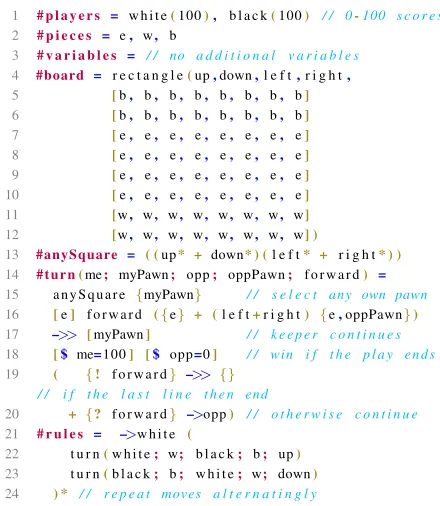
1 # p l a y e r s = w h i t e(100), b l a c k(100) / / 0-100 s c o r e s 2 # p i e c e s = e, w, b
3 # v a r i a b l e s = / / no a d d i t i o n a l v a r i a b l e s 4 #board = r e c t a n g l e(up,down,l e f t,r i g h t,
5 [b, b, b, b, b, b, b, b] 6 [b, b, b, b, b, b, b, b] 7 [e, e, e, e, e, e, e, e] 8 [e, e, e, e, e, e, e, e] 9 [e, e, e, e, e, e, e, e] 10 [e, e, e, e, e, e, e, e] 11 [w, w, w, w, w, w, w, w] 12 [w, w, w, w, w, w, w, w] )
13 #anySquare = ( (up* + down* ) (l e f t* + r i g h t* ) ) 14 # t u r n(me; myPawn; opp; oppPawn; f o r w a r d) =
15 a n y S q u a r e {myPawn} / / s e l e c t a n y own pawn 16 [e] f o r w a r d ({e} + (l e f t+r i g h t) {e,oppPawn})
17 –>> [myPawn] / / k e e p e r c o n t i n u e s
18 [$ me=100] [$ opp=0] / / w i n i f t h e p l a y e n d s 19 ( {! f o r w a r d} –>>{}
/ / i f t h e l a s t l i n e t h e n e n d
20 + {? f o r w a r d} –>opp) / / o t h e r w i s e c o n t i n u e 21 # r u l e s = –>w h i t e (
22 t u r n(w h i t e; w; b l a c k; b; up) 23 t u r n(b l a c k; b; w h i t e; w; down) 24 ) * / / r e p e a t moves a l t e r n a t i n g l y
Figure 1: The complete RBG description of breakthrough.
+{! white wins} →black
.
This fragment is to be executed right after a white’s move. The first option checks if white has already won the game (subexpression “white wins”), sets the scores, and contin-ues with the keeper that has the emptyonaction∅, which is always illegal thus ends the play. Note that the fragment is deterministic, i.e., the keeper has exactly one legal sequence.
RBG Language
The simplest version of the RBG language islow-level RBG (LL-RBG), which directly represents an abstract RBG de-scription in the text. It is to be given as an input for pro-grams (agents, game manager), thus it is simple and easy to process. An extension of LL-RBG is thehigh-level RBG (HL-RBG), which allows more concise and human-readable descriptions. HL-RBG can be separately converted to LL-RBG. This split joins human readability with machine pro-cessability and allows to further develop more extensions in HL-RBG without the need to modify implementations. The technical syntax specification is given in (Kowalski et al. 2018a), and here we give an overall view.
LL-RBG.In LL-RBG there are a few definitions of the form
#name = definition. We have #board specifying Board together
with the initial pieces assignment,#playersand#variables
speci-fying the setsPlayersandVariablestogether withBounds,
#piecesspecifying Pieces, and#rulesdefining the regular
ex-pressionRules.InitialStateis the semi state where all vari-ables are set to 0, the current player is the keeper, and the current position and the pieces assignment are defined by
re-striction since we can set any state at the beginning ofRules. HL-RBG.In high-level RBG we add a simple substitution C-like macro system. A macro can have a fixed number of parameters and is defined by #name(p1;...;pk) = definition (withk parameters) or#name= definition(without parameters). After the definition, every further occurrence ofnameis replaced with definition, where additionally every parameter occurrence in definitionis replaced with the values provided. There are a few other HL-RBG extensions over LL-RBG, such as prede-fined functions to generate typical boards (e.g. rectangular, hexagonal, cubical, etc.).
A complete example of gamebreakthroughin HL-RBG is given in Fig. 1. For instance, the corresponding expression in LL-RBG obtained by unrollingturnmacro in line 22 is:
( (up*+down* ) (l e f t*+r i g h t* ) ) {w} [e] up ({e} + (l e f t+r i g h t) {e , b}) –>>
[w] [ $w h i t e =100] [ $b l a c k =0] ({! up} –>>{} + {? up} –>opp)}
Note that the placement of the moved pawn is postponed to line 18. The keeper performs this action instead of the player since the move is already defined in line 17.
Proper RBG Description and Transition Model
We state two conditions that aproperRBG description must satisfy. They will ensure that the game is finite, well defined, and also allow reasoning algorithms to be more efficient.
In the first condition, we bound the number of modifiers that can be applied during a play, including entering patterns. This implies that we cannot reach the same game state after applying a modifier in the meantime and that every play will eventually finish. For example, the simplest forbidden con-struction is[x]∗; however,(left[x])∗is allowed if the num-ber of valid repetitions ofleft shift action is bounded.
Letstraightnessof a wordwbe the number of modifier occurrences in w. Thestraightness of a languageLis the maximum of the straightnesses of allw ∈ L; if the maxi-mum does not exist, the straightness ofLis infinite. Note that the valid sequences forInitialStatefromL(Rules) de-scribe all possible plays. However, to take into account pat-terns, we need to introduce one more definition. For a semi-stateSand a languageLof non-indexed action sequences, we define the application language, which consists of all valid sequences that we could apply when starting fromS. This includes all valid sequences frompref(L)and also the valid sequences when we are allowed to “go inside” a pat-tern. Formally,app(S, L)is defined recursively by:
app(S, L) ={uis a valid word forSfrompref(L)} ∪ {uv|uis a valid word forSfrompref(L),
u{?M}oru{!M} ∈pref(L), v∈app(S·u,L(M))}.
Therefore, inapp(S, L)there are valid sequences of the formu0u1. . . uh, where auiis a valid prefix of a word from
a pattern language nested at depthi(and fromLfori= 0). We require that for the initial state and the rules, the straight-ness of the application language is finite.
The second condition states that the keeper strategy does not matter as his actions always eventually yield the same game state when another player takes control. Formally, a
game stateSr isreachableif there exists a legal sequence
for InitialState0 under Rules that yields Sr. For a game
state, by its keeper completion we mean a game state af-ter applying any legal move sequence as long as the current player is the keeper and there exists such a sequence. Ap-plying a move sequence can be repeated several times, and if the current player is not the keeper, the keeper completion is the very same game state. In Fig. 1, the keeper in lines 19– 20 always has exactly one choice, depending on whether we can perform forward shift. However, the construction →→(left+right)→pcould possibly yield two keeper com-pletions differing by the position, and then it is incorrect.
Finally, an RBG description isproperif:
1. The straightness ofapp(InitialState,L(Rules))is finite.
2. For every reachable game state, there is exactly one keeper completion.
Now we define precisely the game tree represented by an RBG description, which is important, e.g. for drawing moves at random during a Monte-Carlo search.
A moveis a sequence of pairs (i, v), wherei is the in-dex of a modifier in Rulesˆ ands ∈ Vertices is the posi-tion where the modifier is applied; the last indexed modifier must be a switch, and there cannot be other switches. Every legal move sequence defines a legal move in a natural way. The number of legal move sequences can be infinite (e.g. by (up +down)∗), but due to condition (1), there is a fi-nite number of moves. For example, in Fig. 1, for the keeper completion of the initial state, the white player has exactly
22moves (containing the indices of[e]and→→).
The game tree in RBG is constructed as follows. The root is the keeper completion ofInitialState. For every le-gal move of a node (game state), we have an edge to the keeper completion of the game state obtained by applying that move. The leaves are the nodes without a legal move, where the outcome is the player scores stored in their vari-ables. Note that in this way we do not count keeper game states (unless they are leaves), which are only auxiliary.
Expressiveness and Complexity
Universality. RBG can describe every finite determinis-tic game with perfect information (without simultaneous moves, which are a form of imperfect information). To show this formally, we can follow the definition of extensive-form games (Rasmusen 2007), which has been used to show that GDL and GDL-II are universal for their classes (Thielscher 2011), and prove that in RBG we can define an arbitrary fi-nite game tree. It is enough to encode a game tree inRules, where for every tree node we create a switch.
Theorem 2. RBG is universal for the class of finite deter-ministic games with full information.
Table 1: Complexity of basic decision problems.
Subclass Legal move?(Problem 1) Winning strategy?(Problem 2) Proper description?(Problem 3)
Unrestricted RBG PSPACE-complete EXPTIME-complete PSPACE-complete
k-straight RBG (k≥1) O((|R| · |S|)k+1) EXPTIME-complete PSPACE-complete
GDL EXPTIME-complete 2-EXPTIME-complete EXPSPACE-complete
Given a languageL, letmseq(L)be the set of all factors (substrings) of the words inLthat do not contain a switch. We say that an RBG description isk-straightif the straight-ness of mseq(app(InitialState,L(Rules))) is at most k. When there are no patterns, the straightness is just the max-imum length of a legal move (not counting the final switch). For example, the description in Fig. 1 is3-straight but not
2-straight, because there are three modifiers in lines 17–18 and no more than three modifiers can be applied between switches. Straightness is difficult to compute exactly, but in many cases a reasonable upper bound can be provided. In a wide subclass of descriptions, the straightness is bounded solely by the rules, independently on the game states, and the bound can be easily computed.
Complexity. We consider three representative decision problems, which are important for agents and game man-agers and characterize the complexity of RBG. The in-put is an abstract RBG description, but for more pre-cise results, we split it into the generalized rules R = (Players,Pieces,Variables,Rules) and a game instance S= (Board,Bounds,InitialState). By the lengths|R|and |S| we understand the lengths of their straightforward text representations similar to those in LL-RBG.
Problem 1.Does the first player have a legal move? Problem 2.Does the first player have a winning strategy? Problem 3.Is the game description proper?
Problem 1 is a very basic problem that every player and game manager must solve to play the game. Problem 2 is the classical problem of solving the game; we can assume that winning means getting a larger score than the other players. Problem 3 is important for game designers and is related to exploring the whole game tree.
A basic reasoning algorithm for RBG is based on a DFS on game states; its careful analysis leads to the following: Theorem 3. For a givenk-straight description(k≥1), the set of all legal moves can be found inO((|R| · |S|)k)time and inO(k(|R| · |S|))space.
Our results are summarized in Tab. 1. For our polynomial re-sult, we made a simplifying assumption that arithmetic op-erations on variables bounded byBoundscan be performed in constant time, which is a practical assumption unless vari-ables are exploited. The model where both R and S are given is the common situation occurring in GGP, where a player sees the game for the first time and must be able to play it shortly after that. In another scenario, a player knows the rules before and can e.g. spend some time on analyzing and preprocessing, possibly even with human aid; then the Rcan be considered fixed, and onlySis given. In this sec-ond case, all our hardness results hold as well.
In conclusion, the complexity of RBG seems to be a good choice, especially for board games. Efficient (polynomial) embeddings are possible because in most popular games these problems can be solved polynomially in the size of the representation (i.e., board). However, there are exceptions, e.g. international checkers, where deciding if a given move is legal is coNP-complete, thus polynomial complexity of this task would be insufficient for a concise GGP language.
For a comparison, in Tab. 1 we included GDL (Saffidine 2014) (bounded GDL, the version that is used in practice).
Experiments
We have implemented a computational package for RBG (Kowalski et al. 2018b): a parser (of HL-RBG and LL-RBG), an interpreter that performs reasoning, a com-pilerthat generates a reasoner with a uniform interface, and agame managerwith example simple players.
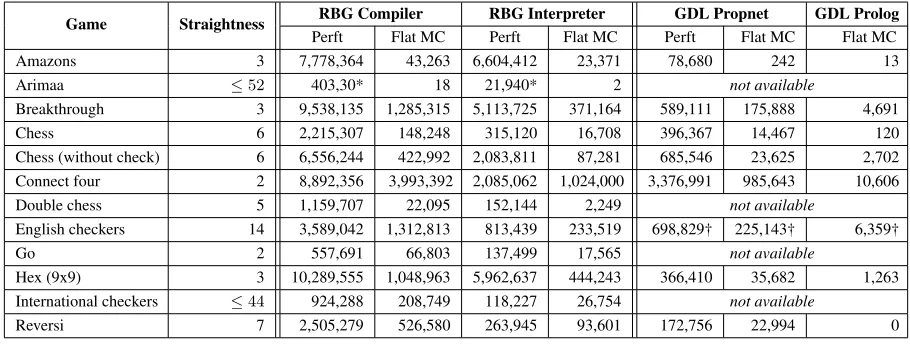
To test the efficiency of reasoning, we used two common settings: computing the whole game tree to a fixed depth (Perft), and choosing a legal move randomly and uniformly (flat Monte-Carlo). They represent both extremal cases: MC is dominated by computing legal moves, as for each visited node we compute all of them, and in Perft the number of computed nodes (plus one) is equal to the number of applied moves. The results of our experiments are shown in Table 2. For a comparison with GDL, we used the fastest avail-able game implementations (when existing), which we took from (Schreiber 2016). We tested on the same hardware one of the most efficient GDL reasoner based on a propositional network (propnet) from (Sironi and Winands 2017), together with a traditional Prolog reasoner (Schiffel 2015). The idea behind propnets is to express the dynamic of the game in a logic circuit, which can be processed using fast low-level in-structions. Although in general, the propositional networks are the fastest known reasoning algorithm for GDL, ini-tializing a propnet can be heavily time and memory con-suming, which is troublesome for large games (Schiffel and Bj¨ornsson 2014). For this reason, games exceeding some complexity level are unplayable via the propnet approach.
Table 2: The average number of nodes per second for a selection of classical games. The tests were done on a single core of Intel(R) Core(TM) i7-4790 @3.60GHz with 16GB RAM, spending at least∼10min. per test.
Game Straightness RBG Compiler RBG Interpreter GDL Propnet GDL Prolog
Perft Flat MC Perft Flat MC Perft Flat MC Flat MC Amazons 3 7,778,364 43,263 6,604,412 23,371 78,680 242 13 Arimaa ≤52 403,30* 18 21,940* 2 not available
Breakthrough 3 9,538,135 1,285,315 5,113,725 371,164 589,111 175,888 4,691 Chess 6 2,215,307 148,248 315,120 16,708 396,367 14,467 120 Chess (without check) 6 6,556,244 422,992 2,083,811 87,281 685,546 23,625 2,702 Connect four 2 8,892,356 3,993,392 2,085,062 1,024,000 3,376,991 985,643 10,606 Double chess 5 1,159,707 22,095 152,144 2,249 not available
English checkers 14 3,589,042 1,312,813 813,439 233,519 698,829† 225,143† 6,359† Go 2 557,691 66,803 137,499 17,565 not available
Hex (9x9) 3 10,289,555 1,048,963 5,962,637 444,243 366,410 35,682 1,263 International checkers ≤44 924,288 208,749 118,227 26,754 not available
Reversi 7 2,505,279 526,580 263,945 93,601 172,756 22,994 0
* Arimaa’s perft was computed starting from a fixed chess-like position to skip the initial setup.
† English checkers in GDL splits capturing rides, allowing only a single capture per turn (no more accurate version is available).
using more accurate rules, which seems to be impossible in GDL at all. Particularly difficult games for GDL reasoning are those with many moves and moves consisting of multiple steps. For example, games like go and international check-ers, concisely expressible and efficient in RBG, were never encoded in GDL, as they are very difficult to implement and a possible implementation would be likely unplayable.
Finally, we mention the most complex game we have im-plemented: arimaa – a game designed to be difficult for com-puters (it took 12 years to beat the arimaa AI challenge (Wu 2015)). The small result for MC comes as a consequence of that computing a single node is equivalent to compute all legal moves for it, which are roughly200,000(as flat MC does not merge the moves that yield the same game state). In fact, together with the perft result, this shows that arimaa is quite playable, especially if one will be computing selec-tively a subset of the moves, which is easy in RBG since it defines intermediate game states.
Conclusions
Being more suitable for particular purposes, RBG fills cer-tain gaps in the existing GGP languages and opens new pos-sibilities. In particular, RBG allows what was not possible with GDL so far. Applications lie in all areas of GGP like de-veloping universal agents, learning, procedural content gen-eration, and game analysis. Also, developing translations be-tween RBG and GDL is an interesting direction for future research. RBG has the following advantages:
Efficient reasoning. Essentially, all game playing approaches (min-max, Monte-Carlo search, reinforcement learning, evolutionary algorithms, etc.) require fast reasoning engines. RBG allows very effective reasoning and is a step toward achieving a high-level universal language with similar per-formance to game-specific reasoners. In fact, the natural rea-soning algorithm for RBG is a generalization of methods
commonly used in game-specific reasoners (e.g. modifying game states with elementary actions and backtracking). Complex games. RBG allows effective processing com-plex games and games with potentially large branching fac-tor (e.g. amazons, arimaa, non-simplified checkers, double chess, go). In the existing languages, reasoning for such games is extremely expensive and, in many cases, the game cannot be played at all (except for languages like Ludi or Metagame, which contain dedicated features to define e.g. longest ride in checkers, but cannot encode them through universal elements). Except for amazons and checkers, the above-mentioned games were even not encoded in any GGP language. Therefore, RBG makes very complex games ac-cessible for GGP through a universal approach.
Board games structure. It is not surprising that a more spe-cialized language makes developing knowledge-based ap-proaches easier. RBG allows defining the game structure in a natural way, especially for board games. It has the concept of the board and pieces, and the rules form a graph (finite au-tomaton). These are great hints for analyzing the game and an easy source of heuristics, which also make it convenient for procedural content generation.
GDL, if the rules are fixed and only the initial game state is the input, the number of possible legal moves depends poly-nomially on the input size, thus the full rules of checkers cannot be encoded in this way, since we can have an ex-ponential number of moves). Hence, RBG can open a new investigation setting in GGP, where a player can learn the rules in advance and then must play on any given instance.
Acknowledgements
This work was supported by the National Science Centre, Poland under project number 2017/25/B/ST6/01920.
References
Abiteboul, S.; Hull, R.; and Vianu, V., eds. 1995. Foun-dations of Databases: The Logical Level. Addison-Wesley Longman Publishing Co., Inc., 1st edition.
Bellemare, M. G.; Naddaf, Y.; Veness, J.; and Bowling, M. 2013. The Arcade Learning Environment: An Evaluation Platform for General Agents. Journal of Artificial Intelli-gence Research47:253–279.
Bj¨ornsson, Y. 2012. Learning Rules of Simplified Boardgames by Observing. InECAI, volume 242 ofFAIA. IOS Press. 175–180.
Browne, C., and Maire, F. 2010. Evolutionary game design. IEEE Transactions on Computational Intelligence and AI in Games2(1):1–16.
Brzozowski, J. A. 1964. Derivatives of regular expressions. J. ACM11(4):481–494.
Campbell, M.; Hoane, A. J.; and Hsu, F. 2002. Deep Blue. Artificial intelligence134(1):57–83.
Dickins, A. 1971. A Guide to Fairy Chess. Dover.
Finnsson, H., and Bj¨ornsson, Y. 2008. Simulation-based Approach to General Game Playing. InAAAI Conference on Artificial Intelligence.
Finnsson, H., and Bj¨ornsson, Y. 2010. Learning Simulation Control in General Game Playing Agents. InAAAI Confer-ence on Artificial IntelligConfer-ence, 954–959.
Genesereth, M., and Thielscher, M. 2014. General Game Playing. Morgan & Claypool.
Genesereth, M.; Love, N.; and Pell, B. 2005. General Game Playing: Overview of the AAAI Competition. AI Magazine 26:62–72.
Kaiser, L., and Stafiniak, L. 2011. First-Order Logic with Counting for General Game Playing. InAAAI Conference on Artificial Intelligence.
Kowalski, J.; Mika, M.; Sutowicz, J.; and Szykuła, M. 2018a. Regular Boardgames. arXiv:1706.02462 [cs.AI]. Kowalski, J.; Mika, M.; Sutowicz, J.; and Szykuła, M. 2018b. Regular Boardgames – source code. https://github. com/marekesz/rbg1.0/.
Love, N.; Hinrichs, T.; Haley, D.; Schkufza, E.; and Gene-sereth, M. 2006. General Game Playing: Game Description Language Specification. Technical report, Stanford Logic Group.
Newell, A.; Shaw, J. C.; and Simon, H. A. 1959. Report on a general problem solving program. InIFIP congress, volume 256, 64.
Pell, B. 1992. METAGAME in Symmetric Chess-Like Games. InHeuristic Programming in Artificial Intelligence: The Third Computer Olympiad.
Perez, D.; Samothrakis, S.; Togelius, J.; Schaul, T.; and Lu-cas, S. M. 2016. General Video Game AI: Competition, Challenges and Opportunities. InAAAI Conference on Arti-ficial Intelligence, 4335–4337.
Pitrat, J. 1968. Realization of a general game-playing pro-gram. InIFIP Congress, 1570–1574.
Rasmusen, E. 2007. Games and Information: An Introduc-tion to Game Theory. Blackwell, 4th ed.
Saffidine, A. 2014. The Game Description Language Is Turing Complete.IEEE Transactions on Computational In-telligence and AI in Games6(4):320–324.
Schaeffer, J.; Burch, N.; Bj¨ornsson, Y.; Kishimoto, A.; M¨uller, M.; Lake, R.; Lu, P.; and Sutphen, S. 2007. Checkers is solved. Science317(5844):1518–1522.
Schaul, T. 2013. A video game description language for model-based or interactive learning. InIEEE Conference on Computational Intelligence and Games, 1–8.
Schiffel, S., and Bj¨ornsson, Y. 2014. Efficiency of GDL Rea-soners. IEEE Transactions on Computational Intelligence and AI in Games6(4):343–354.
Schiffel, S., and Thielscher, M. 2014. Representing and Reasoning About the Rules of General Games With Imper-fect Information. Journal of Artificial Intelligence Research 49:171–206.
Schiffel, S. 2015. General Game Playing. http://www. general-game-playing.de/downloads.html.
Schreiber, S. 2016. Games – base repository. http://games. ggp.org/base/.
Silver, D.; Huang, A.; Maddison, C. J.; Guez, A.; Sifre, L.; van den Driessche, G.; Schrittwieser, J.; Antonoglou, I.; Panneershelvam, V.; Lanctot, M.; Dieleman, S.; Grewe, D.; Nham, J.; Kalchbrenner, N.; Sutskever, I.; Lillicrap, T.; Leach, M.; Kavukcuoglu, K.; Graepel, T.; and Hassabis, D. 2016. Mastering the game of Go with deep neural networks and tree search. Nature529:484–503.
Sironi, C. F., and Winands, M. H. M. 2017. Optimiz-ing Propositional Networks. InComputer Games. Springer. 133–151.
´Swiechowski, M.; Park, H.; Ma´ndziuk, J.; and Kim, K. 2015. Recent Advances in General Game Playing. The Sci-entific World Journal2015.
Thielscher, M. 2011. The General Game Playing Descrip-tion Language is Universal. InInternational Joint Confer-ence on Artificial IntelligConfer-ence, 1107–1112.