R E S E A R C H A R T I C L E
Open Access
Advice alone versus structured detoxification
programmes for complicated medication overuse
headache (MOH): a prospective, randomized,
open-label trial
Paolo Rossi
1,2*, Jessica Veronica Faroni
1, Cristina Tassorelli
2and Giuseppe Nappi
2Abstract
Background:The aim of this study was to compare the effectiveness of an educational strategy (advice to withdraw the overused medication/s) with that of two structured pharmacological detoxification programmes in patients with complicated medication overuse headache (MOH) plus migraine.
Methods:One hundred and thirty-seven complicated MOH patients participated in the study. MOH was defined as complicated in patients presenting at least one of the following: a) a diagnosis of co-existent and complicating medical illnesses; b) a current diagnosis of mood disorder, anxiety disorder, eating disorder, or substance addiction disorder; c) relapse after previous detoxification treatment; d) social and environmental problems; e) daily use of multiple doses of symptomatic medications. Group A (46 patients) received only intensive advice to withdraw the overused medication/s. Group B (46 patients) underwent a standard detoxification programme as outpatients (advice + steroids + preventive treatment). Group C (45 patients) underwent a standard inpatient withdrawal programme (advice + steroids + fluid replacement and antiemetics preventive treatment). Withdrawal therapy was considered successful if, after two months, the patient had reverted to an intake of NSAIDs lower than 15 days/ month or to an intake of other symptomatic medication/s lower than 10 days/month.
Results:Twenty-two patients failed to attend follow-up visits (11 in Group A, 9 in Group B, 2 in Group C, p < 0.03). Overall, we detoxified 70% of the whole cohort, 60.1% of the patients in Group A and in Group B, and 88.8% of those in Group C (p < 0.01).
Conclusions:Inpatient withdrawal is significantly more effective than advice alone or an outpatient strategy in complicated MOH patients.
Keywords:Medication overuse headache, Management, Migraine, Treatment
Background
Medication overuse headache (MOH) is a relevant public health problem worldwide [1,2]. Population-based studies in several European countries have reported prevalence rates of MOH ranging from 0.9 to 1.8%, making it the third most frequent headache disorder after tension-type headache and migraine [3-7].
Medication overuse headache has detrimental effects on patients’quality of life and it places a high economic burden on society [1,2].The recently published findings of the Eurolight project show that the mean per-person annual costs of MOH are 3 times higher than those of migraine and 10 times higher than those of tension-type headache [8].
The diagnosis of MOH has been greatly facilitated by thenew appendix criteria for a broader concept of chronic migraine, published in 2006 by the IHS [9]. These simpli-fied criteria, which eliminate the need for headache reso-lution or reversion to the previous episodic pattern after * Correspondence:[email protected]
1Headache Clinic, INI Grottaferrata, Via S.Anna s.n.c, 00046 Grottaferrata,
Rome, Italy
2Headache Science Centre, National Neurological Institute C. Mondino
Foundation, Pavia, Italy
drug discontinuation in order to confirm the diagnosis, are helping physicians to recognise MOH and thus to re-move the diagnostic barriers to proper care of affected patients.
Drug withdrawal is considered the treatment of choice for MOH, even though this view has recently been chal-lenged [1,2,10-16]. Drug withdrawal is however approached and performed very differently within and across countries. Furthermore therapeutic recommendations for the acute phase of detoxification vary considerably between studies [1,2,17-19]. Other reasons for the heterogeneity in MOH management are the shortage of controlled treatment stud-ies, meaning that treatment recommendations are based mainly on expert opinions rather than on solid scientific evidence [20], and the fact that MOH is, in many respects, a heterogeneous disorder. MOH group indeed encompasses a spectrum of conditions that vary in terms of phenotypical characteristics, type and amount of drugs overused, comor-bidities and response to prophylactic treaments. In order to improve the management of MOH, some authors have pragmatically suggested to subdivide MOH into two clinical subtypes: simple and complex [21-23]. In accordance with this approach we previously demonstrated that in MOH patients with low medical needs and migraine as the pri-mary headache type advice and education were as effective as structured inpatient and outpatient detoxification pro-grammes in achieving withdrawal of the overused medica-tion/s [24]. More recently, other groups studying “mildly” affected MOH populations have confirmed the effectiveness of brief educational intervention alone in reducing medica-tion overuse and headache chronificamedica-tion and also the simi-lar efficacy between inpatient and outpatient programmes [25-27]. These studies thus lend support to the recom-mendation that uncomplicated MOH should, in the first instance, be tackled through outpatient withdrawal pro-grammes [14,20,26-28]. Conversely, complicated forms, such as those with opioids, barbiturates or benzodiaze-pines overuse, or presenting psychological problems or medical comorbidities that could impact on outpatient withdrawal, are generally considered for inpatients with-drawal, as are those who have previously failed outpatient detoxification programmes or who lack the necessary mo-tivation [14,17,18,27]. In partial support of the simple-vs-complex approach, we showed in a previous study that educational intervention alone is significantly more effec-tive in patients with simple MOH as opposed to patients with complicated MOH (92.1% vs 65.3% of responders, re-spectively); although the level of adherence to treatment did not differ between the two groups [24] and notwith-standing the fact that a success rate of 65.3% was obtained in complicated MOH.
The aim of this study was to compare the effectiveness of a simple withdrawal strategy, based exclusively on in-tensive advice to withdraw the overused medication/s,
with that of two structured pharmacological detoxification programmes in a cohort of patients with complicated MOH in whom migraine was the primary headache type.
Methods
For the purpose of this study, complicated MOH was defined by the presence of at least one of the following conditions [29]: a) comorbidity with other clinically rele-vant painful condition (e.g. chronic painful disorders such as fibromyalgia or low back pain, neuropathic pain, etc.); b) ongoing or recent comorbidity with psychiatric dis-orders (i.e. mood disorder, anxiety disorder, substance ad-diction disorder or eating disorder), as assessed by the Structured Clinical Interview for DSM-IV Axis I Disor-ders (SCID-I), Clinician Version [30]; c) moderate/severe psychosocial and environmental problems as defined by DSM-IV Axis IV, assessed at the end of the initial visit by means of a structured interview; d) daily, or almost daily, use of multiple doses of symptomatic medication/s (more than 3 doses/day of analgesics or more than 2 doses/day of triptans, ergots, combinations of acute medications, or analgesics in combination) or anticipatory use of symp-tomatic medication/s; e) relapse into overuse following previous detoxification treatment.
This set of criteria for defining complicated MOH was deemed to represent the best combination of existing cri-teria (already proposed in the literature) and the authors’ personal experience in managing MOH patients attending headache centres in Italy, and it has already proved to be highly sensitive in identifying MOH patients in whom ef-fective drug withdrawal may be obtained through the imparting of advice alone [29].
It has been established that abrupt discontinuation of an overused medication may lead to serious withdrawal symp-toms such as hypotension, tachycardia, vomiting, intense nervousness, sleep disturbances and even hallucinations and seizures, particularly in patients overusing opioids, bar-biturates and tranquillisers, and that these symptoms are best treated under medical supervision in patients with significant complicating medical conditions [1,14,19,20]. Therefore, for ethical reasons, in this study we excluded patients with severe major depression and/or severe psychi-atric illnesses and those likely to encounter problems as withdrawal treatment outpatients. Thus, the final set of ex-clusion criteria were: a) co-existent severe medical (e.g. un-controlled arterial hypertension, unun-controlled diabetes mellitus, ischaemic cardiopathy, etc.) or psychiatric illness; b) overuse of opioids and/or barbiturate-containing agents; c) treatment with migraine prophylactic drugs within the past three months; d) pregnancy or breastfeeding.
(INI Grottaferrata Headache Clinic) were evaluated over an eighteen-month period (July 2009 to December 2010).
The patients were evaluated prospectively and the study lasted 14 weeks for each subject (Figure 1). After the first visit, eligible subjects were asked to keep a diag-nostic headache diary for four weeks, simply recording their headache pattern and drug use (baseline period). This period was purely observational and at this time no diagnosis or therapeutic indications were given. At the sec-ond visit, at the end of this baseline period, the patients still fulfilling the inclusion criteria were randomly assigned (using a computer-generated random number sequence), in equal numbers, to three different treatment groups [24]. Group A received only advice to withdraw the overused medication/s; Group B underwent a standard outpatient detoxification programme consisting of: 1) advice to abruptly withdraw the overused medication/s, 2) prednis-one p.o. during the first 10 days (60 mg/day, 2 days; 40 mg/day, 2 days; 20 mg/day, 6 days) [24], 3) individua-lised preventive treatment begun on day 1 (the preventive agent was chosen on the basis of side-effect profile, comor-bid conditions, the patient’s needs and preferences, and the patient’s previous therapeutic experiences). Group C
underwent a standard inpatient detoxification programme. After receiving advice about the need to withdraw symp-tomatic medications, patients in this group were admitted as inpatients to the INI Grottaferrata Headache Clinic for a 10-day period during which they received: 1) abrupt dis-continuation of the overused medication/s, 2) close obser-vation and support for 8–10 days, 3) prednisone p.o. (60 mg/day, 2 days; 40 mg/day, 2 days; 20 mg/day, 6 days), 4) individualised preventive treatment as from day 1, and 5) parenteral fluid replacement and administration of an-tiemetics (metoclopramide i.v).
In order to standardise the educational part of the treatment programme, all advice was issued by the same physician (PR). The advice to discontinue the overused medication/s was given verbally [24] and its imparting, which took about 15 minutes during the second consult-ation, was structured as follows: a) the role of medication overuse in making headache chronic and in reducing the effectiveness of preventive and behavioural treatments was explained; b) the phenomenon and symptoms of withdrawal headache were explained in detail; c) the bene-ficial long-term effects, on migraine natural history, of re-ducing symptomatic medication intake (which include
Randomisation (n=137)
Group A = simple advice (n=46)
Group B = structured outpatient prog.(n=46)
Group C = structured inpatient prog. (n=45) Baseline recordings (4
weeks)
(5 weeks)
Group A = simple advice (n=36)
Group B = structured outpatient prog.(n=37)
Group C = structured inpatient prog.(n=44)
Dropouts (n=20)
Group A = simple advice (n=35)
Group B = structured outpatient prog.(n=37)
Group C = structured inpatient prog.(n=43) (5 weeks)
Eligibility assessment (n=151)
(n=230)
Excluded (n=14),
Not meeting inclusion criteria (n=10)
Withdrawal in baseline period (n=4)
Dropouts (n=2) 1st VISIT
2nd VISIT
1st FOLLOW UP VISIT
2nd FOLLOW-UP VISIT
reduction of the migraine-reinforcing properties of short-term pain relief) were emphasised; d) anticipatory use of medication was discouraged; and e) the superiority of the detoxification programme over other therapeutic options was emphasised. In patients assigned to Group A the physician emphasised the importance, for patients, of playing an active role in the management of their head-ache, without relying solely on medication.
For the treatment of withdrawal headache and asso-ciated symptoms, patients could be prescribed the follow-ing acute drugs, accordfollow-ing to their personal medical history (the rationale was that patients should not use the drug that she or he had previously been abusing) and headache characteristics:
a) Antiemetics (metoclopramide 10 mg i.m. or p.o.1 to 3 times per day; chlorpromazine, 25–50 mg i.m. or p.o., domperidone 30 mg rectally or 10 mg p.o.), and (with intake limited to no more than two days per week) b) Acetaminophen (1000 mg p.o. or rectally or i.v on
demand, maximum dosage 3 g × day) or naproxen (500 mg p.o. or p.r., maximum dosage 1000 mg × day) or indomethacin (100 mg p.o. or p.r., or 50 mg i.m., maximum dosage 200 mg × day)
c) Eletriptan 40 mg p.o., frovatriptan 2.5 mg p.o., almotriptan 12.5 mg p.o., or rizatriptan 10 mg p.o.
Furthermore, the patients were asked to fill in a detailed diagnostic headache diary. The patients assigned to out-patient treatment groups were also told that they could contact the headache centre for medical help and support, should this be needed.
Follow-up visits were scheduled during the 5th and the 10th week after the start of the detoxification programme. All patients failing to attend the follow-up visits were called by telephone within three months from the start of the detoxification programme in order to ascertain their reasons for not adhering to the treatment programme. As in our previous studies [24,29], the patients were not informed that they were included in a study assessing the effectiveness of simple advice as a withdrawal strategy for MOH. This approach was authorised by the ethics com-mittee of our institute. Therefore, no signed, informed consent was obtained. The research was in compliance with the Helsinki Declaration.
Outcome measures
The primary outcome measures were: a) responders (number of), defined as those subjects who, two months after the start of withdrawal of the overused drug/s, had reverted to an intake of NSAIDs lower than 15 days/ month or to an intake of other symptomatic medication/s lower than 10 days/month; b) adherence to the treatment, expressed as the number of patients who completed the
follow-up visits; c) responders with headache improve-ment (number of ), defined as those patients who, two months after the start of the drug withdrawal, experienced more than 50% reduction in headache frequency from baseline.
As secondary outcome measures we considered the percentage reduction, two months after the start of the withdrawal, in the number of headache days/month, the number of days with use of symptomatic medication/ month, and the number of symptomatic medications/ month.
Power calculation and statistical analysis
The main target parameter was the number of responders. On the basis of the results of previous studies, we assumed a responder rate of 55% in the no-intervention group and of 90% in the structured intervention groups, i. e. the study had to have the power to detect a difference of 35%. In applying the above-mentioned percentages, using a power of 0.8% and a significance level of 5%, a minimum of 35 patients per treatment group was required (Fisher’s exact test, two-tailed). We thus needed a total of 105 patients to complete the study. Given the impossibil-ity of performing a satisfactory a priori analysis of the other outcome measures, the adherence to treatment criterion and the other target criteria were subjected to exploratory statistical analysis.
Multi-group comparisons were performed using the one-way analysis of variance for continuous variables and the non-parametric Kruskal-Wallis test for non-normally distributed data. The chi-square test and Fisher’s exact test with Freeman-Halton extension (when applicable) were used for multi-group comparisons of categorical variables. Given that we were performing multiple testing, the level of significance was set at p < 0.025. The analysis was carried out using SPSS 11 for Windows (SPSS Inc., Chicago, IL).
Results
Table 1 Demographics and headache characteristics of the study population
Group A (n = 46) Group B (n = 46) Group C (n = 45) Statistics
Sexn° (%) NS§
F 39 37 34
M 7 9 11
Agemean ± SD (yrs) 44.9 ± 11 46.2 ± 12 46.3 ± 11.4 NS¤
(median) (48) (48) (49)
Educational leveln° (%)
Secondary school or above 30 31 27 NS§
Primary or middle school 16 15 18
Employedn°(%)
Yes 29 28 25 NS§
No 17 18 20
Marital statusn° (%)
Single 8 7 5 NS§
Married 32 32 35
Widowed/divorced 6 7 5
Migraine subtypen° (%)
With aura 5 3 5 NS*
Without aura 41 43 40
Duration of migraine
mean±SD (yrs) 25.8 ± 12.8 26.0 ± 12 26.1 ± 11.7 NS¤
(median) (29) (29) (30)
Duration of MOH
mean±SD (yrs) 3.3 ±3.3 2.9 ± 3.1 3.4 ± 2.9 NS¤
(3) (2) (3)
Number of headache days/month
mean±SD 24.9 ± 6 25.4 ± 6.7 25.4 ± 6.4 NS¤
(median) (30) (30) (30)
Number of days with use of symptomatic medication/month
mean±SD 23.9 ± 5.4 24.1 ± 4.8 24.3 ± 4.9 NS¤
(median) (30) (30) (30)
Overused drugsn (%): NS*
•Analgesics 16 14 18
•Ergotamine 1 1 1
•NSAIDs in combination 10 11 10
•Combination of acute medications 6 6 6
•Triptans 13 14 10
Number of overused medications/month NS¤
mean ±SD 37.2 ± 28.4 36.9 ± 32.4 38.2 ± 31
(median) (38) (38) (40)
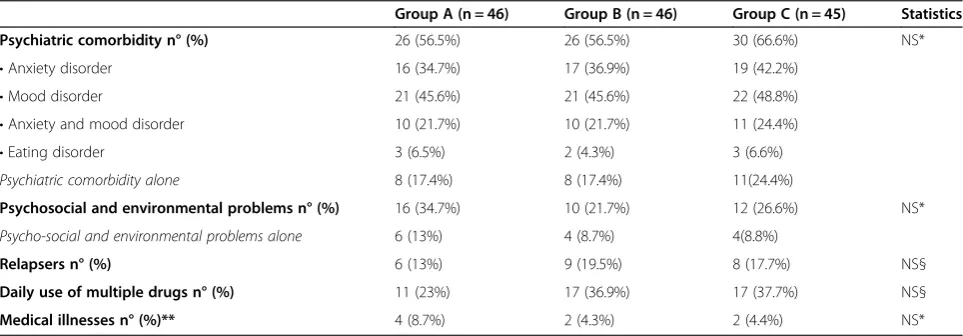
triptans + NSAIDs, 3 used NSAIDs in combination + trip-tans, 1 used triptans + ergotamine). Sociodemographic variables, migraine subtype, migraine duration, MOH du-ration, number of headache days per month, and number and type of overused medication(s) did not differ signifi-cantly between the three groups (Table 1). Table 2 shows the prevalence of the different factors complicating MOH in the three groups of patients.
In group B, 16 patients received valproic acid (500– 1000 mg/day) as preventive medication, 11 received beta-blockers (metoprolol 100–200 mg/ day), nine received amitriptyline (25–75 mg/day), and 10 received topiramate (75 mg/day). In group C, 17 patients received valproic acid (500–1000 mg/ day) as preventive medication, eight re-ceived beta-blockers (metoprolol 75–100 mg/ day), eight received amitriptyline (30–60 mg/ day) and 12 received topiramate (50–75 mg/ day).
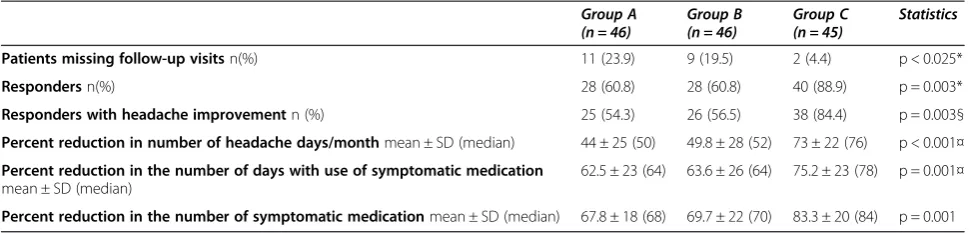
Twenty-two patients (16%) dropped out of the study (11 in Group A, 9 in Group B and 2 in Group C, p < 0.025, Table 3). The reasons given for missing follow-up visits were: lack of time (two in Group A, two in Group B, all at the first follow-up), lack of motivation (two in Group A, one in Group B, one in Group C, all at the first follow-up), the decision to seek other medical help (three in Group A, one in Group B, both at the first follow-up), fear of side effects (one in Group A, two in Group B, both at the first follow-up), health problems (one in Group A, one in group C, both at the second follow-up) and worsening of head-ache (two in Group A, three in Group B, both at the first follow-up). No differences in headache characteristics or demographics were found between the patients from the three groups completing and not completing the follow-up visits (all, p > 0.025).
After two months, 115 patients had completed the follow-up visits (35 in Group A, 37 in Group B, 43 in Group C). Of these, 96 (84.2%) were considered responders
(28 in Group A, 28 in Group B, 40 in Group C, p = 0.003, Table 3). Of all the patients included in the study we suc-cessfully detoxified 70% (60.8% in Groups A and B, and 88.9% in Group C, p = 0.003 Table 3). At two months, 25 patients in Group A (56.5%), 26 in Group B (56%) and 38 in Group C (84.4%) recorded a more than 50% reduction in headache frequency from baseline (p = 0.003) and were thus considered responders with headache improvement.
In the patients completing the study, the percent reduc-tion in the number of headache days/month was 44 ± 25 in Group A, 49.8 ± 28 in Group B and 73 ± 22 in Group C (p < 0.001). The percent reduction in the number of days with use of symptomatic medication was 62.5 ± 23 in Group A, 63.6 ± 26 in Group B, and 75.2 ± 23 in Group C (p < 0.001). The percent reduction in the number of symp-tomatic medications/month was 68,1 ± 18 in Group A, 69.7 ± 22 in Group B and 84.3 ± 20 in Group C (p < 0.001)
Discussion
The main finding of this study was that a structured in-patient detoxification programme was more effective, in the short-term, than advice alone or than a structured out-patient programme in achieving withdrawal of the over-used medication(s) in patients with complicated MOH who had migraine as their primary headache type. In addition, contrary to the pattern emerging in simple MOH [24], outpatient strategies were associated with a lower level of adherence to treatment: 21.8% of the patients allo-cated to outpatient strategies did not complete the study, whereas only 4.6% of the patients allocated to the inpatient programme dropped out of the study.
As in previous studies, conducted in patients with sim-ple or mild MOH [14,24,25], early administration of a pre-ventive treatment in an outpatient setting did not improve the effectiveness of the withdrawal treatment when com-pared with simple advice to withdraw the overused drug
Table 2 Prevalence of clinical factors defining MOH as complicated
Group A (n = 46) Group B (n = 46) Group C (n = 45) Statistics
Psychiatric comorbidity n° (%) 26 (56.5%) 26 (56.5%) 30 (66.6%) NS*
•Anxiety disorder 16 (34.7%) 17 (36.9%) 19 (42.2%)
•Mood disorder 21 (45.6%) 21 (45.6%) 22 (48.8%)
•Anxiety and mood disorder 10 (21.7%) 10 (21.7%) 11 (24.4%)
•Eating disorder 3 (6.5%) 2 (4.3%) 3 (6.6%)
Psychiatric comorbidity alone 8 (17.4%) 8 (17.4%) 11(24.4%)
Psychosocial and environmental problems n° (%) 16 (34.7%) 10 (21.7%) 12 (26.6%) NS*
Psycho-social and environmental problems alone 6 (13%) 4 (8.7%) 4(8.8%)
Relapsers n° (%) 6 (13%) 9 (19.5%) 8 (17.7%) NS§
Daily use of multiple drugs n° (%) 11 (23%) 17 (36.9%) 17 (37.7%) NS§
Medical illnesses n° (%)** 4 (8.7%) 2 (4.3%) 2 (4.4%) NS*
*Fisher’s test, § Chi-square test.
(s). This suggests that hospitalisation was the factor that, in our complicated MOH patients, made the difference versus the other detoxification strategies in both respon-ders and adherence to treatment measures. This is prob-ably because the inpatient approach allowed a more strict control of medication intake, the prompt and inten-sive treatment of withdrawal symptoms, a better patient support, and isolation of patients from the socio-environmental pressures liable to reinforce drug overuse behaviour.
In the recently published EFNS headache panel guide-line on the treatment of MOH [20], the authors concluded that“the type of withdrawal strategy (inpatient, outpatient, advice alone) does not influence the success of the treat-ment and the relapse rate in general”(level A recommen-dation). Two more recent studies, conducted in Europe, seem to support this statement [27,28]. Creac’h et al. com-pared the efficacy of inpatient and outpatient withdrawal programmes in 82 consecutive patients with MOH in an open-label prospective randomised trial. The finding that hospitalisation did not improve either the short or the long-term prognosis of these patients prompted the authors to recommend outpatient withdrawal in the first instance in patients with MOH [27]. Munksgaard et al. investigated the effectiveness of two structured outpatient detoxification programmes in 98 treatment-resistant patients with MOH, i.e. patients previously unsuccessfully treated by specialists [28]. Both programmes proved to be highly effective in the short and the long term, which sug-gests that most MOH patients, even those regarded as treatment-resistant, may be cured in an outpatient setting. However, these two studies [27,28], like all the previous research comparing different approaches to withdrawal therapy [14,20], did not include patients with complicated MOH as defined herein. The present study, in which hos-pitalisation was found to be superior to outpatient strat-egies, is thus the first to investigate the efficacy of different withdrawal strategies in complicated MOH. Nevertheless, it is worth noting that, as in our previous study [29], simple educational intervention alone proved sufficient to
detoxify the majority (60%) of the complicated MOH patients and 80% of the patients completing the study. These data suggest that compliance with outpatient stra-tegies is the main problem in complicated MOH patients, given that almost 20% of them were somewhat dissatisfied by an approach based essentially on the imparting of ad-vice to withdraw the symptomatic drug/s. A recent study showed that MOH patients request information about the disease and want to know how they might actively partici-pate in the treatment of it [31]. It is possible, therefore, that compliance might be improved by taking patient preferences into account when choosing the withdrawal programme [27]. In view of hospitalisation costs, particu-larly in the current economic climate, our experience with complicated MOH patients [29] suggests that advice to withdraw the overused medication/s, on the basis of its ef-fectiveness, safety and cost [14], should be the first step in a step-care approach to MOH management that takes into account patients’preferences. In case of failure, inpatient detoxification should be offered in order to grant a higher rate of success. This approach seems the most adequate one based on the present and on published data, at least until convincing evidence is provided in favour of a strati-fied approach in which patients are assigned to different treatments according to the extent of their medical needs.
Several possible limitations of our study preclude the drawing of definite conclusions regarding the use of sim-ple advice as a withdrawal strategy for MOH. The head-ache clinic setting may have favoured the productive doctor-patient alliance that is essential for successful educational interventions. Thus, the reproducibility of our findings in different settings, such as primary care, remains uncertain.
Furthermore, the classification of MOH patients into simple and complicated subtypes is not immediate and requires the administration of time-consuming structured interviews by experienced physicians. Recent work in Norway with the Severity of Dependence Scale (SDS) sug-gests that this simple and validated questionnaire is useful for predicting the outcome of MOH after an educational
Table 3 Primary and secondary outcome measures
Group A
(n = 46) Group B(n = 46) Group C(n = 45) Statistics
Patients missing follow-up visitsn(%) 11 (23.9) 9 (19.5) 2 (4.4) p < 0.025*
Respondersn(%) 28 (60.8) 28 (60.8) 40 (88.9) p = 0.003*
Responders with headache improvementn (%) 25 (54.3) 26 (56.5) 38 (84.4) p = 0.003§
Percent reduction in number of headache days/monthmean ± SD (median) 44 ± 25 (50) 49.8 ± 28 (52) 73 ± 22 (76) p < 0.001¤
Percent reduction in the number of days with use of symptomatic medication mean ± SD (median)
62.5 ± 23 (64) 63.6 ± 26 (64) 75.2 ± 23 (78) p = 0.001¤
Percent reduction in the number of symptomatic medicationmean ± SD (median) 67.8 ± 18 (68) 69.7 ± 22 (70) 83.3 ± 20 (84) p = 0.001
intervention in the general population [32]. Therefore, SDS might be a helpful tool for identifying MOH patients with higher medical needs.
Third, this study included only MOH patients who had migraine as their primary headache; these patients have a better prognosis than those with other headache types, such as tension-type headache [1,14].
Finally, the proposed criteria for medical comorbidity (the presence of coexistent significant and complicating medical illnesses) might benefit from a more accurate definition deriving from reproducibility study involving different physicians.
Conclusions
Inpatient withdrawal is significantly more effective than advice alone or an oupatient strategy in complicated MOH patients.
Competing interest
The authors declare that they have no competing interests.
Authors’contribution
PR had the original idea for the study and together with JVF, CT and GN planned the overall design. PR prepared the initial draft and was the main author of the present manuscript. PR and JVR carried out the study. CT supported in the design of the study and with scientific input regarding headache. All authors have read, revised and approved the final manuscript.
Acknowledgments
Funded by the Ministry of Health to IRRCS Mondino Institute–Current Research for 2009–2011 triennium.
In collaboration with the University Consortium for Adaptive Disorders and Head pain (UCADH).
Received: 16 November 2012 Accepted: 3 February 2013 Published: 8 February 2013
References
1. Evers S, Marziniak M (2010) Clinical features, pathophysiology, and treatment of medication-overuse headache. Lancet Neurol 9:391–401 2. Dodick DW, Silberstein SD (2008) How clinicians can detect, prevent and
treat medication overuse headache. Cephalalgia 28:1209–1217 3. Aaseth K, Grande RB, Kvaerner KJ, Gulbrandsen P, Lundqvist C, Russell MB
(2008) Prevalence of secondary chronic headaches in a population-based sample of 30–44-year-old persons. The Akershus study of chronic headache. Cephalalgia 28:705–713
4. Colas R, Munoz P, Temprano R, Gomez C, Pascual J (2004) Chronic daily headache with analgesic overuse: epidemiology and impact on quality of life. Neurology 62:1338–1342
5. Katsarava Z, Dzagnidze A, Kukava M et al (2009) Primary headache disorders in the Republic of Georgia: prevalence and risk factors. Neurology 73:1796–1803 6. Straube A, Pfaffenrath V, Ladwig KH, Meisinger C, Hoffmann W, Fendrich K,
Vennemann M, Berger K (2009) Prevalence of chronic migraine and medication overuse headache in Germany–the German DMKG headache study. Cephalalgia 30:207–213
7. Jonsson P, Hedenrud T, Linde M (2011) Epidemiology of medication overuse headache in the general Swedish population. Cephalalgia 31:1015–1022 8. Linde M, Gustavsson A, Stovner LJ, Steiner TJ, Barré J, Katsarava Z, Lainez JM,
Lampl C, Lantéri-Minet M, Rastenyte D, Ruiz de la Torre E, Tassorelli C, Andrée C (2012) The cost of headache disorders in Europe: the Eurolight project. Eur J Neurol 19:703–711
9. Headache Classification Committee, Olesen J, Bousser MG, Diener HC, Dodick D, First M, Goadsby PJ, Göbel H, Lainez MJ, Lance JW, Lipton RB, Nappi G, Sakai F, Schoenen J, Silberstein SD, Steiner TJ (2006) New appendix criteria open for a broader concept of chronic migraine. Cephalalgia 26:742–746
10. Negro A, Martelletti P (2011) Chronic migraine plus medication overuse headache: two entities or not. J Headache Pain 12:593–601
11. Farinelli I, Dionisi I, Martelletti P (2011) Rehabilitating chronic migraine complicated by medication overuse headache: how we can prevent migraine relapse? Intern Emerg Med 6:23–28
12. Katsarava Z, Jensen R (2007) Medication overuse headache: where are we now? Curr Opin Neurol 20:326–330
13. Zeeberg P, Olesen J, Jensen R (2006) Probable medication-overuse headache: the effect of a 2-month drug-free period. Neurology 66:1894–1898 14. Rossi P, Jensen R, Nappi G, Allena M, COMOESTAS Consortium (2009) A
narrative review on the management of medication overuse headache: the steep road from experience to evidence. J Headache Pain 10:407–417 15. Olesen J (2012) Detoxification for medication overuse headache is the
primary task. Cephalalgia 32:420–422
16. Diener HC (2012) Detoxification for medication overuse headache is not necessary. Cephalalgia 32:423–427
17. Pamelaire K, Crevits L, Goadsby PJ, Kaube H (2006) Practical management of medication overuse headache. Acta Neurol Belg 106:43–51
18. Obermann M, Katsarava Z (2007) Management of medication overuse headache. Expert Rev Neurother 7:1145–1155
19. Diener HC, Limmroth V (2004) Medication-overuse headache: a worldwide problem. Lancet Neurol 3:475–483
20. Evers S, Jensen R, European Federation of Neurological Societies (2011) Treatment of medication overuse headache–guideline of the EFNS headache panel. Eur J Neurol 18:1115–1121
21. Radat F, Lanteri-Minet M (2010) What is the role of dependence-related behavior in medication overuse headache? Headache 50:1587–1611 22. Saper JR, Hamel RL, Lake AE III (2005) Medication overuse headache (MOH)
is a biobehavioural disorder. Cephalalgia 25:545–546
23. Lake AE III (2006) Medication overuse headache: biobehavioural issues and solutions. Headache 46(Suppl 3):S88–S97
24. Rossi P, Di Lorenzo C, Faroni J, Cesarino F, Nappi G (2006) Advice alone vs structured detoxification programmes for medication overuse headache: a prospective, randomized, open-label trial in transformed migraine patients with low medical needs. Cephalalgia 26:1097–1105
25. Hagen K, Albretsen C, Vilming ST, Salvesen R, Grønning M, Helde G, Gravdahl G, Zwart JA, Stovner LJ (2009) Management of medication overuse headache: 1 year randomized multicentre open-label trial. Cephalalgia 29:221–232 26. Grande RB, Aaseth K, Benth JS, Lundqvist C, Russell MB (2011) Reduction in
medication overuse headache after short information. The Akershus study of chronic headache. Eur J Neurol 18:129–137
27. Creac’h C, Frappe P, Cancade M, Laurent B, Peyron R, Demarquay G, Navez M (2011) In-patient versus out-patient withdrawal programmes for medication overuse headache. A 2-year randomized trial. Cephalalgia 31:1189–1198 28. Munsksgaard SB, Bendtsen L, Jensen RH (2012) Detoxification of
medication-overuse headache by a multidisciplinary treatment programme is highly effective: a comparison of two consecutive treatment methods in open-label design. Cephalalgia 32:834–844
29. Rossi P, Faroni JV, Nappi G (2011) Short-term effectiveness of simple advice as a withdrawal strategy in simple and complicated medication overuse headache. Eur J Neurol 18:396–401
30. Mazza F, Morosini P, De Girolamo G, Lussettie G, Guaraldi GP (2000) SCID-I CV: Edizione italiana. O.S. Organizzazioni Speciali, Florence
31. Munksgaard SB, Allena M, Tassorelli C, Rossi P, Katsarava Z, Bendtsen L, Nappi G, Jensen R, Comoestas Consortium (2011) What do the patients with medication overuse headache expect from treatment and what are the preferred sources of information? J Headache Pain 12:91–96 32. Lundqvist C, Grande RB, Aaseth K, Russell MB (2012) Dependence scores
predict prognosis of medication overuse headache: a prospective cohort from the Akershus study of chronic headache. Pain 153:682–686
doi:10.1186/1129-2377-14-10