R E S E A R C H
Open Access
Memory access integrity: detecting
fine-grained memory access errors in binary
code
Wenjie Li
1,3,4,5*, Dongpeng Xu
2, Wei Wu
1,3,4,5, Xiaorui Gong
1,3,4,5, Xiaobo Xiang
1,3,4,5, Yan
Wang
1,3,4,5, Fangming gu
1,3,4,5and Qianxiang Zeng
1,3,4,5Abstract
As one of the most notorious programming errors, memory access errors still hurt modern software security. Particularly, they are hidden deeply in important software systems written in memory unsafe languages like C/C++. Plenty of work have been proposed to detect bugs leading to memory access errors. However, all existing works lack the ability to handle two challenges. First, they are not able to tackle fine-grained memory access errors, e.g., data overflow inside one data structure. These errors are usually overlooked for a long time since they happen inside one memory block and do not lead to program crash. Second, most existing works rely on source code or debugging information to recover memory boundary information, so they cannot be directly applied to detection of memory access errors in binary code. However, searching memory access errors in binary code is a very common scenario in software vulnerability detection and exploitation.
In order to overcome these challenges, we propose Memory Access Integrity (MAI), a dynamic method to detect fine-grained memory access errors in off-the-shelf binary executables. The core idea is to recover fine-fine-grained accessing policy between memory access behaviors and memory ranges, and then detect memory access errors based on the policy. The key insight in our work is that memory accessing patterns reveal information for recovering the boundary of memory objects and the accessing policy. Based on these recovered information, our method maintains a new memory model to simulate the life cycle of memory objects and report errors when any accessing policy is violated. We evaluate our tool on popular CTF datasets and real world softwares. Compared with the state of the art detection tool, the evaluation result demonstrates that our tool can detect fine-grained memory access errors effectively and efficiently. As the practical impact, our tool has detected three 0-day memory access errors in an audio decoder.
Keywords: Binary analysis, Fine-grained, Memory access error, Detection
Introduction
Memory access errors, e.g., stack/heap overflow, use after free, use before initialization, have been the most dangerous software vulnerabilities. A successful exploit (Chen et al. 2005) of memory access error may lead to arbitrary code execution or leak of sensitive data. These errors usually hide in critical component of software systems written in memory unsafe languages such as C/C++. They are easy to be neglected but
*Correspondence:[email protected]
1School of Cyber Security, University of Chinese Academy of Sciences, Beijing, China
3Key Laboratory of Network Assessment Technology, CAS, Beijing, China Full list of author information is available at the end of the article
severely threaten modern software security. In 2017, users are still reporting blue screen errors caused by “ATTEMPTED_EXECUTE_OF_NOEXECUTE_MEMORY” when using Windows operating system (Maklakov2017).
To tackle memory access errors, researchers have pro-posed various methods to detect them in software sys-tems. One category of detection methods (Serebryany et al.2012; Nagarakatte et al.2009; Oleksenko et al.2017) check out-of-bounds memory access and dereference of dangling pointers by leveraging source code level informa-tion (e.g., type informainforma-tion) and compiler assisted instru-mentation. Another category is binary level memory error detector, such as Valgrind’s memcheck plugin (Nethercote and Seward2007b) and Dr. Memory (Bruening and Zhao
2011). They recover coarse-grained memory boundary (i.e., the size of memory chunk returned bymalloc), and enforces a set of security policies to detect various mem-ory access errors (e.g., stack overflow, heap overflow, use after free, use before initialization).
Unfortunately, existing detection methods suffer from several limitations. First, these methods only check coarse-grained memory access error, but they are not able to detect memory access errors inside one mem-ory chunk. Particularly, much complex software includes their own memory management module, which usually claims a large memory chunk from operating system and then organizes their own data structure inside the mem-ory chunk. Existing coarse-grained methods can only detect memory access errors across the outermost mem-ory chunk boundary. They cannot handle memmem-ory access errors happened inside data structures within one chunk. The fine-grained memory access information is critical for locating where the memory access error happens and how to fix it. Second, source code or debugging information is missing or not available in many scenarios in practice, e.g., when detecting vulnerabilities in third-party software or checking legacy software. Existing methods utilizing source code information do not directly work on binary code. Moreover, existing methods using compiler assisted instrumentation (Lattner and Adve2004) introduce mem-ory layout differences, which results in false negatives or the error location is not accurately reported.
To overcome the challenges above, we propose a novel method called “Memory Access Integrity” (MAI) for detection of fine-grain-ed memory access errors in binary code without any source code or debugging informa-tion. Our method tracks memory access patterns during runtime. Based on the memory accessing information, it infers and maintains accessing policy between point-ers and memory objects. A warning is reported when a memory access behavior conflicts with the rule.
The key insight is that a boundary of memory objects and accessing policy can be inferred from instructions by checking memory access patterns in binary code dur-ing runtime. To be more specific, our method recognizes the “base+offset” memory access pattern, which provides strong evidence of the boundary and accessing policy. Our method maintains a new memory model, Memory Range Record, to describe the boundary and relation of memory objects during the whole program execution. It reports a memory access error when an instruction tries to access a memory address that is out of the memory boundary controlled by that based address.
Compared with existing methods, our approach facili-tates detection of memory access errors from the follow-ing aspects. First, the memory access policy is collected via memory access patterns, which naturally reflect the data structures inside memory. Therefore, our method
has the ability to handle fine-grained data structures. Second, the inference and checking of memory access pol-icy are purely on assembly instructions, so our method can directly analyze binary code, requiring no help from source code or compilers. To the best of our knowledge, our method is the first one that can detect fine-grained memory access errors in binary code.
To demonstrate the effectiveness of our method, we apply MAI to a set of CTF challenges containing different categories of memory access errors and MAI success-fully detects all memory errors. We also apply MAI to real world programs and compare the detection result with Valgrind, the state of the art. Our result shows that MAI effectively and efficiently detects all fine-grained and coarse-grained memory access errors. Particularly, MAI’s practical impact is demonstrated by finding three 0-day memory access errors in an audio decoder.
In summary, this paper makes the following contributions.
• We propose Memory Access Integrity (MAI), a novel method for checking fine-grained memory access errors in binary code. Our method infers memory access policy based on memory access patterns, and then check memory access errors during program execution.
• We have implemented MAI as a prototype tool and include it in a cross-platform binary analysis framework for detecting and exploiting memory corruption vulnerability.
• We evaluate MAI on various scenarios including CTF challenges and real world software. The result demonstrates MAI can effectively detect and diagnose memory access errors. The practical impact of MAI is demonstrated by the detection of three 0-day vulnerabilities in an audio decoder.
The rest of the paper is organized as follows. SectionBackgrounddescribes the background and chal-lenges. SectionOverviewpresents the overview ofMAI. SectionMemory range record-Error detectiondescribes the design of our method in detail. “Implementation” section presents the implementation and “Evaluation” section describes the evaluation result. We summarize and discuss related work in Section Related work, and finally conclude this work in SectionConclusion.
Background
Memory access error
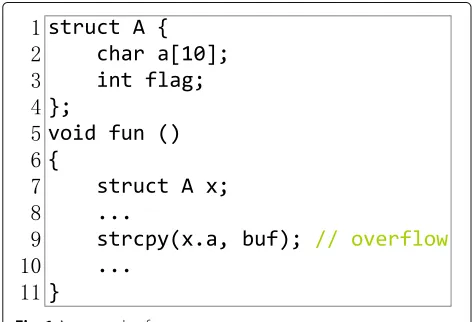
Figure1shows an example of write across boundary, a common memory access error. When the functionfun
copiesbufto arraya[10], no boundary checking is per-formed, so the integer variableflagcould be overflowed.
Detection of memory access error
Memory access errors are not only bugs that may lead to a program crash, but also severe vulnerabilities that could be exploited by attackers. Many attacking meth-ods like ROP (Checkoway et al.2010; Roemer et al.2012; Buchanan et al.2008) rely on memory access errors, such as buffer overflow or dangling pointers, to trigger the first step. Therefore, researchers have been working on vari-ous detection methods to check memory access errors in software.
One group of detection methods aim to help software developers find and correct memory access errors in soft-ware development, so these methods require support from compilers and other tool chains. AddressSanitizer (ASan) (Serebryany et al.2012) is an open source compiler extension developed by Google. It is based on redzone instrumentation in compilers. Redzone is a technique that adds various types of special memory segment between memory areas. When out-of-bounds access happens, the memory operation will first access the redzone memory areas, which will trigger a warning. In the hardware field, Intel MPX (Memory Protection Extensions) (Oleksenko et al.2017) is a set of extensions to the x86 instruction set architecture. Intel MPX brings increased security to soft-ware by checking pointer references. It checks if pointer references casuse a buffer overflow at runtime. MPX can detect the intra-object-overflow vulnerability, but it also needs source code. WIT (Akritidis et al.2008) uses points-to analysis at compile time points-to compute the control flow graph and the set of objects that can be written by each instruction in the program. Then it generates code instru-mented to prevent instructions from modifying objects that are not in the set computed by the static analysis.
Fig. 1An example of memory access error
Softbound (Nagarakatte et al. 2009) is a compile-time transformation for enforcing spatial safety of C. It records base and bound information for every pointer as dis-joint metadata based on the static analysis of the source code. However, all these methods rely on source code information. They are not suitable for analyzing binary code.
Another group aims to detect memory access errors in a binary environment. These methods get necessary information from binary and do not need source code assistance. Memcheck plugin of Valgrind (Nethercote and Seward2007b) aims to recover memory bounds at run-time and enforce a set of security policies to detect various memory corruption bugs. Memcheck monitors heap memory allocation/deallocation to infer the bounds between heap chunks. Valgrind also leverages redzone
technology to do memory error detection. However, Val-grind only inserts redzones between coarse-grained mem-ory chunks, so it is not able to detect fine-grained memmem-ory access errors inside one memory chunk.
Dr. Memory (Bruening and Zhao 2011) is a method introducing a feature called “nudge” to allow users to request a leak scan at any point. it mainly utlizes shadow memory to maintain the status of each memory bytes and cannot detect fine-grained memory access errors.
Fine-grained memory access error
A fine-grained memory access error happens when a member variable inside a data structure is overflowed. An attacker can use this overflow vulnerability to control another member variable to exploit the program. Usually, this type of overflow does not exceed the memory chunk boundary and does not lead to a program crash.
Figure2illustrates a fine-grained memory access error in a link list node. First, a large memory chunk is allo-cated for storing one link list node. Next, member vari-ables are initialized as shown in Fig.2b. The object has a buffer which is prone to be overflowed. When an over-flow happens, the out-of-bounds-write will write in other members such asnext. If the overflowed member vari-able can be exploited to control program execution, the vulnerability is very dangerous.
(a)
(b)
(c)
Fig. 2An example of fine-grained memory access error.buffer overflowsnextinside the same memory chunk
code to do fine-grained detection. These methods are still not feasible for detection of fine-grained memory access errors in binary code.
Challenges
For detection of fine-grained memory access errors as shown in Fig. 2c in binary code, necessary information regarding boundaries of memory ranges have to be col-lected. The most important challenges are summarized as follows.
Missing boundary. To detect out-of-bounds memory write, the boundary information for memory access oper-ations is necessary. Although it is possible to build up some coarse-grained boundary for memory chunks by tracking heap allocation and deallocation, the accurate boundaries that separate sub-fields inside a data object is
still missing. For example, the boundary information of buffer and list node in Fig.2c is lost in the binary code.
Lack of pointer information. Suppose the necessary boundary information is available, it still remains chal-lenging to judge wheth-er a pointer based memory access is valid due to the lack of pointer information, e.g., which pointer is valid for accessing a memory range. In other words, we need an accessing policy to check wheth-er a pointer is legally accessing memory blocks.
Overview
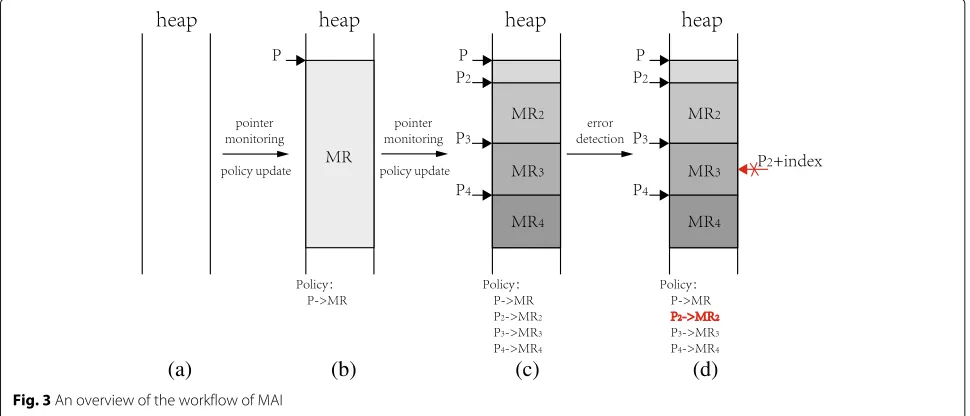
In order to overcome the limitations, we propose Mem-ory Access Integrity (MAI), a novel dynamic method for detection of fine-grain-ed memory access errors in off-the-shelf binaries. Our method monitors memory access behaviors during runtime and reports warnings when ille-gal memory access happens. This is done by building and maintaining a fine-grained memory model to describe the relation between pointers (memory access location) and the range of memory objects. Figure 3 shows a typical step-by-step workflow of our method.
As shown in Fig.3a, no memory chunk is allocated on the heap at the beginning of program execution. Next, when the program requests a memory chunk and the address is stored in pointerP, we create a policy showing
Pis feasible to access the range of the memory rangeMR
as shown in Fig.3b. When the program usesPto access a member variable inside this memory chunk, we record the new memory access address and the related memory range. As shown in Fig. 3c, P2,P3, P4 point to different memory sub-regions inside this memory chunk and dif-ferent gray blocks represent the memory range they can access. The policy is also updated accordingly. In Fig.3d, when the pointerP2is used for out-of-bound accessing the memory block, it violates the policy so our system reports a memory access error.
(a)
(b)
(c)
(d)
Memory access integrity
Design principle
As the key method in our work, we introduce the con-cept of “Memory Access Integrity” (MAI) to describe and check whether a memory access is legal or not. The key idea is inferring the boundary of memory objects from the relation between pointers and memory chunks on the fly. With this information, we recover the memory access policy and use it to check memory access behaviors.
Memory Access Integrity is guaranteed by policy check-ing. More specifically, policy in this paper refers to a set of rules. Each rule is a pair defined as follows. It restricts a memory range to be legally accessed by any pointers inside a pointer set.
Definition 1A rule is a pair (PS, MRR), where PS is a set of pointers and MRR, Memory Range Record, is a memory model for describing memory range and state.
The rules in a policy are inferred from program execu-tion. We achieve this by monitoring pointers dynamically, maintaining a new memory model to describe the bound-ary and life cycle of memory objects, and inferring the relation between pointers and the memory model. Before digging into the details of how we complete these tasks in our method, we provide an intuitive example to walk through these steps. The example presents the following two key insights into our method.
1 The first write operation associated with a pointer can help us know the “point-to” relation between a pointer and a memory chunk.
2 The “base+offset” addressing scheme can be leveraged to infer the ownership between memory chunk and pointers.
An example for walk-through MAI
We use a concrete example to quickly walk through MAI. Figure4presents the source and assembly code related to the motivating example in Fig.2.
The example shows operations on a linked list. We will elaborate on how we build the relation between pointers and memory chunks and the relation between memory chunks. At line 7 of the left hand side of Fig.4,the program allocates anodeobject and we obtain its address and size. From the instruction at Line 9, thenodepointer is used as the base address to calculate the address ofnode->next
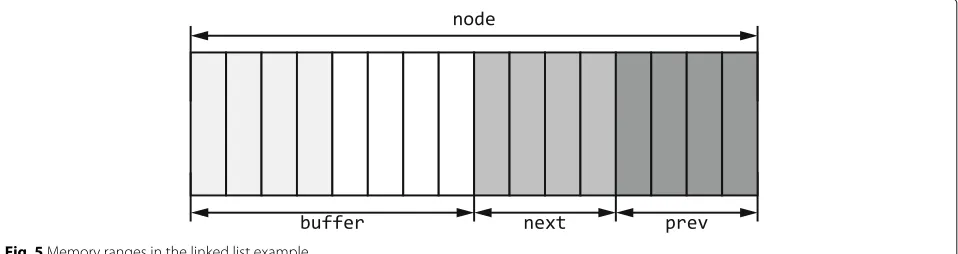
and write 8 bytes in this space. So we know that an 8-byte sub-region begins at the offset 0x88 is used in this memory chunk. Similarly, at line 11, thenodepointer is used as the base address to get its sub-region,buffer. Figure5shows the relation between pointers and memory chunks and the relation between memory chunks after the program execution.
Memory range record
As the core part to support memory access integrity, we design a new memory model called “Memory Range Record” (MRR) to record the fine-grained boundary and life cycle of memory objects. In this section, we first present the concept of MRR and then elaborate vari-ous types of actions on MRR, including generation, range setting, and deletion. Specifically, we introduce how we gradually divide a memory chunk into sub-regions in a fine-grained way based on the memory access pattern of executed instructions.
MRR and MRR tree
In this paper, a Memory Range Record (MRR) is a tuple defined as follows. It describes a memory range and the state of the range. For every MRR, we assign a unique ID number.
Definition 2A MRR is a tuple (id, start, end, state), where id is a unique number, start is the starting address of the range, end is the ending address of the range, and state is one of uninit, used, or free.
MRR is constructed during program execution. In gen-eral, our method creates a new MRR by capturing two types of memory access patterns as follows. These pat-terns reveal information such as the location of memory objects and pointers to access them. More details of MRR generation is elaborated in SectionMRR generation.
1 A new memory chunk is allocated, e.g.,mallocis called.
2 A memory object is accessed bybase+offset
pattern.
In real world software, memory access patterns are com-plex. A very common situation is data structures, which usually have various levels of nested memory ranges. In order to tackle this problem, we organize MRRs as a tree structure. The child MRR is a sub-range of its parent MRR. Our system generates child MRRs by capturing the
base+offsetpattern. When the basepointer is the starting address of the parent MRR, thebase+offsetis the starting address of the child MRR.
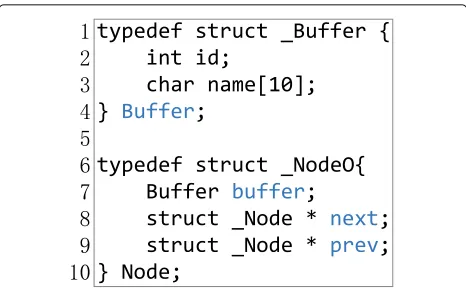
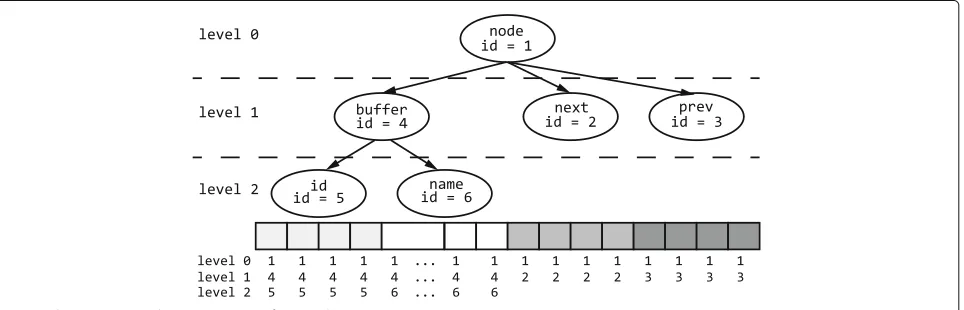
For example, Fig.6 is a linked list node structure. We will build a multi-level MRR model like Fig. 7. MRR
nodecovers all 22 bytes of this linked list structure. MRR
bufferaddressed bynodeaddress has the child MRR of
node’s and covers 14 bytes of this structure. MRRname
addressed bybufferaddress has the level 2’s MRR and covers 10 bytes of this structure.
MRR generation
Fig. 4The source code and assembly code of the linked list example
and child MRR. We have different generation methods for them. A root MRR describes a memory block allocated by the system. e.g., a memory chunk returned by malloc. When the system allocates a block of memory, the start-ing address and block length are known. We generate a new MRR tree and set the root MRR node according to the information of the newly allocated memory block. The root MRR generation rules also apply to stack mem-ory. We identify the stack subtraction operation(e.g.,sub rsp, 0x20) near the entry point of each function as the allocation operation of the stack memory block and generate a new MRR tree for stack memory block.
We generate child MRR based on the “base+offset” memory access pattern. Base-pointer addressing (e.g.,
newptr=ptr+index) assigns a new pointer that is the sum of an offset value and a base pointer. This operation reveals fine-grained boundary information of memory objects, because it is frequently used for accessing a mem-ber in a data structure. The data structure starts from the address of the base pointer, and the member locates at the offset address in that data structure. Therefore, for all “base+offset” memory accessing patterns, if the base is already the starting address of a MRR A, we generate a new child MRR forA.
MRR length
The last section discussed two rules to generate root MRR and child MRR, but we only mentioned getting the start-ing address from memory allocation or base pointers. We still need to find the ending address so as to get the complete boundary of a memory range. Because we are working on binary code, source code level information such as type and data structure is not available. We have to infer the memory range length from the instructions in program execution.
Our method uses a heuristic to infer the length: the first “write” operation to the memory range. Typically, a mem-ory range is initialized by the first write operation after it is allocated, so the initialization “write” naturally covers the whole memory range and reveals the boundary infor-mation. Therefore the length of the first write operation is a good heuristic for inference of the length of the memory range.
We still use the linked list example to explain how to decide the range of a MRR. As shown in Fig.8, the code initializes the linked list node. The code of line 2 in left hand side of Fig.8and line 6 in right hand side generates a root MRR fornode. The calculation operation of line 3 in left and line 9 in right generates a child MRR ofnode
Fig. 6A linked list node structure
fornext. The memory write operation at line 9 writes 4 bytes, so we set these 4 bytes as the accessible range of pointernext. Similarly, Line 11 applys the same opera-tion. Assuming the id of thenodeMRR is 1, MRR id of
nextis 2, MRR id ofprevis 3, MRR id ofbufferis 4, MRR id ofbuffer.idis 5, MRR id ofbuffer.nameis 6, the memory identifier map is shown in Fig.9.
In practice, the first write operation does not always write all memory range inside the boundary. There could be situations when the first write operation writes a larger or smaller memory range. We provide a detailed discus-sion in Section First write. Our discussion result shows that no matter the first write operation write more or less memory chunks, MAI can still correctly detect the memory access errors.
MRR state
In addition to the starting and ending address, MRR can record the state of the memory range. This is important for policy checking. Our system records three different states in the life cycle of a memory range: uninit, used, andfree. When a program allocates a block of memory, the state of the MRR is uninitialized (uninit). After some value is written into the memory range, the MRR state will be changed to (used). When the operating system free the memory area, the according MRR state is changed to (free). Figure10shows the memory state transition dia-grams. The state is used for detection of memory access errors as shown in “Error detection” section.
MRR deletion
After a memory block is freed, no pointer should be able to access this memory; otherwise, it is a use-after-free error. In our multi-level MRR system, we remove the accord-ing MRR tree, mark its state asfree, and also delete the id number. Particularly, the operating system only free a memory block which has been allocated before, so corre-spondingly, the root MRR and the whole tree are deleted in our system.
Pointer monitoring
So far we have elaborated the system we designed for record fine-grained memory boundary and state. As shown in “Design principle” section, MAI policy describes legal accessing relation between a set of pointers and MRRs. Therefore, we also need to monitor the pointers inside the target program.
Fig. 8The source code and assembly code of initializing the linked list node
Since the core rule of MAI is (PS, MRR), we only take care of the memory pointers associated with MRR. We get these pointers naturally from the two ways of MRR generation in5. One is from the program’s allocation oper-ations. When the system allocates a chunk of memory, the pointer it returns is the target pointer we want to moni-tor. Because this operation means the return pointer can access the chunk of memory. Another way is the program’s base-pointer addressing operation. In this operation, we will generate a new MRR and the new base+offset
pointer is our monitoring target.
In the process of pointer monitoring, we also moni-tor the behavior of using the tainted pointer for memory operations. These memory operations include memory reads, memory writes and memory free. Memory read and write operations are performed by using a tainted pointer to read and write memory bytes. The memory free opera-tion is the system’s deleopera-tion of the memory chunk pointed by the tainted pointer. We insert the MAI integrity check before these operations to ensure the security of the pro-gram.
In practice, pointers may have various aliases, e.g., dif-ferent pointers pointing to the same address. In our system, we tackle the pointer alias problem by dynamic multi-tag taint analysis. We keep track of the propagation of pointers and taint all aliases of a pointer with the same tag.
Policy
After introducing MRR and pointer monitoring, now we can associate a pointer set with MRRs to build the MAI policy (PS, MRR). Every MRR is connected to those point-ers that can access the starting address of this MRR. In another words, a rule (PS, MRR) means the pointers inside PS should be used to access the memory objects inside the range of MRR.
In general, the policy in MAI can be formally interpreted as follows.
Definition 3 A memory accessbase+offsetis legal, if and only if:
ifbase∈PS,base+offsetmust be in MRR.
Fig. 10MRR state transition
Particularly, pointers associated with a MRR is also legal to access all its child MRRs, because all child MRRs are sub ranges. In our multi-level MRR systems, this feature also helps us track more information when an overflow happens, e.g., the offset to the head of the memory chunk, where this chunk is allocated. The information is essen-tial in program analysis and it can save lots of time for analysts.
When a memory out-of-bounds-write occurs, we can know where the vulnerable memory area is allocated in the code segment based on the pointer used, which sub-region of the memory block it belongs to, what is the offset to the first byte of the memory chunk and where is the memory block allocation by its parent node, and so on, etc.
For example, when we detect thenamein Fig.7which has an overflow vulnerability, we can know that thename
memory region is the sub-region of buffer and the
bufferis the sub-region ofnode. So we know where this vulnerable memory is allocated, where vulnerable mem-ory is written, what the boundaries inside this vulnerable, and much other useful information. All this information can be queried by this pointer’s MRR chain.
Error detection
Previous sections present the detailed mechanism of MAI. In this section, we describe how to detect fine-grained memory access errors based on MAI system. In general, we examine whether a pointer violates MAI policy from the following two aspects.
1 The pointer is accessing correct location.
2 The pointer is performing correct operation on the memory state.
If one of the aspects failed to pass the detection, an alert indicating memory corruption is automatically reported.
By checking different combinations of pointer opera-tions and memory states, MAI is able to detect three memory access errors as shown in Table1.
Table 1Operation type error: the type of error generated by different types of operations accessing different memory states
Type
State Uninit Used Free
read unintialized-read - read use-after-free
write - - write use-after-free
deallocation - - double-free
allocation chunk overlap chunk overlap
-‘-’ indicates legal access
If the memory access behavior uses a pointer in PS and its address is not inside the corresponding MRR, this is an out-of-bounds error. In this violation case, we could furthermore perform root cause diagnosis, as is shown in Table2. If the victim memory chunk of the invalid mem-ory access is not of root MRR, we are able to draw the conclusion that this out-of-bounds error happens inside a memory chunk. For example, If an out-of-bounds error happens in the heap and the level of the overflowed mem-ory’s MRR is not the root MRR, this error is a fine-grained memory access error.
In addition to the vulnerability types, we also provide some information about Trouble-Shooting. Because we can get the MRR generation address, MRR base address, and parent MRR node by querying the MRR tree. We can get the information about where this memory chunk is first to be written, what the overflowed memory region belong to, where is this memory chunk allocated and so on.
Implementation
This section presents the implementation details of MAI. We implement MAI as an enforcement tool based on the valgrind dynamicbinary instrumentation framework (Luk et al.2005; Hundt et al.2005).
We reused the translation, IR statement analysis and instrumentation of the intermediate language VEX of the Valgrind framework. The core technique is dynamic instrumentation. We insert vex statements to implement the function of MAI, like pointer monitor, MRR maintain-ing. The whole implementation includes about 4,000 lines of C code in total.
Pointer monitoring.The pointer monitoring function is implemented based on taint analysis. We use a dynami-cally expanded shadow memory to taint the pointer store
Table 2Four types of pointer overflow error according to overflow location
- Heap Stack
inside intra-heap overflow intra-frame overflow
address with MRR id. Shadow memory (Nethercote and Seward2007a) consists of shadow bytes that map to indi-vidual bits or one or more bytes in main memory. In order to save space, the size of the shadow memory is dynam-ically expanded. When the pointers are propagated, we copy the id to another. Unlike taint analysis, our imple-mentation uses fewer but sufficient rules which is men-tion in Secmen-tionPointer monitoring. This implementation allows us to circumvent many traditional problems of taint analysis, like overtainting and undertainting, because we greatly reduce the instruction complexity of tracking taint.
MRR record.We record the MMR id and memory state information on another dynamically expanded shadow memory, in order to ensure that the pointer monitor-ing shadow memory will not disturb the content of the MMR’s. Other MRR information is recorded in a global variable as a tree structure, which can be queried by MMR id. We allocate 16-bits shadow memory for each byte. The high 14-bits used to record memory privilege identifier and the low 2-bit used to record memory state.
Policy.The method we build MAI policy (PS,MRR) is implemented by id field. Pointers to be monitored are tainted with an id and MRR has an id field. We bind the pointers and MRRs with the same id, which means the pointers should be used to access the memory objects inside the range of MRR with same id.
Error detection.We insert MAI policy detection before five types of operation: base-pointer addressing operation, read operation, write operation, allocation opertaion and deallocation opertaion. Before these operations, we exam-ine if the id of pointer and target address’s MRR are equal and if the memory state match the opertaion type.
First write
As mentioned earlier, the method we use to determine the MRR length encounters two problems, the length of the first write is less than the actual length of MRR and the length of the first write is longer than the actual length.
In the situation that the length of the first write is less than the actual length of MRR. The MAI will automat-ically expand the range of this MRR, when the remain-ing range of this MRR is written for the first time. The first write operation is longer than the actual length is undoubtedly a malicious operation and may break the program. we will describe how we detect this situation.
There are two situations to discuss here. We will use the structure shown in the Fig.11as an example. In this exam-ple, the program will write 6 bytes to the arrayawhich is an overflow operation. In the first situation, theswitch
variable of the program has been written before the over-flow operation. Shown in the Fig.12-a, theswitchhas already been set a MRR(id=2). When program wants to use arraya’s MRR(id=3) to accessswitch’s MRR(id=2), we will detect this overflow error. In the second situation,
Fig. 11An data structure showing first write
the switchvariable of the program has not been writ-ten before the overflow operation. Shown in the Fig.12-b, theswitchhas no MRR. In this case, we will temporarily recognize the overflow operation as a normal operation and sets a MRR(id=3) whose size is larger than it should be. Since the switchhas not been written to the data, this setting will not cause malicious consequences. When the program reads or writes the variableswitchfor the first time, this error can be detected because MAI finds that the memory already has a MRR. This is a kind of delay detection.
Evaluation
In this section, we present the evaluation scheme and result of MAI. Basically, we design experiments to answer the following three research questions.
1 RQ1:Is MAI able to detect various memory access errors?
2 RQ2:How many false positives and false negatives can MAI produce?
3 RQ3:What is the overhead of MAI?
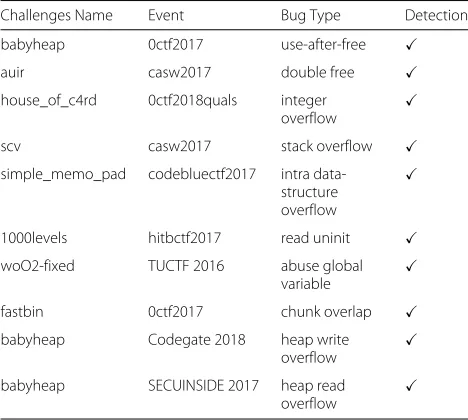
As the response to RQ1, we first apply MAI to a CTF problem set including 10 examples of different types of memory access errors. To check MAI’s effectiveness in practice, we run MAI and Valgrind on 10 real-world pro-grams and compare the result. We also elaborate a case study to give a detailed answer to RQ1. As the answer to RQ2, we apply MAI to 50 randomly selected CTF pro-grams and check the result of false positives and false negatives. In response to RQ3, we compare MAI’s perfor-mance with Valgrind.
The evaluation runs on a 64-bit Ubuntu 16.04 desk-top and 4GB RAM. MAI is complied by GCC 5.4.0. The Valgrind version is 3.14.
CTF challenges
(a)
(b)
Fig. 12Different cases of first write(weight score≥25) from popular CTF events in the past two years. Weight score is an per-event value, depends on tasks and organization level, participated teams or pre-vious years weight used. Events with high weight score means that they are widely known and their competition programs have a high quality.
Table3present the evaluation result. The first and sec-ond column shows the name of challenges and the event name. The third column shows the type of memory access error in that challenge. The last two columns present MAI’s detection result and the error type.
Table 3The detection result of MAI on CTF challenges with ten different memory corruption bugs
Challenges Name Event Bug Type Detection
babyheap 0ctf2017 use-after-free
auir casw2017 double free
house_of_c4rd 0ctf2018quals integer
overflow
scv casw2017 stack overflow
simple_memo_pad codebluectf2017 intra data-structure overflow
1000levels hitbctf2017 read uninit
woO2-fixed TUCTF 2016 abuse global
variable
fastbin 0ctf2017 chunk overlap
babyheap Codegate 2018 heap write
overflow
babyheap SECUINSIDE 2017 heap read
overflow
The evaluation result shows that MAI successfully detects all memory access errors and reports the correct error type in all test programs. Particularly, the “abuse global variable” error type from the challenge “woO2-fixed” is an out-of-bounds access caused by a dangling pointer, which points to a memory block that has been previously freed but reallocated. Since the newly allo-cated memory has a different id than the pointer, MAI successfully captures this memory access error.
Real world programs
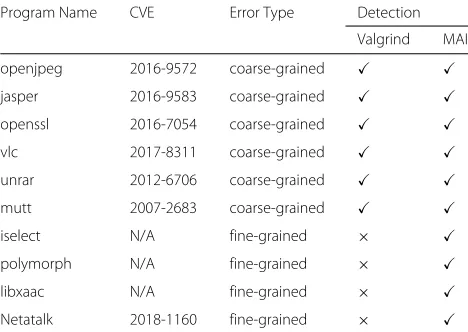
In order to evaluate MAI’s capability in practice, we apply MAI and Valgrind to 10 real-world programs with known memory access errors and compare the detection result. Openjpeg and Jasper are Image toolkit, OpenSSL is a toolkit for the Transport Layer Security (TLS) and Secure Sockets Layer (SSL) protocols. Vlc is a video player. Unrar is a compression software. Iselect is an interac-tive line selection tool for textual files and Polymorph is a filesystem. libxaac is an audio decoder library. Mutt is a command-line email client. Iselect and Polymorph are obtained from the BugBench suite (Lu et al. 2005). The rest eight programs are obtained from Exploit-db and cvedetails.com.
We present the detailed description of the experiment as follows. AFL mutates the provided seed corpus and then feed them to the target program libxaac and MAI runs libxaac to accept the input. MAI detection tool detects if the input causes memory access errors. If it has, we will manually analyze this bug based on the error report. At the beginning of the program, it will allocate a large memory (64MB) to store its data structures. It means the program store many structures in a memory chunk. If one of these structures can be overflowed, other structures will also be affected and this overflow does not cross the boundary of this large memory chunk. Thus this overflow is an intra-frame heap overflow. We have fuzzed three data structures with this vulnerability.
Table 4 lists the program name, CVE numbers and the detection ability of MAI and Valgrind. MAI with full checking was able to detect and prevent all of the errors.The bugs of program iselect, polymorph, libxaac
and netatalk is intra-frame overflow. An attacker will first overflow some intra-frame local variables, then over-flow the out-frame variable to hijack control over-flow. MAI can detect this overflow when an attacker overflows the first intra-frame local variable, but Valgrind memcheck detects this overflow when the attacker overflows the out-frame variable. We will explainNetatalkwith intra-frame overflow as an example.
A case study
Netatalk is an open source file sharing erver. An UNIX, Linux or BSD system running Netatalk is capable of serv-ing many Macintosh clients simultaneously as an Apple-Share file server(AFP).
The vulnerability in Nettatalk 3.x is shown as the fol-lowing code13. Missing length check of the arguments in
memcpyis the root cause.
In this function,dsi->commands is under the con-trol of the attacker. The variable dsi->commandsis a
Table 4The comparison detection result on 10 real programs
Program Name CVE Error Type Detection
Valgrind MAI
openjpeg 2016-9572 coarse-grained
jasper 2016-9583 coarse-grained
openssl 2016-7054 coarse-grained
vlc 2017-8311 coarse-grained
unrar 2012-6706 coarse-grained
mutt 2007-2683 coarse-grained
iselect N/A fine-grained ×
polymorph N/A fine-grained ×
libxaac N/A fine-grained ×
Netatalk 2018-1160 fine-grained ×
char array and the size parameter is limited to a maxi-mum value of 255. So an attacker can write up to 255 bytes starting from the address of thedsi->attn_quantum
which is a 4-byte integer.
attn_quantumis a member of the structDSIwhich is allocated in a 10096 bytes chunk in the heap. The part of this struct is shown as code14. Because of only 251 bytes we can overflow, the members can be con-trolled aredatasize,server_quantum,serverID,
clientID, the commands pointer, and partially into
data. The overflow bytes cannot write over the boundary of this heap chunk.
Luckily the life of thecommandspointer begins shortly after a new connection is forked to its own process.
commandspasses through the system based on a global jump table pointer defined in etc/afpd/switch.c called afp_switch, so the exploit of this vulnerability is feasible.
The initialization of this struct is shown as code15. In line 4, the program allocates 10096 bytes in heap. In MAI, we generate a new MRR(LV0) for this heap and taint the pointdsiwith this new MRR id.
In line 7-9, the program initializes attn_quantum,
server_quantum and dsireadbuf. According to the offset to the pointer dsi, we generate three new MRRs(LV1) and set these MRRs as the child node of the pointerdsi’s and taint their own pointers.
As mentioned in SectionMemory range record, we taint the shadow memory bytes according to the bytes first written by the pointer. This processing will set the range pointer can access. So when the functionmemcpywants to overflow the memberdsi->server_quantumwith the pointerdsi->attn_quantum, MAI will detect this error.
Valgrind sets memory boundaries based on the size of heap chunks, but this overflow operation happens inside a heap chunk and does not over the chunk boundary. There-fore, Valgrind cannot detect this overflow vulnerability.
False positives and false negatives
We evaluate the false positives and false negatives by test-ing 50 CTF programs from 25 CTF events whose weight are higher than 25. We randomly select programs which have memory access error vulnerability in these CTF events to ensure the randomness of the testing. The result shows that the false positive rate is 4% and false negative rate is also 4%.
Fig. 13Netatalk vulnerable code
MRR(with offset 0). So when the MRR(with offset 0) to write the MRR(with offset max length), MAI will report an OOB error which is a false positive. Another example is using different operations to write an int array. When the array is initialized, the program uses the following code in Fig.16.
For each int variable, we give it an MRR that can access 8 bytes, but this array is used later. The source code is shown in Fig.17.
In our MRR’s detection rule, line 3 is an OOB error which is a normal operation. The above two cases have not appeared in other test cases, so these two cases may rarely appear in other programs. These two types of false posi-tives are also well investigated according to the context of error reporting and error reporting points.
There is also other special operation, for example, some functions in glibc, such as malloc, free. They will use a pointer to over-access another memory chunk to do some safety checks. These operations will lead to false positives.
Our solution is to stop memory bounds detection when the program runs the code in libc which will probabally raise false positives.
False negatives are mainly caused by the memory access errors occurring at the locations where MAI does not monitor, such as a global variable in .data segment or function pointer in the .got segment. It is because the generation of the root MRR is based on the program allocation operation. But in the case of the above segment, it has been allocated before the pro-gram is running. So we cannot generate an MRR for this place and cannot detect out of bounds accesses in these places. In addition, since the use of memory on these segments usually directly show as a memory address rather than a form of base_point+offset, it is difficult for MAI to tell if it is a pointer or just an integer value. We provide a manual extension to mark memory pointers and memory bytes. Users can track and do boundary detection on any pointers,
Fig. 15The initialization code in Netatalk
including global variables and function pointers in the .got segment.
Performance
In this section, we evaluate the runtime overhead of 10 real programs. The average overhead of MAI is around 2-26 times (Fig. 18). The black part is MAI’s overhead, and the gray part shows the overhead of Valgrind. In most cases, MAI’s overhead is a little higher (less than twice) than Valgrind’s overhead, and there are also some cases that MAI is lower than Valgrind. The reason is that when we do the optimization, we remove some of Valgrind’s own functions and instruments, such as the execution state of the statement, and greatly optimize the memory read and write of our own system.
There are two primary sources of overhead in MAI. One of the sources is that Valgrind still has the operations that are not necessary for the implementation of MAI. Another source is the runtime overhead of metadata accesses. Fre-quent reads and writes to shadow memory are required in the generation of new MRR and detection of MRR’s queries. In Fig.18, challenges like scv, Houseofcard, Auir and programs like dnstrace, ncompress have few MRRs, so the overhead is low. However, programs like netatalk
andlibxaacgenerate a large number of MRRs due to fre-quent heap memory allocation operations and complex data structure.
Fig. 16The first method of initializing arrays
We also observe that larger number of MRRs leads to higher cost. In our design, we generate a new MRR for each member variable of each data structure to achieve the effect of fine-grained detection. Reuse of a member variable does not generate a new MRR. Therefore, the number of MRRs in the MAI is only related to the number of data structures owned by the program itself. The num-ber of data structures in a program is limited, so the cost is acceptable.
Related work
In this section, we introduce the background of this research and the line of work closely related to our work. The research areas mostly close to ours are exploit mitiga-tions and data-structure recovery.
Exploit mitigations
Control flow integrity (Abadi et al.2005; Kuznetsov et al. 2014) leverages static analysis and program instrumen-tation to guarantee the runtime control flow follows the precomputed correct control flow graph, and thus could detect and prevent an important exploit vector: control flow hijack, however, CFI only detects exploit attempt when the control flow deviates from the legit control flow graph, if the exploitation does not involve control flow vio-lation (e.g., Data-Oriented Programming (Hu et al.2016)), CFI is not able to detect the exploit. Data flow integrity is another technique which prevents invalid read and writes operation by calculating a valid data flow graph at com-pile time. Object Type Integrity (Burow et al. 2018) is
Fig. 18MAI and Valgrind overhead for 10 real programs
designed to protect the programs written in C++ as an orthogonal policy as CFI. OTI tracks the assigned type for every object at runtime. When the object’s type is used for dynamic dispatch, OTI can verify that the type is uncor-rupted. OTI get object information while a program is compiled.
Memory corruption detection technique
Traditionally, dynamic vulnerability analysis technique relies on explict signals such as software crash or sys-tem panic to determine whether a sink point is reached. However, this result in a lot of false negatives because an input which triggers a memory corruption vulnerability does not necessarily crash the target program. To facili-tate detecting trigger of vulnerabilities and analyzing root cause, a majority of research works focuses on design cor-ruption site sensitive vulnerability detection technique to identify orrurrence of memory corruption as early as pos-sible. Another important area of researchis vulnerability detection technique designed to find vulnerability at the site corresponding to the root cause of the vulnerabil-ity. These works are closely collaborate with vulnerability discovery technique (e.g., fuzzing) to generate sink point closer to the memory corruption site.
Based on dependency on source code information, the vulnerability detection technique can be catogorized into two families, one relies on source code information while the other does not. AddressSanitizer (or ASan) (Sere-bryany et al.2012) is an open source compiler extenstion
developed by Google that detects memory corruption bugs such as buffer overflows or dangling pointer accesses (e.g., use-after-free). AddressSanitizer is based on com-piler instrumentation and directly-mapped shadow mem-ory. Asan detects memory overflow error by inserting a special memory between two adjacent memory blocks during program compilation. Wookhyun et al. (Han et al.2018) enforces two extra properties and achieve bet-ter memory corruption detection performance. Although the above approaches incurs a relatively low runtime overhead, it also changes the memory layout, making it tricky to detect some special vulnerabilities. Of course, the dependency on source code is a major difference between address sanitizer and our work.
Another research direction is designing and devel-oping binary analysis tools which are able to per-form vulnerability detection without source code. The lack of type information brings a lot of challenge to vulnerability detection. Valgrind is an instrumentation framework for building dynamic analysis tools. Its core memory error detector—memcheck—detects memory-management problems, primarily for detecting memory corruption for program compiled from C and C++ lan-guage. When a program is executed under memcheck’s supervision, all memory read and write operations are checked, and calls to malloc/new/free/delete are inter-cepted.
information, however, as is shown in “Real world prog-rams” section, such coarse-grained type boundary infor-mation is not enough to detect some intra memory chunk corruption.
Data structure recovery
In the absence of type information(e.g., debug info, symbol-table), approximating and inferring data structure is a very challenging research topic. Gogul addresses the problem with value-set analysis (VSA) in (Balakrishnan and Reps2005), they show the effectiveness by identifying arrays, local variables, and heap-allocated data structures. Asia (Slowinska et al.2010) uses a dynamic approach to extract data-structure. These works are similar to ours in the sense that we are both able to extracting information related to the data structure and its sub-fields. However, these works do not provide us the ability to decide the privilege of instructions tied to memory chunks, including its subfields.
Traditional data structure recovery is different from memory bounds recovery techniques for memory error detection. Traditional data structure recovery techniques focus on restoring all data structures as accurate as pos-sible. But for memory bounds recovery techniques in the field of memory error detection, we only need to recover the memory bounds corresponding to pointers used by the program during the running of a process. VSA (Balakrishnan and Reps2005) shows the effectiveness by identifying arrays, local variables, and heap-allocated data structures. Asia (Slowinska et al. 2010) uses a dynamic approach to extract data-structure. The accuracy of these techniques is around 80%-90%. However, these data struc-ture recovery techniques do not consider time sequence of memory access which is important for memory error detection. For example, DDE uses the spacing between different offsets to decide the range of a pointer. This method cannot provide the information whether a block of memory is written or not. So it is hard to detect some temporal safety memory error likeuninitialized-readand
use-after-free. Moreover, it is not enough to recover the data structure. We also need the relationship between pointers and memory used during the running of the program. Additionally, it is necessary to provide informa-tion pertaining to the root cause of the vulnerability with more details. Traditional data structure recovery tech-niques cannot provide this information. In this paper, we use a new technique to get memory bounds information mentioned in SectionMemory range record.
Conclusion
In this paper, we focus on an interesting and challeng-ing research problem: detect fine-grained memory access errors in binary code. While plenty of research works have been proposed to explore memory corruption detection
with the help of source code and type information or some basic runtime memory usage information, they are barely useful to recover fine-grained memory bound-ary information for binbound-ary executables and thus fail in some memory corruption detection. We propose Mem-ory Acess Integrity, an effective method to infer and check the memory access policy between pointers and memory blocks. We implement a prototype system that facilitates memory access error detection for off-the-shelf binaries and prove the effectiveness of our method.
We demonstrated the utility of MAI with various cate-gories of memory corruption bugs, MAI is able to detect all of the evaluated memory corruption bugs and facilitate root cause diagnosis. MAI’s ability to recover fine-grained memory boundary significantly improve the detectability of memory corruption bugs happening in a single stack frame or a single heap chunk. We plan to release the source of our current implementations as well as migrate the implementation to Valgrind platform. In addition, we will explore to find the theoretic upper bound of mem-ory boundary information that could be extracted from binaries.
Discussion
In this section, we discuss three limitations of MAI, which lead to false positives and false negatives. Then we discuss the solutions taken in two special cases and the risks that may arise.
Compiler optimization. The compiler optimizes the program when it compiles the source code into binary. To minimize the time taken to execute a program, the compiler uses optimization strategies like peephole opti-mizations, local optiopti-mizations, loop optimizations and so on.
MAI method is based on the “first write” and “base+offset” addressing operations. the “first write” oper-ation in MAI’s design decides the length of an MRR. It means the length of the memory region that can be used in a memory object. The length also reflects the “valid” area of the memory object. The compiler’s optimization oper-ation may reduce the number of variables and increase or decrease the initialization length of the variables, but there is no case like initializing 10 bytes but using 15 bytes. So the change of “first write” operation do not cause false positives of false negatives.
between the memory objects and page start address. In this situation, the MAI method generates a root MRR node at the start address of each page and restore the sub-regions inside each page. This memory model is different from the original data structures but does not affect the MAI detection process.
If optimization strategy make the “base+offset” address-ing operation of the same memory object inconsistent, this kind of strategy leads to false positives. For exam-ple, compiler may merge some consecutive pointer offset operations, like merging "p2 = p1+offset1 p3 = p2+offset"to"p3 = p1+offset". After this opti-mizated operation, MAI method generates a child MRR node of p1’s MRR node for p3, but actually p3’s MMR should be the child MRR node ofp2’s. If and only if pro-gram uses pointer p2 to access p3’s MRR range, MAI method reports a false positive error.
Union data structure.The union data structure causes false positives in the MAI method. This is a limitation. In future work, we will use union data structure identifi-cation techniques to solve this problem. Fortunately, the union data structure is not common in programs.
Global variables. MAI method can check heap and stack objects access. However, due to the lack of alloca-tion operaalloca-tion before the global variable is used, the MAI method cannot achieve automatic monitoring of global variables. We try to identify global variables by static anal-ysis, but this method produces many false positives and false negatives. In future work, we will use other global variables identification techniques to solve this problem.
Delay detection.Mentioned in subsectionFirst write, we use “delay detection” solution to detect “malicious first write” error. This technique can stop exploit before it causes harm, but it still causes data pollution. In addition, there is a problem with the location of the vulnerabil-ity in the error report, because it is difficult for MAI to determine whether the location of the vulnerability is the previous overflow write operations or an out-of-bounds access by the new pointer.
Redundant MRR node.When the MAI method han-dles some operations, it generates redundant MRR nodes, which does not affect the detection of MAI but generates extra time overhead. There are two cases to discuss here. The first case is to use a loop to write memory continu-ously. Each round of loops contains a pointer addressing operation and a write operation. According to the rule of MRR’s generation, We generate a child node MRR for each round. We refer to these child nodes as redundant nodes. Because the MRR of the pointer which points to the first address of the memory is the parent node of these child nodes, and its range is the sum of these child nodes. This is in line with the actual situation and does not cause false positives and false negatives. In order to reduce the time overhead of these redundant nodes’s generation, we merge
loop-writing operations by identifying the characteristics of such operations.
The second case is that programs use functions such as “memset” to initialize the entire block of memory. In this case, the MAI method generates a child node with the same range as the root node and the subsequently generated child nodes will become the child node of this node. This node is a redundant MRR node and does not affect the detection of MAI. In order to reduce the time overhead, we hook the libc functions like “memset” and ignore their execution when their parameters meet the conditions for generating redundant nodes.
Acknowledgements Not applicable.
Funding Not applicable.
Availability of data and materials
All public dataset sources are as described in the paper.
Authors’ contributions
WL, DX and XG designed the study. WL, XX and Fg performed the
experiments. DX, WL and WW wrote the paper. XG, YW and QZ reviewed and edited the manuscript. All authors read and approved the manuscript.
Competing interests
The authors declare that they have no competing interests.
Publisher’s Note
Springer Nature remains neutral with regard to jurisdictional claims in published maps and institutional affiliations.
Author details
1School of Cyber Security, University of Chinese Academy of Sciences, Beijing,
China.2University of New Hampshire, Beijing, China.3Key Laboratory of
Network Assessment Technology, CAS, Beijing, China.4Beijing Key Laboratory
of Network Security and Protection Technology, Beijing, China.5Institute of
Information Engineering, Chinese Academy of Sciences, Beijing, China.
Received: 16 April 2019 Accepted: 5 May 2019
References
Abadi M, Budiu M, Erlingsson U, Ligatti J (2005) Control-flow integrity. In: Acm Conference on Computer & Communications Security.http://xueshu. baidu.com/s?wd=paperuri%3A%28f6b7e0d5098513f897e156e75fa04af2 %29&filter=sc_long_sign&sc_ks_para=q%3DControl-flow%20integrity& sc_us=1548336401933715558&tn=SE_baiduxueshu_c1gjeupa&ie=utf-8 Akritidis P, Cadar C, Raiciu C, Costa M, Castro M (2008) Preventing memory error
exploits with WIT. In: 2008 IEEE Symposium on Security and Privacy (sp 2008). IEEE. pp 263–277.https://ieeexplore.ieee.org/abstract/document/4531158/.
Austin TM, Breach SE, Sohi GS (1994) Efficient detection of all pointer and array access errors (Vol. 29, No. 6, pp. 290-301). ACM.https://dl.acm.org/citation. cfm?id=178446
Balakrishnan G, Reps T (2005) Recovery of variables and heap structure in x86 executables. Technical Report 1533, Computer Sciences Department Bruening D, Zhao Q (2011) Practical memory checking with dr. memory. In:
Proceedings of the 9th Annual IEEE/ACM International Symposium on Code Generation and Optimization. pp 213–223. IEEE Computer Society https://dl.acm.org/citation.cfm?id=2190067.
Burow N, McKee D, Carr SA, Payer M (2018) Cfixx: Object type integrity for c++ virtual dispatch. In: Prof. of ISOC Network & Distributed System Security Symposium (NDSS).https://hexhive.epfl.ch/publications/files/18NDSS.pdf. Castro M, Costa M, Harris T (2006) Securing software by enforcing data-flow
integrity. In: Proceedings of the 7th Symposium on Operating Systems Design and Implementation. USENIX Association. pp 147–160.https://dl. acm.org/citation.cfm?id=1298470
Checkoway S, Davi L, Dmitrienko A, Sadeghi A-R, Shacham H, Winandy M (2010) Return-oriented programming without returns. In: Proceedings of the 17th ACM Conference on Computer and Communications Security. ACM. pp 559–572.https://dl.acm.org/citation.cfm?id=1866370 Chen S, Xu J, Nakka N, Kalbarczyk Z, Iyer RK (2005) Defeating memory
corruption attacks via pointer taintedness detection. In: 2005 International Conference on Dependable Systems and Networks (DSN’05). IEEE. pp 378–387.https://ieeexplore.ieee.org/abstract/document/1467812/ Condit J, Harren M, Anderson Z, Gay D, Necula GC (2007) Dependent types for
low-level programming. In: European Symposium on Programming. Springer. pp 520–535. Technical Report EECS-2006-129, UC Berkeley; 2006 Dhurjati D, Adve V (2006) Backwards-compatible array bounds checking for c
with very low overhead. In: Proceedings of the 28th International Conference on Software Engineering. ACM. pp 162–171.https://dl.acm. org/citation.cfm?id=1134309
Dhurjati D, Kowshik S, Adve V (2006) Safecode:enforcing alias analysis for weakly typed languages. Acm Sigplan Not 41(6):144–157
Godefroid P, Levin MY, Molnar D (2012) Sage: whitebox fuzzing for security testing. Commun ACM 55(3):40–44
Han W, Joe B, Lee B, Song C, Shin I (2018) Enhancing memory error detection for large-scale applications and fuzz testing. In: Network and Distributed System Security Symposium (NDSS).https://lifeasageek.github.io/papers/ han-meds.pdf
Hu H, Shinde S, Adrian S, Chua ZL, Saxena P, Liang Z (2016) Data-oriented programming: On the expressiveness of non-control data attacks. In: 2016 IEEE Symposium on Security and Privacy (SP). IEEE. pp 969–986.https:// ieeexplore.ieee.org/abstract/document/7546545/
Hundt R, Ramasamy V, Gouriou E, Babcock DJ, Lofgren TC, Rivera JG, Krishnaswamy U (2005) Dynamic instrumentation of an executable program by means of causing a breakpoint at the entry point of a function and providing instrumentation code. US Patent 6,918,110.
Hewlett-Packard Development Co LP, assignee United States patent US 6,918,110https://patents.google.com/patent/US6918110B2/en Jim T, Morrisett JG, Grossman D, Hicks MW, Cheney J, Wang Y (2002) Cyclone:
A safe dialect of C. In: USENIX Annual Technical Conference, General Track. pp 275–288.https://www.usenix.org/event/usenix02/full_papers/jim/ jim_html
Kuznetsov V, Szekeres L, Payer M, Candea G, Sekar R, Song D (2014)
Code-pointer integrity. In: 11th USENIX Symposium on Operating Systems Design and Implementation (OSDI 14). pp 147–163.https://www.usenix. org/conference/osdi14/technical-sessions/presentation/kuznetsov Lam L-c, Chiueh T-c (2005) Checking array bound violation using
segmentation hardware. In: 2005 International Conference on Dependable Systems and Networks (DSN’05). IEEE, 388–397.https://ieeexplore.ieee. org/abstract/document/1467813/
Lattner C, Adve V (2004) Llvm: A compilation framework for lifelong program analysis & transformation. In: Proceedings of the International Symposium on Code Generation and Optimization: Feedback-directed and Runtime Optimization. IEEE Computer Society. p 75.https://dl.acm.org/citation. cfm?id=977673
Lu S, Li Z, Qin F, Tan L, Zhou P, Zhou Y (2005) Bugbench: Benchmarks for evaluating bug detection tools. In: Workshop on the Evaluation of Software Defect Detection Tools, (vol. 5).http://mir.cs.illinois.edu/~ marinov/sp05-cs598dm/ShanLu.pdf
Luk CK, Cohn R, Muth R, Patil H, Klauser A, Lowney G, Wallace S, Reddi VJ, Hazelwood K (2005) Pin: building customized program analysis tools with dynamic instrumentation. In: Acm sigplan notices (Vol. 40, No. 6, pp. 190–200). ACM.https://dl.acm.org/citation.cfm?id=1065034
Maklakov L (2017) Have the Error Code ATTEMPTED EXECUTE OF NO EXECUTE MEMORY.https://answers.microsoft.com/en-us/windows/forum/ windows_10-performance/have-the-error-code-attempted-execute-of-no/0a35ae12-2c06-4053-8de8-6492d37a290b
Nagarakatte S, Zhao J, Martin MM, Zdancewic S (2009) Softbound: Highly compatible and complete spatial memory safety for c. ACM Sigplan Not 44(6):245–258
Necula GC, Condit J, Harren M, McPeak S, Weimer W (2005) Ccured: Type-safe retrofitting of legacy software. ACM Trans Program Lang Syst (TOPLAS) 27(3):477–526
Nethercote N, Seward J (2007a) How to shadow every byte of memory used by a program. In: Proceedings of the 3rd International Conference on Virtual Execution Environments. ACM. pp 65–74.https://dl.acm.org/ citation.cfm?id=1254820
Nethercote, N, Seward J (2007b) Valgrind: a framework for heavyweight dynamic binary instrumentation. In: ACM Sigplan Notices, (Vol. 42, No. 6, pp. 89–100). ACM.https://dl.acm.org/citation.cfm?id=1250746 Oleksenko O, Kuvaiskii D, Bhatotia P, Felber P, Fetzer C (2017) Intel mpx
explained: An empirical study of intel mpx and software-based bounds checking approaches.https://arxiv.org/abs/1702.00719
Patil H, Fischer C (1997) Low-cost, concurrent checking of pointer and array accesses in c programs. Softw Pract Exper 27(1):87–110
Roemer R, Buchanan E, Shacham H, Savage S (2012) Return-oriented programming: Systems, languages, and applications. ACM Trans Inf Syst Secur (TISSEC) 15(1):2
Serebryany K, Bruening D, Potapenko A, Vyukov D (2012) Addresssanitizer: A fast address sanity checker. In: Presented as part of the 2012 USENIX Annual Technical Conference (USENIXATC 12). pp 309–318.https://www. usenix.org/conference/atc12/technical-sessions/presentation/serebryany Slowinska A, Stancescu T, Bos H (2010) Dde: dynamic data structure
excavation. In: ApSys. ACM. pp 13–18.http://www.syssec-project.eu/m/ page-media/3/dde-apsys10.pdf
Sutton M, Greene A, Amini P (2007) Fuzzing: Brute Force Vulnerability Discovery. Pearson Education.https://books.google.com/books?hl=en& lr=&id=DPAwwn7QDy8C&oi=fnd&pg=PT4&dq=Fuzzing:+Brute+Force+ Vulnerability+Discovery&ots=4xwaG1eHqj&sig=
GXXE617bUn6P6DvVejVIRGupUeY
Xu W, DuVarney DC, Sekar R (2004) An efficient and backwards-compatible transformation to ensure memory safety of c programs. ACM SIGSOFT Softw Eng Notes 29(6):117–126