R E S E A R C H
Open Access
Correlation analysis of the speech multiscale
product for the open quotient estimation
Wafa Saidi
*, Aicha Bouzid and Noureddine Ellouze
Abstract
This article proposes a multiscale product (MP)-based method for estimating the open quotient (OQ) from the speech waveform. The MP is operated by calculating the wavelet transform coefficients of the speech signal at three scales and then multiplying them. The resulting MP signal presents negative peaks informing about the glottis closure, and positive ones informing about the glottis opening. Taking into account the shape of the speech MP close to the derivative of electroglottographic (EGG) signal, we proceed to a correlation analysis for the fundamental frequency and OQ measurement. The approach validation is done on voiced parts of the Keele University database by calculating the absolute and relative errors between the OQ estimated from the speech and the corresponding EGG signals. When considering the mean OQ over each voiced segments, results of our test show that OQ is estimated within an absolute error from 0.04 to 0.1 and a relative error from 8 to 21% for all the speakers. The approach is not so performant when the evaluation concerns the OQ frame-by-frame measurements. The absolute error reaches 0.12 and the relative error 30%.
Keywords:speech, open quotient, multiscale product, crosscorrelation
1. Introduction
According to the source-filter theory of the speech pro-duction [1], voiced speech is represented as the response of the vocal tract filter to the glottal voice source. The glottal source consists of quasi-periodic pulses which are created by the vocal folds oscillations. It is charac-terised by two crucial moments; the glottal closure (GCI) and opening instants (GOI). GCIs and GOIs are required to be estimated accurately for many applica-tions in various speech areas, such as voice quality assessment [2], speech analysis and coding [3], speaker identification [4] and glottal source estimation [5].
A glottal source parameter widely related to the GCI and GOI is the open quotient (OQ). It is defined as the ratio between the glottal open phase duration and the speech period. The open phase is the proportion of the glottal cycle during which the glottis is open. Thus, it is the duration between one GOI and the consecutive GCI. The speech period is the interval limiting two suc-cessive GCIs.
OQ is of considerable interest as it has been reported to be related to voice quality such as “breathy” and “pressed” voices [6,7]. A breathy voice happens when the vocal folds do not completely close during a glottal cycle and thus the OQ is large. A pressed voice is produced with constricted glottis and it corresponds to a small OQ. Vocal quality is studied with more details in [8].
In [9], the OQ changes with vocal registers were analysed using high-speed digital imaging and electro-glottography (EGG). The work presented in [10] pro-poses the OQ measurements from the EGG signal and studies the relationship between the OQ and the per-ception of the speaker’s age. The correlation between the OQ and the fundamental frequency has been stu-died for male and female speakers in [11,12]. Henrich [13] provides an overview of the OQ variations with the vocal intensity and the fundamental frequency.
The EGG signal was the easiest way to measure the OQ as it is a direct representation of the glottal activity. In this context, Henrich et al. [13-15] suggested a corre-lation-based method called DECOM for automatic mea-surement of the fundamental frequency (F0) and the OQ using the derivative of electroglottographic (DEGG)
* Correspondence: [email protected]
Signal, Image and Pattern Recognition Lab., National School of Engineers of Tunis, ENIT Le Belvédère, B.P.37. 1002 Tunis, Tunisia
signals. Bouzid and Ellouze [16] used the multiscale product (MP) of the wavelet transform (WT) for detect-ing sdetect-ingularities in speech signal caused by the opendetect-ing and the closing of the vocal folds. But no quantitative results were given.
For estimating the OQ and other glottal parameters from the speech signal only, many approaches have been proposed to estimate the glottal source signal. These methods are based on the digital inverse filtering using linear prediction or vocal-tract deconvolution [17-19]. A recent study done in [20] uses the zeros of the z-transform with a general model of the glottal flow to compute the OQ and the asymmetry quotient on speech signal of various voice qualities.
In this article, we are inspired by the approach presented in [14] where the OQ is estimated from the EGG signal using a correlation-based algorithm. Know-ing that the speech MP provides a signal havKnow-ing a shape strongly close to the DEGG signal, we apply the Henrich correlation approach on the newly obtained signal and not on the EGG one. Therefore, we can give an estima-tion of the pitch period and the OQ from the speech signal over frames of a fixed length.
This rest of the article is organised as follows. Section 2 presents the MP analysis of the speech sig-nal. Section 3 describes the proposed approach to esti-mate the OQ over a given frame. The method is divided into three stages. The first one operates the speech MP consisting of making the WT coefficients at three scales. The second step consists of windowing the MP signal and then split it into positive and nega-tive parts. The third step computes the crosscorrela-tion funccrosscorrela-tion between the obtained two parts for estimating the open phase duration, and the autocorre-lation of the negative part for estimating the pitch per-iod. Evaluation results are presented in Section 4. Conclusion is drawn in Section 5.
2. MP for speech analysis
WT is a multiscale analysis widely used in image and signal processing. Owing to the efficient time-frequency localisation and the multiresolution characteristics, the WTs are quite suitable for processing signals of transi-ent and non-stationary nature. Mallat and Zhong [21] have shown that multiscale edge detection is equivalent to find the local maximum of its wavelet representation. Several wavelet-based algorithms have been proposed to detect signal singularities [22-24]. GCIs and GOIs are such events characterising the speech signal. The peak displaying the discontinuity in the WT is often damaged by noise when the scale is so fine or smoothed when the scale is large.
To improve edge detection using wavelet analysis, the MP method is proposed. It consists of making the
product of the WT coefficients of the acoustic signal over three scales. It enhances the peak amplitude of the modulus maxima line and eliminates spurious peaks due to the vocal tract effect.
The product of the WT of a functionf(n) at scales is
p(n) = j
Wsjf(n) (1)
whereWsjf(n)represents the WT of the functionf(n)
at scalesj.
The productp(n) shows peaks at signal edges, and has relatively small values elsewhere. An odd number of terms inp(n) preserve the edge sign.
The MP was first related to the edge detection problem in image processing [25,26]. Besides, the MP is proposed by Bouzid and Ellouze [16,27] to extract cru-cial information concerning the vocal source such as glottal opening and closure instants, the fundamental frequency, the OQ and the voicing decision. In previous studies, we proved that the MP is a robust and efficient method for determining the GCI from both clean and noisy acoustic signal [28,29].
Figure 1 illustrates a frame of a voiced speech signal followed by its MP and the DEGG signal. The MP shows minima marking the instants of glottis closing with a high precision and maxima denoting the glottis opening with less precision.
Figure 2 shows the EGG signal followed, respectively, by its derivative and MP. The MP of the EGG signal presents only one peak even when these peaks are imprecise or doubled on the DEGG. In this example, we clearly see the effect of the MP on cancelling the noise and giving accurate peaks.
The strength of the MP of the EGG signal compared to the DEGG signal is profoundly studied by Bouzid and Ellouze [16]. This study attempts to measure the voice source parameters using the MP of the EGG signal.
3. Proposed method for OQ estimation
3.1. Overview of the method
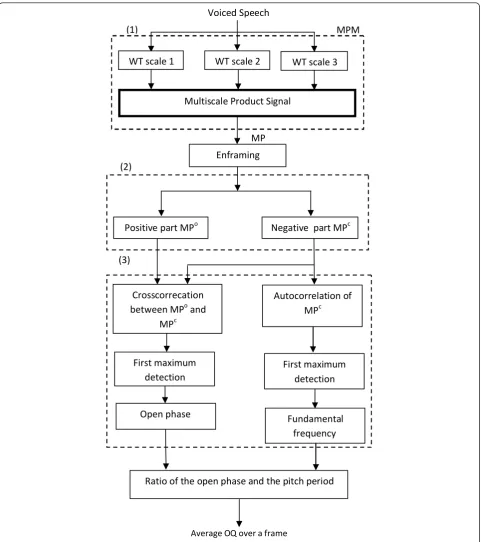
Our proposed approach for the OQ estimation from the speech signal follows three stages as shown in Figure 3.
First stage: consists of computing the MP of a voiced speech signal and then the signal is divided into frames of a fixed length. To compute the MP, we multiply the WTs of the speech signal at scales 2, 5/2 and 3 using the quadratic spline function.
To divide the MP signal into frames of a lengthN, we multiply it by a sliding rectangular window w[N]. The MP over a window of indexiis given by
MPwi[k] =MP[k−iN]w[k] (2)
Second stage: consists of separating the speech MP
into two parts: a negative part MPc which contains
information concerning glottal closure peaks, and a
positive part MPo which contains information about
glottal opening peaks. The MPcsignal is derived from the original signal by replacing any positive value by 0. In the same way, the MPosignal is derived from the ori-ginal signal by replacing any negative value by 0.
Figure 4 depicts the speech signal of the vowel/o/pro-nounced by the female speaker f1 followed by its MP, the MPoand the MPc. Minima of the MP negative part correspond to the GCI and peaks of the positive part fit with GOI.
Third stage: concerns the calculation of the cross-correlation function between the positive and negative parts (MPo and MPc) for estimating the open phase, and the autocorrelation function of MPc to estimate the fundamental frequency over each frame. The open phase and the fundamental frequency are, respec-tively, given by the non-null index matching with the
first maximum of the crosscorrelation and autocorre-lation functions. The OQ is then deduced by calculat-ing the ratio between the open phase and the pitch period.
The crosscorrelation function between MPoand MPc over a frameiis calculated as follows
Ro(k) = N
l=1
MPwoi(l)MPwci(k+l) (3)
By the same way, the autocorrelation function of MPc over a frameiis calculated as follows
Rc(k) = N
l=1
MPcwi(l)MPcwi(k+l) (4)
3.2. Frame selection
Assuming that the fundamental frequency value is approximately known, the frames length is chosen to
0 50 100 150 200 250 300 350 400 450 500
-0.5 0 0.5
0 50 100 150 200 250 300 350 400 450 500
-4 -2 0 2x 10
5
0 50 100 150 200 250 300 350 400 450 500
-10000 -5000 0 5000
Figure 1Speech signal followed by its MP and the DEGG signal.
0 50 100 150 200 250 300 350 400 450 500
-5000 0 5000
A
m
plit
ud
e
EGG signal
0 50 100 150 200 250 300 350 400 450 500
-3000 -2000 -1000 0 1000
DEGG signal
A
m
pl
itude
0 50 100 150 200 250 300 350 400 450 500
-5 0 5x 10
19 MP of the EGG signal
A
m
plit
ud
e
Samples
be no less than four periods and no longer than eight periods. We chose these limits for the frame because on running speech, the fundamental frequency varies by a significant amount over eight periods of pitch. So, we use a rectangular window with a fixed length of
25.6 ms for female speakers and 51.2 ms for male speakers.
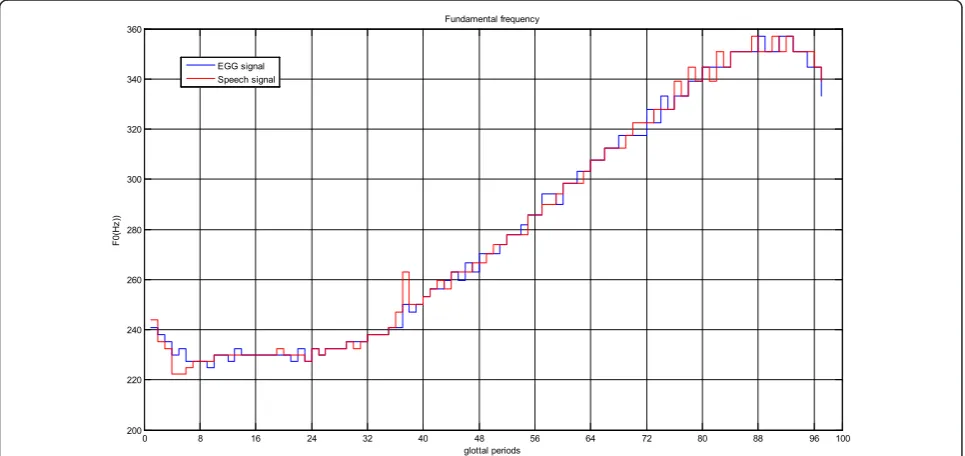
Figure 5 illustrates the instantaneous fundamental fre-quency of each glottal cycle over a voiced segment of 97 periods long. F0 is extracted from both the EGG and
(3)
Positive part MPo Negative part MPc (2)
Voiced Speech
WT scale 2 WT scale 3 WT scale 1
Multiscale Product Signal
MPM
Enframing (1)
MP
First maximum detection Autocorrelation of
MPc
Fundamental frequency Crosscorrecation
between MPo and MPc
First maximum detection
Open phase
Ratio of the open phase and the pitch period
speech signals by detecting GCIs manifested as minima of the MP. This example shows the variation sustained by F0 over running speech. F0 varies significantly when exceeding eight glottal cycles.
3.3. MP autocorrelation for the fundamental frequency estimation
Autocorrelation analysis is a well-known method for fundamental frequency estimation. This technique was
firstly used by Rabiner [30] as a pitch detector. Henrich et al. [14] applied this approach to estimate the funda-mental frequency from the EGG signal.
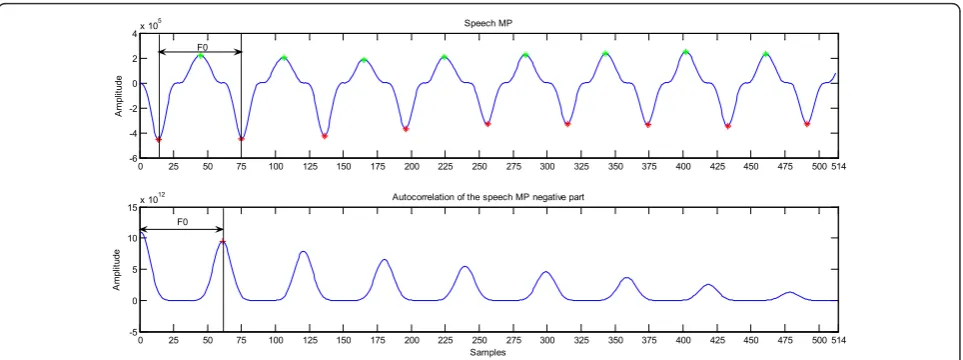
For us, we focus on applying the autocorrelation tech-nique to calculate the fundamental frequency from the speech signal. In fact, we calculate the speech MP of the speech over a frame, and then we compute the autocor-relation function of its negative part. The non-null index of the first maximum corresponds to the mean
0 200 400 600 800 1000 1200 1400 1600 1800 2000
-1 0
1 Speech signal
0 200 400 600 800 1000 1200 1400 1600 1800 2000
-2 -1 0 1x 10
7 Speech MP
0 200 400 600 800 1000 1200 1400 1600 1800 2000
0 2 4
x 106 Positive part of the speech MP
0 200 400 600 800 1000 1200 1400 1600 1800 2000
-2 -1 0 1x 10
7 Negative part of the speech MP
Figure 4Speech signal, the MP of the speech signal, MPoand MPc.
0 8 16 24 32 40 48 56 64 72 80 88 96 100
200 220 240 260 280 300 320 340
360 Fundamental frequency
F0
(H
z)
)
glottal periods EGG signal
Speech signal
value of the duration between two successive GCIs. Figure 6 gives an example where the fundamental period is estimated using the proposed approach.
In [14], Henrich et al. discuss the problems of double or imprecise peaks happening on the DEGG signal at the opening and the closing of the glottis and how to handle them. This glottal behaviour is observed by Ana-stalpo and Karnell [31]. These problems are overcome using the MP of the EGG signal as proposed in [16]. For real speech, typical cases are absent for closing peaks and are seldom observed for opening peaks.
Figure 7 represents an example of a noisy DEGG sig-nal. Peaks are imprecise and double on the DEGG but they are unique not on the MP of the EGG. We note the ability of the MP to eliminate spurious peaks. In this case, we see that peaks indicating the glottis closing are weak and difficult to detect especially at the beginning of the frame. We also note the efficient role of the
autocorrelation function to give a distinguishable maxi-mum indicating the average value of the fundamental frequency over a given frame.
Figure 8 represents the F0 estimated from the speech and the EGG signals using the autocorrelation techni-que over voiced frames spoken by a female speaker (f3). F0 extracted from the speech signal is often near to the reference one and they are confused for many frames.
3.4. MP crosscorrelation for open phase estimation To calculate the glottis open phase duration of the speech signal, we calculate its MP at first. Then, we operate the crosscorrelation between its positive and negative parts. The first maximum index is considered as the open phase.
Figure 9 shows the speech MP followed by the crosscorrelation calculated between its negative and 0 25 50 75 100 125 150 175 200 225 250 275 300 325 350 375 400 425 450 475 500 514
-6 -4 -2 0 2 4x 10
5 Speech MP
A
m
plit
ud
e
0 25 50 75 100 125 150 175 200 225 250 275 300 325 350 375 400 425 450 475 500 514 -5
0 5 10 15x 10
12
Samples
A
m
plit
ud
e
Autocorrelation of the speech MP negative part F0
F0
Figure 6Speech MP and the autocorrelation function of the speech MP negative part.
0 50 100 150 200 250 300 350 400 450 500
-50 0
50 DEGG signal
A
m
plit
ud
e
0 50 100 150 200 250 300 350 400 450 500
-10 -5 0 5x 10
16 MP of the EGG signal
A
m
pl
itude
0 50 100 150 200 250 300 350 400 450 500
0 1 2x 10
14 Autocorrelation of the speech MP negative part
A
m
plit
ud
e
Samples
positive parts. The non-null index matching with the first maximum of the crosscorrelation function corre-sponds to the time between an opening peak and the consecutive closing peak which is termed as the open phase.
However, we note the cases where the speech MP pro-duces more than one positive peak during a period. This behaviour induces double peaks on the crosscorrelation function. So, we consider the mean value of the two max-ima. Our solution gives the nearest value to the open phase measured by the EGG signal as it is considered as the ground truth.
Figure 10 illustrates a problematical case where the opening peaks are double and have very weak amplitude on the MP. On the crosscorrelation function, these peaks are also double but with reinforced amplitude. The middle of the two peaks coincides well with the unique peak given by the EGG signal.
3.5. OQ estimation
Since the fundamental frequency and the open phase are given, it is possible to estimate the OQ.
Figure 11 illustrates the OQ measured from the refer-ence EGG signal and the OQ estimated from the speech signal for the voiced segments uttered by the female speaker f4. In Figure 12, we draw the OQ estimation accuracy by computing the standard deviation of the error calculated between OQ measured from the EGG signal and OQ estimated from the real speech over each voiced segment. We effectively note a good coherence between the estimation from the speech signal and the reference from the EGG signal.
Figure 13 depicts the results of the OQ estimation from both the speech and the reference EGG signals for the frames contained in all the voiced segments corre-sponding to the speaker f4. Figure 14 shows the OQ accuracy over the whole frames.
0 1 2 3 4 5 6 7 8 9 10 11 12 13 14 15 16 17 18 19 20 21 22 23 24 25 26 27 28 29 30 31 32 33 34 35 36 37 200
210 220 230 240 250 260 270
frames
F0
(H
z)
F0 of the speech signal F0 of the EGG signal
Figure 8The F0 estimated from the speech signal and the F0 estimated from the EGG signal.
0 25 50 75 100 125 150 175 200 225 250 275 300 325 350 375 400 425 450 475 500 514 -6
-4 -2 0 2 4x 10
5 Speech MP
A
m
plit
ud
e
0 25 50 75 100 125 150 175 200 225 250 275 300 325 350 375 400 425 450 475 500 514 0
2 4 6 8x 10
12 Crosscorrelation between the positive and negative parts of the speech MP
Samples
A
m
plit
ud
e
0 25 50 75 100 125 150 175 200 225 250 275 300 325 350 375 400 425 450 475 500 514 -6
-4 -2 0 2 4x 10
5 Speech MP
A
m
plit
ud
e
open phase
open phase
Observing the OQ accuracy representation in Figures 12 and 14, we conclude that the OQ estimation is more precise when considering the mean OQ value over the voiced segments.
Gross deviation of the OQ estimation is caused by the errors of the open phase estimation happening when the opening peaks are doubled or imprecise.
The OQ estimation is unbiased in all cases. The error is much larger in Figures 13 and 14 than in Figures 11 and 12, showing that the GOI localisation from the speech signal is less accurate than from the EGG signal in the second case.
4. Experiments and results
4.1. Data
To evaluate the performance of our algorithm for OQ estimation, we use the Keele University database. This database includes the acoustic speech signals and laryn-gograph signals (single speaker recording). Five adult female speakers (fi) and five adult male speakers (mi)
with i Î {1,...,5} are recorded in low ambient noise conditions using a sound-proof room. Each utterance consists of the same phonetically balanced English text: “The North Wind Story.”In each case, the acoustic and laryngograph signals are time-synchronised and share
0 50 100 150 200 250 300 350 400 450 500
-2 -1 0 1x 10
7 Speech MP
A
m
plit
ud
e
0 50 100 150 200 250 300 350 400 450 500
-5 0 5 10x 10
14 Crosscorrelation between the negative and positive parts of the speech MP
A
m
plit
ud
e
0 50 100 150 200 250 300 350 400 450 500
0 1 2x 10
42 Crosscorrelation between the negative and positive parts of the EGG signal MP
Samples
A
m
pl
itude
Figure 10Speech MP, crosscorrelation of the negative and positive parts of the speech MP and the crosscorrelation of the negative and positive parts of the EGG MP.
0 10 20 30 40 50 60
0 0.1 0.2 0.3 0.4 0.5 0.6 0.7 0.8 0.9 1
voiced segments
O
pen Q
uot
ient
(
O
Q
)
EGG signal Speech signal
the same sampling rate value of 20 kHz [32]. The Keele database includes reference files containing a voiced/ unvoiced segmentation and a pitch estimation of 25.6 ms segments with 10 ms overlapping. The reference files also mark uncertain pitch and voicing decisions. The database is open source and it available on [33].
4.2. Results
The Keele University database consists of running speech containing voiced, unvoiced and silence parts.
Only voiced segments extracted from the database are handled by our algorithm.
To evaluate the performance of our approach for OQ estimation, we calculate absolute and relative errors between OQ estimated from the speech signal and the reference OQ estimated from the EGG signal.
We consider the indexes {1,...,10} corresponding to speakers {f1, f2, f3, f4, f5, m1, m2, m3, m4, m5}. Each
speakerk is characterised by Nkthe number of voiced
0 10 20 30 40 50 60
0 0.02 0.04 0.06 0.08 0.1 0.12
voiced segments
st
andar
d dev
iat
ion of
O
Q
Figure 12OQ estimation accuracy over voiced segments for speaker f4.
0 50 100 150 200 250 300 350 400 450 500
0.4 0.5 0.6 0.7 0.8 0.9 1
voiced frames
O
pen Q
uot
ient
(
O
Q
)
EGG signal Speech signal
segments. Each segment is divided intonkiframes where kÎ{1,...,10} andiÎ{1,...,Nk}.
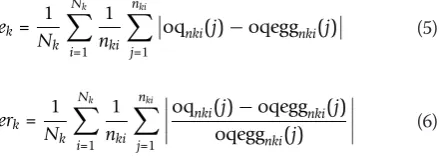
In the first evaluation case, absolute or relative errors over the whole frames for each speakerkare defined as follow
ek= 1
Nk Nk
i=1 1
nki nki
j=1
oqnki(j)−oqeggnki(j) (5)
erk= 1
Nk Nk
i=1 1
nki nki
j=1
oqnki(j)−oqeggnki(j) oqeggnki(j)
(6)
where oqnki(j) is the estimated OQ over a framejthat
belongs to a voiced segment i uttered by a speakerk. oqeggnki(j) is the reference OQ value for the same frame
calculated from the EGG signal.
For the second case, absolute and relative errors are defined by the mean values of the OQ estimated over the frames constituting the voiced segment:
For a given speaker k, the absolute and the relative errors are given by
εk= 1
Nk Nk
i=1
OQki−OQeggki (7)
εrk= 1
Nk Nk
i=1
OQki−OQeggki
OQeggki (8)
where OQki is the mean value calculated over a
seg-ment referring to the frames constituting this voiced segment.
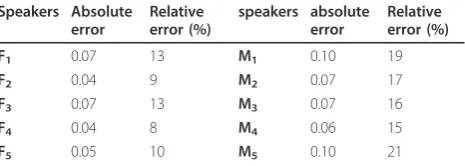
Tables 1 and 2 depict the absolute and relative errors of the OQ estimation, from the speech signal compared to the EGG signal, for all the speakers of the Keele University database.
Table 1 gives errors referring to voiced frames. How-ever, Table 2 gives errors referring to voiced segments.
Overall results show that the estimation of the OQ with the proposed method is competitive especially when considering the errors calculated over voiced seg-ments of the database. In this case, absolute errors are at most 0.1 for speakers M1 and M5 and 0.07 for speak-ers f1 and f3. Relative errors do not exceed 13% for female speakers and 21% for male speakers.
Besides, the proposed approach for the OQ estimation can be considered as interesting and efficient regarding the error values and the lack of developed works in this field.
This research is a first step considered in our global project to give an accurate estimation of instantaneous OQ from the speech signal. That’s why, the proposed measure is of great importance as it permits to give an
0 50 100 150 200 250 300 350 400 450 500
0 0.05 0.1 0.15 0.2 0.25 0.3 0.35 0.4
voiced frames
st
andar
d dev
iat
ion of
O
Q
Figure 14OQ estimation accuracy over voiced frames for speaker f4.
Table 1 Performance of the MP for the OQ estimation over voiced frames of the Keele University database
Speakers Absolute error
Relative error (%)
speakers absolute error
Relative error (%)
F1 0.08 18 M1 0.10 21
F2 0.07 16 M2 0.09 28
F3 0.08 18 M3 0.12 30
F4 0.05 10 M4 0.08 21
approximate interval more little than the period to localise the GOI. Once the GOIs are accurately located, we can turn back to estimate once again the OQ with more precision and for each period.
5. Conclusion
In this article, an approach for the OQ estimation from the speech signal is presented. It is based upon the cor-relation of the speech MP.
The MP is used to provide a simplified transformed speech signal that reminds the derivative of the EGG signal shape representing the global source activity.
The OQ estimation is obtained by calculating the ratio of the open phase over the pitch period. The open phase is referred as the index non-null of the first maximum localised on the inter-correlation function between the positive and the negative parts of the speech MP. As the same way, the pitch period is indexed by the first maxi-mum of the speech MP correlation function.
Evaluation computes the absolute and relative errors between the OQ values determined from the speech sig-nal and the OQ measured on the EGG sigsig-nal considered as a reference. The evaluation is done on the Keele Uni-versity database. The proposed approach reveals inter-esting performance.
Competing interests
The authors declare that they have no competing interests.
Received: 21 January 2011 Accepted: 10 November 2011 Published: 10 November 2011
References
1. G Fant,Acoustic Theory of Speech Production(Mouton, La Hague, 1960) 2. N Gaubitch, P Naylor, Spatio-temporal averaging method for enhancement
of reverberant speech, in5th International Conference on Digital Signal
Processing, 607–610 (2007)
3. P Jinachitra, Glottal closure and opening detection for flexible parametric voice coding. INTERSPEECH (2006). paper 1359-Thu2BuP.2
4. D Guerchi, P Mermelstein, Low-rate quantization of spectral information in a 4 kb/s pitch-synchronous CELP coder, inIEEE Workshop on speech coding, 111–113 (2000)
5. J Gudnason, M Brookes, Voice source cepstrum coefficients for speaker identification, inIEEE International Conference on Acoustics, Speech and
Signal Processing, 4821–4824 (2008)
6. P Alku, E Vilkman, A comparison of glottal voice source quantification parameters in breathy, normal and pressed phonation of female and
male speakers. Folia Phoniatr (Basekl)48, 240–254 (1996). doi:10.1159/ 000266415
7. D Klatt, L Klatt, Analysis, synthesis, and perception of voice quality variations among female and male talkers. J Acoust Soc Am.87, 820–857 (1990). doi:10.1121/1.398894
8. PA Keating, C Esposito, Linguistic voice quality, in11th Australasian
International Conference on Speech Science and Technology(Auckland, NZ,
December 2006)
9. M Echternach, S Dippold, J Sundberg, MF Zander, B Richter, High-speed imaging and elecrtoglottography measurements of the open quotient in untrained male voices’register transitions. J Voices24(6), 644–650 (2010). doi:10.1016/j.jvoice.2009.05.003
10. R Winkler, W Sendlmeier, Open quotient (EGG) measurements of young and eldrly voices: results of production and perception study. ZAS Papers Linguistics40, 213–225 (2005)
11. DG Hanson, BR Gerratt, GS Berke, Frequency, intensity and target matching effects on photogolottographic measures of open quotient and speed quotient. J Speech Hear Res.33, 45–50 (1990)
12. P Kitzing, B Sonesson, A photogolottographical study of the female vocal folds during phonation. Folia Phoniatr (Basekl)26, 138–149 (1974). doi:10.1159/000263776
13. N Henrich, C d’Allessandro, M Castellengo, B Doval, Glottal open quotient in singing: measurements and correlation with laryngeal mechanisms, vocal intensity, and fundamental frequency. J Acoust Soc Am.117(3), 1417–1430 (2005). doi:10.1121/1.1850031
14. N Henrich, C d’Allessandro, M Castellengo, B Doval, On the use of the deravative of electroglottographic signals for characterization of nonpathological phonation. J Acoust Soc Am.115(3), 1321–1332 (2004). doi:10.1121/1.1646401
15. N Henrich, B Doval, C d’Allessandro, M Castellengo, Open quotient measurements on EGG, speech and singing signals, inProceedings of the 4th International Workshop on Advances in Quantitative Laryngoscopy, Voice
and Speech Research, Jena (April 2000)
16. A Bouzid, N Ellouze, Voice source measurement based on multiscale analysis of electroglottographic signal. Speech Commun
17. YL Shue, J Kreiman, A Alwan, a novel codebook search technique for estimating the open quotient, inInterspeech, 2895–2898 (2009) 18. N Sturmel, C d’Allessandro, B Doval, A spectral method for estimation of
the voice speed quotient and evaluation using electroglottography, in7th
Conference on Advances in Quantitative Laryngology(Groningen, The
Netherlands, October 6-7, 2006), p. 6
19. P Jinachitra, JO Smith, Joint estimation of glottal source and vocal tract for vocal synthesis using Kalman smoothing and EM algorithm, in
WASPAA’2005, New Paltz, NY
20. N Sturmel, C d’Allessandro, B Doval, Glottal parameters estimation on speech using the zeros of the z-transform. inINTERSPEECH 2010, 665–668 (2010)
21. S Mallat, S Zhong, Characterization of signals from multiscale edges. IEEE Trans Pattern Anal Mach Intell.14(7), 710–732 (1992). doi:10.1109/34.142909 22. C Wendt, AP Petropulu, Pitch determination and speech segmentation
using the discrete wavelet transform, inProceedings of ISCAS 96, Atlanta2, 45–48 (1996)
23. VN Tuan, C d’Allessandro, Robust glottal closure detection using the wavelet transform, inProceedings of the European Conference on Speech
Technology, 2805–2808 (1999)
24. JF Wang, SH Shen, Wavelet transforms for speech signal processing. J Chin Inst Eng.22(5), 549–560 (1999). doi:10.1080/02533839.1999.9670493 25. A Rosenfeld, A nonlinear edge detection. Proc IEEE.58, 814–816 (1970) 26. Y Xu, JB Weaver, DM Healy, J Lu, Wavelet transform domain filters: a
spatially selective noise filtration technique. IEEE Trans Image Process.3(6), 747–758 (1994). doi:10.1109/83.336245
27. A Bouzid, N Ellouze, Electroglottographic measures based on GCI and GOI detection using MP. Int J Comput Commun Control.III(1), 21–32 (2008) 28. W Saidi, A Bouzid, N Ellouze, Evaluation of multi-scale product method and
DYPSA algorithm for glottal closure instant detection, in3rd International Conference on Information and Communication Technologies: From Theory to
Applications, 2008. ICTTA 2008, 1–5 (April 7-11, 2008)
29. W Saidi, A Bouzid, N Ellouze, MPM method and DYPSA algorithm evaluation for GCI detection in noisy speech signal. Int J Comput Inf Technol and Comp.1(1), 93–105 (2010)
Table 2 Performance of the MP for the OQ estimation over voiced segments of the Keele University database
Speakers Absolute error Relative error (%) speakers absolute error Relative error (%)
F1 0.07 13 M1 0.10 19
F2 0.04 9 M2 0.07 17
F3 0.07 13 M3 0.07 16
F4 0.04 8 M4 0.06 15
30. LR Rabiner, On the use of autocorrelation analysis for pitch detection. IEEE Trans Acoust Speech Signal Process.25(1), 24–33 (1977). doi:10.1109/ TASSP.1977.1162905
31. S Anastalpo, MP Karnell, Synchronized videoscopic and electroglottographic examination of glottal opening. J Acoust Soc Am.83, 1883–1890 (1988). doi:10.1121/1.396472
32. F Plante, G Meyer, WA Ainsworth, A pitch extraction reference database, in
Proc of EUROSPEECH 1995, 837–840 (1995)
33. Keele Pitch Database, Pssychology Home page–Human Machine Perception, (University of Liverpool, 1995) http://www.liv.ac.uk/Psychology/ hmp/projects/pitch.html
doi:10.1186/1687-4722-2011-8
Cite this article as:Saidiet al.:Correlation analysis of the speech
multiscale product for the open quotient estimation.EURASIP Journal on Audio, Speech, and Music Processing20112011:8.
Submit your manuscript to a
journal and benefi t from:
7Convenient online submission 7 Rigorous peer review
7Immediate publication on acceptance 7 Open access: articles freely available online 7High visibility within the fi eld
7 Retaining the copyright to your article