The global burden of migraine: measuring
disability in headache disorders with WHO’s
Classification of Functioning, Disability
and Health (ICF)
M. Leonardi () Scientific Direction,
Italian National Neurological Institute “Carlo Besta”,
Via Celoria 11, I-20133 Milan, Italy e-mail: [email protected] Tel.: +39-02-2394-2511/2498 Fax: +39-02-2363-973 T.J. Steiner
Division of Neuroscience and Mental Health, Imperial College London, Charing Cross Campus,
St. Dunstan’s Road, London W6 8RP, UK A.T. Scher
Department of Preventive Medicine and Biometrics,
Uniformed Services University
Room A 1039 C, 4301 Jones Bridge Road Bethesda, MD 20892, USA
R.B. Lipton
Departments of Neurology, Epidemiology and Social Medicine,
Albert Einstein College of Medicine, Room 332, 1165 Morris Park Ave, Bronx, NY 10467, USA
Matilde Leonardi Timothy J. Steiner Ann T. Scher Richard B. Lipton
Abstract This overview of the pub-lished epidemiological evidence of migraine helps to identify the size of the public-health problem that migraine represents. It also highlights the need for further epidemiological studies in many parts of the world to gain full understanding of the scale of clinical, economic and humanistic burdens attributable to it. This paper presents some of the work on migraine undertaken by the World Health Organization (WHO) in the Global Burden of Disease study con-ducted in 2000 and reported in the
World Health Report 2001. Migraine
was not included in the first Global Burden of Disease 1990. The paper also discusses the measurement of disability attributable to headache disorders using WHO ICF Classification. Using disability-adjusted life years (DALYs) as a summary measure of population health (which adds disability to mor-tality), WHO has shown that mental and neurological disorders collective-ly account for 30.8% of all years of healthy life lost to disability (YLDs) whilst migraine, one amongst these, alone accounts for 1.4% and is in the top 20 causes of disability world-wide. This information is combined with the increasingly widely accepted belief that disability and functioning are relevant parameters for
monitor-ing the health of nations and that there is an increasing need to mea-sure them. WHO’s Classification of Functioning, Disability and Health (ICF) provides a model of human functioning and disability, as well as a classification system, that allows us to highlight and measure all dimen-sions of disability. ICF applied to headache disorders allows compara-bility with other health conditions as well as evaluation of the role of the environment as a cause of disability amongst people with headache. Migraine causes a large proportion of the non-fatal disease-related burden worldwide.Our knowledge of headache related burden is incom-plete and it is necessary to add to it epidemiological studies in many parts of the world and to combine this with measurements of disability using both DALYs and WHO’s ICF Classification. The work described here has been the base for the Global Campaign against Headache disor-ders: “Lifting the Burden”, launched in 2004 jointly by WHO, IHS (International Headache Society), WHA (World Headache Alliance) and EHF (European Headache Federation).
KeywordsBurden •Disability •
Migraine •DALYs •Epidemiology •
ICF Received: 5 September 2005
Introduction
The recognition that headache disorders are greatly bur-densome worldwide and, consequently, a global public-health problem is slowly changing attitudes towards them. These common neurological complaints significantly damage health and lifestyle: almost all people with migraine and 60% of those with tension-type headache experience reductions in social activities and work capac-ity. Despite this, both the public and the majority of health-care professionals still tend to perceive headache disorders as minor or trivial complaints. As a result, the physical, emotional, social and economic burdens imposed by headache disorders are poorly acknowledged and these disorders are seen as unimportant in the priority order for health-care resource allocation.
Whilst financial costs of headache, due mainly to lost productivity, are very high in the developed economies where they have been measured [1], it is right to consider the impact of headache disorders on public health more from a humanitarian perspective of suffering rather than limit the discussion to one focused on these costs alone [2]. The World Health Organization (WHO), at a consensus conference on the public-health impact of headache disor-ders, produced several recommendations; amongst them was underlined the need to evaluate burden more general-ly in assessing the importance of these disorders [3].
Epidemiology is the essential starting point in assess-ing the burden of a disease. The epidemiology of headache disorders is only partly documented; for exam-ple, migraine is the most extensively studied headache disorder, while the more common tension-type headache and the more disabling cluster headache and subtypes of chronic daily headache have been less well investigated. In addition, because of the high cost of conducting large-scale studies, because of obstacles in the way of access to the general population and because headache is accorded low priority in regions where communicable diseases may pose a greater threat to public health, definitive epidemio-logical data for most developing countries is lacking across all headache types [4].
Change has taken place over the past 15 years – slow-ly, but gathering pace. Important epidemiological papers [5–8], joining extensive work on pathophysiology and a revised headache classification (ICHD II) [9], have pro-duced clear evidence of the public-health importance of headache disorders and their impact on people and society. The contemporaneous appearance at an international level of the concept of “sustainable medicine” as a basis for allo-cation of the available health-care resources, which in the case of headache is ill-matched to the high levels of health-care need, has led headache research groups to work close-ly with health economists, public-health administrators
and lay organisations in developing ideas for best practice to meet these needs. One result was the work on burden of migraine undertaken by WHO and reported in the World
Health Report 2001 [10, 11]. This work has been the base
for the Global Campaign to reduce the burden of headache worldwide known as “Lifting the Burden”, which was launched in 2004 jointly by WHO, the International Headache Society (IHS), the World Headache Alliance (WHA) and the European Headache Federation (EHF).
The global burden of disease (GBD) studies
Decision-makers need the best available evidence in mat-ters of interest to them. Obtaining it means systematically identifying and assembling all the relevant evidence then available, and assessing its quality, limitations and uncer-tainty in order to use it to best effect in producing quanti-ty estimates.
“Best available”, however, is not always good. Nonetheless, concerns about poor quality or uncertainty of data are not an acceptable reason for rejecting such evi-dence, as decisions must often be made now: decision-makers cannot and will not wait years for improvement in evidence. In relation to international efforts to improve the health of populations, this applies perfectly to quan-tifications of the burden of disease – existing now and likely to exist in the future – on which health-care policies are to be based. Policy-makers, their partner public-health experts and consumers alike seek rational guides to set priorities for health care in a context of limited resources. They need to evaluate the outcomes of a range of inter-ventions and health-care reforms, monitoring changes over time at local, national, regional or global levels. Clearly, estimation of needs for health services and of the costs and effectiveness of these services requires indica-tors that go beyond measures of death rates or diagnosis alone and takes into account the effects of disease and health care upon people’s ability to function normally.
GBD 1990
epi-demiological assessments for major disorders; and third, to quantify the burden of disease with a measure that could also be used for cost-effectiveness analysis.
Burden of disease has traditionally been measured, in national and international health statistics, only in terms of incidence/prevalence and mortality. These are indicators well suited to acute diseases that either cause death or resolve with full recovery; their use for chronic and dis-abling diseases, however, is subject to serious limitations. This is particularly true for mental and neurological disor-ders, which more often cause lasting disability than prema-ture death. GBD 1990 therefore employed a wider set of indicators, both epidemiological and demographic: preva-lence and incidence rates, life-expectancy estimates based on probabilities of death in different age groups and dis-ability-adjusted life expectancy. As well as generating the most comprehensive and consistent set of estimates of mor-tality and morbidity by age, sex and world region ever [13], GBD 1990 introduced a new metric – disability-adjusted life years (DALYs) – as a summary measure of population health [10]. DALYs represent one way to account for the chronicity of disorders and the disability they cause.
DALYs, YLLs and YLDs
DALYs combine information on impact of illness by adding years lived with disability from incident cases of the health condition (YLDs) to years of life lost due to premature mortality (YLLs). One DALY is the equivalent of one lost year of one person’s healthy life, whether this loss is through early death by one year from a state of full health or through living xyears in a state of full health reduced by 1/x. Thus:
1 YLL=1 year of life lost to early death 1 YLD=1 year lived with disability
(for example, 10 years lived with 10% disability or 2 years lived with 50% disability)
DALYs (burden)=YLLs (mortality)+YLDs (disability)
DALYs are a health-gap measure. The population bur-den of disease expressed in DALYs – the sum, in the pop-ulation, of all YLLs and all YLDs [10, 13] – is a measure-ment of the gap between current health status in that pop-ulation and an ideal situation where everyone lives into old age free from disease and disability. The appeal of DALYs is as a tool in health policy: they translate epidemiological data into information useful to decision-making. Based on a universal measure of time – life years – DALYs provide a common currency enabling priorities for health services to be determined and, for purposes of health-care resource
allocation, the effectiveness of interventions assessed rela-tive to one another across a wide range of health problems [10–12]. However, DALYs are but an aid to decision-mak-ing; they do not provide complete support for decisions because they cannot incorporate all the values relevant to those decisions. Murray and Lopez reviewed the applica-tion of DALYs and other developments in the measure-ment of burden of disease [13].
Estimating YLDs is the most difficult component of bur-den of disease analysis using this methodology. The data needed for calculating YLDs are disability incidence, dura-tion and severity distribudura-tion, together with age at onset, all of which must be disaggregated by age and gender. These in turn require estimates of incidence, remission and case-fatality rates by age and gender, all of which are not neces-sarily constant between populations whilst, often, fragment-ed and partial estimates are available from different studies. Most important of all, meaningful calculation of YLDs depends also on a clear definition of the disorder under con-sideration in terms of case or episode, and severity accord-ing to disease stage where these are related; it is then neces-sary, but often difficult, to ensure that available incidence or prevalence data relate to the same case definition.
A specific software tool, DisMod, has been developed to assist internally consistent estimates of YLDs [10]. The basic formula is
YLDs=IxDWxL
where I is the number of incident cases in the reference period, DW is the disability weight applied to the disorder (in the range 0–1, where 0 is no disability and 1 is total and absolute disability) and L is the average duration of disability associated with the disorder measured in years.
Disability weights
valua-tion tasks that had limited reliability in general populavalua-tion surveys but have been applied widely in industrialised countries among convenience samples of educated respondents [10, 14].
Data sources
Comprehensive and consistent estimates for incidence and point prevalence are the key to accurate estimation of YLDs. Murray et al. [10, 13] specified a range of data sources that are or may be used.
Disease registers record new cases of disease based on
reports by physicians and/or laboratories. They exist mostly as aids to the control of infectious diseases such as tuberculosis, and for cancer and congenital anomalies, but also record some relatively rare diseases such as cystic fibrosis and thalassaemia. In some cases they accurately record incidence and prevalence.
Population surveys, usually by interview, provide
self-reported information on diseases, disabilities and impair-ments. There are commonly large differences between con-cepts of a disease held by members of the general public and the defined disease entity for which information is intended to be collected. Self-reported data, which may be based on self-diagnosis, are therefore not readily compara-ble between countries or cultures and often present difficul-ties in attributing impairment to its underlying cause. In general they fall short of quality requirements for YLD cal-culations, but may provide the only (and therefore the “best”) information available.
Population-based epidemiological studies are the most
useful information sources. Particularly, longitudinal stud-ies of the natural history of a disease can provide a wealth of information on incidence, average duration, severity distribution, remission and case fatality – essentially all that YLD calculations require. Such studies are relatively rare because they are very costly to do well. Many that do exist were conducted in a selected region or town to facil-itate sample access, and therefore case ascertainment, whilst limiting cost; judgement is then needed in extrapo-lating results to a wider population.
Health facility data, derived from consultations, may
be relatively precise but are not very helpful in estimating burden. Facility-based data – unless health-system cover-age is near complete, which is rare – will always be drawn from biased samples and are highly likely to misrepresent the disability present in the wider community. Hospital deaths are unlikely to be useful for the same reason. There are exceptions: the quality of hospital data may be good for conditions inevitably treated in hospital: for example, perinatal complications, meningitis, stroke, myocardial infarction, surgical conditions and serious injuries.
GBD 2000
WHO made a second assessment of the global burden of disease in 2000 (GBD 2000). The three goals of GBD 1990 [10, 12, 13] remained central, if differently expressed: - to decouple epidemiological assessment of the
magni-tude of health problems from advocacy by interest groups of particular health policies or interventions; - to include in international health-policy debates
mation on non-fatal health outcomes along with infor-mation on mortality;
- to undertake the quantification of health problems in time-based units that can also be used in economic appraisal. However, GBD 2000 had specific additional, albeit related, objectives:
- to develop internally consistent estimates of mortality from 135 major causes of death, disaggregated by age and gender, for the world and for major geographic regions; - to develop internally consistent estimates of incidence,
prevalence, duration and case fatality for over 500 sequelae resulting from these causes;
- to describe and value the health states associated with these sequelae of diseases and injuries;
- to quantify the burden of premature mortality and dis-ability by age, gender and region for the 135 major causes or groups of causes;
- to analyse the contribution to this burden of major physiological, behavioural and social risk factors by age, gender and region;
- to develop alternative projection scenarios of mortali-ty and non-fatal health outcomes over the next 30 years, disaggregated by cause, age, gender and region. YLD estimates for GBD 2000 were based largely on the GBD 1990 disability weights, although the disability weight for migraine was developed for GBD 2000 for the first time. One of us Dr Leonardi was responsible for data collection for estimation of the burden of migraine and for the development of the disability weight for migraine under the coordination of Drs B. Ustün, C. Mathers and C.J.L. Murray of who and in collaboration with leading headache experts worldwide. After several discussions it was decided that a 3x3 table of frequency and severity (low, moderate and high in each case) would help to develop the weight for migraine. Comparison with criteria adopted for other fluc-tuating diseases such as asthma balanced the weighting of migraine against those of other disorders
Migraine: the epidemiological evidence
non-published papers of valid population studies on headache disorders. The search for data sources included the databases Medline, Pre-medline, Embase and Cinhal. The strategy was to seek all published articles from all regions of the world in English, (although some grey liter-ature in other languages has been reviewed), using the expanded MESH terms: headache, migraine, tension-type headache, chronic daily headache, (mortality/epidemiolo-gy), plus Africa, China, India, Europe, Eastern Europe, Japan, America, plus focus studies, epidemiological stud-ies, burden of disease; and key words: migraine, tension-type headache, epidemiology, mortality, disability, burden of disease. Unpublished papers were found through expert advice from IHS members and from WHO materials and guidance was obtained from the Italian National Neurological Institute “Carlo Besta” and the WHO library to verify that no obtainable data were missing.
Articles were selected or rejected according to pre-set inclusion criteria so that the inquiry was not data-driven: - population-based studies (sample size n>1000) that
used IHS diagnostic criteria or a modified set of crite-ria based on IHS recommendations [15];
- studies that reported prevalence (whenever possible, where there was specification of the period covered: 1 month, 12 months, lifetime, data were converted into point prevalences);
- studies with explicit methodology using samples that were either random or demonstrated to be nationally or regionally representative;
- data presented on any or all of incidence, prevalence, remission rate, case fatality rate, natural history, age, gender, region or country.
We present here a summary of the epidemiological evidence of migraine. Whilst this helps to create aware-ness of the size of the global public-health problem that migraine represents, it also highlights the need for further epidemiological studies in many parts of the world.
Case definition
The definition of migraine established in the WHO’s International Classification of Disease and related health conditions, 10th edn, 1992 (ICD-10) as well as the diag-nostic criteria from the IHS classification of 1988 [15] were used so that epidemiological data were taken from surveys employing similar and compatible definitions.
Migraine incidence
There were few studies of migraine incidence. Although cross-sectional data can be used to derive incidence
esti-mates, they are better obtained from longitudinal studies [16, 17]. Stewart et al.estimated migraine incidence using report-ed age-at-onset data from a prevalence study, admitting the inherent limitations of imperfect recall, failure to report true symptoms and the reporting of symptoms not actually expe-rienced [18]. In males, the incidence of migraine with aura peaked at around 5 years of age at 6.6/1000 person/years; incidence of migraine without aura peaked at 10/1000 per-son/years between 10 and 11 years. New cases of migraine were uncommon in men in their 20s. In females, the inci-dence of migraine with aura peaked higher (14.1/1000 per-son/years) but later (between 12 and 13 years) and of migraine without aura also (18.9/1000 person/years between 14 and 17 years). On this evidence, migraine begins earlier in males than in females and migraine with aura begins ear-lier than does migraine without aura.
Stang et al. [19, 20] used the linked medical records system in Olmstead County, Minnesota, to identify those who sought medical care for migraine. Incidences were lower: 1.5–2/1000 person/years for men under 30 years of age and 3–6/1000 person/years in women under 30. This would be expected: many people with migraine do not consult doctors or receive a medical diagnosis [17]. Peaks were later than found by Stewart [21], showing that med-ical diagnosis may occur long after onset.
Migraine prevalence
In the decade prior to GBD 2000, several epidemiological studies published estimates of migraine prevalence that varied widely [16, 17, 22–28]. In 1995, a meta-analysis of 24 studies included only five that used IHS diagnostic cri-teria [29], and revealed that case definition, along with differing age and gender distributions of the study sam-ples, explained 70% of the variation in migraine preva-lence between studies. Migraine prevapreva-lence studies pose a number of methodological challenges and the main obsta-cle has been case definition. Fortunately this has been par-tially overcome by the IHS classification [15] and, in our methodology, because case definition so powerfully influ-ences prevalence estimates, we focused on studies that used IHS diagnostic criteria.
In a second meta-analysis confined to studies using IHS criteria, in gender-specific models (females and males were modelled separately), age and geography accounted for much of the variation in prevalence [30].
Influence of race and geography
men and from 11.2% to 25% in women [17–19, 21–23, 27, 31]. In the greater Copenhagen study, lifetime prevalences were 8% for men and 25% for women [30]. One-year peri-od prevalences were 6% and 16% respectively. In the USA, the first American Migraine Study, based on data collected in 1989, used questionnaires mailed to 15 000 households selected to be representative of the US population [18]. Migraine diagnoses were based on modified IHS criteria. Prevalences were 6% in men and 17% for women, closely matching the estimates of Rasmussen [30]. A follow-up study, the American Migraine Study II, used virtually iden-tical methodology 10 years later with very similar findings [27]. In France, Henry et al. reported prevalences of IHS-defined migraine as 4% in men and 11.9% in women [24]. In this study, diagnoses were assigned by lay interviewers using a validated algorithm: for the diagnostic variant of “borderline migraine”, prevalence estimates were higher – 6.1% in men and 17.6% in women – again remarkably close to the findings of Rasmussen [30] and Stewart et al. [29].
Migraine prevalence varies by race and geography but there is some question as to how much. In the USA it was found to be highest in Caucasians, intermediate in African Americans and lowest in Asian Americans [18]. The sec-ond meta-analysis referred to above suggested migraine was most common in North and South America, similar in Europe, lower in Africa and often lowest in studies from Asia (Fig. 1) [17, 27]. The magnitude of the disease in Latin America has been difficult to assess because good studies are scarce. The problem is compounded in areas where large segments of the population do not have access to doctors and facilities for diagnosis are not available. Nevertheless, recent studies from Brazil, Chile and Ecuador show that headache is highly prevalent in these countries and imposes a large economic burden on health-care systems stretched to their limits. As in developed countries, migraine and chronic tension-type headache are
the most common subtypes of headache disorders in South America [32–36]. Tekle Haimanot reported that “literature on prevalence and health burden in Africa is scanty” [37]. Because of the lower life expectancy in African countries, disease prevalence is studied in relatively young popula-tions. Epidemiological surveys in Nigeria, Ethiopia, Tanzania and Zimbabwe produced prevalences of 3%–6.9% among adults, with all studies reporting a female preponderance (male to female ratios of 1:1.3 to 1:2.8). Tekle Haimanot considered migraine with aura to be rela-tively rare in Africans [37]. In Asia, whilst studies in Hong Kong, Malaysia and Japan recorded lower prevalences [38–40], more recent studies [41] in Turkey [42, 43], Oman [44], Saudi Arabia [45] and Iran [46] have found higher prevalences than those included in the meta-analy-sis, more in line with Western estimates. The influence of reporting bias on these findings cannot be excluded.
Influence of age and gender
Before puberty, migraine prevalence is higher in boys than in girls; as adolescence approaches, incidence and preva-lence increase more rapidly in girls than in boys [47–49]. Prevalence continues to increase through early adult life until approximately 40 years of age, after which it declines [18, 31]. The gap between peak incidence in childhood to adolescence and peak prevalence in middle life indicates that migraine is a condition of long duration. The female to male migraine prevalence ratio there-fore varies with age [18, 21, 31]. The onset of hormonal changes associated with menses probably accounts for much of this variation [50] although hormonal factors cannot be the sole cause: differences persist to age 70 years and beyond, well after cyclical hormonal changes can be a factor [21, 51].
Regions of the world as subdivided in the Burden of Disease study
As reported in Ustun and colleagues in 2004 [52], for geo-graphic disaggregating of the GBD 2000 the six regions of the world (Africa, Americas, Eastern Mediterranean, Europe, South East Asia, Western Pacific) were subdivided into 17 epidemiological subregions based on levels of mor-tality (children under 5 years and adults 15–59 years). Five mortality strata were defined in terms of quintiles of the distribution of child and adult mortality. When these mor-tality strata are applied to the 6 WHO regions, they produce 14 mortality subregions. For the purpose of burden of
dis-Fig. 1Prevalence of migraine by geographic area (from [17]) 25%
20% 15% 10% 5% 0%
Female Male
Africa
Adjusted Pr
evalence
Asia
Eur
ope
N America
S/C
ease epidemiological analysis, 2 of these regions were fur-ther subdivided: EurB (WHO European region) into EurB1 and EurB2, the latter including the central Asian states. WPRB (WHO Western Pacific Region) into WPRB1 (mainly China), WPRB2 (South East Asian Countries) and WPRB3 (Pacific Islands). A detailed table of these epi-demiological subregions can be downloaded from the WHO website at http://www.who.int/whr/2003/en/mem-ber_states_182-184_en.pdf.
The World Health Report 2001 and the burden of migraine
In 2001 WHO published the annual World Health Report
entitled Mental health: new understanding, new hope
[11]. It took the findings of GBD 2000 and discussed the burden attributable to the 135 health conditions included therein, but focused on mental and neurological disorders. The report revealed how the burdens these disorders imposed on population health were highlighted by esti-mates that moved from a mortality to a disability perspec-tive using the GBD study methodology. This acknowl-edgement of disability as an equally important part of the burden of disease, and its inclusion in burden measure-ment, substantially increased the relative importance of non-communicable diseases, which generally cause much more disability than mortality and were invisible in past estimates of burden based on mortality measures alone.
The report accordingly demonstrated that a number of mental and neurological disorders are amongst the most disabling. In the GBD 1990 estimates, these disorders accounted for 10.5% of the total DALYs worldwide resulting from all diseases and injuries – a figure that for the first time indicated the high burden imposed by men-tal and neurological disorders. The re-estimate of GBD 2000 was 12.3% and from an analysis of trends it is evi-dent that this burden will increase rapidly in the future, with projections indicating 15% by the year 2020 [13].
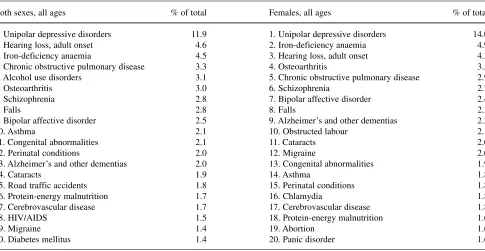
Whilst these disorders collectively account in the Report for 30.8% of all YLDs worldwide, six of them fea-tured in the top 20 causes of disability: unipolar depres-sive disorders, alcohol-use disorders, schizophrenia, bipolar affective disorder, Alzheimer’s and other demen-tias, and migraine [11]. Migraine defined by IHS criteria [15], included for the first time and contributing 1.4% of all YLDs, is the 19th cause of disability in both sexes of all ages and 12th, accounting for 2.0% of YLDs, in women (Table 1).
With the publication of the World Health Report
2001, and this evidence of the high burden of migraine, WHO recognised headache disorders as a high-priority public-health problem. They deserve this recognition: currently they are low in order in the queue for health-care resource allocation.
Our earlier comments made clear that, whilst DALYs translate epidemiological data into usable information for health policy, their validity depends crucially upon the qual-ity of those data. Where epidemiological studies are lacking
Table 1Leading causes of years lived with disability (YLDs)
Both sexes, all ages % of total Females, all ages % of total
1. Unipolar depressive disorders 11.9 1. Unipolar depressive disorders 14.0
2. Hearing loss, adult onset 4.6 2. Iron-deficiency anaemia 4.9
3. Iron-deficiency anaemia 4.5 3. Hearing loss, adult onset 4.2
4. Chronic obstructive pulmonary disease 3.3 4. Osteoarthritis 3.5
5. Alcohol use disorders 3.1 5. Chronic obstructive pulmonary disease 2.9
6. Osteoarthritis 3.0 6. Schizophrenia 2.7
7. Schizophrenia 2.8 7. Bipolar affective disorder 2.4
8. Falls 2.8 8. Falls 2.3
9. Bipolar affective disorder 2.5 9. Alzheimer’s and other dementias 2.2
10. Asthma 2.1 10. Obstructed labour 2.1
11. Congenital abnormalities 2.1 11. Cataracts 2.0
12. Perinatal conditions 2.0 12. Migraine 2.0
13. Alzheimer’s and other dementias 2.0 13. Congenital abnormalities 1.9
14. Cataracts 1.9 14. Asthma 1.8
15. Road traffic accidents 1.8 15. Perinatal conditions 1.8
16. Protein-energy malnutrition 1.7 16. Chlamydia 1.8
17. Cerebrovascular disease 1.7 17. Cerebrovascular disease 1.8
18. HIV/AIDS 1.5 18. Protein-energy malnutrition 1.6
19. Migraine 1.4 19. Abortion 1.6
or of questionable accuracy, degrees of uncertainty affect the calculation of DALYs and YLDs. GBD 2000 estimates for mental and neurological disorders, like those of GBD 1990, were subject to the variable quality of the available preva-lence data summarised above: large gaps prevailed in many regions of the world; uncertainties also existed about the severity distributions of these disorders. These uncertainties reflected, in particular, the limitations of self-report instru-ments and their questionable ability to classify symptoms in a comparable way across and between populations, and pos-sibly erroneous extrapolation of survey results from popula-tion subsets to broader populapopula-tion groups. Lack of informa-tion to assess the severity of disability attributable to the dis-orders of interest was also a factor.
Where inadeguate for a region were available, experts on headache, and on the other neuropsychiatric condi-tions, were encouraged to make informed estimates. Frequently, age-related patterns of incidence and preva-lence were assumed to be similar from one region to another despite differences in overall incidence or preva-lence. In the worst cases, where no information whatsoev-er was available from a region, estimates wwhatsoev-ere made by extrapolation from other regions.
Despite these uncertainties, it has been clearly shown that the disability caused by mental and neurological disor-ders is high in all regions of the world. As a proportion of the total, it is lower in developing countries, mainly because of the large burden of communicable, maternal, perinatal and nutritional conditions in those regions. Even so, mental and neurological disorders cause 17.6% of all YLDs in Africa. These disorders are not the preserve of any special group: they are truly universal, found in people of all regions, all countries and all societies, in women and men at all stages of life, among rich and poor and among people liv-ing in urban and in rural areas. The notion that these disor-ders are problems of industrialised and wealthier parts of the world is simply wrong. The belief that rural communities, relatively unaffected by the fast pace of modern life, are less affected by these disorders is also incorrect [11].
The socioeconomic impact of many of these disorders, with migraine high amongst them, is wide-ranging, long-lasting and enormous. They impose a range of costs on individuals, families and communities as a whole. Part of this economic burden is obvious and measurable, whilst part is almost impossible to quantify. Among the measur-able components are health- and social-service needs, lost employment and reduced productivity, impact on families and demands upon caregivers, and the negative impact of premature mortality [3].
Indirect costs, especially those arising from productiv-ity loss, account for a larger proportion of overall costs than direct costs. WHO defines burden of disease to include the economic and emotional difficulties that a family experiences as a result of them, as well as the lost
opportunities – the adjustments and compromises that pre-vent other family members from achieving their full potential in work, social relationships and leisure [11]. Ideally, all of these would be captured in burden estimates by allowing for them in disability weightings. In reality, all economic evaluations are most certainly underesti-mates, as lost opportunity costs to individuals and families are not taken into account whilst being vital to a full understanding of the implications of a disorder.
Disability in headache disorders and the International Classification of Functioning, Disability and Health (ICF)
Knowledge of prevalence, incidence, natural history and prognosis of many diseases remains limited because of the lack of studies and the methodological weaknesses of many that are done. Epidemiological data on headache dis-orders, as already highlighted in this paper and as for almost all mental and neurological disorders, are scarce in many parts of the world and based on inconsistent sam-pling frames and definitions of prevalence rates (e.g., life-time or point prevalence). We recited the principal method-ological deficiencies earlier. New epidemimethod-ological studies are required; but, especially if these are to demonstrate burden and not merely prevalence of disease, methodolog-ical improvements are called for.
After many years of use of ICIDH 1980, the Inter-national Classification of Impairments, Disabilities and Handicaps that had been developed by WHO for field trials only and after its extensive revision, involving researchers in more than 65 countries, WHO published the International Classification of Functioning, Disability and Health (ICF), approved by the World Health Assembly in May 2001.
ICF is a classification standard and framework for measuring health and disability [53]. It acknowledges the shift in international concern about health-care outcomes toward the consideration of functioning and disability at the level of the whole human being in day-to-day life. It meets the need for universally applicable classification and can be related to many specific assessment tools, both for activity levels and for overall levels of participation by the individual in the basic areas and roles of social life. It is an important development, particularly for those endeavouring to apply appropriate measures to health conditions with low mortality but high disability.
Applying ICF to migraine and other headache disorders
care requirement or outcomes. We also know that diagno-sis is not an accurate predictor of receipt of disability ben-efits, work performance, potential for return to work or the likelihood of social integration. So, a purely medical classification of diagnoses does not provide the informa-tion required for planning and management purposes, especially in chronic and disabling diseases. The International Headache Society (IHS) has a long experi-ence in disease classification [15], and in collaborating with WHO to bring headache disorders into the neurolog-ical adaptation of ICD-10 (ICD-10 NA). This classifica-tion has been very useful in many ways, but it classifies diseases strictly by diagnosis. It does not, and is not intended to, consider the functioning and disability aspects of the many headache disorders it includes.
However, when data on functioning are taken into account along with diagnosis, the predictive power and understanding of needs and outcomes are increased. It is beyond doubt that management and provision of services for migraine would benefit from an informative measure-ment of its functional consequences. ICF, as an interna-tionally recognised tool and a common language to define health and health-related domains, could be the instru-ment to help researchers in the headache field. Classifying functioning and disability in relation to headache disor-ders could:
- provide a common framework for research, clinical work and social policy;
- better define the need for health and social services and related interventions;
- characterise physical, mental, social, economic and environmental interventions that would improve levels of human functioning and therefore lives;
- ensure cost-effective provision and management of health-care and related services;
- better define health outcomes in terms of bodily, per-sonal and social functioning;
- identify environmental barriers or facilitators for headache sufferers.
Disability is a multi-dimensional construct. It encom-passes a range of aspects at body, individual and society levels, from self-care to work capacity, from moving around at home to being able to travel or participate in sport, and from pursuing household activities to voting. It is not easy to measure all the dimensions of disability resulting from a disease like migraine but ICF provides the basic framework. Included is the key role of environ-ment: according to ICF’s construct (Fig. 2), any health condition in an unfavourable environment can cause dis-ability. An adverse environment for migraine sufferers (apart from immediately deleterious conditions such as excessive noise and bright light) could be, for example, and often is, lack of necessary health-care facilities, of
accurate diagnosis, of care or required drugs, but it could also be, and again often is, not being taken seriously. Social planners and service agencies increasingly recog-nise that reducing disability in a population involves not only providing necessary therapies, but also modifying social and physical environments as a means to enhancing people’s levels of functioning. Use of ICF to highlight these additional and so-far unquantified negative aspects of being a migraine sufferer would lead to more complete estimates of burden and is probably a prerequisite for due allocation of health-care resources.
As shown in Fig. 2, working on Environmental Factors is one of the key points in the biopsychosocial model of health and disability. ICF is a classification but at the same time is a common language to define health and health-related domains: because of its features, it can be consid-ered as a tool for putting concepts in order. ICF doesn’t allow users to rate the severity of a disease, but gives the possibility to define which are the elements in the persons’ lives that are more problematic, defining them as impair-ments, activity limitations and participation restrictions. The concepts of impairments is commonly shared with ICD, but with a different meaning: in ICF, an impairment is viewed only with descriptive aims and defined them as problems with function or structure; in ICD impairments are defined, with diagnostic aims, in terms of sign, symp-toms and abnormal clinical or laboratory findings. In using ICF, what users have to do is to translate data deduced from specific assessments into ICF codes, and to link their results in assigning qualifiers [54]. This is very important because ICF is not an assessment tool, but has to be based on specific assessment tools.
In the context of to activity and participation [55], limitation and restrictions are defined as problems and difficulties that an individual could meet in doing activi-ties or being involved in life situations. These domains are mostly out of the medical perspective, but at the same time represent essential conditions in which a disease has its psychosocial effects: difficulties at work, problem with interpersonal relationships, limitations in doing
Fig. 2ICF biopsychosocial model: interaction of components Health Condition
(Migraine)
Activity (Limitations)
Environmental Factors (Barriers or facilitators)
Participation (Restrictions)
Personal Factors Body Function and
household activities, problems in carrying out a full and productive life, for example, represent an important rea-son to need a treatment for migraine. ICF is the only international tool that encompasses these domains, whose consideration is a central element in curing and caring for a person with migraine.
Finally, Environmental Factors [56]. They are quali-fied as facilitators or barriers, and their consideration gives ICF’s user the possibility to define a plan of care, centred on the real needs of the persons, and not on pre-defined paths, which are prepared mostly in consideration of available services in health systems and very often do not consider migraine as a chronic disease needing health and social services.
Place the person in the centre: this is the most impor-tant concept that we want to convey with ICF. Because a rehabilitation or care service could meet the needs of the majority of persons with migraine, but it is frequent that interventions set for one may not fit for others, for all.
One of the central possible application of ICF in the field of migraine care could be, from our point of view, that of health-related data management [57–60]. ICF is a tool that could be very helpful, as we have shown, in plan-ning intervention centred on the persons, but is a very complete tool to manage great amounts of information too. WHO experts suggest to insert ICF structural forms in administrative databases, because this is the way to define the impact of environmental factors in large populations: this will be very useful in deciding how to assign meagre economic resources, so as to compare different types of treatment, and the same type of treatment in different set-tings or countries. Using Functioning as an indicator is the way to capture information on persons’ health that is com-prehensive of social and psychological aspects: ICF clas-sification gives the theoretical and practical basis to col-lect this information in a coherent and standard way. This will help in reaching the objective of the WHO-IHS-EHF-WHA Lifting the Burden Campaign that says that it is nec-essary to improve access to health-care services offering correct diagnosis and effective management whilst
enhancing social understanding of headache disorders. This can be done also recognising that gaps exist every-where between needs of people with headache and provi-sion of health care for headache.
Conclusions
Headache disorders are common, in many cases lifelong conditions and associated with recognisable burdens that include personal suffering, disability and impaired quality of life. With the publication of data on burden of migraine in WHR 2001, WHO recognises headache disorders as a high-priority public health problem and as such they deserve higher attention, but low priority is given to them in the queue for health care. It is right to consider the impact of headache disorders on public health from the humanistic perspective of suffering rather than limit the discussion to one focused on cost.
Using WHO’s criteria and methods for measuring bur-den of disease in DALYs, headache disorders can be placed correctly in the context of other mental and neuro-logical disorders and other chronic illnesses. In order to know the full burden attributable to headache disorders, however, further epidemiological work must be conducted around the world and this must encompass assessments of clinical, economic and humanistic impacts. The International Classification of Functioning, Disability and Health (ICF) provides a means of doing this.
ICF can usefully contribute to the debate on service provision and policy development for headache, to devel-opment of intervention strategies, to economic analyses and to scientific research on functioning and disability in headache disorders.
It is hoped that further collaboration between the sci-entific and lay non-governmental organisations such as the International Headache Society and World Headache Alliance will lead to implementation of ICF in their joint objective to reduce the burden of headache worldwide.
References
1. Berg J, Stovner LJ (2005) Cost of migraine and other headaches in Europe. Eur J Neurol 12[Suppl 1]:59–62 2. Martelletti P, Leonardi M (2003) The
global impact of migraine. J Headache Pain 4[Suppl 1]:S1–S3
3. World Health Organization (2000) Headache disorders and Public Health. WHO.MSD.MBD/00.9. WHO, Geneva, Switzerland
4. Leonardi M (2003) Migraine and dis-ability: WHO’s work to measure func-tioning, disability and health and the Global Burden of Diseases Study. J Headache Pain 4[Suppl 1]:S12–S18 5. Osterhaus JT, Gutterman DL,
Plachetka JR (1992) Healthcare resource and lost labour costs of migraine headache in the US. Pharmacoeconomics 2:67–76
6. Stewart WF, Lipton RB, Simon D (1996) Work-related disability: results from the American migraine study. Cephalalgia 16:231–238
8. Rasmussen BK (1991) Epidemiology of headache. Cephalalgia 21:774–777 9. Headache Classification Subcommittee
of International Headache Society. (2004) The International Classification of Headache Disorders, 2nd edn. Cephalalgia 24[Suppl 1]1–160 10. Murray CJL, Lopez AD, Mathers CD,
Stein C (2000) WHO Burden Series paper 36: The Global Burden of Disease 2000 project: aims, methods and data sources
11. WHO (2001) The World Health Report 2001: Mental health, new understand-ing new hope. World Health
Organization, Geneva, Switzerland (http://www.who.int/whr/2001/main/en /overview/outline.htm)
12. World Bank (1993) World Development Report: investing in health. Oxford University Press for the World Bank, New York
13. Murray CJL, Lopez AD (eds) (1996) The global burden of diseases: a com-prehensive assessment of mortality and disability from diseases, injuries and risk factors in 1990 and projected to 2020. Harvard School of Public Health on behalf of the World Health Organization and the World Bank (Global Burden of Disease and Injury series, Vol. II), Cambridge, MA 14. WHO (2001) Social consequences and
economic aspects. Fact Sheet No. 166. World Health Organization, Geneva 15. Headache Classification Committee of
the International Headache Society. (1988) Classification and diagnostic criteria for headache disorders, cranial neuralgias, and facial pain. Cephalalgia 8[Suppl 7]:1–96
16 Scher AI, Stewart WF, Lipton RB (1999) Migraine and headache: a meta-analytic approach. In: Crombie IK (ed) Epidemiology of pain. IASP Press, Seattle, WA, pp 159–170
17. Lipton RB, Bigal ME, Scher AI, Stewart WE (2003) The global bur-den of migraine. J Headache Pain 4[Suppl 1]:S3–S11
18. Stewart WF, Lipton RB, Celentano DD, Reed ML (1992) Prevalence of migraine headache in the United States. JAMA 267:64–69
19. Stang PE, Osterhaus JT, Celentano DD (1994) Migraine: patterns of health care use. Neurology 44[Suppl 4]:47–55
20. Stang PE, Yanagihara T, Swanson JW et al (1992) Incidence of migraine headaches: a population-based study in Olmstead County, Minnesota.
Neurology 42:1657–1662
21. Stewart WF, Linet M, Celentano D, Van Natta M, Ziegler D (1991) Age and sex specific incidence rates of migraine with and without visual aura. Am J Epidemiol 134:1111–1120 22. Rasmussen BK (1995) Epidemiology
of headache. Cephalalgia 15:45–68 23. Manzoni GC, Torelli P (2003)
Epidemiology of migraine. J Headache Pain 4[Suppl 1]:S18–S22
24. Henry P, Michel P, Brochet B et al (1992) A nationwide survey of migraine in France: prevalence and clinical features in adults. Cephalalgia 12:229–237
25. Gobels H, Petersen-Braun M, Soyka D (1994) The epidemiology of headache in Germany: a nationwide survey of a representative sample on the basis of the headache classification of the International Headache Society. Cephalalgia 14:97–106
26. Launer LJ, Terwindt GM, Ferrari MD (1999) The prevalence and characteris-tics of migraine in a population-based cohort: the GEM Study. Neurology 53:537–542
27. Lipton RB, Stewart WF, Diamond S, Diamond ML, Reed M (2001) Prevalence and burden of migraine in the United States: data from the American Migraine Study II. Headache 41:646–657
28. Lipton RB, Hamelsky SW, Stewart WF (2001) Epidemiology and impact of headache. In: Silberstein SD, Lipton RB, Dalessio DJ (eds) Wolff’s headache and other head pain, 7th Edn. Oxford University Press, New York, pp 85–107
29. Stewart WF, Simon D, Shechter A, Lipton RB (1995) Population variation in migraine prevalence: a meta-analy-sis. J Clin Epidemiol 48:269–280 30. Rasmussen BK (2001) Epidemiology
of headache. Cephalalgia 21(7):774–777
31. Rasmussen BK, Jensen R, Schroll M, Olesen J (1991) Epidemiology of headache in a general population – a prevalence study. J Clin Epidemiol 44:1147–1157
32. Bigal ME, Bordini CA, Speciali JG (2000) Etiology and distribution of headaches in two Brazilian primary care units. Headache 40:241–247 33. Cruz ME, Schoemberg BS, Ruales J,
Barberis P, Proaño J, Bossano F et al (1985) Pilot study to detect neurologic disease in Ecuador among a population with a high prevalence of endemic goi-ter. Neuroepidemiology 4:108–116 34. Jaillard AS, Mazetti P, Kala E (1997)
Prevalence of migraine and headache in a high-altitude town of Peru: a popu-lation study. Headache 37:95–101 35. Cruz ME, Cruz I, Preux PM, Schantz P,
Dumas M (1995) Headache and cys-ticercosis in Ecuador, South America. Headache 35:93–97
36. Dos Santos VM, da Cunha SF, Teixeira VP et al (1999) Headache in Chagasic women. Rev Inst Med Trop Sao Paolo 41:119–122
37. Tekle Haimanot R (2003) Burden of headache in Africa. J Headache Pain 4[Suppl 1]:S47–S54
38. Wong TW, Wong KS, Yu TS, Kay R (1995) Prevalence of migraine and other headaches in Hong Kong. Neuroepidemiology 14:82–91 39. Alders EEA, Hentzen A, Tan CT
(1996) A community based prevalence study on headache in Malaysia. Headache 36:379–394
40. Sakai F, Igarashi M (1997) Prevalence of migraine in Japan: a nationwide sur-vey. Cephalalgia 17:15–22
41. Wang SJ (2003) Epidemiology of migraine and other types of headache in Asia. Curr Neurol Neurosci Rep 3(2):104–108
42. Koseoglu E, Nacar M, Talaslioglu A, Cetinkaya F (2003) Epidemiological and clinical characteristics of migraine and tension type headache in 1146 females in Kayseri, Turkey. Cephalalgia 23(5):381–388 43. Kececi H, Dener S (2002)
Epidemiological and clinical character-istics of migraine in Sivas, Turkey. Headache 42(4):275–280
44. Deleu D, Khan MA, Al Shehab TA (2002) Prevalence and clinical charac-teristics of headache in a rural commu-nity in Oman. Headache
45. Al Jumah M, Awada A, Al Azzam S (2002) Headache syndromes amongst schoolchildren in Riyadh, Saudi Arabia. Headache 42:281–286 46. Ayatollahi SM, Moradi F, Ayatollahi
SA (2002) Prevalences of migraine and tension-type headache in adolescent girls of Shiraz (Southern Iran). Headache 2002; 42:287–290
47. Bille B (1962) Migraine in school chil-dren. Acta Paediatr Scand 51[Suppl 136]:1–151
48. Bille B (1989) Migraine in children: prevalence, clinical features, and a 30-year follow-up. In: Ferrari MD, Lataste X (eds) Migraine and other headaches. Parthenon, New Jersey
49. Sillanpaa M (1994) Headache in chil-dren. In: Olesen J (ed) Headache clas-sification and epidemiology. Raven Press, New York, pp 273–281 50. Silberstein SD, Merriam GR (1997)
Sex hormones and headache. In: Goadsby P, Silberstein SD (eds) Blue books of practical neurology: headache. Butterworth Heinemann, Boston, pp 143–176
51. Stang PE, Osterhaus JT (1993) Impact of migraine in the United States: data from the National Health Interview Survey. Headache 33:29–35 52. Ustun TB, AyusoMateos JL et al
(2004) Global burden of depressive disorders in the year 2000. Br J Psychiatry 184:386–392 53. WHO (2001) International
Classification of Functioning Disability and Health: ICF. World Health Organization, Geneva, Switzerland
54. Cieza A, Brockow T, Ewert T, Amman E, Kollerits B, Chatterji S, Ustun TB, Stucki G (2002) Linking health-status measurements to the International Classification of Functioning, Disability and Health. J Rehabil Med 34:205–210
55. Granlund M, Eriksson L, Ylven R (2004) Utility of International Classification of Functioning, Disability and Health’s participation dimension in assigning ICF codes to items from extant rating instruments. J Rehabil Med 36(3):130–137
56. Schneider M, Hurst R, Miller J, Ustun B (2003) The role of environment in the International Classification of Functioning, Disability, and Health (ICF). Disabil Rehabil
25(11–12):588–595
57. Iezzoni L, Greenberg M (2003) Capturing and classifying functional status information in administrative databases. Health Care Financ Rev 24(3):61–76
58. Ustun TB, Chatterji S, Kostansjek N, Bickenbach J (2003) WHO’s ICF and functional status information in health records. Health Care Financ Rev 24(3):77–88
59. Swanson G, Carrothers L, Mulhorn KA (2003) Comparing disability survey questions in five countries: a study using ICF to guide comparisons. Disabil Rehabil 25(11–12):665–675 60. Ustun TB, Chatterji S, Bickenbach J,
Kostanjsek N, Schneider M (2003) The International Classification of
Functioning, Disability, and Health: a new tool for understanding disability and health. Disabil Rehabil
![Fig. 1 Prevalence of migraine by geographic area (from [17])](https://thumb-us.123doks.com/thumbv2/123dok_us/9550999.1938086/6.595.54.295.538.707/fig-prevalence-migraine-geographic-area.webp)