A Novel Text Encryption and Decryption
Scheme using the Genetic Algorithm and
Residual Numbers
Peter Awon-natemi Agbedemnab, Edward Yellakuor Baagyere
and Mohammed Ibrahim Daabo
Department of Computer Science,
University for Development Studies, Navrongo, Ghana.
[email protected], [email protected] & [email protected]
Abstract
Data Security is a major concern for both individuals and organisations that are engaged in one form of communication or the other, especially in the cyberspace as a result of the emergence of digital computing and communication. In this paper, we present a novel three-layered text encryption and decryption scheme that is capable of encrypting and decrypting any character or symbol using Genetic Algorithm (GA) and some inherent properties from the Residue Number System (RNS). Simulated results of the proposed scheme shows that it is chaotic by sense of sight, robust with a very wide key space composed at different stages of the scheme and has a good throughput rate as well as being able to encrypt both smaller and larger messages.
Keywords: data security, encryption, decryption, genetic algorithm, residue number system, cyberspace.
1
Introduction
Data security involves techniques of communicating in a secret manner in such a way that valuable information is kept sacrosanct from unauthorized users (Phaneendra, 2014; Stinson, 1995). In order to ensure this secret communication, many cryptographic schemes have been developed over the years with different number of keys, and levels of encryption and decryption. The sole objective of such schemes is to make it difficult for untended persons on the line of communication to have access to the information or message and/or if they ever did, then it should be very difficult for such persons to decode the content of the transmitted message. However, the degree of security offered by a cryptographic scheme depends to a larger extent on the type and length of the keys utilised, the levels of encryption to create chaos, the throughput rate of the algorithms as well as the ability of such encryption algorithms to encrypt smaller messages, (Stinson, 1995). Encryption involves translating the
Volume 12, 2019, Pages 20–31
original message (usually in plaintext) into a cypher text using an encryption key. The reverse process of getting back the plaintext (message) from the cypher text (also with a decryption key) is termed decryption, (Abdul-mumin & Gbolagade, 2018; Pakshwar, Trivedi, & Richhariya, 2013).
There are three major types of cryptography namely symmetric, asymmetric and hash functions. Symmetric cryptography uses a single key for both encryption and decryption. The asymmetric cryptography uses two keys; one for encryption (known as the public key), and the other for decryption (known as private key). The final class, Hash Functions use no key but compute a fixed-length mathematical irreversible hash value based on the plaintext that makes it impossible for either the contents or length of the plaintext to be recovered (Kessler, 2018; Kumar & Ghose, 2009). Popular amongst the cryptographic schemes are the Data Encryption Standards (DES) and Advance Encryption Standards (AES) for single key cryptography and the Rivest, Shamir and Adlemnan (RSA) for double key cryptography. However, these schemes have been susceptible to cryptographic attacks such as brute force attacks in the case of DES and AES, and computational attacks on the RSA, (Abdul-mumin & Gbolagade, 2018; Almarimi, Kumar, Almerhag, & Elzoghbi, 2014).
The Genetic Algorithm (GA) is an evolutionary search algorithm that mimics the mechanics of natural genetics, (Goldberg, 1989; Wu & Rulkov, 1993) by enhancing and diversifying the characteristics of individuals in one or more populations into new and improved populations based on desired characteristics . The Residue Number System (RNS) on the other hand, belongs to the family of non-weighted number systems that decomposes larger integers into smaller residues (remainders) uniquely to represent numbers. This system can be applied in areas such as cryptography, Digital Signal Processing systems and any computational intensive systems.
In this paper, a new text encryption and decryption scheme is proposed using the operators of GA (selection, crossover and mutation) at different levels of encryption and decryption, and the inherent features of RNS such as residues and parallelism in a three-layered scheme to encrypt and decrypt text data. The rest of the paper is organized as follows: A background information relating to key concepts of GA and RNS is presented in Section 2 with a review of related existing schemes. Section 3 presents the algorithm and cryptosystem of the proposed scheme. In Section 4, a hardware implementation and realisation is presented with test simulations. The performance of the proposed scheme is evaluated in Section 5, whiles the paper is concluded in Section 6.
2
Background Information and Related Works
The set of GA operators are selection, crossover, and mutation operations. These operators together makes GA a powerful search algorithm. It begins with the selection of fit chromosomes from a population of chromosomes and then goes through mating and recombination of parent chromosomes to result into fitter offspring chromosomes. The operators – crossover and mutation particularly make GA very suitable for data encryption, (Kumar & Ghose, 2009).
The RNS possesses inherently desirable properties such as parallel computation, and carry free arithmetic, which are the major operations in fields like digital signal processing, cryptography, digital communication and image processing, (Agbedemnab & Bankas, 2015; Daabo & Gbolagade, 2012; Omondi & Premkumar, 2007; Sousa, 2015). The RNS is capable of enhancing schemes in these applications by providing fewer hardware resources, improved delays and power profiles in devices that run on batteries. The decomposition of numbers into residues by sight looks chaotic and thus makes the RNS suitable for encryption purposes. RNS is defined by a set of relatively prime moduli
{𝑚1, 𝑚2, … , 𝑚𝑛} such that the gcd(𝑚𝑖, 𝑚𝑗) = 1 for 𝑖 ≠ 𝑗, and gcd means the greatest common divisor of 𝑚𝑖 and 𝑚𝑗; and 𝑀 = ∏𝑛𝑖=1𝑚𝑖, is the Dynamic Range ( DR). The residues of a decimal number 𝑋 can be obtained as 𝑥𝑖= |𝑋|𝑚𝑖, thus 𝑋 can be represented in RNS as 𝑋 = (𝑥1, 𝑥2, … , 𝑥𝑛), 0 ≤ 𝑥𝑖≤ 𝑚𝑖
Conversion; and arithmetic operations such as addition, subtraction and multiplication are performed totally in parallel on the independent residues, (Younes & Steffan, 2013). Reverse Conversion on the other hand, is converting back from RNS notation into conventional notation but is a more complex operation. This has been computed generally, by two techniques: Chinese Remainder Theorem (CRT) and Mixed Radix Conversion (MRC) and their modified variants in the new CRTs I-III, Core function and Modular Weighed Sum Method, (Omondi & Premkumar, 2007).
The CRT is computed as:
𝑋 = |∑ ℓ𝑖 𝑛
𝑖=1
|𝑘𝑖𝑥𝑖|𝑚𝑖| 𝑀
(1)
where,
𝑀 = ∏ 𝑚𝑖 𝑛
𝑖=1
; ℓ𝑖=
𝑀 𝑚𝑖
; |𝑘𝑖× ℓ𝑖|𝑚𝑖= 1
Whereas, the CRT is computed using mod-𝑀, the MRC uses mod-𝑚𝑖 for computation and involves sequential operations, which can limit speed (Gbolagade, Chaves, Sousa, & Cotofana, 2010).
developing novel multi-layered cryptosystem is necessary to resist security breaches of these systems. Quantum computers are also concern to modern cryptosystems. This paper therefore, attempts to address this problem by proposing a three-layered text encryption and decryption scheme in the subsequent section.
3
Proposed Scheme
We propose a new text encryption and decryption scheme called GARN (Genetic Algorithm Residue Numbers), which combines the operators of GA and residues numbers to encrypt and decrypt different kinds of text in a three-layered manner (i.e. RNS data conversion, Crossover and Mutation).
3.1
Algorithm for the Proposed Scheme
Algorithm 1 is the pseudocode for the proposed GARN scheme. In the algorithm, GenModulus(𝟏𝒏) generates the keys for the scheme, Encsk and Decsk denote the levels of encryption and decryption respectively. Also, 𝐶𝑖𝑘𝑒𝑦 and 𝜌𝑖𝑘𝑒𝑦 refer to the crossover and mutation keys respectively as 𝐶𝑖 and 𝜌𝑖 denote crossover and mutation.
Algorithm 1: Proposed Algorithm // Encryption Process
Input: Get ASCII codes or Unicode of all characters from inputted text
Result: GenModulu(1n) runs GARN(1n) to obtain 𝑚
𝑖, 𝐶𝑖𝑘𝑒𝑦 and 𝜌𝑖𝑘𝑒𝑦, 𝑖 = 1, 2, … , 𝑁
Input: (Encsk(𝑋))1: 𝑚𝑖, choose 𝑛 ∈ 𝑀; 𝑀 is the dynamic range, and compute 𝑥𝑖= 𝑋mod𝑚𝑖: 𝜑𝑖= [𝑥1𝑥2… 𝑥𝑁]
Input: (Encsk(𝜑𝑖))2: 𝜑𝑖,
while 𝑖 ≤ 𝑁𝐵𝑙𝑜𝑐𝑘𝑠 Do
XOR 𝐿𝑆𝐵 of 𝜑𝑖 and 𝜑𝑖+1 if 𝑁𝐵𝑙𝑜𝑐𝑘𝑠 𝑚𝑜𝑑 2 ≠ 0then
Append zero chromosome end
Output: 0 → Two-point Crossover 1 → Multi-point Crossover
end
(Encsk(𝐶𝑖))3: Mutate 𝐶𝑖 using 𝜌𝑖𝑘𝑒𝑦 to 𝜌𝑖
Result: Store 𝜌𝑖 as cipher text // Decryption Process
Input: (Decsk(𝜌𝑖))1: 𝜌𝑖𝑘𝑒𝑦; mutate 𝜌𝑖to get 𝐶𝑖 (Decsk(𝐶𝑖))2: while 𝑖 ≤ 𝑁𝐵𝑙𝑜𝑐𝑘𝑠 Do
XOR 𝐿𝑆𝐵 of 𝐶𝑖 and 𝐶𝑖+1 to determine type of crossover end
Result: 𝜑𝑖= [𝑥1, 𝑥2, … , 𝑥𝑁], ASCII/Unicode character values in RNS representation
Output: (Decsk(𝐶𝑖))3: 𝑚𝑖, and compute 𝑋 using CRT
3.2
Proposed Cryptosystem
For all 𝑋𝑖∈ 𝑀 ∈ ℤ+ choose 𝑛 ∈ ℤ+∋ 𝑀 = ∏𝑁𝑖=1𝑚𝑖 is large enough to contain 𝑋𝑖 with a key space
𝒫 = {𝑋𝑖∈ 𝑀}
𝒞 = {𝜌𝑖∈ ℤ+}
ℰ1(𝑋): 𝑋 ≡ 𝑥𝑖 mod 𝑚𝑖, 𝜑𝑖
ℰ2(𝑋): Crossover, 𝐶𝑖
ℰ3(𝑋): 𝜌𝑖= 𝑀𝑢𝑡𝑎𝑡𝑖𝑜𝑛
𝒟1(𝑋): 𝐶𝑖= 𝑀𝑢𝑡𝑎𝑡𝑖𝑜𝑛
𝒟2(𝑋): Crossover, 𝜑𝑖
𝒟3(𝑋): R-B Conversion
Where 𝒫 and 𝒞 are the ASCII/Unicode values of the plain and cipher texts respectively. Also, ℰ
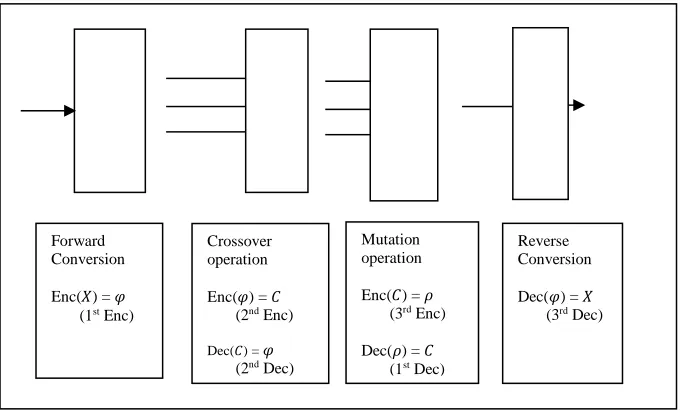
and 𝒟 denote the encryption and decryption rules respectively. 𝒦 is the set containing the keys at the different stages of the encryption or decryption processes. Figure 1 is the structure of the proposed cryptosystem; the front and back ends of the system use data conversions in RNS. Whilst the Crossover and Mutation operations come after the forward conversion during encryption, these operations take place before the reverse conversion during decryption.
4
Implementation of the Proposed Scheme
In this paper, the moduli set {2𝑛−1− 1, 2𝑛− 1, 2𝑛}, is used for the implementation of the proposed scheme. This moduli set is well-balanced with efficient properties such as non-derailment of the various channels in order not to impose unnecessary delay on schemes. It is therefore, suitable for the Proposed Scheme as it has the capacity of enhancing the throughput rate.
For the chosen moduli set, any binary number 𝑋, which is (3𝑛 − 1)-bits wide can be partitioned into three sub-blocks for easy implementation as:
𝑋3𝑛−2𝑋3𝑛−3… 𝑋2𝑛
⏟
𝐵3−(𝑛−1) 𝑏𝑖𝑡𝑠
| 𝑋⏟ 2𝑛−1𝑋2𝑛−2… 𝑋𝑛 𝐵2−𝑛 𝑏𝑖𝑡𝑠
| 𝑋⏟ 𝑛−1𝑋𝑛−2… 𝑋0 𝐵1−𝑛 𝑏𝑖𝑡𝑠
(2)
Which can be computed as, Forward
Conversion
Enc(𝑋) = 𝜑
(1st Enc)
Crossover operation
Enc(𝜑) = 𝐶
(2nd Enc)
Dec(𝐶) = 𝜑
(2nd Dec)
Mutation operation
Enc(𝐶) = 𝜌
(3rd Enc)
Dec(𝜌) = 𝐶
(1st Dec)
Reverse Conversion
Dec(𝜑) = 𝑋
(3rd Dec)
𝑋 = 𝐵1+ 2𝑛𝐵2+ 22𝑛𝐵3 (3) Such that,
𝑥1= |𝑋|2𝑛−1−1= ||𝐵1|2𝑛−1−1+ |2𝑛𝐵2|2𝑛−1−1+ |22𝑛𝐵3|2𝑛−1−1|2𝑛−1−1
= |𝐵1+ 𝐵2+ 𝐵3|2𝑛−1−1 (4)
𝑥2= |𝑋|2𝑛−1= ||𝐵1|2𝑛−1+ |2𝑛𝐵2|2𝑛−1+ |22𝑛𝐵3|2𝑛−1|2𝑛−1
= |𝐵1+ 𝐵2+ 𝐵3|2𝑛−1 (5)
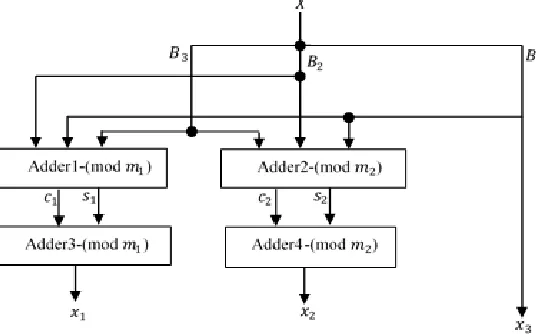
𝑥3= |𝑋|2𝑛 =𝐵1 (6) The schematic diagram for the forward converter is shown in Figure 2. The third residue, 𝑥3, needs no computation since it is equal to the value of the first block 𝐵1 after splitting the decimal number 𝑋.
Figure 2: Block diagram of Forward Converter for the Proposed Scheme
The computations of 𝑥1 and 𝑥2 are performed at the same time first by using Adders 1 and 2 respectively, which respective residues and carries computed with Adders 3 and 4. Adders 1 and 2 are Carry Save Adders whilst Adders 4 and 5 are Carry Propagate Adders.
𝜑𝑖 is a concatenation of the residues as 𝑥1𝑥2𝑥3 for each respective character in the set 𝒫 = {𝑋𝑖∈
𝑀} and successively paired for a random crossover operation, 𝐶𝑖 after XORing the LSBs to determine the crossover rule:
0 → 𝑇𝑤𝑜 − 𝑝𝑜𝑖𝑛𝑡 𝐶𝑟𝑜𝑠𝑠𝑜𝑣𝑒𝑟 1 → 𝑀𝑢𝑙𝑡𝑖 − 𝑝𝑜𝑖𝑛𝑡 𝐶𝑟𝑜𝑠𝑠𝑜𝑣𝑒𝑟
After the crossover operations, each chromosome is mutated by a simple 𝑛-bits circular left shift of
𝐶𝑖 to get 𝜌𝑖 which is stored as the cipher text.
The decryption process involves a reversal of the mutation, followed by the crossover operation and then RNS-Binary conversion. To reverse convert an RNS number with the given moduli set, a simplified CRT is achieved through mathematical manipulation:
Theorem 1: For the moduli set {2𝑛−1− 1, 2𝑛− 1, 2𝑛}, the following holds true from Equation (1):
|𝑘1|𝑚1 = 2𝑛−2 (7)
|𝑘2|𝑚3= −2 (8)
Proof: If it can be demonstrated that |ℓ𝑖× 𝑘𝑖|𝑚𝑖 = 1, then |𝑘𝑖|𝑚𝑖 is the multiplicative inverse of ℓ𝑖
mod 𝑚𝑖, for 𝑖 = 1,2,3.
Thus, for Equation (7), |2𝑛(2𝑛− 1) × (2𝑛−2)|
2𝑛−1−1= |2𝑛−1(2𝑛−1) × (2𝑛−1)|2𝑛−1−1 = |(1)(1)(1)|2𝑛−1−1= 1 Also, for (8) |2𝑛(2𝑛−1− 1) × (−2)|
2𝑛−1= |(−1)(2𝑛− 2)|2𝑛−1
= |(−1)(−1)|2𝑛−1= 1 Lastly for (9), |(2𝑛− 1)(2𝑛−1− 1) × (2𝑛−1+ 1)|
2𝑛 = |(−1)(−1)(1)|2𝑛
= 1 ∎
Hence Equations (7) to (9) hold true since:
ℓ1= 2𝑛(2𝑛− 1)
ℓ2= 2𝑛(2𝑛−1− 1)
ℓ3= (2𝑛− 1)(2𝑛−1− 1)
} (10)
Theorem 2: For the given moduli set, any RNS number X can be represented as;
𝑋 = 2𝑛ℨ + 𝑥
3 (11)
where,
ℨ = |𝐴𝑥1− 𝐵𝑥2+ 𝐴𝑥3+ 𝑥3|𝑚1 (12)
and
𝐴 = 2𝑛−2(2𝑛− 1), 𝐵 = 2(2𝑛−1− 1)
Proof: Substituting Equations (7) – (9), (10) in Equation (1), factorizing and taking the floor function
we obtain Equation (11). ∎
Now, to implement Equation (11), we simplify further as:
𝑋 = ℨ2𝑛−2ℨ2𝑛−3… ℨ1ℨ000 … 00⏞ 𝑛−𝑏𝑖𝑡𝑠
+ 𝑥3,𝑛−1𝑥3,𝑛−2… 𝑥3,1𝑥3,0 (13) Since 𝑥3 is an 𝑛-bit number, it can easily be joined to ℨ to occupy the 𝑛-bit positions of zeros by a process called concatenation without necessarily requiring any hardware as:
𝑋 = ℨ2𝑛−2ℨ2𝑛−3… ℨ1ℨ000 … 00⏞ 𝑛−𝑏𝑖𝑡𝑠
⋈ 𝑥3,𝑛−1𝑥3,𝑛−2… 𝑥3,1𝑥3,0 = ℨ2𝑛−2ℨ2𝑛−3… ℨ1ℨ0𝑥3,𝑛−1𝑥3,𝑛−2… 𝑥3,1𝑥3,0
= 𝑋3𝑛−2𝑋3𝑛−3… 𝑋1𝑋0 (14) where,
ℨ = ||(2𝑛−2)(2𝑛− 1)𝑥
1|ℓ3+ |(−2)(2𝑛−1− 1)𝑥2|ℓ3+ |(22𝑛−2− 2𝑛−2− 1)𝑥3|ℓ3|ℓ
3
= ||𝐴𝑥1|ℓ3− |𝐵𝑥2|ℓ3+ |𝐴𝑥3|ℓ3− 𝑥3|ℓ3 = ||𝐴(𝑥1,𝑛−2… 𝑥1,0)|ℓ
3+ |𝐵̅(𝑥̅2,𝑛−1… 𝑥̅2,0)|ℓ3+ |𝐴(𝑥3,𝑛−1… 𝑥3,0)|ℓ3+ (𝑥̅3,𝑛−1… 𝑥̅3,0)|ℓ3
(15) and,
𝐴 = 111 … 11⏟
𝑛−𝑏𝑖𝑡𝑠
00 … 0⏟
(𝑛−2)−𝑏𝑖𝑡𝑠
and 𝐵 = 111 … 11⏟
(𝑛−1)−𝑏𝑖𝑡𝑠
0
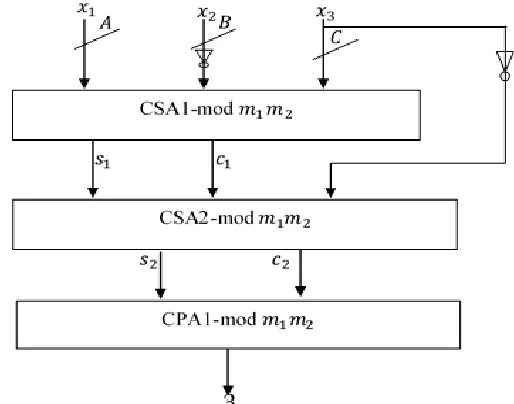
Figure 3: Schematic diagram of Reverse Converter for the Proposed Scheme
Since the values of 𝐴 and 𝐵 are known, it will be hardwired to append to the residues as in equation (15) through a (2𝑛 − 1)-bit modulo carry save adder (CSA1). The outputs from this adder will intend be added with 𝑥3 using another (2𝑛 − 1)-bit modulo carry save adder (CSA2). In order to get the value of ℨ, a carry propagate adder (CPA1) is used, which is also (2𝑛 − 1)-bit wide and a modulo adder. The binary number 𝑋 is the result of a concatenation in equation (14) which does not require any hardware resources but append an extra 𝑛-bits, thereby increasing the bit length to (3𝑛 − 1)-bits wide.
4.1
Simulation
The Proposed Scheme was tested on different types of files containing letters, numbers and symbol characters. The simulation was done using MatLab® R2017b and a CORETM i7 microprocessor laptop. The simulated results are shown in Table 1 with their average times of execution.
S/N File Name Original Text Encrypted Text Decrypted Text Average Runtime
1. A.txt This is a new text encryption technique using genetic algorithm and residue numbers
This is a new text encryption technique using genetic
algorithm and residue numbers
0.0472s
2. B. txt we can also encrypt symbols =
*&^%$#@!()_+-/?><}{][\|~
we can also encrypt symbols =
*&^%$#@!()_+-/?><}{][\|~
3. C. txt 170003467 70087645 180890011 180000334
170003467 70087645 180890011 180000334
0.0384s
Table 1: Simulated Results
5
Performance Evaluation
The encrypted results from Table 1 look very chaotic by sense of sight and do not give any clue whatsoever to the original files. Regarding the robustness of the proposed scheme, an attacker has a
+∞ times of guessing the value of 𝑛, after which he has 2𝑀!× 𝑁 (𝑁 is number of moduli) chance of getting the moduli set used, 𝑁! for the order before the modulo operations to get the residues, (Abdallah & Skavantzos, 1995). The attacker has to continue to obtain the crossover and mutation keys in order to have a complete breakthrough of the proposed scheme at different stages. Thus, for an attacker, without the knowledge of the parameters of the algorithm, it would be an NP-Hard problem which (through a formal proof can be shown) is unfeasible.
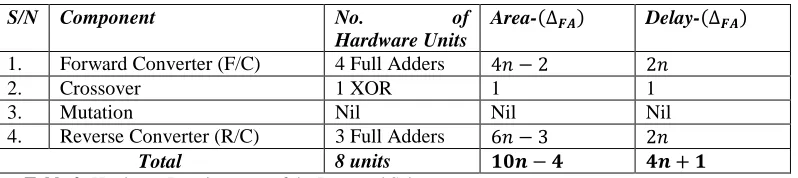
The computational complexity of the proposed scheme is defined by the hardware resources that it requires: the Forward Converter (F/C) requires four modulo adders – two (𝑛 − 1)-bits and two 𝑛-bits adders; the crossover operation requires just a XOR unit; the mutation operation requires no hardware unit; and the Reverse Converter (R/C) requires three modulo adders of length (2𝑛 − 1)-bits as shown in Table 2. Thus, whiles the scheme is robust at different layers, it requires few hardware units thereby making it computationally efficient. This is corroborated by the times of execution as measured in Table 3.
S/N Component No. of
Hardware Units
Area-(∆𝑭𝑨) Delay-(∆𝑭𝑨) 1. Forward Converter (F/C) 4 Full Adders 4𝑛 − 2 2𝑛
2. Crossover 1 XOR 1 1
3. Mutation Nil Nil Nil
4. Reverse Converter (R/C) 3 Full Adders 6𝑛 − 3 2𝑛
Total 8 units 𝟏𝟎𝒏 − 𝟒 𝟒𝒏 + 𝟏
Table 2: Hardware Requirements of the Proposed Scheme
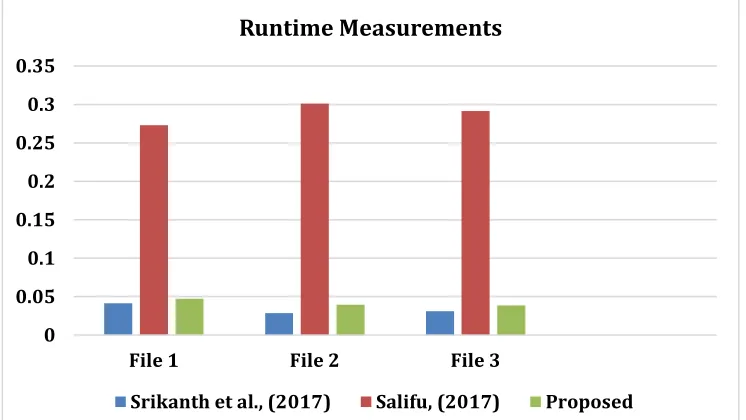
The runtime performance of the scheme was compared to similar existing schemes by (Srikanth et al., 2017) and (Salifu, 2017); this because, the scheme by (Srikanth et al., 2017) employed GA with some other techniques whilst that by (Salifu, 2017) used the RNS and the CRT techique as in this paper. However, the results showed that the proposed scheme performs favourably better. The runtimes of three different files are shown in Table 3:
File Scheme Average Runtime
A.txt
Srikanth et al., (2017) 0.0415s
Salifu, (2017) 0.2731s
Proposed 0.0472s
B.txt
Srikanth et al., (2017) 0.0284s
Salifu, (2017) 0.3012s
Proposed 0.0394s
C.txt
Srikanth et al., (2017) 0.0312s
Salifu, (2017) 0.2913s
Table 3: Evaluation of Runtime by a Comparison of other existing Schemes
As observed from Figure 4 the scheme by (Salifu, 2017) has the highest runtime due to the RSA component of the scheme. The scheme by (Srikanth et al., 2017) has the lowest runtime as seen in both Table 3 and Figure 4; however, it does not achieve optimum results when the message to be encrypted is small. It also has only two layers of encryption. Even though, the proposed scheme has three layers of encryption and decryption, its runtime rises minimally above the scheme by (Srikanth et al., 2017) but outperforms the scheme by (Salifu, 2017). Thus, the throughput rate of the proposed scheme competes favourably when compared to similar existing schemes.
Figure 4: Bar chart showing runtimes of compared schemes
6
Conclusion
Security is a very topical issue currently in digital computing. In this paper, a new text encryption and decryption technique using GA and Residue Numbers (GARN) was presented with its hardware realization and simulation. The simulated results show that the proposed scheme is very chaotic and robust and the throughput rate of the scheme (runtime) competes very favourably with existing similar schemes. In future, this work will be scaled up to include other multimedia elements such as images, videos and audio which are predominantly being used on the Internet.
References
Abdallah, M., & Skavantzos, A. (1995). A systematic approach for selecting practical moduli sets for residue number systems. Proceedings of the 27th Southeastern Symposium on System Theory, SSST 1995, 445–449. https://doi.org/10.1109/SSST.1995.390542
Abdul-mumin, S. (2016). Mixed Radix Conversion based RSA Encryption System. International 0
0.05 0.1 0.15 0.2 0.25 0.3 0.35
File 1 File 2 File 3
Runtime Measurements
Journal of Computer Applications (0975 – 8887), 150(1), 43–47.
Abdul-mumin, S., & Gbolagade, K. A. (2018). Rivest Shamir Adleman Encryption Scheme Based on the Chinese Remainder Theorem. Advances in Networks, SciencePG, 6(1), 40–47. https://doi.org/10.11648/j.net.20180601.14
Agbedemnab, P. A., & Bankas, E. K. (2015). A Novel RNS Overflow Detection and Correction Algorithm for the Moduli Set {2^n-1,2^n,2^n+1}. International Journal of Computer Applications, 110(16), 30–34. https://doi.org/10.5120/19403-0925
Almarimi, A., Kumar, A., Almerhag, I., & Elzoghbi, N. (2014). a New Approach for Data Encryption, (August).
Daabo, M. I., & Gbolagade, K. A. (2012). RNS Overflow Detection Scheme for the Moduli set {M − 1, M}. Journal of Computing, 4(8), 39–44.
Gbolagade, K. A., Chaves, R., Sousa, L., & Cotofana, S. D. (2010). An improved reverse converter for 2^(2n+1)-1,2^n,2^n-1 moduli set. IEEE International Symposium on Circuits and Systems (ISCAS 2010), 2103–2106.
Goldberg, D. E. (1989). Genetic algorithm in search optimization and machine learning. Boston: Addison-Wesley Publishing Company, Inc.
Jassim, A., & Ali, M. (2013). Randomly Encryption Using Genetic Algorithm. International Journal of Application or Innovation in Engineering & Management (IJAIEM), 2(8), 242–246.
Kessler, G. C. (2018). An Overview of Cryptography.
Kumar, A., & Ghose, M. K. (2009). Overview of information security using genetic algorithm and chaos. Information Security Journal, 18(6), 306–315. https://doi.org/10.1080/19393550903327558
Lenstra, A. K., & Citibank, N. A. (2001). Selecting Cryptographic Key Sizes. Journal of Cryptology, 14, 255–293. https://doi.org/10.1007/s00145-001-0009-4
Navin, A. H., Oskuei, A. R., Khashandarag, A. S., & Mirnia, M. (2012). A Novel Approach Cryptography by using Residue Number System. In 6th International Conference on Computer Sciences and Convergence Information Technology (pp. 636–639).
Omondi, A., & Premkumar, B. (2007). Residue Number Systems: Theory and Implementation. Advances in Computer Science and Engineering: Texts (Vol. 2). Published By Imperial College Press and Distributed by World Scientific Publishing Co. Retrieved from http://www.worldscientific.com/worldscibooks/10.1142/p523
Pakshwar, R., Trivedi, V. K., & Richhariya, V. (2013). A Survey On Different Image Encryption and Decryption Techniques. (IJCSIT) International Journal of Computer Science and Information Technologies, 4(1), 113–116.
Phaneendra, H. D. (2014). Identity-Based Cryptography and Comparison with traditional Public key Encryption : A Survey. International Journal of Computer Science and Information Technologies, 5(4), 5521–5525.
Salifu, A.-M. (2017). Residue Number System Based Fault TolerantT Scheme for enhancing Rivest Shamir Adleman Encryption Scheme. Kwara State University, Malete.
Sousa, L. (2015). 2^n RNS Scalers for Extended 4-Moduli Sets. IEEE Transactions on Computers, PP(99), 1–14. https://doi.org/10.1109/TC.2015.2401026
Srikanth, P., Mehta, A., Yadav, N., Singh, S., & Singhal, S. (2017). Encryption and Decryption Using Genetic Algorithm Operations and Pseudorandom Number. Computer Science and Network, 6(3), 455–459.
Stinson, D. (1995). Cryptography: Theory and Practice. CRC Press LLC.
Wu, C. W., & Rulkov, N. F. (1993). Studying chaos via 1-Dmaps - a tutorial. In IEEE Transaction on Circuits and Systems-I: Fundamental Theory and Applications, (pp. 707–721).
Younes, D., & Steffan, P. (2013). Universal Approaches for Overflow and Sign Detection in Residue Number System Based on {2n – 1, 2n, 2n + 1}. In ICONS 2013, The Eighth International