Original Research
Medical Journal of Islamic Republic of Iran, Vol. 26, No. 2, May. 2012, pp. 66-72
__________________________________________________________________________________________________ 1.(Corresponding author) MD., MPH Assistant professor, Stroke center, Firoozgar General Hospital, Tehran University of Medical Sciences, Tehran, Iran. [email protected]
2.MD. Tehran University of Medical Sciences, Tehran, Iran. [email protected]
3.MD. Member of Firoozgar Clinical Research Development Center (FCRDC). Tehran University of Medical Sciences, Tehran, Iran. [email protected]
4.MD. Assistant professor, Neurology ward, Firoozgar general hospital, Tehran University of Medical Sciences, Tehran, Iran. [email protected]
5.MD., MPH., Member of Firoozgar Clinical Research Development Center (FCRDC). Tehran University of Medical Sciences, Tehran, Iran. [email protected]
Serum uric acid level in acute stroke patients
Masoud Mehrpour1, Mahbubeh Khuzan2, Neda Najimi3, Mohamad R. Motamed4, Seyed-Mohammad Fereshtehnejad5
Department of Neurology, Firoozgar General Hospital, Tehran University of Medical Sciences, Tehran, Iran.
Received: 26 December 2011 Revised: 24 January 2012 Accepted: 26 February 2012 __________________________________________________________________________________________
Abstract
Background: The role of uric acid as a risk factor for vascular disease and acute stroke is controversial and there is little information about it. In this study, we determined serum uric acid levels in patients with acute stroke and assessed its relationship with cerebrovascular risk factors.
Methods: In this cross sectional study, we assessed patients with acute stroke who were admitted in Firoozgar Hospital from September 2010 to March 2011. Clinical records of patients and their serum uric acid level was investigated. Finally, collected data were analyzed using SPSS software Ver.16.
Results: Fifty five patients with acute stroke were evaluated who 25 of these patients (45.5%) were female and 30 of them (54.5%) were male. The mean age of patients was 67±14 years. Mean serum uric acid levels in the patients studied 5.94±1.70 mg/dl, and about half of the patients (47.3%) were hyperuricemic. There was a significant negative correlation between age of patients and their serum uric acid level (p=0.04, R =-0.27). Uric acid level was significantly higher in men than women (p=0.03). Hyperuricemia was associated with increased amounts of triglycerides and Low-density lipoprotein (LDL) cholesterol (p=0.03, p=0.02). In patients with acute stroke, there was no significant association between serum uric acid level and diabetes mellitus, hypertension, history of ischemic heart disease, smoking, prescription rTPA, and type of stroke.
Conclusion: Due to the high prevalence of hyperuricemia in patients with acute stroke, and its accompany-ing increase in triglyceride and LDL cholesterol levels, it can be considered as a risk factor for acute stroke.
Keywords: Uric acid, Acute stroke, Triglyceride.
_______________________________________________________________________________________
Introduction
Stroke is a growing disease; according to a recent report. About 780000 Americans ex-perience a new or recurrent stroke each year, on average, one stroke every 40 seconds (1). Stroke is the third common cause of death in the world after coronary heart disease and cancer especially in the elderly (2,3). The
mortality rate of stroke in the acute phase is as high as 20% and it remains higher for several years after the acute event in stroke patients than in the general population (2). Stroke is the second cause of disability and dementia in adults aged ≥ 65 years world-wide: close to 25% of stroke survivors de-velop dementia (4). Stroke is also an im-portant cause of morbidity and long term
M.Mehrpour, et. al.
67 MJIRI, Vol. 26, No. 2, May 2012, pp. 66-72
disability: up to 40% of survivors are not expected to recover their independence with self-care and 25% become unable to walk independently (2).
Uric acid is the ultimate catabolite of pu-rine metabolism in human and higher pri-mates (5). It exists in the extracellular com-partment as sodium urate, and it is cleared from the plasma through the kidney (6). Uric acid levels are influenced by age and sex. Prior to puberty, the average serum uric acid is 3.6 mg/dl for males and females. Follow-ing puberty, value rises to adult levels with women typically 1 mg/dl less than men. This lower level in women apparently reflects estrogen related enhancement of renal urate clearance (5).
It has been reported that increased levels of uric acid are associated with established cardiovascular risk factor such as elevated serum triglyceride and cholesterol concen-tration, hypertension, obesity, insulin re-sistance and metabolic syndrome (2, 6).On the other hand uric acid has been known to exert neuroprotective effects by acting as a free radical scavenger (6, 7).In humans, ap-proximately one half the antioxidant capaci-ty of plasma comes from uric acid (7, 8).
The role of urate in ischemic stroke is poorly understood. A retrospective analysis of hospitalization data of 2495 patients in Glasgow suggested that higher serum urate on admission predicted poor outcome (dead or in care) and higher vascular event rate following ischemic stroke(9).By contrast a prospective hospital-based study involving 881 patients found that higher level of serum urate predicted better outcomes following stroke, suggesting that serum urate may be beneficial and protect against poor outcomes (10).In addition an experimental study showed that uric acid administered early af-ter thromboembolic stroke is neuroprotective in the rat brain and it extends the benefits of recombinant tissue plasminogen activator (rTPA) (11).
Therefore the role of uric acid as a risk factor for vascular disease and acute stroke is controversial and there is little information about it, so in this study we decided to
de-termine serum uric acid levels in patients with acute stroke and assess its relationship with cardiovascular risk factors.
Methods
Patients
A total of 55 patients aged from 30 to 90 years old, who were admitted in Firoozgar hospital (Tehran, Iran) were evaluated in a cross-sectional study. The patients were re-cruited from September 2010 to March 2011 with acute stroke. All patients were informed and the consent was obtained from all pa-tients. Demographic data, including age, sex, and history of diseases like diabetes mellitus, hypertension, and Ischemic Heart Disease was recorded based on medical records of the patients. Smoking history and its dura-tion was asked from the patients. As acute stroke patients were included in the study, if rTPA was administered for them, it was rec-orded. Baseline blood pressure of the pa-tients was recorded (in supine position). Blood sample was taken from all patients with acute stroke during 24 hour of admis-sion to check uric acid level, Fasting blood sugar and lipid profile.
Statistical analysis
Statistical analysis was done using SPSS software for windows ver.16. Mean and standard deviation (SD) of all continuous data are reported. To compare means in 2 independent groups (like diabetics and non-diabetics), independent samples T-test in normally distributed variables and Mann-Whitney U test if the distribution was not normal were used. Chi-square test was used for nominal data comparison and Spearman correlation test was used to determine rela-tion of two continuous variables. R was re-ported for correlation tests. Level of signifi-cance was considered 0.05 (two-sided).
Results
Fifty five acute stroke patients were stud-ied of whom 25 (45.5%) were female and 30 (54.5%) were male. Mean age of the patients was 67(SD=13.6) years. 46 (83.6%) had is-chemic stroke and 9 (16.4%) had
Uric acid in acute stroke
68 MJIRI, Vol. 26, No. 2, May 2012, pp. 66-72
Table 1. Mean and Standard deviation of stroke risk factors in relation with uric acid (All evalu-ated associations have non-significant p-value of >0.05)
Spearman's r Mean (SD)
Risk Factors
-0.27 67 (13.6)
Age (years)
0.06 126.33
(61.0) FBS on
admis-sion (mg/dl)
0.18 6.30 (2.1)
HbA1c(mg/dl)
0.08 135.51
(23.8) SBP (mmHg)
0.10 80.73
(11.9) DBP (mmHg)
0.15 133.56
(58.9) Triglyceride
(mg/dl)
0.02 180.09
(47.7) Total Cholestrol
(mg/dl)
-0.01 40.29
(12.2) HDL (mg/dl)
-0.03 115.85
(36.9) LDL (mg/dl)
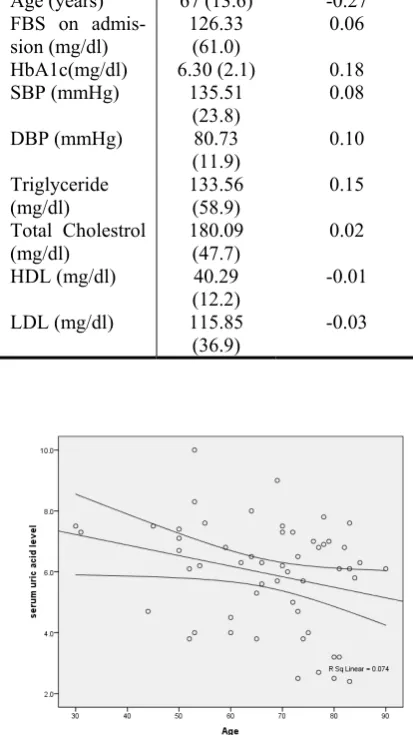
Fig. 1. Negative relationship between age of the patients and serum uric acid level (r= -0.27, p=0.04)
rhagic stroke. 9 (16.4%) patients received rTPA.
Eleven patients had a known history of di-abetes mellitus with mean fasting blood sug-ar (FBS) of 126.33 (SD=61.02) mg/dl. HbA1c was higher than normal in 16 (29.1%) patients. Regarding the data ob-tained, 18(32.7%) patients had diabetes (7 diagnosed by admission blood tests). Serum triglyceride level was 133.56 mg/dl (SD=58.90), a total of 9(16.4%) patients had higher than normal level of triglyceride (>150mg/dl). Serum total cholesterol level was 180.09 mg/dl (SD=47.70), Low-density lipoprotein (LDL) was 115.85(SD=36.90) and high-density lipoprotein (HDL) level was 40.29 (SD=12.20). Based on the data, 9 (16.4%) had low levels of HDL (<40 mg/dl).
Baseline mean blood pressure of the pa-tients was 135/80 mmHg after stroke. 33 (60%) had a known history of hypertension.
15 (27.3%) patients smoked, 24 (43.6%) patients had a history of ischemic heart dis-ease.
Mean serum uric acid level was 5.94 (SD=1.70) mg/dl. Regarding the definition of high uric acid level (more than 7 mg/dl in men and more than 6 in women), 26 (47.3%) patients had hyperuricemia.
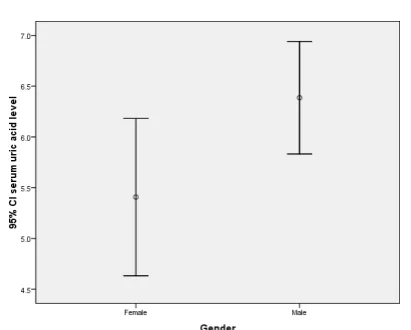
There was a negative relationship between age of the patients and serum uric acid level (r= -0.27, p=0.04; Fig. 1). There was a statis-tically significant difference in uric acid lev-el between men and women (p=0.03, Fig. 2). There was no statistically significant differ-ence between uric acid levels in diabetics and diabetics, hypertensive and non-hypertensive patients.
There was a statistically significant differ-ence in uric acid level between patients with dyslipidemia (triglyceride >150 mg/dl and LDL > 130 mg/dl) and normal lipid levels (p=0.03 and p=0.02, respectively).
The data for risk factors related to acute stroke are summarized in Table 1. There was no statistically significant difference be-tween uric acid levels in patients receiving rTPA and non-receivers (p>0.05).
Discussion
In this study we determined the serum uric acid levels in patients with acute stroke. Mean serum uric acid level was 5.94 (±1.70) mg/dl and about half of the patients were hyperuricemic. According to a large 10 years follow up study the prevalence of hyper-uricemia in United state is 20.1% (12). An-other large study in Bangkok population showed that prevalence of hyperuricemia is 24.4%(13) and a study in a developing coun-try reported the prevalence of hyperuricemia is 35.2% in men and 8.7% in women (14). According to these studies prevalence of
M.Mehrpour, et. al.
69 MJIRI, Vol. 26, No. 2, May 2012, pp. 66-72
Fig. 2. significant difference in uric acid level be-tween men and women (p=0.03)
hyperuricemia is significantly higher in pa-tients with acute stroke than normal popula-tion.
Stroke is the one of the main clinical man-ifestation of CVD and studies investigating the relation between the uric acid and stroke have been inconsistent. Some studies report-ed a positive independent relationship be-tween uric acid and stroke whereas others demonstrated that uric acid did not relate significantly to stroke occurrence (2).
Bansal et al studied 50 patients with ischem-ic thrombotischem-ic cerebrovascular disease: thirty percent of the cases showed hyperuricemia and they concluded that elevated serum uric acid level may be a playing a role in the cau-sation of ischemic thrombotic cerebrovascu-lar disease in general and especially in pa-tients below 40 years of age (15). Kim et al conducted a systematic review and meta-analysis of 16 prospective cohort studies in-cluding 238449 adults to assess the association between hyperuricemia and risk of stroke in-cidence and mortality. They found that hyperuricemia may modestly but statically significant increase the risk of both stroke incidence and mortality(1) .According to results of Milionis et al study, elevated se-rum uric acid levels associated with in-creased risk of acute ischemic stroke in the elderly(16). On the other hand in the Syst-Eur trial that included patients with isolated systolic hypertension, no significant rela-tionship was detected between serum uric acid levels and fatal and non fatal strokes (17). Moreover ,in a Japanese middle-aged population, hyperuricemia was not associat-ed with stroke mortality in 108284 person-years of follow up(18).Goldberg et al studied middle aged men and followed them for 20 years and they did not show a significant correlation between serum uric acid and thromboembolic stroke (19). Cazzato et al. reported no difference in uric acid level be-tween patients with stroke and control group and their results demonstrated that hyperuricemia was not a high risk factor in cerebrovascular disease (20). Recently Chen et al studied 226 hemodialysis patients and
followed them for 18 months, 43 patients experienced acute ischemic stroke; serum uric acid is inversely related to acute ischem-ic stroke morbidity in hemodialysis patients (21). There is some explanations for discrep-ancies; there are several limitations includ-ing the study design, the population studied (different ethnicities with different CVD risk) and the confounders measured (2).
In our study, there was a significant nega-tive correlation between age of patients and their serum uric acid levels. This result in contrast to study there was a weak but sig-nificant positive association between age of patients and their serum uric acid levels (14). Similarly to the previous studies, our study showed that the significant differences in uric acid level between men and women. In the other word, uric acid level was signif-icantly higher in men than women (22, 23, 24) but there was no difference in prevalence of hyperuricemia between men and women. In contrast, another study by Conen et al demonstrated that prevalence of hyperuricemia is higher in men than women and higher al-cohol consumption in men may be the cause of this difference (14).
In this study, there was no significant as-sociation between serum uric acid level and diabetes mellitus, hypertension and smoking. In contrast some previous studies reported significant association between insulin re-sistant, systolic and diastolic blood pressure
Uric acid in acute stroke
70 MJIRI, Vol. 26, No. 2, May 2012, pp. 66-72 and serum uric acid levels (10,25).
Chammaro et al. assessed prognostic sig-nificance of serum uric acid concentration in patients with acute ischemic stroke and they reported that diabetic had lower uric acid concentration than other patients and uric acid concentration inversely associated with fasting blood glucose (10).A study by Bonora et al showed that there is no signifi-cant association between smoking and uric acid level (25).
In this study there was no significant asso-ciation between serum uric acid level and serum triglyceride, total cholesterol, HDL cholesterol and LDL cholesterol but hyperuricemia was associated with serum triglyceride and LDL cholesterol. Some pre-vious studies including different groups of patients, for example patients with gout, re-ported the association between uric acid lev-els and triglyceride levlev-els(24, 26). Bonora et al studied 957 young men and demonstrated that there was a significant positive correla-tion between serum uric acid levels and lev-els of serum triglyceride, total cholesterol and LDL cholesterol (25). Another study including healthy people in developing countries showed a closely association be-tween serum uric acid level and amount of serum triglyceride (14). Moreover, Chammaro et al reported the association be-tween serum uric acid level and amount of serum triglyceride (10).
The mechanism of this strong association between serum uric acid levels and triglycer-ide levels is still poorly understood. Alt-hough some studies reported the role of ge-netic factors in the occurrence of gout and hypertriglyceridemia (27, 28), most of re-searchers believed that hyperuricemia and hypertriglyceridemia may reflect the pa-tient’s life style as a part of metabolic syn-drome (14).
According to our study there was no asso-ciation between serum uric acid levels and history of ischemic heart disease. In contrast a study by Freedman et al reported that hyperuricemia often exists in patients with ischemic heart disease and it can be a risk factor for these diseases (22).
In this study there was no association be-tween type of stroke (hemorrhagic or is-chemic) and serum uric acid levels. Different studies assessed the uric acid levels exclu-sively in patients with ischemic stroke where there was significant association between uric acid level and incidence of acute is-chemic stroke (16, 29). According to results of Bos et al. ,hazard ratio of elevated serum uric acid levels in ischemic stroke was 1.77 and in hemorrhagic stroke was 1.68 (30).
Recombinant tissue plasminogen activator (rTPA) is the only approved treatment in pa-tients with acute ischemic stroke, but be-cause of bleeding complication of this treat-ment rTPA use for a little part of patients (31).In the present study, rTPA administered for 16.4 percent of patients and there was no significant difference in uric acid levels be-tween these patients and the other patients.
Our study has some limitations. First, this study was cross-sectional descriptive, we can assess the association between uric acid level and incidence of stroke if we used co-hort study. In addition, we didn’t consider a control group; if we used the control group we can assess the risk factor of stroke inci-dence and their association with serum uric acid levels. Therefore further studies will be a cohort prospective and use the control group beside case group.
Conclusion
Our study showed that prevalence of hyperuricemia in patients with acute stroke was significantly higher than normal popula-tion. There was a significant negative corre-lation between age of patients and their se-rum uric acid levels. Uric acid level was sig-nificantly higher in men than women. Hyperuricemia was associated with in-creased amounts of triglycerides and LDL cholesterol. In patients with acute stroke, there was no significant association between serum uric acid level and diabetes mellitus, hypertension, history of ischemic heart dis-ease, smoking, prescription rTPA, and type of stroke. Due to the high prevalence of hyperuricemia in patients with acute stroke, and its accompanying increase in
M.Mehrpour, et. al.
71 MJIRI, Vol. 26, No. 2, May 2012, pp. 66-72
ide and LDL cholesterol levels, it can be considered as a risk factor for acute stroke.
References
1.Kim SY, Guevara JV, kim KM, et al. Hyperuricemia and Risk of stroke: A Systematic Re-view and Hariklia VD, Apostolos H, Haralambosk. The Role of Uric Acid in Stroke. The lssue Remains Unresolved. The Neurologist. 2008; 14: 238-242.
2.Hariklia VD, Apostolos H, Haralambosk. The Role of Uric Acid in Stroke. The lssue Remains Un-resolved. The Neurologist. 2008; 14: 238-242.
3.Feigin VL, Lawes CM, Bennett DA, et al. Worldwide stroke incidence and early case fatality reported in 56 population- based studies: a systematic review. Lancet Neurol. Llibre J, valhuerdi A, Fernan-dez O. prevalence of stroke and Associated Risk fac-tors in Older Adults in Havana city and Matanzas Provinus, Cuba (10/66 Population- Based study). MEDICC Review. 2010; 12: 20-24.
4.Llibre J, valhuerdi A, Fernandez O. prevalence of stroke and Associated Risk factors in Older Adults in Havana city and Matanzas Provinus, Cuba (10/66 Population- Based study). MEDICC Review. 2010; 12: 20-24.
5.Barr WG. Uric acid. In: Walker HK,Hall WD, Hurst JW, editors. Clinical Methods. The History, Physical, and Laboratory Examination, 3rd ed. Bos-ton: Butter worth: 1990. P: 760-763.
6.Heo SH, Lee SH. High levels of serum Uric ac-id are associated with silent brain infarctivn. Jaurnal of the Neurol Scien. 2010; 297:6-15.
7.Amaro S, Urra X, Gomez- Choco M. Uric Acid Levels Are Relevant in Patients With Stroke Treated with Thrombolysis. Stroke. 2011; 42:28-32.
8.Ogbera A, Azenabor A. Hyperuricemia and the metabolic syndrome in type 2 DM. Diabetol Metab Syndr 2010; 2:24-30.
9.Weir CJ, Muir SW, Walters MR, et al. Serum Urate as an independent predictor of poor outcome and future vascular events after acute ischemic stroke. Stroke 2003; 34: 1951-1956
10.Chamorro A, obach V, cerrera A, et al. Prog-nostic significance of uric acid serum concentration in patients with acute ischemic stroke. Stroke. 2002; 33:1048-1052.
11.Romanos E, Planas AM, Amaro S, et al. Uric acid reduces brain damage and improves the benfits of rtPA in a rat model of the thrombo- embolic stroke. J cereb Blood Flow Metab. 2007; 27: 14-20.
12.Yanyan Z, Bhavik P, Hyon C. Prevalence of Hyperuricemia in the US General Population: The National Health and Nutrition Examination Survey (NHANES) 1999-2008. Arthritis and Rheumatism 2010; 62 Suppl 10 :1363
13.Uaratanawong S, Suraamornkul S, Angkeaw
S, et al. Prevalence of hyperuricemia in Bangkok population. Clin Rheumatol. 2011:8. [Epub ahead of print]. DOI: 10.1007/s10067-011-1699-0.
14.Conen D, Wietlisbach V, Bovet P, et al. Prev-alence of hyperuricemia and relation of serum uric acid with cardiovascular risk factors in a developing country. BMC Public He. Bansal BC, Gupta RR, Bansal MR, et al. Serum lipids and uric acid relation-ship in ischemic thrombotic cerebrovascular disease. Stroke 1975; 6:304-307alth. 2004;25(4):9.
15. Bansal BC, Gupta RR, Bansal MR, et al. Se-rum lipids and uric acid relationship in ischemic thrombotic cerebrovascular disease. Stroke 1975; 6:304-307
16.Milionis HJ, Kalantzi KJ, Goudevenos JA, et al. Serum uric acid levels and risk for acute ischaemic non-embolic stroke in elderly subjects. J Intern Med 2005;258:435-41.
17.De Leeum PW, Thijs L, Birkenhager WH, et al. systolic hypertension in Europe (Syst-Eur) trial investigators, Prognostic significance of renal func-tion in elderly patients with isolated systolic hyper-tension, results from the Syst-Eur trial. Am Soc Nephrol 2002; 13: 2213-2221
18.Sakata K, Hashimoto T, Ueshima H, et al. Ab-sence of an association between serum uric acid and mortality from cardiovascular disease: NIPPON DA-TA 80, 1980-1994, National integrated projects for prospective observation of non-communicable dis-ease and its trend in the aged. Eur J Epidemiol; 17: 461-468.
19.Goldberg RJ,Burch fiel CM,Benfante R,et al.Life style and biologic factors associated with atherosclrotic disease in middle- aged men.20- year, finding from the Honolulu Heart Program. Arch lntern Med. 1995;155:686-694.
20.Cazzato G, Zorzon M, Mouti F, et al. The blood level of uric acid as a risk factor in transient cerebral ischemic attack and non-embolic acute in-farct. Riv Neurol 1982; 52:355-369.
21.Chen Y, Ding X, Teng J, et al. Serum uric ac-id is inversely relate to acute ischemic stroke mor-bidity in hemodialysis patients. Am J Nephrol 2011;33(2):97-104.
22.Freedman DS, Williamson DF, Gunter EW, et al. Relation of serum uric acid to mortality and is-chemic heart disease. The NHANES I epidemiologic follow-up study. Am J Epidemiol 1995; 141:637-644.
23.Nicholls A, Snaith ML, Scott JT. Effect of es-trogen therapy on plasma and urinary levels of uric acid. BMJ 1973; 1:449-451.
24.Matsubara K, Matsuzawa Y, Jiao S, et al. Re-lationship between hypertriglyceridemia and uric acid production in primary gout. Metabolism 1989; 38:698-701.
25.Bonora E, Targher G, Zenere MB, et al. Rela-tionship of uric acid concentration to cardiovascular risk factors in young men, Role of obesity and central fat distribution, The Verona Young Men Atheroscle-rosis Risk Factors Study. Int J Obes Relat Metab
Uric acid in acute stroke
72 MJIRI, Vol. 26, No. 2, May 2012, pp. 66-72
Disord 1996; 20(11):975-80.
26.Johnson RJ, Kivlighn SD, Kim YG, et al. Re-appraisal of the pathogenesis and consequences of hyperuricemia in hypertension, cardiovascular disease and renal disease. Am J Kidney Dis 1999; 33:225-234.
27.Ferns GA, Lanham J, Dieppe P, et al. A DNA polymorphism of an apoprotein gene associates with the hypertriglyceridemia of primary gout. Hum Genet 1988; 78:55-59.
28.Moriwaki Y, Tetsuya Y, Takahashi S, et al. Apolipoprotein E phenotypes in patients with gout: relation with hypertriglyceridemia. Ann Rheum Dis 1995; 54:351-354
29.Hozawa A, Folsom AR, Ibrahim H, et al. Se-rum uric acid and risk of ischemic stroke: the ARIC Study. Atherosclerosis 2006;187(2):401-407
30. Bos MJ, Koudstaal PJ, Hofman A, et al. Uric Acid Is a Risk Factor for Myocardial Infarction and Stroke. The Rotterdam Study. Stroke 2006;37:1503-1507.
31.Amaro S, Soy D, Obach V, et al. A Pilot Study of Dual Treatment With Recombinant Tissue Plasminogen Activator and Uric Acid in Acute Is-chemic Stroke. Stroke 2007; 38(7):2173-5.