ISSN: 2334-2986 (Print), 2334-2994 (Online) Copyright © The Author(s). 2014. All Rights Reserved. American Research Institute for Policy Development 42 Monticello Street, New York, NY 12701, USA. Phone: 1.347.757.4901 Website: www.aripd.org/jea
Modern Methods of Constructions and Their Components
Lenka Kyjaková 1, Tomáš Mandičák 2 & Peter Mesároš 3
Abstract
Increasingly in the construction industry appears concept of modern methods of construction in delivering faster and more efficient construction. One of these systems and methods are volumetric structural systems. This article analyzes the modern methods of constructions, and points to one of their components, specifically to modular constructions. Examined their design and also shows the benefits that come with this of type modern methods of constructions. Common ground benefits of modular construction philosophy begin to break the unprofessional especially from the public. Examples from abroad clearly demonstrate that this technology has potential even in modern architecture. The success of this technology depends on how they use the possibilities architects, planners and building engineers.
Keywords: modern methods of construction, construction components
Introduction
Many people prefer homes built the traditional way, board by board, nail by nail, right close by at the construction site. Nevertheless, they don't construct them like they used to. The huge mainstreams of houses these days are built with at least some factory-built components.
1 Technical University of Košice, Faculty of Civil Engineering, Institute of Construction Technology
and Management, Vysokoškolská 4, 042 00 Košice, Slovakia
2 Technical University of Košice, Faculty of Civil Engineering, Institute of Construction Technology
and Management, Vysokoškolská 4, 042 00 Košice, Slovakia
3 Technical University of Košice, Faculty of Civil Engineering, Institute of Construction Technology
And a healthy proportion are put together almost totally off-site. The cause is generally cost. The building method approach to home building save time, and time is money, not just to the people who raise houses but as well to the people who pay money for them (Off-site Construction, 2013. Modern methods of construction (MMC) originated in the United Kingdom (UK) as a common term for offsite methods of construction and onsite methods of construction.
Offsite MMC are prefabrication elements or parts of structures, constructed in factory, then transported and assembled on-site. Onsite MMC are building blocks and parts of structures takes place directly on site. Virtually all of the good quality products are built in factories around the world. Cars, planes, ships, computers, printers, cell phones, even the pen you write with are built in factories. In addition, even site built homes use many components that were produced in factories. Modular homes take a shorter time for construction compared with site-built homes. This is due to the fact that while the modular is being built in the factory, another crew is building the foundation at the same time 0Chen, 2010).
1. Defining and Classifications of Modern Methods of Construction
MMC originated in the United Kingdom as a common term for offsite methods of construction and onsite methods of construction. Offsite MMC are prefabrication elements or parts of structures, constructed in factory, then transported and assembled on-site. Onsite MMC are building blocks and parts of structures takes place directly on site.
Defining of Modern Methods of Construction
They engage people and process to seek improvement in the delivery and performance of construction. The authors (Burwood and Jess, 2005) defined MMC as those which provide and efficient product management process to provide more products of better quality in less time. It can be classified in various ways and may involve key services (e.g.) plumbing, key items (e.g. foundations) inner shell (walls etc), external walls, or any combination of these elements. It can also be classified by material (timber, steel, concrete and masonry). According to Warszawski (Warszawski, 1999). MMC are defined as a set of element or component which are inter-related towards helping the implementation of construction works activities. He also expounded that MMC are an investment in equipment, facilities, and technology with the objective of maximizing production output, minimizing labour resource, and improving quality. Thikha (Trikha, 1999) defined MMC as a system in which concrete components prefabricated at site or in factory are assembly to form the structure with minimum in situ construction.
Classifications of Modern Methods of Construction
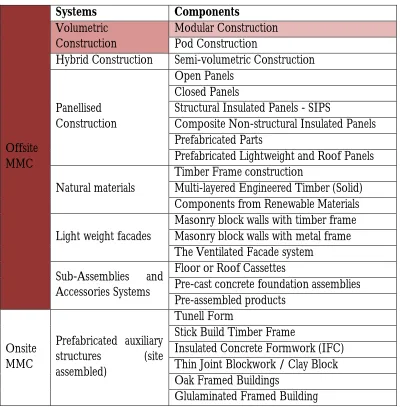
Table 1 Classifications MMC
Offsite MMC
Systems Components
Volumetric Construction
Modular Construction Pod Construction
Hybrid Construction Semi-volumetric Construction
Panellised Construction
Open Panels Closed Panels
Structural Insulated Panels - SIPS
Composite Non-structural Insulated Panels Prefabricated Parts
Prefabricated Lightweight and Roof Panels
Natural materials
Timber Frame construction
Multi-layered Engineered Timber (Solid) Components from Renewable Materials
Light weight facades
Masonry block walls with timber frame Masonry block walls with metal frame The Ventilated Facade system
Sub-Assemblies and
Accessories Systems
Floor or Roof Cassettes
Pre-cast concrete foundation assemblies Pre-assembled products
Onsite MMC
Prefabricated auxiliary
structures (site
assembled)
Tunell Form
Stick Build Timber Frame
Insulated Concrete Formwork (IFC) Thin Joint Blockwork / Clay Block Oak Framed Buildings
Glulaminated Framed Building
2. Modular construction as one of the components of the modern methods of constructions
The entire production is the production of individual parts of the module, such as: frame, floor, ceiling, walls, and other accessories.
The Basic the Design of the Modular Construction
The steel structure consists of hollow profiles and rolled, self-supporting, anti corrosion primer and polyurethane topcoat paint. Standard container module has a galvanized profiled sheet. Atypical containers can have final surface treatment of as wood, metal, fiber-cement or plaster. Figure 1 shows a modular metal frame construction (Rikostav, 2007).
Figure 1 Metal frame (www.fagus.sk)
Inner surface can be made of materials such as drywall, wood paneling, ceramic tiles. Thermal insulation is used mineral wool. Composition of layers modular construction is shown in Figure 2.
Figure 2 Composition of layers modular construction
Composition floors and walls (Figure on the left):
1. Insulated transverse column, 2. The external cladding,
3. Internal cladding of fermacell plates with wallpaper or chipboard,
4. Frame of galvanized sheet metal to accommodate the insulation, which is separate vapor barrier,
4. PVC flooring, linoleum, carpet, laminate flooring, 5. Cement board CTD, 6. Water vapor barrier foil
Composition ceiling (Figure on the right):
1. Steel cube,
2. Transverse beam used to downcomer water an insulated with polystyrene, 3. Galvanized of trapezoidal sheet, 4. Ceiling insulation of mineral wool, 5. Steel U-profiles to grip the ceiling,
6. White PVC extrusions.
Appearance of each module can be customized according to the requirements always to be met. The same applies to the design of windows and doors. The modular system can be combined as the extension of the walled building. Can be built on a concrete base, concrete blocks, and panels. May be three floor. Individual modules can be optionally built beside or behind. Dimensions of individual modules allow interesting layouts. It is this flexibility module gives the opportunity and space to the imagination. The facade may be standard of painted galvanized trapezoidal sheet (www.ikosatv.sk).
The Benefits of Modular Constructions
Hundreds of end users benefit from the ease of use and flexibility that modular construction offers. Attractive prefabricated buildings can be any size, have multiple stories and custom designed to meet specific needs.
Modular constructions are manufactured in a dry, secure facility, where predictability of quality centered in a factory benefits the project. Modules are easily transported to site for installation. This process saves project time and money because site preparation occurs while the buildings are being manufactured and there are no weather delays. Site installation is also much faster than ‘stick-built’ (www.atcol.com).
The authors (Lender and Media, 2010) one key advantage of modular construction is that it's more cost effective than traditional on-site building. Modular builders take advantage of economies of scale by building multiple similar pieces at once. They also get to work on smaller pieces of the building, reducing the need to use ladders or scaffolding. Finally, since the bulk of the construction and finishing work is done indoors, there's less risk of weather-related delays in construction that can cause workers to sit around idly waiting for the ability to work.
The nature of factory building also makes modular homes faster to build. They're frequently built on an assembly line that continuously operate. Companies have their own inspectors on site, so the units can be checked as they're built without having to wait for a city inspector to come and sign off on the work. Finally, when they get built on-site, all that needs to be done is to have them placed on the site and joined together. This process can be completed in hours or days instead of weeks or months.
3. Conclusion
Modern methods of constructions are not new in developed countries in Europe and the USA. Modern methods of constructions should be seen as innovation in construction. It is imperative that modern methods of constructions are seen as an evolution of construction using new and innovative techniques rather than a revolution. Modern methods of constructions are not to be seen as a threat to traditional methods. Both methods should be able to work together and improve their processes collectively. This paper analyzed of the modern methods of constructions, and points to one of their components, specifically to modular constructions. Examined their design and also shows the benefits that come with this of type modern methods of constructions. Common ground benefits of modular construction philosophy begin to break the unprofessional especially from the public. Examples from abroad clearly demonstrate that this technology has potential even in modern architecture. The success of this technology depends on how they use the possibilities architects, planners and building engineers.
Acknowledgements
The article presents a partial research result of project VEGA 1/0677/14 „Research of construction efficiency improvement through MMC technologies”.
References
Azman, M.N.A., et al. (2012) The perspective vies of Malaysian industrialized building system (IBS) under IBS precast manufacturing. The 4th Internatiional Engineering
Conference – Towards engineering of 21st century. 13 p.
Burwood, S. and Jess. P. (2005) Modern Methods of Construction. Evolution or Revolution? A BURA Steering and Development Forum Report.
CHAPTER (2012) 3. Modern methods of construction. Technical Manual – T8-0 11-050 104 12. [on-line], Available:
http://www.premierguarantee.co.uk/media/12725/chapter_3.pdf
Doherty, (2011) T. Modern methods of Construction (MMC) & Eco-Building. 19 p.
Available:http://www.buildstore.co.uk/developers/site-files/pdfs/Introduction%20to%20MMC%20&%20Eco%20COnstruction%20%20Ti m%20Doherty.pdf(26/10/2013)
Estate, (2010) Modern methods of construction. [on-line], Available:
http://www.zurich.com/NR/rdonlyres/4DF72E44-8958-4E78-93BB DF2D18D0C7/0/Modernmethodsofconstruction.pdf(15/10/2013) http://rikostav.sk/
http://www.atcosl.com/en-ca/About-Us/Why-Modular
http://www.structure1.com/html/modular3.htm
Kempton, J. (2009) Modern methods of construction: Maintenance issues in the registered social landlord sector. In: Dainty, A.R.J. (Ed) Procs Annual ARCOM Conference, 7-9 September, Nottingham, UK, Association of Researchers in Construction Management, p. 251-60.
Kozlovská, M. and Spišáková, M. (2013) Nové technológie výstavby z pohľadu znižovania odpadov. In: Waste Forum. no. 2 (2013), p. 50-59, ISSN 1804-0195.
Lander, S., Media D. (2010) Advantages and disadvantages of Modular Construction. [on-line], Available: http://everydaylife.globalpost.com/advantages-disadvantages-modular-construction-27124.html
Off-site Construction. (2013). [on-line], Available:
http://www.ukessays.co.uk/essays/property/off-site-construction.php(03/03/2014) Postnote. (2003) Modern methods of house building. No 209, London, The parliamentary
Office of Science and Technology, 4 p.
Ross, K. (2005) Modern methods of house construction: a surveyor´s guide. Garston: BRE Trust.
Trikha, D.N. (1999) Industrialised Building System: Prospect in Malaysia. Proceeding of World Engineering Congress. Kuala Lumpur.
Using modern of construction to build homes more quickly and efficiently. Report by the National Audit Office.
Warszawski, A. (1999) Industrialized and Automated Building System. Technion-Israel Institute of Technology. E & FN Spoon.
Waste and resource programe. Current practices and future potencial in modern methods of construction, Veľká Británia, 2007.
Y. Chen, et al., (2010) Sustainable performance criteria for construction method selection in concrete buildings. Automation in Construction. vol. 19, p.235-244.