ISSN: 2334-2986 (Print), 2334-2994 (Online) Copyright © The Author(s). 2014. All Rights Reserved. American Research Institute for Policy Development 42 Monticello Street, New York, NY 12701, USA. Phone: 1.347.757.4901Website: www.aripd.org/jea
Management of Information Exchange Strategies for Designing Green
Tomáš Mandičák1, Zuzana Poórová2, Peter Mesároš3 and Zuzana Vranayová4
Abstract
Few years prior, the idea of plants on roof, green tops or facades and ecological buildings, the idea of sustainability would have been premature. While the concept of healthy buildings has long been championed and practiced, it is increasingly in common in some countries, but it is still in its infancy in other ones. Growing concerns about the environmental aspects have done a great deal to open minds to the concept of designing green. Interest in green is coming from myriad fronts leading to incremental changes in public, environmental policy and shifts in site, to building design and a new awareness of the role green can play. As cities expand to the edges of the countryside, green roofs and facades represent an innovative way to preserve green natural space, reduce the impact of development and artificial space and help with purifying air. Green softens urban areas, reduces impervious spaces and contained storm water runoff. These processes need to be controlled and managed. Human is a key factor in planning and making these strategies come true. The aim of this paper is to view green design strategies and sustainability in terms of management of information exchange controlled by humans.
Keywords: four infrastructures, host system, imitation, ecosystem, self monitoring sustainability, information exchange
1 Technical University of Košice, Civil Engineering Faculty, Institute of Construction Technology and
Management, Vysokoškolská 4, 042 00 Košice, Slovakia
2 Technical University of Košice, Civil Engineering Faculty, Institute of Architectural Engineering,
Vysokoškolská 4, 042 00 Košice, Slovakia
3 Technical University of Košice, Civil Engineering Faculty, Institute of Construction Technology and
Management, Vysokoškolská 4, 042 00 Košice, Slovakia
4 Technical University of Košice, Civil Engineering Faculty, Institute of Architectural Engineering,
Introduction
These days, we are aware of numerous pressing global social issues, poverty, water problems, adequate food, providing clean water, proper sanitation, sustainability, water retention and so forth. Humans with everything else on and in the planet belong to the Earth system. However, humans have developed the system how to effect, or even destroy the Earth´s system. Truly said, saving the environment that is being destroyed by human´s activities is becoming the most vital issue of the day. Question of sustainability became lately very popular in many communities. Improving quality of life is goal people want to achieve.
Green design is an answer to all these questions. But the question is, what is green design. It would be a mistake to see a green design simply about eco-engineering, technologies that are rapidly developing and advancing towards a green architecture and built environment. Green design is also not only about rating and accreditations. Ratings are helpful and useful references, but not comprehensive. They are useful as a partial checklist for some key consideration.
Designing healthy green cities, bringing nature to dwellings, covering building in plants, integrating wildness in cities, designing and constructing vegetative roofs, living walls, implementing green policies.
The claim of this article is to show how important are the relationships in building management that create harmless sustainable system in smaller detail and how important are the relationships between cities and landscape in bigger urban detail. Informative technologies have important role in controlling these relationships co-operations.
1. Ken Yeang and 4 Infrastructures
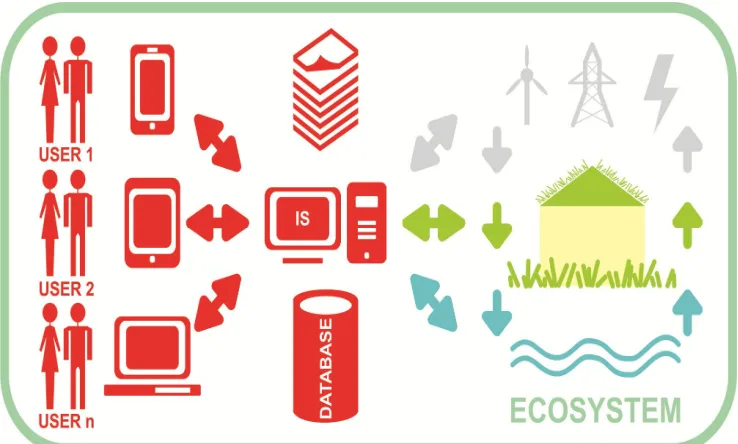
Ken Yeang claims that green design is the blending of four co-operating infrastructure strands into a seamless system (Yeang, Spector, 2011). Informative technologies in the building have important role in controlling co-operation of these four strands (Fig. 1). Achieving effective green design is much more than we have ever imagined. It is complex.
The red (human) infrastructure is the human community. It´s built environment. Buildings, houses, hardscapes and regulatory systems like laws, ethics etc. This is the social and human dimension that is often missing in the work of green designers. It is clear that our lifestyles, economies, and industries, mobility diet and food production all need to become sustainable (Hart, 2011).
The grey (engineering) infrastructure is the usual urban engineering infrastructure of roads, drains, sewerage, water reticulation, telecommunications, energy and electric power distribution system. These engineering systems should integrate with the green infrastructure rather than vice-versa, and should be designed to be sustainable (Hart, 2011).
Figure 1 Information Flows and Processes Scheme
(Own processing)
The connectivity of the landscape with the built environment is a horizontal and a vertical process. An obvious demonstration of horizontal connectivity is the provision of ecological corridors and links in regional and local planning which are crucial in making urban patterns more biologically viable. Connectivity over impervious surface can be achieved by using eco-bridges, undercrofts and ramps. Besides improved horizontal connectivity, vertical connectivity is also necessary, since most buildings are not single but multi-storey. Designers must extend eco-corridors upward, with greenery spanning a building from its foundations to the rooftops (Blanc, 2012).
The blue (water) infrastructure. The water cycle should be managed to close the loop, although this is not always possible. Rainwater needs to be harvested and recycled. Surface water needs to be retained within the site and returned to the land for the recharging of groundwater by means of filtration beds, pervious roadways and built surfaces, retention ponds and bio-swales. Water used in the built environment needs to be recovered and reused wherever possible (Hart, 2011).
Site planning must consider site´s natural drainage patterns and provide surface-water management so that rainfall is not allowed to drain away. Combined with green eco-infrastructure, storm water management enables the natural processes to infiltrate, evapo-transpire or capture and use storm water on or near site, potentially generating other environmental benefits. Waterways should be replaced by wetlands and buffer strips of ecologically functional meadow and woodland habitat. Sealed surfaces can reduce soil moisture and leave low-lying areas susceptible to flooding from excessive run-off. Wetland greenways need to be designed as sustainable drainage systems to provide ecological surfaces. Buffers can be combined with linear green spaces to maximize their habitat improvement potential. Eco-design must create sustainable urban drainage systems which can function as wetland habitats, not only to alleviate flooding but also to create buffer strips for habitats. We need to realize things like surface-water management maximizes habitat potential (Hart, 2011).
2. Bio Integration
Bio integration represents seamless and benign integration of artificial and natural environment. It is a hard to successfully integrate a building into a natural ecosystem and this is the cause of all environmental problems. If we were able to integrate our business processes, our design, our work, everything we do or make in the built environment with the natural environment in a seamless and benign way, there would be no environmental issues.
Physical, systemic and temporal integration of built environment and natural environment in a benign and positive way. Bio integration designing may be regarded as having these three aspect (Yeang, 2009).
Physical integration requires an understanding of the site´s ecology. Any activity from our design takes place with the intention to integrate benignly with the eco-system. We need to understand the eco-system before human activity. Every site has its own ecology with the capacity to withstand stresses imposed upon it. If the site is stressed behind this capacity, it is becoming damaged and devastated. What needs to be done is ascertaining an eco-system´s structure and flow of the system. Its ecological properties, structures, activities, diversity, species. We must identify all parts of the ecosystem. Finally we must consider the impact of intended construction and its use (Yeang, 2009).
Systemic integration is another major issue. Its operational systems and internal processes with the eco-system in nature. If our built systems and processes do not integrate with nature, they remain artificial items and potential pollutants. Their eventual integration after manufacture and use is only through biodegradation. This requires a long-term natural process of decomposition (Yeang, 2009).
Temporal integration involves the conservation of both, renewable resources and non-renewable resources to ensure that they are sustainable for future generations. This includes designing low energy build system that is independent of non-renewable energy sources (Yeang, 2009).
3. Eco Imitation
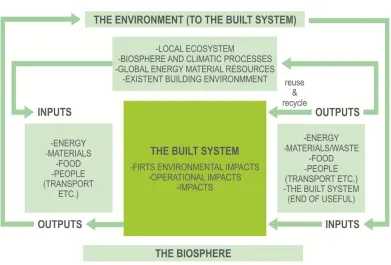
Figure 2 Information Exchange Scheme
(Yeang, Spector, 2011)
Abiotic and biotic units that create eco-system work together as a whole. This concept, our made, built environment must be designed analogously. Architecture must be integrated in the nature. But, constructions, manufacturing and other activities are making the biosphere increasingly inorganic, artificial. We are keeping making our environment more and more inorganic. This results in not well balances eco-system. We must reverse this trend and balance our built environment with greater levels of ecological connectivity. This leads to using more and more green materials, components that are reused, recycled, that can be reintegrated in the eco-system. We need to imitate nature. No waste, no new species, closing the loop in reusing and recycling (Yeang, Spector, 2011).
4. Man Made Ecosystem vs Nature Made Ecosystem
Improving ecological linkage between designed system, business processes with surrounding landscape. Achieving this linkage ensure species connectivity, interaction and sharing resources. Improvements like this ecological nexus enhance biodiversity and species survival. Providing ecological corridors and linkages is crucial in making urban patterns more biologically viable (Yeang, Spector, 2011).
Connecting inorganic aspects, built environment, made artificial environment and organic aspects, natural environment so they become mutual. Creating compatible system of artificial and natural system is another key of maintaining sustainability (Yeang, Spector, 2011).
5. Self Monitoring Sustainability
The fifth strategy is to regard designed system in the context of the biosphere globally as a series of interdependent interactions whose monitoring is necessary to ensure global environmental stasis and the repair of environmental devastation by humans, natural disasters and the impact of our built environment, activities and industries. These environmental interactions need to me monitored for appropriate and immediate corrective action to be taken to maintain global ecological stability (Yeang, Spector, 2011).
6. Information Flow Management
• Emphasizing the value of individual contributions to the project goals;
• Managing expectations by maintaining accountability, discipline, and fairness by establishing clear and consistent goals;
• Understanding the existing mental models of team members and providing connection links between them and the project.
Utilization of information technologies in the construction industry and primarily in the multienterprise scenario of project management requires readiness not only within one organization (contractor, project developer), but also within all the organizations involved in the construction processes (Nitithamyong and Skibniewski, 2006).
Effective management information exchange of four infrastructure strands is a complicated process in which there is a large number of information flows. To effectively manage these processes and flows are specially designed information systems. Information systems are currently based on the use of information and communication technology. In its narrowest perception IS is a hardware and software solution for processing of information for decision support and control (Basl, 2008). Architecture of the information system and the illustration of information flows and processes is shown in Fig. 1.
Managing of four infrastructure strands for creating and controlling ecological, harmless and healthy building requires effective information and communication management between all the project team members leading to required coordination and collaboration. For distributed design teams and managing team in any discipline, effective and information and communication technology based flow of project information between team members is critical for project progress (Eckert and Clarkson and Stacey, 2011). Progressive technologies facilitates a more integrated design, construction process and managing four infrastructures strands that results in better quality buildings, creating and controlling ecological, harmless and healthy building.
In construction projects and companies exist various types of information systems (IS), such as construction management or business software, have been developed, applied, and widely used. The basic question is what an information system in the construction enterprise is and what features should include the effective information flow management. Information system represents a set of people, processes, technical and software tools providing collection, transfer, storage and
processing of data for distribution and presentation of information (Čarnický and
Mesároš, 2009). Information systems are currently based on the use of information and communication technology.
8. Conclusions
Sustainability is very important. It is no point to have a success today, and not have it tomorrow. We need to design building of 21´st century, buildings responsible to its environment.
All of these examples need to be complex, be part of strategies controlled by information exchange management. This paper analyses policies and cooperation of natural and unnatural environment for creating total living system.
There is so much theoretical work, technical research, environmental studies etc. that have to be done and tested before we can say that we have a green building, or dwelling. Green architecture concepts need to be more understood. The answer to ecological questions is co-operation of grey and green, blue and red, prosthesis, imitation...
Acknowledgement
The paper presents the results of the project “Identification of key competencies of university students for the needs of knowledge society development in Slovakia”, which is supported by the Ministry of Education, Science, Research and Sport of the Slovak Republic in supplying incentives for research and development from the state budget in accordance with Act no. 185/2009 Z. z. on incentives for research and development and on supplementing Act. 595/2003 Z. z. Income Tax, as amended, by Act no. 40/2011 Z. z.
References
Basl, J. (2008) Podnikové informační systémy (podnik v informační společnosti). 2. ed.. Praha
: Grada Publishing, a.s.,283 p. ISBN 970–80-247-2279-5
Čarnický, Š. & Mesároš, P. (2009) Informačné systémy podnikov. Bratislava: Ekonóm. 233. s.
ISBN 978-80-225-2676
Eckert, C. & Clarkson, J. & Stacey, M. (2011) Information flow in engineering companies: problems and their causes. In: Culley S (ed) International conference on engineering design ICED 01.Wiley, Glasgow, pp 43–50
Yeang K., Spector A. (2011), Green design. From theory to practice, Black dog publishing Hart S., Ecoarchitecture (2011). The work of Ken Yeang
Mcintosh, B. & Sloan. (2001) The potential impact of electronic procurement and global sourcing within the UK construction industry, Proc. ARCOM 17th Annual Conference, vol. 1, University of Salford, UK, September, 232–240.
Nitithamyong, P. & Skibniewski, M. J. (2012) Success/failure factors and performance measures of web-based construction project management systems: professional viewpoint, Journal of Construction Engineering and Management, 80–87.
Phelps, A. F. (2012) Managing Information Flow on Complex Projects. Balfour Beatty Construction
Yeang K. (2009), Ecomasterplanning