Research Article
Evaluation System Problems and
Professional Behavior: The Perspective of
Healthcare Providers in Iran
© 2017 Alipour et al; licensee Iran University of Medical Sciences. This is an open access article distributed under a
Background and Objectives
Measurement is a key to status improvement, and organizational management expert emphasize the importance of measurement and supervision because people care about things that would be evaluated.1 This is
also true about professional behavior.2 In the presence of
an evaluation system, the staff can receive feedback about their performance, educational plans may be designed for them, and their productivity and motivation will be enhanced.3,4 Measurement of professionalism has been
a challenging5-8 but improving9 matter in recent years;
however, it is important to pay special attention to the
*Corresponding Author: Zahra Shahvari, Professionalism Office, Tehran University of Medical Sciences, Tehran, Iran. Tel: +989127650349, Email: [email protected]
Fateme Alipour
1, Fariba Asghari
2, Shahram Samadi
3, Homayoun Amini
4,
Zahra Shahvari
5*1 Professionalism Office & Eye Research Center, Farabi Eye Hospital, Tehran University of Medical Sciences, Tehran, Iran. 2 Professionalism
Office & Medical Ethics and History of Medicine Research Center, Tehran University of Medical Sciences, Tehran, Iran. 3 Professionalism Office
& Department of Anesthesia and Intensive Care, Tehran University of Medical Sciences, Tehran, Iran. 4 Professionalism Office & Department of
Psychiatry, Tehran University of Medical Sciences, Tehran, Iran. 5 Professionalism Office, Tehran University of Medical Sciences, Tehran, Iran.
Abstract
Background and Objectives: This paper has attempted to explore physicians and staffs’ views about evaluation system problems and its impact on maintaining professional behavior in clinical setting within the context of Iran.
Methods: Data were collected through 22 focus group sessions from October 2015 to March 2016. The participants were selected using purposive sampling. The research topic was introduced in the beginning of each session based on a list of the code of professionalism approved by Tehran University of Medical Sciences (2013) and the participants were asked to review the items and express their comments regarding barriers to respect each item or overall barriers to maintaining high standard of professional behavior. After each session, the related audio file was transcribed and coded. Finally, the data were analyzed using content analysis.
Findings: Evaluation challenges were expressed in 173 codes based on which “lack of appropriate evaluation”, “weakness in supervision”, and “feedback system problems” were identified as the barriers to maintaining high standard professionalism.
Conclusions: In order to improve professionalism in clinical setting, there is a need for supervision and evaluation systems to be appropriately defined, evaluations to be performed in safe environments, proper feedback to be provided for professional performance in individual and group levels, and finally the effect of these measures on professionalism improvement to be constantly assessed.
Keywords: Evaluation, Supervision, Medical professionalism, Clinical Environment, Qualitative Research, Professional Behavior
evaluation of professionalism10 and devise mechanisms
for identification of professional lapses.5
Professionalism is a necessary competency for medical team members, and policy makers ought to focus on what policy changes may mean for supporting health care organizations’ professionalism.11 Although
Tehran University of Medical Sciences and many other Iranian medical universities have provided guidelines on professional behavior for their staff, medical professionals do not care about professionalism in some situations. It seems that there are some barriers to professional performance in some levels. Since professionalism is a culture-related issue,12 the researchers conducted
a qualitative study in TUMS to identify its barriers from the viewpoint of physicians, clinical staff, and medical students. They found that problems related to supervision,
IJHR
Open Access
Abstract
Background and Objectives: Endometrial hyperplasia (EH) is an abnormal overgrowth of endometrium that may lead to endometrial cancer, especially when accompanied by atypia. The treatment of EH is challenging, and
previous studies report conflicting results. Metformin (dimethyl biguanide) is an anti-diabetic and insulin sensitizer
agent, which is supposed to have antiproliferative and anticancer effects and the potential to decrease cell growth in endometrium. While some studies have evaluated the anticancer effect of metformin, studies on its potential effect on endometrial hyperplasia are rare. To address this gap, in this comparative trial study, we evaluate the effect of additive metformin to progesterone in patients with EH.
Methods: In this clinical trial, 64 women with EH were randomized in two groups. The progesterone-alone group
received progesterone 20 mg daily (14 days/month, from the 14th menstrual day) based on the type of hyperplasia, and the progesterone-metformin group received metformin 1000 mg/day for 3 months in addition to progesterone. Duration of bleeding, hyperplasia, body mass index (BMI), and blood sugar (BS) of the patients were then
com-pared between the two groups.
Findings: NA mean age of 44.5 years, mean BMI of 29 kg/m2 and mean duration of bleeding of 8 days were calcu -lated for the study sample. There was no significant difference in age, BMI, gravidity, bleeding duration, and duration of disease at baseline between the two groups. While all patients in the progesterone-metformin group showed bleeding and hyperplasia improvement, only 69% of the progesterone-alone patients showed such an improvement, with the difference between the two groups being significant (P = 0.001). Although the difference between two groups in the post treatment endometrial thickness was not significant (P = 0.55), post treatment BMI in the progesterone-metformin group was significantly lower than in the progesterone-alone group (P = 0.01). In addition, the BS reduction in the progesterone-metformin group was significantly larger than that in the progesterone-alone group (P = 0.001). Conclusions: Our results indicated that administration of progesterone 20 mg/day plus metformin 1000 mg/day
can significantly decrease bleeding duration, hyperplasia, BMI and BS in women with EH. Keywords: Endometrial hyperplasia, Metformin, Progesterone
Background and Objectives
Endometrial hyperplasia (EH) is an abnormal over
-growth of endometrium that may lead to endometrial cancer, especially when accompanied by atypia [1].
Although the effect appears only in 5% of asymptom-atic patients, its prevalence in patients with PCOS
and oligomenorrhea is about 20% [2]. Body mass index (BMI) and nulliparity are two main risk factors for EH. Other risk factors include chronic
anovula-tion, early menarche, late onset of menopause and
diabetes [3], which are related to increased
circulat-ing estrogen [4]. The treatment of EH is challengcirculat-ing and previous studies report conflicting results [5]. Age, fertility, and severity of EH in histology are the most important factors determining the treatment op -tion [5]. Most studies have addressed hysterectomy
in patients with atypical EH [5], particularly those
with PCOS, and have led to conflicting results [5-11].
Evaluation of the Effect of Additive
Metformin to Progesterone on Patients
with Endometrial Hyperplasia
Afsaneh Tehranian 1, Nasim Zarifi 1*, Akram Sayfolahi 2, Sara Payami 2, Faezeh Aghajani 2
1 Department of Gynecology and Obstetrics, Arash Women's Hospital, Tehran University of Medical Sciences, Tehran, Iran 2 School of Medicine, Tehran University of Medical Sciences, Tehran, Iran
*Corresponding author: Afsaneh Tehranian, Department of Gynecology and Ob-stetrics, Arash Women's Hospital, Tehran University of Medical Sciences, Tehran, Iran, P.O.Box: 1653915981, Tel: +98 21 77719922, Fax: +98 21 2177883196, E-mail: [email protected]
RESEARCH ARTICLE
Cre-evaluation, and feedback systems comprised a major part of the extracted codes. These codes had a high status regarding repetition, weight, and agreement among the participants. It seems that insufficient evaluation and supervision is a barrier to professional performance. Therefore, the researchers decided to report the problems related to professionalism evaluation supervision and feedback systems in clinical environments of TUMS separately and more carefully. Our study provides answers to the following question: What are the evaluation system problems and its impact on maintaining professional behavior among Iranian healthcare providers? This phenomenon has been previously described neither through quantitative data nor in qualitative studies in Iran or other country.
Methods
This study was a research project approved by TUMS to identify the barriers to the maintaining professional behavior in clinical environments using focus group discussion. The protocol of the study was approved by the Ethics Committee of TUMS.
The data were collected during 22 focus group sessions with faculty members, residents, interns, nurses, midwives, and other clinical staff. Fourteen sessions were held with non-physician staff, 6 sessions were held with faculty members and residents, and 2 sessions were held with interns.
The inclusion criterion was education or occupation in one of the hospitals affiliated with the University. The participants were selected using purposive sampling. To ensure all themes were identified, it was tried to include participants with maximum diversity regarding age, work experience and location, and major. The sessions were directed by 2 of the authors (SZ and FAl). The sessions lasted between 1.5 to 2 hours. Data were collected from October 2015 to March 2016.
Accepting to participate in sessions was considered as consent to participation in the study. The research topic was introduced in the beginning of each session and the participants were assured that the discussions were confidential and only the overall results were reported. A list of the code of professional conduct – approved by TUMS in 2013- was provided for the participants. They were then requested to review the items and express their comments regarding barriers to respect each item or overall barriers to the maintaining high standard of professional behavior in general. After each session, the related audio file was transcribed. The researchers gained an overall sense of the sessions through studying the transcripts. Then, the transcripts were coded. Finally, the data were analyzed
using conventional content analysis and version 10 of the MAXQDA software.
To enhance the accuracy of the study, the researchers tried to win the trust of the participants by providing a safe environment for expressing their experiences. No relevant data were excluded or irrelevant data were included during data analysis. In addition, the research team tried to increase the validity of the data through long-term engagement and data immersion. The transcripts and codes were evaluated in group sessions of the research team. The main researchers reanalyzed the transcripts and corrected and modified discrepancies in code extraction.
Results
A total of 182 people participated in the study, 82 non-physician staff (40.5%) including 70 nurses, 5 midwives, 5 paramedics, and 2 orderlies, 35 faculty members (19.23%), 40 residents (21.97%), and 25 interns (13.73%).
In general, 173 codes were extracted regarding the evaluation system problems, including 80 codes from the perspective of non-physician staff and 93 codes from the viewpoint of physician and medical students.
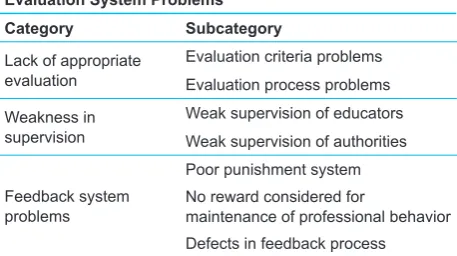
The codes were categorized in 3 categories and 7 subcategories. The categories included “lack of appropriate evaluation”, “weakness in supervision”, and “feedback system problems”.
A. Lack of Appropriate Evaluation
“Lack of appropriate evaluation” refers to barriers that make people believe evaluation of professional behavior has serious flaws. Two subgroups of “evaluation criteria problems” and “evaluation process problems” formed this category. Regarding “evaluation criteria problems”, the participating physicians and medical students mentioned “arbitrary evaluation of residents”, “arbitrary evaluation of faculty members”, and “inappropriate evaluation of residents’ professionalism”. The physicians mentioned “acquiring information from wrong persons” and “failure to follow valuation results” for “evaluation process problems” (Table 1).
When I work with a faculty member, he knows me. But when I don’t work with him, he has no choice but to evaluate me based on the test result and not based on my adherence to the professionalism …”
A faculty member said: “What is the benefit of evaluating a resident’s professionalism? What do you want to do if they don’t respect it? The best thing you can do is to stop their promotion for one year. What can be done for small lapses?”
The physicians and students who participated in the study believed that the system for evaluating faculty members was arbitrary, collected information from irrelevant persons, lacked clear standards for professional behavior, and the results were not taken into consideration. “One important issue is that students evaluate faculty members. It ties our hands. After being in a ward for 1-2 months, externs are required to evaluate their faculty members. If the faculty member is strict, he is a bad one! If he is lenient and easy-going, he is a good one! So the professor takes it easy with the trainees”, said one of the faculty members. Another faculty member said: “Standards of professional behavior are not yet clear for us. We should first make sure everyone knows the standards; then, they should be regarded mandatory for evaluation…”
The participating physicians also mentioned “failure to follow-up of evaluation results”. They believed that not punishing offenders after they are identified would result in ignoring professionalism. They also stated that the evaluation results were not used appropriately. One of the faculty members said: “When someone fails the dressing code or any other code, (s) he should be reprimanded. We suspended a resident for 3 months, the resident and the other residents understood that it was serious, it is not just talks. But most faculty members don’t care, they are afraid of the consequences of these kinds of actions. Thirty out of 150 annual promotion scores are considered for evaluation of the professional behavior of the residents. I myself give Table 1. Evaluation System Problems in Clinical Environments From the Perspective of Physician and Other Staff of Tehran University of Medical Sciences
Evaluation System Problems Category Subcategory Lack of appropriate
evaluation
Evaluation criteria problems Evaluation process problems Weakness in
supervision
Weak supervision of educators Weak supervision of authorities
Feedback system problems
Poor punishment system No reward considered for
maintenance of professional behavior Defects in feedback process
28-30 to all residents. We don’t fail anyone. The residents don’t have to be outstanding to score 30. I agree that a resident may be mature, but they all need supervision. Everyone should be supervised. There should be serious consequences. A resident should be suspended for not adhering to the codes of professionalism…” Another faculty member said: “We evaluate the students this year. We also evaluate them next year. But if a student or resident doesn’t get a good score, do we consider any conditions like participation in classes on professionalism? Or workshops on communication with people? We don’t consider the results of the previous year… meaning our evaluation is worthless after all.”
In the subgroup of “criteria problems”, clinical staff mentioned the codes of “lack of a clear checklist for evaluation”, “arbitrariness of evaluations”, “considering factors other than professional behavior”, “quantitative nature of evaluations”, and “non-consideration of student/ resident-patient relationship when evaluating students/ residents”. There were mentions of “not filling evaluation checklists accurately”, “weakness in continuity of supervision and evaluation”, and “evaluation based on written reports” (Table 1).
One of the participants said: “The evaluation method is defective. The chance of someone with a professional behavior being recognized and encouraged is low. We still don’t have a checklist to show what -professional behavior is and what is not.” A midwife said: “We are evaluated based on written works. We only write instead of clinical work. When the patient is discharged, it is enough to write necessary education was given. No one asks what it was, was it enough, and was it delivered with an encouraging gesture? Did we answer the patient’s questions? Did we answer with respect? These things are not written, and no one sees them, so why should we adhere to them?” A nurse said: “Sometimes I think these evaluations are biased. Evaluators are humans, and they might like you this year and have a grudge against you the next year, or they may feel well or unwell! Twelve people evaluate you! Of them, 10 might not have worked a single shift with you, and they imitate the first person’s evaluation of you”. A midwife said: “The inspectors deliberately look for faults in reports. It is not important if the patient is happy with our conduct and behavior, if their blood pressure is recorded correctly, or if the fetal heart rate is controlled according to the protocol. The inspector is only looking for defects in the reports of our professional behavior.” Another midwife said: “Decisions are made only based on your superiors’ reports. No one calls you to ask the reason behind your unprofessional behavior.”
professionalism”, the nurses believed that evaluations were sometimes affected by factors like academic degree, work record and experience, flattery, pretense, and personal favors to superiors.
B. Weakness in Supervision
“Weakness in supervision” refers to a situation when lack of an efficient supervision system results in non-adherence to professionalism codes. This category was discussed from the aspects of “weak supervision of faculty members” and “weak supervision of authorities”. Some examples were lack of supervision over relationship with patients, order, and professional dress codes. Physicians and trainees believed that the authorities’ supervision over the staff’s and faculty members’ adherence to professional behavior was weak. They mentioned unnecessary inter-hospital referrals (to avoid legal responsibilities) as an example of the authorities’ weak supervision on inter-hospital relationships. From the perspective of the nurses, inappropriate inspection of the wards’ performance and lack of supervision over teamwork were examples of weak supervision (Table 1).
One of the physicians said: “Authorities don’t become involved in obtaining informed consent because they don’t have the time. No one has been responsible for these sorts of tasks.” One of the faculty members said: “The concept of the university’s supervision over ethics is misinterpreted. We don’t see shortcomings and don’t remind them in time.” Another faculty physician said: “The trainer does not supervise his residents’ affairs, so who will see the faults?” One of the residents said: “It is like speeding; if there is no police, we speed!” Another resident said, “We are not reprimanded or punished for our unprofessional behavior.” As for lack of supervision on inter-hospital relationships, a resident said: “The resident of a hospital sends all patients to our hospital because he wants to have time for studying for an exam, and no one oversees! I am a human being; I sometimes become angry and yell at patients. His behavior and conduct is unprofessional and makes me act unprofessionally, as well.”
The nurses believed that the hospital managers’ not paying attention toward inspection makes the staffs who respect professional behavior to be unrecognized. “No one knows what is going on in the wards. Whatever the supervisors mention in their reports is accepted for a fact. The hospital manager has no time see how the staff works and how the patients are treated … and no one dares to convey their idea, because they know the supervisors won’t like it,” said one of the participants.
The nurses also believed that lack of supervision on how tasks are done in the team encourages some staff
to impose their duties on others, which disturbs the spirit of cooperation and respect. One of the paramedics said: “A resident must be present when the patient is being dispatched. It is a law. On evening and night shifts, the resident sends an intern and we cannot say anything. It is not my duty; there should be a supervisor to check whether everyone is doing their duty.” A nurse said: “If a nurse or any other staff knows that his conduct is under supervision, (s)he treats patients much better.”
Another nurse said: “Not much attention is paid to supervision in the hospital. Attending professors don’t like to do something that offends the residents and don’t like to be bossy. The trainers’ supervision on their students is weak, and the students seize the opportunity and play with their cell phones.” One of the head nurses said: “Hierarchical supervision is fading. The resident is not afraid of being questioned about his conduct and behavior. No one oversees dress codes. No one cares. Everyone wonders why they should offend others.”
C. Feedback System Problems
“Feedback system problems” refers to the situation when shortcomings in appropriate and timely reward and punishment result in non-adherence to professional behavior. There problems were discussed in three levels of “poor punishment system”, “no reward considered for maintenance of professional behavior”, and “defects in feedback process”.
The codes of “ignoring professional lapses”, “lack of admonishment for non-adherence to professional behavior”, “lack of feedback for non-adherence to professional behavior”, and “impossibility of punishing offenders ” were the problems of the punishment system from the viewpoint of physicians.
From the perspective of physicians and medical students, “inattention to necessity of reward for exemplary professional behaviors” and “inattention to necessity of positive feedback for professional behavior” were indicative of “no reward considered for maintenance of professionalism” by authorities. Moreover, the physicians and medical students discussed “providing feedback based on unrealistic reports” in the subcategory of “defects in feedback process” (Table 1).
for residents. It motivates other departments.” A faculty member said: “The system does not care if you adhere or don’t adhere to professionalism.”
Regarding “impossibility of punishing offenders”, a faculty member said, “If we notice a resident is absent on the shifts repeatedly, all we can do is give verbal warning. We can neither make them retake the course nor can we extend their residency period. Or during internship, do we consider if an intern treats patients well? No! We don’t even thank them!”
Regarding “providing feedback based on unrealistic reports”, a faculty member said: “Students evaluate faculty members based on their strictness. Stricter professors are the worst ones. What is worse is that this feedback is given to the faculty member. No one cares if you have a professional behavior. So there is no motive for commitment to professionalism. And we see no reason to be strict about professionalism.”
From the nurses’ perspective, “inconsistency between punishment and unprofessional conduct” was one of the problems of the punishment system. The nurses believed that “inattention to necessity of positive feedback for commitment to professionalism” and “ineffectiveness of maintaining professional behavior in increasing the salary and bonuses” indicated that authorities did not consider any rewards for adhering to professionalism. From the perspective of the nurses, “lack of support for proper feedback of the staff to the system” and “appreciating unreal examples of professional behavior” were some shortcomings of the feedback process (Table 1).
One of the nurses said: “Bonuses are all bases on quantity. For example, a person who doesn’t care about professionalism works evening and night shifts and receives more money. This person may not even work 3 hours effectively on each shift. No one cares if this person’s behavior is professional or not.” Another nurse said, “What do managers do to keep their productive personnel? No appreciation, no acknowledgement, no respect … no one cares about professionalism.” One of the head nurses believed that lack of authority in middle managers is the main reason for lack of reward or punishment and said, “Unfortunately managers have little authority for punishment and reward. They cannot change the salary and bonus of the personnel based on their behavior. So there is no difference between good and bad personnel.”
“Inconsistency between punishment and unprofessional conduct” was another code mentioned by the staff. One of the nursing managers said, “I don’t like to report my colleagues’ professional laps because they suddenly cut all their bonuses and don’t care if their other activities are satisfactory.”
Discussion
In the present study, “lack of appropriate evaluation”, “weakness in supervision”, and “feedback system problems” were the most important problems of the professionalism evaluation system in clinical environments. Regarding effective supervision over commitment to professionalism, the competency of the evaluators and the evaluation system in the organization were mentioned as necessary conditions. Since the responsibility of the evaluation of professionalism is usually given to people who are weak at it, evaluations are usually degraded by problems such as being “unimportant”, “ineffective”, “unfair”, “arbitrary”, and “trivial”. It is expected that people who undertake evaluations adhere to professional behavior; otherwise, their feedback is not taken seriously. It seems that hiring managers that are committed to professionalism increases the motivation of the staff to adhere to the codes of professionalism. Larkin et al believe that for successful evaluation of professional behavior in residents, faculty members themselves should master the knowledge and behavioral objectives of professionalism.9 It is not always
possible to put people whose adherence to professionalism has already been evaluated as acceptable in charge of evaluations, which may decrease the effectiveness of the feedback on professionalism. On the other hand, even in the best circumstances, an evaluator may not have a complete view of all the behaviors of the person being evaluated13; therefore, it is appropriate that all relevant
individuals participate in the evaluation process and provide direct or indirect feedback. Giving an appropriate weight to each evaluation and considering them in the final feedback improves the attitude of the evaluators and evaluates towards the evaluation system.
In this study, defects in the faculty member evaluation system were mentioned as one of the shortcomings. In a study by Shakurnia et al, besides relative satisfaction with the evaluation of their educators, the students mentioned that authorities did not take their evaluations seriously).14
However, some of the educators who participated in our study believed that the students’ evaluation of their educators was not reliable. This finding is in line with the results of a study by Ranjbar et al who found that educators had a negative attitude towards the students’ competency and honesty when completing the related questionnaires for evaluating trainers and that the evaluation priorities were different from the perspective of students and trainers.15 Moreover, both the trainers and students in our
study believed that some items of professional code of conduct like relationship with patient are not considered in the student and trainer evaluation.
evaluation system is the optimality of the feedback system. The participants in this study mentioned “lack of appropriate punishment and reward systems” and “feedback system problems”. It is clear that documenting a negative behavior requires a system in which positive behaviors are also identified, documented, and rewarded. Unfortunately the health system has not paid enough attention to punishment and reward for observing or not observing professionalism. In general, the shortcomings of the reward, punishment, and feedback systems result in the deliberate fading or disappearing of the learned professional behavior. The code “ineffectiveness of professional behavior in the salary and bonuses” refers to this point. “Lack of positive feedback about professionalism” is a code that shows the staff expects their efforts to be acknowledged. According to the participants, neither the system nor the patients give feedback on professionalism. Non-utilization of the evaluation results in the improvement of professionalism was another factor mentioned by the participants. It is important to use the results of clinical evaluations; in other words, the results of the mass of data collected through evaluations should be organized to identify what part of professionalism needs improvement, and the process of improvement should be monitored in an organized manner.16
Other researchers also believe that evaluators should master the feedback principles in order to be able to use the evaluation results to correct unprofessional behaviors and reinforce appropriate professional behaviors.17
The participants believed that arbitrary and inappropriate confrontation or lack of confrontation with offenders diminishes the importance of professionalism or the effectiveness of the feedback. “Inconsistency between punishment and unprofessional conduct” was a code mentioned by nurses, indicating the evaluations may cause trouble for people. This point is one of the reasons why physicians do not report their colleagues’ unprofessional behaviors. It is necessary to ensure healthcare professionals that if they report their colleagues’ lapses, the consequences will be fair and directed towards solving the offender’s problem and the system’s flaws. Therefore, evaluations should be performed in a safe environment. Hodges et al believe that assessment programs should benefit from appropriate tools in a safe environment and complete the assessment process through timely provision of proper feedback and follow-up of the behavior change in the course of time.18
Moreover, according to Lucey and Souba, education is an appropriate reaction to deviation from professional behavior. This education must be provided by capable educators after root cause analysis. Punishment should
only be considered for those who cannot be corrected with education.19 Another point mentioned by the participants
was weakness in sustained supervision and evaluation. Intermittent evaluations certainly do not lead to permanent behavior change. One of the characteristics of an effective performance evaluation system is that the staff receives adequate and continuous feedback from different sources to gain the required knowledge of their status in relation to the expected function.20
Another extracted code was “lack of support for proper feedback of the staff to the system”, which decreases the trust of the staff interested in improvement in the system. Managers should continuously revise and improve the rules governing the system and use the staff’s feedback to enhance the system. It could be stated that “supporting the staff’s proper feedback to the system” is one of the motivators in Herzberg’s theory which can be applied to organizational subgroups.21
The participants believed that evaluations forms are not completed accurately, the questions cannot properly evaluate commitment to professionalism, or the results are not reported correctly. Considering the distrust in the evaluation results, future studies should evaluate how the staff’s trust in the evaluation results can be enhanced.
Study Limitations
This study is a qualitative research with a limited number of participants. Therefore, the results may not be generalizable. The results are based on participants’ perspective and may be affected by their judgment or mood. It seems that with regards to the definitions of professionalism, part of what is identified as barriers or challenges of dedication to professionalism is in fact the result of non-adherence to the codes of professionalism. However, evaluation in any form is a result of human judgment and therefore cannot be free of the influence of different factors like the psychological and personality characteristics of the evaluator and the evaluator-evaluate relationship. It is again emphasized that there are different reasons for not remaining true to the codes of professional conduct and some of these factors were assessed in this study.
Conclusions
Please cite this article as:
Alipour F, Asghari F, Samadi S, Amini H, Shahvari Z. Evaluation system problems and professional behavior: the perspective of healthcare providers in Iran. Int J Hosp Res. 2017;6(1):1-7. doi:10.15171/ijhr.2017.01.
on the individual and group levels in an appropriate and fair manner. Non-utilization of the evaluation results and lack of feedback downgrade evaluations. In this regard, some measures may be taken such as making evaluators and evaluated more familiar with evaluation objectives and tools, increasing the number of evaluators, continuous evaluation in the course of time, using formative and summative evaluations, confidentiality of summative evaluations, giving less attention to evaluation score, and focusing on descriptive evaluations. Our study implies that efforts to improve supervision and evaluation systems in clinical environments would result in more adherences of staff to professionalism.
Authors’ Contributions
FAl and ZS contributed to data collection and analysis and drafted the manuscript. FAs supervised the data analysis. HA coordinated and supervised the study process and revising the manuscript. SS contributed to interpretation of the results. All authors read and approved the final manuscript.
Competing Interests
The authors declare no competing interests.
Acknowledgements
The authors thank all participants for making this research possible.
References
1. Copperman K, Canepa K, Murphy K, Acosta-La Greca M, Chuang L, Copperman AB. People respect what you inspect. Fertil Steril.92(3):S61-S62. doi:10.1016/j. fertnstert.2009.07.239.
2. Cruess RL, Cruess SR. Teaching professionalism: general principles. Med Teach. 2006;28(3):205-208. doi:10.1080/01421590600643653.
3. Longenecker CO, Nykodym N. Public sector performance appraisal effectiveness: a case study. Public Pers Manage. 1996;25(2):151-64. doi:10.1177/009102609602500203. 4. Roberts GE, Pavlak T. Municipal Government Personnel
Professionals and Performance Appraisal: Is There a Consensus on the Characteristics of an Effective Appraisal System? Personnel Administration. 1996;25(3):379-408. doi:10.1177/009102609602500310.
5. Hickson GB, Pichert JW, Webb LE, Gabbe SG. A complementary approach to promoting professionalism: identifying, measuring, and addressing unprofessional behaviors. Acad Med. 2007;82(11):1040-1048. doi:10.1097/ ACM.0b013e31815761ee.
6. Boon K, Turner J. Ethical and professional conduct of medical students: review of current assessment measures
and controversies. J Med Ethics. 2004;30(2):221-226. 7. Stern DT. Measuring Medical Professionalism. Oxford
University Press; 2006.
8. Arnold L. Assessing professional behavior: yesterday, today, and tomorrow. Acad Med. 2002;77(6):502-515.
9. Larkin GL, Binder L, Houry D, Adams J. Defining and evaluating professionalism: a core competency for graduate emergency medicine education. Acad Emerg Med. 2002;9(11):1249-1256.
10. Amini H. Editorial. Iranian Journal of Psychiatry and Clinical Psychology. 2015;21(2):85-87.
11. Mason DJ. Professionalism in health care organizations. JAMA. 2017;317(12):1203-1204. doi:10.1001/ jama.2017.1753.
12. Wagner P, Hendrich J, Moseley G, Hudson V. Defining medical professionalism: a qualitative study. Med Educ. 2007;41(3):288-294. doi:10.1111/j.1365-2929.2006.02695.x 13. Stark R, Korenstein D, Karani R. Impact of a 360-degree
professionalism assessment on faculty comfort and skills in feedback delivery. J Gen Intern Med. 2008;23(7):969-972. doi:10.1007/s11606-008-0586-0.
14. Shakurnia A, Motlagh Me, Malayeri Ar, Jouhanmardi A, Komaili Sani H. Students’ opinion on factors affecting faculty evaluation in Jondishapoor medical university. Iran J Med Educ. 2005;5(2):101-110.
15. Ranjbar M, Vahidshahi K, Mahmoudi M. Viewpoints of the attendings and medical students about the students’ evaluation of the attendings, Mazandaran. J Mazandaran Univ Med Sci. 2007;16(56):126-135.
16. Jamtvedt G, Young JM, Kristoffersen DT, O’Brien MA, Oxman AD. Does telling people what they have been doing change what they do? A systematic review of the effects of audit and feedback. Qual Saf Health Care. 2006;15(6):433-436. doi:10.1136/qshc.2006.018549.
17. Rossi PH, Lipsey MW, Freeman HE. Evaluation: A Systematic Approach. Sage publications; 2003.
18. Hodges BD, Ginsburg S, Cruess R, et al. Assessment of professionalism: recommendations from the Ottawa 2010 Conference. Med Teach. 2011;33(5):354-363. doi:10.3109 /0142159x.2011.577300.
19. Lucey C, Souba W. Perspective: the problem with the problem of professionalism. Acad Med. 2010;85(6):1018-1024. doi:10.1097/ACM.0b013e3181dbe51f.
20. Bernardin HJ. Human resource management: an experiential approach. Irwin Professional Pub; 2002.