15
A NEW HANDOFF BASED METHOD FOR IMPROVING THE
CHANNEL IN MANETS
Dr. A. Arunkumar1, R. Gopinath2, Karthick Manoj3
1
Post Doctoral Fellow, School of mathematical Science, Yangzhou University, Yangzhou, china
2
Director, Centre for Science Engineering Technology and Medicine, Tamilnadu, India.
3
Project Associate, S and G Innovators, Tamilnadu, India.
ABSTRACT—In Mobile Ad hoc Networks, one of the most important and challenging problems is the development of an efficient routing protocol that can provide high quality communications among mobile hosts. A new protocol is introduced to improve the performance of channel, in which the Average Non Fading Duration is defined as routing metric and from this stable links will be selected by using the Channel Aware - Ad hoc On demand Multipath Distance Vector (CA-AOMDV) protocol. For persistent data forwarding, select the minimum dynamic duration route with the longest lifetime and from that stable route is maintained based on handoff strategy. Simulation results shows that the performance of channel-Aware Adhoc On demand Multipath Distance Vector(CA-AOMDV) outperforms the AOMDV. Simulation is done using NS2 (Version 2.34)
KEY TERMS— MANET, Channel Fading.
1.Introduction
Mobile Ad hoc Networks is a self configuring infrastructureless networks in which nodes will have mobility and its topology may change rapidly or unpredictably and also it operate in highly dynamic environments. In Ad hoc networks with respect to ensuring connectivity and robustness is much more demanding than in the wired networks [1-3]. Because the strength of the connection can change rapidly in time or even disappear completely. Nodes can also remain the same condition as the time goes on and all the time the network connections should work between the nodes that are part of it.
The main contribution [4-10] is that node lifetime and path lifetime in a route-discovery period that predicts the lifetime of routes discovered and then, a longest lifetime route will be selected for persistent data forwarding when making a route decision. MANETs, a route [11-12] consists of multiple links in series, and thus, its lifetime depends on the lifetime of each node, as well as the wireless links in between adjacent nodes. Mobile Adhoc Network (MANET) is a collection of
independent mobile nodes that can communicate to each other via radio waves. The mobile nodes that are in radio range of each other can directly communicate, whereas others needs the aid of intermediate nodes to route their packets. These networks are fully distributed, and can work at any place without the help of any infrastructure. This property makes these networks highly flexible and robust. The communication terminals have a mobility nature which makes the topology of the distributed networks time varying.
The dynamical nature of the network topology increases the challenges of the design of ad hoc networks. Each radio terminal is usually powered by energy limited power source (as rechargeable batteries).The mobile devices usually have limited storage and low computational capabilities. They heavily depend on other hosts and resources for data access and information processing. A reliable network topology must be assured through efficient and secure routing protocols for Ad Hoc networks.
16 2.1 Ad Hoc On-Demand Distance Vector
Aodv is based on hop by hop routing approach. Route discovery typically involves a network wide flood of route request (RREQ) targeting the destination and waiting for a route reply[2]. An intermediate node receiving a RREQ packets first sets up a reverse path to the source using the previous hop of the RREQ as the next hop on the reverse path.
If a valid route to the destination is available, then the intermediate node generates a RREP. As the RREP proceeds towards the source,a forward path to the destination is established. Route Maintenance is done using route error (RERR ) packets. When a link failure is detected, a RERR is sent back via separately maintained predecessor links to all sources using that failed link. Routes are erased by the RERR along its way . When a traffic source receives a RERR, it initiates a new route discovery if the route is still needed.
2.2 Dynamic Source Routing Protocol
DSR is a proactive routing protocol in which routes are discovered on-demand. The key feature of DSR is the use of source routing[2]: the source node looks up its route cache to determine if it already contains a route to the destination. If the source finds a valid route to the destination, it uses this route to send its data packets. If the node does not have a valid route to the destination, it initiates the route discovery process by broadcasting a route request message. The route request message contains the address of the source and the destination, and a unique identification number. An intermediate node that receives a route request message searches its route cache for a route to the destination. If no route is found, it appends its address to the route record of the message and forwards the message to its neighbors.
Route Maintenance is used to handle route breaks. When a node encounters a fatal transmission problem at its data link layer, it removes the route from its route cache and generates a route error message. and unique request ID. Each node receives the packet checks whether if route is available or not. If does not, it adds its own address to the route record and forwards the packet. Route Maintenance
is achieved through the use of Route Error packet (RERR) and acknowledgements. Route error packets are generated at a node due to the problem of fatal transmission at the data link layer. When a route error packet is received, the hop in error is removed from the nodes route cache and all routes containing the truncated at the point.
3 Path Selection Process
We have selected the path for routing based on two different protocols, one is by AOMDV protocol and other by an CA-AOMDV protocol.
3.1 Ad Hoc On Demand Multipath Distance Vector Routing Protocol
The Ad hoc On-Demand multipath Distance Vector (AOMDV) protocol enables self-starting, multihop routing between participating mobile nodes wishing to establish and maintain an ad hoc network[1]. AOMDV allows mobile nodes to obtain routes quickly for new destinations, and does not require nodes to maintain routes to destinations that are not in active communication. AOMDV allows mobile nodes to respond to link breakages and changes in network topology in a timely manner. Advertised hop count is used (i.e) maximum overall paths from the source node to destination node.
One distinguishing feature of AOMDV is its use of a destination sequence number for each route entry. The destination sequence number is created by the destination to be included along with any route information it sends to requesting nodes. Using destination sequence numbers ensures loop freedom.
Main disadvantage of AOMDV protocol is that it will consider only the number of hops during the selection of a path. Stability of the path is negligible. Because of the instability in path leads to frequent link disconnections. During transmission, fading will occurs and this is also not considered.
3.2 Channel Aware-Ad hoc On demand Multipath Distance Vector Protocol
17 metric to select stable links for path discovery[1]. CA-AOMDV uses the ANFD (Average Non Fading Duration) as a measure of link life time. The duration (D), of a path is defined as the minimum ANFD over all of its links
D ANFDh
Where h is the link number, and H is number of links/ hops in the path. Before forwarding a RREQ to its neighbors, it will insert current speed also.
3.2.1 Handoff
For the purpose of maintaining the selected path, handoff strategy is used and also to maintain reliable connections by using channel state information. A network specific threshold is fixed, signal strength will be predicted and updated at each node. Handoff strategy using signal strength prediction, if the predicted link signal strength level falls below a network specific threshold, then the protocol will swaps to a good-quality link. All nodes present during the transmission will maintain a separate table for past signal strength.
Handoff Request (HREQ) packet is transmitted by the faded link to its neighbors to handover the transmission to reach the destination.Using the same information, paths can be reused when they become available again, instead of being discarded it. In conditions of high channel variability, there is little sense in even attempting channel prediction and other performance improvement methodologies will need to be utilized.
4.Problem Definition
Routing protocols are mainly focusing on either minimizing the delay during the transmission or minimizing the number of overheads in order to make the routing scheme as efficient. Either performance or reliable concerns are concentrated or either of the one is achieved at the cost of other. In this work performance analysis parameters like
Routing control overhead, throughput, packet delivery ratio and end-end delay are considered. Our aim is to achieve routing paths as energy efficient and paths can be reused without discarding it.
5. Methodology
The AOMDV and CA-AOMDV protocols have been simulated to select the stable links and to improve the channel utilization. A channel based average fading duration routing metric is selected and predicted signal strength is combined with the handoff strategy to overcome the channel fading during the path maintenance. The AOMDV protocol has been simulated and compared with the CA-AOMDV protocol to show the increased performance.
6.Results And Discussion
The Simulation is carried out in NS2 under LINUX platform for comparing the protocols based on different parameters:
1. Packet delivery ratio
The ratio of the number of packets received and the number of generated packets during the transmission.
2. Routing control overhead
The ratio of number of routing control packets to the delivered data packets during the transmission.
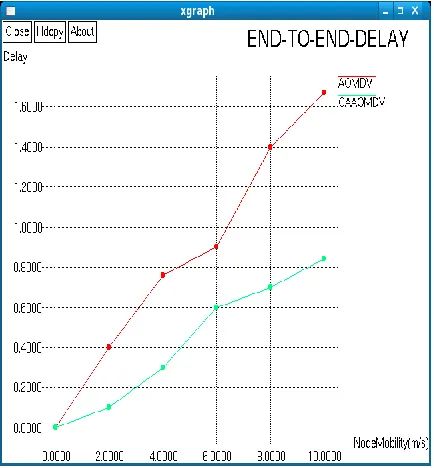
End-End Delay
The End-End Delay refers to the time taken for a packet to be transmitted across the network from source to the destination.
18 Fig (1) Fading path selection employing Channel Aware routing protocol and packet transmission.
The Figure 1 shows the transmission of packets and fading path selection process by employing Channel Aware routing protocol.
.
Fig (2) Packet delivery ratio vs NodeMobility
From the above result we infer that as CA-AOMDV protocol proves a better packet delivery ratio when compared with AOMDV protocol.
Fig (3) Routing Control Overhead Vs NodeMobility
The Figure 3 shows the plots of Routing Control Overhead on Y-axis and time on X-axis. This result also proves the overhead of CA-AOMDV method over the AOMDV method.
19 The Figure 4 shows the delay on Y-axis and NodeMobility taken on X-axis. The random selection method ie, AOMDV shows an increased delay compared with the CA-AOMDV.
6.Conclusion
In this paper an efficient path selection method based on the AOMDV and CA-AOMDV has been simulated and the performance of these two protocols in terms of Routing Control Overhead, packet delivery ratio and End-To-En delay has been analyzed. From the result we infer the significance of CA-AOMDV based path selection rather than AOMDV.
Futurework
The future work will be to incorporate certain energy constraints into the path selection process. for the best path selection and alternate routing when fading occurs but in this energy is not considered. For this purpose ,along with the path selection we incorporate the energy efficient protocol where the energy level is determined by the energy aware selection mechanism and maximal nodal surplus energy estimation. Equally important is to preserve the network performance parameters. A comparison between the CA-Aomdv and the EE-Aomdv will be made for certain parameters .
References
1. xiaoqin chen and Haley M. Jones “ Channel-Aware Routing in MANETs with Route Handoff,” IEEE Trans. Mobile Computing, World of Wireless Mobile and Multimedia Networks , pp. 22-30, Jan 2011.
2.M.K. Marina and S.R. Das, “On-Demand Multipath Distance Vector Routing in Ad Hoc Networks,” Proc. Ninth Int’l Conf. Network
Protocols (ICNP), pp. 14-23, Nov. 2005.
3. William Su and Mario Gerla, “IPv6 flow handoff in AD HOC wireless networks using mobility prediction,” Proc. IEEE Global Telecomm. Conf. (GLOBCOM), vol. 1a, pp. 271-275, Dec. 1999.
4. S. Biswas and R. Morris, “ExOR: Opportunistic Multi-Hop Routing for Wireless Networks,” ACM SIGCOMM Computer Comm. Rev., vol. 35, no. 4, pp. 133-144, Aug. 2005.
5. M. Park, J. Andrews, and S. Nettles, “Wireless Channel-Aware Ad Hoc Cross-Layer Protocol with Multiroute Path Selection Diversity,” Proc. IEEE Vehicular Technology Conf. (VTC)-Fall, vol. 4,pp. 2197-2201, Oct. 2003.
6. S. Zhao, Z. Wu, A. Acharya, and D. Raychaudhuri, “PARMA:A PHY/MAC Aware Routing Metric for Ad-Hoc Wireless Networks with Multi-Rate Radios,” Proc. Sixth IEEE Int’l Symp. World of Wireless Mobile and Multimedia Networks (WoWMoM), pp. 286-292, June 2005.
7. A.B. Mnaouer, L. Chen, C.H. Foh, and J.W. Tantra, “OPHMR: An Optimized Polymorphic Hybrid Multicast Routing Protocol for MANET,” IEEE. Trans. Mobile Computing, vol. 5, no. 6, pp. 503-514,May 2007.
8. M.R. Souryal, B.R. Vojcic, and R.L. Pickholtz, “Information Efficiency of Multihop Packet Radio Networks with Channel-Adaptive Routing,” IEEE J. Selected Areas in Comm., vol. 23, no. 1,pp. 40-50, Jan. 2005.
9.Marc Greis’ Tutorial for the UCB/LBNL/VINT Network Simulator.
10. S. Panichpapiboon, G. Ferrari, and O.K. Tonguz, “Optimal Transmit Power in Wireless Sensor Networks,” IEEE Trans. Mobile Computing, vol. 5, no. 10, pp. 1432-1447, Oct. 2006.
11.P. Bergamo A. Giovanardi, et al, “Distributed power control for energy efficient routing in ad hoc networks,” Kluwer Wireless Networks, vol.10, pp,.29-42, 2004.
12. NETWORK SIMULATOR