Volume 65, 2019, Pages 15–27
GCAI 2019. Proceedings of the 5th Global Conference on Artificial Intelligence
Practical Query Rewriting for
DL-Lite
with Numerical Predicates
∗
Christian Alrabbaa, Patrick Koopmann, and Anni-Yasmin Turhan
Theoretical Computer Science, Technische Universit¨at Dresden, Germany
Abstract
We present a method for answering ontology-mediated queries for DL-Lite extended with a concrete domain, where we allow concrete domain predicates to be used in the query as well. Our method is based on query rewriting, a well-known technique for ontology-based query answering (OBQA), where the knowledge provided by the ontology is compiled into the query so that the rewritten query can be evaluated directly over a database. This tech-nique reduces the problem of query answering w.r.t. an ontology to query evaluation over a database instance. Specifically, we consider members of the DL-Lite family extended with unary and binary concrete domain predicates over the real numbers. While approaches for query rewriting DL-Lite with these concrete domain have been investigated theoretically, these approaches use a combined approach in which also the data is processed, and require the concrete domain values occurring in the data to be known in advance, which makes the procedure data-dependent. In contrast, we show how rewritings can be computed in a data-independent fashion.
1
Introduction
Formal ontologies are useful to augment application data in order to be able to extract more consequences from the data by use of background knowledge than from a query over the plain data alone. In recent years,ontology-based query answering (OBQA) by means of Description Logics (DLs) has become a prominent example of this setting. In many practical applications such as medical or stream-reasoning applications, where data is produced by sensors, the data need not always be symbolic, but can be numerical. Concepts from such applications can be characterized by relating their instances to numerical values. For example, patients with high blood pressure can be modelled as patients with a value for blood pressure over 180. Such statements can be expressed in an ontology by the use of concrete domains [5].
In OBQA applications, the expressiveness of the underlying DL can lead to high complexity of query answering, which limits a fast execution of ontology-based queries [14,12, 10]. This has lead to the development of the DL-Lite family of DLs that are designed such that their expressiveness admits to perform query answering by the well-known rewriting approach for
answering conjunctive queries [7,2]. In the classical rewriting approach, the query is rewritten such that the resulting query incorporates the relevant knowledge from the ontology. Then, the rewritten query is answered over the plain (or possibly enriched) data by a database engine di-rectly. DLs that admit this approach are calledfirst-order rewritable. The rewriting approach has strong benefits. Since answering conjunctive queries has a complexity of AC0 measured
in the size of the data, rewritability means that query answering is of the same complexity. Furthermore, the rewriting isdata-independent, and thus only has to be performed once, after-wards the rewritten query can be executed on different databases without further adaptations or further reasoning steps. This is especially useful for querying big data or frequently changing data. Another approach to solve OBQA by means of standard database query answering is the
combined rewriting approach, in which the data is enriched based on the ontology before the rewritten query is executed [11,9,8].
Combinations of DL-Lite and concrete domains have been investigated in regard of query answering early on [13, 15, 3]. In these combinations either the concrete domain predicates are only unary [13, 15, 3] or the query language does not admit the use of concrete domain predicates [13]. Both restrictions are severe limitations on the expressiveness.
Recently, Baader et al. identified in [4] a criterion for concrete domains withn-ary predicates that admitscombined rewritability when used in combination withDL-Lite. This so-called cr-admissibilityconsists of several properties that the concrete domain must fulfill. Among others, the concrete domain must be convex and admit polynomial reasoning, it must contain equality in its set of predicates, and it must be functional, i.e. for any predicate (of non-zero arity) applied to a tuple of variables, where one of these variables has a fixed value, there is at most one solution. See [4] for a discussion of all the properties required by cr-admissibility.
Two concrete domains that are identified as cr-admissible in [4], are those over the rational numbers with predicates including equality and one comparison ∼d ∈ {<d, >d} to arbitrary valuesdand a predicate to state a distance +d(v, w) from one value to another. The presence of both comparison operators or a binary predicate<d could be desirable, but it would destroy convexity of the concrete domain. This concrete has infinitely many different unary and also binary predicates. The latter gives more expressiveness as the concrete domains considered in earlier approaches and admits to express the example from above:
HighBloodPressurePatient v Patientu ∃hasBloodPressure. >180.
Furthermore it can express that high risk patients are patients whose systolic blood pressure is above their diastolic blood pressure by 90 (mmHg):
HighRiskPatientvPatientu ∃hasDiastolicBloodPressure,hasSystolicBloodPressure.+90.
Despite being a polynomial method for evaluating queries, the technique proposed in [4] is a combined rewriting approach, which means that the data has to be processed before the rewrit-ten query can be executed. Furthermore, the query rewriting procedure requires full knowledge of the concrete domain values that occur in the data. This limits the practical applicability of the technique for large or frequently changing data sets—one of the main advantages of DLs ad-mitting full first-order rewritability. To solve this issue, we present adata-independentrewriting procedure forDL-Liteextended with the aforementioned cr-admissible concrete domains.
implies a positive distance between a pair of values, and the ontology also states a bound for the first value, then a bound on the second value can be inferred. Such information does only depend on the ontology and not on the data. In the first phase, our rewriting approach makes such information explicit and adds it to the TBox in the form of new axioms. This TBox saturation can be done even independently of the query. In the second phase, our algorithm computes a rewriting of a given query in regard to the saturated TBox. In contrast to the classical rewriting forDL-Litewithout concrete domains, here the challenge is that our rewriting procedure needs to cope with a potentially infinite set of predicates.
This paper is structured as follows. The next section introduces the concrete domainsR> andR<, the resulting logicDL-Liteu(R∼) and answering of conjunctive queries. Section3gives an overview of the rewriting method and Section 4, describes the TBox saturation and its properties. Section5 introduces the algorithm to compute the query rewriting and we show that it is complete and terminating. Finally, we provide our conclusion in Section 6. Proof details of our results can be found in the extended version of the paper [1].
2
Query Answering in
DL-Lite
u(
R
>)
and
DL-Lite
u(
R
<)
We recall syntax and semantics ofDL-Liteu(D) and the main task conjunctive query answering.
2.1
The Concrete Domains
R
>and
R
<We define two concrete domains over the real numbers,R> andR<, that are used in our DL.
In general, a concrete domain [5] is a tuple D = h∆D,PD,arD,·Di of a set ∆D of concrete
domain elements, a set of PD of concrete domain predicates, where to each Π ∈ P an arity
ar(Π)∈N is associated, and an interpretation function ·D which assigns to each Π∈ P with
ar(Π) = n a set ΠD ⊆ (∆D)n. We focus on two concrete domains, R> and R<, defined
byR∼ =hR,PR∼,arR∼,·R∼i, for one comparison predicate ∼ ∈ {<, >} per concrete domain,
with the setPR∼of predicates defined asPR∼ ={>1
R∼,>
2
R∼,⊥
1
R∼,⊥
2
R∼} ∪ {=d,∼d,+d |d∈R},
arities arR∼(=
d) = arR∼(∼d) = arR∼(>1R∼) = arR∼(⊥1R∼) = 1 and arR∼(+d) = arR∼(>2R∼) =
arR∼(⊥2
R∼) = 2, and an interpretation function defined as
(>1
R∼)
R∼ =
R (⊥1R∼)
R∼
= (⊥2
R∼)
R∼
=∅ (∼d)R∼ ={d0 |d0∈R, d0 ∼d}
(>2
R∼)
R∼
=R×R (=d)R∼ ={d} (+d)R∼ ={hd1, d2i |d1, d2∈R, d1+d=d2}.
Given two predicates Πa and Πb of the same arity, we write Πa|= Πb iff (Πa)R∼ ⊆(Πb)R∼.
2.2
The Description Logics
DL-Lite
u(
R
∼)
We recallDL-Liteu(R∼) with the two concrete domains just introduced. LetNC,NR,NAandNI be pairwise disjoint, countably infinite sets of respectivelyconcept names,role names,attribute names and individual names. A role R is an expression of the form r or r−, where r ∈ NR.
DL-Liteu(D) concepts C, D and axioms a are defined according to the following syntax rule, whereA∈NC,R, S are roles,U1, . . . , Un∈NA, and Πn∈ PR∼ s.t.arR∼(Πn) =n:
C::=> | A | CuC | ∃R | ∃U1, . . . , Un.Πn D:: = ⊥ | C | ∀U1, . . . , Un.Πn
We assume (nested) conjunctions to be represented as sets, that is, they never contain dupli-cates, and the order of conjuncts is not important.
A TBox is a finite set of axioms. Let A∈NC, a, b∈NI,r∈NR, U ∈NA, and d∈R. An
ABox is a set ofassertions, which are of the formsA(a),r(a, b), andU(a, d). Aknowledge base
(KB) is a tuplehT,Ai, where T is a TBox andAan ABox.
Example 1. Assume that A, B1, B2 ∈ NC, r ∈ NR, U, U1, U2 ∈ NA, and b ∈ NI. Then, let
K=hT,Ai be a knowledge base with T ={B1 v ∃r−, Av ∃U.>3.5, B2 v ∀U1, U2.+10} and
A={A(b), B2(b), U1(b,11), U2(b,21)}.
The semantics of KBs is defined in terms of interpretations. An interpretation is a tuple
I =h∆I,·I,
R∼i, where ∆I is a set called thedomain, ·I is a function, andR∼ is a concrete domain. The function ·I maps every a ∈ NI to an element aI ∈ ∆I, every concept name
A to a set AI ⊆ ∆I, every role name r to a relation rI ⊆ ∆I ×∆I, and every attribute
U ∈NA to a relationUI⊆∆I×R. We require the domain ∆Ito be disjoint with the concrete
domain: ∆I∩R=∅. The interpretation function is extended to roles by setting (r−)I= (rI)−,
and to concepts by (>)I= ∆I, (⊥)I=∅,
(C1uC2)I=C1I∩C2I, (∃R)I={e∈∆I| ∃e0∈∆I:he, e0i ∈RI}, (∃U1, . . . , Un.Π)I ={e∈∆I| ∃he, d1i ∈U1I, . . . ,∃he, dni ∈UnI :hd1, . . . , dni ∈ΠR∼}, (∀U1, . . . , Un.Π)I ={e∈∆I| ∀he, d1i ∈U1I, . . . ,∀he, dni ∈UnI :hd1, . . . , dni ∈ΠR∼}. LetX,Y be concepts or roles. An interpretationI satisfies an axiom X vY (in symbols
I |=XvY) iffXI⊆YI. Isatisfies an assertionA(a) iffaI∈AI,r(a, b) iffhaI, bIi ∈rI, and
U(a, d) iffhaI, di ∈UI. I is amodel of a KB (TBox) if it satisfies all axioms and assertions in it. Two TBoxesT,T0 are equivalent (in symbolsT ≡ T0) if they have the same set of models. An axiom/assertionbisentailed by a KBK(in symbolsK |=b) ifI |=bfor all modelsI ofK.
2.3
Conjunctive Queries for
DL-Lite
u(
R
∼)
KBs
Let NV be a countably infinite set of variables pairwise disjoint with NC, NR, NA, and NI.
Elements fromNI∪NV areabstract terms and elements fromR∪NV are concrete terms. The
union of abstract and concrete terms is calledterms. Let A∈NC, r∈NR, U ∈NA, Π∈ PR∼
with arityn,ta, t0abe abstract terms andtc1, . . . , tcnbe concrete terms. Anatomis an expression
of the formsA(ta),r(ta, t0a), =(ta, ta0),U(ta, tc) or Π(tc1, . . . , tcn). Aconjunctive query (CQ) is
an expression of the formφ=∃x1, . . . , xn.α1∧. . .∧αm, wherex1, . . . , xn∈NV, andα1, . . . , αn are atoms. We denote terms in α(/φ) by terms(α) (/terms(φ)), and variables in α (/φ) by
var(α) (/var(φ)). Variables in φ that are not bound by an existential quantifier are called
answer variables. A union of CQs (UCQ) is a non-empty set of CQs, where each CQ has the same set of answer variables. We denote the set of answer variables of a UCQ Ψ byvarans(Ψ). A UCQ Ψ is calledBoolean ifvarans(Ψ) =∅. Given a UCQ Ψ, ananswer to Ψ is a mapping
a:varans(Ψ)→NI∪R, and we denote bya(Ψ) the Boolean UCQ obtained by replacing every
answer variablexbya(x). Answer variables and answers are defined accordingly for CQs. Given an interpretationI, a Boolean CQφissatisfied byI(in symbolsI |=φ) if there exists a homomorphism h: terms(φ)→ ∆I∪R s.t. for every =(ta, t0a)∈ φwe have h(ta) =h(t0a), for everyd∈terms(φ)∩Rwe haveh(d) =d, for everya∈terms(φ)∩NI we haveh(a) =aI,
for every A(t) ∈ φ we have h(t) ∈ AI, for every r(t1, t2) ∈ φ we have hh(t1), h(t2)i ∈ rI, for every U(t1, t2) ∈ φ we have hh(t1), h(t2)i ∈ UI, and for every Π(t1, . . . , tn), we have
hh(t1), . . . , h(tn)i ∈ ΠR∼. We might then also write I |= h(φ). A Boolean UCQ Φ is
every model ofK. A Boolean CQ/UCQ Φ is unsatisfiable in a TBoxT if for every modelI of
T, we haveI 6|= Φ. An answer ato a UCQ Ψ is acertain answer to Ψ ifK |=a(Ψ).
Example 2. Let K be a KB as shown in Example 1. Let φ1 and φ2 be CQs s.t. φ1 =
∃x, v.U(x, v), andφ2 =∃v1, v2.(U1(x, v1)∧U2(x, v2)∧+10(v1, v2)). We have varans(φ1) =∅,
and varans(φ2) = {x}. Furthermore, φ1 is Boolean and K |= φ1. The answer a for φ2 with
a(x) =bis a certain answer to φ2 in K, sinceK |=a(φ2).
3
Overview of the Query Rewriting Method
Our aim is to develop a practical rewriting method for answering UCQs with concrete domain predicates overR∼w.r.t.DL-Liteu(R∼) ontologies. While in principle, a single rewriting step can be sufficient to enable query answering, it does not yield a practical algorithm that lends itself to implementation. This is mainly due to consequences that follow from the concrete domain alone, or from its combination with the TBox. For example, axioms of the formCv ∀U1, U2.+d make both attributes U1 and U2 functional for instances of concept C. Consequences of this sort hold independently of the query and the data, and thus would need to be re-discovered for each answered UCQ in a classical rewriting system. A more efficient way is to compute these consequences once and reuse them. To this end, we present an approach that consists of two steps. The first one is a preprocessing step of the TBox T, which is called TBox saturation, and the second is the rewriting of the query w.r.t. the saturated version ofT.
In the TBox saturation step, a set of saturation rules augments the TBox with additional axioms. The rewriting step is then similar to the classical one forDL-Lite[7], and employs a set ofrewriting rules. Starting from some CQφin the input UCQ Φ, and for every rewriting rule
R, ifφsatisfies the premise of R, and the side condition of Ris also met, then the conclusion of R, as a new CQφ0, is added to Φ. This process is repeated for every CQ in Φ until a fixed-point is reached. As we present later on, the side conditions of the rewriting rules check for the existence of certain axioms that follow fromT, but are not necessarily present inT. But since the query rewriting step is based on the saturated version ofT, a syntactic check suffices to inspect the satisfaction of these side conditions. In the extended version of this paper, we show that this method yields a sound and complete procedure for query rewriting forDL-Liteu(R∼).
4
TBox Saturation
We introduce the calculus for generating the saturated version of a given TBox T, which is then used by the query rewriting procedure. Afterwards, we discuss properties of this calculus.
4.1
TBox Saturation Calculus
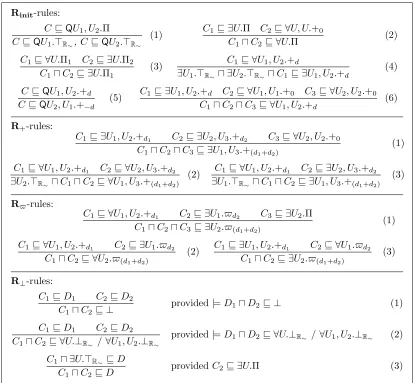
Our calculus consists of the rules shown in Figure1. In these rules, Π1,Π2 ∈ PR∼ are some
predicates fromR∼,$ ∈ {<,=, >} is a comparison operator fromPR∼, that together with a valuedgives rise to the unary predicate$d, andQ∈ {∀,∃}is a quantifier. The preconditions are to be checked syntactically and the derived statements are added as axioms to the TBox.
The rules in the calculus are grouped according to the kind of inference they yield. The rules inRinit infer the straightforward properties of attributes. For example, ruleRinit-6 states that
Rinit-rules:
CvQU1, U2.Π
CvQU1.>R∼,CvQU2.>R∼
(1) C1v ∃U.Π C2v ∀U, U.+0
C1uC2v ∀U.Π
(2)
C1v ∀U.Π1 C2v ∃U.Π2
C1uC2v ∃U.Π1
(3) C1v ∀U1, U2.+d
∃U1.>R∼u ∃U2.>R∼uC1v ∃U1, U2.+d
(4)
CvQU1, U2.+d
CvQU2, U1.+−d
(5) C1v ∃U1, U2.+d C2v ∀U1, U1.+0 C3v ∀U2, U2.+0
C1uC2uC3v ∀U1, U2.+d
(6)
R+-rules:
C1v ∃U1, U2.+d1 C2v ∃U2, U3.+d2 C3v ∀U2, U2.+0
C1uC2uC3v ∃U1, U3.+(d1+d2)
(1)
C1v ∀U1, U2.+d1 C2v ∀U2, U3.+d2
∃U2.>R∼uC1uC2v ∀U1, U3.+(d1+d2)
(2) C1v ∀U1, U2.+d1 C2v ∃U2, U3.+d2
∃U1.>R∼uC1uC2v ∃U1, U3.+(d1+d2)
(3)
R$-rules:
C1v ∀U1, U2.+d1 C2v ∃U1.$d2 C3v ∃U2.Π
C1uC2uC3v ∃U2.$(d1+d2)
(1)
C1v ∀U1, U2.+d1 C2v ∃U1.$d2
C1uC2v ∀U2.$(d1+d2)
(2) C1v ∃U1, U2.+d1 C2v ∀U1.$d2
C1uC2v ∃U2.$(d1+d2)
(3)
R⊥-rules:
C1vD1 C2vD2
C1uC2v ⊥
provided |=D1uD2v ⊥ (1)
C1vD1 C2vD2
C1uC2v ∀U.⊥R∼ / ∀U1, U2.⊥R∼
provided |=D1uD2v ∀U.⊥R∼ / ∀U1, U2.⊥R∼ (2)
C1u ∃U.>R∼ vD C1uC2vD
provided C2v ∃U.Π (3)
Figure 1: TBox saturation rules.
numbers, and distances can simply be propagated down (/up) the number line. Rules inR$ lead to the inference of an attribute value based on the following: if the distance between two attribute successors and the value of one of them are known, then the value of the other attribute successor can be inferred. Lastly, the rules in R⊥ lead to axioms stating which concepts cannot have certain attribute successors or which concepts are unsatisfiable. Observe that the saturation rules can refer to (the presence of) data while staying data-independent. This is achieved by the use of∃U.>R∼ in the left-hand side of the inferred statements.
4.2
Properties of the Saturation Calculus
In Algorithm 1, the saturation rules are used to infer all axioms from the TBox which are relevant to our rewriting procedure. The relevance of these axioms is determined mainly by
following case as an example. Assume we are given the TBoxT ={C2v ∃U1.=3,> v ∃U2.>R∼, C1 v ∀U1, U2.+2}, the ABoxA ={C1(b), C2(b)}, and the CQ φ=∃v.(U2(x, v)∧=v(5)). It is easy to see that hT,Ai |=φ, but h∅,Ai 6|= φ. In order to be able to rewrite φ into Φ s.t.
h∅,Ai |= Φ, we need some axioma in T of the form C1uC2v ∃U2.=5. Thus,a is arelevant axiom from therewritabilityaspect, and therefore, a rule to generate such an axiom, from such a TBox, is needed. In this example, this rule isR$-1. Let us considerφ0=∃v.(U2(x, v)), where
a1= (C1uC2v ∃U2.>R∼) is needed to get the rewriting ofφ, but actuallya1 is not a relevant
axiom because its effect is already covered, since (C1uC2v ∃U2.=5)|= (C1uC2v ∃U2.>R∼).
This type of entailments is handled by the rewriting rules from Section5.
The other criterion for relevance is termination. The interaction between the rules, or even between the conclusion and the premise of the same rule, enables infinitely many rule applications. Axioms inferred using theR⊥can be utilised to prevent such behaviour: note that an axiom of the formCv ∀U.⊥R∼ makes all other axioms of the form Cv ∀U.Π superfluous,
which can be used to limit the number of inferred axioms to be kept. Therefore theR⊥ rules are applied preferred to any other rule, see Algorithm1.
Let T be a TBox, R a saturation rule from Figure 1, and a an axiom. The axiom a is
derivable by RfromT (in symbols T `Ra) iff the premise(s) of Roccur inT and ais of the
form of the conclusion ofR.T `adenotes thatais derivable fromT using any saturation rule in the calculus. We show in the extended version of the paper, that the calculus yields a sound TBox saturation procedure.
Lemma 1(Soundness). Let T be a TBox and a be an axiom. Then,T `a only ifT |=a.
To ensure termination of the TBox saturation process, we refer to “superfluous axioms”.
Definition 2 (Redundant axiom). Let T be a TBox and a1,a2 ∈ T. Then, a2 is redundant
toa1 w.r.t.T if at least one of the following conditions is satisfied:
1. a1 is of the formCvD, anda2 is of the form CuC0vD;
2. a1 is of the formCv ∀U.⊥R∼, anda2 is of the formCuC
0 v ∀U.Π; or
3. a1 is of the formCv ∀U1, U2.⊥R∼, anda2 is of the formCuC
0v ∀U
1, U2.+d.
The axiom a2 ∈ T is a redundant axiom in T iff there exists some a1 ∈ T such that a2 is redundant toa1 w.r.t.T.
From this definition, it follows that for any TBoxT, we haveT ≡ T \ {a2}wherea1,a2∈ T, and a1 makes a2 redundant in T. Therefore, a refinement function of T can be defined as
refine(T) ={a∈ T |a is not redundant inT \ {a}}.Algorithm 1specifies the computation of the saturated TBox (in symbols: saturate(T)). In the extended version of the paper, we prove that for any TBoxT, and due to redundancy elimination, Algorithm1terminates on any input.
Algorithm 1:Computation of saturate(T)
Input: TBox T.
while T `a for somea andanot redundant in T do
while T `R⊥ a
0 for somea0 anda0 not redundant inT do set T :=refine(T ∪ {a0}).
setT :=refine(T ∪ {a}).
Theorem 3(Termination of saturation). Algorithm 1 always terminates.
In the following, we show an example of the saturation process of a given TBoxT.
Example 3. Consider the TBox T = {A v ∃U1.=2.6, B v ∀U2, U1.+0.4}. We show the
computation of some axioms insaturate(T), by applying the rules from Figure1as follows:
T ∪ { Rinit−5
−−−−−→Bv ∀U1, U2.+−0.4 ,
Rinit−4
−−−−−→ ∃U1.>R∼u ∃U2.>R∼uBv ∃U2, U1.+0.4 ,
Rinit−5
−−−−−→ ∃U1.>R∼u ∃U2.>R∼uB v ∃U1, U2.+−0.4 ,
R+−2
−−−−→ ∃U2.>R∼uB v ∀U1, U1.+0 , ∃U1.>R∼uBv ∀U2, U2.+0 ,
Rinit−2
−−−−−→ ∃U2.>R∼uAuB v ∀U1.=2.6 ,
R$−1
−−−−→ ∃U2.>R∼uAuBv ∀U2.=2.2 , . . .}.
5
Query Rewriting
This section presents the computation procedure for rewriting a given UCQ Φ w.r.t. a saturated TBox. The idea is to apply a set of rules on Φ, so that the union over the resulting set of CQs Φ0 has exactly those certain answers overh∅,Aias Φ has overhT,Ai. We make the following sim-plifying assumptionson CQsφin Φ: i)for every atom of the form =(ta, t0a)∈φ,ta ∈varans(φ), and ii) terms(φ)∩R = ∅. These assumptions are w.l.o.g. since for i), if =(ta, t0a)∈φ and
ta 6∈varans(φ), we can replaceta byt0aexhaustively in the query, and equality between different constants that would make the query unsatisfiable can be easily detected; and forii), since we can replace every real numberd∈terms(φ) by a variablevd, for which we add the atom =d(vd). To keep queries in that form, we use a slightly non-standard notion of substitutions.
Definition 4 (Substitution). Let φbe a CQ, αan atom s.t. α∈φ. Asubstitution on φis a
function σ:terms(φ)→NV∪NI, with the additional requirement that σ(t) =t ift ∈NI. The
result of applyingσ on atom α (in symbols: ασ) is an atom obtained by replacing every term
t∈terms(α) by σ(t). The result of applyingσ on CQ φ (in symbols: φσ) is obtained from φ
by replacing every atom α∈φof the form =(t1, t2) by=(t1, σ(t2))and every other atom αby
ασ, and adding an atom =(x, t)for every answer variablexs.t.σ(x) =t6=x.
Note the special treatment of atoms of the form =(t1, t2): by assumption i), these are only used to express equality of answer variables with other terms. Definition4ensures that we can substitute answer variables in the remaining query without affecting the answers of the query. Before we discuss the rewriting rules, we need to address the syntactic mismatch between queries and axioms. Specifically, the rewriting rules may operate on roles or complex concepts as they can refer to axioms. Since the syntax of CQs does not admit these, we employ equivalences that “bridge” this gap between query and rules. The idea is that the syntactic matching of rules to a CQ is done modulo these equivalences. Letφ be a CQ, {x, y} ⊆ NV, and X be a role or a concept allowed on the left-hand side of an axiom. IfX is a role and X =r−, then (φ∧r−(x, y))≡(φ∧r(y, x)). Letv, w∈NV\var(φ). IfX is a concept, then, depending on the structure ofX, the CQ φb= (φ∧X(x)) is equivalent to:
• φ∧C1(x)∧C2(x), ifX =C1uC2;
• φ∧U(x, v)∧Π(v), ifX =∃U.Π; but it is
φ∧U(x, w), ifC=∃U.>R∼;
• φ∧U1(x, v)∧U2(x, w)∧Π(v, w), ifX=∃U1, U2.Π;
• φ∧A(x), ifX =A∈NC;
• φ, ifX =>;
RR1 φ∧X(~t) φ∧Y(~t)
Y vX0,
|=X0vX RR2
φ∧Π1(v)
φ∧C(x)∧U(x, v)
Cv ∀U.Π2,
Π2|= Π1
RR3 φ∧+d(v1, v2)
φ∧C(x)∧U1(x, v1)∧U2(x, v2)
Cv ∀U1, U2.+d
RR4 φ∧U(x, v)
φ∧C(x)∧=d(v)
Cv ∃U.=d
RR5 φ∧U1(x, v1)∧U2(y, v2)∧+d(v1, v2)
φ[y7→x]∧C(x)∧U1(x, v1)
Cv ∃U1, U2.+d,
v26∈var(φ)
RR6 φ∧U1(x, v1)∧$d1(v1)
φ∧C(x)∧U1(x, v1)∧U2(x, v2)∧$d1+d2(v2)
Cv ∀U1, U2.+d2
RR7 φ∧U1(x, v1)∧$d1(v1)
φ∧(C1uC2)(x)∧U2(x, v2)∧+d2(v1, v2)∧$d1+d2(v2)
C1v ∀U2, U2.+0,
C2v ∃U1, U2.+d2
RR8 φ∧U1(x, v1)∧+d1(v2, v1)
φ∧C(x)∧U1(x, v1)∧U2(x, v3)∧+d1+d2(v2, v3)
Cv ∀U1, U2.+d2
RR9 φ∧U1(x, v2)∧+d1(v1, v2)
φ∧(C1uC2)(x)∧U2(x, v3)∧+d1+d2(v1, v3)∧+d2(v2, v3)
C1v ∀U2, U2.+0,
C2v ∃U1, U2.+d2
Figure 2: Query rewriting rules dependant on the TBox. (If a variablex occurs only in the conclusion of a rule, we assumeφcontains an atom of the formU0(x, v0).)
RC1 φ∧+d1(v1, v2)∧+d2(v2, v3)
φ∧+d1(v1, v2)∧+(d1+d2)(v1, v3)
RC2 φ∧+d(v1, v2)
φ∧+(−d)(v2, v1)
RC3 φ∧=d1(v1)∧=d2(v2)
φ∧=d1(v1)∧+(d2−d1)(v1, v2)
RC4 φ∧=d1(v1)∧+d2(v1, v2)
φ∧=d1(v1)∧=(d1+d2)(v2)
RC5 φ∧+d2(v1, v2)∧$d1(v1)
φ∧+d2(v1, v2)∧$(d1+d2)(v2)
RC6 φ∧Π1(v)∧Π2(v)
φ∧Π1(v) , Π1|= Π2
RC7 φ∧U1(x1, v1)∧U2(x2, v1)
φ∧U1(x1, v1)∧U2(x2, v2)∧+0(v1, v2)
RC8 φ∧$d(w)
φ
RC9 φ∧U(x, v)∧U(x, w)∧+0(v1, w)
φ∧U(x, v) RC10
φ∧+d(v, w)
φ
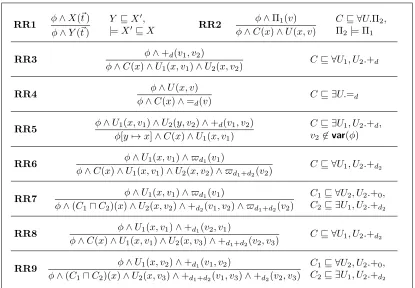
The rewriting rules are grouped into TBox-dependent rules (see Figure 2) and TBox-independent rules (see Figure3). RR1is the standard rewriting rule forDL-Lite, andRR2and
RR3are the variant dealing with universal restrictions, already used in [4]. RR5corresponds to a special case of RR1 in which an additional substitution step is required. The main func-tion of most rules in Figure3is to reformulate the concrete domain expressions in the query in an equivalence preserving way. While the TBox saturation already computes some inferences between concrete domain predicates, not every possible combination of concrete domain predi-cates that may occur in a query can be treated oblivious of the query. It is thus possible that the query contains concrete domain predicates saturation has not considered yet, but which can be transformed into the required form. This is done by Rules RC1 to RC5 and RC7. The purpose of other rules is to reduce the number of occurrences of a variable, to make other rules applicable. This is the main motivation behindRR4,RC6,RC9andRC10, and is also achieved byRR6 toRR9. Note that we have to be careful here not to lose the “link” of any variable occurring in the rest of the query: if we would drop a variable occurring elsewhere, we would allow for additional matches not covered by the original query. In [4], shared variables in the query are eliminated using a specialsplitting-rule, which splits shared occurrences of a variable by assigning a fixed value to them, where the set of values is determined based on the TBox and the ABox. Since we want to obtain a data-independent and goal-oriented procedure, our rewriting procedure does not use a splitting rule.
However, in order to achieve full data-independence, a bit more has to be done. Note that the fillers of concrete domain attributes can be determined by both: numbers occurring in the data and axioms in the TBox. If a predicate in the query refers to an attribute filler implicit in the data, we may need to “push” the concrete domain predicates in the query towards those attribute fillers explicit in the data. This is the purpose of rulesRR6toRR9. Note that these rules, similar to some of the TBox saturation rules, may make use of local functionalities of an attribute expressed by an axiom of the formCv ∀U, U.+0.
To obtain a rewriting procedure that is both complete and terminating, two problems have to be addressed. First, the rules need not be applicable to a query, as some rules require certain variables to occur only once or twice in the query. If a CQ contains a variable multiple times, it is often possible to reduce the number of occurrences by applying appropriate substitutions. Second, termination of the rewriting has to be ensured. Note that rulesRR6to RR9rely on predicate atoms of the form$d(v) (or +d(v, v0)) in their precondition and generate predicate atoms with same kind of predicate, but with a new value fordand thus with a new predicate and with different variables. This generation process can continue, but it generates only redundant queries. We adress the two problems in the following.
Achieving applicability of rules can require to unify soame variables, which is usually
achieved by applying substitutions. From a single CQ, a set of many CQs can be derived from the same CQ by such substitutions. One can easily see that not all possible substitutions are relevant here, but only those that unify different atoms. We make this intuition formal. Let
A={α1, . . . , αn}be a set of atoms. SetAunifies(to a singleton) if there exists a substitutionσ s.t. α1σ=. . .=αnσ. We then callσaunifier ofA. For each such set, we select amost general
unifier mgu(A), which is defined as a unifierσ ofA s.t. for every other unifierσ0 of A, there exists some substitutionσ00 s.t. σ◦σ00=σ0. We define the set of all CQs that can be obtained by unifying any set of atoms in the CQφasreduce(φ) ={φσ |σ=mgu(A), A⊆φ, Aunifies}.
Achieving termination of rule application depends on limiting the number of new predi-cates introduced by rules, and on limiting the number of variables introduced. The latter effect can be remedied by avoiding redundant queries in the query set.
Definition 5(Redundant query). Given two CQsφ1 andφ2,φ2 is redundanttoφ1, iff there
exists a substitutionσs.t. φ1σ⊆φ2. CQφ2 is redundant in a UCQΦif there existsφ1∈Φto
whichφ2 is redundant.
By Lemma6, removing redundant CQs from Φ does not affect the entailment of Φ.
Lemma 6(Query redundancy elimination). Let Φbe a Boolean UCQ, and φ1, φ2∈Φs.t. φ2
is redundant toφ1. It holds for every interpretation I, that I |= ΦiffI |= Φ\ {φ2}.
Proof. LetIbe an arbitrary interpretation s.t.I |= Φ\ {φ2}. By the definition of entailment of UCQs, and since Φ\ {φ2}(Φ, we haveI |= Φ. For the reverse direction, letI be an arbitrary
interpretation, and assumeI |= Φ and I 6|= Φ\ {φ2}. This means two things. First, I |=φ2, and therefore there exists a homomorphism h:terms(φ2)→∆I∪R. Second, I 6|= φ1. But
sinceφ2 is redundant toφ1, there exists a substitution σs.t.φ1σ⊆φ2. We know that σis a mapping from terms inφ1 to terms in φ2, and h is a mapping from terms in φ2 to elements in ∆I∪R. Therefore, we can construct a mappingh0 =σ◦h s.t.h0 : terms(φ1)→∆I∪R.
The function h0 is indeed a homomorphism from terms of φ1 into I. Hence I |= φ1, and consequently,I |= Φ\ {φ2}, which contradicts the original assumption.
The algorithm to compute the rewriting of a UCQ Φ, written as rew(Φ), uses the
rewriting rules shown in Figures 2 and 3, where X and Y are both either roles or concepts. The complete UCQ rewriting is depicted in Algorithm2.
Example 4. Let T ={a1=Av ∃U3, U1.+3, a2=Av ∀U1, U2.+1, a3=B v ∃U2.>R∼}be a
TBox, A={A(c), B(c), U1(c,10)} an ABox, andφ=∃v3.(U3(x, v3)∧>5(v3)) a CQ. Then,a
witha(x) =c is a certain answer toφ inhT,Ai. In the following, we show how it is obtained. First, we computesaturate(T), which containsa4=∃U2.>R∼uAv ∀U1, U1.+0, among other
axioms. This axiom is derived by applying Rinit-5on a2, and then R+-2 on the result and a2.
To obtain the CQ for whichais a certain answer inh∅,Ai, we compute rew(φ), which consists ofφ and the following queries:
RR7(a1,a4 )// A(x) ∧ U1(x, v1) ∧ U2(x, v2) ∧ +3(v
3, v1) ∧ >8(v1)
RC10// A(x) ∧ U
1(x, v1) ∧ U2(x, v2) ∧ >8(v1)
RR1(a3 )// A(x) ∧ U1(x, v1) ∧ B(x) ∧ >8(v1) = φ0.
Inh∅,Ai,φ0 has a match, and thereforeais a certain answer to rew(φ).
Let T be a saturated TBox, φ a CQ, and RR some rewriting rule. In Algorithm 2, we denote byφ RR,T // φ0 a rewriting step w.r.t. T s.t. some atom(s) in φsatisfy the premise(s) of RR, and the resulting queryφ0 is in the form of the conclusion of RR.
In order to prove termination of the algorithm, we need to show that the number of generated rewritings (CQs) is bounded. Actually, whether a rewriting rule depends on some axioma∈ T
Algorithm 2:Computation of rew(Φ)
Input: UCQ Φ, saturated TBox T.
forφ∈Φdo
forφr∈reduce(φ)andψ such thatφr RR,T// ψdo
if ψis satisfiable w.r.t. T and not redundant in Φthen
set Φ :={ψ0∈Φ|ψ0 is not redundant toψ} ∪ {ψ};
returnΦ;
Theorem 7(Termination of rewriting). Algorithm 2 always terminates.
In the extended version of the paper, we show that the obtained rewriting yields a sound and complete query rewriting procedure. We start by proving that for any Boolean CQ φ,
hT,Ai |=φiffh∅,Ai |=rew(φ). Once this is proven, and because of the definition of entailment of UCQs, we obtain the following theorem.
Theorem 8(Soundness and completeness of rewriting). Let T be a saturated TBox andAbe
an ABox s.t.K=hT,Aiis satisfiable. Then, for any UCQΦ, and any answera toΦ,ais a certain answer to ΦinK iffais a certain answer to rew(Φ) inh∅,Ai.
6
Conclusion
In this paper, we have considered extensions ofDL-Litewith concrete domains overR. In this setting, we have presented a query rewriting approach that handles not only unary concrete domain predicates, but also binary ones. The key idea is that entailments that are caused by the TBox and the functionality of the cr-rewritable concrete domains employed here, are computed beforehand and are added to the TBox during saturation. Although this step can be costly, it only needs to be performed once (for all queries) and can be done “off-line”, before query execution. Furthermore, we have shown that our approach yields a sound, complete, and terminating query rewriting procedure. This procedure is, in contrast to earlier approaches [4], data-independent. The latter is crucial for gaining practicality on larger data sets, and our method allows for a more goal-oriented computation of rewritings than the other approaches. In order to support this claim, we are currently working on an implementation of our approach, where the resulting UCQ is translated into a union of SQL queries which then can be answered using any RDBMS. We plan to use the rewritings not only on classical data sets, but also on probabilistic data in which concrete domain values are characterised by continuous probability distributions. OBQA for this setting has been theoretically investigated in [6].
As for future work, there are various directions we are considering. First, we would like to investigate the possibility of extending the concrete domains with more binary predicates, e.g. multiplication, while preserving first order rewritability of CQs. On the other hand, we would like to study query rewriting w.r.t. with other concrete domains, for instance those over strings. We believe that the rules we have introduced in this paper could serve as a basis for a more generalised procedure supporting those domains.
References
[1] Christian Alrabbaa, Patrick Koopmann, and Anni-Yasmin Turhan. Practical Query Rewriting for
Theory, Institute for Theoretical Computer Science, Technische Universit¨at Dresden, Dresden, Germany, 2019. Seehttps://lat.inf.tu-dresden.de/research/reports.html.
[2] Alessandro Artale, Diego Calvanese, Roman Kontchakov, and Michael Zakharyaschev. The DL-LiteFamily and Relations. Journal of Artificial Intelligence Research, 2009.
[3] Alessandro Artale, Vladislav Ryzhikov, and Roman Kontchakov. DL-Lite with Attributes and Datatypes. InECAI 2012: 20th European Conference on Artificial Intelligence (ECAI’12), 2012. [4] Franz Baader, Stefan Borgwardt, and Marcel Lippmann. Query rewriting forDL-Litewithn-ary concrete domains. InProc. of the 26th International Joint Conference on AI (IJCAI’17), 2017. [5] Franz Baader and Philipp Hanschke. A Scheme for Integrating Concrete Domains into Concept
Languages. InProc. of the 12th International Joint Conference on AI (IJCAI’91), 1991.
[6] Franz Baader, Patrick Koopmann, and Anni-Yasmin Turhan. Using ontologies to query proba-bilistic numerical data. InProc. of Frontiers of Combining Systems, (FroCoS’17), 2017.
[7] Diego Calvanese, Giuseppe De Giacomo, Domenico Lembo, Maurizio Lenzerini, and Riccardo Rosati. Tractable Reasoning and Efficient Query Answering in Description Logics: TheDL-Lite
Family. Journal of Automated Reasoning, 2007.
[8] David Carral, Irina Dragoste, and Markus Kr¨otzsch. The Combined Approach to Query Answering inHorn-ALCHOIQ. InProceedings of KR’18, 2018.
[9] Roman Kontchakov, Carsten Lutz, David Toman, Frank Wolter, and Michael Zakharyaschev. The Combined Approach to Ontology-Based Data Access. In Proc. of the 22nd International Joint Conference on Artificial Intelligence,(IJCAI’11), 2011.
[10] Carsten Lutz. Inverse roles make conjunctive queries hard. In Proc. of the 20th International Workshop on Description Logics, (DL’07), 2007.
[11] Carsten Lutz, David Toman, and Frank Wolter. Conjunctive Query answering in the Description LogicELUsing a Relational Database System. InProc. of the 21st International Joint Conference on Artificial Intelligence, (IJCAI’09), 2009.
[12] Nhung Ngo, Magdalena Ortiz, and Mantas Simkus. Closed Predicates in Description Logics: Results on Combined Complexity. InProceedings of KR’16, 2016.
[13] Antonella Poggi, Domenico Lembo, Diego Calvanese, Giuseppe De Giacomo, Maurizio Lenzerini, and Riccardo Rosati. Linking data to ontologies.Journal on Data Semantics, 2008.
[14] Sebastian Rudolph and Birte Glimm. Nominals, inverses, counting, and conjunctive queries or: why infinity is your friend! Journal of Artificial Intelligence Research, 2010.