64
ISSN-2394:3076 CODEN(USA) : JBPCBK
Journal of Biological Pharmaceutical And Chemical Research , 2014,1(1): 64-100
)
http://www.jobpcr.com/arhcive.php (
Current Condition of Environmental Law and Its Implementation Regulations
in Indonesia: Future and Challenging Matters in the Case of General Mining
Development
Ukar Wijaya Soelistijo[1*], Marwan Zam Mili[2]
1
University of Islam Bandung (UNISBA), Institute of Technology Bandung (ITB), Mineral and Coal Technology R&D Center (MCTRDC), Center for Education and Training of Mineral and Coal
(CETMC), Bandung, Indonesia
2
University of Halu Oleo (UHO), Kendari, Indonesia
ABSTRACT
In line with the Indonesia constitution, that the development of mineral resources is the utilization effort of one out of the several national resources that are used for the greatest welfare of the people. For that, the development and utilization of mineral resources must be referring to the existing law of management and protection of the environment, in the sense of physical and non-physical environment (social economic and cultural). Furthermore, the efforts to develop mineral resources must also follow the global policy on the maintenance of the environment, among others about the Agenda-XXI in mining sector in line with the Kyoto Protocol, among others utilization of mineral resources with the protection of environmental function, development in the provision of mineral as raw materials, employment, foreign exchange, integrated regional development, coordination, illegal mining, location of artisanal mining, friendly environment, multiple land use function, professional, offshore, standards, infrastructure, reached agreement on forest land-use map, overlapping, illegal mining, location of artisanal mining, mine reclamation, legislation both in terms of legislation, policy and its implementation. A variety of future challenges to be faced including, among others, controlling, human resource development within the region, Indonesia incorporated, greenhouse gas, globalization, utilization of the EEZ (exclusive economic zone). As far as possible, Indonesia has followed the international policy on the management and protection of the environment in accordance with the related implementation law. It should be realized that the prevention of environmental problems is not only a burden but as well an opportunity as a profit business. The methodology used in this study is based on observations and investigation in terms of legislation on the development of global as well as regional and national environment by attention to the principles of environmental economic, while the environment is a part of economic development.
Key words: Environmental laws, regulations, general mining, Indonesia.
65
INTRODUCTION
66
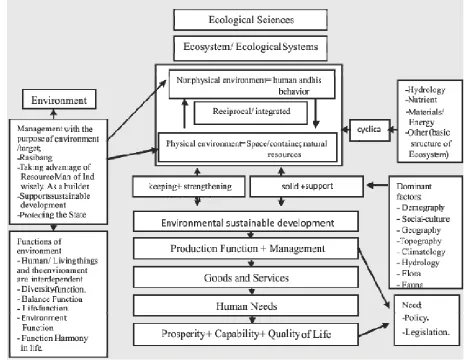
Figure1.The Mindset ofthe LawNo.32Year2009 on ManagementandProtectionof the Environment
.
MATERIALS AND METHOD
Theory and Methodology
67
living thing and inanimate objects in it. The essence of green development could be clarified as:
• Conscious and planned effort that integrates the environment, including the resources, to the development process to ensure the ability, well-being, and quality of life of the present and future generations (Law No. 32/2009).
• Guarantee that it will not collapse because of environment can no longer support the development. Development raises the quality of life and while maintaining and strengthening the environment for supporting the sustainable development (Salim, 1986). In the environment there is a term carrying capacity is the environment's ability to support human life and living organisms or the ability of the environment capacity to content and change of life. Whereas the meaning of resilience is the ability of an environmental system to recover after it was exposed to disruption. Environment (Figure 2) consists of a variety of ecological processes (reciprocal relationships among the living creatures with their environment) and as one unity; has a cyclical process that supports the environment to development (transformation of resources into goods and services). Environment cycle in the form hydrological cycle or water system; nutrient cycling in the food; energy and material cycles (use and change); and another cycle example, the basic structure of ecosystem. Development (change and growth) produces consumer goods, capital goods and services. Capital goods can generate new technologies (positive and negative). Development requires resources: negative impact for the community (externalities to the country economy or beyond the calculation of market and price), and positive (favorable) one to people's lives. The development requires development administration in order the utilization of natural resources is optimum in achievement of national goals. Ecosystem is a central concept in ecology, i.e. an ecological system that is formed by the interrelationships between living creatures with their environment. The system consists of components that work regularly as a unity. Ecosystem is an ecological relationships (human, living beings and the surrounding objects (natural resources). Environmental management is a conscious attempt to maintain or improve the quality of the environment and in order our basic needs are met as well as possible. Dead environment for example is the moon. The objectives of environment management may include:
• Achieving of harmony between humans and the environment as a whole of Indonesia human development goals.
• The controlled utilization of resources wisely.
• The realization of the Indonesian people as trustees of environment.
• Implementation of environmentally sound development for the benefit of future generations and sparingly.
68
Utilization of natural resources must consider the dominant factors those are demography, socio-cultural matters, geography, topography, hydrography, climatology, flora, fauna. Furthermore, it is expected that environment function is in terms of:
• For various creatures along with environment content and related interdependent;
• The existence of diversity-function content of the environment;
• The existence of functions that connect life;
• The existence of equilibrium function elements that exist in the environment;
• There is a harmony function in the life of environment.
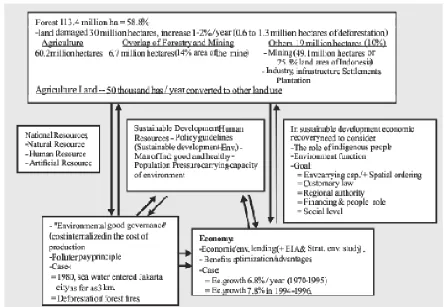
• A mining operation once started must pay attention to the interaction among the terms of exploitation of mineral resources, of economic activity and of the environment of both physical and non-physical ones in order to achieve the national goal (Figure 3).
The statement can be visualized in Figure 4.
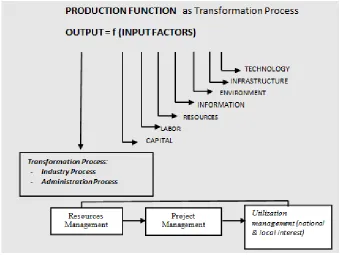
The methodology used in this study is based on observations and investigation in terms of legislation against the development of the global environment, regional and national attention to the rules of the economic environment, whichever the environment is a part of economic development. In the production function, environmental issues should be as an integral part of one of the input factors or economic costs both the physical environment (reclamation, rehabilitation, revegetation, waste neutralization and the like) and non-physical or economic-cultural-social (CSR or corporate social responsibility, including CD or community development as a chart of the development area). The relationship in production function, it is known that in a developing science and technology (Science and Technology) must be rooted in the national culture in creating added value in human life, to be able to reach mission efficiency and increased productivity application of science and technology in development both at the national and regional scale in its role to produce goods and services in an innovative and competitive in lifting the nation's dignity in the international world. Added value can be visualized in the form of quality of life, mastery of science and technology, environmental quality and the creation of adequate employment opportunities that brings jobs and revenue for the improvement of the welfare of human race.
69
Figure 2. Environmental Coverage Scheme
70
Figure 4. Visualization of Natural Resources-Economic-Environment Interaction
Science and technology is needed in the process/production function (Fischer 1981; Soelistijo 2011-2014):
Y = f (K, L, R, E)T
In this case Y = output (wares and services), K = capital, L = labor (human resource), R = natural resources (material/energy, etc.), E = environment, and T = change in technology (Science and Technology); and science and technology is a input factor in order to create the possibility of stepping productivity. For the development of science and technology in application, information and communication to facilitate the mobility of global science and technology as a factor of economic input in the production process to meet the needs of mankind in the continuity of life are required.
RESULT AND DISCUSSION
Analysis and Discussion
Global Development of Environment
71
Environment (UNEP) in Stockholm are realized the understanding of the world of the environment, and the need to pay attention to developing countries. In 1992 (June), UNCED (UN Conference on Environment and Development) Summit in Rio de Janeiro, Brazil:
• It is a political declaration on environment and development.
• "Human being is the center of concern in sustainable development".
• Agenda 21: "Programme upon to manage the environment and development program", with 4 dimensions of social economy; conservation and management of resources to support development: protection of the atmosphere; planning and management of land resources; the fight against deforestation; conservation of biodiversity; protection of the quality and supply of fresh water resources; strengthening of major groups (NGOs, women, youth, etc.); implementation facilities.
• 2 lines of sustainable development: resources management, maintaining environment quality: preventing pollution and management technology environment.
• Environment does not hamper trade and can be a profit business.
• Technology embodied in goods and services, so that requiring accreditation.
• ISO 14000 (Environment Management) is a trade gateway.
• Sustainable environment (the environment that can maintain assets, and at least are not depleting them) to maintain/ preserve assets (non-renewable resources and renewable resources), and least, not depleting.
UN FCCC COP-1 prior to the last COP-20 was held in Bonn in 2014 (http://www.google search UNFCCC COP-1 up to COP-20) that discusses the problem of global warming (Soelistijo, 2014), it is an encouraging step for the world to obtain the solution to climate change.
Archetype references of the related prevailing policies/legislative regulations (Anonymous (a) 1991 up to (i) 2009).
a) The Constitution of 1945.
• In the Preambule it is stipulated that the State protects the nation and the country in terms of prosperity and intelligence.
• In Article 33, verse 3 it is stated that earth and water authorized by the State and everything contained in it, utilized for the maximum benefit of the people.
b) Law No. 4 of 2009 on mining of mineral and coal, among others, containing:
72
sustainability of the related water resources function and carrying capacity in line with the stipulated guide line of the law and regulations. Article 99: (1) The every holder of the mining permit and special mining permit is obliged to submit reclamation and post mining plan at the time of offering application of production operation mining permit or production operation special mining permit. (2) Realization of reclamation and activity of post mining period is carried out in line with the post mining period land use. GR No. 78 of 2010. Article 2 Verse (1) The holder of exploration mining permit and exploration special mining permit is obliged to carry out reclamation. (2) The production operation mining permit and production operation special mining permit is obliged to carry out reclamation and post mining period. (3) The reclamation as mentioned on verse (1) is carried out upon the disturbed land during the period of exploration activity. (4) The reclamation as mentioned on verse (2) is carried out upon the disturbed land during the period of mining activity by using the method of: a. open pit mining, and b. underground mining. Article 3 (1) The implementation of reclamation carried out by the exploration mining permit and the exploration special mining permit is obliged to meet the principle of : a. protecting and treating the mining environment; b. safety and health. (2) The implementation of reclamation and post mining period carried out by the holder of production operation mining permit and the holder of production operation special mining permit is obliged to meet the principle of: a. protecting and treating the mining environment; b. safety and health; c. conservation of mineral and coal.
c) Law No. 32/2009 concerning the management and protection of the environment (instead of the previous Law No. 23 /1997), which includes the physical environment (space unity with all things, power, situation) and non-physical environment (living creatures, including human beings and their behavior) which influence the lives and well-being of humans and other living things, need to be managed in an integrated manner to preserve the environmental functions in the implementation of sustainable development (Figure 1). d) The Law No. 26 of 2007 (instead of the previous Law No. 24 of 1994) concerning spatial
ordering: that the management of diverse natural resources on land, at sea and in the air, we need to be coordinated and integrated with human resources and resources made in the pattern of sustainable development by developing layout in one unified system dynamic environments while maintaining environmental sustainability capabilities in accordance with environmentally sound development, which is based archipelago and National Resilience (Figure 1).
e) The Law No. 5 of 1990 on the conservation of natural resources and ecosystems. Conservation of natural resources is the management of non renewable natural resources to ensure the utilization wisely and renewable natural resources to ensure their availability while maintaining and improving the quality and diversity.
f) Protecting areas.
73
the frequently region and potential to get natural disasters such as volcanic eruptions, earthquakes, landslides.
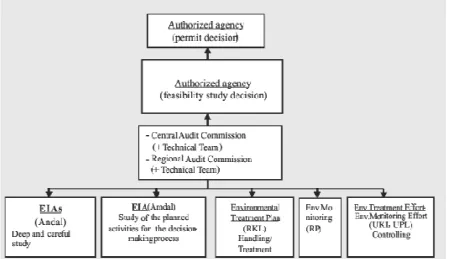
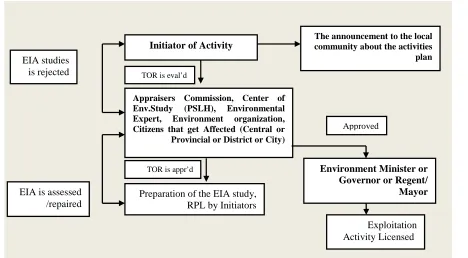
g) Government Regulation (GR) No. 27 of 1999 on environmental impact analysis (Figure 5). EIA is a study of a large impact and important of business and/or planned activities on the environment necessary for the decision-making process concerning the business Implementation and/or program.
h) The State Minister of Environment Decree No.14/Men LH/3/1999 concerning general
guidelines for the preparation of environmental impact assessment. Environmental impact assessment (environmental impact analysis (assessment)): environmental
impact assessment of a project includes job evaluation and estimation of the impact of the project on the environment and human life, or a study of the impact of a planned activity on the environment.
i) Environment Minister Decision No. 17 of 2001 concerning the type of business and/or activity must be accompanied by an environmental impact assessment
j) GR. No. 82 of 2001 concerning the management of water quality and water pollution controls.
Concerning with the activity in various sectors including mining sector, methods of environmental impact assessment have been developed that should be carried out by every entrepreneur who will do its business in order to implement maintenance program of environmental functions. Mining development is sustainable when it extracts non-renewable resources (NRR) with the course of space and time but still expect to be as well off at the end as it is at the beginning even through it will be substituted by renewable resources (RR) which will be developed through human investment and invention.
Environmental Impact Assessment (EIA) (Figure 5)
1). EIAs and EIA
a). EIAs (Environmental Impact Assessment): an analysis of the environment impact of a project that includes job of evaluation and estimation of the impact of the (plus(es)/minus(es)) of project in its development process or project system to the environment and human life.
b). EIA (Environmental Impact Analysis) (article 1, paragraph 1 of GR No. 27/1999): Studies on large impact and important business and /or planned program in the environment that is required for the decision process concerning the implementation of and/or program. Large and significant impact criteria: (a).Total humans affected; (b) The total area of the impact distribution ; (c) Intensity and impact duration; (d) The number of other components of the environment affected; (e) The nature of cumulative impacts; (e) Turning (reversible) and do not turn around (irreversible) impact.
74
Figure 5. The hierarchical of authority in handling the environmental impact study
(agency) to central/regional and transcript to the central/ local (the issuing agency business) ; Expiration: 3 years, is canceled if changes location design; IV The control agency of development environmental impact of Audit Commission (AC), the business sector agency develops implementer of PKL: Education, Training and R&D; Qualifying preparation of EIA; V Monitoring (the Proponent has to report the implementation of the Environmental Treatment Plan (RKL)/Environmental Monitoring Plan (RPL) to Governor and agency; The agencies which doing control and evaluation. Testing of reports and reporting of control and evaluation result); VI Disclosure of Information and the Role of public (Every business is announced before the application for EIA; Society reserves the right to make suggestions/comments that must be considered; Society shall be involved; All documents are opened to public; VII Fundings (Audit Commission/Technical team by related institution; preparation and assessment by the proponent); VIII Transitional Provisions: 6 months; IX Final Provisions.
The impact of mining and energy activities on environment.
a. Mining and energy activities include general prospecting, exploration, exploitation, processing and refining. The sector may include mining, oil and gas, energy and electricity.
b. Mining and energy activity components and its impacts.
1) General Prospecting and exploration. In general there is no significant impact, because it is very short period of activity with lower intensity.
2) Construction. Construction activities can cause significant impacts such as social impact, noise, dust, erosion and so on. However, construction in general does not take too long.
75
Some construction is also done by using explosives material that can also cause noise. Erosion can also occur at the time of land clearing and excavation during construction. 3) Mining exploitation.
In the mining exploitation activities is the main component of the excavation, ore leaching, and transport.
- Excavation. Excavation activities are as special characteristics of mining activity. These activities can lead the changes of landscape; interference with local hydrology; erosion and siltation; pollution of water bodies by soil erosion; dust appears by excavation, especially during the dry season; noise by operation of excavation equipment; shock waves can occur when using explosives to destroy the rock layers and so on.
Some special cases may be mentioned:
> Coal Mining. In the open pit produced ecological disturbances such as dust, soil destruction, flood erosion, suspended solids. In deep mining can result, among others, ruints, acid draining, fumes of fires. In leaching can produce a disruption e.g. leaching waste. In transportation produces dust and noise. In the combustion of coal results the presence of smoke, odors and exhaust gases (C0x, N0x, S0x), and fine particles (Figure 6).
> Gold. The process of excavation and transporting gold ore generally involves a number of dugouts very much because of the gold content is only between 2-21 grams of gold per tonne of ore excavated. Lateritic gold mining often requires cyanide or mercury processing. Waste containing both these chemicals should be treated so as not to pollute water bodies. Alluvial gold mining does not use chemicals, but must do some digging in a large area, so it may cause erosion and siltation of the river. > Excavation of tin ore leaves the infertile land and holes. Reclamation of this damaged land requires a
good attention.
> Copper. Copper mining in Papua has a negative potential impact on the eternal snow and damage to the Carstensz grass of Puncak Jaya Wijaya area. The investigation of this issue is being done.
> Industrial mineral (non-metal). Many nonmetallic mineral minings which seriously damage the
environment and water management such as excavation of sand, stone, soil and others (Manaf, 1991). Supervision of the implementation is carried out by the local government.
- Washing. Various mining activities often involve leaching of excavated products, such as in coal mining. Coal often is washed before being shipped to improving its quality (reducing dirt soil). Soil washing can lead to siltation of water bodies. Besides that, the residual water of coal leaching often contains a fine grains of coal and requires careful separation process. Washing water is often acidic. The problem of waste treatment processes should pay serious attention.
- Transportation. Transportation of minerals can cause dust and traffic noise. Contamination by dust often occurs during the transportation of nickel ore and gold ore. Dust generally arise out of the mine in a isolated areas that generally does not paved.
- It is often feared by those who have not experienced is of the existence of floating coal dust in the atmosphere during transportation. In fact, that has been washed coal, generally does not cause dust in its transportation.
4). Processing of minerals.
Mineral processing activities can produce significant impacts on water bodies in the form of pollution, emissions, noise, and others. In gold mining, cyanide or mercury pollution often need to be aware of. Similarly, lead ore processing can cause cyanide pollution.
:
c. Clarification of the environmental impact (Figures 7 and 8) can be expressed as follows 1) Environmental Impact of Mining/Processing
76
c) On the waterfront: Beach erosion → change shoreline → backward (Tangerang 40-50 m, Bangka tin mines).
d) In the uphills: Landslide and degradation (e.g. Bogor-Puncak-Cianjur area).
e) Processing: Au with the neutralized B3 waste then into the river: Mud affect the aquifer.
2) Environmental geology criteria as inputs for mining operations: (i) Topography: beach, flat, hills, karst; (ii) Top soil: fertility; (iii) Physical rock: weathered to hard cause actual landslides; (iv) Water system: do not be exceeded underground water by the presence of wells population; (v) geological natural disasters: volcanoes, land movement, flood.
3) Impact of Waste Materials for Aquatic Organisms (Adiwilaga,1991;Alhadar, 1991; Sudiyono, 1991).
a) 3 groups of metals in terms of biology: Light metals: Na, K, Ca as cathions that taken in the water; Transition metals: Fe, Cu, Co, Mn; Heavy metals: Hg, Pb, Sr, Sn, As.
b) Impact: (i) Biodegradation: decomposition by microorganisms. (ii) Bioaccumulation: accumulation in certain organisms through the food chain (plant plankton, organic microscopic if eaten by zooplankton, fish can be eaten up next to humans). (iii) toxicity (direct lethal effects of lethal and sublethal effects are not immediately lethal. Sublethal effects: biochemical effects (changes in blood chemistry, hydrocarbons, etc.); Physiological effects (less fit or stress); Effects pathology/morphology (erosion scales, bone disorders, etc.); Behaviouris effect (behavior); Ecological effects (on physics, chemistry and aquatic biota); Genetic effects (loss of superior characteristics).
4). Combating efforts of environmental impact.
a) On the plains: Keeping top soil; Close holes (needs EIA); Above the local ground water table; Waste of water need pool (mud) new to the general flow (stream); Water puddles → mosquito breeding; Steer clear of settlement; Benching (incline).
b) At the beach: Protection of with the coastal mangrove; protection of coral reefs; Support the deepening of the shipping channel (to prevent the deposition process); preventing deterioration of beach (slope stability).
c) At the river: to prevent the hydraulic damage → water flow function; gradually to prevent of flow danger; prevention of meanders that exceeds the river banks; to prevent degradation → cliff avalanche; do not exceed the thickness of the shield layer; to prevent the silting; to protect the dams, bridges, public buildings.
d) Hills: Top soil for reclamation; Excavation up to the same height of the surrounding plains (topography); Tiered slope (rocks off the 2/1 - 3/1 stiff 1/1, not much to ½ - 2/3,); Rock solid 1/3); attention to disaster-prone areas; need check dams to prevent puddling; so protect the catchment area.; ≥ 2 km from the settlement.
e) Processing: The dangerous and poisonous matters × disposal, does not interfere with underground water.
77
Figure 6. Possible Effects of Mining Activities to the Environment
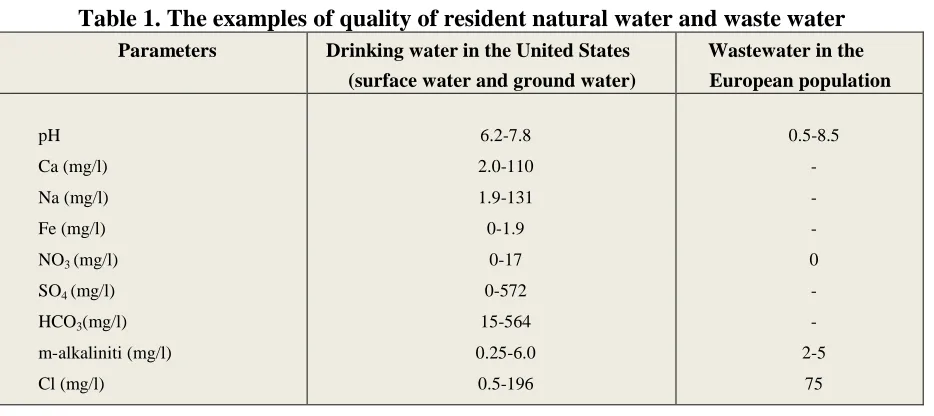
Table 1. The examples of quality of resident natural water and waste water
Parameters Drinking water in the United States
(surface water and ground water)
Wastewater in the
European population
pH
Ca (mg/l)
Na (mg/l)
Fe (mg/l)
NO3 (mg/l)
SO4 (mg/l)
HCO3(mg/l)
m-alkaliniti (mg/l)
Cl (mg/l)
6.2-7.8
2.0-110
1.9-131
0-1.9
0-17
0-572
15-564
0.25-6.0
0.5-196
0.5-8.5
-
-
-
0
-
-
2-5
78 PO4 (mg/l)
SiO2 (mg/l)
BOD (mg O2/l)
COD (mg O2/l)
Suspended substances (mg/l)
N- Kjeldahl (mg/l)
0-0.6 0.121 - - 1-3800 -15 - 300 750 500 60
Source: Kartawiria, J., 1991, "Handling of industrial waste," Training Seminar and Environmental Management Exhibition in General Mining Sector, Jakarta. 6). Heavy Metals (Table 2)
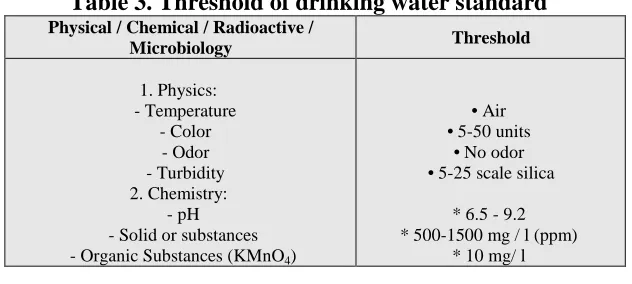
7). Drinking water standards (Table 3) (Algamar, 1991)
- Combating case of air pollution of PT. INCO South Sulawesi (1990) (Susanto, 1991). - Noise 80%> 85 decibell (the threshold).
- Dust> 0:26 mg/Nm3 (the threshold).
- Emissions of dust g/NM3 1.8 (0.6 g/NM3 threshold)
Measured gas: CO, CO2, H2, SO2, O2): SO2> 0:13 mg/Nm3.
- Ambient air: (i) Settlement 0:15 mg/Nm3 (0:26 mg/Nm3 threshold); (ii) plant 1.5 mg/Nm3 (above the threshold)
- Dust fall: (i) Plant> 11.5 ton/km2/month; (ii) Settlement 4.5 - 7 ton/km2/month (<).
- S Plates: (i) plant SO2 0:04 ppm /day (> 0:02 ppm/day); (ii) Settlement 0.001 ppm/day (<0:02 ppm/day).
The management of the EIA.
a. Legal basis.
Rules that underlying of development and environmental protection in Indonesia contained in the 1945 Constitution, which reads: "Later than that for the formation of Indonesia which shall protect all the Indonesian people and the
entire state of Indonesia to promote the general welfare, to educate the nation ..." This provision confirms the "duty" of state and government's duty to protect all human resources of Indonesia and the Indonesian environment for all people of Indonesia and the happiness of all humanity.
Then Article 33, paragraph 3 formulate the basic ideas more concrete, and readable as follows: " Pursuant to which, in order to form a Government of the State of Indonesia that shall protect the whole people of Indonesia and the entire homeland of Indonesia, and in order to advance general prosperity, to develop the nation’s intellectual life". This provision gives the "ruling right" to the State and the government over the whole of Indonesia's natural resources and provides an obligation to use it for the greatest welfare of the people. Various other legislation that became the legal basis for the need for environmental protection is Law No. 4/1982 updated by Law No. 23/1997 on environmental management which then re-updated into Law No. 32 of 2009 on management and protection of the environment, and GR
No.51/1993 updated with GR No.27/1999 concerning environmental impact analysis.
b. The scope of EIA.
Analyzing the scope of the environmental impact can be said to be quite broad. From the various problems affected divided into several important categories, namely: (i) biogeophysical-chemical, (ii) socio-economic environment, (iii) socio-cultural environment.
79
Environmental impact studies carried out systematically according to the following stages: 1) Descriptions of the environmental baseline.
At this stage include the input of data about the state of the environment at the beginning or before the construction activities are held, namely: (i) abiotic hue, (ii) biotic spectrum, (iii) base line socio-cultural population.
2) Description of the construction activity.
This stage includes activities that will be implemented of humans including the following phases: pre-construction, construction and post-construction.
Table 2. Heavy metals and their effects on health
The element Origin mineral Diseases Threshold
*As *Cd *Cr *Co *Cr *Co *Pb *Cu *Mn *Hg *Ag Pyrite Greenockite (sulfide) Chromite
Compounds of As, S, O
Sulfide
Chalcocite (CuS2), Chalcopyirite
MnO2, sulfide
Cinnabar
Sulfide
* Poisoning
* Blood Systems, tumors,
poisoning
* The skin, breath, heart,
stomach
* Diarrhea, liver, urine,
blood pressure ↓
* Blood, nerves, kidneys
* Breath, urination, coma
* Paralyzed, insomnia
* Digestion, breath,
kidneys, eyes.
* Stomach, throat, eyes.
* As203 12:25 m/m3.
* 0:05 mg Cd/m3
* 00:05 mg/m3
* 0:01 mg Co/m3
* Air: 0.2 mg/m3
Blood: 70-80 microg/100 cc
of blood of men
Blood: 40 cc of blood
micrig.100 women.
* Cu 0.2 mg/m3 of air
* Mn 5 mg/m3,
Mn3O4 1 mg/m3
* Air 0.05 mg Hg/m3
Urine 250 microg/l.
Blood 6 microg/100 cc.
* Air 0.1 mg Ag/m3
Sources: Sudiyono, H., et al, 1991, "Heavy metals and their effects on health," Training Seminar and on Environmental Management Exhibition in General Mining sector, Jakarta.
Table 3. Threshold of drinking water standard Physical / Chemical / Radioactive /
Microbiology Threshold 1. Physics: - Temperature - Color - Odor - Turbidity 2. Chemistry: - pH - Solid or substances - Organic Substances (KMnO4)
• Air • 5-50 units
• No odor • 5-25 scale silica
* 6.5 - 9.2 * 500-1500 mg / l (ppm)
80 -CO2 -Hardness -Ca -Mg -Fe -Mn -Cu -Zn -Cl -SO4 -H2S -F -NH4 -NO3 -NO2 -Phenol -As -Pb -Se -Cr -CN -CD -Hg 3. Radioactive Alpha Beta 4. Microbiological -Parasitic / Pathogenic
* 0 * 5-10o D * 75-200 mg/l * 30-150 mg/l * 0.1-1.0 mg/l * 0.05-0.5 mg/l * 0.05-1.5 mg/l * 1-15 mg/l * 200-600 mg/l
* 400 mg/l * 200-400 mg/l
* 1-10 mg/l * 0-2 mg/l
* 0 * 0 * 0001-0002 mg
*0.05 mg/l *0.1 mg/l *0.01 mg/l *0.05 mg/l 0.05 mg/l 0.01 mg/l 0.001 mg/l 10-9 uc/mg/l 10-8 uc/mg/l
0 (in 100 ml of water)
Source: Oginawati, K., 1991, "Processing of clean water and domestic wastewater," Training Seminar and Environmental Management Exhibition in General Mining sector, Jakarta.
Figure 7. Procedure of Environmental Impact Assessment
Minister EIAs (ANDAL) Env.Information ReportPIL Concerned agencies :Technical Dep./Governor Initiators TOR (KA) Responsible agency RPL RKL
Approval of RPL
81
Figure 8. Schematic Flowchart Mechanisms for EIA at the Central Institution and in the Region
3). Impact assessment.
This stage includes the analysis and interpretation of significant impacts, among others, the number of people affected, the widespread of deployment impact, many components of the affected environment, the intensity of the impact, the impact of the communicative nature of turning or irreversibility of the impact. 4). Alternative actions.
This stage includes a summary of the environmental impact assessment of plans and drafting of environmental management program, including maintenance.
d. Stages in the management of EIA (Figures 7 and 8)
1). Presentation of environmental information (PEI) may include several matters such as(i) the identity of the initiator, (ii) a brief description of the proposed activities, (iii) evaluation of the impact and combating the negative environmental impacts as well as the development of a positive impact, (iv) references. 2). Environmental impact assessment (EIAs).
Arrangement of EIAs needs a completeness of a competent institution about the need for EIA. If these requirements are met, then it can be composed of a frame of EIA reference that include the following: uses a frame of reference; variations in the relationship between the proposed project activities with environmental impacts; interest; scope; working methods; list of teams that did the study. From this frame of reference can be arranged EIAs. EIAs arrangement includes few things. The following description is presented EIA guideline preparation: (I summary, (ii) introduction, (iii) activities proposed, (iv) environment early ue, (v) estimates of significant environmental impact, (vi) EIAs results was proposed at the competent (Environment) to obtain the approval of the
contents can be a statement that the impact is larger negative so that can not be overcome.
3). Environmental Management.
In a broad sense, environmental management can be defined as a conscious effort to preserve the EIA studies
is rejected
Approved
Preparation of the EIA study, RPL by Initiators
Appraisers Commission, Center of Env.Study (PSLH), Environmental Expert, Environment organization, Citizens that get Affected (Central or Provincial or District or City)
TOR is appr’d TOR is eval’d
Initiator of Activity
The announcement to the local community about the activities plan
EIA is assessed /repaired
Environment Minister or Governor or Regent/ Mayor
82
environment and improve the environmental quality in order to our basic needs are met as well as possible. To obtain a good environment quality, our efforts is to enlarge the environmental benefits and minimize environmental risks, so that we preserve the carrying capacity of the environment that can sustainably the growth and development, and not just to preserve the harmony and balance of the environment. As a follow-up of the preparation of EIA is environmental management. Because without managing the preparation of EIA is useless or just a concept only. In this environmental management conducted a careful monitoring of the impacts arising from the project activities implemented. The composition of this environmental management includes the initiator's identity, purpose, usability, and alternative approaches. Then also included a description of the environmental management. Environmental management was resubmitted to the authorities (Minister of Environment). From these authorities will be obtained if the answer is no requirement or without a requirement or less perfect. If less than perfect it is necessary to improve return preparation RKL. As the final stage of the environmental impact assessment to monitor the state of the environment. Even this monitoring plan is submitted to the authorities, then wait for the decision of whether or not the plan is perfect. If less than perfect is necessary realignment of the environmental treatment plan (RKL). If approved, there are three criteria for follow-up: (i) If within three years of environmental monitoring plan (RPL) is not implemented so its stated is expired. For this there are two options expire if EIAs/RKL/RPL can be reused or not (to be made the new one again); (ii) Directly it is applied to the construction phase; (iii) In the event of a fundamental change in the environment then all fall and need to regroup EIAs with new environmental color/status/hue. At this stage the proponent is also the supervisor of the RKL implementation and RPL must give a report to the Minister of Environment for the work or the monitoring results. EIAs requires a systematic approach, so easily explored many groups and interdisciplinary team. Systematic means all consideration and evaluation has been carried out for all possible of environmental impacts caused by human action. Environmental impact of human actions includes physical properties, chemical, biological, socio-economic and socio-cultural. Basically all the inputs from various sciences conducted analyzing to obtain an overview of the possible impact that will occur.
Nonphysical environment (community development, CD).
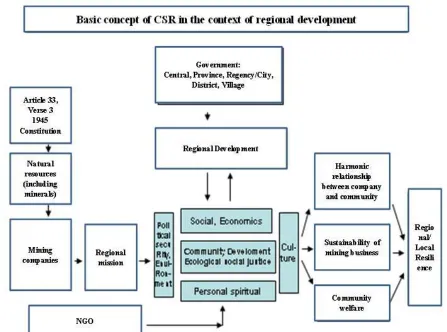
CD mindset about mining is a device based on the principle of bottom-up (Figure 9). Basically, limitations of CD is as a series of development and utilization of existing structures and the ongoing community empowerment, so that people can meet their own needs. The basic principle of community development is to involve society since the beginning of the activities to be able to recognize the real needs and realize together with various related stakeholders. A fact that people around the large companies have often encountered welfare level is still low, although it is recognized that the company has provided assistance to their surroundings.
83
planning for sustainable development. Regarding the scope of CD includes qualitative improvement effort of a system, including improving resource utilization that can be maintained forever with two CD approach perspectives, the ecological and social justice that can be translated into operational principles, such as integrated development, structural injustice, human rights, sustainability, empowerment, community ownership, self-confidence, without violence, consensus, cooperation, participation, defining requirements, inclusiveness, process requirements, processes and outcomes, community building, their types of expertise, organizational development, stages of development, short-term goals and vision of the end, freedom of the country, as well as personal and political rights. In the context of development in the mining sector, the experts tried to translate the CD program in popular indicator that can be traced from several things, namely community development, physical, social, economic, environmental, cultural and legal aspects in accordance with the current conditions in the field, the company's program, and the wishes of the around people. As a basic measure of democracy, CD activities of mining companies must cover some important aspects, namely: - Relationship of companies and people in a CD program, with its indicator: CD program has a clear concept, a special section has a full-time staff who can work with governments and stakeholders, especially local communities, coverage of programs covering various aspects of community life, continuity of time, and the planning process.
- The physical aspects (physical infrastructure capacity building), with indicators: presence of infrastructure development in accordance with the needs of the community such as economics, health, education, sports, arts; geographical distribution and the development of the sector; perpetrators and funders maintenance functions, as well as the availability of facilities such as clean water.
- Social aspects, with indicators: the use of local labor (quantity and quality); employment in the construction period and the production period; improvement of skills; and participatory planning. This includes the social aspects of economic, health, education, sports and the arts.
- Economic aspects, with indicators: relations companies and local communities economic are backward, forward, final demand, and technological linkages; technical assistance in the form of capital, management assistance, development of local economic institutions, technology and marketing.
- Environmental aspects (physical) which includes two things, i.e.: land rehabilitation programs and resources, as well as an increase in food safety.
- Cultural aspects and legality with indicators: regulatory control of land; legal aspects of the protection of migrants and the local community; empowerment of women; environmental issues (sustainability of natural resources); social security in a post-mining.
- The relationship between the company and local government, with the indicator: CD program linkages with local development plans; portion of funds from the company for regional development; partnership between them in the CD program; ease for NGO participation in implementation of the CD program.
In the mining industry the CD activity is social investment in improving the performance of mining production, because it can eliminate conflicts between companies and communities and ensure the continuity of their business activities, even if the public may be able to feel and come to "own" the company. CD activities as the core of corporate social responsibility, that the management of the mining company has a moral obligation to help the socio-economic welfare of the surrounding community.
84
of society towards people with independence. So that the process can be optimized, hence the role must be an integral part of regional development activities is undertaken by local governments, especially in developing the potential of the region in which it operates. This is important given the demands of society in the reform era has increased. The corporate managers have realized that in general the company is a "servant of the community", the company is nothing without the community. Companies must not only think for mere profit, but should be broad minded earnestly to support the economic growth of countries and regions in which they do business. The scope of the study of the CD can include:
> Inventory of various issues associated with several instruments, such as: container organizations/institutions, programs, budget, target group, and others.
> Identification and analysis of the characteristics/peculiarities of society, among others: human scale, identity and ownership, liability, inheritance values, culture, regional values.
> Identification and analysis of the success factors of development are covered: the development of alternative, free from pressure, and development from below or bottom.
> Identification and analysis of the relevance and benefits of the mining area. The value of these benefits is often called the value of social benefits (net social gain) that reduced the company's total acquisition value of factor inputs and intermediate plus net external effects.
> Identification and analysis of potential areas that can support mining activities to include community participation.
> Formulating and developing a standard CD program for mining companies to pay attention to the peculiarities of the area and the local community.
a. Efforts.
Companies are required to make efforts in the following items:
- Maintaining and developing relationships in harmony with the principle of fairness, openness, solidarity fan respect and human dignity;
- Improving communication and coordination of network planning, utilization and utilization of mineral resources for the benefit of society.
- Improving the quality of human resources, especially around the mine so that they are more independent, has knowledge particularly and the required skills to face the competitive global market. - Improving nature conservation optimally and utilization of wealth proportionally to the face of
post-mining in the context of socio-economic structural transformation.
- Enhancing the conducive atmosphere to the development of businesses, cooperatives, small businesses, and institutions of people's economy for the benefit of society.
- Creating jobs directly and indirectly in efforts to improve the life of people's lives.
- Enhance the atmosphere of a society that is more developed through environmental regulation that is more humane.
- Fostering and enhancing the harmonious and meaningful relationships with local government and community agencies in the state and nation.
- Fostering a sense of ownership and sense of responsibility of local communities towards the company.
b. Output solution.
> Encouraging the excitement and economic activities, especially around the location of the company's work, as well as preparing them in the process of structural transformation of the post-mining economic life based mining to non-mining economy.
85 > Expanding employment and employment opportunities. > Improving the standard of living and welfare.
> Chick conditions of harmonious life, mutualism and synergy between local communities and companies.
c. A case study of PT FI
PT FI faced demolition of small-scale (artisanal) gold mining through empowerment. With EIAs apparently has not solved the problem of artisanal workers. because many of the problems upstream EIAs limited to handle the physical environment. Then developed a Strategic Environmental Assessment that many aspects of the socio-economic or cultural downstream to complete the EIAs (see Figure 10).
d. Study on Net Social Gains (NSG).
There have been many studies on the NSG conducted by the MTDC to calculate the net social benefits that have been and can be utilized by the local community in the context of community development (or CD). Some studies NSG can be seen in Table 1.
Evaluation method of EIA studies.
a. Appearances: (i) Does all the pages read well? (ii) Does the image and the map clearly and accurately? b. Format: (i) Does technical guidelines be followed carefully? (ii) Does the terms of reference (TOR)
followed carefully?
c. Material: (i) Does the material presented reasonable? (ii) Is there a contradiction between one part and the other? (iii) Are the data and information that are used quite good and fresh? (iv) Are there visible things that want to be covered? (v) Are all potential impacts have been identified.? (vi) Does limits the potential impact is tilled carefully?
If one of the items above are not met, then the study can be considered incomplete and must be repaired. The conclusion of evaluation must state whether or not the project is environmentally feasible.
86
87
Figure 10. The series of Strategic Environmental Assessment, PT Freeport Indonesia (PT FI)
Table 4. Net Social Benefit (NSG) Mining Company in Indonesia 1999-2002
Source: Mineral Technology Development Center (MTDC)
88
of the deficiencies and depending on the review. The study may need to be returned to the proponent for improvement.
f. Assessment project description: (i) Project description must be clear and detailed enough so that officers can estimate impact evaluation activities on the environment; (ii) Evaluation of many officers experience determines its ability to estimate the impact that may occur; (iii) When the reported descriptions are incomplete. then the proponent should be asked to add an explanation; (iv) A list of the relationship between environmental activities for each type of project can be very helpful in evaluating studies quickly and accurately.
g. The purpose of presenting baseline.
In the evaluation phase of the study, the baseline assessment was not intended to examine carefully about the environmental data presented, but only to get a quick overview of the initial state as a comparison with a state that can be caused by the project activities.
h. Assessment of whether the study can be justified scientifically: (i) The work is needed to see whether: There are enough good data to draw conclusions; is it initiator draw conclusions correctly; (ii) To conduct such examinations need to assess whether the method of data collection is correct, including equipment used for sampling and analysis procedures; examine whether the restrictions study broad enough to cover all potential impacts; assess whether the data that is used quite fresh not expired.
i. If it turns out the data quality is doubtful, then the study should be returned to the proponent.
Identification of changes in environmental quality due to the project activity: (i) the proponent has mentioned the possibility of changes in environmental quality. The officer responsible for the evaluation of whether the initiator presentation makes sense. The approach that can be used are: Review the PEI (if available); Review the PEI with other similar projects; Assess other similar references; Establish a list of similar project impacts based on the reference; Compare this list with the presentation of the study; (ii) Whenever it appears a lot of shortcomings, the studies must be returned to the proponent.
j. Identification and assessment of impact: (i) In evaluating the study, the attention should be focused on the following three things: Identify what will happen to the environment by the project activity; How large is the effect of the impacts; What action is thought to minimize the impact on the environment; (ii) Assessment of the magnitude of the impact is done as follows: Compare with the existing rules (GR, Decree or other standards); Consult with other agencies; Check if there are specific things (protected areas, protected species, etc.); Check whether the project is consistent with the policies and objectives of the general government; Assess the methods used by the proponent to identify and assess the impact. k. Assessment of alternatives and effort to minimize impact: (i) The proponent should be appropriately
mention the effort that will be used to minimize the impact; (ii) A vague statement such as: "Project proponents will make every effort to minimize the impact as well as possible". Should not be accepted by the officer evaluation; (iii) Several attempts to minimize the impact: Moving the location; Adding equipment to reduce pollutants levels; Compensation to the injured partite; (iv) In this case the work is more art. Evaluation officer must understand the local situation well.
l. The final report of the evaluation officer.
Evaluation officer must make a report to EIAs commission on the final outcome of their evaluation that among other things should mention: (i) Various consideration for conclusions given, both for studies that are considered environmentally feasible or not feasible; (ii) The impact that may still be there, even though the entire effort has been made to minimize them.
m. Law No. 32 of 2009.
Everyone has equal right to have a good environment and healthy living. Every person is obliged to preserve the function of the environment and prevent and mitigate pollution and environmental destruction. Any unlawful act such as pollution and/or destruction of the environment that cause harm to others or the environment, require the person in charge of the business and/or activity to pay compensation and/or perform certain acts.
89
Minimum quality that required for personnel evaluation study are: (i) Knowledge of EIAs regulations: Law No. 32 of 2009 and its implementation regulations: Decisions of Environmental Minister; Decisions of the Technical Minister; Decisions/regional regulations; (ii) Knowledge of technical guidelines; (iii) Knowledge of regulations on EIAs from other countries; (iv) Have reference and good books; (v) Basic knowledge of statistics; (vi) A basic knowledge of environmental science.
o. Some consultants error: (i) Thickness of the report is considered a perfect: Too much for reviews; Elusive essence; Requires a lot of energy, time and cost; (ii) Working with muscle not brains: Citing EIAs Output without a good adjustment; Not referring to the existing rules; Lazy to calculate; Subjective consideration; (iii) Report of origin so: print errors that interfere with understanding; Picture/map is not legible; (iv) Covering a negative impact.
p. Technical Guidelines for preparation of Environmental Impact Assessment (EIAs) for the General Mining Activities is clarified in Annex IV of Energy and Mineral Resources Decree No. 1453K/29/MEM/ 2000, that mainly includes (i) Technical guidelines for the preparation of terms of reference EIAs of General Mining activity, (ii) Technical guidelines for the preparation of general mining EIAs activity, (iii) Technical guidelines for the preparation of RPL for general mining activity, (iv) Technical Guidelines for Preparation of UKL (effort of environmental treatment/management) and UPL (effort of environmental monitoring) for general mining, (v) Technical Guidelines for Annual Plan of RTKL (annual plan of environmental management) and RTPL (annual plan of environmental monitoring).
Environmental status in the mining industry
a. Environmental aspects include: EIA, RKL, RPL, reclamation and rehabilitation, community development, social programs in line with the national standards.
b. Mining generally is a way open and alluvial mining in remote areas with conventional standard techniques, but local social factors need to be studied and adapted in management strategies.
c. In mining operations, the company generally has been carrying out aspects of the environment to meet standards and government regulations even international standards and accepted by the local parties. Although for some mines especially small-scale mines such as industrial mineral mining category, there are who do not pay attention to environmental issues.
d. Controlling pollution has been using advanced technologies, including its equipment in the processing of gold, a smelter and a processing plant.
e. In relation to the socio-economic environment, some companies such as PT. Freeport and PT. KPC has taken a partnership of business/economics with the local community.
f. Rehabilitation of post-mining area has been carried out and productively revegetation by productive plants has been attempted by PT. Antam, PT. BA, PT. INCO, PT. KPC, PT. Freeport and others. For soil with special conditions does require research and experimentation.
Renewable resources have been tried in post-mining landscapes such as wood for paper pulp, agriculture, fisheries, even tourism projects.
g. Faced major problems in terms of post-mining land and small-scale land old mines post, which requires the attention from the local government by the support that integrated with economic development planning and supported with by the industry in the future.
Cases of mining environment
Some cases the results of the environmental control efforts can be shown as follows: a. Environmental control in PT. Koba Tin Banka.
90 c. Environmental control PT. BA (1992).
Including surface water (with a settling pond), dust (with watering water), soil disturbance with land restoration and replanting (3-5% of the cost of production).
d. Environmental management of PT. INCO. (Soesanto, 1991).
Including erosion problems in mining areas with revegetation, dust emissions at the processing plant (by installing dust handling equipment), and socio-economic community (community development).
e. Planning, monitoring and environmental management of PT. Freeport. (Marsh, 1991). Including long term environmental monitoring program, meteorological and hydrological stations, glacier monitoring, biology, water quality, sediment transport, aquatic biology, mapping, air quality, laboratory, environmental management.
f. Environmental monitoring of PT. Kelian.
Including cyanide supervision, tailings dams, the tailings dam cyanide properties (0.1-1 ppm), sampling and analysis of tailings dams, discharge from the tailings dam, polishing pond, discharge into the Kelian river (0.1 ppm even 25-50 times lower than this limit).
91
Table 5. Resume case status and general mining environment
92
Environmental Economic
a. Developing a model of the environment is not only a burden but also as one of the economy business sector, such as the utilization purification of waste, reclamation business to further development into productive land.
b. Development should be implemented in a sustainable and environmentally sound.
> The pattern of investment of environmentally sound in terms of application investment must be equipped with requirement of environmental studies (EIAs and so on).
> Adapting of understanding that the environment is also a production factor of besides the other production factors such as labor, capital, materials, information and the like. In this case on the basis of the principle of "the polluter pay principle", despite the environment in economic is externalities (as in outside factors of economic calculation): Y = f (K, L, R, I, E, …, T); in this case: Y = output (GDP); K = kapital; L = labor; R = natural resources; I = information; E = environment; T = technology.
> Increasing the gross national product should be higher than the gross national pollution. Thus the carrying economic capacity is higher than the externalities pressure. GNP = C + I + X - M + net income from abroad; in this case: I = investment; C = consumption; X = exports; M = imports.
- The Relation between production functions and management in controlling production can be seen in Figure 11.
Figure 11. Environmental cost as inherent in the mining production cost
Special problems associated with the Ministry of Energy and Mineral Resources (MEMR) (Table 6).
a. Utilization of natural resources in protected areas is carried out through an approach that is most beneficial for the state by comparing the economic, technological, and as a result of damage to the environment.
93
c. MEMR has a role to implement the agenda that includes 5 sectors: energy, mining, housing, tourism, and forestry.
d. Solving environmental problems need to be agreement among districts and across the district. e. MEMR does not inventory the environmental problems because of limited funds and technology. f. MEMR has compiled a substance related to: (i) The technical guidelines of preparation the EIA
for mining and energy; (ii) Technical guidelines assessment of EIA documents for mining and energy; (iii) The procedure for the revision of the EIA on mining activities change and energy; (iv) The format of reports and monitoring the implementation of environmental management of mining and energy activities; (v) Guidelines of assessment for consultant capable to making up environmental impact studies on mining and energy; (vi) Statement of the company in the field of environmental performance for companies engaged in the mining and energy sectors; (vii) The environmental management system of mining and energy sectors; (viii) Guidelines for environmental performance assessment in order to award the mining environment and energy; (ix) Raw wastewater quality for mining and energy; (xii) The criteria for the spatial aspects of mining and energy.
Table 6. Example matrix of the Agenda XXI of the General Mining in Indonesia
Overview of Implementation of Environmental Protection and Natural Resources Sustainability In General Mining Sector - In Order Agenda XXI
94
Challenges
Several challenging matters that are necessarily overcome, among others, are:
a. Regulatory system in Indonesia actually has been pretty good, but the implementation and monitoring mechanisms still need maturation.
b. Required more intensive effort and extensive that mining companies (Figure 12) have and continue to strive to implement regulations on environmental standards and the role of effort in the field of socio-economic environment integrated with mining activities.
c. As far as programs and environmental planning into the affairs between the government, industry and government as well as the local community, the pollution control, reclamation and rehabilitation needs to be integrated with economic and human resource development areas to reach the condition that the carrying capacity of the nature should be over the population pressure (Figure 13).
Figure 12. Main Mining Locations in Indonesia
95
a. Government and industry must work together in training, research, expertise, knowledge and high-tech equipment in the field of environment. Transfer of knowledge and information with the developed countries needs to be done continuously.
b. Sustainable development at local, national and global needs to be done and donated by the mining industry under the basic concept of natural resource development system (Figures 14 and 15). The mining sector is able to contribute to the development of poor areas to develop human resources and to develop the economy and future generations.
Figure 14. Environment and globalization
a. Cooperation between the government, mining industry and the local community (Indonesian incorporated) in the control of environment needs to be strengthened with good planning, technology, and resource management that can definitely answer correctly to solving environmental problems. b. Population (zero population growth) of 220 million people (2005) to 290 million people (2030) which
requires 250 million hectares of land with 193 million hectares of land available and less of 57 million ha. Family planning needs to be carried out at a rate of 2% to 1.3% and finally down to 0%.
c. The opportunity of utilizing extensive Exclusive Economic Zone of about 2 million hectares to 5 million hectares (Figure 16) most likely to be encouraged through mastering the advanced technology and high capital intensive investment.
96
Figure 15. Natural Resources Development System
97
Figure 17. Gas Components of Green House Effect
CONCLUSION
98
REFERENCES
[1] Anonymous (a). ”Keputusan Meneg Lingkungan Hidup No.17 Tahun 2001 Tentang Jenis Usaha dan Kegiatan Yang Wajib Dilengkapi Dengan AMDAL” 2001.
[2] Anonymous (b). “Masalah Lingkungan Hidup.” Proyek Peningkatan Tertib Hukum dan Pembinaan Hukum Mahkamah Agung RI. Mahkamah Agung RI. 1994.
[3] Anonymous (c). “Pengupasan tanah penutup dan masalah penimbunannya dilihat dari aspek perencanaan suatu tambang berwawasan lingkungan.” Divisi Enjiniring PTBA. Seminar Pelatihan dan Pameran Pengelolaan Lingkungan Hidup Bidang Pertambangan Umum. Jakarta. 1991.
[4] Anonymous (d). “Peraturan Pemerintah RI No.27/1999 Tentang Analisis Mengenai Dampak Lingkungan.” Bapedal. 1997.
[5] Anonymous (e). “Undang-Undang RI Nomor 26 Tahun 2007 Tentang Penataan Ruang.” 2007. [6] Anonymous (f). “Undang-Undang RI Nomor 23 Tahun 1997 Tentang Pengelolaan Lingkungan Hidup.”1997.
[7] Anonymous (g).“ Undang-Undang RI Nomor 11 Tahun 1967. Tentang Pokok-Pokok Pertambangan”1967.
[8] Anonymous (h). “Undang-Undang RI No. 4 Tahun 2009. Tentang Pertambangan Mineral dan Batubara. 2009.
[9] Anonymous (h). ”Undang-Undang RI No. 5 Tahun 1990 tentang Konservasi Sumber Daya Alam Hayati dan Ekosistemnya.”1990.
[10] Anonymous (i). ”Undang-Undang RI No.32 Tahaun 2009 tentang Pengelolaan dan Perlindungan Lingkungna Hidup.”2009.
[11] A.C.Fisher. “Resource and environmental economics”. Cambridge University Press. Cambridge. London. 1981.
[12] B.E. Marsh. ”Biological and phytoplankton sampling Freeport Environmental long term program (LTEMP).” Seminar Pelatihan dan Pameran Pengelolaan Lingkungan Hidup Bidang Pertambangan Umum. Jakarta. 1991
[13] B. Soesanto. “Pemantauan dan peanggulangan pencemaran udara di pabrik pengolahan nikel. PT INCO.” Seminar Pelatihan dan Pameran Pengelolaan Lingkungan Hidup Bidang Pertambangan Umum. Jakarta. 1991.
[14] E.M. Adiwilaga.”Efek potensial bahan buangan tambang bagi kehidupan akuatik.” Seminar Pelatihan dan Pameran Pengelolaan Lingkungan Hidup Bidang Pertambangan Umum. Jakarta.
1991.
[15] E. Salim. “Pembangunan Berwawasan Lingkungan. “ Penerbit LP3ES. Jakarta. 1986. [16] H.Alhadar.”Kajian terhadap kualitas lingkungan hutan. tanah dan air akibat kegiatan pertambangan emas Cikotok. Jabar.” Seminar Pelatihan dan Pameran Pengelolaan Lingkungan Hidup Bidang Pertambangan Umum. Jakarta. 1991. [17] H. Manaf. ”Penataan bekas penambangan trass di Puncak Jawa Barat.” Seminar Pelatihan dan Pameran Pengelolaan Lingkungan Hidup Bidang Pertambangan Umum. Jakarta. 1991.
99
Pameran Pengelolaan Lingkungan Hidup Bidang Pertambangan Umum. Jakarta. 1991.
[19] H. Surono. “Penetapan hutan lindung. hutan suaka alam dan hutan wisata.” Seminar Pelatihan dan Pameran Pengelolaan Lingkungan Hidup Bidang Pertambangan Umum. Jakarta. 1991.
[20] J. Kartawiria. “Penanganan limbah industri.” Seminar Pelatihan dan Pameran Pengelolaan Lingkungan Hidup Bidang Pertambangan Umum. Jakarta. 1991.
[21] K. Oginawati. ”Pengolahan air bersih dan air limbah rumah tangga.” Seminar Pelatihan dan Pameran Pengelolaan Lingkungan Hidup Bidang Pertambangan Umum. Jakarta. 1991.
[22] K. Algamar.”Metode. prosedur dan peralatan untuk pengambilan contoh air dan penafsiran hasil analisanya.” Seminar Pelatihan dan Pameran Pengelolaan Lingkungan Hidup Bidang Pertambangan Umum. Jakarta. 1991.
[23] http://www.google serach Kyoto Protocol, 1997.
[24] http://www.google serach UNFCCC COP1 (1994) up to COP20 (2014)
[25] U. W. Soelistijo, L. O. Aswandi, M. Zam Mili. Dynamic Conditions of Global and Indonesia Climate Change: Efforts and Policies. International Journal of Environmental Monitoring and Protection. Vol. 1, No. 2, 2014, pp. 35-46.
[26] U.W. Soelistijo, “Mining and Energy Sector Development Program in Eastern Indonesia,” ISSN 0854-9931, Indonesian Mining Journal, volume 5 number 3, October, 1999. [27] U.W. Soelistijo, ”Pengaruh Ekonomi Makro Regional Tambang Emas Pongkor – PT Antam Jawa Barat dan Potensi Transformasi Pasca Tambang.” Seminar Pembangunan Provinsi Jawa Barat, 12-13 Juni 2012,Jatinangor, Bandung, 2012. [28] U.W. Soelistijo, “Beberapa Aspek Terkait Investasi Dalam Usaha Pertambangan,” Pendidikan dan Pelatihan Analisis Potensi Untuk Penilaian Kelayakan Investasi, Pusdiklat Mineral dan Batubara, Bandung 13-15 Maret 2012. [29] U.W. Soelistijo, “Pengembangan Regional Berkelanjutan.” Fakultas Teknik Pertambangan dan Perminyakan ITB, 2012. [30] U. W. Soelistijo, L.O. Aswandi, 2014. “Future Trend of Mineral Industries Development in Indonesia.” Earth Science. Vol. 3, No. 2, 2014, pp. 58-67. doi: 10.11648/j.earth.20140302.14, 2014. [31] U.W. Soelistijo. “The influence of geopolitics and strategical factors upon the development of natural and human resources in Indonesia”. Scence Publishing Group, Social Sciences. Vol.2, No. 6.
2013, pp. 200-211. Doi:10.11648/j.ss.20130206.15
[32] U.W. Soelistijo. “Dinamika Penanaman Modal Asing (PMA) Bidang Pertambangan Umum di Indonesia”, Mimbar, Jurnal Sosial dan Pembangunan, Volume XXVII, No.1 (Juni 20111), Unisba,
2011