Iran University of Medical Sciences
____________________________________________________________________________________________________________________ 1. MSc in Nursing, Master’s Student in School of Nursing and Midwifery, Tehran University of Medical Sciences, Tehran, Iran.
2. (Corresponding author) MSN, PhD in Distance Education Planning, Instructor, Virtual School, Tehran University of Medical Sciences, Tehran, Iran. [email protected]
3. MSN, PhD in Distance Education Planning, Assistant Professor, Virtual School, Member of Nursing and Midwifery Care Research Center, Tehran University of Medical Sciences, Tehran, Iran. [email protected]
4. MD, PhD in Distance Education Planning, Assistant Professor, Virtual School, Center of Excellence for E-learning in Medical Education, Tehran University of Medical Sciences, Tehran, Iran. [email protected]
Comparing nurses' knowledge retention following electronic
continuous education and educational booklet: a controlled trial
study
Mahmud Badiei1, Mitra Gharib*2, Mitra Zolfaghari3, Rita Mojtahedzadeh4
Received:3 August 2015 Accepted:16 December 2015 Published:7 May 2016
Abstract
Background:Training methods that enhance nurses’ learning and retention will increase the quality of patient care. This study aimed to compare the effectiveness of electronic learning and educational booklet on the nurs-es’ retention of diabetes updates.
Methods: In this controlled trial study, convenience sampling was used to select 123 nurses from the endocri-nology and internal medicine wards of three hospitals affiliated to Tehran University of Medical Sciences (Teh-ran, Iran). The participants were allocated to three groups of manual, electronic learning, and control. The book-let and electronic learning groups were trained using educational bookbook-let and electronic continuous medical ed-ucation (CME) website, respectively. The control group did not receive any intervention. In all the three groups, the nurses' knowledge was measured before the intervention, and one and four weeks after the intervention. Data were collected by a questionnaire.
Results: Significant differences were observed between the mean scores of the three groups one and four weeks after the intervention (F=26.17, p=0.001 and F=4.07, p=0.020, respectively), and post hoc test showed that this difference was due to the higher score in e-learning group. Both e-learning and booklet methods could effectively improve nurses' knowledge (χ²=23.03, p=0.001 and χ²=51.71, p=0.001, respectively).
Conclusion: According to the results of this study, electronic learning was more effective than booklet in en-hancing the learning and retention of knowledge. Electronic learning is suggested as a more suitable method as it provides appropriate interactions and attractive virtual environments to motivate the learners and promote retention.
Keywords: Knowledge, Nursing Care, Distance Education, Booklet, Continuing Medical Education.
Cite this article as:Badiei M, Gharib M, Zolfaghari M, Mojtahedzadeh R. Comparing nurses' knowledge retention following electronic continuous education and educational booklet: a controlled trial study.Med J Islam Repub Iran2016 (7 May). Vol. 30:364.
Introduction
According to adult learning theory, learn-ing is a self-directed activity requirlearn-ing mo-tivation, desire, and effort on the part of the learner (1). In fact, it comprises intellectual activities, including recognition and re-membering, which relate to what learners should know and understand (2). Remem-bering generally involves reviving what a person has learned and retained. More spe-cifically, it is the process of recollection
and retention through which past memories are remembered in the form of words, meanings, actions, or mental pictures. As learners tend to absorb meaningful, concep-tual, and new subjects more deeply, such subjects are expected to be forgotten more slowly (3). Andrusyszyn defined knowledge retention as recalling materials 25.5 days after learning (4).
Despite its importance, retention of knowledge and skills has rarely been
ied (4-8). Because problems related to the retention of nursing knowledge and skills have been documented, selecting the best training method will definitely depend on identifying any factors that may contribute to the problem (9). Research has shown that teaching accompanied by colors, illustra-tions, and animation (dynamic content) can enhance the understanding of the material, learners’ ability to organize the concepts, and retention of knowledge (10-12).
Continuous training after graduation aims at maintaining the acquired skills, qualita-tive and quantitaqualita-tive promotion of such skills, and teaching new scientific contents and skills. Continuous education programs include seminars, congresses, workshops, conferences, short professional courses, well-organized plans, as well as training, research, and self-education activities (13).
Internet-based continuous education of-fers electronic, learner-centered, self-learning courses intending to promote knowledge (14-17) through the engagement of multiple senses (18).
Educational booklets are also widely used as the first generation of self-directed learn-ing media. However, durlearn-ing their prepara-tion, readability for the target group, pres-ence of simple pictures and diagrams, bold-facing important words and phrases, includ-ing up-to-date information, and usinclud-ing relia-ble sources have to be considered. On the other hand, previous studies have reported the insufficiency of educational booklets and thus suggested e-learning as a more favorable choice (19,20).
Electronic Continuous Education Website uses interactive scenario-based-learning approach. Scenario-based e-learning can improve participants' engagement and deeper understanding of content by moti-vating them to think and analyze before making decisions (11,21). In Addition, electronic continuous medical education (eCME) facilitates learning using a con-structivist orientation. Constructivism is a learning paradigm, which explains how people learn. According to this theory, peo-ple learn by constructing their own training
experiences (22). Constructivism seeks to associate new knowledge with previously learned information. Therefore, instead of transferring knowledge from an educator to a learner, constructivism focuses on learn-ers and assists them to create knowledge and give it an individual meaning (23,24). Electronic continuous medical education (eCME) encourages learning through active involvement with valuable information and provides a responsive learning environment (with questions and answers) and learner-centered teaching (6,9,23,25).
Integration of e-learning and continuous medical education implies that in adult medical education, trainers are not merely the distributors of content but act as learn-ing facilitators. E-learnlearn-ing improves reten-tion, provokes better use of the content, and consequently increases the accessibility of knowledge, attitude, and skills (14,26).
The relationship between nursing educa-tion and nursing services is growing steadi-ly (27). In addition, the production of nurs-ing knowledge is on a constant rise (27,28). Hence, nursing educators are constantly trying to teach learning methods to their students. The ultimate goal in professional nursing is to provide high-quality biologi-cal, psychologibiologi-cal, and social care to pa-tients. Therefore, surface learning and in-complete information will affect the per-formance of the nurses in dealing with pa-tients, and may lead to patients’ complaints, and managers’ concerns. To prevent such problems, nursing educators should use modern teaching methods to prevent sur-face learning and promote t students’ criti-cal thinking, problem solving, and infor-mation retention skills (27). Evidently, bet-ter learning of educational mabet-terials on the part of nurses will increase the quality of patient care (29).
While time constraints placed on nurses is a challenge that prevents them from updat-ing their knowledge, the flexibility of dis-tance education may be a good solution for organizations; i.e., the knowledge of nurses can simply be completed, modified, and updated through distance education system.
Distance-learning delivery methods can range from paper- based to internet- based materials and their impact is not clearly stated.
Therefore, this study aimed to compare the efficacy of educational booklets and the electronic continuous medical education system on enhancing the retention and deep learning of the recent advances in diabetes. As no similar study was found in this field, conducting this research seemed necessary.
Methods
This quasi-experimental study aimed to compare nurses’ ability to retain diabetes updates, which was learned through the electronic method and booklet. Considering the power of 80% with a confidence level of 95%, the needed sample size was about 120. Convenience sampling was used to select 123 nurses from endocrinology and internal medicine wards of three hospitals affiliated to Tehran University of Medical Sciences (Tehran, Iran). These three hospi-tals had the largest number of patients and nurses in the ward.
The inclusion criteria were at least one year experience of working in endocrinolo-gy and internal medicine wards, a mini-mum of bachelor’s degree in nursing, hav-ing finished obliged service in remote are-as, having access to computers and the in-ternet at home or workplace, and being skilled at working with the internet (accord-ing to the participants themselves). At any stage of the study, nurses who were not willing to participate, or were transferred to other wards were excluded.
The eligible nurses were allocated to e-learning (n=38), booklet (n=43), and con-trol groups (n=42). To prevent information exchange between the participants, each group was selected from a different hospi-tal; that is, the names of the hospitals were written on paper and randomly selected.
To measure nurses' knowledge before the intervention, all groups were asked to fill out a researcher-made questionnaire about diabetes updates (pre-test). The booklet and e-learning groups received the educational
content in the form of a booklet and eCME (http://cme.tums.ac.ir), respectively. To de-velop educational materials, extensive li-brary research, and domestic and interna-tional website search were conducted. The educational content was prepared using up-to-date articles, reliable sites and new edu-cational books. The training content in-cludes muscular and skeletal complications of diabetes such as diabetic hand syndrome, frozen shoulder syndrome, diabetic diet, desired levels of glucose control, insulin and its complications, new treatments for diabetes, common diabetes skin diseases and diabetic foot ulcers. The content was given to 14 outstanding professors and their corrective comments were applied. Then the materials were prepared in two formats of booklet and eCME. Educational objec-tives and titles were identical for both groups. Using illustrations and tables, the colored booklet of diabetes updates was prepared and given to the manual group. For the electronic group, interactive prob-lem- based scenarios were developed, and the content was placed on CME website after the administrative procedures (con-firmed by two reviewers and after obtaining a license from The National Continuing Education Office of Ministry of Health and Medical Education) in collaboration with electronic continuing education center at Virtual School of Tehran University of Medical Sciences. The e-learning group also attended a 30-minute session to learn how to log in to the website and how to use the program.
In the e-CME group, after coordinating with Hospital authorities and obtaining the required permissions, with the assistance of the hospital’s information technology team, a 24/7 service was provided and the e-learning group could access the website without interruption regardless of time or day. Moreover, to facilitate access to the educational material at the endocrinology and internal wards of the hospital, the web-site was set as the homepage in "Mozilla Firefox" and "Microsoft Internet Explorer". The control group did not receive any
tervention. One week and one month later, the questionnaires were distributed among all the three groups again without notice.
The pre and post-test were identical. The questionnaire consisted of two parts: The first part included demographic characteris-tics of the participants, while the second part assessed knowledge about diabetes up-dates. The last part was a researcher-made questionnaire to assess knowledge about diabetes updates. It contained 30 multiple (three-four) choice items with one positive score each. The items’ scores were summed up and calculated out of 100. Scores ≥75, 74-51 and ≤50 represented favorable, mod-erate, and low levels of knowledge, respec-tively. The questionnaire evaluated knowledge about desirable glucose control (nine items), insulin and its complications (four items), complications of diabetes (four items), diabetic diet (four items), musculoskeletal complications of diabetes (four items), novel treatments of diabetes (two items), common dermatological mani-festations in diabetics (two items), and dia-betic foot ulcer (one item).
The questionnaire was designed accord-ing to the conditions and features of the training program, and through library re-search and review of the literature includ-ing the “University of Michigan Diabetes
Knowledge Questionnaire” (30). The valid-ity of the whole questionnaire was assessed by expert review; i.e., it was handed out to 10 faculty members of School of Nursing and Midwifery (TUMS, Tehran, Iran), and their comments were applied. To evaluate the test-retest reliability of the question-naire, 10 nurses with similar characteristics to those of our participants were asked to complete the questionnaire twice, with a two-week interval. The reliability coeffi-cient of the questionnaire with test-retest was then calculated (r=0.91). It should be noted that these people were excluded from the study.
The results were finally analyzed using variance and chi-square, Fisher’s exact, Friedman, and Tukey's test; and p<0.05 was considered as statistically significant.
Results
We studied 123 nurses in three groups (booklet, e-learning, and control). The mean age of the booklet, control, and e-learning groups was 30.6±5.3, 32.5±5.5, and 29.4±5.2 yrs., respectively. The three groups were compared using Fisher's Exact Test and Chi- square analysis, and no statis-tically significant demographic differences were found. Demographic characteristics of the three groups are presented in Table 1.
Table 1. Frequency Distribution of Demographic Characteristics of the Nurses in the Three Groups
Groups Significancy*
Booklet
(n=43) (n=38)eCME Control(n=42)
Gender (female) 40 (93.0%) 41 (97.6%) 36 (94.7%) P= 0.680
Academic degree (bachelor) 42(97.7%) 38 (100%) 42 (100%) P= 0.999 Computer skills (good) 27 (62.8%) 15 (39.5%) 25 (59.5%) P= 0.060 Work experience (less than 5 years) 17 (39.5%) 21(55.3%) 17(41.5%) P= 0.570 * Fisher’s Exact test was used to analyze data related to gender, academic degree and computer skills; and ANOVA for work experience.
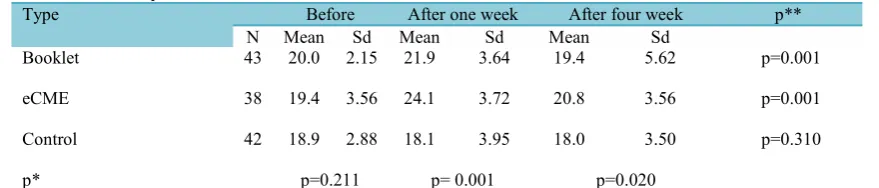
Table 2. Descriptive Statistics of the Scores before the Intervention, and One and Four Weeks after the Intervention for the Three Groups
Type Before After one week After four week p**
N Mean Sd Mean Sd Mean Sd
Booklet 43 20.0 2.15 21.9 3.64 19.4 5.62 p=0.001
eCME 38 19.4 3.56 24.1 3.72 20.8 3.56 p=0.001
Control 42 18.9 2.88 18.1 3.95 18.0 3.50 p=0.310
p* p=0.211 p= 0.001 p=0.020
*ANOVA was used to test for the differences between the mean scores of the three groups (eCME, booklet and control).
** Friedman was used to determine significant differences in the dependent mean scores of each group (before, after one week and after four week).
The mean (SD) of the pretest and posttest scores for the three groups are shown in Table 2. While the mean scores of the three groups were not significantly different be-fore the intervention (p=0.211), significant differences were observed between the mean scores of the three groups one and four weeks after the intervention (F=26.17, p=0.001 and F=4.07, p=0.020, respective-ly). Friedman analysis revealed that both electronic learning and booklet methods
could effectively improve nurses'
knowledge (χ²=23.03, p=0.001 and
χ²=51.71, p=0.001, respectively), but no significant difference was found in the pre and posttest scores in the control group (p=0.31).
Tukey's test revealed that the mean scores of knowledge were significantly higher in the e-learning group than in the booklet group (p=0.024) and the control group (p=0.001) one week after the intervention. The e-learning group had significantly greater mean score of knowledge compared to the control group (p=0.014) four weeks after the intervention, but the difference was not significant between the mean scores of e-learning and booklet groups (p=0.328).
Discussion
In this research, we compared the effects of booklets and e-learning on nurses’ reten-tion of knowledge about diabetes updates. We found that e-learning could significant-ly improve nurses’ knowledge compared to the control group; in addition, results sug-gested more desirable retention rate follow-ing e-learnfollow-ing.
In support of the above findings, Short et al. found that continuous medical education programs could effectively change the knowledge, attitude, beliefs, and self-reporting behaviors of the physicians. They reported these changes to last for more than 12 months (6). Tsai et al. found e-learning (with multimedia) to significantly increase the level of knowledge after one and two weeks (p<0.001) (31). Bloomfield et al. compared the effects of computer-assisted
learning and traditional face-to-face meth-ods on learning and retention of hand wash-ing skills. They concluded that although knowledge scores increased significantly in both groups, knowledge obtained through computer-assisted learning was better re-tained (7). Yaghoubian et al. indicated that the use of manuals failed to increase the mean scores of knowledge three weeks af-ter the inaf-tervention. In facts, the mean scores decreased from 8.55 before the tervention to 8.47 three weeks after the in-tervention (19).
E-learning is established based on con-structivism in which knowledge is not simply transferred from an educator to a learner, but it is instead learned through the creation of associations between the exist-ing knowledge and new information and giving it an individual meaning. E-learning increases retention, improves the use of the content, and thus leads to better access to knowledge (14,32,33).
Soleimanpour et al. did not observe a sig-nificant difference between e-learning (us-ing information and communications tech-nology) and traditional learning (through lectures) immediately and one month after intervention. However, the third post-test (three months after the intervention) showed a significant difference between the two groups. Hence, they stated that teach-ing science based on information and communications technology results in sus-tainable knowledge in students of the third grade of junior high school (17). In con-trast, the Aleman et al. showed that when compared to traditional teaching, e-learning led to significantly higher level of knowledge immediately after the interven-tion. Nevertheless, the retention of knowledge was similar in both groups 10 weeks after the intervention (8).
Sustainable learning occurs when the learner is able to organize and relate new concepts and information with his/her men-tal cognitive structures (27,34). E-learning encourages the learners to participate in learning actively and thus engages them with the content. Interactive learning
changes the focus from passive, teacher-centered methods to active, learner-centered methods and results in more effi-cient learning (14).
In conclusion, the review of the literature on retention indicated they are few espe-cially on knowledge retention; for example, Aleman in 2011 examined knowledge re-tention in medical surgical nursing students (8). Two other studies examined the reten-tion of practical skills including Beeckman who studied students’ retention in bedsore care in 2008, and Bloomfield who studied the retention of hand washing in 2010 (33,7). Inadequacy of studies on retention makes the conclusion difficult and indicates the need for further studies in this field.
Conclusion
Considering the results of studies on eC-ME and the results of this research, it can be stated that eCME can effectively pro-mote nurses’ knowledge and retention. Therefore, eCME systems can be used as an alternative or supplement to traditional teaching (e.g., booklets and lectures) in continuous education for nurses. This method enhances learning and retention by active engagement of the learners in the learning process through an interactive sce-nario. It facilitates learning by associating previously obtained knowledge with new information. Superficial learning and in-complete information will affect the per-formance of nurses in dealing with patients, resulting in patient complaints, and leading to real concerns for nursing managers. Ap-parently, the quality of nursing care can be increased by promoting the knowledge of nurses.
Acknowledgments
This research has been supported by Teh-ran University of Medical Sciences & Health Services Grant No. 19294-28-03-91; and has been registered in Iranian Registry for Clinical Trials (ID: IRCT201208251599 N19).
References
1. Jalali R. The survey of nurses' viewpoints on Continuing Nursing Education In the teaching hos-pitals in Kermanshah, 2002. Strides Dev Med Educ 2005;1(2):113-120. (Persian)
2. Khobi M. Comparing the learning and satisfac-tion of third year undergraduate students of Tehran University of Medical Sciences in tow methods of training via CD and traditional training 1391-1390. (dissertation). School of Nursing and Midwifery, Tehran University of Medical Sciences 2012. (Per-sian)
3. Khaksari M, Sajadi S, Salehi M. Retention data for evaluating teachers teach students of Rafsanjan University of Medical Sciences). Journal of Shahid Sadoghi University of Medical Science 2000;8(2): 32. (Persian)
4. Andrusyszyn MA. The effect of the lecture dis-cussion teaching method with and without audio-visual augmentation on immediate and retention learning. Nurse Education Today 1990;10:172-180.
5. Harris Jr JM, Kutob RM, Surprenant ZJ, Maiuro RD, Delate TA. Can Internet-based Education Im-prove Physician Confidence in Dealing with Do-mestic Violence? Family Medicine 2002; 34(4):287-92.
6. Short LM, Surprenant ZJ, Harris Jr JM. A community-based trial of an online intimate partner violence CME program. American journal of pre-ventive medicine 2006;30(2):181-5.
7. Bloomfield J, Roberts J, While A. The effect of computer-assisted learning versus conventional teaching methods on the acquisition and retention of hand washing theory and skills in pre-qualification nursing students: A randomized controlled trial. International Journal of Nursing Studies 2010; 47(3):287-94.
8. Fernández Alemán JL, Carrillo de Gea JM, Rodríguez Mondéjar JJ. Effects of competitive computer-assisted learning versus conventional teaching methods on the acquisition and retention of knowledge in medical surgical nursing students. Nurse Education Today 2011;31(8):866-71.
9. Bloomfield JG, While AE, Roberts JD. Using computer assisted learning for clinical skills educa-tion in nursing: integrative review. Journal of ad-vanced nursing 2008;63(3):222-35.
10. Smith M, Roediger Henry L. Covert retrieval practice benefits retention as much as overt retrieval practice. Journal of Experimental Psychology Learning Memory and Cognition 2013;39(6):1712-1725.
11. Gerdprasert S, Pruksacheva T, Panijpan B, Ruenwongsa P. Gerdprasert. Development of a web-based learning medium on mechanism of labour for nursing students. Nurse Education Today 2010; 30(5):464-9.
12. Khandandel B, Aliabadi Kh, Nourozi D, Ka-saeian A. Investigating the Effect of Color in Educa-tional Films on Learning. Knowledge & Health
2008;3(3-4):30-34. (Persian)
13. Mirshahzadeh N, Tootoonchi M. The Quality of Books, Questions and Teaching Method of Self-Learning in Continuing Medical Education: The Viewpoints of Self-learning Program's Participants in Isfahan University of Medical Sciences. Iranian Journal of Medical Education 2007;7(1):129-136. (Persian)
14. Ruiz JG, Mintzer MJ, Leipzig RM. The im-pact of e-learning in medical education. Academic medicine 2006;81(3):207-12.
15. Zolfaghari M, Mehrdad N, Parsa Yekta Z, Salmani Barugh N, Bahrani N. The Effect of Lec-ture and E-learning Methods on Learning Mother and Child Health Course in Nursing Students. Irani-an Journal of Medical Education 2007;7(1):31-39. (Persian)
16. Saeedinejat S, Vafaeenajar A. The Effect of E-Learning on Students' Educational Success. Iranian Journal of Medical Education 2011;11(1):1-9. (Per-sian)
17. Soleimanpor J, Khalkhali A, Roayat konnande falah L. The Effect of ICT- Based Teaching Meth-ods in Creating Sustained Learning in Experimental Science Course in Third Grade Secondary School Students. Information and Communication Technol-ogy in Educational Sciences 2010;1(2):77-93. (Per-sian)
18. Keulers BJ, Welters CF, Spauwen PH, Houpt P. Can face-to-face patient education be replaced by computer-based Patient education? A randomised trial. Patient education and counseling 2007;67(1-2):176-82.
19. Yaghobian M, Yaghobi T, Salmeh F, Golmo-hammadi F, Safari H, Savasari R, et al . Comparing the Effect of Teaching Using Educational Booklets and Lecture along with Educational Booklets on Nurses' Knowledge about Professional Laws and Regulations. Iranian Journal of Medical Education 2010;9(4):372-380. (Persian)
20. Khorami Rad A, Heidari A, Ahmari Tehran H. Comparison of Two Self-Learning Methods (CD-Rom or Booklet) for Physician Education about Reporting Diseases Cases. Iranian Journal of Medi-cal Education 2011;11(2):149-158. (Persian)
21. Pappas Ch. The Basics of Scenario-Based e-Learning. (updated 2014 February 14). Available from: http://elearningindustry.com/the-basics-of-scenario-based-e-learning
22. What is constructivism? Concept to classroom. Available from: http://www.thirteen.org/edonline/ concept 2class/constructivism/
23. Mirsaidghazi T, Kharat M, Kardan A, Eghbali N. A framework for learner preparation and support in academic e-learning environment. International Journal of Information and Communication Tech-nology 2011;3(1):33 - 41. (Persian)
24. Rahmani A, Mohajjel Aghdam A, Fathi Azar E, Abdullahzadeh F. Comparing the Effects of Con-cept Mapping and Integration Method on Nursing Students' Learning in Nursing Process Course in Tabriz University of Medical Sciences. Iranian Journal of Medical Education 2007;7(1):41-49. (Persian)
25. Abdelaziz M, Samerkamel S, Karam O, Ab-delrahman A. Evaluation of E-learning program versus traditional lecture instruction for undergradu-ate nursing students in a faculty of nursing. Teach-ing and LearnTeach-ing in NursTeach-ing 2011;6(2):50-58.
26.. Hugenholtz N, de Croon EM, Smits PB, van Dijk F, Nieuwenhuijsen K. Effectiveness of e-learning in continuous medical education for occu-pational physicians. Occuoccu-pational Medicine 2008; 58(5):370-372.
27.Khaledi SH, Moridi G, Shafieian M, Gharibi F. A comparison between the lecture method and the three combination participatory method of teaching and learning on nursing students' sustainable learn-ing. Dena Journal 2011;5(3-4):1-12. (Persian)
28. Golshiri P, Sharifirad G, Baghernezhad F. Comparison of two methods of education (lecture and self-learning) on knowledge and practice of mothers with under 3 year old children about growth monitoring and nutritional development stages. Ira-nian Journal of Medical Education 2011;10 (5):927-936. (Persian)
29.Ghanbari A, Paryad E, Ehsani M. The effect of teaching concept mapping on learning and retention in a course in nursing. The Journal of Medical Edu-cation and Development 2010;7(2):112-118. (Per-sian)
30. Michigan Diabetes Research and Training Center. For Health Professional. Survey Instru-ments. Available from: http://www.med.umich. edu/borc/profs/survey.html
31. Tsai SL, Tsai WW, Chai SK, Sung WH, Doong JL, Fung CP. Evaluation of computer-assisted multimedia instruction in intravenous injec-tion, International Journal of Nursing Studies 2004; 41(2):191-8.
32. Moule P, Ward R, Lockyer L. Nursing and healthcare students’ experiences and use of e-learning in higher education. Journal of Advanced Nursing 2010;66(12):2785-2795.
33. Beeckman D, Schoonhoven L, Boucqué H, Van Maele G, Defloor T. Pressure ulcers: e-learning to improve classification by nurses and nursing stu-dents. Journal Clinical Nursing 2008;17(13):1697-1707.
34. Sarhangi F, Masoumi M, Ebadi A, Seyyed Mazhari M, Rahmani A. Comparing the effect of lecture- and concept mapping based learning on cognitive learning levels. IJCCN 2010;3(1):1-5.