Iranian Chemical Society
Anal. Bioanal. Chem. Res., Vol. 3, No. 2, 217-224, December 2016.
Sensitive Electrochemical Determination of Gallic Acid: Application in Estimation
of Total Polyphenols in Plant Samples
M.A. Sheikh-Mohseni*
Shahid Bakeri High Education Center of Miandoab, Urmia University, Urmia, I.R. Iran (Received 6 April 2016, Accepted 14 July 2016)
A modified electrode was prepared by modification of the carbon paste electrode (CPE) with graphene nano-sheets. The fabricated modified electrode exhibited an electrocatalytic activity toward gallic acid (GA) oxidation because of good conductivity, low electron
transfer resistance and catalytic effect. The graphene modified CPE had a lower overvoltage and enhanced electrical current respect to the
bare CPE for the oxidation of GA. The oxidation potential of GA decreased more than 210 mV by the modified electrode. The modified electrode responded to the GA in the concentration range of 3.0 × 10⁻⁵-1.5 × 10⁻⁴ M with high sensitivity by the technique of differential
pulse voltammetry. Also, detection limit of 1.1 × 10⁻⁷ M was obtained by this modified electrode for GA. This electrode was used for the
successful determination of GA in plant samples. Therefore, the content of total polyphenols in plant samples can be determined by the proposed modified electrode based on the concentration of GA in the sample.
Keywords: Gallic acid, Graphene nano-sheets, Voltammetry, Polyphenols, Plant samples
INTRODUCTION
Free radicals have been implicated in over a hundred disease conditions in humans, including arthritis, atherosclerosis, advancing age, Alzheimer’s and Parkinson’s diseases, tumor promotion and carcinogenesis. Antioxidants are potent scavengers of free radicals and serve as inhibitors of neoplastic processes. Based on epidemiological studies, five to seven servings of fresh fruit and vegetables per day can lead to a prolonged healthy life. This capacity is attributed to content of polyphenols in fresh fruits and vegetables, which are well-known antioxidant compounds [1,2]. Plant polyphenols include catechines, flavanols, flavanones, phenolic acids, glycosides, aglycons of plant pigments and some other chemical forms. Polyphenols in different plant samples, are natural antioxidant [3], and have a scavenging effect on active
*Corresponding author. E-mail: m.shiekhmohseni@urmia. ac.ir
oxygen radical [4]. Therefore, it is necessary to estimate the average content daily intake of total polyphenols.
The most main polyphenolic compound is gallic acid (GA, 3,4,5-trihydroxybenzoic acid), which widely present in fruits, vegetables and drinks [5]. GA is often used as a standard substance for the estimation of total polyphenol content, i.e., antioxidant capacity index of the foods. Many methods have been applied for determination of polyphenols and GA, including spectrophotometry [5], high performance liquid chromatography (HPLC) [6], capillary zone electrophoresis [7] and mass spectrometry [8]. Expensive equipment, complicated operation, time-consuming and large amounts of toxic organic solvents are some disadvantages of most of these methods. While, electrochemical methods using modified electrodes offer a powerful tool for environmental, clinical and food analysis because of their advantages of high sensitivity, good selectivity, simplicity and low-cost [9-11].
construction of novel electrochemical sensors because of their excellent properties [12-14]. Graphene, a monolayer of hexagonally configured sp2 bonded carbon atoms, is a nanomaterial which continues to attract a considerable degree of attention in scientific and technological areas [15]. The most important property of graphene is its excellent electrical conductivity [16]. Therefore, it is widely used in construction of modified electrodes and electrochemical sensors [17,18].
In the present study, a graphene modified carbon paste electrode is fabricated. This electrode is used for rapid and sensitive electrocatalytic determination of GA. Also, the total polyphenol content of some plant samples including apple peel, apple flesh and nettle is estimated by the modified electrode.
EXPERIMENTAL
Apparatus and Chemicals
Electrochemical measurements were performed by a potentiostat/galvanostat (SAMA 500, electroanalyzer system, I.R. Iran). All electrochemical measurements were carried out in a three electrode cell including modified or bare CPE, saturated calomel electrode (SCE) and a platinum wire as working, reference and counter electrodes, respectively. The pH value of solutions were adjusted using a Milwaukee pH meter.
All solutions were freshly prepared with deionized water. Phosphate buffers were prepared from orthophosphoric acid and its salts (Merck, Germany). The graphite fine powder and paraffin oil (DC 350, 0.88 g cm-3), both from Merck (Germany), were used as received. The graphene nano-sheets were purchased from Sharif Solar I.R. Iran. The GA was from Merck and all other reagents were from Sigma-Aldrich.
Fabrication of the Modified Electrode
The graphene modified electrode was prepared by mixing 0.02 g of graphene nano-sheets, 0.38 g of graphite powder and appropriate amount of paraffin oil with a mortar and pestle until a uniform paste was obtained. The paste was then packed into the end of a plastic tube (3.5 mm i.d. and 10 cm long). The electrical contact was provided by inserting a copper wire into the carbon paste. The
unmodified carbon paste electrode was prepared in the same way without adding graphene.
RESULTS AND DISCUSSION
Electrochemical Oxidation of GA
The electro-oxidation of GA at the modified and unmodified electrodes were investigated by cyclic voltammetry (CV). The curves (a) and (b) in Fig. 1 show the cyclic voltammetric responses of 1.0 mM GA at graphene modified electrode (curve a) and bare CPE (curve b) at scan rate of 40 mV s-1 in phosphate buffer solution pH 7.0. The anodic peak potential of GA is higher than 450 mV at bare CPE (curve b), while it is decreased to the potential of about 240 mV at graphene modified CPE (curve a). Therefore, the graphene nano-sheets show efficient catalytic effect to the oxidation of GA. Also, the anodic peak current of GA is significantly improved at the modified CPE, indicating large surface area of the modified electrode.
The results show that the presence of graphene nanosheets at the electrode has a great improvement on the electrochemical responses, which can decrease the overpotential and enhance the peak current for GA oxidation. Therefore, graphene modified CPE offers a favorite electrode for oxidation and electroanalysis of GA because of low resistance, catalytic effect and large accessible surface area.
The influence of the amounts of graphene nanosheets in modified CPE was studied for electrocatalysis of GA. The value of anodic peak current of 1.0 mM GA at several modified electrodes containing various percentage of graphene takes as criterion for optimization. The results indicate the maximum anodic peak current of GA obtained at electrode with 5.0% of graphene (0.02 g of graphene nano-sheets, 0.38 g of graphite powder). By increasing the percentage of graphene nanosheets, the surface area of the electrode and also the electron transfer rate of the electrode are increased and more amounts of GA can be oxidized at the electrode. The higher percentage does not show any enhancement in current processing.
Fig. 1. Cyclic voltammograms of 1.0 mM GA at graphene modified CPE (curve a) and bare CPE (curve
b); curve (c) is the cyclic voltammogram of graphene modified CPE in the absence of GA; in all cases scan rate is 40 mV s-1 and solution is phosphate buffer with pH 7.0.
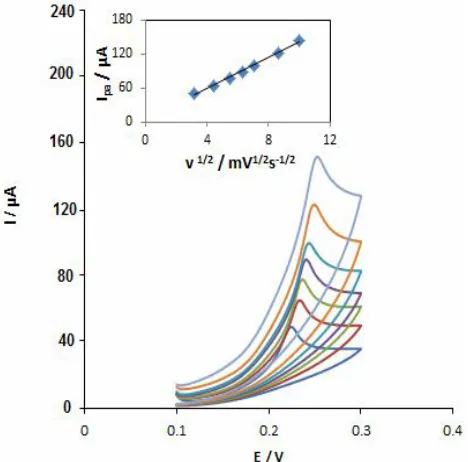
Fig. 2. Cyclic voltammograms of 1.0 mM GA at different scan rates (from inner to outer corresponds to 10, 20, 30, 40, 50, 75 and 100 mV s-1) on graphene modified CPE; inset: plot of anodic peak current (Ipa) vs. the square root of scan rate (ʋ1/2).
figure shows that the plot of the anodic peak current height of GA vs. the square root of scan rate (ν1/2) is linear in the range of 10-100 mV s-1. This linear behavior indicates that the electrochemical oxidation of GA at the graphene modified CPE is controlled by diffusion [19].
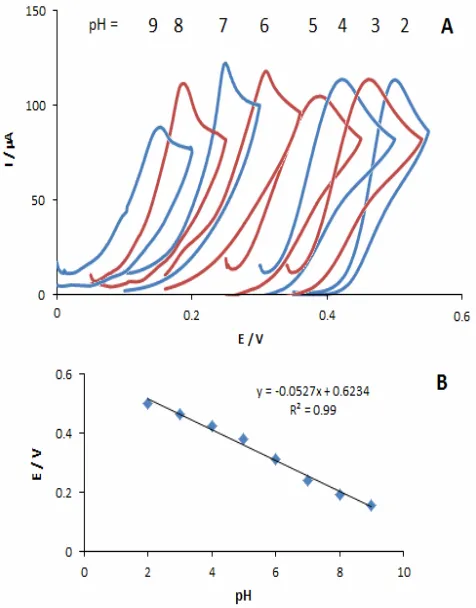
The electrochemical behavior of GA on the graphene modified CPE was studied at different pHs using CV (Fig. 3). It was observed that the anodic peak potential of GA shifted to negative values with increasing the pH from 2.0 to 9.0 (Fig. 3A). The potential-pH diagram, constructed by plotting the Epa values as the function of pH, shows a linear
equation with the slope of 52.7 mV pH-1 (Fig. 3B). This slope is close to the theoretical Nernstian value, indicating that GA has the equal proton and electron transfer number during the oxidation process on the modified electrode [19]. Therefore, it can be assumed that the oxidation of GA on graphene modified CPE has taken place by a 2e- and 2H+ process as displayed in Scheme 1.
Chronoamperometry Study
Chronoamperometry was also used for the electrochemical study of GA oxidation at graphene modified CPE. Figure 4 demonstrates the results of chronoamperometric measurements of graphene modified CPE (curve a) and bare CPE (curve b) in the presence of GA. These chronoamperograms were recorded at potential step of 0.3 V. It can be seen that the graphene modified CPE has a higher steady state current in comparison with the bare CPE at the same potential step over 10 s measurements, because GA is more easily oxidized in this potential (0.3 V) at the modified electrode [20]. This observation shows the catalytic effect of graphene nanosheets in oxidation process of GA.
Fig. 3. A)Cyclic voltammograms of 1.0 mM GA at scan rates of 75 mV s-1 in buffer solutions with different pHs on graphene modified CPE; B) the plot of the anodic peak potential vs. pH.
Fig. 4. Chronoamperometric measurements at the potential step of 0.3 V for 0.5 mM GA at graphene modified CPE (curve a) and bare CPE (curve b).
Scheme 1. Proposed electrochemical oxidation reaction mechanism of GA
Calibration Plot of GA
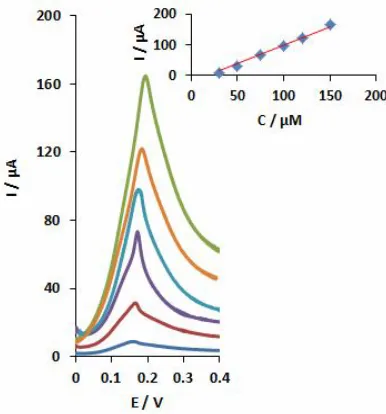
The technique of differential pulse voltammetry (DPV) was used to obtain the calibration plots of GA using modified electrode. For this purpose, the DP voltammograms of different concentrations of GA was recorded at the potential window of 0.0-0.4 V (Fig. 6). The results showed that the DPV peak currents of GA are linearly dependent on the concentration of GA in the range of 3.0 × 10⁻⁵-1.5 × 10⁻⁴ M (inset of Fig. 6). The linear equation of the calibration plot was obtained I (µA) = 1.3CGA (µM)-3.099, where I is the anodic peak current and
CGA is the concentration of GA. The detection limit was
calculated 1.1 × 10⁻⁷ M for GA by the slope of the calibration plot at 3σ level.
The ability of the proposed sensor was compared with some other sensors proposed for determination of GA and estimation of polyphenols. The results of the comparison are indicated in Table 1. As shown, the simplest method and cheapest electrode is the present sensor for determination of GA. Also the GA detection potential of the proposed sensor is lower than that of the other sensors excluding references [23] and [25] those that an enzyme is used in their structures. Moreover, only the proposed sensor in this work and reference [25] can detect GA in neutral pH. Obviously, the cost and simplicity of the sensor in reference [24] is similar to those in the present sensor, however the parameters of the present sensor (detection limit, linear rang, pH and detection potential) are better.
Selectivity Study
Fig. 5. A) Chronoamperograms obtained at graphene modified electrode for different concentrations of
GA from bottom to top: 0.0, 0.35, 0.4, 0.45 and 0.5 mM GA; B) plots of I vs. t-1/2 obtained from chronoamperograms of GA; C) the plot of the slopes of the straight lines against the GA concentration.
Fig. 6. DP voltammograms of different concentrations of GA (from inner to outer corresponds to 30, 50, 75, 100, 120 and 150 µM) on graphene modified CPE; inset is the calibration plot of GA.
some amino acids (histidine, threonine, tryptophan). The results showed that they have no significant influence on the detection of GA since the peak current changes were below 5%. Also, some ions including Na+, K+, Ca2+, Mg2+, Zn2+, SO42-, NO3-, Cl- and CO32- have no obvious interference for
GA detection even at 100-folds level. Therefore, determination of GA can be carried out in real samples with an acceptable accuracy.
Estimation of Total Polyphenols in Plant Samples The graphene modified CPE can determine the concentration of GA with high sensitivity. Therefore, this sensor may be useful for estimation of total polyphenols of a plant sample, because GA is a suitable representative for polyphenols [5,21]. To study the applicability of the modified electrode in electroanalysis of real samples and also estimation of the total polyphenols, this electrode was applied for determination of GA in some plant samples.
Determination in real samples was performed by DPV technique. The mean peak current of three repeated DP voltammograms was used in standard addition method to estimate the concentration of GA. Also, after adding a certain amount of GA to the intended sample, the concentration of GA was determined again and the recovery percentage was calculated. The content of total polyphenols in each sample is the concentration of GA in it [21]. The results for some diluted plant samples are given in Table 2. Also, considering the dilution factor, the concentration of GA was obtained 411.0, 190.2 and 186.0 µM, respectively, in apple peel, apple flesh and nettle extraction samples.
Repeatability, Reproducibility and Life Time of the Electrode
The repeatability of the modified electrode was studied by recording the DP voltammograms for 10 measurements of GA with the concentration of 1.0 × 10⁻⁴ M. The relative standard deviations (RSD) of the anodic currents were calculated 2.8%, indicating the suitable repeatability in determination of GA.
Table 1. Comparison of some Nanostructured Electrochemical Sensors in the Electroanalysis of GA
Method Electrode Nanomaterial pH
Detection potential (mV)
Linear range (M)
Detection limit
(M)
Ref.
DPV GCEa CS-fFe2O3-ERGOb 2.0 500
1.0×10⁻⁶-
5.0×10⁻⁵ 1.5×10
-7
[22]
Amp.c SPE-Aud
AuNPs-linker/fullerenol-TvLe 4.0 -100
3.0×10⁻⁵-
3.0×10⁻⁴ 6.0×10
-7
[23]
DPV CPE MWCNTf 2.0 525 1.0×10
-6
-6.25×10⁻⁶ 2.0×10
-7
[24]
Amp. GCE Tyr-nAug 7.4 -100 2.5×10
-5
-
9.0×10⁻³ 7.0×10
-7
[25]
AdS-SWV h GCE PEP(isn’t
nanostructure) i 1.8 530
1.0×10⁻⁶-
2.0×10⁻⁵ 6.63×10
-7
[26]
DPV CPE Graphene nanosheets 7.0 160 3.0×10
-5
-
1.5×10⁻⁴ 1.1×10
-7
This work
a
Glassy carbon electrode. bChitosan, fishbone-shaped Fe2O3 and electrochemically reduced graphene oxide. c
Amperometry. dGold screen printed electrode. eGold nanoparticles/fullerenol-Trametes versicolor Laccase. fMultiwalled carbon nanotube. gTyrosinase enzyme gold nanoparticle. hAdsorptive stripping square wave voltammetry. iPolyephineprine.
Table 2. The Concentration (i.e. Content of Total Polyphenols) and Recovery Percentage of GA in some Diluted Plant Samples Obtained by the Modified Electrode
Plant sample Sample number Added
(μM)
Found
(μM)
Recovery
(%)
1 0.0 68.5 -
2 20 90.1 101.8
Apple peel
3 30 96.0 97.5
1 0.0 31.7 -
2 20 49.9 96.5
Apple flesh
3 30 62.0 100.5
1 0.0 31.0 -
2 20 53.1 104.1
Nettle
electrodes in a solution of 1.0 × 10⁻⁴ M GA and the peak current was recorded. The calculated RSD for peak currents is about 3.5%. The life time of the graphene modified CPE was tested over a two-month period. During this period, the current and potential of the DPV peak of GA was unchanged relative to the initial response. Consequently, the repeatability, reproducibility and life time of the modified electrode are acceptable for determination of GA.
CONCLUSIONS
A modified electrode was fabricated simply by modification of a carbon pate electrode with graphene nano-sheets. This electrode showed a good catalytic activity toward the oxidation of GA, so that the oxidation potential of GA decreased and the anodic peak current of GA enhanced at the surface of the modified electrode with respect to the bare CPE. The modified electrode was used for electroanalytical determination of the concentration of GA. The content of total polyphenols of some plant samples was calculated based on the concentration of GA in the sample. Therefore, the proposed modified electrode presents a fast and simple method for estimation of the content of total polyphenols in a sample.
ACKNOWLEDGMENTS
The authors would like to thank National Elites Foundation of Iran for financial support of this research and also wish to thank Urmia University and Shahid Bakeri high education center.
REFERENCES
[1] D. Bagchi, M. Bagchi, S.J. Stohs, D.K. Das, S.D. Ray, C.A. Kuszynski, S.S. Joshi, H.G. Pruess, Toxicology 148 (2000) 187.
[2] I. Urquiaga, F. Leighton, Biol. Res. 33 (2000) 55. [3] H. Tanizawa, S. Toda, Y. Sazuka, T. Taniyama, T.
Hayashi, S. Arichi, Y. Takino, Chem. Pharm. Bull. 32 (1984) 2011.
[4] B.L. Zhao, X.J. Li, R.G. He, S.J. Cheng, W.J. Xin,
Cell Biophys. 14 (1989) 175.
[5] X. Wang, J.N. Wang, Food Chem. 105 (2007) 340. [6] F. Puoci, A. Scoma, G. Cirillo, L. Bertin, F. Fava, N.
Picci, Biochem. Eng. J. 198-199 (2012) 529.
[7] H. Franquet-Griell, A. Checa, O. Núñez, J. Saurina, S. Hernández-Cassou, L. Puignou, J. Agric. Food Chem. 60 (2012) 8340.
[8] L. Jaitz, K. Siegl, R. Eder, G. Rak, L. Abranko, G. Koellnsperger, S. Hann, Food Chem. 122 (2010) 366. [9] M. Mazloum-Ardakani, M.A. Sheikh-Mohseni, M. Abdollahi-Alibeik, A. Benvidi, Analyst 137 (2012) 1950.
[10] M. Noroozifar, M. Khorasani Motlagh, R. Akbari, M. Bemanadi Parizi, Anal. Bioanal. Chem. Res. 1 (2014) 62.
[11] M. Mazloum-Ardakani, M.A. Sheikh-Mohseni, B.F. Mirjalili, Electroanalysis 25 (2013) 2021.
[12] M. Tefera, S. Admassie, M. Tessema, S. Mehretie, Anal. Bioanal. Chem. Res. 2 (2015) 139.
[13] F. Gholamian, M.A. Sheikh-Mohseni, H. Naeimi, Mater. Sci. Eng. C 32 (2012) 2344.
[14] A. Afkhami, A. Bahiraei, T. Madrakian, Mater. Sci. Eng. C 59 (2016) 168.
[15] Y. Zhu, S. Murali, W. Cai, X. Li, J.W. Suk, J.R. Potts, R.S. Ruoff, Adv. Mater. 22 (2010) 3906. [16] A. Ambrosi, C.K. Chua, A. Bonanni, M. Pumera,
Chem. Rev. 14 (2014) 7150.
[17] M. Mazloum-Ardakani, A. Khoshroo, L. Hosseinzadeh, Sens. Actuator B Chem. 204 (2014) 282.
[18] A. Afkhami, H. Khoshsafar, H. Bagheri, T. Madrakian. Sens. Actuator B Chem. 203 (2014) 909. [19] A.J. Bard, L.R. Faulkner, Electrochemical Methods
Fundamentals and Applications, Wiley, New York, 2001.
[20] M. Mazloum-Ardakani, A. Khoshroo, L. Hosseinzadeh, Sens. Actuator B Chem. 214 (2015) 132.
[21] S. George, P. Brat, P. Alter, M.J. Amiot, J. Agric. Food Chem. 53 (2005) 1370.
[23] C. Lanzellotto, G. Favero, M.L. Antonelli, C. Tortolini, S. Cannistraro, E. Coppari, F. Mazzei, Biosens. Bioelectron. 55 (2014) 430.
[24] S. M. Ghoreishi, M. Behpour, M. Khayatkashani, M. H. Motaghedifard, Anal. Methods 3 (2011) 636.
[25] V. Carralero Sanz, M. Luz Mena, A. Gonzalez-Cortes, P. Yanez-Sedeno, J.M. Pingarron, Anal. Chim. Acta 528 (2005) 1.