Iran University of Medical Sciences
____________________________________________________________________________________________________________________ 1. (Corresponding author) Assistant Professor, Department of Foreign Languages, School of Health Management and Information Sciences, Iran University of Medical Sciences, Tehran, Iran. [email protected]
Evaluation of the learning management system using students’
perceptions
Nasrin Sayfouri*1
Received:23 April 2016 Accepted:26 August 2016 Published:24 December 2016
Abstract
Background:Learning Management System (LMS) is a web-based system designed to support teaching and learning at an institution. The capabilities of any LMS are required to be evaluated to detect the room for im-provement. This study aimed at discovering the students’ perceptions of the functions of the LMS at Iran Uni-versity of Medical Sciences (IUMS).
Methods: This qualitative study included 15 students of two master programs of Biostatistics and Medical Librarianship during the fall semester of 2015. The participants were asked to write down their perceptions of the experiences they had while using the LMS and classify them based on two categories of “Advantages and Drawbacks”. Framework Analysis technique was used to analyze the views.
Results:The themes emerging from the ‘Advantages’ included advantages for the students, advantages for the teachers, and advantages for both; however, those from the ‘Drawbacks’ were found to be technical and non-technical problems.
Conclusion:The major debated points in the comments comprised the students’ positive accounts of the Fo-rum section, and their complaints of the frequent glitches recurring in the system as well as some constructive problems such as inefficient tools for typing in English. Some all-inclusive inferences concerning the methodol-ogy of the study have also been pointed out in the final section.
Keywords: Computer-Assisted Instruction, Qualitative Research, Education, Students, Perceptions, Language, learning, Health Services Research, Iran.
Cite this article as:Sayfouri N. Evaluation of the learning management system using students’ perceptions.Med J Islam Repub Iran2016 (24 December). Vol. 30:460.
Introduction
Learning Management System (LMS) is a web-based system designed to support teaching and learning at an institution. In-structors have access to this system, which enables them to host a range of online re-sources and tools such as tutorials, con-tent/skills-related activities, quizzes, mes-sage boards (1), chats, discussion lists, tracking of students’ progress, course con-tent pages and systems for collecting and collating students’ marks (2).
At Iran University of Medical Sciences (IUMS), the LMS was established around 2008 to provide an electronic platform for the master’s degree of Medical Education. Recently, there has been a tendency to use the system to complement face-to-face
classes with e-learning sessions; thus, the system has been enhanced to be employed for that purpose. The English Department, which is in charge of managing and admin-istering all levels of English classes at IUMS, was among the groups who partici-pated actively in using the system during the fall semester of 2015. To boost stu-dents’ learning, some instructors of English for Specific Academic Purposes (ESAP) courses at different schools and different levels took advantage of the LMS to pro-vide more opportunities for their students to practice the particular academic English of their own fields.
The LMS at IUMS, like similar systems, was intended to help teachers reflect on students’ processes of learning as well as
meeting the needs of individual students (2). Some of the major opportunities avail-able in the system included course content repository, recording students’ marks, dis-cussion lists (forum) where class members could observe the activities and provide their own contributions, calendars, provi-sion of exercises together with their an-swers, assigning deadlines for students to send their own answers to the exercises, correction of the students’ exercises, etc.
However, the capabilities of any LMS are required to be evaluated to explore the ef-fectiveness and the organization of the sys-tem, which can result in detecting the room for improvement (3). This study, therefore, attempted to identify the positive and nega-tive aspects of the function of the system from the viewpoints of the students of two ESAP courses. To illuminate the status of this study in the related literature, a brief account of the pertinent studies related to using different types of LMS in the related areas of blended English courses are pre-sented below.
Studies have investigated different as-pects of the adoption of electronic LMSs in English classes. The Unified Theory of Ac-ceptance and Use of Technology (UTAUT) model have been used as a framework to investigate the ESL (English as a Second Language) college students’ perspectives on what factors affected their acceptance or rejection of Modular Object-Oriented Dy-namic Learning Environment (Moodle) (4). In another study, the attitudes of higher ed-ucation foreign language learners toward Moodle as an LMS and Facebook as an ad-junctive informal learning environment were explored (5).
Some instructors as researchers have re-cently published their experiences of scru-tinizing blended type of medical English classes. They have incorporated both in-class activities as well as making use of Moodle for the purpose of enhancing learn-ers’ autonomy (6), Drupal Platform to out-line English language needs of students of medicine (7), Web-based College English Teaching Platform (WCETP) to
com-pare/contrast the outcomes of the blended learning and those of traditional classroom learning (8), and weblog asynchronous sys-tem to explore if blended learning could change students’ negative attitudes toward usual writing classes (9). As far as the in-vestigations carried out in this study are concerned, students’ perceptions have not yet been used to evaluate the function of an LMS in a medical university.
This study has surveyed the ESAP stu-dents’ perceptions towards the LMS cur-rently in use at IUMS, with the purpose of identifying the strengths and the weakness-es of the system. The findings of this study will not only help quantifying and qualify-ing the services provided by the LMS, but can also demonstrate how much infor-mation the students, as the major users, can provide to evaluate a system. Finally, the outcomes may generally provide hints to expand and enrich the roles played by any electronic system involved in any blended learning worldwide.
Methods
The participants of this qualitative study included currently-accepted students of two master’s programs at IUMS including ‘Bio-statistics’, with five students (three females and two males), and ‘Medical Librarian-ship’ with 10 students (one male and 9 fe-males). The research activities were carried out in their ESAP classes by the researcher of this study, who was the instructor of the course as well. The two programs of Bio-statistics and Medical Librarianship were offered in two different schools of ‘Public Health’ and ‘Health Management and In-formation Sciences’, respectively, during the fall semester of 2015. The students’ ag-es ranged from 24 to 32. The classag-es were offered in blended form. Main topics were covered in face-to-face classes, while the additional tasks and assignments were up-loaded in the LMS. The students were re-quired to send their own answers on the due time.
This study started when the LMS was in-troduced to the students in the class. They
were asked to reflect on the functions of the system, while they were doing some partic-ular academic English language tasks, us-ing the system. It was decided to elicit the students’ perceptions of the LMS through asking them to upload their reflections on the system by means of going through the two provisional a priori categories (10); namely, advantages and drawbacks of the system. To avoid the influence of others’ views, they were inquired not to upload their files in the discussion page (Forum), but as the answer to a task designed as an exercise. To provide enough instrumental motivation for the students, they were in-formed that their reflections would be con-sidered as an integral part of their final scores.
To provide time triangulation (collecting data at different points of time) (11) for the study, which could result in reducing sub-jectivity and increasing the validity and re-liability of the views, it was planned to col-lect adequate amount of data through reas-suring the students to gain bonus if they send more reflections at different intervals. Triangulation has a number of advantages: Not only it provides a more balanced pic-ture, it can also help explain things that seem to contradict or not support one an-other (11). During the semester, the stu-dents’ files were downloaded and their ac-tivities were observed, while they were busy doing their assignments. Those who were found to be negligent to do the tasks were notified. To ensure that they were do-ing the task with enough care and account-ability, their ideas were sometimes read and the required guidelines to produce richer ideas (such as taking instant notes of their feelings/appreciations/criticisms, etc. while using the system.) were provided to them.
Like any first-time experiences, this type of practice was involved with tension for the students. To reduce this pressure, it was decided to take advantage of mobile phones by informing the representatives of the two classes about the uploaded new task files via SMS. These members, then, were re-sponsible to contact their classmates
through their own social network groups (chiefly Telegram) designed formerly by the students to exchange any type of aca-demic information. At the end of the se-mester, the students’ reflections were col-lected and analyzed. Framework analysis type of qualitative data analysis (10) was used for data analysis.
Results
After a period of ten weeks, well before the last weeks of the semester, it was de-cided to start analyzing the data. As the analysis of qualitative studies is a continu-ing process of reduccontinu-ing information to find explanations and patterns (11), the ideas belonging to all students were transferred to a word document file to start the coding process. To prevent bias as well as to ob-serve ethical considerations, a number was allocated to each student and the reflections related to each number were inserted in the file. The names of the students were not included in any of the texts or the initial drafts.
Before starting the process of reflection analysis, it was necessary to read the ideas several times to become familiar with the relationships between and among them. This process led to coming across two problems in the reflections: 1) Some mis-matches were detected between the stu-dents’ ideas and the categories mentioned above; 2) Some ideas, which were not re-lated to any of the two categories, were ob-served. Therefore, it was decided to assign a true and relevant category (from the two provisional categories of advantage or drawback) to each idea, irrespective of the one the students, themselves, had chosen. This was not a threat to the validity of the data as it was quite evident that while stu-dents took notes of their views, some of them were so engaged with the task that they were negligent of the category of their notes. During reading the views or after-wards, a code (label), in the form of a phrase, was allocated to any idea in each category. For instance, the student’s idea: “When a student is absent, s/he can refer to
the materials available in the system” was coded (labeled) as ‘having access to the materials when absent’, and it was consid-ered to be related to the ‘advantage’ catego-ry. Any other reflection conveying similar idea was labeled with the same code.
Some measures were cautiously taken to enhance the validity of the data as well as the reliability of the analytical procedure throughout data analysis processes. Care was taken to use the same number to differ-ent codes when they conveyed exactly the same information. This procedure made the
classification of all the ideas possible and helped maintain the content validity. For instance, ‘accessibility of the course con-tent at any time’ and ‘removing time limita-tion’ were both coded as No. 7, and were considered as containing the same idea. While the ideas were coded, those that were too general, broad, imprecise, or confusing were excluded from the analysis. For in-stance, the ideas such as “[The system pro-vides] easier contacts between students and teachers “or “[The system is] useful and applicable”, which do not refer to any
defi-Table 1. Themes Derived from the ‘Advantages’
Advantages RT* Advantages RT*
No. Advantages for the Students
(Theme A) No. Advantages for both Students and Teachers(Theme C)
Codes Codes
1 Having access to more teaching materials
in the system 2 1 Easy access during the first week/**Total availa-bility of the system at the beginning of the semes-ter/Easy system use initially
3
2 The possibility for evaluating and assessing
stu-dents’ tasks 1
2 Assigning deadline: Persuading the
stu-dents to do their tasks on time 1 3 Access to the course content every-where/Removing space limitation 2 3 The possibility for students to read and
criticize ideas mutually in the Forum page 1 4 Accessibility of the course content anytime/Removing time limitation (2) 3 4 Familiarizing students with technological
innovations in education 1 5 Accessibility of the course content as frequentlyas possible 1 5 More appealing activities compared with
routine classroom activities 1 6 The Forum Page: Information and ideas exchang-es between the teacher and all the students /Opportunity for students to read and criticize ideas mutually/ Providing variety for item ex-change, e.g. information, knowledge, sugges-tions, and recommendations /The possibility of knowing about students’ views on different areas/ Visibility of the content of the Forum Page for all/The possibility for assigning group working in the forum page/ Learning, teaching, and infor-mation exchanges between students and the teacher
7
6 Having access to class materials when
ab-sent 1
7 Having access to classmates’ tasks in the
Forum 1
8 Enhancing Students’ contributions 1 9 The possibility of uploading files for the
exercises 1
10 Receiving comments from the instructor 1 11 The possibility for students to observe their
own scores 1
12 The possibility of assigning more materials
for more diligent students 1 7 Capability to retain materials without occupyingphysical space 1 Advantages for the teachers
(Theme B) 8 Saving time 2
1 Capability to classify the course content 1 9 Saving expenses 1 2 Capability to edit the course content 1 10 Holding classes during holidays 1 3 Capability to help produce powerful and
cohesive course content thanks to the op-tion of content revision
1 11 User friendliness 2
4 The possibility of considering variety in
creating categories/sub-categories 1 12 Satisfactory graphical menus 1 5 Capability to insert file details when
up-loading it 1 13 Involving the students with more materials out ofthe class 3 6 The possibility of considering variety in the
course content 1 14 Evaluation and assessment of the students’ tasksby the teachers 1 15 The possibility of retaining the materials after the
semester 1
*RT: Repeated Times
**/:Slashes in the Codes mean that the same idea has been mentioned, using different wordings by the students.
nite, clear, or observable features of the system were omitted (Appendix 1).
As it is demonstrated in Appendix 1, the categories – as the headings of the columns – as well as the codes of each category were shown in a table. To keep the data anonymous, labels B (Biostatistics) and L (Librarianship), together with a number were assigned to each student. The re-sponses were numbered thoughtfully so that similar codes received the same num-bers. There were totally 55 and 32 codes related to the advantages and drawbacks, respectively.
A. Themes Derived from the Advantages
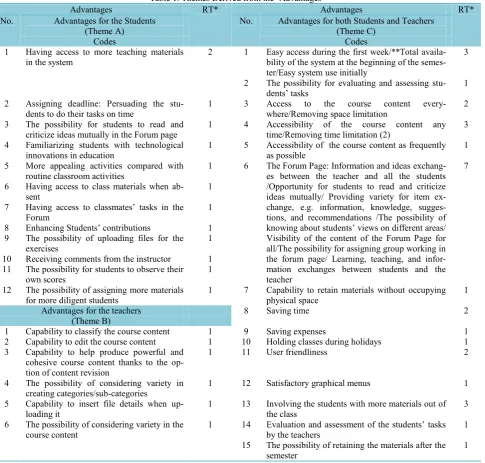
After becoming familiar with all the 55 codes related to the advantages, it was ob-served that the codes could meaningfully lend themselves to be divided into three types of themes (Table 1): Advantages for the students (A), advantages for the
teach-ers (B), and advantages for both students and teachers (C). Following more scrutiny, the data were recoded so that similar ideas were given the same code. For instance, all the ideas related to students’ appreciation of the Forum (seven students) was inserted in No. 24 (Table 1). Finally, as displayed in Table 1, a number of 12, 6, and 15 idea cat-egories (Codes) were found to be related to the three themes, A, B, C, respectively.
B. Themes Derived from the Drawbacks
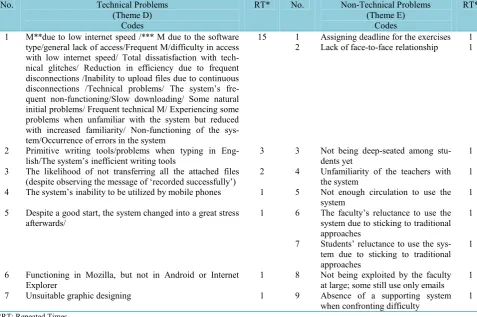
Ideas related to the drawbacks, which were manifested in the students’ perceptions were found to be divided into two more themes: Technical problems (Theme D), and non-technical problems (Theme E) (Table 2), with 7 and 9 codes, respectively. No. 35 (Table 2) shows that there were 15 ideas expressing malfunctions, either gen-eral or specific, in the system.
Table 2. Themes Derived from the ‘Drawbacks’ No. Technical Problems
(Theme D) Codes
RT* No. Non-Technical Problems (Theme E)
Codes
RT*
1 M**due to low internet speed /*** M due to the software type/general lack of access/Frequent M/difficulty in access with low internet speed/ Total dissatisfaction with tech-nical glitches/ Reduction in efficiency due to frequent disconnections /Inability to upload files due to continuous disconnections /Technical problems/ The system’s fre-quent non-functioning/Slow downloading/ Some natural initial problems/ Frequent technical M/ Experiencing some problems when unfamiliar with the system but reduced with increased familiarity/ Non-functioning of the sys-tem/Occurrence of errors in the system
15 1 Assigning deadline for the exercises 1 2 Lack of face-to-face relationship 1
2 Primitive writing tools/problems when typing in
Eng-lish/The system’s inefficient writing tools 3 3 Not being deep-seated among stu-dents yet 1 3 The likelihood of not transferring all the attached files
(despite observing the message of ‘recorded successfully’) 2 4 Unfamiliarity of the teachers withthe system 1 4 The system’s inability to be utilized by mobile phones 1 5 Not enough circulation to use the
system 1
5 Despite a good start, the system changed into a great stress
afterwards/ 1 6 The faculty’s reluctance to use thesystem due to sticking to traditional approaches
1
7 Students’ reluctance to use the sys-tem due to sticking to traditional approaches
1
6 Functioning in Mozilla, but not in Android or Internet
Explorer 1 8 Not being exploited by the facultyat large; some still use only emails 1 7 Unsuitable graphic designing 1 9 Absence of a supporting system
when confronting difficulty 1
*RT: Repeated Times **M: Malfunctions
***Slashes in the codes mean that the same idea has been mentioned, using different wordings by the students.
Discussion
In general, the analysis of the data re-vealed that the higher frequency of positive points, (33) compared with the negative ones (16), demonstrated the relative satis-faction of the users with the system. The two major debated points in the two tables included the students’ positive / apprecia-tion of the ‘Forum Secapprecia-tion’ and their disap-provals of the frequent technical glitches as well as some system failure such as the ed-iting tool. The technical problems have ac-tually hindered these students to take ade-quate advantage of the system.
Apart from the overall outcome explained above, some contradictory opinions emerged from the data. The first one can be seen in Table 1, Theme C, No. 1, where the three positive views on ‘Easy access during the first week’ are in contrast with the same theme being assumed as undesirable in Ta-ble 2, Theme D, No. 5; i.e., ‘Despite a good start, the system changed to a great stress afterwards.’ The second conflicting vision is related to ‘Assigning a deadline for the exercises being regarded as a shortcoming by one student in Table 2, Theme E, No. 1, whereas, simultaneously, it was held as a benefit by another one in Table 1, Theme A, No. 2. The contradictory views of the students can also be observed evidently in Appendix 1 where some students have pre-dominantly shown positive attitudes (e.g., B1, B3, L1), some mostly negative atti-tudes (B2, L8), and some expressing both attitudes with similar degrees (B5, B4, L4). An extreme example is that of L3 (Appen-dix 1) for whom ‘total dissatisfaction with technical glitches’ is the only opinion. These incompatible outlooks, which might be realized in any attitude-related type of study, stand for the variety of worldviews existing among people, which may perhaps be due to different experiences, different personality types, or at least based on tem-per ups and downs during different circum-stances.
There are some similarities and differ-ences between the findings in this study and those of the other studies. The positive
adjunctive informal function of Facebook in one study, which provided more flexibil-ity to help tolerate the controlled formal educational environment of the LMS (5), can be compared with the roles of the email messages, mobile-based SMSs, and social networking (Telegram) in this study. These out-of-the-system ways allowed stress-reducing interactions between the instructor and the representatives of the classes and among the students as well. These facilitat-ing electronic and/or social networkfacilitat-ing al-ternatives are possibly used in other e-learning environments, the value of which might not have been fully recognized by the users yet.
Although the instrument used in this study (elicitation of perceptions) and that employed in Liu’s study (4) (the UTAUT model) have been different, two of the posi-tive features attributed to the LMS in the former; namely, ‘providing more appealing activities and ‘providing more materials out of the class’ are in line with the outcomes appreciated in the latter including ‘giving them emotional motivation’ and ‘providing multiple learning resources’, respectively. On the other hand, some challenges were reported in Tanveer’s study; namely, ‘mar-ginally less technologically sophisticated faculty’, ‘unreliable technology’, ‘lack of confidence and experience of instructors and students with technology’ (12) are sim-ilar to the students’ views in this study, which can be seen in Table 2 in front of Theme E, No. 4; Theme D, No. 1; and Theme E, Nos. 7 and 8, respectively.
In one study, the shortcoming of ‘fre-quent malfunctions/disconnections’, high-lighted by the participants in the present study, has been considered a [normal] pain. The authors explain that factors that ac-company adoption of the system; namely, the discomfort of initial implementation, cannot normally be fully removed (13). On the contrary, another study argues that ‘it is imperative that an LMS be effective, relia-ble, operative, understandarelia-ble, functional, learnable, memorable, and efficient’ (3). The study reiterates that usability of an
LMS is a significant contributor to student satisfaction, as they need to focus on learn-ing the content rather than system naviga-tion (3). Although participants of this study seemed to be content with the user-friendliness of the system, the recurrent technical problems they encountered de-creased their positive attitudes toward the system to a great extent.
Limitations
As only the instructor of the two courses conducted the whole study, there were no relevant colleagues available to help con-duct an inter-rater reliability assessment during the coding process. However, when doubtful, some particular students’ ideas were discussed with some colleagues in the office, or with the students, themselves, as the owners of the reflections. Another limi-tation was that the findings of this AR study have been produced from the reflec-tions of 15 students of two master pro-grams. If it was possible to include more classes, there could be more dependable findings. However, the considerable num-ber of ideas elicited from the students might have partly compensated the short-age of the number of the students.
Conclusion
The findings ultimately revealed that am-ple amount of students’ reflections, while using the LMS, could provide adequate da-ta out of which the students’ collective per-ceptions were drawn. Categorization of the perceptions could offer outcomes which were successfully used to evaluate the func-tions of the LMS. One possible wide-ranging message obtained from the findings is the considerable amount of information collected from the main target users of the LMS in this study. This demonstrates that the type of perception-elicitation procedure performed in this study; (i.e., allowing the students to produce as many ideas as they wish while practicing the system), could effectively bring about the facts and reali-ties which might not have been achieved if only ‘a controlling on the spot technique’
(like a questionnaire) had been applied. This benefit was obtained thanks to the availability of manageable, natural, and un-restricted educational setting; i.e., the class-rooms. In this procedure, the instructor made almost no manipulation during the extraction of the students’ views. People naturally display diverse – and sometimes opposing – views if they are permitted to express themselves in different occasions. This is called ‘reality’, which we should seek in conducting any true research.
Another all-inclusive lesson is that in a tertiary context, for a face-to-face instruc-tor, an institutionally-sanctioned LMS should offer a convenient and relatively stable online platform to complement course activities (1). Thus, it is recom-mended that the authorities in charge of e-learning take serious and thoughtful measures to set up, first and foremost, the availability and accessibility of the system if they want to pay off all the resources spent on launching the LMS, whether in the form of the budgets allocated, the amount of time spent, or the human efforts used up.
References
1. Motteram G, editor. Innovations in learning technologies for English language teaching. Lon-don: British Council 2013:135.
2. Murray DE, Mcpherson P. Learning Manage-ment Systems. In: Using the web to support lan-guage learning. Sydney: published by NCELTR, Macquarie University 2004:65-67.
3. Green LS, Inan FA, Denton B. Examination of factors impacting student satisfaction with a new learning management system. Turkish Online Jour-nal of Distance Education 2012;13(3):189-197.
4. Liu J. E-learning in E-classroom: Investigating factors impacting on ESL college students’ ac-ceptance and use of the Modular Object-Oriented Dynamic Learning Environment (Moodle) 2013. Unpublished Thesis: Iowa State University, Gradu-ate College.
5. Dogoriti E, Pange J, Andersom GS. The use of networking and learning management systems in English language teaching in higher education. Campus-Wide Information Systems 2014;31(4): 254-263.
6. Alajab MA, Hussain AMA. The impact of a blended learning course on Khartoum University students’ achievement and motivation to learn
tific English. American International Journal of So-cial Science 2015;4(2):132-158.
7. Asgari Arani J. A blended learning setting in English for medical purposes course incorporating competencies. International Journal of Language and Linguistics 2014;1(2):31-36.
8. Zhang W, Han C. A case study of the applica-tion of a blended learning approach to web-based college English teaching platform in a medical uni-versity in Eastern China. Theory and Practice in Language Studies 2012;2(9):1961-1970.
9. Asgari Arani J. Teaching English medical writ-ing in a blended settwrit-ing. International Journal of Emerging Technologies in Learning 2012;7(4):34-37.
10. Lacey A, Laff D. Qualitative data analysis. The NIHR Research Design Service for Yurkshire and the Humber 2009:6-110.
11. Burns A. Doing action research in English language teaching: a guide for practitioners. New York: Routledge 2010:7-170.
12. Tanveer M. Integrating E-learning in class-room-based language teaching: perceptions, chal-lenges, and strategies. [Proceedings of] International Conference “ICT for Language Learning”, 4th
Edi-tion; Florence, Italy 2011 Oct:1-6.
13. Black EW, Beck D, Dawson K, Jinks S, Dipietro M. Considering implementation and use in the adoption of an LMS in online and blended learn-ing environment. Tech Trends 2007;51(2):35-53.
Appendix 1. Categories and Codes Resulting from the Students’ Reflections
Course Code Advantages (Theme) Drawbacks (Theme)
Bi
os
ta
tis
tic
s
B1 1. Involving the students with materials not to be dealt with in the class due to lack of time
2. The possibility of assigning more materials for more diligent students
3. The possibility of assigning group working in the Forum page
4. The possibility for students to read and criticize ideas mutually in the forum page
5. Evaluation and assessment of students’ tasks by the teachers
6. Accessibility of the course content everywhere 7. Accessibility of the course content any time
8. Accessibility of the course content as frequently as possi-ble
9. Information and ideas exchange in in the Forum Page 10. Capability to retain materials without occupying physi-cal space
11. Capability to classify the course content 12. Capability to edit the course content
13. Capability to help produce powerful and cohesive course content thank to the option of content revision
14. The possibility of recognizing students’ views on differ-ent areas
15. The possibility of considering variety in creating catego-ries/subcategories based on the faculty’s interests
16. The possibility of Retaining the materials after the se-mester
1. Lack of face to face relationship 2. Assigning deadline for the exercises
B2 17. information exchanges between students and the teacher 7. Removing time limitation
18. Inserting file details in accompany with uploading it 19. Visibility of the content of the Forum Page for all 20. Total availability of the system at the beginning of the semester
3. Not being deep seated among students
4. Not being exploited by the faculty at large; some still use only emails
5. Unfamiliarity of the teachers with the system 6. Not enough circulation to use the system
7. technical glitches and low speed (This may not be due to the web-site features, but because of the low speed of internet servers) 8. The problems of the system might be due to heavy software 9. Primitive writing tools of the system
7. The probability of not sending all the attached files
8. The probability of the file not being received by the teacher despite observing the pop-up ‘recorded successfully’!
9. Inability to upload files due to lack of access to the system 10. Problems in working with the system for those who prefer tradi-tional approaches to teaching/learning
10. Despite a good start, working with the system changed into a great stress afterwards.
B3 21. Advantage of assigning deadline: persuading the stu-dents to do their tasks on time
7. Removing time limitation 6. Removing space limitation
Easier contact between students and the teacher(Omitted) 22. Similar to 9. Forum page: Fruitful opportunities for providing educational environment
23. Time saving
24. Providing variety of exchange items: information, knowledge, suggestions, and recommendations [in the Fo-rum Page]
25. Familiarizing students with technological innovations in Education
26. Holding classes during holidays
27. Providing more encouragement for students thank to more appealing activities compared with routine classroom activities
7. Frequent technical malfunctions
B4 28. Finding access to class materials when absent 29. User friendliness
30. satisfactory graphical menus
19. Having access to the classmates’ tasks [in the Forum Page]
8. Difficulty in access with low internet speed
9. Functioning in Mozilla, but not in Android or Internet Explorer 10. Problems when typing in English
11. Absence of a supporting system when confronting difficulty
B5 Useful and applicable (Omitted) Suitable way of communication (Omitted) 23. Saving time
31. Saving expenses
32. Enhancing Students’ contributions 7. Removing time limitation
12. unsuitable graphic designing
13. Uselessness of the calendar and the courses’ tables 14.The system’s lack of strength (Omitted)
15. The system’s inability to be utilized by mobile phones 10. The system’s primitive writing tools
L1 33 The feature of a separate page for every course 9. The possibility of discussion in the forum page 34. The possibility of uploading files for the exercises 35. the possibility receiving comments from the instructor An easier way of communication between the student and the in-structor(Omitted)
36. Assigning deadline for the exercises = providing obligation for the student to do the task on time
7. Technical problems
L2 29. User friendliness 37. Variety of options 29. Easy uploading 38. Observing the scores
7. The system’s frequent non-functioning 8. Slow downloading
L3 7. Total dissatisfaction with technical glitches
L4 Efficiency of the system(Omitted)
39. A potential efficient way to enhance the quality of education 7. Some natural initial technical problems7. Occasional disconnection in the system
L5 8. Experiencing some problems when unfamiliar with the system but re-duced with increased familiarity
9. Reduction in efficiency due to frequent disconnections L6 No reflections
L7 1. Working on the materials not being dealt with in the class due to
lack of time 7. Natural initial problems
L8 40. No difficulty in working with the System during the first
ses-sion 7. Difficulties in the system which need to be removed due to the efficientrole of the system 7. Inability to use the system during the second and third sessions, resulting in using the teacher’s email address to send the tasks
10. Limitation: The time schedule is controlled only by the teacher; out of the control of the students
L9 40. Easy System use during the first session 7. The second session: non-functioning of the system for one week L10 40. Easy system use initially 7. Non-functioning of the system
7.Occurrence of errors in the system