VOLUME NO.3(2013),ISSUE NO.03(MARCH) ISSN 2231-5756
A Monthly Double-Blind Peer Reviewed (Refereed/Juried) Open Access International e-Journal - Included in the International Serial Directories
Indexed & Listed at:
VOLUME NO.3(2013),ISSUE NO.03(MARCH) ISSN 2231-5756
INTERNATIONAL JOURNAL OF RESEARCH IN COMMERCE, IT & MANAGEMENT
CONTENTS
CONTENTS
CONTENTS
CONTENTS
Sr.No.
TITLE & NAME OF THE AUTHOR (S)
Page No. 1. EXTENT OF ABSOLUTE POVERTY IN RURAL SECTOR OF HIMACHAL PRADESH: A MEASURE OF UNEMPLOYMENT
RAMNA
1
2. THE ENTREPRENEURSHIP CORE COMPETENCES FOR DISTRIBUTION SERVICE INDUSTRY
SU-CHANG CHEN, HSI-CHI HSIAO, JEN-CHIA CHANG, CHUN-MEI CHOU, CHIN-PIN CHEN & CHIEN-HUA SHEN
5
3. THE RELATIONSHIP BETWEEN MACROECONOMIC VARIABLES AND CEMENT INDUSTRY RETURNS: EMPIRICAL EVIDENCE FROM PAKISTANI CEMENT INDUSTRY
MUHAMMAD IMRAN & QAISAR ABBAS
10
4. OUTLOOK OF MANAGEMENT STUDENTS TOWARDS EFFICIENCY OF ONLINE LEARNING-A CASE STUDY OF SHIVAMOGGA CITY, KARNATAKA STATE SANDHYA.C, R. HIREMANI NAIK & ANURADHA.T.S
17
5. TRAFFIC RELATED MORTALITY AND ECONOMIC DEVELOPMENT MURAT DARÇIN
21
6. SUBSCRIBER’S PERCEPTION TOWARDS CUSTOMER CARE SERVICE IN MOBILE TELECOMMUNICATION WITH SPECIAL REFERENCE TO TUTICORIN CITY
S. ANTHONY RAHUL GOLDEN. & DR. V. GOPALAKRISHNAN
27
7. A STUDY OF WAVELET BASED IMAGE COMPRESSION ALGORITHMS CHETAN DUDHAGARA & DR. KISHOR ATKOTIYA
31
8. A STUDY OF CONSUMER’S IMPULSE BUYING BEHAVIOUR WITH REFERENCE TO EFFECT OF PROMOTIONAL TOOL IN THE OUTLETS OF CHHATTISGARH
DR. MANOJ VERGHESE & POOJA G. LUNIYA
37
9. STUDY OF CONSUMER BEHAVIOR IN CELL PHONE INDUSTRY DR. ARUNA DEOSKAR
41
10. ANOTHER APPROACH OF SOLVING UNBALANCED TRANSPORTATION PROBLEM USING VOGEL’S APPROXIMATION METHOD DILIP KUMAR GHOSH & YASHESH ZAVERI
45
11. PROBLEM OF NON-PERFORMING ASSETS OF STATE BANK OF INDIA: A CASE STUDY OF NAGPUR DISTRICT DR. N. K. SHUKLA & M. MYTRAYE
49
12. INVESTMENT STRATEGY OF LIC OF INDIA AND ITS IMPACT ON PROFITABILITY T. NARAYANA GOWD, DR. C. BHANU KIRAN & DR. CH. RAMAPRASADA RAO
59
13. PREDICTION OF DHAKA TEMPERATURE BASED ON SOFT COMPUTING APPROACHES SHIPRA BANIK, MOHAMMAD ANWER & A.F.M. KHODADAD KHAN
65
14. SET THEORETIC APPROACH TO FUNDS FLOW STATEMENTS – A STUDY WITH REFERENCE TO STATE BANK OF INDIA DR. PRANAM DHAR
71
15. STRATEGIES FOR THE SUCCESS OF BRAND EXTENDED PRODUCT : AN ANALYTICAL STUDY OF DEHRADUN DISTRICT WITH SPECIAL REFERENCE TO FMCG
DR. AMIT JOSHI, DR.SAURABH JOSHI, DR. PRIYA GROVER & PARVIN JADHAV
80
16. VALUE ADDED TAX AND ECONOMIC GROWTH: THE NIGERIA EXPERIENCE (1994 -2010) DR. OWOLABI A. USMAN & ADEGBITE TAJUDEEN ADEJARE
85
17. CORPORATE SOCIAL RESPONSIBILITY INITIATIVES BY POWER GRID CORPORATION OF INDIA LIMITED: A STUDY DR. S. RAGHUNATHA REDDY & MM SURAJ UD DOWLA
90
18. METADATA MANAGEMENT IN DATA WAREHOUSING AND BUSINESS INTELLIGENCE VIJAY GUPTA & DR. JAYANT SINGH
93
19. QUALITY OF WORK LIFE - A CRITICAL STUDY ON INDIAN HOSPITALS B.UMA RANI & M. SARALA
97
20. BUSINESS ETHICS: WAY FOR SUSTAINABLE DEVELOPMENT OF ORGANISATION DR. SATYAM PINCHA & AVINASH PAREEK
105
21. USE OF ICT TOOLS IN HIGHER EDUCATION SANDEEP YADAV & KIRAN YADAV
108
22. CONSTRUCTING CONFIDENCE INTERVALS FOR DIFFERENT TEST PROCEDURES FROM RIGHT FAILURE CENSORED NORMAL DATA V. SRINIVAS
111
23. RECOGNISING CUSTOMER COMPLAINT BEHAVIOUR IN RESTAURANT
MUHAMMAD RIZWAN, MUHAMMAD AHMAD ATHAR, MUBASHRA WAHEED, ZAINAB WAHEED, RAIMA IMTIAZ & AYESHA MUNIR
116
24. SOCIO-CULTURAL EFFECTS OF ALCOHOL CONSUMPTION BEHAVIOUR OF YOUNG COMMERCIAL DRIVERS IN SOUTH WEST NIGERIA DR. ADEJUMO, GBADEBO OLUBUNMI
123
25. MEAN-SHIFT FILTERING AND SEGMENTATION IN ULTRA SOUND THYROID IMAGES S. BINNY
126
26. E-TAILING, ONLINE RETAILING ITS FACTORS AND RELATIONS WITH CUSTOMER PERSPECTIVE WASIMAKRAM BINNAL
131
27. THE KNOWLEDGE MANAGEMENT AND THE PARAMETERS OF THE TECHNOLOGICAL INNOVATION PROCESS: APPLICATION IN THE TUNISIAN CASE MLLE MAALEJ RIM & HABIB AFFES
134
28. THE RELATIONSHIP BETWEEN CORPORATE SOCIAL RESPONSIBILITY AND CORPORATE FINANCIAL PERFORMANCE: META-ANALYSIS ASMA RAFIQUE CHUGHTAI & AAMIR AZEEM
139
29. AN EMPIRICAL STUDY ON STRESS SYMPTOMS OF ARTS, ENGINEERING AND MANAGEMENT STUDENTS IN TIRUCHIRAPALLI DISTRICT, TAMIL NADU S. NAGARANI
144
30. PURCHASE INTENTION TOWARDS COUNTERFEIT PRODUCT
MUHAMMAD RIZWAN, SYEDA RABIA BUKHARI, TEHREEM ILYAS, HAFIZA QURAT UL AIN & HINA GULZAR
152
VOLUME NO.3(2013),ISSUE NO.03(MARCH) ISSN 2231-5756
CHIEF PATRON
CHIEF PATRON
CHIEF PATRON
CHIEF PATRON
PROF. K. K. AGGARWAL
Chancellor, Lingaya’s University, Delhi
Founder Vice-Chancellor, Guru Gobind Singh Indraprastha University, Delhi
Ex. Pro Vice-Chancellor, Guru Jambheshwar University, Hisar
FOUNDER
FOUNDER
FOUNDER
FOUNDER PATRON
PATRON
PATRON
PATRON
LATE SH. RAM BHAJAN AGGARWAL
Former State Minister for Home & Tourism, Government of Haryana
Former Vice-President, Dadri Education Society, Charkhi Dadri
Former President, Chinar Syntex Ltd. (Textile Mills), Bhiwani
CO
CO
CO
CO----ORDINATOR
ORDINATOR
ORDINATOR
ORDINATOR
AMITA
Faculty, Government M. S., Mohali
ADVISORS
ADVISORS
ADVISORS
ADVISORS
DR. PRIYA RANJAN TRIVEDI
Chancellor, The Global Open University, Nagaland
PROF. M. S. SENAM RAJU
Director A. C. D., School of Management Studies, I.G.N.O.U., New Delhi
PROF. M. N. SHARMA
Chairman, M.B.A., Haryana College of Technology & Management, Kaithal
PROF. S. L. MAHANDRU
Principal (Retd.), Maharaja Agrasen College, Jagadhri
EDITOR
EDITOR
EDITOR
EDITOR
PROF. R. K. SHARMA
Professor, Bharti Vidyapeeth University Institute of Management & Research, New Delhi
CO
CO
CO
CO----EDITOR
EDITOR
EDITOR
EDITOR
DR. BHAVET
Faculty, Shree Ram Institute of Business & Management, Urjani
EDITORIAL ADVISORY BOARD
EDITORIAL ADVISORY BOARD
EDITORIAL ADVISORY BOARD
EDITORIAL ADVISORY BOARD
DR. RAJESH MODI
Faculty, Yanbu Industrial College, Kingdom of Saudi Arabia
PROF. SANJIV MITTAL
University School of Management Studies, Guru Gobind Singh I. P. University, Delhi
PROF. ANIL K. SAINI
Chairperson (CRC), Guru Gobind Singh I. P. University, Delhi
DR. SAMBHAVNA
VOLUME NO.3(2013),ISSUE NO.03(MARCH) ISSN 2231-5756
INTERNATIONAL JOURNAL OF RESEARCH IN COMMERCE, IT & MANAGEMENT
DR. MOHENDER KUMAR GUPTA
Associate Professor, P. J. L. N. Government College, Faridabad
DR. SHIVAKUMAR DEENE
Asst. Professor, Dept. of Commerce, School of Business Studies, Central University of Karnataka, Gulbarga
ASSOCIATE EDITORS
ASSOCIATE EDITORS
ASSOCIATE EDITORS
ASSOCIATE EDITORS
PROF. NAWAB ALI KHAN
Department of Commerce, Aligarh Muslim University, Aligarh, U.P.
PROF. ABHAY BANSAL
Head, Department of Information Technology, Amity School of Engineering & Technology, Amity
University, Noida
PROF. A. SURYANARAYANA
Department of Business Management, Osmania University, Hyderabad
DR. SAMBHAV GARG
Faculty, Shree Ram Institute of Business & Management, Urjani
PROF. V. SELVAM
SSL, VIT University, Vellore
DR. PARDEEP AHLAWAT
Associate Professor, Institute of Management Studies & Research, Maharshi Dayanand University, Rohtak
DR. S. TABASSUM SULTANA
Associate Professor, Department of Business Management, Matrusri Institute of P.G. Studies, Hyderabad
SURJEET SINGH
Asst. Professor, Department of Computer Science, G. M. N. (P.G.) College, Ambala Cantt.
TECHNICAL ADVISOR
TECHNICAL ADVISOR
TECHNICAL ADVISOR
TECHNICAL ADVISOR
AMITA
Faculty, Government M. S., Mohali
FINANCIAL ADVISORS
FINANCIAL ADVISORS
FINANCIAL ADVISORS
FINANCIAL ADVISORS
DICKIN GOYAL
Advocate & Tax Adviser, Panchkula
NEENA
Investment Consultant, Chambaghat, Solan, Himachal Pradesh
LEGAL ADVISORS
LEGAL ADVISORS
LEGAL ADVISORS
LEGAL ADVISORS
JITENDER S. CHAHAL
Advocate, Punjab & Haryana High Court, Chandigarh U.T.
CHANDER BHUSHAN SHARMA
Advocate & Consultant, District Courts, Yamunanagar at Jagadhri
SUPERINTENDENT
SUPERINTENDENT
SUPERINTENDENT
SUPERINTENDENT
SURENDER KUMAR POONIA
VOLUME NO.3(2013),ISSUE NO.03(MARCH) ISSN 2231-5756
CALL FOR MANUSCRIPTS
CALL FOR MANUSCRIPTS
CALL FOR MANUSCRIPTS
CALL FOR MANUSCRIPTS
Weinvite unpublished novel, original, empirical and high quality research work pertaining to recent developments & practices in the area of Computer, Business, Finance, Marketing, Human Resource Management, General Management, Banking, Insurance, Corporate Governance and emerging paradigms in allied subjects like Accounting Education; Accounting Information Systems; Accounting Theory & Practice; Auditing; Behavioral Accounting; Behavioral Economics; Corporate Finance; Cost Accounting; Econometrics; Economic Development; Economic History; Financial Institutions & Markets; Financial Services; Fiscal Policy; Government & Non Profit Accounting; Industrial Organization; International Economics & Trade; International Finance; Macro Economics; Micro Economics; Monetary Policy; Portfolio & Security Analysis; Public Policy Economics; Real Estate; Regional Economics; Tax Accounting; Advertising & Promotion Management; Business Education; Management Information Systems (MIS); Business Law, Public Responsibility & Ethics; Communication; Direct Marketing; E-Commerce; Global Business; Health Care Administration; Labor Relations & Human Resource Management; Marketing Research; Marketing Theory & Applications; Non-Profit Organizations; Office Administration/Management; Operations Research/Statistics; Organizational Behavior & Theory; Organizational Development; Production/Operations; Public Administration; Purchasing/Materials Management; Retailing; Sales/Selling; Services; Small Business Entrepreneurship; Strategic Management Policy; Technology/Innovation; Tourism, Hospitality & Leisure; Transportation/Physical Distribution; Algorithms; Artificial Intelligence; Compilers & Translation; Computer Aided Design (CAD); Computer Aided Manufacturing; Computer Graphics; Computer Organization & Architecture; Database Structures & Systems; Digital Logic; Discrete Structures; Internet; Management Information Systems; Modeling & Simulation; Multimedia; Neural Systems/Neural Networks; Numerical Analysis/Scientific Computing; Object Oriented Programming; Operating Systems; Programming Languages; Robotics; Symbolic & Formal Logic and Web Design. The above mentioned tracks are only indicative, and not exhaustive.
Anybody can submit the soft copy of his/her manuscript anytime in M.S. Word format after preparing the same as per our submission guidelines duly available on our website under the heading guidelines for submission, at the email address: [email protected].
GUIDELINES FOR SUBM
GUIDELINES FOR SUBM
GUIDELINES FOR SUBM
GUIDELINES FOR SUBMISSION OF MANUSCRIPT
ISSION OF MANUSCRIPT
ISSION OF MANUSCRIPT
ISSION OF MANUSCRIPT
1. COVERING LETTER FOR SUBMISSION:
DATED: _____________
THE EDITOR
IJRCM
Subject: SUBMISSION OF MANUSCRIPT IN THE AREA OF .
(e.g. Finance/Marketing/HRM/General Management/Economics/Psychology/Law/Computer/IT/Engineering/Mathematics/other, please specify)
DEAR SIR/MADAM
Please find my submission of manuscript entitled ‘___________________________________________’ for possible publication in your journals.
I hereby affirm that the contents of this manuscript are original. Furthermore, it has neither been published elsewhere in any language fully or partly, nor is it under review for publication elsewhere.
I affirm that all the author (s) have seen and agreed to the submitted version of the manuscript and their inclusion of name (s) as co-author (s).
Also, if my/our manuscript is accepted, I/We agree to comply with the formalities as given on the website of the journal & you are free to publish our contribution in any of your journals.
NAME OF CORRESPONDING AUTHOR: Designation:
Affiliation with full address, contact numbers & Pin Code: Residential address with Pin Code:
Mobile Number (s): Landline Number (s): E-mail Address: Alternate E-mail Address:
NOTES:
a) The whole manuscript is required to be in ONE MS WORD FILE only (pdf. version is liable to be rejected without any consideration), which will start from the covering letter, inside the manuscript.
b) The sender is required to mention the following in the SUBJECT COLUMN of the mail:
New Manuscript for Review in the area of (Finance/Marketing/HRM/General Management/Economics/Psychology/Law/Computer/IT/ Engineering/Mathematics/other, please specify)
c) There is no need to give any text in the body of mail, except the cases where the author wishes to give any specific message w.r.t. to the manuscript. d) The total size of the file containing the manuscript is required to be below 500 KB.
e) Abstract alone will not be considered for review, and the author is required to submit the complete manuscript in the first instance.
f) The journal gives acknowledgement w.r.t. the receipt of every email and in case of non-receipt of acknowledgment from the journal, w.r.t. the submission of manuscript, within two days of submission, the corresponding author is required to demand for the same by sending separate mail to the journal. 2. MANUSCRIPT TITLE: The title of the paper should be in a 12 point Calibri Font. It should be bold typed, centered and fully capitalised.
3. AUTHOR NAME (S) & AFFILIATIONS: The author (s) full name, designation, affiliation (s), address, mobile/landline numbers, and email/alternate email address should be in italic & 11-point Calibri Font. It must be centered underneath the title.
VOLUME NO.3(2013),ISSUE NO.03(MARCH) ISSN 2231-5756
INTERNATIONAL JOURNAL OF RESEARCH IN COMMERCE, IT & MANAGEMENT
5. KEYWORDS: Abstract must be followed by a list of keywords, subject to the maximum of five. These should be arranged in alphabetic order separated by commas and full stops at the end.
6. MANUSCRIPT: Manuscript must be in BRITISH ENGLISH prepared on a standard A4 size PORTRAIT SETTING PAPER. It must be prepared on a single space and single column with 1” margin set for top, bottom, left and right. It should be typed in 8 point Calibri Font with page numbers at the bottom and centre of every page. It should be free from grammatical, spelling and punctuation errors and must be thoroughly edited.
7. HEADINGS: All the headings should be in a 10 point Calibri Font. These must be bold-faced, aligned left and fully capitalised. Leave a blank line before each heading.
8. SUB-HEADINGS: All the sub-headings should be in a 8 point Calibri Font. These must be bold-faced, aligned left and fully capitalised. 9. MAIN TEXT: The main text should follow the following sequence:
INTRODUCTION
REVIEW OF LITERATURE
NEED/IMPORTANCE OF THE STUDY
STATEMENT OF THE PROBLEM
OBJECTIVES
HYPOTHESES
RESEARCH METHODOLOGY
RESULTS & DISCUSSION
FINDINGS
RECOMMENDATIONS/SUGGESTIONS
CONCLUSIONS
SCOPE FOR FURTHER RESEARCH
ACKNOWLEDGMENTS
REFERENCES
APPENDIX/ANNEXURE
It should be in a 8 point Calibri Font, single spaced and justified. The manuscript should preferably not exceed 5000 WORDS.
10. FIGURES & TABLES: These should be simple, crystal clear, centered, separately numbered & self explained, and titles must be above the table/figure. Sources of data should be mentioned below the table/figure. It should be ensured that the tables/figures are referred to from the main text.
11. EQUATIONS: These should be consecutively numbered in parentheses, horizontally centered with equation number placed at the right.
12. REFERENCES: The list of all references should be alphabetically arranged. The author (s) should mention only the actually utilised references in the preparation of manuscript and they are supposed to follow Harvard Style of Referencing. The author (s) are supposed to follow the references as per the following:
•
All works cited in the text (including sources for tables and figures) should be listed alphabetically.•
Use (ed.) for one editor, and (ed.s) for multiple editors.•
When listing two or more works by one author, use --- (20xx), such as after Kohl (1997), use --- (2001), etc, in chronologically ascending order.•
Indicate (opening and closing) page numbers for articles in journals and for chapters in books.•
The title of books and journals should be in italics. Double quotation marks are used for titles of journal articles, book chapters, dissertations, reports, working papers, unpublished material, etc.•
For titles in a language other than English, provide an English translation in parentheses.•
The location of endnotes within the text should be indicated by superscript numbers.PLEASE USE THE FOLLOWING FOR STYLE AND PUNCTUATION IN REFERENCES: BOOKS
•
Bowersox, Donald J., Closs, David J., (1996), "Logistical Management." Tata McGraw, Hill, New Delhi.•
Hunker, H.L. and A.J. Wright (1963), "Factors of Industrial Location in Ohio" Ohio State University, Nigeria.CONTRIBUTIONS TO BOOKS
•
Sharma T., Kwatra, G. (2008) Effectiveness of Social Advertising: A Study of Selected Campaigns, Corporate Social Responsibility, Edited by David Crowther & Nicholas Capaldi, Ashgate Research Companion to Corporate Social Responsibility, Chapter 15, pp 287-303.JOURNAL AND OTHER ARTICLES
•
Schemenner, R.W., Huber, J.C. and Cook, R.L. (1987), "Geographic Differences and the Location of New Manufacturing Facilities," Journal of Urban Economics, Vol. 21, No. 1, pp. 83-104.CONFERENCE PAPERS
•
Garg, Sambhav (2011): "Business Ethics" Paper presented at the Annual International Conference for the All India Management Association, New Delhi, India, 19–22 June.UNPUBLISHED DISSERTATIONS AND THESES
•
Kumar S. (2011): "Customer Value: A Comparative Study of Rural and Urban Customers," Thesis, Kurukshetra University, Kurukshetra.ONLINE RESOURCES
•
Always indicate the date that the source was accessed, as online resources are frequently updated or removed.WEBSITES
VOLUME NO.3(2013),ISSUE NO.03(MARCH) ISSN 2231-5756
SET THEORETIC APPROACH TO FUNDS FLOW STATEMENTS – A STUDY WITH REFERENCE TO STATE BANK
OF INDIA
DR. PRANAM DHAR
ASSOCIATE PROFESSOR
DEPARTMENT OF COMMERCE & MANAGEMENT
WEST BENGAL STATE UNIVERSITY
BERUNANPUKURIA
ABSTRACT
Two most popular as well as basic financial statements are INCOME STATEMENTS and BALANCE SHEET. These two statements serve a very important purpose. They enlighten us about the economic goals of a business entity through the figure of net income and the presentation of the financial position of the enterprise as represented by its assets and liabilities. Nevertheless, these two statements fail to enlighten us about the other important financial aspects of a business entity. They do not give us any information regarding the financing of business operations. i.e. the manner in which the funds have been generated by the enterprise and the pattern of their utilization in such operations. This missing link in these financial statements is provided by the preparation of a additional statement called ‘Statement Of Changes In Financial Position’. The statement is also known as ‘Fund Flow Statement’ or ‘Statement of Sources and Applications of Fund’. A statement of sources and application of funds, is a technical advice designed to highlight the changes in financial position of business enterprise between two dates. It is a statement showing flow or movement of funds during a given accounting period. It is basically an inflow-outflow of funds statement. This statement has two parts : resources provided(sources of funds) and resources applied (uses of funds). The difference between the totals of the two sections indicates the net change in funds during the period. Under the above backdrop, let me present before you an interesting discourse for your cerebral exercise. It will spot on some key-issues on how funds-fiow analysis can be formulated in terms of set theory. The approach presented here provides an introduction to some basic set-theory concepts in the context of a familiar accounting problem; accordingly, definitions and explanations of these concepts are included.
KEYWORDS
Fund Flow Statement, Financial Position, Set Theory, Analysis.
1.0. BACKDROP
wo most popular as well as basic financial statements are INCOME STATEMENTS and BALANCE SHEET. These two statements serve a very important purpose. They enlighten us about the economic goals of a business entity through the figure of net income and the presentation of the financial position of the enterprise as represented by its assets and liabilities. Nevertheless, these two statements fail to enlighten us about the other important financial aspects of a business entity. They do not give us any information regarding the financing of business operations. i.e. the manner in which the funds have been generated by the enterprise and the pattern of their utilization in such operations. This missing link in these financial statements is provided by the preparation of a additional statement called ‘Statement Of Changes In Financial Position’. The statement is also known as ‘Fund Flow Statement’ or ‘Statement of Sources and Applications of Fund’. A statement of sources and application of funds, is a technical advice designed to highlight the changes in financial position of business enterprise between two dates.
Funds Flow Statement is a statement showing flow or movement of funds during a given accounting period. It is basically an inflow-outflow of funds statement. This statement has two parts :
1. Resources provided(sources of funds) and 2. Resources applied (uses of funds).
The difference between the totals of the two sections indicates the net change in funds during the period.
The present study demonstrates how funds-flow analysis can be formulated in terms of set theory. The approach presented here provides an introductionto some basic set-theory concepts in the context of a familiar accountingproblem; accordingly, definitions and explanations of these concepts areincluded. The Statement of Sources and Uses of Working Capital Regardless of the definition of "funds" adopted, the usual first step inpreparing a funds statement is the computation of the net change in funds.
This requires a separation of balance sheet accounts into fund (which enter directly into the computation of funds) and non-fund accounts (which do not). For convenience, "funds" are defined as "working capital" unless otherwise stated. Thus, current assets and current liabilities are the fund accounts and all other non-current accounts are the non-fund accounts which we refer to as non-current.
We cover but a few of the basic concepts because of space limitations. No use, for instance, is made of the set ordering brackets in this article. But were it necessary to refer to a set of current assets and were it desired to list accounts in the order of liquidity, we could stipulate this by introducing angular brackets: Current assets = (Cash, Marketable Securities, Accounts Receivable, . . . , Prepaid Expenses).
2.0. BRIEF REVIEW OF THE AVAILABLE LITERATURE
While finding the pin-pointed research gap and appropriate research questions on the aforesaid topic, we had to jump into a glimpse of available literature, presented underneath :
Most introductory textbooks on mathematics now include a discussion of set theory concepts. For the interested reader, the following introductory material is noted:
Samuel Goldberg, Probability: An Introduction (Englewood Cliffs: Prentice-Hall, 1960), Chap. 1, pp. 1-44;
W. Allen Spivey, "Basic Mathematical Concepts," in Linear Programming and the Theory of the Firm, K. E. Boulding and W. A. Spivey, eds. (New York: Macmillan, 1960), pp. lS-24; F. Mosteller.
R. E. K. Rourke, and G. B. Thomas, Probability with Statistical Applications (Reading, Mass.: .A.ddison-Wesley, 1961). pp. 403-16. More advanced treatment may be found in Mathematical Association of America, Committee on the Undergraduate Program,
Elementary Mathematics of Sets with Applications fNew Orleans: Tulane University, 1958); Patrick Suppes, Axiomatic Set Theory (Princeton, N. J.: Van Nostrand, 1960).
For a discussion of the mathematical logic underlying funds-flow analyses without the use of set theory concepts, see Ching-wen Kwang and Albert Slavin, "The Mathematical Unity of Funds-Flow Analyses," NAA Bulletin, Jan. 1965, pp. 49-56.
3.0. FINDING THE ULTIMATE RESEARCH VACUUM
After a minute study of the above available literatures, we found that no such study has yet been made in the analysis of financial statements of the corporates, especially, belonging to those in the Banking Sector.
VOLUME NO.3(2013),ISSUE NO.03(MARCH) ISSN 2231-5756
INTERNATIONAL JOURNAL OF RESEARCH IN COMMERCE, IT & MANAGEMENT
4.0. OBJECTIVES OF THE PRESENT STUDY
In view of the above available literatures, we find the following objectives pertinent to our study : 1. To Analyse the Funds Flow Statements in a new approach
2. To make the analysis and interpretation of the Funds Flow and Cash Flow Statements more interesting and attractive to the non-commerce background people.
3. To use more mathematics for managerial decision making, depending on the financial statements. 4. To throw some light on the new approaches used by financial analysts.
5.0. INTRODUCTION TO SET THEORY
A set is a well defined collection of distinct objects. Since accounts are defined in accounting, and since each is distinct from the others, the totality of all balance sheet accounts constitutes a set. When a set consists of all objects under discussion in a given context it is called the universe of discourse or the universal set, which we denote by the symbol U. The set of balance sheet accounts is one such universal set. The individual objects which collectively comprise a given set are called its members or elements. The membership relation is denoted by the inclusion symbol €. For example, the cash account Ls an element of U, and we write "cash account € U." An exclusion symbol €is used to indicate that an object does not belong to a given set. In general, capital letters are used to designate sets while lower case letters are used to indicate elements of sets. A set can be specified by listing its members.
5.1. SET INCLUSION – CONCEPTUAL ASPECTS
Set inclusion refers to the relationship that one set is a subset o." another set.
Suppose A ⊆B and B⊆C, then it follows that A⊆C. We say tiiat set inclusion ia a transitive relation. In set notation the transitivity relation may be wT-itten; {R, B} ⊆ RE & RE ⊆NC {R, E] ⊆NC.
The set of the sets of revenues iind expenses being a subset of retained earnings and retained earnings being a subset of the non-current set implies that the set of the sets of revenues and expenses is a subset of the non-current set. Henceforth, to avoid the cumbersome statement, "is a subset of the non-current set," the more compact expression, “non-current subset,'' or simply a non-current set, will be used.
5.2. APPLICATION OF SET THEORY IN FINANCIAL STATEMENT ANALYSIS For our present work, in universal set U, we write
U = {Cash. Accounts Receivable, . . . , Plant and Equipment, . . . , Bonds Payable, . . . , Capital Stock, Retained Earnings}.
This notation is read "the set U is the set whose members are the accounts Cash, . . . , Capital Stock, Retained Earnings." Alternately, a set may be defined by specifying some property (or properties) that tells us which things are members and which are not. "The universal set" can be shown (by introduction of a paradox attributed to Bertrand Russell) to be non-existent. The correct expression would be "universe of discourse"; however, "universal set" is a more compact term and will be used in this paper as a synonym for "universe of discourse.''
For logical reasons, the universal set U is a subset of itself; the empty set Ø which contains no elements is considered a subset of every set.
Thus we might wish to describe an asset as follows:
X € A p, f{x).
Something, X, is an asset (strictly translated—is a member of the set of assets. A) if and only if it is possessed, p, by a business and is expected to yield beneficial services in the future, f.
From the elements of the universal set ‘U’, we can form new sets which are called subsets of ‘U’. For any two sets A and B, the set A is said to be a subset of B if, and only if, every element of A is also an element of B. This is indicated by A⊆B. The three major categories of balance sheet accounts, assets, liabilities, and owners' equity are subsets of the set of all balance sheet accounts. This relationship is shown (by means of a Venn diagram) in Figure 1 and 2 as above. The large rectangle represents U; the areas labeled A, L, and OE represent the three major classifications. For purposes of analyzing changes in working capital, the balance sheet accounts must be further subdivided. Figure 2 shows these relationships in terms of the subsets pertinent to the preparation of the statement oi' sources and uses of working capital, where –
A = assets;
CA = current assets;
A — CA == A = non-current assets;
L = liabilities;
CL = current liabilities;
L — CL = L = non-current liabilities;
OE = owners' equity.
This graphical method of representing sets is named after the English logician John Venn and hence called Venn diagrams. The type we used here is a special kind attributed to Lewis Carroll (Charles Dodgson). For further discussions, see Kenneth O. May, Elements of Modern Mathematics (Reading, Mass.: Addison-Wesley, 1959), pp. 152-156.
More technically, a partition of a set S is a set of subsets of S which are (1) disjoint, i.e., no two subsets have any elements in common; and (2) exhaustive, i.e., the elements in all the subsets taken together constitute the original set S.
5.3. SET THEORETICAL DEFINITIONS OF CURRENT ACCOUNTS AND NON-CURRENT ACCOUNTS
We refer to the current accounts as the current set and the non-current accounts as the non-current set. The subdivision of a set into subsets in such a way that every element belongs to one, and only one, of the subsets is called a partition of the set. In other words, every member of the original set must be contained in one of the subsets and no member must belong to more than one subset. It is sometimes convenient to be able to refer to a single account as "a current set" instead of "a member of the current set" or ''a subset of the current set.'" To insure against ambiguity in these terms, we designate the universal set as : Current Set
U = {Cash, Accounts Receivable, ……, Prepaid Expenses, Accounts Payable, ….., Current Maturities of Long Term Debt} Non-Current Set
U = {Property, Plant & Equipment (net), ….., Cash Surrender Value of Life Insrance, Bonds Payable, ….., Retained Earnings}
L
A
CL
CA
VOLUME NO.3(2013),ISSUE NO.03(MARCH) ISSN 2231-5756 Each element (e.g.. Cash) of a subset (e.g.. Current Set) of the universal set can be viewed as a set in itself. When thus conceived, each, account is a set and has its own elements, we may use the expression "cash is a current set" as well as "cash is a subset of the current set" because:
1. The former expression is less cumbersome, as well as less precise.
2. The characteristic which determines membership in the current set is the condition of being considered current; therefore, it is perfectly proper to refer to a set by mentioning its identifying characteristic - in this instance, the adjective "current."
Before proceeding further, we define additional symbols as follows;
CC
= contributed capital;
DIV
= dividends paid;
R
= revenues;
E
= expenses;
∆
=
the set of changes in account balances between the two balance sheet dates obtained by
subtracting the beginning account balances from the ending balances. Where the distinction between a
debit change and a credit change is to be made, the notation
∆
d(debit change) and
∆
c(credit change)
will be used;
NC =
the set of non current accounts;
S = the set of sources of funds;
U
=
the set of uses of funds;
T
=
the set containing transfers between non-current accounts, defined as transactions involving
reciprocal changes in non-current accounts only. Such a transaction has no effect on funds.
I = increase in an account balance;
= decrease in an account balance;
=
if and only if;
=
implies,
Debit change or credit change in an account balance is used here as defined in standard accounting terminology. For a single transaction, Δd will be used to
indicate debit parts of the transaction and Δc will be used to indicate credit parts.
5.4. SET THEORETICAL EXPLANATION TO FUNDS FLOW STATEMENTS
The net change in working capital for a given accounting period may be calculated as follows: ΔCA - ΔCL - ΔL + ΔOE – ΔA ……….. (1)
Equation (1) expresses the fact that the net change in funds must be equal to the algebraic sum of the changes in non-current accounts and can, therefore, be "explained" in terms of these changes; with some exceptions discussed below, debit changes in non-current accounts are uses of funds while credit changes are sources of funds. The mere listing of the changes in non-current account balances generally will not provide sufficiently detailed information for managerial purposes. Hence, in funds-flow analysis the terms on the right-hand side of equation (1) must be decomposed and/or regrouped into explanatory accounting classifications, each designated as either a source (or use) of funds or as having no effect on funds.
Therefore, we take the set of changes in all account balances as the universalset in the preparation of the funds statement. The universal set is first partitioned (as in Figure 2) into (1) changes in current account balances and (2) changes in non-current account balances. To explain the net change in funds we further form the partition {S, U, T] of the set of all changes in non current account balances. The set T has already been defined as transfers between non current accounts. The sets S and IJ are defined as follows:
For sources
x
∈
∈
∈
∈
S x
∈
∈
∈
∈
∆
cand x
∈
∈
∈
∈
{ A, L, CC, R} and x
∉
∉
∉
∉
T,
where x stands for the credit change in any account balance or one of the component credit items in the net change in an account balance. For uses
[y € U] y €
∆
dand y € { A , L,
CC, E,
DIV}
and
y
€
T,
Where y stands for the debit change in any account balance or one of thecomponent debit items in the net change in an account balance.
The above definitions serve to identify the sources and uses of funds. For example, a stock dividend declared is a transfer between non-current accounts and, hence, is neither a source nor a use of funds. Bad debts expense, on the other hand, involves a non current account (retained earnings) and a current asset valuation account; and it is, therefore, a use of funds within the definitions employed here. In general, the net change in each of two accounts—fixed assets and retained earnings—is effected by more than a single source or a single use of funds. Consequently, further analysis of these accounts is necessary in order to isolate all the sources and uses involved. For fixed assets (net of ' accumulated depreciation), the following equation will serve (observe that the symbols below- are not intended to be sets but merely labels for the variables in an equation):
Be = Bo+ A - D - BVD, where
Be = ending balance, Bo = opening balance,
A = acquisitions,
VOLUME NO.3(2013),ISSUE NO.03(MARCH) ISSN 2231-5756
INTERNATIONAL JOURNAL OF RESEARCH IN COMMERCE, IT & MANAGEMENT
Acquisitions are, of course, uses of funds; the current depreciation charges and the disposition of fixed assets, however, must be considered in relation to the retained earnings account. Since all revenue and expense accounts are subsets of retained earnings and since retained earnings is a subset of the non-current set, by transitivity of set inclusion, all revenue and expense accounts are also subsets of the non-current set. Consequently the provision for depreciation is a transfer between non-current accounts and does not, therefore, affect the funds position. The decrease in fixed assets upon disposal is combined with any gain or loss reflected in the retained earnings account to obtain the total funds from disposal. The decomposition of the net change in an account balance and the regrouping of terms are guided by the accounting meaning of the subtotals thus derived and the objectives of the analysis.
The analysis of the retained earnings account is also directed toward the segregation of transactions which affect the account balance. The net income for the period and dividends are generally the major items affecting the ending balance of retained earnings. While dividends are uses of funds, the net income figure customarily enters into the computation of "funds provided by operations" as a source of working capital. In determining the funds provided by operations, the conventional approach is to begin with the net income per income statement and make all necessary adjustments to it until the amount of funds provided by operations is obtained. An alternate approach is to list separately as sources all revenues which increase working capital, and as uses all expenses which decrease working capital. The definitions of sources and uses of funds given above are designed to implement this alternate method. Therefore, individual items of revenue and expense must be identified and classified as sources of funds, uses of funds, or as transfers between non-current accounts.
That is to say, retained earnings contains the effects of all revenue and expense accounts as a result of the closing process; hence, revenue and expense accounts may be considered subsets of retained earnings, that is, {R, E}⊆ RE.
There are unusual situations where it is considered desirable to show a transfer between non-current accounts as both a source and a use of funds. For example, suppose real estate is exchanged for capital stock. Although this transaction will neither increase nor decrease the amount of funds, it might be deemed advisable to show the details of the transaction on the funds statement by assuming hypothetical intermediate cash exchanges. Such a situation could thereby be made to conform to the general definitions of sources and uses of funds that have been presented.
Finally, it might be mentioned that in some instances aggregation of accounts will lead to the destruction of subset information. For instance, there may be no net change in long-term, notes payable although those on the beginning balance sheet may have been refinanced. Had these accounts been disaggregated showing two different issues of notes, then both a source and a use would have resulted from the application of the definitions.
5.5. SET THEORETICAL EXPLANATIONS TO CASH FLOW STATEMENTS
The basic logic of the preparation of the cash-flow statement is the same as that in the construction of the statement of sources and uses of working capital. While the term "cash-flow" has been used to refer to a variety of different concepts, we shall adopt here the common textbook definition of "cash" as the cash account balance. Let C = cash account, and A — C = G = non-cash assets. We can then rewrite equation (1) as
∆C = ∆ L+ ∆ OE - ∆ C. ………. (2)
In terms of set theory, the universal set is here partitioned into: [{∆C}, {∆L, ∆OE, ∆C}].
The sources and uses of cash are elements of the set {∆L,∆OE, ∆C]and are defined as follows :
[x
∈
S] *X
∈
∆
Cand x
∈
{ C, L, CC, R } and x is not merely a transfer between non-cash accounts :
[y
∈
U] ^ y
∈
∆
dand y
∈
{ C, L , CC, E, DIV} and y is not merely a transfer between non-cash accounts.
The similarities between these definitions and the previous ones are readily apparent; note especially the restriction on transfers. In general, depending on the definition of funds, this restriction might be worded, "w is not merely a transfer between NON-FUKD accounts." The same qualifications that were mentioned in our discussion of sources and uses of working capital apply to these definitions also.
It is easily seen that analysis of cash balance changes consists in the decomposition and/or regrouping of terms on the right-hand side of equation (2). The major step in this analysis is the derivation of the "net cash receipts from operations" which is the difference of "cash receipts from operations" and "cash disbursements for operations." For convenience, we will also refer to these terms as the "net profit or income on cash basis," "sales on cash basis," and "operating expenses on cash basis." The procedure followed is to make adjustments to the profit and loss items reported on an accrual basis." The following symbols will be used:
Si = sales on basis i where i = a (accrual), c (cash); AR = accounts receivable net of allowance for bad debts; BD = bad debts expense;
Ei = operating expenses on basis i, i = a (accrual), c (cash); INV = merchandise inventory;
AP = accounts payable;
CSi = cost of sales on basis i, i = a (accrual), c (cash); D = depreciation expense;
AE = accrued expenses; PE = prepaid expenses.
The cash receipts from operations is computed as follows: Sc = (Sa - BD) ~ ∆AR ……… (3)
There are two major components of "cash disbursements for operations," namely, "cash payments for purchases" (CSc) and "cash operating expenses"(Ec). These
are defined by the following formulae: CSc = CSa + ∆INV - ∆AP, ………(4) Ec = Ea - (BD + D) + (∆PE - ∆AE)} ………. (5)
The "net cash receipts from operations" is then determined by Sc - {CSc + Ec).
The "net cash receipts from operations" is also referred to as the "cash increase from operations."'
If there exist other non-cash expenses, these will also have to be subtracted from the operating expenses on accrual basis {E^). The notation that has been employed in equations 3, 4, and 5 takes advantage of the sign of each change and is, therefore, compact.
Any remaining changes in current assets and in current liabilities will be treated in the same way as changes in non-current accounts, since the primary partition of the universal set is based on the dichotomy of "cash" and "non-cash" accounts. For example, an increase or a decrease in marketable securities will be listed as a separate use or source of cash. It is easy to see that, after the amount of net cash receipts from operations has been determined and any remaining changes in current accounts properly classified, all other changes in non-current accounts are treated exactly as under the funds (working capital) statement.
5.6. AN ILLUSTRATION TO THE ABOVE EXPLANATIONS
VOLUME NO.3(2013),ISSUE NO.03(MARCH) ISSN 2231-5756 PROPERTY ITEMS (NET)
Opening balance Equipment purchases
80,000 87,000
Depreciation
Book value of equip, sold— Closing balance
12,000 5,000 (A) 150,000
1,67,000 1,67,000
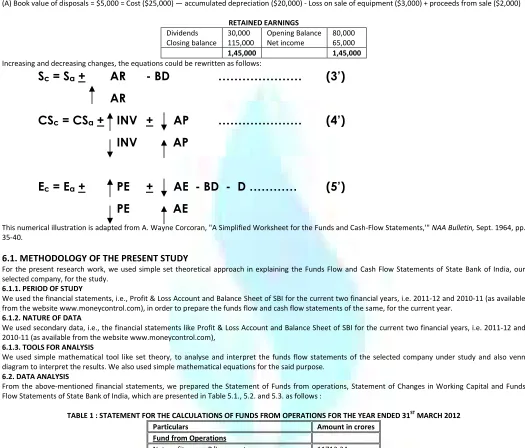
(A) Book value of disposals = $5,000 = Cost ($25,000) — accumulated depreciation ($20,000) - Loss on sale of equipment ($3,000) + proceeds from sale ($2,000) RETAINED EARNINGS
Dividends Closing balance
30,000 115,000
Opening Balance Net income
80,000 65,000 1,45,000 1,45,000 Increasing and decreasing changes, the equations could be rewritten as follows:
S
c= S
a+
AR
- BD
………
(3’)
AR
CS
c= CS
a+ INV + AP
………
(4’)
INV AP
E
c= E
a+
PE
+ AE - BD - D …………
(5’)
PE
AE
This numerical illustration is adapted from A. Wayne Corcoran, "A Simplified Worksheet for the Funds and Cash-Flow Statements,'" NAA Bulletin, Sept. 1964, pp. 35-40.
6.1. METHODOLOGY OF THE PRESENT STUDY
For the present research work, we used simple set theoretical approach in explaining the Funds Flow and Cash Flow Statements of State Bank of India, our selected company, for the study.
6.1.1. PERIOD OF STUDY
We used the financial statements, i.e., Profit & Loss Account and Balance Sheet of SBI for the current two financial years, i.e. 2011-12 and 2010-11 (as available from the website www.moneycontrol.com), in order to prepare the funds flow and cash flow statements of the same, for the current year.
6.1.2. NATURE OF DATA
We used secondary data, i.e., the financial statements like Profit & Loss Account and Balance Sheet of SBI for the current two financial years, i.e. 2011-12 and 2010-11 (as available from the website www.moneycontrol.com),
6.1.3. TOOLS FOR ANALYSIS
We used simple mathematical tool like set theory, to analyse and interpret the funds flow statements of the selected company under study and also venn diagram to interpret the results. We also used simple mathematical equations for the said purpose.
6.2. DATA ANALYSIS
From the above-mentioned financial statements, we prepared the Statement of Funds from operations, Statement of Changes in Working Capital and Funds Flow Statements of State Bank of India, which are presented in Table 5.1., 5.2. and 5.3. as follows :
TABLE 1 : STATEMENT FOR THE CALCULATIONS OF FUNDS FROM OPERATIONS FOR THE YEAR ENDED 31ST MARCH 2012 Particulars Amount in crores
Fund from Operations
Net profit as per P/L account 11713.34 Adjustments for
Add: Provision for Taxation 6776.02 Net Profit before Tax 18,483.36 Add: Depreciation Debited to p/l account 1007.16 Add: Provision for Depreciation in Investment 663.70 Add: Provision for Standard Asset 978.81 Add: Provision for NPA 11545.85 Add: Interest on capital Paid 3592.20 Add: Other Provision Written off (98.13) Less: Dividend from Subsidiaries / joint venture 767.35 Add: Loss on sale of Fixed Asset 44.15 Add: Loss on sale of Investment 919.74 Net Fund Flow from Operations 36369.49
VOLUME NO.3(2013),ISSUE NO.03(MARCH) ISSN 2231-5756
INTERNATIONAL JOURNAL OF RESEARCH IN COMMERCE, IT & MANAGEMENT
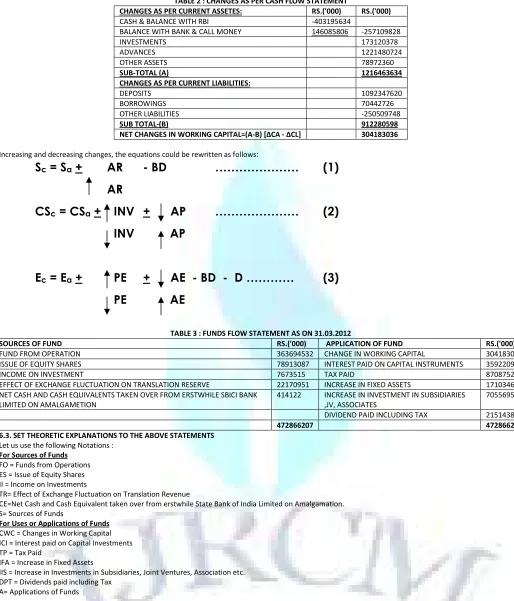
TABLE 2 : CHANGES AS PER CASH FLOW STATEMENT
CHANGES AS PER CURRENT ASSETES: RS.('000) RS.('000) CASH & BALANCE WITH RBI -403195634
BALANCE WITH BANK & CALL MONEY 146085806 -257109828
INVESTMENTS 173120378
ADVANCES 1221480724
OTHER ASSETS 78972360
SUB-TOTAL (A) 1216463634
CHANGES AS PER CURRENT LIABILITIES:
DEPOSITS 1092347620
BORROWINGS 70442726
OTHER LIABILITIES -250509748
SUB TOTAL-(B) 912280598
NET CHANGES IN WORKING CAPITAL=(A-B) [∆CA - ∆CL] 304183036
Increasing and decreasing changes, the equations could be rewritten as follows:
S
c= S
a+
AR
- BD
………
(1)
AR
CS
c= CS
a+ INV + AP
………
(2)
INV AP
E
c= E
a+
PE
+ AE - BD - D …………
(3)
PE
AE
TABLE 3 : FUNDS FLOW STATEMENT AS ON 31.03.2012
SOURCES OF FUND RS.('000) APPLICATION OF FUND RS.('000)
FUND FROM OPERATION 363694532 CHANGE IN WORKING CAPITAL 304183036 ISSUE OF EQUITY SHARES 78913087 INTEREST PAID ON CAPITAL INSTRUMENTS 35922091
INCOME ON INVESTMENT 7673515 TAX PAID 87087529
EFFECT OF EXCHANGE FLUCTUATION ON TRANSLATION RESERVE 22170951 INCREASE IN FIXED ASSETS 17103468 NET CASH AND CASH EQUIVALENTS TAKEN OVER FROM ERSTWHILE SBICI BANK
LIMITED ON AMALGAMETION
414122 INCREASE IN INVESTMENT IN SUBSIDIARIES ,JV, ASSOCIATES
7055695
DIVIDEND PAID INCLUDING TAX 21514388
472866207 472866207
6.3. SET THEORETIC EXPLANATIONS TO THE ABOVE STATEMENTS Let us use the following Notations :
For Sources of Funds FO = Funds from Operations ES = Issue of Equity Shares II = Income on Investments
TR= Effect of Exchange Fluctuation on Translation Revenue
CE=Net Cash and Cash Equivalent taken over from erstwhile State Bank of India Limited on Amalgamation. S= Sources of Funds
For Uses or Applications of Funds CWC = Changes in Working Capital ICI = Interest paid on Capital Investments TP = Tax Paid
IFA = Increase in Fixed Assets
IIS = Increase in Investments in Subsidiaries, Joint Ventures, Association etc. DPT = Dividends paid including Tax
A= Applications of Funds
VOLUME NO.3(2013),ISSUE NO.03(MARCH) ISSN 2231-5756
Therefore, S = FO
∪
∪
∪
∪
ES
∪
∪
∪
∪
II
∪
∪
∪
∪
TR
∪
∪
∪
∪
CE ………. (1)
Therefore, CWC ∪∪∪∪ ICI ∪∪∪∪ TP ∪∪∪∪ IFA ∪∪∪∪ IIS ∪∪∪∪ DPT ………..(2)
As, S = A,
Therefore, Eq. (1) = Eq. (2),
i.e., (FO ∪∪∪∪ ES ∪∪∪∪ II ∪∪∪∪ TR ∪∪∪∪ CE) = (CWC ∪∪∪∪ ICI ∪∪∪∪ TP ∪∪∪∪ IFA ∪∪∪∪ IIS ∪∪∪∪ DPT).
For Net Changes in Working capital: ΔCA= Changes in Current Assets C= Cash
CB= Cash Balance with RBI
BB= Balance with Bank and Call money Ad= Advances (increase)
Inv= Investments (Other than investments in subsidiaries/JV/associates) OA= Other Assets
S
FO
II
ES
TR
CE
A
CW
C
TP
ICI
IFA
IIS
DPT
CWC
ICI
TP
IFA
IIS
VOLUME NO.3(2013),ISSUE NO.03(MARCH) ISSN 2231-5756
INTERNATIONAL JOURNAL OF RESEARCH IN COMMERCE, IT & MANAGEMENT
From the above notations, we draw the following Venn Diagram
And again,
ΔCL= Changes in Current Liabilities D= Deposits
B= Borrowings
OLP= Other Liabilities & Provisions
From the above notations, we draw the following Venn Diagram
Therefore, Net Changes in Working Capital =ΔCA – ΔCL 5.4. FINDINGS FROM THE ABOVE STUDY
From the above analysis, we see that the sources and applications of funds are the universal sets S and A respectively and their different sources and sub-sources are denoted as different subsets, which may be equal or equivalent, depending on their nature of explanation. Therefore, the portion of NPA or Standard Asset etc. could be easily measured as a subset of the total sources of funds or its applications, for example, and their changes should be equated or derivated to find the net pie, instead or traditional accounting calculations. This may show us some new ways to the analysts as how to explain the financial statements and their changes.
REFERENCES
VOLUME NO.3(2013),ISSUE NO.03(MARCH) ISSN 2231-5756 4. Arnold, A. C. 1959. Making forms control work for the company. N.A.A. Bulletin (July): 44-48.
5. Arnstein, W. E. 1963. The profitability approach to credit policy. N.A.A. Bulletin (October): 47-51. 6. Arrol, J. 1962. Budgeting for direct material inventories. N.A.A. Bulletin (February): 59-66.
7. Avery, H. G. 1959. Economic value vs. original cost - A discussion of bases for calculating earnings. N.A.A. Bulletin (February): 5-14. 8. Avery, H. G. 1961. Some comments on lease accounting. N.A.A. Bulletin (August): 90-91.
9. Avery, H. G. 1964. Accounting principles - A retrospective. N.A.A. Bulletin (October): 31-34 .
10. Backer, D. D. 1963. Principal features of the income tax credit for new investment. N.A.A. Bulletin (April): 13-19. 11. Backer, M. 1961. Flexible costs for pricing decisions. N.A.A. Bulletin (May): 55-66.
12. Backer, M. 1962. Additional considerations in return on investment analysis. N.A.A. Bulletin (January): 57-62. 13. Bagaloff, L. 1958. Considerations in equipping the accountant's office. N.A.A. Bulletin (December): 57-58. 14. Baldwin, A. M. 1965. Controllership in a defense contracting business. N.A.A. Bulletin (April): 57-63. 15. Baldwin, W. E. 1957. Tool costing in aircraft production. N.A.A. Bulletin (October): 51-56.
16. Baran, J. J. 1965. Exponential smoothing. N.A.A. Bulletin (May): 51-52.
17. Barbatelli, E. 1963. Opportunities in depreciation under revenue procedure 62-21. N.A.A. Bulletin (January): 41-47.
18. Bareuther, E. E. and B. E. Stromberg. 1957. Budgeting policy and practice in a decentralized company. N.A.A. Bulletin (October): 31-44. 19. Baridon, F. E. 1960. Profit and loss budget by volume. N.A.A. Bulletin (November): 83-89.
20. Barisa, L. A. 1965. A pattern for profitable automotive fleet transportation. N.A.A. Bulletin (February): 56-64. (Purchase, lease, or reimburse employees who own them).
21. Barker, J. W. 1958. How to get useful truck transportation costs quickly. N.A.A. Bulletin (August): 47-56. 22. Barker, R. D. 1964. Toward automated production planning. N.A.A. Bulletin (October): 47-52 . 23. Barnum, W. H. 1961. The challenge to the accountant to challenge costs. N.A.A. Bulletin (July): 74. 24. Barnum, W. H. 1962. The "where" of computer management. N.A.A. Bulletin (November): 20.
25. Barr, A. 1962. Accounting and auditing preparation for public offering of securities. N.A.A. Bulletin (February): 17-30. 26. Barr, A. 1963. Financial statements - How reliable? N.A.A. Bulletin (September): 3-12.
27. Barr, R. B. 1964. Use of graphs in financial reporting. N.A.A. Bulletin (December): 8-13 .
28. Barra, J. A. 1963. How one company organized for electronic data processing. N.A.A. Bulletin (June): 39-45. 29. Barrett, C. T. 1961. Control of detail parts in airframe manufacturing. N.A.A. Bulletin (December): 75-82. 30. Barry, J. E. Jr. 1959. Forms designing as a step in systems improvement. N.A.A. Bulletin (November): 65-76. 31. Barth, E. E. 1959. Standard cost accounting for returnable shipping containers. N.A.A. Bulletin (May): 62-64. 32. Bartz, D. J. 1958. Reports which alert supermarket management. N.A.A. Bulletin (October): 65-74. 33. Battista, G. L. 1962. Direct costing and the balance sheet. N.A.A. Bulletin (March): 90.
34. Battista, G. L. and G. R. Crowingshield. 1964. Absorption, direct or relevant costing? N.A.A. Bulletin (August): 11-23. 35. Battista, G. L. and G. R. Crowingshield. 1965. Inventories at realizable values? N.A.A. Bulletin (May): 31-43.
36. Battista, G. L. and G. R. Crowningshield. 1963. Accounting for depreciation and repair costs. N.A.A. Bulletin (December): 21-30.
37. Battista, G. L. and G. R. Crowningshield. 1963. The balance sheet - A subordinate statement. N.A.A. Bulletin (February): 27-32. (The balance sheet is a compilation of sundry residues and not a serviceable financial statement. For a rebuttal see Zeff, S. A. 1964. The balance sheet and income statement - Analytically coordinated. N.A.A. Bulletin (February): 27-31).
38. Bauer, W. C. 1961. Leasing equipment - Advantageous to whom? N.A.A. Bulletin (March): 44-46. 39. Baur, P. C. Jr. 1965. Profit performance index. N.A.A. Bulletin (March): 17-20.
40. Bauscher, H. A. 1959. Leasing of machine tools. N.A.A. Bulletin (October): 88-89.
41. Beardsley, R. 1960. Company administrated salesmen expense drafts. N.A.A. Bulletin (October): 15-22 . 42. Bechtel, R. C. 1963. Electronic billing at Bell Telephone. N.A.A. Bulletin (August): 55-61.
43. Beckett, J. A. 1964. Management accounting in the age of systems. N.A.A. Bulletin (April): 3-10. 44. Beckett, L. I. 1959. Using "value groups" in cycle counts. N.A.A. Bulletin (August): 92.
45. Bedford, N. M. 1961. Emerging tools for managerial accounting. N.A.A. Bulletin (October): 31-37.
46. Bedford, N. M., C. H. Griffin and T. H. Williams. 1962. Emerging role of mathematical methodology in accountancy. N.A.A. Bulletin (June): 33-38. 47. Beerman, R. E. 1959. Cycle payment of vendor invoices. N.A.A. Bulletin (June): 14.
48. Behrmann, R. D. 1961. Manufacturing expenses - A burden or not? N.A.A. Bulletin (May): 79-84.
49. Beichley, M. W. and H. L. Poppel. 1965. Use of EDP and teletype in monthly financial closings. N.A.A. Bulletin (January): 27-32. 50. Belda, B. J. 1965. Operations research at work. N.A.A. Bulletin (August): 51-55.
51. Bell, C. S. 1960. Wanted: Qualified accountants for the opportunities ahead. N.A.A. Bulletin -1960 Conference ProceedingsI (July): 22-28. 52. Bell, H. M. 1957. Machine accounting and the medium-size business. N.A.A. Bulletin (September): 29-30.
53. Bell, J. W. 1960. Brewery inventory control with electronic data processing. N.A.A. Bulletin (October): 45-52. 54. Bendel, C. W. 1958. An accountant draws some blue-prints for the foreman. N.A.A. Bulletin (February): 29-35. 55. Benson, R. A. 1963. Pricing interplant transfers for measuring plant operations. N.A.A. Bulletin (February): 53-57. 56. Berman, N. D. 1961. Profit analysis practices in an oil refining company. N.A.A. Bulletin (July): 63-68.
57. Berst, I. P. 1958. Efficient accounting for the small company. N.A.A. Bulletin (April): 37-45.
58. Biagioni, L. F. 1965. Answers to several critical questions on direct costing. N.A.A. Bulletin (May): 23-27.
59. Bielenberg, L. F. and A. T. O'Rourke. 1964. Expediting credit and collections by computer processing. N.A.A. Bulletin (May): 15-18. 60. Bienz, J. F. 1961. Extending your accounting education. N.A.A. Bulletin (October): 80.
61. Bierman, H. J. 1957. Some problems in computation and use of return on investment. N.A.A. Bulletin (December): 75-82. 62. Bierman, H. Jr. 1959. A way of using direct costing in financial reporting. N.A.A. Bulletin (November): 13-20.
63. Bierman, H. Jr. 1962. Capital budgeting - The present-value method and a further step. N.A.A. Bulletin (May): 13-18.
64. Birthisel, V. H. 1959. Producing production standard costs on a computer. N.A.A. Bulletin (February): 77-82. (Inventory valuation and control for 10,000 product items at a class manufacturer).
65. Bisset, R. 1960. Installing a standard material cost program. N.A.A. Bulletin (December): 79-82. 66. Black, M. L. 1958. Getting cost control facts to the supervisors. N.A.A. Bulletin (September): 91-92. 67. Blackman, W. A. Jr. 1963. Small contractor - Do you have this information? N.A.A. Bulletin (March): 13-14.
68. Blair, J. P. The counter-part accounting organization - An adventure in service to management. N.A.A. Bulletin (November): 37-43. 69. Blake, R. A. 1962. The management data book - A handy source of information. N.A.A. Bulletin (May): 43-50.
70. Blanc, L. C. 1962. Making work measurements in the office. N.A.A. Bulletin (July): 37-46.
VOLUME NO.3(2013),ISSUE NO.03(MARCH) ISSN 2231-5756
INTERNATIONAL JOURNAL OF RESEARCH IN COMMERCE, IT & MANAGEMENT
REQUEST FOR FEEDBACK
Dear Readers
At the very outset, International Journal of Research in Commerce, IT and Management (IJRCM)
acknowledges & appreciates your efforts in showing interest in our present issue under your kind perusal.
I would like to request you to supply your critical comments and suggestions about the material published
in this issue as well as on the journal as a whole, on our E-mail i.e.
for further
improvements in the interest of research.
If you have any queries please feel free to contact us on our E-mail
.
I am sure that your feedback and deliberations would make future issues better – a result of our joint
effort.
Looking forward an appropriate consideration.
With sincere regards
Thanking you profoundly
Academically yours
Sd/-