S T U D Y P R O T O C O L
Open Access
The improving care in chronic obstructive lung
disease study: CAROL improving processes of
care and quality of life of COPD patients in
primary care: study protocol for a randomized
controlled trial
Claudia Steurer-Stey
1*, Stefan Markun
1, Kaba Dalla Lana
1, Anja Frei
1, Ulrike Held
1, Michel Wensing
2and Thomas Rosemann
1Abstract
Background:The Swiss health ministry launched a national quality program‘QualiCCare’in 2011 to improve health care for patients with COPD.
The aim of this study is to determine whether participation in the COPD quality initiative (‘QualiCCare’) improves adherence to recommended clinical processes and shows impact on patients’COPD care and on the impact of COPD on a person's life.
Methods:CAROL is a cluster-randomized controlled trial with randomization on the general practioner (GP) level. Thirty GPs will be randomly assigned to equally sized intervention group or control group.
Each GP will approach consecutively and regardless of the reason for the current consultation, patients aged 45 years or older, with a smoking history of≥ten pack-years (PY). Patients with confirmed (by spirometric evaluation) COPD will be included in the study. GPs in the intervention group will receive‘QualiCCare’education, which addresses knowledge, decision-making and behavioural aspects as well as delivery of care according to COPD quality indicators and evidence-based key elements. In the control group, no educational intervention will be applied and COPD patients will be treated as usual. The study period is one year.
The primary outcome measure is an aggregated score of relevant clinical processes defining elements in the care of patients with COPD: smoking cessation counseling, influenza vaccination, motivation for physical activity, appropriate pharmacotherapy, patient education and collaborative care. Given a power of 90% and a significance level alpha of 5%, 15 GPs recruiting eight patients each will be necessary in both study arms. With an assumed dropout rate of 20%, 288 patients will need to be included.
Discussion:It is important to develop and implement interventions that add value to COPD care considering quality and efficiency. Care pathways modifying the knowledge and behavior of physicians have the potential for improving care by transferring knowledge to clinical practice.
Trial registration:ClinicalTrials.gov: NCT01921556
* Correspondence:[email protected] 1
Institute of General Practice and Health Services Research, University of Zurich, Pestalozzistrasse 24, 8091 Zurich, Switzerland
Full list of author information is available at the end of the article
Background
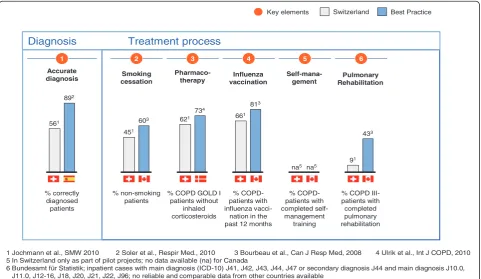
Chronic obstructive pulmonary disease (COPD), an ill-ness with a prevalence of about 10% in the adult Swiss population causes significant burden to patients and the health care system [1-3]. COPD often remains undiag-nosed, and if diagundiag-nosed, attention is mainly directed to-wards pharmacologic treatment, in particular treatment of exacerbations [4]. The course of illness and quality of life of patients can be improved by pharmacological and non-pharmacological interventions [5,6]. Besides appropri-ate pharmacological treatment, smoking cessation, sustain-ing physical activity, influenza vaccination and empowersustain-ing patients to recognize and self-manage exacerbations in an early phase define high quality care of patients with COPD. Recently, we reported on gaps in COPD management in Swiss primary care with overuse of inhaled corticosteroids in moderate COPD and too little emphasis on smoking ces-sation counseling and patient education [7] (Figure 1). Such deficiencies in health care delivery lead to increased mor-bidity and excessive use of health care resources [8] and disclose the need for quality improvement.
Studies in various countries have demonstrated that fea-tures of successful COPD care programs are the appropri-ate delivery of medication, planned regular consultations, activation and education of the patients, adequate exacer-bation management and collaborative, integrated disease management [9-13]. The successful COPD programs used
more or less a framework known as the chronic care model (CCM) [14] for developing and implementing ac-tivities to improve primary care for patients with chronic illnesses. The CCM combines delivery system redesign, clinical information systems, decision support, and self-management support within a practice, linked with health care organization and community resources beyond the practice. Successful implementation of CCM elements provided evidence for improved COPD care [4,15]. An important assumption of the CCM is that the effect of a number of elements and organizational factors combined is higher than their sum of effects.
[image:2.595.58.540.425.704.2]In 2011, the Swiss health ministry launched the national quality initiative ‘QualiCCare’ to improve the quality of care for COPD patients. In relation to international data, it focuses on adherence with COPD guideline recom-mendations and on CCM based actions that emerged to improve the course of COPD by prevention and reduc-tion of exacerbareduc-tions, and thereby also health care costs [4-6,16,17]. These actions include a more proactive and coordinated COPD team care to provide self-management support, smoking cessation counseling, annual influenza vaccination, motivation for physical activity and pul-monary rehabilitation and appropriate pharmacologic treatment considering severity, symptoms and risk of exacerbations. The central aspect of the‘QualiCCare’ pro-gram is a multifaceted implementation approach. It aims
% correctly diagnosed patients
% non-smoking patients
% COPD GOLD I patients without
inhaled corticosteroids
% COPD-patients with influenza
vacci-nation in the past 12 months
% COPD III-patients with
completed pulmonary rehabilitation %
COPD-patients with completed
self-management training
1 2 3 4 5 6
Key elements
Accurate
diagnosis cessationSmoking Pharmaco-therapy vaccinationInfluenza Self-mana-gement
Pulmonary Rehabilitation
1 Jochmann et al., SMW 2010 2 Soler et al., Respir Med., 2010 3 Bourbeau et al., Can J Resp Med, 2008 4 Ulrik et al., Int J COPD, 2010 5 In Switzerland only as part of pilot projects; no data available (na) for Canada
6 Bundesamt für Statistik; inpatient cases with main diagnosis (ICD-10) J41, J42, J43, J44, J47 or secondary diagnosis J44 and main diagnosis J10.0, J11.0, J12-16, J18, J20, J21, J22, J96; no reliable and comparable data from other countries available
Switzerland Best Practice
892
561 603
451
734 621
813
661
na5 na5
433
91
Diagnosis Treatment process
not only to increase knowledge but also internal motiv-ation and decision-making by offering stimuli, resources and written instruments [18-21]. Further it categorizes and delineates specific professional and organizational in-terventions and comprises a short list of evidence-based
practice items into a primary care ‘COPD care bundle’
that should guide and support better performance. So far, experience with care bundles for COPD only exists for discharge in patients hospitalized with COPD exacerba-tions [22].
In Switzerland, such a multifaceted COPD targeted quality program has not yet been broadly implemented and evaluated. The aim of the study is, therefore, to evalu-ate the effect of the‘QualiCCare’COPD intervention on COPD management in patients with diagnosed COPD in primary care practices in the Canton of Zurich.
Hypotheses
The‘QualiCCare’intervention will improve adherence to suggested ‘good care’standards in COPD, namely: smok-ing cessation counselsmok-ing, influenza vaccination, appropri-ate pharmacotherapy with less overuse of inhaled steroids and correct inhalation technique, consideration of exacer-bations, physical activity, pulmonary rehabilitation and patient education, and care coordination. Improvement in these processes is the first step towards improved clin-ical outcome measures as health status, and therefore, we also expect over time, a reduced impact of COPD on pa-tients’lives.
Methods/Design
We will conduct a cluster-randomized controlled trial (randomization on GP level) with primary care physicians in the Canton of Zurich in the years 2013 and 2014.
Recruitment and eligibility of primary care physicians GPs are eligible for participation if they provide care in the routine primary setting (single handed practices and group practices) to unselected patients.
About 300 GPs in the area of Zurich and Winterthur are invited to an information meeting by a formal letter of the Institute of General Practice and Health Services Research of the University of Zurich and the Depart-ment of Health of the Canton of Zurich. In this informa-tion meeting an overview of the study will be given. The main focus of the first information meeting for all GPs is to present the project and to motivate GPs to take part in the study. Additionally, the project will be presented in several quality circle meetings in doctors’ networks (regions Zurich, Winterthur).
GPs who agree to participate will be randomized, strati-fied by practice organization (single handed versus group practices). All participating GPs/practice assistants will receive instruction by a pneumologist and a spirometry
technician in performing a spirometry. Practices in the intervention group get detailed information on
evidence-based COPD management and‘QualiCCare’training
ses-sions and instruments, designed to increase knowledge, internal motivation and decision-making and to support incorporation of evidence into their daily work (details described in the intervention section).
The GPs of the control group apply‘care as usual’ with-out receiving the ‘QualiCCare’training and implementa-tion tools.
Patient recruitment
All GPs are asked to approach consecutively and regard-less of the reason for the current consultation, patients
aged 45 years or older with a smoking history of ≥ ten
pack-years (PY) and to include patients with COPD di-agnosed by spirometric evaluation.
To assure an appropriate spirometric evaluation, all GPs will participate in a spirometric training by a pneu-mologist and a spirometry technician before starting the patient recruitment process and before randomization of the GPs. The aim of this procedure is to diagnose COPD or confirm the diagnosis of COPD by a current and cor-rect spirometry in both arms of the study.
Patient inclusion criteria
1) Males and females≥45 years of age and 2) Smoker or ex-smoker (with at least ten PY) and 3) Obstruction in spirometry FEV1/FVC < 0.7
Patient exclusion criteria
1. No obstruction in spirometry (FEV1/FVC≥0.7) or 2. Patients with history of asthma or hay fever or 3. Other concomitant pulmonary disease or
4. Patients with malignancies of any other system and/ or other severe disease with an estimated life expectancy of less than six months or 5. Insufficient German language skills or
6. Patients who contact the practice for emergencies only or as a substitute practice
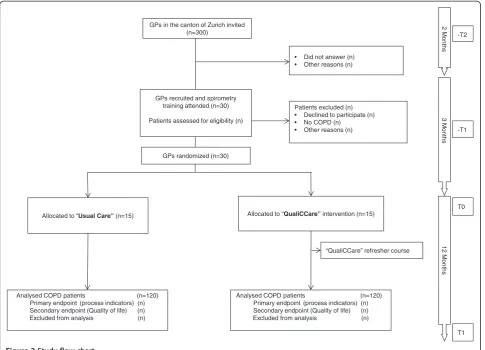
The flow chart of GP and patient recruitment of the study is shown in Figure 2.
Clinical interventions/guideline adherence
in case of an exacerbation; appropriate pharmacologic treatment for stable and exacerbated COPD, and pro-active, collaborative COPD care.
Implementation program
Instruction of the GPs and practice assistants in the intervention group
Physicians randomized into the intervention group get a
‘QualiCCare’ training workshop designed to educate
professionals on the guidelines, but also and particularly, governing professional behavior by feedback, reminders and pathways that help to change their attitudes and care behavior [23-25]. Based on behavioral and learn-ing theory [26],‘QualiCCare’ intervention not only tries to increase knowledge but also internal motivation and decision- making by stimuli and resources and by written instruments that guide evidence-based decision support.
The education sessions will actively involve GPs and practice assistants with tasks and responsibilities and also, by demonstrating them (by interactive teaching, case vi-gnettes and role plays), ways on how evidence-based tasks could be incorporated into their daily work.
Three instruments (A-C) have been developed based on a review of international and national guidelines and in collaboration with the Swiss Respiratory Society, Swiss Societies of Internal and General Medicine and College of Primary Care Medicine, with a specific focus on pri-mary care circumstances and needs. These instruments will be introduced to the intervention group as working tools for daily practice to support decision-making and adherence with recommended COPD care.
A. The Swiss COPD quintessence for primary care is a clinical guideline for GPs which is consistent with international guidelines for COPD [27] and the newly published Swiss COPD guideline [6], but more comprehensive and summarizing the key elements of COPD management for Swiss primary care [28].
B. The COPD pocket guide contains evidence-based information, assessment tools (MRC, CAT, STS), opinion sheets (early diagnosis, smoking cessation advice), treatment algorithm and decision aids for the key COPD elements: Confirm diagnosis, GPs in the canton of Zurich invited
(n=300)
• Did not answer (n) • Other reasons (n)
Patients excluded (n) • Declined to participate (n) • No COPD (n)
• Other reasons (n)
Allocated to “QualiCCare” intervention (n=15)
Analysed COPD patients (n=120) Primary endpoint (process indicators) (n) Secondary endpoint (Quality of life) (n) Excluded from analysis (n)
“QualiCCare” refresher course
2 M
onths
3 M
o
nths
12 M
o
nths
GPs recruited and spirometry training attended (n=30)
Patients assessed for eligibility (n)
T0
T1 -T2
-T1
Allocated to “Usual Care” (n=15)
[image:4.595.57.543.89.439.2]Analysed COPD patients (n=120) Primary endpoint (process indicators) (n) Secondary endpoint (Quality of life) (n) Excluded from analysis (n) GPs randomized (n=30)
Optimize symptoms, Prevent deterioration, and Develop network and self-management support. The pocket guide also contains addresses and links to useful information as well as for specialist support, pulmonary rehabilitation and community resources offering, for example, smoking cessation and patient education.
C. The Primary care COPD Care bundle is something new for the primary care setting. So far, experience for COPD only exists for discharge care bundles for COPD patients hospitalized with acute
exacerbations. The implementation of a discharge care bundle improved adherence with optimum health care practice [22]. Our primary care COPD care bundle comprises a short list of evidence-based practice items to be implemented into primary care for patients with COPD. It can function as a reminder and as a checklist of all necessary activities that can be ticked as performance control. It is expected to function as a stimulus for increased guideline adherence and internal motivation for behavior change.
Bundle items selected for primary care are:
1. Identify COPD in a smoker or ex-smoker (with at least ten PY) with symptoms (cough, sputum or dyspnea).
2. If the patient is still a smoker, offer smoking cessation assistance.
3. Motivate for physical activity and consider/refer for pulmonary rehabilitation.
4. Motivate for influenza vaccination.
5. Offer appropriate pharmacologic treatment for stable and exacerbated COPD.
6. Demonstrate and check correct use of inhalers. 7. Give written information about COPD including
Lunge Zürich self-management booklet and an action plan.
8. Offer proactive follow-up and integrated services (for example follow-up, feedback and scheduling and
‘navigation’functions by the trained practice
assistant, arranging appointments, and connecting patients to internal and external providers and resources).
A specialized and experienced team of a pneumologist and a respiratory physiotherapist and master trainer will hold the ‘QualiCCare’ training workshop (half a day ses-sion). The three dimensions knowledge, skills and behavior in COPD management are addressed with consideration of the COPD care bundle items.
A‘QualiCCare’refresher course will be held six months after the first training workshop.
Outcomes Primary outcome
Difference in ‘quality of care process’ (total increase in performed measures/fulfilled indicators) after one year between COPD patients in the intervention and control group as reported by the patient (described below).
Secondary outcomes
a. Percentage of COPD patients with FEV1 < 60% and/or≥two exacerbations who received
advice to participate in pulmonary rehabilitation
referral to pulmonary rehabilitation
a written action plan for exacerbation management
proactive follow up and integrated services (arrangement for follow up and referrals) b. Quality of life (CAT)
c. Aggregate measure for‘quality of care process’ reported by the GPs
Details on the purpose defined, aggregate outcome meas-ure (primary outcome and secondary outcome b):
Every process indicator will get a rating of 1, when performed (or done) and 0 when not performed. The range of the primary outcome will be from 0 to a max-imum of 9, the range of the secondary outcome - applicable only for a subgroup of patients - will be 0 to a max-imum of 13:
Indicators for the primary outcome:
1. Smoking cessation advice 2. Smoking cessation intervention 3. Influenza vaccination
4. Assessment of physical activity 5. Advice for physical activity
6. Assessment of exacerbation frequency
7. Appropriate pharmacological treatment: (no inhaled corticosteroids in patients with FEV1 > 50% and < two exacerbations/year)
8. Instruction in correct inhalation technique 9. Information and patient education: additional
indicators for the secondary outcome: COPD patients with FEV1 < 50% or≥two exacerbations 10. A written action plan for exacerbation management 11. Advice to participate in pulmonary rehabilitation 12. Referral to pulmonary rehabilitation
13. Proactive follow-up and integrated services
Quality of life
is a validated short and simple patient-completed ques-tionnaire that has been developed for use in routine clin-ical practice to measure the health status and grading the impact of COPD on patients’life. The CAT is available in different languages (http://www.catestonline.org). It com-promises eight simple questions, eight items on a scale of 0 to 5 with a total scoring range of 0 to 40; CAT score < 10 low impact, 10 to 20 medium impact and > 30 very high impact of COPD on a patient’s life [29].
Measures at baseline and follow up Baseline
Patient demographics: gender, age, race/ethnicity, employ-ment status, and family background.
Clinical characteristics: comorbidities (predefined selec-tion of frequent comorbidities cardiovascular, diabetes type II), BMI, smoking status, PYs smoking, respiratory symp-toms cough, sputum, dyspnea and severity of dyspnea (Medical research council MRC dyspnea scale), spirometry (FEV1/FVC < 70%) and grade of severity (FEV1 > 80% GOLD I mild COPD, FEV1 50 to 80% GOLD II moderate COPD, FEV1 30 to 50% GOLD III severe COPD, FEV1 < 30% GOLD IV very severe COPD) according to GOLD guidelines. Burden of COPD in daily life assessed with the COPD assessment test (CAT). Current drug therapy, exac-erbations and health care utilization in previous year due to pulmonary problems, including hospital admissions and emergency department attendances or unscheduled visits are also assessed.
Follow-up
We use a data collection tool with clinical questionnaires for patients and GPs (each with an allocated correspond-ing code) to measure performance.
Data collection procedures Patient questionnaire
The patients will receive detailed written information on the aim of the study. After giving their written informed consent they will receive a questionnaire (T0) assessing gender, age, employment status, and family background, the CAT, information on respiratory symptoms (cough, sputum, dyspnea), and severity of dyspnea (Medical re-search council MRC dyspnea scale), smoking status, mo-tivation to quit, exacerbations and health care utilization (including unscheduled visits, emergency department at-tendances and hospital admissions due to pulmonary problems). Patients are asked at T0 whether, in the pre-vious year before study inclusion, they had received: advice to quit smoking, assessment and advice for phys-ical activity or advice/referral to pulmonary rehabilitation, recommendation/application of influenza vaccination, patient education with defining COPD and information about the main causes, signs and symptoms, information
on medication and using inhalation devices with face-to-face instruction and demonstration of inhalation tech-nique, information on how to identify and manage an aggravation of symptoms (exacerbation) and an action plan for exacerbation management including medication adjustment for exacerbation treatment. In addition patients are asked whether they have received COPD support by community resources (lung associations, support groups) and other specialized health professionals. Patients are asked the same questions one year after study inclusion T1. They receive the questionnaires and stamped enve-lopes with the postal address of the university and are asked to return the questionnaire in the envelope to the university at T0, and T1 after 12 months.
Patients will also be informed that neither the GP nor the practice team has any possibility of obtaining know-ledge of their answers.
GPs
The GP will maintain a record of the participants with an allocated code for each patient. This code is also marked on the questionnaires. The university only receives the pa-tients’codes and has no access to their names.
A questionnaire is filled out by the GPs with informa-tion on the professional characteristics (gender, age, specialty, work time) and of the organizational context, such as single or group practice, regional structures and available resources.
At T0, the GP gives information for each participat-ing patient on demographics, clinical characteristics: comorbidities, BMI, smoking status, PYs smoking, infor-mation on respiratory symptoms cough, sputum, dyspnea and severity of dyspnea (Medical Research Council MRC dyspnea scale) spirometry (FEV1/FVC < 0.7) and grade of severity according to GOLD guidelines FEV1 > 80% GOLD I mild COPD, FEV1 50 to 80% GOLD II moderate COPD, FEV1 30 to 50% GOLD III severe COPD, FEV1 < 30% GOLD IV very severe COPD), exacerbation fre-quency and current (pulmonary) drug therapy.
devices, face-to-face instruction and demonstration of halation technique is supplied. Additionally, whether in-formation on how to identify and manage an aggravation of symptoms (exacerbation) and whether an action plan for exacerbation management, including a written medi-cation adjustment for exacerbation treatment is sup-plied, is asked about. GPs are also asked whether they educate patients in the practice or refer them to an exter-nal COPD program connecting COPD patients with spe-cialized health professionals and community resources (lung associations, support groups).
This procedure will be carried out to compare patients’
reported procedures with GPs’ self-reported performed
procedures and is assessed as secondary outcome measure. The GP questionnaires are also marked with the patient’s code and will be returned to the university in a stamped envelope. GP measurements will take place at baseline (pre-data collection) and after 12 months (post-data collec-tion). Pre-data collection is estimated to last three months.
An independent research assistant of the university will enter the data directly into the SPSS program (ver-sion 18.0 or higher, SPSS, Chicago, IL, USA).
For an intermediate outcome, we will assess mediating processes with a self-efficacy scale for professional knowledge, skills and behaviour before and right after the‘QualiCCare’workshop and after 12 months.
The process evaluation will also include outreach visits and interviews, which have shown to be effective strategies to support implementations in primary care. Therefore, one outreach visit will be performed eight to twelve weeks after the training workshop for GPs and practice assistants in the intervention group. The aim of this outreach visit is to assess if the structures in the practices are appropriate to perform care according to the study protocol. Further-more, the visit aims to reveal possible problems which might have occurred, and to discuss and implement ap-propriate solutions. Whether the instruments are used as intended will also be checked. The outreach visit will be performed by a study nurse of the study center.
Statistical analysis Calculation of sample size
Based on available data from Switzerland [7,30], and a recently performed cross-sectional survey of our study group, we assume a mean of four regarding the number of performed indicators (primary outcomes 1 to 9 as mentioned above) and a SD of 2.3. We assume an in-crease in the intervention group in the mean of per-formed indicators of 1.5. Given a power of 90% and a significance level alpha of 5%, as well as an intracluster correlation coefficient (ICC) of 0.04, we will need eight pa-tients per GP assuming participation of 30 GPs, resulting in 240 patients. Assuming a dropout rate of at least 20% (dropouts are possible on a GP level but also on a patient
level, therefore this rate is estimated to be about 20%), we will need 288 patients.
Data analysis
At-test will be used for independent group comparisons in the primary outcome between control and intervention group. Each quality indicator itself can also be regarded as a binary outcome (performing a specific procedure (yes/no)). To analyze these binary outcomes separately logistic regression will be used to model the relationships between the outcome and treatment group, age and gen-der. Other potentially important covariates will be identi-fied through exploratory analyses. The longitudinal aspect of the data can be incorporated into the model in various ways; we will utilize the generalized estimating equations (GEE) approach [31].
For continuous outcomes such as quality of life (QoL) instruments, repeated measures analysis of variance is appropriate [32].
Fixed effect parameters will include treatment group, age, gender, and other potentially important covariates. The pri-mary data analysis will follow the intent-to-treat (ITT) ap-proach where appropriate. This means that all available data from all individuals will be analyzed according to treat-ment group assigntreat-ment, regardless of whether or not each individual actually received the assigned treatment.
Timeframe of the study
The recruitment of the 30 GPs is planned over two months between July and August 2013 (−T2).
Patient eligibility screening and patient inclusion is projected within a period of three months (−T1). The intervention courses will start subsequently.
Assessments will be made as described above, T0 base-line assessments start from the inclusion; at basebase-line, data regarding COPD management in the year before inclusion will also be assessed retrospectively from the patient charts and transferred anonymously to the study center.
Final measurements (T1) will be performed one year after the‘QualiCCare’intervention.
Ethical principles
The study is conducted in accordance with medical pro-fessional codex and the Helsinki Declaration as of 1996 as well as Data Security Laws and according to good clinical practice guidelines.
Study participation of patients is voluntary and can be cancelled at any time without provision of reasons and without negative consequences for their future medical care.
Patient informed consent
the planned study from the GPs; for instance about po-tential benefits and popo-tential risks to their health. In case of acceptance, they sign the informed consent form.
In case of study discontinuation, all material will be destroyed or the patient will be asked if he/she accepts that existing material can be analyzed in the study.
Vote of the Ethics Committee
The study protocol is approved by the Ethics Committee of the Kanton Zurich (reference KEK-ZH_number 2013-0189).
Data security/disclosure of original documents
The patient names and all other confidential information fall under medical confidentiality rules and are treated according to appropriate Federal Data Security Laws. The results of the patient questionnaires are not access-ible to the GPs. Questionnaires are directly mailed to the study center by the patient.
All study related data and documents are stored on a protected central server of the University of Zurich. Only direct members of the internal study team can ac-cess the respective files.
Intermediate and final reports are stored in the office of the Department of General Practice and Health Ser-vices Research at the Zurich University Hospital (USZ).
Discussion (expected results)
Improving care for people with chronic diseases is one of the big challenges in health care worldwide [17]. In this era plagued by ever-tightening health care resources, it is of utmost importance to identify and implement in-terventions that are of added value to quality and effi-ciency of care [14,33]. Efficient professional interventions and care pathways, which detail essential steps in the care of patients, have the potential for improving patient care by reaching quality standards and decreasing unwarranted practice variation. However, evaluation of their impact is
important. According to Lemmens et al. [34]
improve-ment of expertise, information and resources will affect behavioral intention, which leads to professional behav-ioral change and this should lead to improved health ef-fects. We expect that the‘QualiCCare’intervention can be implemented into primary care practices and will consti-tute a path forward for better quality in COPD care. After adjusting for age, gender, number of chronic conditions, participating sites are expected to show significant im-provement for several quality indicators, including smok-ing cessation advice, influenza vaccination, appropriate medical therapeutics, rehabilitation and self-management education efforts and better proactive, collaborative care compared to the‘usual care’group.
Professional support and improvement in these pro-cesses is the first step towards improved clinical out-come measures as quality of life and therefore, we also
expect a significant difference for our secondary out-come QOL assessed by the patient.
In addition, we try to identify professional behavior change mechanisms and gain insight into some
imple-mentation processes that could help to open the ‘black
box’ that frequently lies between input and outcome of
interventions.
The vision that emerges from our study is of organiza-tions that aim to implement best practice and to
im-prove the value of care in COPD, one of the world’s
major chronic illnesses. This study is, therefore, of great interest not only from the patient perspective but also from a health care system perspective.
Trial status
Patient recruitment had not started at the time of first submission in August 2013.
Abbreviations
BMI:body mass index; CAT: COPD assessment test; CCM: chronic care model; COPD: chronic obstructive pulmonary disease; FEV1: forced expiratory volume in first second; FVC: forced vital capacity; GEE: generalized estimating equations; GOLD: Global initiative on Obstructive Lung Disease; GP: general practitioner; ICC: intracluster correlation coefficient; ICS: inhaled
corticosteroids; ITT: intent-to-treat; MRC: Medical Research Council dyspnea scale; PY: pack-years; QoL: quality of life; RCT: randomized-controlled trial; STS: sit to stand test.
Competing interests
The authors declare that they have no competing interests.
Authors’contributions
CS: conception and design, financial support, data collection and analysis, manuscript writing and final approval of the manuscript. SM: data collection and analysis, critical revision and final approval of the manuscript. KD: data collection and analysis, critical revision and final approval of the manuscript. AF: data collection and analysis, critical revision and final approval of the manuscript. UH: statistics and analysis, critical revision and final approval of the manuscript. MW: conception and design, manuscript writing, final approval of manuscript. TR: conception and design, financial support, critical revision and final approval of the manuscript. All authors read and approved the final manuscript.
Acknowledgements
This project is supported by grants from the Swiss Federal Office of Public Health (BAG), the Swiss Medical Association (FMH) and the Department of Health of the Canton of Zurich, Further, by unrestricted grants for Chronic Care and Patient Education from AstraZeneca Switzerland, and Boehringer Ingelheim Switzerland.
We thank Professor Johann Steurer who provided support and fruitful discussions for preparing the study protocol.
Author details
1Institute of General Practice and Health Services Research, University of
Zurich, Pestalozzistrasse 24, 8091 Zurich, Switzerland.2Scientific Institute for Quality in Healthcare, Radboud University Nijmegen Medical Center, Nijmegen, Netherlands.
Received: 20 August 2013 Accepted: 10 March 2014 Published: 27 March 2014
References
1. Chapman KR, Mannino DM, Soriano JB, Vermeire PA, Buist AS, Thun MJ, Connell C, Jemal A, Lee TA, Miravitlles M, Aldington S, Beasley R:
Epidemiology and costs of chronic obstructive pulmonary disease.
2. Bridevaux PO, Probst-Hensch NM, Schindler C, Curjuric I, Felber Dietrich D, Braendli O, Brutsche M, Burdet L, Frey M, Gerbase MW, Ackermann-Liebrich U, Pons M, Tschopp JM, Rochat T, Russi EW:Prevalence of airflow obstruction in smokers and never-smokers in Switzerland.Eur Respir J2010,36:1259–1269. 3. Buist AS, McBurnie MA, Vollmer WM, Gillespie S, Burney P, Mannino DM,
Menezes AM, Sullivan SD, Lee TA, Weiss KB, Jensen RL, Marks GB, Gulsvik A, Nizankowska-Mogilnicka E, Group BCR:International variation in the prevalence of COPD (the BOLD Study): a population-based prevalence study.Lancet2007,370:741–750.
4. Fromer L:Implementing chronic care for COPD: planned visits, care coordination, and patient empowerment for improved outcomes.Int J Chron Obstruct Pulmon Dis2011,6:605–614.
5. Vestbo J, Hurd SS, Rodriguez-Roisin R:The 2011 revision of the global strategy for the diagnosis, management and prevention of COPD (GOLD) - why and what?Clin Respir J2012,6:208–214.
6. Russi EW, Karrer W, Brutsche M, Eich C, Fitting JW, Frey M, Geiser T, Kuhn M, Nicod L, Quadri F, Rochat T, Steurer-Stey C, Stolz D:Diagnosis and management of chronic obstructive pulmonary disease: the Swiss guidelines. Official guidelines of the Swiss Respiratory Society.
Respiration2013,85:160–174.
7. Steurer-Stey C, Dallalana K, Jungi M, Rosemann T:Management of chronic obstructive pulmonary disease in Swiss primary care: room for improvement.Qual Prim Care2012,20:365–373.
8. Sharma G, Kuo YF, Freeman JL, Zhang DD, Goodwin JS:Outpatient follow-up visit and 30-day emergency department visit and readmission in patients hospitalized for chronic obstructive pulmonary disease.Arch Intern Med
2010,170:1664–1670.
9. Bourbeau J, Julien M, Maltais F, Rouleau M, Beaupre A, Begin R, Renzi P, Nault D, Borycki E, Schwartzman K, Singh R, Collet JP:Reduction of hospital utilization in patients with chronic obstructive pulmonary disease: a disease-specific self-management intervention.Arch Intern Med2003,
163:585–591.
10. Casas A, Troosters T, Garcia-Aymerich J, Roca J, Hernandez C, Alonso A, del Pozo F, de Toledo P, Anto JM, Rodriguez-Roisin R, Decramer M:Integrated care prevents hospitalisations for exacerbations in COPD patients.
Eur Respir J2006,28:123–130.
11. Sridhar M, Taylor R, Dawson S, Roberts NJ, Partridge MR:A nurse led intermediate care package in patients who have been hospitalised with an acute exacerbation of chronic obstructive pulmonary disease.
Thorax2008,63:194–200.
12. Chavannes NH, Grijsen M, van den Akker M, Schepers H, Nijdam M, Tiep B, Muris J:Integrated disease management improves one-year quality of life in primary care COPD patients: a controlled clinical trial.Prim Care Respir J2009,18:171–176.
13. Gruffydd-Jones K, Richman J, Jones RC, Wang X:A pilot study of identification and case management of high-risk COPD patients in a general practice.Fam Pract2010,27:494–498.
14. Wagner EH:Chronic disease management: what will it take to improve care for chronic illness?Eff Clin Pract1998,1:2–4.
15. Adams SG, Smith PK, Allan PF, Anzueto A, Pugh JA, Cornell JE:
Systematic review of the chronic care model in chronic obstructive pulmonary disease prevention and management.Arch Intern Med
2007,167:551–561.
16. Qaseem A, Wilt TJ, Weinberger SE, Hanania NA, Criner G, van der Molen T, Marciniuk DD, Denberg T, Schunemann H, Wedzicha W, MacDonald R, Shekelle P:Diagnosis and management of stable chronic obstructive pulmonary disease: a clinical practice guideline update from the American College of Physicians, American College of Chest Physicians, American Thoracic Society, and European Respiratory Society.Ann Intern Med2011,155:179–191.
17. Wagner EH, Austin BT, Von Korff M:Organizing care for patients with chronic illness.Milbank Q1996,74:511–544.
18. Foster JA, Yawn BP, Maziar A, Jenkins T, Rennard SI, Casebeer L:Enhancing COPD management in primary care settings.Med Gen Med2007,9:24. 19. Fromer L, Barnes T, Garvey C, Ortiz G, Saver DF, Yawn B:Innovations to
achieve excellence in COPD diagnosis and treatment in primary care.
Postgrad Med2010,122:150–164.
20. Johnston KN, Young M, Grimmer-Somers KA, Antic R, Frith PA:Why are some evidence-based care recommendations in chronic obstructive pulmonary disease better implemented than others? Perspectives of medical practitioners.Int J Chron Obstruct Pulmon Dis2011,6:659–667.
21. Cooke CE, Sidel M, Belletti DA, Fuhlbrigge AL:Review: clinical inertia in the management of chronic obstructive pulmonary disease.COPD2012,
9:73–80.
22. Hopkinson NS, Englebretsen C, Cooley N, Kennie K, Lim M, Woodcock T, Laverty AA, Wilson S, Elkin SL, Caneja C, Falcon C, Burgess H, Bell D, Lai D:
Designing and implementing a COPD discharge care bundle.Thorax
2012,67:90–92.
23. Cabana MD, Rand CS, Powe NR, Wu AW, Wilson MH, Abboud PA, Rubin HR:
Why don't physicians follow clinical practice guidelines? A framework for improvement.JAMA1999,282:1458–1465.
24. Grimshaw JM, Shirran L, Thomas R, Mowatt G, Fraser C, Bero L, Grilli R, Harvey E, Oxman A, O'Brien MA:Changing provider behavior: an overview of systematic reviews of interventions.Med Care2001,39:II2–45. 25. Grol R, Wensing M:What drives change? Barriers to and incentives for
achieving evidence-based practice.Med J Aust2004,180:S57–60. 26. Bandura A:Health promotion by social cognitive means.Health Educ
Behav2004,31:143–164.
27. From the Global Strategy for the Diagnosis, Management and Prevention of
COPD.[http://www.goldcopd.org]
28. Steurer-Stey C, Senn O, Pfisterer J, Karrer W, Russi EW, Müller M: COPD-Quintessenz für den Grundversorger.Swiss Med Forum2013,13:227–230. 29. Jones PW, Harding G, Berry P, Wiklund I, Chen WH, Kline Leidy N:
Development and first validation of the COPD Assessment Test.
Eur Respir J2009,34:648–654.
30. Jochmann A, Neubauer F, Miedinger D, Schafroth S, Tamm M, Leuppi JD:
General practitioner's adherence to the COPD GOLD guidelines: baseline data of the Swiss COPD Cohort Study.Swiss Med Wkly2010,140:w13053. 31. Diggle P, Heagerty P, Kung-Yee L, Zeger S:Analysis of Longitudinal Data
(Oxford Statistical Science Series).USA: Oxford University Press; 2002. 32. Vonesh E, Chichilli V:Linear and Nonlinear Models for the Analysis of
Repeated Measurements.6000 Broken Sound Parkway NW, Boca Raton, FL
33487 USA: CRC Press; 1996.
33. Grol R:Improving the quality of medical care: building bridges among professional pride, payer profit, and patient satisfaction.JAMA2001,
286:2578–2585.
34. Lemmens KM, Nieboer AP, van Schayck CP, Asin JD, Huijsman R:A model to evaluate quality and effectiveness of disease management.Qual Saf Health Care2008,17:447–453.
doi:10.1186/1745-6215-15-96
Cite this article as:Steurer-Steyet al.:The improving care in chronic obstructive lung disease study: CAROL improving processes of care and quality of life of COPD patients in primary care: study protocol for a randomized controlled trial.Trials201415:96.
Submit your next manuscript to BioMed Central and take full advantage of:
• Convenient online submission
• Thorough peer review
• No space constraints or color figure charges
• Immediate publication on acceptance
• Inclusion in PubMed, CAS, Scopus and Google Scholar
• Research which is freely available for redistribution