A b s t r a c t. The field experiment was carried out on a smooth-stalked meadow-grass to analyse the effect of tractor traffic on herbage production and root morphology. The multiple passes of tractor changed physical properties of soil. Increase in bulk density and penetration resistance of soil under smooth-stalked meadow-grass was recorded up to the depth of 30 cm. The tractor traffic re-sulted in changes in smooth-stalked meadow-grass yields. During the second and the third harvest it was found that wheel traffic de-creased plant yields. For the first harvest the opposite effect in herbage production was noticed. The tractor traffic significantly changed the root morphometric properties in the upper, 0-5 cm, soil layer. Intensive tractor traffic (four and six passes) signifi-cantly increased the root length in diameter range of 0.1-0.5 mm. There were no differences in both mean root diameter and specific root length what indicated that traffic treatment applied did not change the root diameter. The results indicate that smooth-stalked meadow-grass could be recommended for compacted soils when intensive traffic is present.
K e y w o r d s: meadow-grass, soil compaction, yields, roots
INTRODUCTION
Modern agricultural production systems tend to increa-se the number of pasincrea-ses and the loads carried on agricultural vehicles, resulting in a potential for increased compaction. Soil compaction is now recognized as one of the main factors that can lower crop yields and thus is a serious agri-cultural problem. Compaction leads to soil structure degra-dation, where the size and shape of pores are changed (Hamza and Anderson, 2005). Many researchers agree that soil compaction leads to plant yield reduction (Whalleyet al., 2008) including decreased production of perennial fo-rage crops (G³¹b, 2008). This yield decline is the conse-quence of both soil compaction and shoot injury caused by wheel traffic. It is a serious problem for perennial crops,
where the soil is subjected to wheel traffic. Soil strength is increased year-after-year and all machine traffic during field operation cause direct damages to plants which are reported to be more important in contributing to decreased plant yield than soil compaction. On the other hand, it has also been reported that the yields of perennial plants were not always reduced by compaction and sometimes were larger in compacted soil than in non-compacted (Frost, 1998). These trends could be attributed to better water and nutrient supply and recovery of soil pore system (Scottet al., 2005).
The degraded soil physical environment due to com-paction influences of shoots as well as roots growth and development. Soil compaction increases mechanical impe-dance, creates unfavourable growing conditions for roots and restricts oxygen, water and nutrients supply (Chen and Weil, 2010; G³¹b and Kopeæ, 2009). A common response of the root system to increasing bulk density is to decrease in length, concentrating roots in the upper layer and decreasing rooting depth (Lipiecet al., 2003). Strongly compacted soils are usually penetrated by roots in cracks, fissures and bio-pores (macrobio-pores formed by earthworms). This provides advantage to elongating roots but also results in a hetero-geneous root distribution. However, changes in root system appearance do not necessarily cause an alteration in above-ground growth or yield (Kristoffersen and Riley, 2005). Overall, it is a very difficult to quantify con- sistently in field trials the relation between root growth and plant yield.
It was also stated that plant roots played favourable role in recovery of strongly compacted soil (Milleretet al., 2009). Author stated in previous work (G³¹b, 2005) that roots of perennial legumes reduced soil compaction and improved water retention of soil.
Int. Agrophys., 2013, 27, 7-13 doi: 10.2478/v10247-012-0062-2
Impact of soil compaction on root development and yield of meadow-grass
T. G³¹b
Institute of Machinery Exploitation, Ergonomics and Production Processes, University of Agriculture, Balicka 116B, 31-149 Cracow, Poland
Received November 14, 2011; accepted December 30, 2011
© 2013 Institute of Agrophysics, Polish Academy of Sciences
*Corresponding author e-mail: [email protected]
I
I
INNNTTTEEERRRNNNAATATTIIIOOONNNAAALLL
A
A
In Poland the total area of permanent grassland is over 4 mln ha, which comprises 13% of the country area and 22% of all agricultural land. The area of permanent grassland meadows is over 2 390 ha, which is nearly 75% of all per-manent grasslands. There are usually two or three cut mea-dows. The most popular method of harvest conservation is hay production using the surface of the meadow (more than 60% of total herbage production) (Statistical Yearbook, 2008). Although the new silage technologies appeared (bales, tubes, etc.) hay making is still popular method of conserving grass in Central Europe mainly due to low ex-penses and favourable climate condition. However, one of the great disadvantages of this method is a very intensive tractor traffic connected with operation like cutting, tedding, raking, lifting and fertilizing.
The objective of this study was to evaluate the effect of: – tractor traffic on soil physical properties,
– soil compaction on root morphology and
– tractor passes on herbage production of smooth-stalked meadow-grass.
MATERIAL AND METHODS
The smooth-stalked meadow-grass is a very common for extensive permanent grassland in Central Europe and plays important role as valuable botanical component in grass mixtures (Gajda, 1997).
This study was conducted as a field experiment located in Mydlniki near Cracow, Poland (50°04’N, 19°51’E, 211 m a.s.l., slope: 2°) over a three-year period (2007-2009). The climate of the experimental site is temperate-continental. Average annual precipitation reaches 839 mm year-1, mean daily temperature is around 6°C. The field experiment was located on silty loam Mollic Fluvisol (IUSS Working Group WRB, 2007) with a 290 g kg-1of sand, 670 g kg-1of silt and 40 g kg-1of clay.
The soil was ploughed and harrowed in spring 2006 for seedbed preparation then, in April 2006, the smooth-stalked meadow-grass (Poa pratensisL.) seeds were sown at a rate of 16 kg ha-1. In 2006 herbicides and frequent cutting were applied due to removing weeds. Fertilization was applied every year at a rate of: N – 100, P2O5– 60, and K2O – 80 kg ha-1. Experimental plots (9 m2) were established in a completely randomized design with four replications. Four compaction treatments were applied using the following numbers of tractor passes: untreated control (P0), two passes (P2), four passes (P4) and six passes (P6). URSUS C-360 tractor of 2 056 kg mass was used for traffic simulation. The inflation pressure of the front tires (6.00-16 6PR) of tractor was 150 kPa and that of rear tires (14.9-28 8PR) 100 kPa. The multiple pas-ses were applied in a wheel-beside-wheel design, after every harvest (3 times a year). The wheel traffic was applied at soil moisture content of approximately 0.30±0.03 cm-3 cm-3. This water content corresponded to the value of a field water capacity. The harvest dates were: May 24, July 19, and September 13 in 2007; May 23, July 21, and September 15 in
2008; June 5, July 18, and September 12 in 2009. Dry matter production was determined on each plot based on grass herbage cut with an Agria mower (Typ 3200, Agria-Werke GmbH, Germany). The dry matter (DM) of the yield was determined by drying a subsample of 500 g at 70°C to a con-stant mass.
The soil samples were collected in September 2007, 2008 and 2009, after the third harvest. Three soil layers: 0-5, 10-15 and 20-25 cm, were chosen for the investigation. Dry bulk density was measured by taking samples of soil using corer with a 100 cm3volume sample ring in four replications for every plot. The samples were weighted and dried (105°C) until they reached a constant mass. Total porosity was cal-culated from solid phase density (2.56 g cm-3) and dry bulk density of the samples. The penetration resistance was mea-sured using STIBOKA penetrometer (Ejkelkamp Agrisearch Equipment, the Netherlands) with a base area of 1 cm2and 60°cone angle. The penetration measurements were done up to the depth of 70 cm in six replications for every plot.
Roots were sampled using the soil-core method in autumn 2009. The core diameter was 80 mm. Samples were taken in four replication for every plot from a 15 cm depth and were divided into 3 sections: 0-5, 5-10 and 10-15 cm. Roots were washed using a hydropneumatic elutriation system (Smuckeret al., 1982) to remove mineral particles from the samples. Before scanning, any organic contami-nations were manually removed. Digital images were ob-tained with an Epson Perfection 4870 Photo (Seiko Epson Corp., Japan) scanner. The collected images were saved in the tiff format with a resolution of 600 dpi. Then the images were analyzed using APHELION, software for image ana-lysis (ADCIS S.A. and Amerinex Applied Imaging, France) and root characteristics were calculated. The measured root length was divided into eight diameter classes: 0-0.02, 0.02-0.05, 0.05-0.1, 0.1-0.2, 0.2-0.5, 0.5-1.0, 1.0-2.0 and >2.0 mm. The root length density (RLD) was calculated by dividing the total root length by the volume of the sample. The specific root length (SRL) was calculated by dividing the total root length by the root dry mass. The mean diameter (MD) was calculated as weighted mean of root length for particular diameter classes. After scanning, roots were dried at 70°C for dry matter determination (RDM).
An analysis of variance for a completely randomized design was performed to evaluate the significance of soil compaction on root characteristics and plant yields using the statistical package STATISTICA 6.0 (StatSoft Inc.). Means were compared using Tukey test with a level of significance of p<0.05.
RESULTS AND DISCUSSION
was recorded in the 0-10 cm soil layer at the P6 treatment in 2007. It was observed that in the next years, 2008 and 2009, the bulk density of soil at strongly compacted treatments (P4 and P6) decreased. The bulk density at the P0 treated control, did not statistically change during three years of the experiment (1.42 g cm-3in average in 0-10 cm soil layer).
The opposite effect was recorded in the total porosity. The intensive tractor traffic resulted in decrease in total porosity. The lowest value was observed in 2007 at the P6 treatment (0.36 in the 0-10 cm soil layer). However, it in-creased in the next years and reached 0.40 in 2009.
The tractor traffic caused soil compaction what re-sulted in higher penetration resistance with respect to control untreated (P0). In September 2007, after the third harvest, the penetration resistance become stable on all treatments and did not change during the 2008 and 2009. It was also observed that penetration resistance slightly de-creased during the experiment especially in strongly com-pacted soil (P6). The highest value of penetration resistance (3.26 MPa) was noticed in the upper soil layer in the P6 treatment in 2007, whereas in 2009 at the same treatment this value decreased to 2.51 MPa.
The highest root concentration was found in the upper (0-5 cm) soil layer. There was approximately 81% of dry root matter (RDM) of the total, 0-15 cm, investigated soil layer whereas in the 5-10 and 10-15 cm, there were only 12% and 7%, respectively (Fig. 1). The similar relationship
was obtained for RLD values, where the participations of roots were 63, 20 and 17% for the 0-5, 5-10 and 10-15 cm soil layers, respectively (Fig. 2).
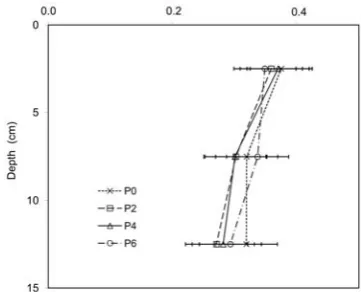
The tractor traffic significantly changed the root morpho-metric properties. However, the changes were noticed only in the upper, 0-5 cm, soil layer. The P6 and P4 treatments significantly increased root length in diameter range of 0.1-0.5 mm in comparison with the P0. The root length distri-bution in particular roots diameter classes is presented in Fig. 3. The highest RLD value, above 50 cm cm-3, was noti-ced at the P4 treatment. Whereas the RLD value at untreated control (P0) and the P2 treatment was below 40 cm cm-3. Below the depth of 5 cm the RLD was only 14 cm cm-3in average. The similar effect was also noticed for the RDM pa-rameter. Intensive wheel passes involved higher concentra-tion of dry root matter (0.011 g cm-3at the P6) in the 0-5 cm soil layer with respect to untreated control (0.007 g cm-3). The SRL was not altered by multiple passes and it varied from 6 337 cm g-1in the upper (0-5 cm) soil layer to above 12 430 cm g-1below 5 cm (Fig. 4). The mean value of the MD was 0.32 mm and it was also not affected by both, the soil depth and soil density caused by tractor traffic (Fig. 5). The lack of differences in the MD and SRL values indicated that traffic treatment applied did not change the root diameter.
The total annual yield of smooth-stalked meadow-grass was 8.1 t DM ha-1(Table 2). Three cuts were obtained every year and they were approximately 47, 33 and 21% of total IMPACT OF SOIL COMPACTION ON ROOT DEVELOPMENT AND YIELD OF MEADOW-GRASS 9
Treatment
Bulk density (g cm-3) Total porosity Penetration resistance (MPa)
2007 2008 2009 2007 2008 2009 2007 2008 2009
Soil depth 0-10 cm
P0 1.44 1.42 1.42 0.44 0.45 0.45 1.52 2.02 2.13
P2 1.48 1.50 1.49 0.42 0.41 0.42 2.40 2.64 2.29
P4 1.57 1.54 1.51 0.39 0.40 0.41 2.71 2.78 2.35
P6 1.64 1.60 1.55 0.36 0.38 0.40 3.26 3.26 2.51
Soil depth 10-20 cm
P0 1.46 1.43 1.43 0.43 0.44 0.44 1.44 1.69 2.51
P2 1.47 1.54 1.52 0.43 0.40 0.41 1.95 2.34 2.62
P4 1.52 1.58 1.55 0.41 0.38 0.40 2.41 2.41 2.57
P6 1.59 1.62 1.58 0.38 0.37 0.38 2.62 2.57 2.52
Soil depth 20-30 cm
P0 1.47 1.45 1.46 0.43 0.43 0.43 1.34 1.59 2.18
P2 1.51 1.48 1.48 0.41 0.42 0.42 1.91 2.17 2.35
P4 1.53 1.50 1.51 0.40 0.41 0.41 2.34 2.25 2.39
P6 1.53 1.47 1.50 0.40 0.42 0.42 2.56 2.41 2.32
LSD0.05 0.042 0.036 0.038 0.017 0.016 0.017 0.321 0.330 0.312
annual yield. There was significant interaction between treatment applied and the time of harvest. In the first cut it was observed that increase in number of passes increased the herbage production. The only exception was the first cut in 2007 when no significant differences between treatments were observed because this harvest was done before the first tractor traffic. In both, 2008 and 2009, the tractor traffic significantly increased the DM values during the first cut.
For the second and the third cut it was found that multiple passes decreased plant yields. For the second cut the DM of the P2 treatment was 92% in average with respect to the P0. At the P4 and P6 treatments it was 86 and 83%, respectively. This tendency for the third cut was very similar. In spite of this the total annual herbage production were not affected by traffic treatment applied. The yield decrease noticed during the second and third cuts was compensated by yield increase obtained during the first cut.
The results obtained in field trial indicated that tractor traffic significantly affect physical properties of soil in the 0-30 cm soil layer. The more intensive wheeling was applied the higher value of bulk density and penetration resistance but lower values of total porosity were recorded. This relation agree with earlier results (Pagliali et al., 2003).
After the first year of experiment the penetration resistance become stable on all treatments and did not change during 2008 and 2009. This effect was confirmed by Bouwman and Arts (2000) where the stabilization was reached after two years. In the second and third year of the experiment a de-creases in bulk density and penetration resistance were no-ticed in the upper, 0-10 cm, soil layer. The main reason for reduction in soil compaction was higher concentration of roots. Approximately 81% of the root dry matter (RDM) was noticed in the 0-5 cm layer. It was particularly identified in 2009 when root system was fully developed. This effect can be attributed to perennial plant roots and earthworms activity and is usually account for favourable changes in pore system. Bronick and Lal (2005) in their review indi-cated that plant roots and their rhizosphere had many favou-rable effects on soil aggregation. Roots and their exudates are responsible for physical, chemical and biological chan-ges that influence aggregation and soil structure. According to Wuest (2001) in compacted, untilled soil a number of biopores increased with respect to traditional tillage what played favourable role in decreasing soil compaction and root development because they predominately grow in existing biopores. These results were also confirmed by IMPACT OF SOIL COMPACTION ON ROOT DEVELOPMENT AND YIELD OF MEADOW-GRASS 11
Fig. 4.The effect of tractor traffic onPoa pratensisL. specific root length (SRL) distribution in three soil layers. Horizontal bars represent standard errors.
Fig. 5.The effect of tractor traffic onPoa pratensisL. root mean diameter (MD) distribution in three soil layers. Horizontal bars represent standard errors.
Treatment
Yield (t DM ha-1)
1st cut 2nd cut 3rd cut
2007 2008 2009 2007 2008 2009 2007 2008 2009
P0 3.59 3.24 4.05 2.89 2.85 3.13 1.70 2.51 1.91
P2 3.58 3.75 3.92 2.95 2.22 2.96 1.70 2.28 1.60
P4 3.59 3.63 4.46 2.75 2.02 2.87 1.62 2.33 1.28
P6 3.57 3.76 4.39 2.48 2.06 2.84 1.52 2.18 1.38
LSD0.05 n.s. 0.232 0.229 0.193 0.198 0.201 0.150 0.148 0.168
Hirth et al. (2005) who described the ability of Lolium perenneL. roots to penetrate biopores in compacted soil.
The roots of smooth-stalked meadow-grass were cha-racterized by high concentration in the upper soil layer (0-5 cm). According to Bengough and Mullins (1990) classi-fication, the roots ofPoa pratensisL. belong to root density class described as a ‘very dense’ (RLD >20 cm cm-3).
It has been reported that a common response of the root system to increasing bulk density is a decrease in root length and rooting becoming concentrated in the upper soil layer (Ball-Coello et al., 1998; Lipiec et al., 2003). However, these works concerned mainly annual species. The results ob-tained in the current experiment with perennial species did not confirm this trend. In the upper soil layer the compaction applied caused the increase in length and dry matter of roots. This positive correlation between soil density and roots cha-racteristics was also confirmed by Ball-Coelloet al. (1998). They stated that root length density was positively associa-ted with capillary pore space and aggregation. Increased bulk density can trigger lateral root formation, and in this way contribute to greater root development in the top 10 cm of compacted soil. Schoonderbeek and Schoute (1994) also found a negative relationship between high macroporosity (pores with diameter >30 ìm) and root length. In soil with greater macroporosity there were fewer roots than in com-pacted soil. In their study, horizontal cracking caused by wheel traffic compaction resulted in more horizontal root growth. The changes in root morphology described above were attributed to increased moisture conditions and greater soil strength that reduces elongation of root main axes and stimulates branching (Cannell and Hawes, 1994).
In the dry matter production it was observed that tractor traffic decreased plant yields during the second and third harvest. These results are confirmed by those obtained by author (G³¹b, 2008) who also noticed the similar yield decli-ne for lucerdecli-ne. However, in this study the opposite effect was noticed for the first harvest when the traffic treatment increased herbage production. It was probably the result of a long period of time between the first harvests in 2008 and 2009 and the third harvests and trafficking simulations in the previous years. During this time plants recovered from da-mage caused and regenerated shoots. The increase in yields during the first cut corresponds with results obtained in roots length and dry matter where higher values of the RLD and RDM were recorded in compacted soil. These results indi-cate that smooth-stalked meadow-grass root found the better growing condition in compacted soil than in a very porous. The results obtained in this study confirm the recent tenden-cy in smooth-stalked meadow-grass utilization. The signifi-cance of this species increased as a very important compo-nent in mixtures for sport and hard wear. This is ascribed to wear tolerance and capability to recover quickly from the under-ground rhizomes.
CONCLUSIONS
1. The bulk density and penetration resistance of soil under perennial grass increased with the increase in number of tractor passes.
2. During the three years of smooth-stalked meadow-grass cultivation the soil compaction slightly decreased, especially in the upper soil layer. This effect can be ascribed to the high root concentration.
3. The roots were significantly affected by tractor traffic only in 0-5 cm soil layer. The permanent tractor passes in-creased the dry matter and length of roots in diameter range of 0.1-0.5 mm.
4. It was noticed that increase in number of passes increased the plants yields in the first cut. During the second and the third cut it was found that multiple passes decreased plant yields. However, the tractor traffic did not result in any changes in smooth-stalked meadow-grass annual yields.
REFERENCES
Ball-Coelho B.R., Roy R.C., and Swanton C.J., 1998.Tillage alters corn root distribution in coarse-textured soil. Soil Till. Res., 45, 237-249.
Bengough A.G. and Mullins C.E., 1990. Mechanical impedance to root growth: a review of experimental techniques and root growth responses. J. Soil Sci., 41, 341-358.
Bouwman L.A. and Arts W.B.M., 2000. Effects of soil compac-tion on the relacompac-tionships between nematodes, grass pro-duction and soil physical properties. Appl. Soil Ecol., 14, 3, 213-222.
Bronick C.J. and Lal R., 2005. Soil structure and management: a review. Geoderma, 124, 3-22.
Cannell R.Q. and Hawes J.D., 1994. Trends in tillage practices in relation to sustainable crop production with special referen-ce to temperate climates. Soil Till. Res., 30, 245-282. Chen G. and Weil R.R., 2010. Penetration of cover crop roots
through compacted soils. Plant Soil, 331, 31-43.
Frost J.P., 1998.Effects on crop yields of machinery traffic and soil loosening. Part 1. Effects on grass yield of traffic fre-quency and date of loosening. J. Agric. Eng. Res., 39, 302-312.
Gajda J., 1997.Floristic composition of meadow in relation to fertilization under conditions of ground water optimal level. Proc. Int. Occasional Symp. EGF, May 19-23, Warszawa-£om¿a, Poland.
G³¹b T., 2005.The influence of roots of perennial legumes on the water retention of soil. Bericht uber die 11 Lysimetertagung, Lysimetrie Im Netzwerk Der Dynamik Von Okosystem, BAL Gumpenstein, Austria, 167-168.
G³¹b T., 2008.Effects of tractor wheeling on root morphology and yield of Lucerne (Medicago sativaL.). Grass Forage Sci., 63, 398-406.
G³¹b T. and Kopeæ S., 2009.Effect of soil compaction on root system morphology and yields of meadow fescue (Festuca pratensis). Polish J. Environ. Studies, 18/2, 219-225. Hamza M.A. and Anderson W.K., 2005.Soil compaction in
Hirth J.R., Mckenzie B.M., and Tisdall J.M., 2005. Ability of seedling roots ofLolium perenneL. to penetrate soil from artificial biopores is modified by soil bulk density, biopore angle and biopore relief. Plant Soil, 272, 327-336. IUSS Working Group WRB,2007.World Reference Base for Soil
Resources. World Soil Resources Reports 103, FAO Press, Rome, Italy.
Kristoffersen A.R. and Riley H., 2005. Effects of soil compac-tion and moisture regime on the root and shoot growth and phosphorus uptake of barley plants growing on soils with varying phosphorus status. Nutrient Cycling in Agro-ecosys., 72, 135-146.
Lipiec J., Medvedev V.V., Birkas M., Dumitru E., Lyndina T.E., Rousseva S., and Fulajtar E., 2003.Effect of soil compaction on root growth and crop yield in Central and Eastern Europe. Int. Agrophysics, 17, 61-69.
Milleret R., Le Bayon R.C., Lamy F., Gobat J.M., and Boivin P., 2009.Impact of roots, mycorrhizas and earthworms on soil physical properties as assessed by shrinkage analysis. J. Hydrol., 373, 499-507.
Pagliai M., Marsili A., Servadio P., Vignozzi N., and Pellegrini S., 2003.Changes in some physical properties of a clay soil in
Central Italy following the passage of rubber tracked and wheeled tractors of medium power. Soil Till. Res., 73, 119-129.
Schoonderbeek D. and Schoute J.F.T., 1994.Root and root-soil contact of winter wheat in relation to soil macroporosity. Agric. Ecosys. Environ., 51, 89-98.
Scott D.I., Tams A.R., Berry P.M., and Mooney S.J., 2005.The effects of wheel-induced soil compaction on anchorage strength and resistance to root lodging of winter barley (Hordeum vulgareL.). Soil Till. Res., 82, 147-160. Smucker A.J.M., Mc Burney S.L., and Srivastova A.K., 1982.
Quantitative separation of roots from compacted soil pro-files by the hydropneumatic elutriation system. Agron. J., 74, 500-503.
Statistical Yearbook, 2008. Central Statistical Office Press, Warsaw, Poland.
Whalley W.R., Watts C.W., Gregory A.S., Mooney S.J., Clark L.J., and Whitemore A.P., 2008.The effect of soil strength on the yield of wheat. Plant Soil, 306, 237-247.
Wuest S.B., 2001. Soil biopores estimation: effects of tillage, nitrogen and photographic resolution. Soil Till. Res., 62, 111-116.