Please cite this article as: J. Rezaeian Zeidi,M. Zarei, K. Shokoufi, Pareto-based Multi-criteria Evolutionary Algorithm for a Parallel Machines Scheduling Problem with Sequence-dependent Setup Times, International Journal of Engineering (IJE), TRANSACTIONS C: Aspects Vol. 30, No. 12, (December 2017) 1863-1869
International Journal of Engineering
J o u r n a l H o m e p a g e : w w w . i j e . i rPareto-based Multi-criteria Evolutionary Algorithm for a Parallel Machines
Scheduling Problem with Sequence-dependent Setup Times
J. Rezaeian Zeidi*,M. Zarei, K. Shokoufi
Department of Industrial Engineering, Mazandaran University of Science and Technology, Babol, Iran
P A P E R I N F O
Paper history: Received 28 October 2016
Received in revised form 07 August 2017 Accepted 08 September 2017
Keywords:
Multi-objective optimization Unrelated parallel machine Just-in-time scheduling
Controlled elitism non-dominated sorting genetic algorithm
Mixed-integer programming Sequence-dependent setup time
A B S T R A C T
This paper addresses an unrelated multi-machine scheduling problem with sequence-dependent setup time, release date and processing set restriction to minimize the sum of weighted earliness/tardiness penalties and the sum of completion times, which is known to be NP-hard. A Mixed Integer Programming (MIP) model is proposed to formulate the considered multi-criteria problem. Also, to solve the model for real-sized applications, a Pareto-based algorithm, namely controlled elitism non-dominated sorting genetic algorithm (CENSGA), is proposed. To validate its performance, the algorithm is examined under six performance metric measures, and compared with a Pareto-based algorithm, namely NSGA-II. The results are statistically evaluated by the Mann–Whitney test and t-test methods. From the obtained results based on the t-test, the proposed CENSGA significantly outperforms the NSGA-II in four out of six terms. Additionally, the statistical results from Mann– Whitney test show that the performance of the proposed CENSGA is better than the NSGA- II in two out of six terms. Finally, the experimental results indicate the effectiveness of the proposed algorithm for different problems.
doi: 10.5829/ije.2017.30.12c.07
1. INTRODUCTION1
In real manufacturing environments, managers often face several criteria and try to find the best solution that satisfies all the considerations. In most of the cases, the desired objectives are conflicting and managers require to optimize these conflicting objectives simultaneously. Hence, developing multi-objective models and algorithms are essential.
One of the well-known objective functions in multi-machine scheduling is to minimize total weighted earliness/tardiness penalties, in which jobs should be finished at times as near as possible to due dates. On the other hand, reducing the completion times causes a reduction in the number of total works-in-process (WIP) inventories. Therefore, decreasing the completion times is also one of the important objective functions [1].
Behnamian et al. [2] proposed a new hybrid meta-heuristic algorithm to solve the parallel machines
* Corresponding Author’s Email: [email protected] (J. Rezaeian
Zeidi.)
scheduling problem with two objectives, namely makespan and sum of the earliness and tardiness of jobs. Zarandi and Keyvanfar [3] considered a bi-objective scheduling problem on identical parallel machines to minimize the total costs of earliness and tardiness as well as makespan. They applied a non-dominated sorting genetic algorithm II (NSGA-II) and non-dominated ranked genetic algorithm (NRGA).
Lin et al. [4] proposed two heuristics and a genetic algorithm (GA) to find non-dominated solutions to multi-objective unrelated parallel machine scheduling problems. Tavakkoli-Moghaddam et al. [5] presented a new mathematical model and a meta-heuristic method based on a GA for a multi-criteria unrelated parallel machine scheduling problem minimizing the total earliness and tardiness penalties as well as machine costs.
Tavakkoli-Moghaddam [7] presented an algorithm based on a multi-objective immune system (MOIS) for a bi-objective flow shop scheduling problem with sequence-dependent setup times to minimize the total completion time and the total earliness/tardiness for all jobs.
Most of the studies have considered single-criteria algorithms. However, a new scheme of the multi-criteria algorithms has been proposed recently. These algorithms do not transform a multi-criteria problem to a single criterion one that more intensity to lead a multi-criteria procedure [8]. The NSGA-II proposed by Deb [8]is one the most well-known algorithms in this category. A controlled based version of the NSGA-II is called a controlled elitism NSGA (CENSGA) [9].
Li et al. [10] considered the problem Pm| ri, sij|(Cmax, ∑Tj) and proposed the NSGA-II and strength Pareto evolutionary algorithm (SPEA-II). Fakhrzad et al. [11] presented a multi-objective hybrid GA for job shop scheduling with sequence-dependent setup times. The objectives are to minimize the makespan and the sum of the earliness/tardiness of jobs. They compared their algorithm with an SPEA-II. Rahmati [12] proposed the Pareto-based CENSGA for the multi-objective flexible job shop scheduling problem.
This paper addresses a multi-objective scheduling problem with sequence-dependent setup times, different release dates of jobs and processing set restrictions on m unrelated-parallel machines to minimize the total weighted earliness/tardiness penalties and the total of completion times, simultaneously.
According to the best of our knowledge, there exists no accomplished research on a multi-objective unrelated parallel machines environment considering both the total weighted earliness/tardiness penalties and the total of completion times. Following, the notation system introduced by Graham et al. [13], this problem is denoted as R| rj, sij, Mj| (∑αjEj+βjTj, ∑Cj) that is known to be strongly hard because the sub-problem is NP-completeness [1].
The donation of our study is to propose first a MIP model. Second, we apply the CENSGA for searching Pareto-optimal solutions. Then, the proposed algorithm is compared with a benchmark based on the NSGA-II.
The rest of the paper is organized as follows. In Section 2, problem definition and notations are introduced, and then a new mathematical model is proposed. Section 3 describes the proposed multi-objective GA and solution methodology. Section 4 shows the experimental results. Finally, the conclusion and further studies are presented in Section 5.
2. PROBLEM DESCRIPTION
In this study, the problem of scheduling n different jobs on m unrelated-parallel machines is considered.
Preemption is not allowed. All machines are not capable of processing all jobs. All jobs are not available for processing at time zero. The sequence-dependent setup time is considered. At any time, each machine can process at most one job, and each machine can only process one job at the same time.Also, processing times and due dates are deterministic. The test time is included in the processing time.
2. 1. Indices and Parameters
𝑛 : Number of jobs
𝑚 : Number of machines
𝑖 : Machine index (𝑖 = 1,2, … , 𝑚)
𝑗, 𝑘 : Job index (𝑗, 𝑘 = 0,1,2, … , 𝑛)
𝑝𝑖𝑗 : Processing time of job j on machine i
dj: Due date of job j 𝑅𝑗 : Release date of job j
𝑆𝑖𝑗𝑘 : Past-sequence-dependent setup time of job j if job
k precedes job j
𝛼𝑗 : Earliness penalty for job j
𝛽𝑗: Tardiness penalty for job j
𝑆𝑡𝑗 : Start time of job j
𝑎𝑖𝑗 : 1 if job j can be processed by machine i; 0,
otherwise
2.2. Decision Variables
𝑥𝑖𝑗 : 1 if job j is processed on machine i; otherwise 0
𝑦𝑗𝑘 : 1 if job k has been scheduled right after job j; 0,
otherwise
𝐶𝑗 : Completion time of job j
𝑧𝑗 : 1 if job j is processed on machine m; 0, otherwise
𝐸𝑗 : Earliness of job j
𝑇𝑗 : Tardiness of job j
2. 3. Mathematical Model The considered problem can be formulated by using the following MIP model:
Min ∑𝑛𝑗=1𝛼𝑗𝐸𝑗+ ∑𝑛𝑗=1𝛽𝑗𝑇𝑗 (1)
Min ∑𝑛𝑗=1𝐶𝑗 (2)
s.t.
∑𝑚𝑖=1𝑥𝑖𝑗= 1 (3)
∑𝑛𝑗=0𝑦𝑗𝑘= 1 (4)
∑𝑚𝑘=0𝑦𝑗𝑘 ≤ 1 (5)
𝑦𝑗𝑘≤ 1 − 𝑥𝑖𝑗+ (1 − ∑𝑖′≠𝑖𝑥𝑖′𝑘) (6)
𝑥𝑖𝑗≤ 𝑎𝑖𝑗 (7)
𝑆𝑡𝑘≤ ∑𝑖=1𝑚 𝑆𝑗𝑘𝑖. 𝑥𝑖𝑘+ 𝐶𝑗− 𝑀. [(1 − 𝑦𝑗𝑘) + (1 − 𝑧𝑘) (9)
𝑆𝑡𝑘≥ 𝑅𝑘 (10)
𝑆𝑡𝑘≤ 𝑅𝑘+ 𝑧𝑘. 𝑀 (11)
𝐶𝑗= 𝑆𝑡𝑗+ ∑𝑚𝑖=1𝑥𝑖𝑗∗ 𝑃𝑖𝑗 (12)
𝐶𝑗+ 𝐸𝑗− 𝑇𝑗= 𝑑𝑗 (13)
𝑥𝑖𝑘, 𝑦𝑗𝑘∈ {0,1} (14)
𝐶𝑗, 𝐸𝑗, 𝑇𝑗≥ 0, 𝑗, 𝑘 = 0,1,2, … , 𝑛,𝑖 = 1,2, … , 𝑚 (15)
Equations (1) and (2) represent the objective functions, which aim to minimize the weighted sum of earliness/tardiness penalties cost and the sum of completion time. Equation (3) ensures that each job is scheduled only once and processed by one machine. Equations (4) to (6) ensure that each job (but not the last scheduled job) must come immediately before, and each job (but not the first scheduled job) must come immediately after only one other job. It is assumed a dummy job 0, which always presents at the first position on each machine. Equation (7) ensures that each job is assigned to one of the machines. With regards to release dates and setup times of jobs, Equations (8) to (12) calculate the completion time of each job. Equation (13) indicates the relation between earliness and tardiness for each job.
3. NSGA-II AND CENSGA
The NSGA-II attempts to find Pareto-optimal solutions in a multi-objective optimization problem. This algorithm uses an elitist principle and emphasizes non-dominated solutions [2, 8].
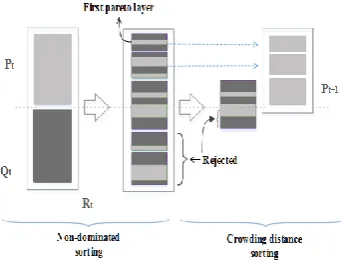
The NSGA-II uses a crowding distance in their selection to maintain diversity. The mechanism is illustrated in Figure 1, where Pt indicates the main population at iteration t [12]. A mating pool is created and binary tournament selection with replacement is used to fill the mating pool, in which two solutions are selected randomly from the population and then the better solution is chosen. The one with a higher crowding distance is selected if the solutions have the same rank and the one with a lower rank is selected if the solutions are from different ranks [12].
In a mating pool, it creates a new population Qt by using the main operators, namely crossover and mutation. To create a larger population Rt, main and new populations are merged. For inserting a dominance concept in the NSGA-II and CENSGA, fast non-dominated sorting (FNDS) is used for searching the objective of Pareto-based algorithms, which is good convergence. FNDS is performed and the solutions in Rt
are sorted. The less value of FNDS means a better rank. To create the main population with the same size as Pt, it is needed to perform a selection operation [12].
The CENSGA is a developed version of the popular NSGA-II [8]. Most of the CENSGA’s operators are designed, like NSGA-II. The major difference of the CENSGA with the NSGA-II is a selection strategy, in which CENSGA participates all fronts in selection through a geometric distribution [12]. See the CENSGA schematically in [8].
3. 1. Chromosome Representation Chromosome representation determines how the problem is structured in the GA. For representing chromosomes, we use binary coding. Chromosomes are made of zero-one genes. Genes encode two pieces of information, a job and the number of the machine selected for its processing. Each gene is represented by a pair of numbers (0, 1), while 1 denotes the job being assigned to the corresponding machine and 0 means that a job is not assigned to that machine. The initial chromosomes are created and developed at random. The introduced chromosome contains all the jobs assigned to each machine and machines assigned to each job.
3. 2. Selection Method and Elitism Another operator called a crowing distance (CD) is considered, which finds the distance between each individual in a front based on their m objectives in m-dimensional solutions space [8]. The NSGA-II and CENSGA use crowding distances in their selection to maintain diversity. A crowding distance is a measure of the objective space and is defined for solutions of the same rank.
Among two solutions with the same rank, the one with a higher crowding distance is preferable. A binary tournament selection is performed according to these two operators. The CENSGA is a developed version of the NSGA-II, in which a specific selection is done such that all fronts participate in the selection strategy [8]. This process is controlled by a geometric distribution (see Figure 2).
Equation (16) formulates this distribution. In this equation, 𝑛𝑖 denotes the maximum number of the
allowed individuals in the i-th front and r denotes the reduction rate (r<1). Allowed individuals in the i -thfront and r denote the reduction rate (r <1) [8].
𝑛𝑖= 𝑟. 𝑛𝑖−1 (16)
It is also worth to be mentioned, in a population of size N, the maximum number of individuals, which is allowed in each front (𝑖 = 1,2, … , 𝑘) is calculated by [8]:
𝑛𝑖= 𝑁
1−𝑟
1−𝑟𝑘𝑟𝑖−1 (17)
3. 3. Crossover Operator The crossover operation generates offspring by combining two chromosomes’ features. It has been shown in the literature that a uniform crossover works better than one- and two-point crossovers [14]. In order to do that, two chromosomes of the current generation are selected. A vector of a random number between 0 and 1 should be generated. For each gen of the chromosome, if this vector value is less than 0.7, the gen from the “first” chromosome is copied to the new chromosome; otherwise, the gen from the “second” chromosome is selected (see Figure 3) [15].
Figure 2. Selection strategy of CENSGA vs. NSGA-II
(a) Parent 1
2.33 1.67 2.53 2.33 0.10 0.50 2.33 0.03
0.70 0.90 0.78 0.23
(b) Parent 2
3.34 1.44 2.69 0.36 0.10 0.48 0.79 0.54
0.28 0.36 0.14 0.58
(c) Random numbers 0.45 0.83 0.68 0.75
(d) Offspring
2.33 1.44 2.53 0.23 0.10 0.50 0.23 0.54
0.70 0.36 0.78 0.58
Figure 3. Uniform crossover example
3. 4. Mutation Operator A mutation operator ensures that diversity is maintained in the population which prevents the GA from becoming trapped in ‘blind corners’ or ‘local optima’ during the search. Here, a random mutation approach is used. A gene is selected randomly and replaced with a different random number in allowed bounds.
4. EXPERIMENTAL RESULTS
This section investigates the effectiveness of the proposed algorithm and its priority to the NSGA-II. To present the efficiency of the proposed algorithm, different sets of inputs are tested. For each method, each instance is implemented 10 times and the average value of the 10 runs is considered. The algorithms are written by Matlab software on a PC with 4 GB RAM and 2.5 GHz CPU. The population and iteration size in all test problems are set to 200 and 100, respectively. Pc=85% (i.e., crossover rate), and Pm=10% (i.e., mutation rate). In the following sub-sections, the computational results of the algorithm on some multi-objective performance metrics are presented.
4. 1. Evaluation Metric A conflicting nature of Pareto archive’s solutions makes us use some performance measures to have a better assessment of the proposed algorithm. So, six performance metrics are taken into account.
4. 1. 1. Mean Ideal Distance (MID) This measure presents the closeness between a Pareto solution and ideal point (0, 0), which can be shown as:
𝑀𝐼𝐷 =∑𝑛𝑖=1𝑐𝑖
𝑛 (18)
where n is the number of non-dominated set and 𝑐𝑖=
√𝑓1𝑖2+ 𝑓2𝑖2, and 𝑓1𝑖2, 𝑓2𝑖2are the value of i-th
non-dominated solution for the first and second objective functions, respectively [15].
4. 1. 2. Rate of Achievement to All Responses Simultaneously (RAS) It balances in reaching to objective functions [15].
𝑅𝐴𝑆 =∑ (
𝑓1𝑖−𝐹𝑖
𝐹𝑖 )+(
𝑓2𝑖−𝐹𝑖
𝐹𝑖 )
𝑛 𝑖=1
𝑛
(19)
where 𝐹𝑖= min{ 𝑓1𝑖, 𝑓2𝑖}, [16]
4. 1. 3. Spread of Non-dominance Solution (SNS) It is a diversity measure of Pareto archive solutions [15].
𝑆𝑁𝑆 = √∑𝑛𝑖=1(𝑀𝐼𝐷−𝑐𝑖)2
4. 1. 4. Spacing (S) This metric introduced by Schott [17] is used for measuring the extent of spread among the obtained solutions. It is formulated by:
𝑆 = √1
|𝑛|∑ (𝑑𝑖− 𝑑̅)
2 𝑛
𝑖=1 (21)
where 𝑑𝑖= min⏟
k∈n,𝑘≠1∑ |𝑓𝑚
𝑖 − 𝑓
𝑚𝑘|, 2
𝑚=1 𝑑̅ = ∑
𝑑𝑖 |𝑛| 𝑛
𝑖=1 is
the mean of all 𝑑𝑖, and n denotes the size of the Pareto
front [18].
4.1.5. Number of Pareto Solution (NPS) This metric is used to show the number of Pareto-optimal solutions obtained by each of the meta-heuristic algorithms [18].
4. 1. 6. RUN TIME (RT) This measure presents the computational time of meta-heuristic algorithms to obtain optimal solutions.
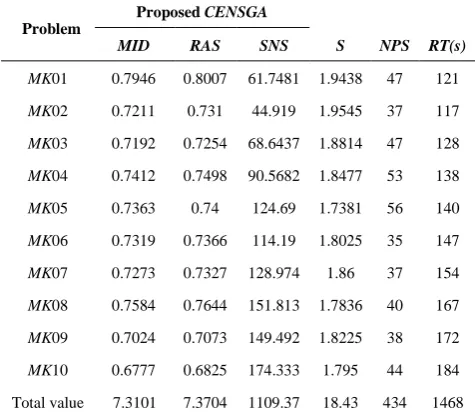
4. 2. Computational Results By using data given in some related articles (e.g., [1]) that are simplified models of this paper, we apply this algorithm to a number of test problems and examples. The outputs of the mentioned metrics are shown in Tables 1 and 2. Also, it should be noticed that for the SNS and NPS, big values are better, while as for the MID, RAS, RT and S, small values are better.
Now, in a total view to summarized results presented in the last row of Tables 1 and 2, the CENSGA has a better value of the MID, RAS, SNS, NPS and RT measures while as NSGA-II just has a better value of the S measure. These results are evaluated statistically by the means of Mann–Whitney test and t-test [19]. Outputs of these statistical tests are shown in Tables 3 and 4.
TABLE 1. Results of CENSGA on multi-objective metrics
Problem
Proposed CENSGA
MID RAS SNS S NPS RT(s)
MK01 0.7946 0.8007 61.7481 1.9438 47 121
MK02 0.7211 0.731 44.919 1.9545 37 117
MK03 0.7192 0.7254 68.6437 1.8814 47 128
MK04 0.7412 0.7498 90.5682 1.8477 53 138
MK05 0.7363 0.74 124.69 1.7381 56 140
MK06 0.7319 0.7366 114.19 1.8025 35 147
MK07 0.7273 0.7327 128.974 1.86 37 154
MK08 0.7584 0.7644 151.813 1.7836 40 167
MK09 0.7024 0.7073 149.492 1.8225 38 172
MK10 0.6777 0.6825 174.333 1.795 44 184 Total value 7.3101 7.3704 1109.37 18.43 434 1468
TABLE 2. Results of NSGA-II on multi-objective metrics
Problem Proposed NSGA-II
MID RAS SNS S NPS RT(s)
MK01 0.7946 0.8007 61.7481 1.9637 12 269
MK02 0.7211 0.731 44.919 1.939 15 258
MK03 0.7192 0.7254 68.6437 1.9264 15 287
MK04 0.7412 0.7498 90.5682 1.8216 34 295
MK05 0.7363 0.74 124.69 1.7202 25 299
MK06 0.7319 0.7366 114.19 1.7624 26 315
MK07 0.7273 0.7327 128.974 1.6989 28 325
MK08 0.7584 0.7644 151.813 1.738 30 352
MK09 0.7024 0.7073 149.492 1.7296 21 361
MK10 0.6777 0.6825 174.333 1.6238 20 393 Total value 7.3101 7.3704 1109.37 17.9236 226 3154
TABLE 3. Statistical comparison of the proposed algorithms by using the Mann–Whitney test
Measures
Mann–Whitney test
P-value Result Final Result
MID 0.075 H0 isn’t rejected - RAS 0.089 H0 isn’t rejected - SNS 0.909 H0 isn’t rejected - S 0.162 H0 isn’t rejected - RT 0.000 H0 is rejected CENSGA NPS 0.000 H0 is rejected CENSGA
TABLE 4. Statistical comparison of the proposed algorithms by using the t-test
Measures t-test
p-value Result Final Result
MID 0.028 H0 is rejected CENSGA RAS 0.027 H0 is rejected CENSGA SNS 0.959 H0 is not rejected -
S 0.255 H0 is not rejected - RT 0.000 H0 is rejected CENSGA NPS 0.000 H0 is rejected CENSGA
The Mann–Whitney test, as a non-parametric alternative to the two-sample t-test is used for testing the equality of two population medians. On the other hand, the t-test performs a parametric hypothesis test for evaluating equality of two population means [18].
and NPS measures. But in terms of SNS and S, the two algorithms are not statistically different, which means the t-test does not reject the null hypothesis of equality the CENSGA and NSGA-II. In addition, the statistical results from the Mann–Whitney test indicate that the performance of the CENSGA is better than the NSGA-II in the terms of RT and NPS, and in the remained measures, the two algorithms are not statistically different. So in total, the proposed CENSGA is more efficient than the NSGA-II and recommended for the problem.
In this research, in order to exhibit real-world situation, a bi-objective scheduling problem is formulated, which simultaneously minimizes (1) the total cost of earliness/tardiness and (2) the total of completion times or flow time. In practice, the usage of both objectives is well-justified, the first objective
actually focuses on the make-to-order (MTO)
philosophy in supply chain management and production theory: an item should be delivered exactly when it is required by the customer, and the second one is related to WIP inventory and rapid turn-around of jobs.
5. CONCLUSION AND FUTURE STUDIES
This paper considered the multi-objective problem of scheduling unrelated parallel machines to minimize the total weighted earliness, tardiness penalties and the sum of completion times. In this paper, a Pareto-based algorithm, called CENSGA, was implemented for solving an unrelated parallel machines scheduling problem with sequence-dependent setup times and release date. Then, this algorithm was compared with the benchmark algorithm, namely NSGA-II, on some multi-objective metrics. These metrics were also analyzed statistically by the means of the comparison test. Computational results show that the obtained solutions of the proposed CENSGA are better than the NSGA-II in this field of scheduling problems.
In the future research, it may be desirable to apply other meta-heuristic algorithms to our problem and compare outcomes on this topic. In addition, presenting other performance metrics can be advantageous for this algorithm.
6. REFERENCES
1. Tavakkoli-Moghaddam, R., Taheri, F. and Bazzazi, M., "Multi-objective unrelated parallel machines scheduling with sequence-dependent setup times and precedence constraints",
International Journal of Engineering, Transactions A: Basics,
Vol. 21, No. 3, (2008), 269-278.
2. Behnamian, J., Zandieh, M. and Ghomi, S.F., "Bi-objective parallel machines scheduling with sequence-dependent setup times using hybrid metaheuristics and weighted min–max technique", Soft Computing, Vol. 15, No. 7, (2011), 1313-1331.
3. Zarandi, M.F. and Kayvanfar, V., "A bi-objective identical parallel machine scheduling problem with controllable processing times: A just-in-time approach", The International
Journal of Advanced Manufacturing Technology, Vol. 77, No.
1-4, (2015), 545-563.
4. Lin, Y.-K., Fowler, J.W. and Pfund, M.E., "Multiple-objective heuristics for scheduling unrelated parallel machines",
European Journal of Operational Research, Vol. 227, No. 2,
(2013), 239-253.
5. Tavakkoli-Moghaddam, R., Jolai, F., Khodadadeghan, Y. and Haghnevis, M., "A mathematical model of a multi-criteria parallel machine scheduling problem: A genetic algorithm (research note)", International Journal of
Engineering-Transactions A: Basics, Vol. 19, No. 1, (2006), 79-86.
6. Tavakkoli-Moghaddam, R., Taheri, F., Bazzazi, M., Izadi, M. and Sassani, F., "Design of a genetic algorithm for bi-objective unrelated parallel machines scheduling with sequence-dependent setup times and precedence constraints", Computers &
Operations Research, Vol. 36, No. 12, (2009), 3224-3230.
7. Amin-Tahmasbi, H. and Tavakkoli-Moghaddam, R., "Solving a bi-objective flowshop scheduling problem by a multi-objective immune system and comparing with spea2+ and spga",
Advances in Engineering Software, Vol. 42, No. 10, (2011),
772-779.
8. Deb, K., "Multi-objective optimization using evolutionary algorithms, John Wiley & Sons, Vol. 16, (2001).
9. Zitzler, E. and Thiele, L., "Multiobjective optimization using evolutionary algorithms—a comparative case study", in international conference on parallel problem solving from nature, Springer., (1998), 292-301.
10. Li, X., Amodeo, L., Yalaoui, F. and Chehade, H., "A multiobjective optimization approach to solve a parallel machines scheduling problem", Advances in Artificial
Intelligence, Vol. 2010, (2010), 1-10.
11. Fakhrzad, M., Sadeghieh, A. and Emami, L., "A new multi-objective job shop scheduling with setup times using a hybrid genetic algorithm", International Journal of
Engineering-Transactions B: Applications, Vol. 26, No. 2, (2012), 207-218.
12. Rahmati, S.H.A., "Proposing a pareto-based multi-objective evolutionary algorithm to flexible job shop scheduling problem",
World Academy of Science, Engineering and Technology, International Journal of Mechanical, Aerospace, Industrial,
Mechatronic and Manufacturing Engineering, Vol. 6, No. 1,
(2012), 316-321.
13. Graham, R.L., Lawler, E.L., Lenstra, J.K. and Kan, A.R., "Optimization and approximation in deterministic sequencing and scheduling: A survey", Annals of discrete mathematics, Vol. 5, (1979), 287-326.
14. Chaudhry, I.A. and Drake, P.R., "Minimizing total tardiness for the machine scheduling and worker assignment problems in identical parallel machines using genetic algorithms", The
International Journal of Advanced Manufacturing
Technology, Vol. 42, No. 5, (2009), 581-594.
15. Karimi, N., Zandieh, M. and Karamooz, H., "Bi-objective group scheduling in hybrid flexible flowshop: A multi-phase approach", Expert Systems with Applications, Vol. 37, No. 6, (2010), 4024-4032.
16. Rodriguez, F.J., Lozano, M., Blum, C. and GarcíA-MartíNez, C., "An iterated greedy algorithm for the large-scale unrelated parallel machines scheduling problem", Computers &
Operations Research, Vol. 40, No. 7, (2013), 1829-1841.
18. Chambari, A., Rahmati, S.H.A. and Najafi, A.A., "A bi-objective model to optimize reliability and cost of system with a choice of redundancy strategies", Computers & Industrial
Engineering, Vol. 63, No. 1, (2012), 109-119.
19. Hollander, M., Wolfe, D.A. and Chicken, E., "Nonparametric statistical methods, John Wiley & Sons, (2013).
Pareto-based Multi-criteria Evolutionary Algorithm for Parallel Machines Scheduling
Problem with Sequence-dependent Setup Times
J. Rezaeian Zeidi,M. Zarei, K. Shokoufi
Department of Industrial Engineering, Mazandaran University of Science and Technology, Babol, Iran
P A P E R I N F O
Paper history: Received 28 October 2016
Received in revised form 07 August 2017 Accepted 08 September 2017
Keywords:
Multi-objective optimization Unrelated parallel machine Just-in-time scheduling
Controlled elitism non-dominated sorting genetic algorithm
Mixed integer programming Sequence-dependent setup time
ديكچ ه
نیا نیشام هلئسم ،قیقحت یاه
یزاوم طبترمان اب نامز هدامآ یزاس هتسباو هب ،یلاوت نامز سرتسد و اهراک تیدودحم شزادرپ
دروم ار اهراک هنیمک ،فده .تسا هداد رارق هعلاطم
هنیزه ینزو عومجم یزاس درک دوز یاه
نینچمه و اهراک درک رید و
هنیمک نامز عومجم یزاس یم اهراک لیمکت یاه
هئارا طلتخم حیحص ددع یطخ لدم کی ،رظن دروم هلئسم یارب .دشاب
لئاسم هتسد رد هلئسم هک ییاجنآ زا نینچمه .تسا هدش هدیدرگ
NP-Hard
،یعقاو هزادنا رد لئاسم لح یارب ،دراد رارق
مان اب وتراپ رب ینتبم متیروگلا کی
CENSGA
متیروگلا اب یدرکلمع رایعم شش رد هدش هئارا متیروگلا .تسا هدش هئارا
NSGA-II
تسدب جیاتن .تسا هدش هتفرگ رارق یجنس رابتعا و هسیاقم دروم نیگنایم شیامزآ طسوت یرامآ تروص هب هدمآ
Mann–Whitney
شیامزآ و
t
هدش هداد رارق یبایزرا دروم زا لصاح جیاتن .تسا
شیامزآ
t
یم ناشن متیروگلا هک دهد
CENSGA
متیروگلا هب تبسن یرتهب درکلمع یهجوت لباق روط هب رایعم شش زا رایعم راهچ رد
NSGA-II
.تسا هتشاد
نیگنایم شیامزآ زا لصاح یرامآ جیاتن ،نینچمه
Mann–Whitney
یم ناشن متیروگلا درکلمع هک دهد
CENSGA
رد
متیروگلا درکلمع زا رتهب رایعم شش زا رایعم ود
NSGA-II
هدوب تسا
.
هدنهد ناشن یبرجت تاشیامزآ جیاتن ،ورنیا زا
یم فلتحم لئاسم یارب هدش یفرعم متیروگلا لااب ییاراک .دشاب