Please cite this article as: M. Yaghoubi, M. Zahedi, Cycle Time Reduction and Runtime Rebalancing by Reallocating Dependent Tasks, International Journal of Engineering (IJE), TRANSACTIONS C: Aspects Vol. 30, No. 12, (December 2017) 1831-1839
International Journal of Engineering
J o u r n a l H o m e p a g e : w w w . i j e . i rCycle Time Reduction and Runtime Rebalancing by Reallocating Dependent Tasks
M. Yaghoubi*a,b, M. Zahedib
a Computer Engineering Department, Faculty of Engineering, Golestan University, Iran b Computer & IT Engineering Department, Shahrood University of Technology, Shahrood, Iran
P A P E R I N F O
Paper history:
Received 24 April 2017
Received in revised form 09 July 2017 Accepted 08 September 2017
Keywords: Business Process Cycle Time Workload Balancing Resource Allocation Dependent Tasks Task Concurrency
A B S T R A C T
Business Process Management Systems (BPMS) is a complex information system that provides designing, administrating, and improving the business processes. Task allocation to human resources is one of the most important issues which should be managed more efficiently in BPMS. Task allocation algorithms are defined in order to meet the various policies of organizations. The most important of these policies could be reducing the average cycle time, balancing the resource workload, increasing the product quality and minimizing the production costs. Therefore, choosing an appropriate resource in task allocation algorithms could influence on overall policy of the organization. In heavy load conditions or when the number of human resources is limited, workload balancing can increase the stability of the system. In this paper, a task allocation algorithm is proposed to rebalance the resource workload in runtime while minimizing cycle time by offering dependent pair tasks to resources for concurrent processing. The experimental results show that the combination of previous algorithms with the proposed algorithms would have 4.42% reduction in cycle time in contrast to most efficient state-of-the-art algorithms.
doi: 10.5829/ije.2017.30.12c.03
1. INTRODUCTION1
Development and productivity of many companies and organizations are growing rapidly. Although this development is achieved through the use of novel technology and advanced skills in management, the strong competitions in the global market cannot be avoided. Companies and organizations which are working in a field of global trade should benefit from new ways of customer orientation and management of business processes to retain and increase their customers. Therefore, BPMS provides to better manage of the business processes [1-3]. BPMS makes for users to have an intelligent management on business processes. While the older tools of workflow management systems (WFMS) provide development, execution and management of business processes, BPMS can also provide the possibility to manage the interaction between processes and it is more compatible with process models with reality [3, 4]. In this study, we propose that the dependent tasks to be distributed
*Corresponding Author’s Email: [email protected] (M. Yaghoubi)
according to expertise and ability of resources by creating balance in the workload of service agents (resources) and managing diversity and dependency of tasks, which are assigned in worklist of each resource. Appropriate allocation of tasks alongside balancing the workloads can reduce the delivery time (cycle time) of requests in the business process. To achieve this goal, we use the history of process executions by looking events log and provide a more appropriate distribution of tasks to the work list of resources by extracting information of "concurrent performing of tasks". The main idea of this article is based on statistical analysis of the history of events log from previous performances of the business process. While techniques such as modeling on queuing networks [5-9], reinforcement learning models [10] and stochastic models [8, 11, 12] have been used in many studies conducted.
2. RELATED WORKS
maintaining the length of the worklists of resources from not violating a specified size of usually a long given time [13]. A technique to increase the system stability is the resource workload balance, especially when the number of service provider resources is limited. This technique is used in various fields in industry and computer science. Among them, distributed systems and parallel computing [14], grid computing [15] and database management system [16] could be noted. The technique has also been used in workflow management systems [10, 17-27].
Annually, costly researches are done to reduce the cycle time in manufacturing plants; one of them is the research carried out on open issue of Job shop scheduling, which aims to create an optimal scheduling for minimizing flow time [28-30]. The result of this research can be used in the business process management systems and while the problems defined in BPMS become complex due to the probabilistic nature and its interaction with human activities.
In general, a major factor in the efficiency of implementing business processes can be known in the way of task allocation to resources. FIFO (First in First Out), SPT (Shortest Processing Time), EDD (Earliest Due Date) and MST (Minimum Slack Time) are among the simplest techniques provided [31]. The advantage of these basic methods is that they can be easily used in any system or combined with other more complex methods. Another factor which can be raised is the use of ability and expertise information of resources during the assigning tasks to agents [10, 17, 18, 32]. This approach indirectly tries to create a kind of priority in task allocation according to role of resources, which collectively improves the performance of allocation algorithm in the selection of appropriate resource, but it decreases the flexibility of allocation algorithm in free choice of human resources.
2. 1. Cycle time Reduction as an Objective There exist some papers which considered cycle time reduction as their objective [17, 21, 33]. Xingmei Liu et al. [33] showed their technique reduces the cycle time by extracting social relation between resources involved with each trace as a parameter in reinforcement learning algorithm for task allocation problem. They have examined their own algorithms on BPI Challenge 2012 dataset. They showed that considering social relations lead to cycle time reduction [33-35]. Muehlen et al. [21] have outlined the major aspects of resource management within workflow applications, following the workflow life cycle. They presented a generic resource Meta model for the initial specification of the resource structure and its population, which combines workflow-oriented with organization-oriented modeling concepts. Finally, they presented strategies for the use of workflow audit trail data to improve resource
utilization and develop new process strategies. Xu et al. [17] presented a resource allocation method, which minimized process cost under the limited time constraint. A resource selection rule is presented in the study of Nisafani et al. [23] which considers factors such as workload, queue, working hours, inter-arrival time, and others which affect human resource performance. They used a Bayesian Network (BN) to incorporate those factors into a single model, which we have called the Bayesian Selection Rule (BSR). They show that the BSR can reduce waiting time, completion time and cycle time. The study of Wibisono et al. [24] proposes an on-the-fly performance-aware resource allocation to manage human resources in BPM. They utilize Naïve Bayes Model in the Naïve Bayes Selection Rule (NBSR) algorithm in order to select an appropriate resource to perform an incoming task. The study of Kumar et al. [34] introduced a novel and more sophisticated mechanism to distribute work than the ones that are currently employed in workflow systems. Compared to existing workflow management systems which provide pure push or pull approaches, the mechanism allows on-the-fly balancing of quality and performance considerations. It merges work distribution and delegation into an integrated framework.
2. 2. Workload Balancing as an Objective There are some papers which considered workload balancing as their objective [17, 21, 33]. Although cycle time reduction is an important issue in BPM, some workload balancing mechanisms have emerged to resolve the limitation of resources’ abilities [25, 35].
The papers presented by Byung-Hyun Ha et al. [22] showed that the balancing of resources’ workloads makes it more resistant to the increased volume of customers’ incoming requests. Larbi et al. [35] presented a model to solve scheduling problem in identical parallel machines. They solve load balancing in parallel machines by mapping strategy to time Petri-net. Byung-Hyun Ha et al. [25] presented a method for workload balancing of agents that perform the tasks in the business process. They used an analytic process model based on process specification and execution history data. They then used a queuing network built from the analytic process model in order to establish task assignment policies for the efficient execution of the business process. After that, as a practical use of the queuing network, workload balancing is presented to improve overall business process efficiency using a linear programming formula. Finally, a set of simulation experiments is conducted in order to validate the performance with respect to using shared work lists [22, 25].
problems which is modeled as Markov Decision Processes (MDPs) and queuing network in the literature [10, 25, 33]. Since resource allocation in BPMS is an interactive problem, reinforcement learning would be an appropriate option to solve the corresponding MDP problem. Ly et al. discovered the task allocation rules from event log and organizational structure by using the decision tree algorithm. They considered process performers and type of activities as input, and whether participants are involved in activities as classification results, to learn the resource allocation model inductively. They concentrated on a process mining from resource perspective such as staff assignment rules extraction. They have shown the problem of deriving staff assignment rules using information from audit trail data and organizational information. Ly et al. [36] have used decision tree learning to derive meaningful staff assignment rules. Thus, it is possible to provide staff assignment information about activities enabling a better understanding of the underlying process. Yang et al. [37] used the hidden Markov model to build resource allocation models by mining initialization parameters from event logs, to recommend suitable process resources to activities according to the probability of employees involved in these activities and the transaction among the staff.
In many studies conducted, stochastic models are used as a model to analyze business processes. This research has shown that these stochastic models can be used for various purposes very well. Probabilistic Timed Graph which was established on the basis of plausible events in business processes, showed that it can have a better analysis from the performance of resources and thus has provided better management for scheduling the resources [38]. Using the queue modeling in BPMS and taking advantage of simulation techniques, Narahari et al. [8] could achieve the various methods to reduce cycle time by using queuing model analysis. Using the modeling of each task in the business process as a queue service provider, Son and Kim [9] could provide a method to calculate the capacity of each resource due to completion time for the process execution. Chang et al. [5] studied methods to identify the critical path in business processes. Stochastic Workflow Net (SWN) is one of the other models which are widely used by researchers. This model has been well-defined based on theoretical foundation. SWN is a stochastic counterpart of untimed Petri Nets which is used for modeling the workflow and its analysis results are invoked to business processes [8, 11, 12, 39].
3. THE PROPOSED METHOD
Some concepts and definitions such as analytic process model, stored event, task, work item and activity in
BPMS are introduced in order to clarify the proposed method.
3. 1. Analytic Process Model In this section, we suggest Analytic Process Model, which serves as an intermediate model from the business process model to process in the queueing model. The analytic process model provides the information about the business process flow and the resources executing tasks, so we define the analytic process model as an n-tuple 𝑝 = 〈𝜑, 𝑇, 𝐹, 𝑅, 𝑈, 𝜇, 𝛿, 𝑄, 𝑤𝑙〉 which is characterized by the following:
i. 𝝋 is arrival rate of customers’ incoming requests. ii. 𝑻 is a set of defined tasks in the business process. iii. 𝑭 ⊆ 𝑻 × 𝑻 is a set of directional connections
between tasks, which represents the defined workflow in the business process and determines what task should be done after other task.
iv. 𝑹 is a set of human resources.
v. 𝑼 ⊆ 𝑻 × 𝑹 is a set of responsibility of resources to carry out the tasks. Each member of the set indicates which resource is responsible for which task in the business process.
vi. 𝝁: 𝑼 → ℝ+is a function, which maps each item 〈𝑡, 𝑟〉 ∈ 𝑈 onto execution time of task t that are performed by resource r.
vii.𝜹: 𝑼 × 𝑻 → ℝ+is a function which maps each item
〈𝑡, 𝑟, 𝑡′〉 ∈ 𝑈 onto concurrent execution time of two
dependent tasks of 𝑡 and 𝑡′ that are perfoemd by
resource r.
viii. 𝑸: 𝑹 → 𝑻∗is a function which associates resources
toa queue of work items in terms of sequences. ix. 𝒘𝒍: 𝑹 → ℝ+ is the amount of workload of each
resource. The value of 𝑤𝑙(𝑟) requires 𝑸 and 𝝁
components and is computed by 𝑤𝑙(𝑟) =
∑𝑡∈𝑄(𝑟)𝜇𝑡,𝑟.
3. 2. Stored Event A 5-tuple of 𝑒 = 〈𝑇𝑦𝑝𝑒, 𝐶𝑎𝑠𝑒𝐼𝑑, 𝑇𝑎𝑠𝑘, 𝑇𝑖𝑚𝑒, 𝑅𝑒𝑠𝑜𝑢𝑟𝑐𝑒𝐼𝑑〉is an event stored in the event log which is recorded in system storage during the creation, allocation, start and finish of each work item.
i. Type: Specifies the type of event which takes one of the values: allocation, Start, Complete, Fail, Cancel, Suspend and Resume by itself.
ii. CaseId: is the case identifier that event e occurs on it.
iii. Task: is the work item on which event has been occurred while performing.
iv. Time: is timestamp of event.
v. ResourceId: is the resource identifier which has performed the task related to event e.
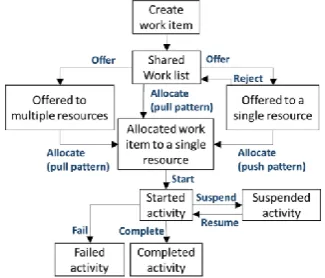
Figure 1 shows life cycle of a work item in a state diagram. Each item in the figure represents a state of a work item which may occur in life cycle. Each edge shows an occurrence of an event in which the state of a work item changes and is then recorded in the log. In this paper, we show an event with symbol e and use the functions e.type and e.case respectively to access the
Type and Case that the event occurred on it. Similarly, we can use the operator dot(.) to access the other components of event.
3. 3. Task, Work Item and Activity The three concepts of task, work item and activity are the main concepts in BPMS. Figure 2 depict the conceptual relationship between the mentioned concepts. When a task in an instance of process execution is attributed to a case, a work item is created; in other words, a work item is a task which defines on a certain case; when a work item is assigned to a certain resource to perform the task on the case, an activity is defined. Execution of activity
a in BPMS, a sequence of events is recorded in Event log. Each event e includes information of case, resource and task which is accessible with three functions e.case, e.resourceId and e.task, respectively. These values are the same for all events of an activity, then we use three functions a.case, a.resourceId and a.task for each activity to easier access to this information. There is at least one event with type ‘Start’ and one event with type
‘Complete’ in each completed activity which initialize the values of a.start and a.complete. So, we have Equation (1) to initializing them by the following:
(1)
∃𝑒 ∈ 𝐸𝑣𝑒𝑛𝑡 𝑙𝑜𝑔, 𝑒. 𝑇𝑦𝑝𝑒 =
𝑆𝑡𝑎𝑟𝑡, 𝒆 𝑜𝑐𝑐𝑢𝑟𝑠 𝑜𝑛 𝑝𝑒𝑟𝑓𝑜𝑟𝑚𝑖𝑛𝑔 𝒂 ⇒ 𝑎. 𝑆𝑡𝑎𝑟𝑡 = 𝑒. 𝑇𝑖𝑚𝑒
∃𝑒 ∈ 𝐸𝑣𝑒𝑛𝑡 𝑙𝑜𝑔, 𝑒. 𝑇𝑦𝑝𝑒 =
𝐶𝑜𝑚𝑝𝑙𝑒𝑡𝑒, 𝒆 𝑜𝑐𝑐𝑢𝑟𝑠 𝑜𝑛 𝑝𝑒𝑟𝑓𝑜𝑟𝑚𝑖𝑛𝑔 𝒂 ⇒ 𝑎. 𝐶𝑜𝑚𝑝𝑙𝑒𝑡𝑒 = 𝑒. 𝑇𝑖𝑚𝑒
Figure 2. Conceptual relationships between task, work item
and activity
3. 4. Estimating the Execution Time of Tasks By analyzing recorded events in the Event-log, there is the possibility to calculate average execution time of each task in business process. This value is good to estimate for execution time of the activity. Equation (2) shows calculation method for execution time of performing activity t by resource r.
(2)
𝜇𝑟(𝑡) =∑𝑎∈𝐴𝐶𝑡,𝑟(𝑎. 𝐶𝑜𝑚𝑝𝑙𝑒𝑡𝑒− 𝑎. 𝑆𝑡𝑎𝑟𝑡) |𝐴𝐶𝑡,𝑟|
𝐴𝐶𝑡,𝑟= {𝑎|𝑎 ∈ 𝐸𝑣𝑒𝑛𝑡𝐿𝑜𝑔, 𝑎 . 𝑇𝑎𝑠𝑘 = 𝑡, 𝑎.𝑟𝑒𝑠𝑜𝑢𝑟𝑐𝑒𝐼𝑑= 𝑟}
The event log of a real-life process of BPI Challenge 2012, adopted from a Dutch financial institute, is used for simulation. Of 6078 cases, 5 activities and 55 resources are acquired from the real-life log. By investigating BPI challenge 2012 dataset, it is observed that 4823 pair activities are simultaneously executed by one resource. By more analyzing the pair activities, this comes out that they are relevant from data perspective and the resources probably intentionally choose to process the pair activities so as to process faster. The fact is also revealed that some pair activities take less time when processed simultaneously than individually. So what is obvious is the impact of conducting these activities on each other that will be discussed later in this article. Here, we introduce two types of estimating the execution time for tasks.
3. 4. 1. Estimating the Execution Time of Independent Tasks In Equation (2), if there has not been performed any other activity by the same resource concurrently with all activities 𝑎 ∈ 𝐸𝑣𝑒𝑛𝑡𝐿𝑜𝑔 conducted by resource r, the value calculated in Equation (2) will be the value of "estimation of execution time for independent tasks".
3. 4. 2. Estimating the Execution Time of Dependent Tasks Consider the two tasks of t1
and t2, and set of all activity in event log related to these
two tasks which are performed by resource r, has been shown with
𝐴𝑡1
𝑟 = {𝑎 ∈ 𝐸𝑣𝑒𝑛𝑡𝐿𝑜𝑔|𝑎. 𝑇𝑎𝑠𝑘 = 𝑡
1, 𝑎. 𝑅𝑒𝑠𝑜𝑢𝑟𝑐𝑒𝐼𝑑 = 𝑟} and 𝐴𝑡2
𝑟 = {𝑎 ∈ 𝐸𝑣𝑒𝑛𝑡𝐿𝑜𝑔|𝑎. 𝑇𝑎𝑠𝑘 = 𝑡
2, 𝑎. 𝑅𝑒𝑠𝑜𝑢𝑟𝑐𝑒𝐼𝑑 = 𝑟} respectively. For each pair of activities 𝑎𝑖∈ 𝐴𝑡1and 𝑏𝑗∈ 𝐴𝑡2, two activities ai and bj may be
done independently or concurrently for different values of i and j by resource r. Simultaneity of two activities may occur in one of the following ways.
i. Start and completion time of an activity ai is
absolutely between start and completion of bj.
ii. Part of the first or last of an activity to be inside the other; in other words, starting time of ai is
within the start and completion time of bj, or
starting time of bi is within the start and
So, set 𝐴𝑡1𝜑𝐴𝑡2 is a subset of 𝐴𝑡1× 𝐴𝑡2 which includes all concurrent activities of two tasks t1 and t2 which is
defined based on Equation (3).
(3) 𝐴𝑡𝑟1𝜑𝐴𝑡
2
𝑟 =
{
〈𝑎, 𝑏〉|𝑎 ∈ 𝐴𝑡1
𝑟, 𝑏 ∈ 𝐴
𝑡2
𝑟,
𝑎. 𝑆𝑡𝑎𝑟𝑡 ≤ 𝑏. 𝑆𝑡𝑎𝑟𝑡 ≤ 𝑏. 𝐶𝑜𝑚𝑝𝑙𝑒𝑡𝑒 ≤ 𝑎. 𝐶𝑜𝑚𝑝𝑙𝑒𝑡𝑒 𝑜𝑟 𝑏. 𝑆𝑡𝑎𝑟𝑡 ≤ 𝑎. 𝑆𝑡𝑎𝑟𝑡 ≤ 𝑎. 𝐶𝑜𝑚𝑝𝑙𝑒𝑡𝑒 ≤ 𝑏. 𝐶𝑜𝑚𝑝𝑙𝑒𝑡𝑒 𝑜𝑟 𝑎. 𝑆𝑡𝑎𝑟𝑡 ≤ 𝑏. 𝑆𝑡𝑎𝑟𝑡 ≤ 𝑎. 𝐶𝑜𝑚𝑝𝑙𝑒𝑡𝑒 ≤ 𝑏. 𝐶𝑜𝑚𝑝𝑙𝑒𝑡𝑒 𝑜𝑟 𝑏. 𝑆𝑡𝑎𝑟𝑡 ≤ 𝑎. 𝑆𝑡𝑎𝑟𝑡 ≤ 𝑏. 𝐶𝑜𝑚𝑝𝑙𝑒𝑡𝑒 ≤ 𝑎. 𝐶𝑜𝑚𝑝𝑙𝑒𝑡𝑒 }
Statement 𝐴𝑡𝑟𝜑𝐴𝑟𝑡𝑘= ∅,
∀𝑡
𝑘∈ 𝑇 is established for eachindependent task t in event log. For a dependent task 𝑡′, we should obtain its independent (𝑖𝑛𝐴𝑡′𝑟) and dependent
(𝑑𝑒𝐴𝑡′𝑟) activities. Then, we estimate the dependent and
independent execution time. Since 𝐴𝑟𝑡′= 𝑖𝑛𝐴𝑡′𝑟 ∪ 𝑑𝑒𝐴𝑡′𝑟
is established, obtaining one of them is sufficient. Equations (4) and (5) have shown how to calculate them.
(4)
𝑑𝑒𝐴𝑡′𝑟 = {𝑎|𝑎 ∈ 𝐴𝑡′, ∃𝑡 ∈ 𝑇, ∃𝑏 ∈ 𝐴𝑡, 〈𝑎, 𝑏〉 ∈ 𝐴𝑡′𝜑𝐴𝑡}
(5)
𝑖𝑛𝐴𝑡′𝑟 = 𝐴𝑡𝑟′− 𝑑𝑒𝐴𝑡′𝑟
To estimate the independent execution time of a dependent task 𝑡′, it is sufficient that we use 𝑎 ∈ 𝐴𝑡′𝑖𝑛
instead of the 𝑎 ∈ 𝐸𝑣𝑒𝑛𝑡𝐿𝑜𝑔 in Equation (2). As a result, independent time estimate of a dependent task 𝑡′ is obtained from Equation (6).
(6)
𝜇𝑟(𝑡′) =∑𝑎∈𝐴𝐶 𝑡′,𝑟(𝑎.𝐶𝑜𝑚𝑝𝑙𝑒𝑡𝑒−𝑎.𝑆𝑡𝑎𝑟𝑡)
|𝐴𝐶𝑡′,𝑟|
𝐴𝐶𝑡′,𝑟=
{𝑎|𝑎 ∈ 𝑖𝑛𝐴𝑡′𝑟, 𝑎 . 𝑇𝑎𝑠𝑘 = 𝑡, 𝑎. 𝑟𝑒𝑠𝑜𝑢𝑟𝑐𝑒𝐼𝑑 = 𝑟}
For a dependent task 𝑡′, there are also execution times dependent on another task t. To estimate, it is necessary that functions of 𝑇+,𝑇∪ and 𝑇∩to be defined for two
activities a and b so that we can estimate the dependent execution time 𝑡′ based on Equation (10).
(7)
𝑇+(𝑎, 𝑏) = (𝑎. 𝐶𝑜𝑚𝑝𝑙𝑒𝑡𝑒 − 𝑎. 𝑆𝑡𝑎𝑟𝑡)
+ (𝑏. 𝐶𝑜𝑚𝑝𝑙𝑒𝑡𝑒 − 𝑏. 𝑆𝑡𝑎𝑟𝑡)
(8)
𝑇∩(𝑎, 𝑏) = min(𝑎. 𝐶𝑜𝑚𝑝𝑙𝑒𝑡𝑒, 𝑏. 𝐶𝑜𝑚𝑝𝑙𝑒𝑡𝑒) − max(𝑎. 𝑆𝑡𝑎𝑟𝑡, 𝑏. 𝑆𝑡𝑎𝑟𝑡)
(9)
𝑇∪(𝑎, 𝑏) = 𝑇+(𝑎, 𝑏) − 𝑇∩(𝑎, 𝑏)
(10)
𝛿𝑟(𝑡′, 𝑡) =
∑ 〈𝒂,𝒃〉 ∈ 𝐴𝑡1𝑟 𝜑𝐴𝑡2𝑟 (𝑇∪(𝑎,𝑏))
𝑎.𝑟𝑒𝑠𝑜𝑢𝑟𝑐𝑒𝐼𝑑=𝑏.𝑠𝑜𝑢𝑟𝑐𝑒𝐼𝑑=𝑟
𝑁𝑢𝑚𝑏𝑒𝑟 𝑜𝑓 𝑒𝑙𝑒𝑚𝑒𝑛𝑡 𝑖𝑛 ∑
In Equation (10), function 𝛿𝑟(𝑡′, 𝑡) is ‘estimated
dependentexecution time’ of dependent task 𝑡′ when it
is conducted concurrent with task t by resource r. If the value of 𝛿𝑟(𝑡′, 𝑡)is smaller than the value of
𝜇
𝑟(𝑡′)+
𝜇
𝑟(𝑡) for a dependent task 𝑡′, it shows that if resource rperforms task t concurrent with task 𝑡′, it has saved in
time of doing tasks t and 𝑡′ in amount of 𝜇𝑟(𝑡′) +
𝜇
𝑟(𝑡) − 𝛿𝑟(𝑡′, 𝑡). On the other hand, if 𝛿𝑟(𝑡′, 𝑡) islarger than the value of 𝜇
𝑟
(𝑡′) +
𝜇
𝑟(𝑡), it is better thatdependent task 𝑡′ is performed independently by
resource r to improve the cycle time. Another important point is that a task may be independent for a resource and to be dependent for another resource and values
𝜇
𝑟(𝑡′) +𝜇
𝑟(𝑡) and 𝛿𝑟(𝑡′, 𝑡) to be different according tothe resource.
3. 5. Workload Rebalancing by Reallocating the Dependent Tasks Workload balancing of resources and cycle time reduction of business process are the most important goals of BPMS. If the objective of workload balancing is sought in a system, the second objective which is the optimum value for the cycle time, will not be achieved very well. And on the other hand, creating an optimum cycle time will lead to non-balancing of workload [32]. When the policy of workload balancing is followed in a system, the situation of cycle time may be suboptimal for several reasons. These reasons include:
i. Reducing the cycle time has not been seen theoretically in equations of workload balancing ii. Workload balancing is performed by estimated
values from service time of resources and tasks are placed in specific work list of resources based on estimated values. But in fact, a work list may be finished earlier and resources become inactive for some time.
Byung-Hyun Ha et al. [25] could significantly improve the cycle time of cases with the workload estimation of resources based on queuing network model and providing new workload balancing algorithm.
We follow the same objective and we want to compensate the weakness of workload balancing algorithm by reducing cycle time. In this paper, we develop the algorithm presented in [25] and provide heuristic distribution of work items which reduces the cycle time of cases by offering synchronization of dependent tasks, in addition to balancing the workload. The proposed algorithm is shown as follow:
Algorithm: Workload rebalancing by reallocating dependent
tasks (WRRDT)
Input: business process model 𝑝 = 〈𝜑, 𝑇, 𝐹, 𝑅, 𝑈, 𝜇, 𝛿, 𝑄, 𝑤𝑙〉
1: 𝑤𝑙̅̅̅ ← ∑𝑟∈𝑅𝑤𝑙(𝑟) |𝑅| ⁄
2: 𝐿𝑊𝑅 ← {𝑟|𝑟 ∈ 𝑅, 𝑤𝑙(𝑟) < 𝑤𝑙̅̅̅} // Resources with workload lower than average workload
4:𝒇𝒐𝒓 𝒆𝒂𝒄𝒉 (𝑟 ∈ 𝐿𝑊𝑅){
5: 𝑇𝑟← {𝑡|〈𝑡, 𝑟〉 ∈ 𝑈} 6: 𝑚𝑎𝑥 ← −∞
7: 𝐴𝑠𝑒𝑙𝑒𝑐𝑡𝑒𝑑← ∅
8: 𝒊𝒇 ( ∃𝑡, 𝑡
′∈ 𝑇, ∃〈𝑎, 𝑏〉 ∈ 𝐴 𝑡
𝑟𝜑𝐴
𝑡′
𝑟,
𝜇𝑟(𝑡′) + 𝜇𝑟(𝑡) − 𝛿𝑟(𝑡′, 𝑡) > 0) { 9: 𝒇𝒐𝒓 𝒆𝒂𝒄𝒉(〈𝑎, 𝑏〉 ∈ 𝐴𝑡𝑟𝜑𝐴𝑡𝑟′){
10: 𝒊𝒇 (𝜇𝑟(𝑡′) + 𝜇𝑟(𝑡) − 𝛿𝑟(𝑡′, 𝑡) > 𝑚𝑎𝑥 ){
12: 𝑏𝑠𝑒𝑙𝑒𝑐𝑡𝑒𝑑← 𝑏
13: 𝑚𝑎𝑥 ← 𝜇𝑟(𝑡′) + 𝜇𝑟(𝑡) − 𝛿𝑟(𝑡′, 𝑡) 14: }//if
15: }//for each
16: 𝐴𝑠𝑒𝑙𝑒𝑐𝑡𝑒𝑑← {𝑎𝑠𝑒𝑙𝑒𝑐𝑡𝑒𝑑, 𝑏𝑠𝑒𝑙𝑒𝑐𝑡𝑒𝑑} 17: 𝑄𝑟← 𝐴
𝑠𝑒𝑙𝑒𝑐𝑡𝑒𝑑∪ 𝑄𝑟//reallocate to resource r
18: }//if
19: 𝒆𝒍𝒔𝒆 𝒊𝒇 (∃𝑡 ∈ 𝑇𝑟, ∃𝑎 ∈ 𝐴𝑡𝑟 𝑎𝑛𝑑 𝒂 𝑛𝑜𝑡 𝑠𝑡𝑎𝑟𝑡𝑡𝑒𝑑 ) 20: 𝑄𝑟← 𝑄𝑟∪ {𝑎}
21: }//for each
22: 𝑤𝑙̅̅̅ = ∑𝑟∈𝑅𝑤𝑙(𝑟) |𝑅| ⁄
23: 𝐿𝑊𝑅 ← {𝑟|𝑟 ∈ 𝑅, 𝑤𝑙(𝑟) < 𝑤𝑙̅̅̅}
24: }//while
Suppose |𝑅| is the number of resources and |𝑇| is the number of tasks defined in the process and C is the number cases in a given period of time in the event log, they are needed to compute 𝐴𝑡𝑟𝜑𝐴𝑡𝑟′, time complexity of preparing and computing the set 𝐴𝑟𝑡𝜑𝐴𝑡𝑟′for all tasks and resources would be 𝑂((𝐶|𝑇||𝑅|)2) in the worst case. Therefore, the time complexity of the algorithm would be 𝑂(2|𝑅| +|𝑅|
2 (𝐶|𝑇||𝑅|)
2). The 2|𝑅| term is computed
for 𝑤𝑙̅̅̅ and 𝐿𝑊𝑅 values (lines 1 and 2), the (𝐶|𝑇||𝑅|)2 and |𝑅|
2 factors are respectively to search for the maximum similarity distance between two activities of 𝐴𝑡𝑟𝜑𝐴𝑡𝑟′ (loop in line 9) for each 𝐿𝑊𝑅 element (loop in line 4).
The proposed method is an extension to resource allocation algorithm and periodically rebalances the work loads of all resources. Rebalancing requires redispatching the work items from worklists of resources with workload higher than the average workload to worklists of resources with workload lower than the average workload. To be exact, for each resource r with workload lower than the average workload, two work items with maximum value 𝜇𝑟(𝑡′)
+ 𝜇
𝑟(𝑡) − 𝛿𝑟(𝑡′, 𝑡) are chosen to beredispatched. The chosen pair of work items is executionally concurrent and would help execute faster by allocated resources. Figure 3 depicts general procedure of the proposed algorithm after allocating tasks to resources by base algorithm (like workload balancing).
4. EXPERIMENT AND DISCUSSION
To analyze the effectiveness of the proposed method, we consider a real life log. BPI challenge 20122 is the real life log chosen to be the benchmark dataset.
2
http://data.4tu.nl/repository/uuid:3926db30-f712-4394-aebc-75976070e91f
Figure 3. Graphical model of the proposed algorithm
The event log of a real-life process (see Figure 4) of BPI Challenge 2012, adopted from a Dutch financial institute, is used for simulation. Of 13078 cases, 5 activities and 55 resources are acquired from the real-life log.
In this section, the proposed method will be evaluated with some algorithms presented in other researches. These algorithms are listed in Table 1. We use 200 customer requests with different arrival rates (between 1/15 to 1/3) for the 6 methods listed in Table 1. To ensure the resulting values, experiments are repeated 10 times for each method and we used mean values to depict in Figure 5.
Figure 4. BPMN1 model for real-life financial process [25]
TABLE 1. List of some task allocation algorithms
Ref. Description (publication year)
Short name
[26] Dynamic Stochastic task allocation
approach for Workload Balancing as a base allocation (2015)
DSWB
[24] Naïve Bayes Selection Rule (2015)
NBSR
[33] Q-learning for task allocation based on
Social Relation (2015) QL+SR
[22] Workload Balancing task allocation with queueing network model (2004) WB
[25] Dynamic Rebalancing task allocation
approach for Workload Balancing as a base allocation (2006)
WB+DR
The results of comparison between 6 fore-mentioned on ‘financial’ process are obtained in Figures 5. It shows the proposed algorithm by using the concurrent execution of dependent tasks ofreduced cycle time of the process more than other state-of-the-art methods.
Figure 6 depicts minimum and maximum value of resource workloads for each algorithms mentioned in Table 1. If the difference between minimum and maximum value is smaller, the dispatching of tasks between resources is more balance. In Figure 6, the workload balancing (WB) algorithm has best balance dispatching of tasks. This algorithm allocate tasks base on queueing network factors then it creates optimal workload balancing for resources. After WB algorithm, the WB+WRRDT, DSWD and WB+DR create better workload balancing for resources, respectively. These algorithms use reallocating technique at business process runtime after allocating WB algorithm as base algorithm.
At the runtime of the business process execution (not during the execution of the work item), a set of the work items in the worklist of resources are placed by allocation algorithm. Some of these work items in the worklist wait for the end of serving the resources. The complementary algorithm can reallocate pending work items from the resource worklist to another, in other words, it moves work items between worklists at the process instance runtime.
Figure 5. Comparison of the cycle time results
Figure 6. Comparison of the workload percentage range
Figure 7. The cycle time reduction percentage rate of the
proposed method (WB+WRRDT) in contrast to the DSWB method
This technique causes to more reduction in cycle time but a little away from the optimal workload balancing.
Figures 5 and 6 show the proposed algorithm in both its objectives of workload balancing and cycle time reduction provides better results in contrast to others.
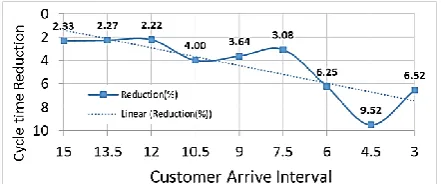
The cycle time reduction percentage rate of the proposed method (WB+WRRDT) in contrast to the DSWB method for different arrival rates (between 1/15 to 1/3) are shown in Figure 7. The maximum reduction with value 9.52% is happened in arrival rate of 1/4.5 and the minimum reduction with value 2.22% is happened in arrival rate of 1/12. The average cycle time reduction of the proposed algorithm in contrast to the DSWB algorithm is 4.42%. The linear trend of reduction increases by increasing arrival rate. When the arrival rate increases, then the number of work items in work list of resources and the probability of dependent tasks reallocating is increased. In addition, the more reduction in cycle time is occurred.
5. CONCLUSION
In this paper, workload balancing and business process cycle time reduction are the two main objectives. By analyzing the real-life dataset of BPI, Challenge 2012 showed that there is a dependency in concurrent execution of tasks which causes that their concurrent execution have less time to separate execution of them. Therefore, we used this property which was implied in the event log and introduced an algorithm to use the property in allocation of tasks to resources and dependent tasks to be used in work list of resources. Therefore, the flowtime of case in business process reduces in addition to balancing the workload of resources. The proposed method was compared with other algorithms and the expected results were obtained.
increasing the customer arrival rate. Third, the proposed algorithm reduces the cycle time of process 4.42% more than the other algorithms. Finally, there is the possibility of combining it with other algorithms in researches.
6. REFERENCES
1. Hammer, M., "The agenda: What every business must do to dominate the decade, Crown Pub, (2003).
2. Hammer, M. and Champy, J., "Reengineering the corporation: Manifesto for business revolution, a, Zondervan, (2009).
3. Smith, H. and Fingar, P., "Business process management: The third wave, Meghan-Kiffer Press Tampa, Vol. 1, (2003).
4. Van Der Aalst, W.M., Ter Hofstede, A.H. and Weske, M., "Business process management: A survey", in International conference on business process management, Springer., (2003), 1-12.
5. Chang, D.-H., Son, J.H. and Kim, M.H., "Critical path identification in the context of a workflow", Information and Software Technology, Vol. 44, No. 7, (2002), 405-417. 6. Reijers, H.A., "Design and control of workflow processes:
Business process management for the service industry, Springer-Verlag, (2003).
7. Narahari, Y., Viswanadham, N. and Kumar, V.K., "Lead time modeling and acceleration of product design and development",
IEEE Transactions on Robotics and Automation, Vol. 15, No. 5, (1999), 882-896.
8. Zerguini, L. and van Hee, K.M., "A new reduction method for the analysis of large workflow models", in Promise, Citeseer., (2002), 188-201.
9. Son, J.H. and Kim, M.H., "Improving the performance of time-constrained workflow processing", Journal of Systems and Software, Vol. 58, No. 3, (2001), 211-219.
10. Huang, Z., van der Aalst, W.M., Lu, X. and Duan, H., "Reinforcement learning based resource allocation in business process management", Data & Knowledge Engineering, Vol. 70, No. 1, (2011), 127-145.
11. Van Der Aalst, W.M., Van Hee, K.M. and Reijers, H.A., "Analysis of discrete‐time stochastic petri nets", Statistica Neerlandica, Vol. 54, No. 2, (2000), 237-255.
12. van Hee, K. and Reijers, H., "An analytical method for computing throughput times in stochastic workflow nets",
Simulation in Industry, Vol. 10, No. 3, (1999).
13. Kumar, P. and Meyn, S.P., "Stability of queueing networks and scheduling policies", IEEE Transactions on Automatic Control, Vol. 40, No. 2, (1995), 251-260.
14. Culler, D.E., Singh, J.P. and Gupta, A., "Parallel computer architecture: A hardware/software approach, Gulf Professional Publishing, (1999).
15. Grosu, D. and Chronopoulos, A.T., "Algorithmic mechanism design for load balancing in distributed systems", Systems, Man, and Cybernetics, Part B: Cybernetics, IEEE Transactions on, Vol. 34, No. 1, (2004), 77-84.
16. Rahm, E., "Dynamic load balancing in parallel database systems", in Euro-Par'96 Parallel Processing, Springer., (1996), 37-52.
17. Xu, J., Liu, C. and Zhao, X., "Resource allocation vs. Business process improvement: How they impact on each other", in BPM, Springer. Vol. 2008, (2008), 228-243.
18. Huang, Z., Lu, X. and Duan, H., "A task operation model for resource allocation optimization in business process
management", Systems, Man and Cybernetics, Part A: Systems and Humans, IEEE Transactions on, Vol. 42, No. 5, (2012), 1256-1270.
19. Jin, L.-j., Casati, F., Sayal, M. and Shan, M.-C., "Load balancing in distributed workflow management system", in Proceedings of the 2001 ACM symposium on Applied computing, ACM., (2001), 522-530.
20. Zhao, W., Yang, L., Liu, H. and Wu, R., The optimization of resource allocation based on process mining, in Advanced intelligent computing theories and applications. 2015, Springer. 341-353.
21. Zur Muehlen, M., "Organizational management in workflow applications–issues and perspectives", Information Technology and Management, Vol. 5, No. 3-4, (2004), 271-291.
22. Ha, B.-H., Bae, J. and Kang, S.-H., Workload balancing on agents for business process efficiency based on stochastic model, in Business process management. 2004, Springer.195-210.
23. Nisafani, A.S., Wibisono, A., Kim, S. and Bae, H., "Bayesian selection rule for human-resource selection in business process management systems", Journal of Society for e-Business Studies, Vol. 17, No. 1, (2014).
24. Wibisono, A., Nisafani, A.S., Bae, H. and Park, Y.-J., On-the-fly performance-aware human resource allocation in the business process management systems environment using naïve bayes, in Asia pacific business process management. 2015, Springer.70-80.
25. Ha, B.-H., Bae, J., Park, Y.T. and Kang, S.-H., "Development of process execution rules for workload balancing on agents", Data & Knowledge Engineering, Vol. 56, No. 1, (2006), 64-84. 26. Xie, Y., Chien, C.-F. and Tang, R.-Z., "A dynamic task
assignment approach based on individual worklists for minimizing the cycle time of business processes", Computers & Industrial Engineering, Vol. 99, No. 1, (2015), 401-414. 27. Xie, Y., Chien, C.-F. and Tang, R.-Z., "A method for estimating
the cycle time of business processes with many-to-many relationships among the resources and activities based on individual worklists", Computers & Industrial Engineering, Vol. 65, No. 2, (2013), 194-206.
28. Coffman, E.G. and Bruno, J.L., "Computer and job-shop scheduling theory, John Wiley & Sons, (1976).
29. Baker, K.R., "Introduction to sequencing and scheduling, John Wiley & Sons, (1974).
30. Pinedo, M., Scheduling: Theory, algorithms and systems, 1995, Prentice-Hall, Englewood Cliffs, NJ.
31. Rhee, S., Bae, H., Ahn, D. and Seo, Y., "Efficient workflow management through the introduction of toc concepts", in Proceedings of the 8th annual international conference on industrial engineering theory, applications and practice (IJIE2003)., (2003).
32. Shen, M., Tzeng, G.-H. and Liu, D.-R., "Multi-criteria task assignment in workflow management systems", in System Sciences, 2003. Proceedings of the 36th Annual Hawaii International Conference on, IEEE., (2003), 9-17.
33. Liu, X., Chen, J., Ji, Y. and Yu, Y., "Q-learning algorithm for task allocation based on social relation", Process-Aware Systems, (2015), 49-58.
34. Kumar, A., van der Aalst, W.M. and Verbeek, E.M., "Dynamic work distribution in workflow management systems: How to balance quality and performance", Journal of Management Information Systems, Vol. 18, No. 3, (2002), 157-193. 35. Larbi, S. and Mohamed, S., "Modeling the scheduling problem
36. Ly, L.T., Rinderle, S., Dadam, P. and Reichert, M., "Mining staff assignment rules from event-based data", in Business process management workshops, Springer., (2006), 177-190.
37. Yang, H., Wang, C., Liu, Y. and Wang, J., "An optimal approach for workflow staff assignment based on hidden markov models", in On the Move to Meaningful Internet Systems: OTM 2008 Workshops, Springer., (2008), 24-26.
38. Eder, J., Pichler, H., Gruber, W. and Ninaus, M., "Personal schedules for workflow systems", in International Conference on Business Process Management, Springer., (2003), 216-231.
39. Motameni, H., Movaghar, A. and Amiri, M.F., "Mapping activity diagram to petri net: Application of markov theory for analyzing non-functional parameters", International Journal of Engineering Transactions B Applications, Vol. 20, No. 1, (2007), 65-73.
Cycle Time Reduction and Runtime Rebalancing by Reallocating Dependent Tasks
M. Yaghoubi*a,b, M. Zahedib
a Computer Engineering Department, Faculty of Engineering, Golestan University, Iran b Computer & IT Engineering Department, Shahrood University of Technology, Shahrood, Iran
P A P E R I N F O
Paper history:
Received 24 April 2017
Received in revised form 09 July 2017 Accepted 08 September 2017
Keywords: Business Process Cycle Time Workload Balancing Resource Allocation Dependent Tasks Task Concurrency
ديكچ ه
راک و بسک دنیآرف تیریدم یاه متسیس
(BPMS)
تاعلاطا متسیس کی دوبهب و تیریدم ،یحارط هک تسا هدیچیپ
.دنک یم مهارف ار راک و بسک یاهدنیآرف رد دیاب هک تسا یلئاسم نیرتمهم زا یکی یناسنا عبانم هب هفیظو صیصخت
BPMS
.دوش تیریدم .تسا هدش فیرعت اه نامزاس فلتخم یاه تسایس عفر روظنم هب هفیظو صیصخت متیروگلا
اوت یم اهتسایس نیا نیرتمهم هب و لوصحم تیفیک شیازفا ،عبانم راک مجح ندومن لداعتم ،طسوتم هخرچ نامز شهاک دن
رب دناوت یم فیاظو صیصخت یاه متیروگلا رد بسانم عبنم کی باختنا ،نیاربانب .دشاب دیلوت یاه هنیزه ندناسر لقادح
بانم دادعت هک ینامز ای و نیگنس راب طیارش رد .دراذگب ریثأت نامزاس تسایس لک رد راک لداعت ،تسا دودحم یناسنا ع
نامز رد یراک راب لداعت یارب هفیظو صیصخت متیروگلا کی هلاقم نیا رد .دهد شیازفا ار متسیس تابث دناوت یم متسیس
جیاتن .دنک یم مهارف نامزمه شزادرپ یارب عبانم هب هتسباو یاه هنارای هئارا اب ار هخرچ نامز لقادح و دوش یم هئارا ارجا
رجت هتفرشیپ یاه متیروگلا رثکا اب هسیاقم رد ،یداهنشیپ یاه متیروگلا اب یلبق یاه متیروگلا زا یبیکرت هک دهد یم ناشن یب
شهاک ثعاب ،تلاح نیرت
٪
۴۲ / ۴ .دوش یم هخرچ نامز رد
![Figure 4. BPMN1 model for real-life financial process [25]](https://thumb-us.123doks.com/thumbv2/123dok_us/203447.2014617/6.595.318.530.391.516/figure-bpmn-model-real-life-nancial-process.webp)